
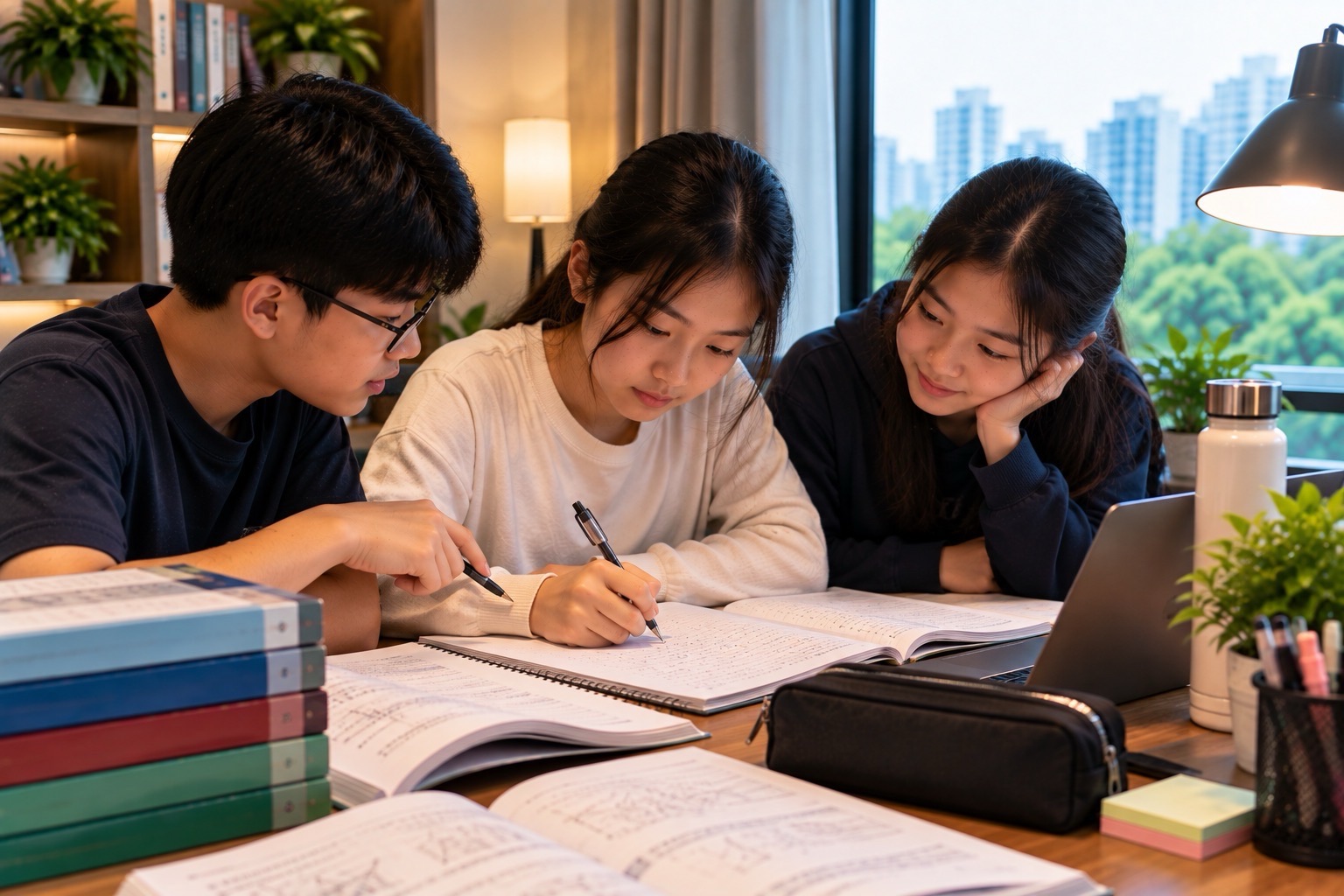
G3 Humanities (Social Studies, Literature in Chinese) is a combined 2027 Singapore-Cambridge Secondary Education Certificate (SEC) Humanities subject, code K338, replacing O-Level 2263. Both components are compulsory and weighted equally: Paper 1 Social Studies is 1 hour 45 minutes, 50 marks and 50%; Paper 2 Literature in Chinese (华文文学) is 1 hour 40 minutes, 50 marks and 50%. Social Studies examines three issues—Citizenship and Governance, Living in a Diverse Society, and Being Part of a Globalised World—through a 35-mark source-based case study and 15 marks of structured responses. The Chinese Literature paper tests one prescribed poem or short-story question and one unseen modern literary extract, each worth 25 marks. It does not include the full-novel paper required by standalone Chinese Literature K332.
For families in Punggol, K338 must be distinguished from Humanities (Social Studies, Geography) K335, Humanities (Social Studies, History) K336, Humanities (Social Studies, Literature in English) K337 and standalone Literature in Chinese K332. A school may teach Chinese language and Social Studies without offering this particular combined Humanities option for every cohort. Ask the actual secondary school for its Year 3 subject-combination list, eligibility, language support and teacher guidance. A pupil entering Secondary 3 in 2027 usually sits the final SEC in 2028, so the correct 2028 K338 syllabus and prescribed literature must be consulted when released. This guide uses the verified 2027 examination scheme and focuses on both source-based civic reasoning and evidence-based literary interpretation.
- 2027 G3 combined Humanities (Social Studies, Literature in Chinese): K338, previous O-Level 2263; both components compulsory.
- Paper 1 Social Studies: 1h45, 50 marks, 50%; Section A source-based case study 35 marks, Section B two compulsory structured-response questions totalling 15 marks.
- Social Studies case study: five questions; first four focus on specific-source skills for 25 marks, fifth uses multiple sources and another perspective for 10 marks.
- Structured Social Studies: Question 6 (7 marks) gives reasoned explanation or recommendations in Singapore context; Question 7 (8 marks) weighs factors/perspectives to a judgement.
- Paper 2 Literature in Chinese: 1h40, 50 marks, 50%; Section A select one of two questions on prescribed poetry or modern short fiction (25), Section B select one of two unseen prose or poetry questions (25).
- Prescribed Chinese poetry includes 李白, 杜甫, 苏轼, 李清照, 徐志摩, 余光中, 杜南发 and 林得楠, among the specific 2027 works; modern short fiction includes 鲁迅, 汪曾祺, 西西, 李永平 and 小寒.
- Unlike standalone K332, K338 does not require the prescribed full-novel Paper 1; the Chinese Literature component is one paper paired with Social Studies.
- Ask the Punggol school which combined Humanities code the pupil is offered before choosing past-year papers or literary books.
How the K338 combined subject teaches source and literary reasoning
Definition lock | K338 is one subject with two different intellectual tasks
K338 is Singapore’s 2027 G3 Humanities examination combining compulsory Social Studies and Literature in Chinese, each contributing fifty per cent. It is not a bundle of two independent subject grades and is not the same as taking a standalone Chinese Literature elective alongside another Humanities paper. The two components develop related habits of evidence-based reasoning but use different source material and language expectations. Social Studies asks students to evaluate information and construct arguments about societal issues; Chinese Literature asks them to interpret artistic choices in poetry and short fiction. A family should understand this before committing to a school combination or purchasing literature notes.
Social Studies and Literature share reasoning but not the same evidence
In Social Studies, a poster, written source or chart is evidence about a societal issue and may need evaluation for reliability, purpose or perspective. In Literature, an image or narrative voice is part of a writer’s creative work and may be examined for artistic effect. A student cannot assume that a technique from one paper works automatically in the other. Calling a literary narrator ‘unreliable’ requires a different discussion from assessing whether a public claim can be corroborated by an independent source. Yet both papers reward precise reading, justified inference and clear explanation. The pupil should learn to ask what kind of source is present, what question is being asked and what counts as support in that discipline. This prevents superficial reuse of memorised essay structures across different tasks.
Paper 1 is a complete G3 Social Studies examination
The Social Studies component has one paper of one hour forty-five minutes and fifty marks. Section A contains a compulsory thirty-five-mark source-based case study, while Section B includes two compulsory structured-response questions totalling fifteen marks. The source-based material can concern any of three societal issues, and the structured questions are on another issue rather than the same issue as the source-based case study. Students need conceptual understanding across the syllabus and the skills to work with unfamiliar sources. A pupil who memorises one essay about citizenship but has weak corroboration skills may struggle with most of the source component. Conversely, someone good at identifying bias must still explain Singapore issues accurately. Good preparation separates source skills and issue knowledge while connecting them through practice.
The three Social Studies issues should be learned as inquiries
The 2027 syllabus organises Social Studies around Exploring Citizenship and Governance, Living in a Diverse Society and Being Part of a Globalised World. Each issue poses a question rather than simply requiring a list of historical facts. Who is responsible for the good of society? How can people live together across differences? How should communities respond to global connections? A good student recognises competing interests, assumptions and practical trade-offs instead of applying a universal slogan. For example, participation by citizens and decisions by public institutions may have different roles in a particular community issue. The examination expects an explanation grounded in the syllabus and supplied evidence, not unsupported assertions about real people. Inquiry-based learning teaches students to build reasoned conclusions while recognising the limits of available information.
Citizenship and governance involve choices and responsibilities
Issue 1 addresses citizenship, the functions and roles of government, the challenges of determining the good of society and the ways citizens and government can work together. A teenager might assume that one solution is automatically best for everyone, but different groups may experience costs and benefits unequally. Social Studies encourages evaluating those differences and the governance principles relevant to Singapore. A well-supported answer identifies a specific issue, the people affected and a plausible mechanism rather than repeating that everyone should cooperate. For a hypothetical Punggol neighbourhood question about shared facilities, students can examine user needs and trade-offs without inventing public consultations or claiming actual decisions were made. The educational method is to distinguish what the scenario says from what the candidate infers or recommends.
Living in a diverse society needs fairness and careful evidence
Issue 2 asks how identities are shaped and what helps a diverse society live with mutual respect. The syllabus discusses different social and cultural identities, shared spaces, positive exchange and also challenges such as stereotypes, prejudice, discrimination and competition for resources. A responsible response should not classify an entire community as possessing one characteristic. Instead, identify relevant factors, distinguish individual actions from broad patterns and consider different stakeholder perspectives. In a question about access to public activities, the candidate can explain how arrangements may affect different groups and what responses are possible. These are analytical tasks; the aim is not to campaign for a political position or state inflammatory claims about actual communities. Accurate Social Studies uses evidence, reasonable nuance and context.
Globalisation includes economic, cultural and security impacts
Issue 3 addresses the effects of technological change, transport, digital connections and multinational businesses on societies. The syllabus examines economic opportunities and vulnerability, cultural exchange and dilution, and security concerns such as cyber threats and transnational risks. Students should recognise that benefits and costs vary according to the context and people affected. A new digital service can create convenience while raising privacy or resilience questions; a cultural trend can introduce new ideas while changing local practices. The examination asks for reasoned explanation and judgement rather than an automatic claim that globalisation is wholly beneficial or harmful. Strong responses identify the causal mechanism and the evidence supplied, then consider conditions under which different outcomes are more likely. Avoid inventing statistics to make a point sound persuasive.
The source-based case study is not a reading-comprehension copy task
Section A’s case study contains five questions and is worth thirty-five marks. Questions 1–4 together account for twenty-five marks and focus on handling specific sources. The fifth question is worth ten marks and requires using multiple sources while considering the issue from another perspective. Students may need to infer a source’s message, compare accounts, evaluate usefulness or reliability and draw a reasoned conclusion. Copying the longest paragraph from a source does not demonstrate those skills. The pupil should identify what the question asks, select relevant evidence and explain how it supports the claim. If reliability is in issue, consider purpose, context and corroboration with other available sources. A source’s emotional language may matter, but it does not automatically make every claim false or true.
Source reliability depends on question, purpose and corroboration
A common mistake is to describe a source as unreliable solely because it contains an opinion. Opinion and evidence are not mutually exclusive, and reliability depends on the specific claim and the reason the source was produced. A government communication, personal testimony or social-media post may each provide different kinds of information and have limitations. Students should identify the content being evaluated, explain its origin and consider whether other supplied evidence supports or contradicts it. A strong answer avoids blanket rules such as ‘photographs always prove the truth’ or ‘one-sided sources are useless’. The candidate may still extract useful information from a partial perspective when the question and contextual checks permit it. Source evaluation is careful reasoning, not a collection of fixed distrust phrases.
Comparison and inference should be demonstrably linked to sources
When comparing two sources, the pupil should state the relationship and provide appropriate evidence from each. Merely saying that both concern the same topic is often too general; sources can discuss one issue while taking opposing positions or emphasising different consequences. An inference is also more than copying a sentence. The candidate should state what the evidence suggests and explain the connection. A source about a community event may show support from some participants without establishing that every resident agrees. The answer should preserve the distinction between what is observed and what can reasonably be inferred. This is particularly useful in a diverse society, where sweeping claims can be inaccurate and unfair. Teaching should focus on the precise inferential move rather than memorised sentence starters.
Structured responses require explanation and a judgement
The two compulsory Section B questions carry seven and eight marks. Question 6 may seek multiple reasons or strategies and a recommendation in Singapore context; Question 7 may require discussing two factors or perspectives and judging their relative importance. A candidate who lists two generic benefits without explaining how they operate is offering only a skeleton answer. More effective writing states the reason, shows its mechanism and connects it to the issue. Where judgement is required, explain the criterion being used, such as likely impact or scope, and acknowledge a meaningful limitation. The conclusion should not simply announce that both factors are important. This form of reasoned answer can be practised on fictional contexts before using official classroom material, avoiding unsupported claims about current policy or local experiences.
Paper 2 is Literature in Chinese, not an ordinary Chinese paper
The second paper is one hour forty minutes, fifty marks and fifty per cent of K338. It tests selected poetry and modern short fiction written in Chinese, together with an unfamiliar literary extract. It does not test a regular Chinese functional email, listening or oral conversation. Nor does it reproduce the standalone K332 requirement for a full-novel paper. This distinction is central when choosing resources. A learner who can compose an excellent Chinese narrative may still need to learn how to analyse a poem’s imagery or discuss the significance of a narrator’s decisions. The exam demands close reading and evidence-based interpretation in Chinese, which can be supported by broader literary interest but cannot be replaced by unrelated language grammar drills.
The prescribed Chinese poems cover several periods and perspectives
The 2027 K338 list includes classical poems by 李白, 杜甫, 苏轼 and 李清照, alongside modern and contemporary works by 徐志摩, 余光中, 杜南发 and 林得楠. The specified poems include 《渡荆门送别》, 《春夜喜雨》, 《水调歌头》, 《如梦令》, 《偶然》, 《珍珠项链》, 《传灯》 and 《彩窗》. Students should confirm the exact edition and text with the teacher, and not assume that knowing a poet’s biography is enough. A literary response should attend to images, shifts in voice, structure and the relationship between language and theme. Historical context may clarify a convention, but a question about one line still requires analysis of that line. The range of works encourages reading distinct voices rather than treating all Chinese poetry as one universal statement about longing.
Modern short fiction also requires close reading
The K338 prescribed short stories include 《孔乙己》 by 鲁迅, 《陈小手》 by 汪曾祺, 《像我这样的一个女子》 by 西西, 《拉子妇》 by 李永平 and 《回不去的候车站》 by 小寒. Each work should be studied on its own terms and through the school-approved text. A pupil may remember plot events but fail to explain how dialogue, narration or an apparently ordinary detail conveys a social situation or character change. The strongest answer selects a small relevant moment and shows why it matters to the question. Avoid reducing stories written in different regional contexts to one stereotype about Chinese-speaking communities. Studying multiple authors can expand literary appreciation when their individual craft is taken seriously. The answer should distinguish what the text actually states from what a reader infers.
Unseen poems and microfiction make memorisation insufficient
K338 Paper 2 Section B presents two unfamiliar choices, generally a modern short-story or flash-fiction extract and a modern poem, and candidates select one. This cannot be prepared through exact-text memorisation. Instead, teach the pupil to read first for situation, speaker and movement, then identify a few meaningful patterns in the language. A sudden shift in tone may change the reader’s understanding; a repeated image may suggest an evolving emotion. A technique label is useful only when the student explains its effect. The candidate should form an arguable interpretation and support it with precise evidence from the supplied extract. Regular practice with new age-appropriate literary material improves independence and reduces the temptation to force an unrelated prepared essay onto the question.
Social Studies and Chinese Literature require different answer languages
The Social Studies paper is examined through its own English-medium component, while the Literature in Chinese component uses Chinese literary materials and written interpretation. Students need to be comfortable reasoning in each context without translating everything mechanically from one language to another. A pupil may be confident explaining a Social Studies source in English yet struggle to express a nuanced literary idea in Chinese. Another may write elegantly in Chinese but rely on weak source evaluation in Social Studies. The correct teaching diagnosis separates those gaps. The shared intellectual habit is explaining why evidence supports a conclusion, but the vocabulary, source conventions and assessment expectations differ. Parents should arrange practice aligned with each component rather than assume strength in one automatically transfers to the other.
The combined 50–50 grade deserves balanced planning
K338 is a single Humanities subject made up of two equal components. A student who loves Chinese poetry may spend all week studying verses while neglecting Social Studies source skills, or a pupil confident with civic issues may avoid unfamiliar literary excerpts. Either can compromise the combined result. A practical weekly routine should protect time for both while allowing more focused work on the actual weaker skill. The learner might complete one source-evaluation paragraph and one short literary interpretation, followed by a review of specific mistakes. Full timed papers are useful after the methods have become reasonably accurate. Parents should not treat the 50–50 weighting as evidence that the papers have identical study demands; equal marks can involve very different kinds of reading and writing.
School options, not generic subject titles, govern the Punggol route
The national directory lists K338, but a Punggol-area secondary school may offer Humanities with Geography, History or English Literature without offering the Chinese Literature combination. It may offer standalone Chinese Literature or enrichment instead. Ask the school’s current Year 3 options guide and teacher rather than infer from the presence of Chinese language classes. Confirm the student’s language proficiency, required subject combinations and any relevant prerequisites. A teenager who enjoys literature but lacks access to K338 can continue reading Chinese works independently without claiming a formal examination entry. The decision should account for the pupil’s interests and the workload of English, Mathematics, Science, other subjects and CCA. Honest education planning means selecting only genuine options.
Learning to judge evidence is the central transferable benefit
The combination can develop the ability to read public arguments critically and interpret literary language thoughtfully. Both skills matter in later study and ordinary life, but this qualification does not by itself guarantee a particular junior-college subject, university programme or career. Future pathways depend on the institution’s rules and the student’s full performance. A family should choose K338 because the actual school offers it and the child is prepared to study both Social Studies and Chinese Literature. The immediate goal is to build independent reading, precise explanation and a reasoned conclusion when faced with unfamiliar evidence. A pupil who can say what a source establishes, what a poem suggests and why the distinction matters has developed something more durable than a memorised examination template.
Punggol school choice | Confirm the exact Humanities pairing
The official 2027 G3 SEC directory lists K338 alongside separate Literature in Chinese K332 and other combined Humanities routes. The K338 syllabus describes its fifty-fifty papers and the precise Chinese literary selection. Ask the actual secondary school for its approved Year 3 options and pupil’s eligibility rather than infer that every Chinese department offers this particular combination. Edgefield’s subject-combination information is school-specific rather than a guarantee for all Punggol-area students.
Families can use one short Social Studies inference and one Chinese literary paragraph to learn whether a student enjoys the course’s distinct methods. A child who understands community questions but cannot read Chinese poetry with confidence may need language-based literary support. Another who writes compelling analysis of a poem may need explicit practice corroborating sources in English. These are teachable needs, not reasons to assume one academic identity. The final decision should reflect actual availability, balanced interest and a sustainable timetable alongside other school subjects and CCA. A correct subject choice is a concrete school registration, not an article title.

Twelve common K338 errors and their specific repairs
An overall Humanities mark can hide a weakness in Social Studies inference or Chinese literary expression. Effective teaching identifies which step failed and uses a different lesson accordingly. The following diagnostic examples preserve the distinction between handling social evidence and analysing a creative text.
1. K338 is confused with standalone K332
The pupil prepares the separate full-novel paper but does not account for compulsory Social Studies. A combined Humanities title can look similar to standalone Literature. Formal codes and papers determine what a student actually studies.
Check the exact code and its two 50% components before choosing books. The course map is correct. Repeat the skill on a fresh source, poem or story after feedback to show that the method can be used independently.
2. A different Humanities K code is used
A school option for Geography or History is mistaken for Chinese Literature. Each Humanities subject pairing has its own code. A school option that shares Social Studies does not automatically contain the same second paper.
Verify the actual paper pairing on the Year 3 options form. The required subject is identified. Repeat the skill on a fresh source, poem or story after feedback to show that the method can be used independently.
3. A source claim is copied as an inference
The student quotes a sentence without showing what it suggests or why. Inference requires a reasoned step beyond the source’s wording. The learner should identify both the claim and what supports it.
State the inferred idea and link it to precise source content. The reasoning is visible. Repeat the skill on a fresh source, poem or story after feedback to show that the method can be used independently.
4. Reliability is judged by one fixed label
An opinion source is called entirely useless without examining its purpose or corroboration. Reliability is a specific judgement about evidence. A source’s existence, perspective or emotional tone alone does not settle every claim.
Evaluate the specific claim using contextual and supporting evidence. The judgement is proportionate. Repeat the skill on a fresh source, poem or story after feedback to show that the method can be used independently.
5. Two sources are compared only by topic
The answer says both discuss globalisation but ignores differing viewpoints or implications. Source comparison must address substantive positions or content. Repeating the topic name is not a meaningful comparison.
Identify a substantive similarity or difference with evidence from each. Comparison is meaningful. Repeat the skill on a fresh source, poem or story after feedback to show that the method can be used independently.
6. Structured response becomes a list
Two policies or factors are named without explaining consequences or considering relevance. Explanations need mechanisms and priorities. Listing factors does not show why they matter or which one is more significant.
Develop causal explanation and finish with a justified judgement where required. The answer is analytical. Repeat the skill on a fresh source, poem or story after feedback to show that the method can be used independently.
7. Literature preparation omits prescribed poetry
A pupil reads short stories and assumes that will cover all choices. The K338 prescribed list is a real examination constraint. General cultural reading is valuable but cannot replace the texts the paper can test.
Learn the exact 2027 prescribed poetry and short fiction list. Literary preparation is complete. Repeat the skill on a fresh source, poem or story after feedback to show that the method can be used independently.
8. A poetry device is named without an effect
The candidate identifies a metaphor and writes only that it makes a passage vivid. A literary label is not analysis until its effect in this passage is explained. The student must show how language supports meaning.
Explain what the image suggests in context and how it develops meaning. The interpretation is supported. Repeat the skill on a fresh source, poem or story after feedback to show that the method can be used independently.
9. A short story is entirely retold
The student describes events but does not explain the narrator’s choices or character tension. Stories use craft to shape meaning. Full plot recall is useful background, not a sufficient answer to a question about technique.
Analyse one decisive textual detail in relation to the question. The response goes beyond plot. Repeat the skill on a fresh source, poem or story after feedback to show that the method can be used independently.
10. An unseen passage is replaced by memorised notes
The pupil writes an essay about a prescribed story rather than the extract provided. Unseen literature rewards independent reading. Memorised essays cannot substitute for interpreting the extract on the examination paper.
Read the new text and select its own relevant evidence. The answer fits the prompt. Repeat the skill on a fresh source, poem or story after feedback to show that the method can be used independently.
11. Chinese literary ideas are translated word for word
A pupil prepares in English and produces awkward Chinese that obscures the claim. Chinese literary explanation must be communicable in the language actually assessed. An unclear translated phrase can hide good reasoning.
Practice concise accurate Chinese literary explanation from the actual passage. Meaning is preserved. Repeat the skill on a fresh source, poem or story after feedback to show that the method can be used independently.
12. Revision neglects one of the two papers
A favourite subject consumes most time while the other is attempted only near the exam. Equal contribution requires attention to both components. A candidate cannot rely on one strong paper to make the other irrelevant.
Map one weekly task and precise feedback for both 50% components. Preparation is balanced. Repeat the skill on a fresh source, poem or story after feedback to show that the method can be used independently.
Eight-week integrated K338 learning plan
This is a flexible home learning model, not the school’s official teaching calendar. The actual 2027 prescribed texts and 2028 replacement list when issued must be followed for the candidate’s examination year. The plan keeps both equally weighted components visible while selecting focused practice based on real weaknesses.
Week 1: Confirm K338 and both components
Ask the school for the registered Humanities code, current Chinese literary texts and Social Studies paper map. Before practise begins, the school record should identify K338 and the correct prescribed works. That avoids carrying over a K332 full-novel plan.
Independent progress check: The subject is identified. Retain the initial attempt, precise correction and another new task without a model answer.
Week 2: Source inference and context
Read an unfamiliar Social Studies source and support an inference without copying text mechanically. A supported inference is more than a copied line. Ask exactly what the evidence suggests and why an alternative reading may be weaker.
Independent progress check: The claim follows evidence. Retain the initial attempt, precise correction and another new task without a model answer.
Week 3: Compare and evaluate sources
Use two sources to discuss a meaningful difference and test the reliability of one claim. Source evaluation is best developed on unfamiliar cases. The student should notice purpose and corroboration rather than trust a memorised reliability slogan.
Independent progress check: Evidence and context are used. Retain the initial attempt, precise correction and another new task without a model answer.
Week 4: Social Studies issue explanation
Develop reasons about citizenship, diversity or globalisation with a clear Singapore-context example. An essay about society must explain a mechanism and consider affected groups. The answer should be balanced and evidence-based rather than an unsupported broad claim.
Independent progress check: The response is reasoned. Retain the initial attempt, precise correction and another new task without a model answer.
Week 5: Prescribed classical and modern poems
Read selected K338 poems and explain a significant image or shift in voice. Poetry requires close attention to language. Classical and contemporary works may demand different contextual explanations, while both need precise evidence.
Independent progress check: Poetic analysis is precise. Retain the initial attempt, precise correction and another new task without a model answer.
Week 6: Prescribed Chinese short fiction
Analyse one story’s narration, character conflict or turning point without extensive plot retelling. Short stories invite analysis of perspective and turning points. Select the moment most useful to the actual question.
Independent progress check: Textual evidence is meaningful. Retain the initial attempt, precise correction and another new task without a model answer.
Week 7: Unseen Chinese literature
Read a new contemporary poem or short fiction extract and form an original supported interpretation. A text that has never been seen checks whether the pupil can form a defensible reading without memorised notes.
Independent progress check: The method transfers. Retain the initial attempt, precise correction and another new task without a model answer.
Week 8: Timed two-paper balance
Plan a Social Studies case study and two Literature responses using unfamiliar material. Timed practice comes after accurate explanation. The goal is to finish both papers with complete and relevant responses.
Independent progress check: Both components receive attention. Retain the initial attempt, precise correction and another new task without a model answer.
Frequently asked K338 Humanities questions for Punggol parents
What is G3 Humanities K338?
The 2027 SEC combined subject Social Studies and Literature in Chinese, previously 2263. Confirm the individual school’s option and the appropriate exam-year syllabus before buying papers or assuming a future admission route.
What is the component weighting?
Paper 1 Social Studies 50% and Paper 2 Literature in Chinese 50%. Confirm the individual school’s option and the appropriate exam-year syllabus before buying papers or assuming a future admission route.
How long are the papers?
Social Studies 1h45 and Chinese Literature 1h40. Confirm the individual school’s option and the appropriate exam-year syllabus before buying papers or assuming a future admission route.
How is Social Studies assessed?
A 35-mark source-based case study and two compulsory structured questions totalling 15 marks. Confirm the individual school’s option and the appropriate exam-year syllabus before buying papers or assuming a future admission route.
Does K338 require a full prescribed novel?
Its Literature component has prescribed poetry and short fiction plus unseen extracts; it is not standalone K332’s novel paper. Confirm the individual school’s option and the appropriate exam-year syllabus before buying papers or assuming a future admission route.
What is examined in Chinese Literature?
One 25-mark choice on prescribed texts and one 25-mark choice on unfamiliar literary material. Confirm the individual school’s option and the appropriate exam-year syllabus before buying papers or assuming a future admission route.
Can a pupil choose K338 at any Punggol school?
No such availability is guaranteed. Check the school’s actual subject combinations and entry criteria. Confirm the individual school’s option and the appropriate exam-year syllabus before buying papers or assuming a future admission route.
Does K338 replace compulsory Social Studies?
It includes Social Studies as the compulsory first half of the combined subject, rather than omitting it. Confirm the individual school’s option and the appropriate exam-year syllabus before buying papers or assuming a future admission route.
Effective teaching develops two forms of critical reading
A student can progress well through school Social Studies and Chinese Literature lessons without supplementary tuition. Additional guidance helps when the same misconception recurs: treating source reliability as a slogan, omitting evidence from a societal argument, or naming a literary image without interpreting its effect. A good educator models a small reasoned step and asks the pupil to repeat it on a different source. A small group can facilitate discussion of alternative viewpoints and literary readings, but class size does not guarantee marks. The goal is a learner who can evaluate public evidence and interpret literary language independently, while understanding the different conventions of the two papers.
The eduKateSG Clementi immutable tutorial reference provides a clear educational structure: immediate useful information, definition, explanation, targeted practice and independent retry. It is an instructional foundation for the present guide, not an assertion that K338 classes or exam places are available at any particular Punggol tuition provider.
Official 2027 K338 syllabus and related subjects
SEAB’s official 2027 K338 Humanities (Social Studies, Literature in Chinese) syllabus · 2027 G3 SEC directory · Standalone Literature in Chinese K332 explained · Humanities (Social Studies, Literature in English) K337 explained. Each has a distinct examination scheme; the 2028 specification should be checked for a pupil entering Secondary 3 in 2027.


