
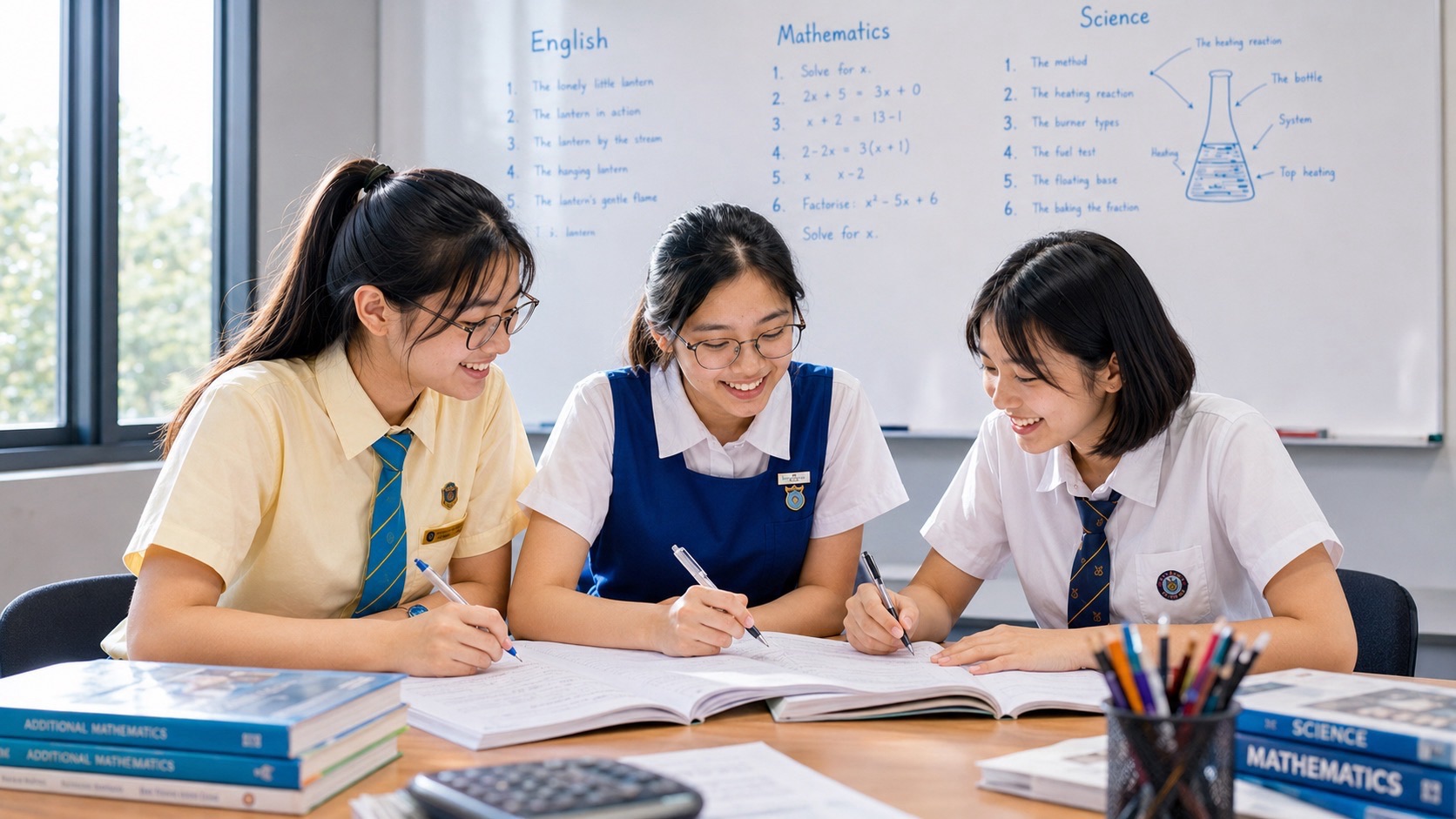
G3 Humanities (Social Studies, Literature in English) is a combined Singapore upper-secondary Humanities subject at G3 level, examined as syllabus K337 in the 2027 Singapore-Cambridge Secondary Education Certificate (SEC), replacing O-Level reference 2262. It has two compulsory, equally weighted papers. Social Studies Paper 1 takes 1 hour 45 minutes and contributes 50%, with a 35-mark source-based case study and 15 marks of structured responses. Literature in English Paper 2 takes 1 hour 40 minutes and contributes the remaining 50%; candidates answer one question on a studied prose text and one question on unseen poetry, each worth 25% of the total qualification.
For Punggol parents, the key distinction is that K337 is not standalone G3 Literature in English K331. The combined Literature paper does not require a separate drama paper, while Social Studies is compulsory. The student’s school determines which Humanities combinations it offers, which prescribed prose text is taught, and the option and eligibility rules for the relevant cohort. Families should ask for the actual Year 3 subject-combination booklet rather than assume a school offers K337 simply because it has an English or Literature department. A student entering Secondary 3 in 2027 normally takes the final SEC in 2028, so the 2028 examination-year requirements should be checked when released.
- 2027 G3 Humanities (Social Studies, Literature in English): K337, earlier reference 2262.
- Paper 1 Social Studies: 1 hour 45 minutes, 50 marks and 50%; source-based case study (35) plus structured response (15).
- Social Studies issues: citizenship and governance, diversity and society, global interdependence.
- Paper 2 Literature in English: 1 hour 40 minutes, 50 marks and 50%; prose set text question (25% overall) and unseen poetry question (25% overall).
- Candidates select one of the questions on their studied prose text, and one of two unseen poetry questions.
- Do not confuse K337 with standalone Literature in English K331, which has a different paper and genre structure.
- School action: confirm actual K337 availability and the prescribed prose text, then inspect the pupil’s source and close-reading skills.
Definition lock | G3 Humanities (Social Studies, Literature in English)
K337 is the 2027 SEC combined G3 Humanities subject containing compulsory Social Studies and Literature in English. Social Studies is Paper 1 and Literature in English is Paper 2, each contributing fifty per cent of the total assessment. The Literature portion examines a school-studied prose text and unseen poetry; it should not be confused with standalone G3 Literature K331. G3 refers to this particular subject’s level, while subject allocation and other G-levels depend on the student’s actual school circumstances.
How civic reading and literary close analysis work together
Two disciplines, two kinds of reading
Social Studies and Literature in English both use reading and argument, yet the questions they ask are different. A Social Studies source might reveal what a group thinks about a public issue, prompting evaluation of evidence and social consequences. A fictional narrator may reveal a character’s desires through silence, contradiction or a recurring image, prompting interpretation of a writer’s choices. Neither method is simply about identifying difficult words. Both ask students to support an explanation, but literary ambiguity and civic factual claims must be handled differently. A student can offer two defensible interpretations of a poem while still recognising that a political claim about the world must be checked against evidence. Understanding the distinction improves both components of K337.
Combined Literature is not standalone Literature K331
The K337 qualification includes compulsory Social Studies and a Literature paper focused on prose and unseen poetry. Standalone G3 Literature in English K331 has its own paper structure and includes drama work. Parents should not buy a complete standalone K331 package and assume every set text or genre belongs in K337. Nor should they believe that a student choosing K337 can avoid Social Studies because reading fiction is their principal interest. The examination weights are explicit: half the total comes from Social Studies. The school must confirm whether K337 is offered, the prescribed prose text studied and any combination rules. In subject-choice discussions, ask what kind of reading and writing the child enjoys, then let the actual assessment shape the preparation.
Social Studies Paper 1: evidence, issues and judgement
The 2027 K337 Social Studies paper is one hour forty-five minutes and contributes fifty per cent. Section A’s source-based case study carries thirty-five marks; Section B’s structured responses carry fifteen. The three issue areas are Citizenship and Governance, Living in a Diverse Society, and Being Part of a Globalised World. Students must read information from different perspectives, interpret what sources demonstrate and construct responsible judgements. A student who simply says ‘we should all respect one another’ may express a worthwhile value without answering a question about how a policy works or which evidence supports it. Strong responses identify the actor, issue, reasons and relevant consequences. This component deserves dedicated revision even if the learner performs especially well in Literature.
A Social Studies source is not the same as a literary narrator
A source may be an article, infographic, statement or image created for a particular audience. It can be useful evidence about what the author intended even when some factual claims require checking. A literary narrator is a deliberate device within a fictional work, and readers may need to consider what that narrator knows, hides or misunderstands. Confusing these approaches can produce weak answers in both papers. Students should first identify the question’s purpose: Is it asking what a source implies about a public issue? Is it asking how a writer makes an audience distrust a character? For Social Studies, provenance and corroboration may be central. For Literature, form, voice, language and context within the work may be more useful. Both demand careful textual evidence.
Source-based case studies reward precise inference
A child may read a statement, repeat the sentence and believe they have analysed the source. A better answer goes beyond literal comprehension without inventing unsupported motives. Suppose a source describes residents finding public services difficult to access because of competing schedules. A reasonable inference might concern unequal access, provided the answer points to the relevant wording and observes that the source does not establish every resident’s experience. The same discipline applies to comparisons. Two sources might share a concern yet differ about whose responsibility it is to respond. The pupil needs to identify that substantive difference and, if required, explain whether context or purpose can account for it. This is more useful than memorising the instruction ‘state inference, quote, explain’ without knowing what each stage accomplishes.
Social Studies structured questions require constructive judgement
The structured-response section invites reasoned discussion about societal issues. A recommendation should connect a real problem, a proposed action, the people affected and likely consequences. The pupil should be prepared to acknowledge trade-offs without treating every perspective as equally supported. An answer about social cohesion may consider both common experiences and the importance of respecting different identities. A globalisation question may discuss opportunities alongside economic or security vulnerabilities. Strong judgement is neither a personal political slogan nor a mechanical ‘on the one hand, on the other hand’ paragraph. It weighs evidence and makes an argument proportionate to the question. Families can practise respectful discussion of examples without requiring the child to adopt an adult’s views.
The Literature paper has only two required answers
For the 2027 K337 Literature in English Paper 2, candidates answer two questions in one hour forty minutes. Section A is Prose: they answer one question relating to their studied set text. Section B is Unseen Poetry: they choose one of two new poems and answer the corresponding question. Each section contributes twenty-five per cent of the entire Humanities qualification, together making fifty per cent. These are substantial written responses, so timing should be practised without sacrificing close reading. The examination does not reward writing as many quotations as possible. Students need a relevant interpretation supported by textual detail, organised into purposeful paragraphs. A long introduction that delays analysis is usually a poor use of time. The appropriate preparation is deep familiarity with the prescribed prose and flexible reading of unfamiliar poems.
A set prose text must be read rather than reduced to notes
Students sometimes believe they can replace the entire novel or collection with a character chart and a list of model quotations. Such notes can help revision, but they do not reproduce the movement of the text, the narrator’s decisions or the significance of a phrase within a chapter. A pupil needs to know what changes between scenes, what motivates characters and how the writer develops tension or perspective. If the question supplies an extract, the answer should analyse that passage closely while using wider knowledge where appropriate. Quotations must be accurate and purposeful. A sentence that simply repeats the plot is not yet literary analysis. Ask which precise word, contrast or structural choice creates the effect being discussed, and why the surrounding context supports that interpretation.
Unseen poetry tests a transferable way of reading
A poem the student has never met can be intimidating if revision has consisted only of memorising answers on familiar texts. A better approach reads the poem first for situation and voice, then for changes in tone, imagery, pattern or perspective. The student should notice which words feel unusual and ask what they contribute to the poem’s possible meanings. An unseen poem may have several reasonable interpretations, but each should be defended with the text. Avoid hunting mechanically for alliteration or metaphor to fill a checklist. A technical term is useful only if it helps the pupil explain a meaningful effect. Short weekly practice on unfamiliar poetry is more valuable than a folder of identical paragraphs that the student cannot adapt to a new question.
Imagery, tone and structure are choices that communicate
A poem about a crowded street might use an image of a river to convey movement, continuity or a sense of being carried along. The correct emphasis depends on the words around that image. Similarly, a story may withhold an answer until a late sentence, changing how readers understand a character. Students should not simply state that a metaphor ‘creates a vivid picture’; they should identify what particular relationship the image suggests and how it shapes the reader’s response. Tone may shift from playful to uncertain, or from angry to resigned, and that movement can be central to the text’s meaning. Structure is not an optional decorative feature of analysis. Where a poem breaks a line or a narrative changes point of view, explain why that choice matters.
There is no single formula for a convincing literary paragraph
A useful paragraph generally makes a claim, identifies precise textual evidence and explains how the evidence supports the interpretation. Yet filling a template with empty statements does not demonstrate understanding. ‘The author uses diction to convey emotions’ tells us little until the particular words and emotions are named. Students should be prepared to qualify their interpretation or compare alternatives when the passage supports complexity. Rather than write five short points with no development, explain two or three carefully chosen observations. The reader needs to see the reasoning, not only the quotation. Families can help by asking the child to explain one line aloud before turning the thought into a paragraph. Spoken clarity can expose an inference that sounded more impressive on paper than it actually was.
The prescribed prose text is a school-specific planning question
The 2027 syllabus provides a set-text arrangement for the Literature paper, and candidates answer on the text they have studied. Schools select appropriate texts under the examination arrangements. A parent should therefore confirm the actual book with the child’s school before buying annotated editions, assessment guides or tuition materials. A popular online summary about an unrelated prescribed text may teach general literary concepts but cannot be a substitute for the student’s work. The school can also explain whether a particular edition is required and how teachers handle unfamiliar extracts. Family reading sessions should support the student’s own independent reading instead of replacing it with adult explanations of the ‘correct’ meaning. The goal is for the child to know the text well enough to interpret fresh questions without a script.
Social Studies and Literature share transferable skills but retain boundaries
Both components reward accurate comprehension, reasoned explanation and the appropriate use of evidence. That connection can help learners who feel that they are studying two unrelated subjects. Yet the kind of evidence changes. A Social Studies claim about factual circumstances might require corroboration and attention to source purpose. A literary argument about a character’s silence should use the words, structure and dramatic situation of the fictional text. An exercise that simply labels all sources ‘biased’ or all language choices ‘effective’ misses those differences. Encourage the pupil to ask three questions before responding: What is the enquiry? What kind of source am I reading? What counts as evidence for this particular claim? This brief pause can improve relevance, especially under timed conditions.
How Punggol parents can discuss subject fit intelligently
A teenager who enjoys stories, poems and classroom discussion may find K337 appealing, but interest in Literature does not mean that the Social Studies component will be effortless. Another student who likes current affairs may struggle with interpreting tone and imagery. Both are ordinary learning gaps rather than permanent labels of ability. Start with one unfamiliar poem and one Social Studies source-based response. Examine how the child uses evidence, whether they tolerate ambiguity and how they organise written reasoning. Then ask the school which Humanities combinations are available in that student’s cohort and how the subject fits alongside Mathematics, Science, languages and co-curricular activities. A manageable combination with strong engagement is more productive than selecting a subject because it appears easier to score.
Civic understanding and literary empathy can reinforce each other
Studying different voices in Literature can help a child notice how experiences and expectations affect perspective. Social Studies can add structured inquiry into how groups with different needs live and make decisions together. These connections should not be overstated: reading a fictional character’s thoughts is not the same as researching a real community, and a novel does not establish a policy fact. But careful reading can develop patience with complexity. Students may learn to ask what is missing from a public claim, whose experience is represented and which evidence supports an interpretation. These are meaningful habits for contemporary life, even if the learner does not later pursue an arts-related career. The subject’s immediate value lies in more independent and responsible thinking.
What a teacher should diagnose before asking for more essays
The visible grade may hide different problems. One student understands the poem but writes an unfocused answer; another chooses a quotation but cannot explain how its words work; a third writes excellent literature paragraphs yet repeatedly misjudges Social Studies source usefulness. These require separate repairs. Ask to inspect the first unsupported sentence in a marked script, explain why it fails and reconstruct the reasoning on a short related task. Then change the source or poem and check whether the pupil can repeat the skill independently. If progress occurs only with the exact model answer still visible, the method is not yet secure. Purposeful feedback should gradually make the student less dependent on external phrasing.
Punggol school options and book choices require confirmation
The SEAB G3 subject directory shows that K337 is nationally examined; it does not guarantee a K337 class at every school. Edgefield’s Year 3 options page, Greendale’s published upper-secondary subjects and Punggol Secondary’s teaching list are separate local starting points. Check the current school’s actual combination choices and the exact prose text assigned to the pupil.
Families should also distinguish interest from readiness. A child who loves reading may still need explicit practice explaining a quotation or answering a civic source question. Another pupil may write confident Social Studies arguments but struggle with ambiguity in unseen poetry. Start with the student’s existing marked work and ask which error occurs repeatedly. Then plan a small learning action that matches the real obstacle. Consider whether the whole subject combination leaves enough time for languages, Mathematics, Sciences, CCA and independent reading. No one Humanities route is automatically the best choice for every student, and eligibility is determined by school rules, not by a general article.

Twelve common K337 errors and the targeted repair
A low mark can arise from using the wrong syllabus, failing to analyse a source, quoting a novel without explaining it or mismanaging the two Literature tasks. These errors should not be grouped under the broad label of ‘weak Humanities’. The most effective next lesson identifies the first unstable move and checks it on a fresh piece of evidence.
1. Using standalone K331 preparation as if it were K337
The student revises a drama paper or extra pure-Literature content while neglecting compulsory Social Studies. The subject code defines the examined genres and the compulsory civic component. A learner who studies the wrong literature paper may be working hard at irrelevant material. Begin by checking the school’s actual registration and text.
Confirm K337 and its exact two-paper structure, then use the school’s prescribed prose text. Every resource supports the right course. Give a new task without the earlier answer visible. Genuine improvement means the learner can make the necessary interpretive decision independently and explain why it is justified.
2. Treating an authorial choice as a civic fact
A literary narrator’s feelings are treated like a verified statement about real Singapore society. Evidence has different functions across disciplines. A literary narrator is part of an imagined construction, while a Social Studies document is a source about a real issue. A good answer keeps that distinction visible.
Identify the genre, question and kind of claim before selecting evidence. The answer uses the correct method of interpretation. Give a new task without the earlier answer visible. Genuine improvement means the learner can make the necessary interpretive decision independently and explain why it is justified.
3. Social Studies source claims go unchecked
A poster’s claim is repeated as an objective fact without considering purpose or corroboration. A source can be useful for revealing a point of view even when its factual assertions require verification. Ask exactly what the question is investigating before judging its usefulness.
Distinguish what the source says from what the wider evidence can establish. The judgement remains grounded. Give a new task without the earlier answer visible. Genuine improvement means the learner can make the necessary interpretive decision independently and explain why it is justified.
4. A civic recommendation becomes a slogan
An answer concludes that everyone should ‘show respect’ without explaining how the proposed measure addresses the issue. Societal judgement requires a causal argument. A fine-sounding value can be the beginning of a response but cannot replace an account of who would act, why and with what consequences.
Specify actor, action, relevant social mechanism and possible limitation. The recommendation is reasoned. Give a new task without the earlier answer visible. Genuine improvement means the learner can make the necessary interpretive decision independently and explain why it is justified.
5. The prose answer retells the plot
The pupil narrates what happened to a character without explaining why the writer presents the scene in that way. A novel is more than a plot. Understanding how events are presented and why a writer selects particular details is the intellectual work of Literature. The student should move from what happened to how meaning was shaped.
Make an interpretive claim and analyse a precise detail before adding wider context. Each paragraph explains writerly choice. Give a new task without the earlier answer visible. Genuine improvement means the learner can make the necessary interpretive decision independently and explain why it is justified.
6. A quotation is inserted without analysis
A long passage is copied into the answer, leaving little space to interpret its language. The purpose of a quotation is to make an interpretation inspectable. A smaller precise reference often supports more meaningful analysis than a paragraph-long extract that is not explained.
Choose fewer relevant words and explain what they suggest in this setting. The evidence supports the claim. Give a new task without the earlier answer visible. Genuine improvement means the learner can make the necessary interpretive decision independently and explain why it is justified.
7. Technique labels replace meaning
A student identifies imagery or metaphor but only writes that it creates an interesting effect. Technique terminology is an aid, not the destination. Ask what exact feature produces which impression and why it matters in the wider scene or poem.
Describe the specific impression or tension created by the chosen wording. The effect is precise. Give a new task without the earlier answer visible. Genuine improvement means the learner can make the necessary interpretive decision independently and explain why it is justified.
8. Tone is named without evidence
The learner calls a poem sad because of the topic, ignoring shifts in voice or contrast. Tone can shift even when the topic stays the same. Look for contrasts, punctuation, images or changes in the speaker’s attitude before applying an emotional label.
Trace words and structure that support the tonal interpretation. The tone reading is demonstrable. Give a new task without the earlier answer visible. Genuine improvement means the learner can make the necessary interpretive decision independently and explain why it is justified.
9. Unseen poetry is approached as a memory test
A new poem causes panic because no model paragraph matches its images. A new poem is a test of reading method. The child should be able to identify situation, voice, key changes and persuasive textual evidence without access to a prepared analysis.
Read for situation, voice and change; then build an inference from the actual lines. The child responds to new material. Give a new task without the earlier answer visible. Genuine improvement means the learner can make the necessary interpretive decision independently and explain why it is justified.
10. One apparent meaning is treated as the only permitted reading
The pupil believes any alternative interpretation must be wrong without testing the textual context. Literature can support more than one interpretation without making all interpretations equally well evidenced. Compare the competing possibilities against what the text actually says.
Consider two plausible readings, then prefer the one most strongly supported by the passage. The conclusion acknowledges ambiguity responsibly. Give a new task without the earlier answer visible. Genuine improvement means the learner can make the necessary interpretive decision independently and explain why it is justified.
11. The set text is replaced by online summaries
Students memorise quotations without knowing what happened before or after them. Summary guides can reinforce memory, but they cannot recreate the writer’s pacing, details or full context. Return to the actual work to see what the chosen quotation means.
Return to full chapters and trace the development of character, setting or conflict. The child can use wider context accurately. Give a new task without the earlier answer visible. Genuine improvement means the learner can make the necessary interpretive decision independently and explain why it is justified.
12. Timed answers lose balance across components
A pupil spends too long on the first prose response and leaves unseen poetry unfinished. Examination time is part of the task. A student who spends all available effort on one excellent paragraph may fail to show the required second response. Practice should preserve both depth and balance.
Plan brief answer-bearing points and rehearse both required Literature questions under realistic timing. Both questions receive developed responses. Give a new task without the earlier answer visible. Genuine improvement means the learner can make the necessary interpretive decision independently and explain why it is justified.
Eight-week practical study plan for Social Studies and Literature
The sequence below is an illustrative home-learning plan, not a substitute for the school’s own text schedule or assessment rules. It balances the civic and literary components and uses short, checkable tasks. Students should retain ownership of their responses; adults and tutors may ask questions but should not write assessed analysis on the child’s behalf.
Week 1: Confirm K337 and the set prose text
Check the exact subject code and required two papers; obtain the current prescribed book from school. Begin with the actual school option form and the prescribed prose book. This prevents well-intentioned families from buying a resource designed for a different Literature syllabus.
Progress check: The learner’s materials match the school course. Keep one independent example, a precise correction and a short note about what changed. Repeat the same kind of skill later with different material.
Week 2: Social Studies inference
Interpret a short unfamiliar source, citing evidence and distinguishing claim from fact. Use an unfamiliar source rather than a passage whose sample answer has already been memorised. Ask for the inference, supporting evidence and relevant limitation.
Progress check: The response is supported and proportionate. Keep one independent example, a precise correction and a short note about what changed. Repeat the same kind of skill later with different material.
Week 3: Civic judgement
Write one structured response identifying a societal issue, possible action and trade-off. Keep the civic response tied to the defined problem. Compare two realistic possibilities, identify their costs and explain why the chosen approach might be justified.
Progress check: The recommendation has a clear mechanism. Keep one independent example, a precise correction and a short note about what changed. Repeat the same kind of skill later with different material.
Week 4: Prose close reading
Choose a short passage from the school’s set text and analyse a character or narrative decision. Read the scene in full, not only the quoted line. Ask what happens immediately before and after the detail and how that placement influences meaning.
Progress check: The paragraph moves beyond plot summary. Keep one independent example, a precise correction and a short note about what changed. Repeat the same kind of skill later with different material.
Week 5: Writer’s language and structure
Study two details from the same scene and explain how they shape the reader’s response. A technique label is not enough. Encourage the child to explain what the writer’s words make the reader understand about character, setting or conflict.
Progress check: Writerly choices are linked to meaning. Keep one independent example, a precise correction and a short note about what changed. Repeat the same kind of skill later with different material.
Week 6: Unseen poetry voice
Read a fresh poem twice, annotate its speaker, situation and changes in tone or imagery. Short new poems develop adaptability. After identifying a tentative reading, check whether the rest of the poem supports or complicates it.
Progress check: The interpretation relies on the new poem. Keep one independent example, a precise correction and a short note about what changed. Repeat the same kind of skill later with different material.
Week 7: Prose and poetry comparison of techniques
Practise a short argument on each form without recycling an irrelevant model paragraph. Practise transferring a close-reading method across prose and poetry while respecting their different forms. A story passage and poem can require different explanations of voice and structure.
Progress check: The evidence is appropriate to each task. Keep one independent example, a precise correction and a short note about what changed. Repeat the same kind of skill later with different material.
Week 8: Balanced two-paper practice
Attempt a Social Studies source task and both required Literature response types independently. Finish with fresh tasks under realistic conditions. The correction should be followed by a second independent attempt after several days to test durable transfer.
Progress check: The child can respond to unseen material and manage time. Keep one independent example, a precise correction and a short note about what changed. Repeat the same kind of skill later with different material.
Frequently asked parent questions about K337
What is K337?
The 2027 G3 combined Humanities qualification comprising compulsory Social Studies and Literature in English. For actual school allocation, set-text choices, examination entry or future educational pathways, verify the correct year’s official syllabus and the student’s own school instructions.
Does K337 include drama?
Its 2027 Literature Paper 2 assesses prose and unseen poetry; do not confuse it with standalone K331’s separate requirements. For actual school allocation, set-text choices, examination entry or future educational pathways, verify the correct year’s official syllabus and the student’s own school instructions.
How much is Social Studies worth?
Fifty per cent of the total K337 qualification, with its own 1-hour-45-minute paper. For actual school allocation, set-text choices, examination entry or future educational pathways, verify the correct year’s official syllabus and the student’s own school instructions.
How long is Literature Paper 2?
One hour forty minutes; candidates answer one studied prose question and one unseen poetry question. For actual school allocation, set-text choices, examination entry or future educational pathways, verify the correct year’s official syllabus and the student’s own school instructions.
Do students memorise a specific unseen poem?
No. ‘Unseen’ means the poem is unfamiliar at the examination, so adaptable close-reading skills are required. For actual school allocation, set-text choices, examination entry or future educational pathways, verify the correct year’s official syllabus and the student’s own school instructions.
Can the school choose which prose text is taught?
The candidate studies an approved set text arranged by the school; parents should confirm the exact title with the teacher. For actual school allocation, set-text choices, examination entry or future educational pathways, verify the correct year’s official syllabus and the student’s own school instructions.
Is K337 the same as a Literature elective for every student?
No. The school must actually offer K337 and the pupil must meet the relevant combination and subject-level requirements. For actual school allocation, set-text choices, examination entry or future educational pathways, verify the correct year’s official syllabus and the student’s own school instructions.
Does K337 guarantee an arts or law pathway?
No. Later institutions set their own entry criteria and may require other subjects and results. For actual school allocation, set-text choices, examination entry or future educational pathways, verify the correct year’s official syllabus and the student’s own school instructions.
Tuition support should build independent reading, not model-answer dependence
Not all K337 learners require private tuition. School feedback and a regular reading routine may already provide the structure needed for progress. Additional teaching helps when the pupil repeatedly makes the same unsupported inference, cannot connect evidence to interpretation, or leaves a required response unfinished. A well-run tutorial should model a reading decision, invite a guided attempt and then ask the child to explain an unfamiliar passage without prompts. A class of three may allow closer discussion, but group size is not proof of outcomes. The purpose is to deepen reasoning and confidence while respecting the originality and integrity of the pupil’s own assessed work.
The eduKateSG Clementi immutable tutorial reference demonstrates useful teaching principles: diagnosis of the exact error, clear explanation, feedback, practice and independent retry. For K337, those principles should produce a student who can analyse new prose or poetry and evaluate new civic sources without reaching for an unrelated prepared paragraph. This reference does not promise a specific K337 class or place in Punggol.
Official syllabus and connected Punggol guides
SEAB’s 2027 G3 K337 Humanities syllabus specifies the Social Studies and Literature papers, set prose choices and unseen poetry assessment. The existing Punggol Tuition 2027 K337 examination guide focuses on studying for the paper, while the standalone G3 Literature in English guide explains the different K331 route. Recheck the correct examination-year syllabus for pupils who enter Secondary 3 in 2027.


