
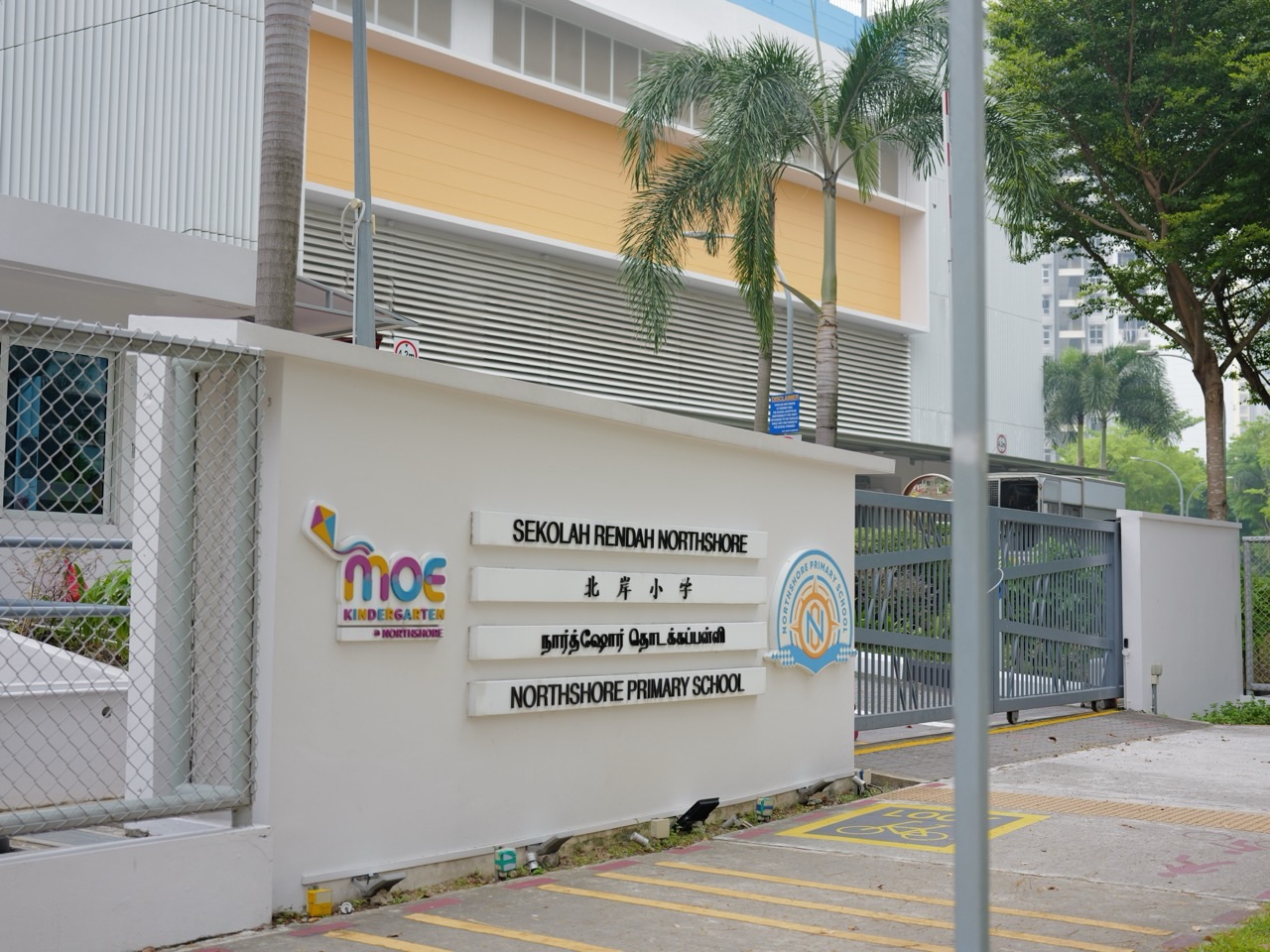
Why did Northshore Primary School begin operations in 2021, while Valour Primary School welcomed its first Primary 1 cohort in 2020? The two schools were announced as part of Singapore’s response to growing demand for primary-school places in Punggol. Their different opening arrangements show that a school’s timing is linked not only to construction but also to when families actually move into nearby homes.
In September 2018, the Ministry of Education announced Valour Primary and Northshore Primary to serve demand in the expanding town. Subsequent arrangements changed as local developments progressed. Valour started in January 2020 using a temporary holding site at Punggol Cove Primary for its first term, before moving to its permanent campus. Northshore’s opening was deferred to January 2021 because the expected nearby BTO population would arrive later. These are documented examples of a town adjusting school services as homes and residents arrive in stages.
- Why build new schools? Growing housing estates can create local demand for primary places.
- 2018 plan: MOE announced Valour Primary and Northshore Primary to meet Punggol demand.
- Valour: first P1 intake in January 2020 at a temporary holding site, followed by permanent-campus operation in March 2020.
- Northshore: opening moved to January 2021 to align better with nearby housing occupancy.
- Crucial distinction: a school building can be constructed before enough local families are present to justify opening every programme.
- For parents: the existence of a school does not guarantee a particular P1 place; MOE’s registration rules still apply.
- Best next step: use current MOE SchoolFinder and P1 registration information, not historical opening announcements, for a real application.
Why housing growth can lead to a school shortage
A new BTO precinct can change the distribution of children in a town. Families with school-age children may move in over several years, sometimes creating strong demand for schools near their new homes.
A town can have enough primary schools in total while still experiencing inconvenience or pressure in a particular part of the town. Location matters because primary pupils are young and repeated long journeys can be demanding.
MOE’s 2018 statement on Punggol identified growing demand as the reason for creating additional schools. That is a documented local example of planning capacity in response to demographic change, not merely a generic claim that more buildings always require more schools.
Why a school cannot be added overnight
A functioning primary school needs land, an approved building, classrooms, utilities, appropriate circulation, safety provisions, educators, administration and learning resources.
Construction itself has a schedule. Recruiting staff, preparing programmes and admitting pupils have other schedules. These tasks interact even when they do not all occur on the same day.
The useful lesson is that a school place is a service supported by infrastructure and people. A town cannot create that service merely by placing a sign reading “Primary School” on a vacant site.
Why MOE announced two schools in 2018
MOE announced Valour Primary and Northshore Primary in September 2018 to respond to demand in Punggol. The two schools had different geographical catchments within the growing town and supported the broader distribution of primary education.
At that time, the public announcement anticipated their first P1 cohorts in 2020. The later variation in Northshore’s schedule shows why a plan must be read alongside subsequent updates.
This is not evidence that either school was unimportant. It shows that the right time to provide a service can change when assumptions about nearby population and construction completion change.
Why an empty school building would not automatically be useful
A completed campus can provide classrooms and specialist rooms, but its purpose is to educate children. If few children are expected to live nearby in a particular year, opening the full operation immediately may not be the best use of available resources.
MOE explained that the first nearby BTO flats around Northshore Primary were expected to complete from the second quarter of 2020, with many residents moving in later. It therefore anticipated low 2020 demand and revised the school’s opening to January 2021.
That is a concrete example of demand timing, not just building timing, affecting a public service. The school must be ready for the children it is intended to serve.
Why Northshore’s planned date changed
The original public announcement and the later implementation decision differ. The September 2018 plan identified a 2020 intake; the subsequent MOE arrangements deferred Northshore Primary’s opening to 2021.
A resident reading only the older announcement might incorrectly conclude the school had been open since 2020. A current historical explanation should state the initial plan, the revised decision and the resulting opening year separately.
This is an important way to avoid accidentally misleading families. An official source can be correct for the plan at its date and no longer be the best statement of what eventually occurred.
Why Northshore is not interchangeable with Valour
The schools were introduced in one broader policy context but served different places. Northshore Primary School is in the newer northern housing environment, while Valour Primary School is associated with Punggol Central and Punggol Way.
Their separate site and occupancy conditions influenced their opening schedules. It would be inaccurate to say that both schools were delayed in the same way or that they were simply two names for one campus.
For a family, the exact school identity also matters to admissions. A geographical label is not a substitute for checking the official school address, programmes and present registration information.
Why Valour used a temporary holding site
When Valour’s permanent campus encountered a short delay, MOE arranged for the first cohort to start at Punggol Cove Primary School for Term 1 in 2020. The arrangement allowed lessons to begin while the permanent site was prepared.
The published holding period was 2 January to 13 March 2020, with the move to the permanent campus following the March holidays. MOE’s published annex identifies the temporary site at 52 Sumang Walk, near the intended permanent location.
This was a historical transition measure, not a current instruction for parents to send Valour pupils to Punggol Cove. An undated article that repeats the temporary address today would be misleading.
Why two schools could share a site without becoming one school
During the temporary arrangement, Valour and Punggol Cove conducted their own lessons and programmes while sharing selected facilities such as the canteen, library and specialist rooms.
That required careful coordination of schedules and spaces. A shared physical building did not erase each school’s separate identity, staff or educational programme.
The lesson goes beyond schools: two services can share premises while maintaining distinct responsibilities. This is similar to a community hub whose organisations use common circulation but operate different programmes.
Why the temporary site was chosen nearby
The published 2019 MOE annex identified the holding site as roughly 400 metres from Valour’s intended permanent campus. Proximity helped keep the arrangement within the general neighbourhood context.
But a map distance does not guarantee identical travel time or access conditions for every family. A route can have crossings, weather exposure and transport choices that affect actual effort.
Families at the time needed the exact temporary entrance and school notices. For readers today, the important lesson is why proximity and transport were considered in a temporary operational plan.
Why a temporary school arrangement still needs a timetable
When two schools share parts of one campus, the canteen, hall or library cannot automatically host incompatible activities at the same moment.
MOE described coordinating the use of shared resources during Valour’s holding period. That illustrates a scheduling problem: physical space must be allocated in time, not only on a floor plan.
A simple classroom exercise can show why. If two groups both need the same hall at 10am, the school must arrange another slot or a suitable alternative. Building-sharing requires management rather than merely opening a connecting door.
Why starting a P1 cohort is not the same as opening every school level
A new primary school may begin with an intake of Primary 1 pupils and grow in subsequent years as the first cohort moves through the levels and new cohorts join.
This staged pattern differs from instantly operating every grade at full size. It influences the use of classrooms, specialist facilities and staffing over time.
A resident should not take a school’s first-year enrolment as evidence of its eventual capacity or long-term demand. The school and the neighbourhood may be growing together.
Why the school population changes year by year
Children move from one school level to the next. New households arrive, some families relocate and the local age distribution changes.
A newly populated estate may have many young children, while a more established area may later experience a different mix. Planning therefore needs periodic review rather than one permanent forecast made before the first BTO launch.
MOE has explained that it reviews demand and supply at national and local levels. An individual family should not assume the vacancy pattern at one school in one year will necessarily repeat several years later.
Why school distance matters for young children
A short, manageable journey can make early mornings easier for pupils and caregivers. It also reduces the number of transport stages a family may need to coordinate.
MOE’s parent guidance encourages families to consider schools reasonably close to home, alongside the child’s needs, interests and strengths. Location is one practical factor rather than the only measure of school suitability.
A school that seems prestigious but requires an exhausting daily journey may not suit every child. The purpose of distributing schools across a town is to make appropriate options more accessible.
Why the nearest school is not a guaranteed school place
Primary 1 registration is governed by a national phased process with eligibility rules, vacancies and balloting conditions. Distance can matter within that process, but living nearby does not automatically guarantee admission.
MOE’s official P1 portal explains the phases and provides current vacancies and balloting information for the relevant exercise. Families should use those official tools rather than infer their admission outcome from a map.
This is the central distinction between planning enough public school capacity and allocating a particular place to a particular child. The two are related but are not the same decision.
Why the 2026 exercise is not the 2027 exercise
An annual P1 registration exercise generally admits pupils for the following school year. The 2026 exercise concerns the 2027 P1 cohort, while a later exercise will have its own dates and rules.
MOE’s 2026 portal identifies children born between 2 January 2020 and 1 January 2021, both dates inclusive, for that year’s exercise. It also explains that eligible citizens and permanent residents register in phased periods, with international-student arrangements separate.
Dates, vacancies and rules should always be checked for the child’s actual registration year. Copying a 2020 or 2026 poster into a future application can create avoidable errors.
Why ‘within 1 km’ is not an acceptance promise
Parents sometimes treat a home-to-school distance category as if it functions like a reserved ticket. In reality, distance priority is relevant within the applicable registration and oversubscription conditions.
A school can receive more eligible applicants than the available places in a phase. Balloting rules then apply, with citizenship and other published criteria also relevant.
The accurate family advice is to confirm the official home-school distance, the child’s eligible phase and the current vacancy position. A street-level estimate of “about one kilometre” does not replace MOE’s formal calculation.
Why parents must use the correct home address
MOE has requirements governing which residential address may be used for registration and how long a family must reside there when distance priority is claimed.
A parent should not treat a relative’s address or an intended future BTO move as automatically eligible without checking the current rule and any relevant approval route.
The principle is that admission information must reflect the child’s permitted circumstances, not a convenient address chosen to improve the apparent distance. Accurate records protect the integrity of the process for other applicants.
Why registration phases need careful reading
The P1 process includes phases associated with existing school ties and later opportunities for children without such ties. The eligibility criteria and number of reserved places follow the rules in the relevant year.
A family may know it lives near a school but still be uncertain about the correct phase. The answer comes from the official portal and any supporting documentation, not from comparing two neighbours’ stories.
The correct educational habit is to identify the governing rule before applying an example. A phrase like “my friend’s child entered under 2A” is not enough to establish another child’s eligibility.
Why older balloting data is useful but not destiny
Past registration statistics can reveal how many applicants and places were recorded for a particular school in previous years. Parents may use them to understand possible demand.
However, school capacity, applicants, demographics and regulations can change. The result of last year’s exercise is not an algorithm guaranteed to predict the next one.
MOE’s official resources encourage families to examine prior vacancy and balloting information while considering a range of schools. That is planning under uncertainty, not a promise of admission.
Why some schools grow while others may shrink
A young estate may see rising demand, while some older areas experience lower demand as households age and children move through the system.
MOE must consider both national and local changes when planning the school network. Building only where demand is rising and never reviewing older capacities would not use resources efficiently.
Punggol’s 2018 school announcements demonstrate one direction of this balancing process. They do not imply that every school in every town should expand indefinitely.
Why an established secondary school was relocated
The 2018 Punggol announcement also included the relocation of Yusof Ishak Secondary School from Bukit Batok to Punggol to respond to changing demand.
This offers a contrast with building new primary schools. A network can respond by creating a new institution at one location or moving an existing one to a different part of Singapore under carefully planned arrangements.
The article’s main focus remains P1 provision, but the comparison shows why education infrastructure is planned across the whole country rather than one town in isolation.
Why a new school’s name does not define its entire programme
Valour and Northshore are recognisable local school names. But a school’s educational offering includes its curriculum, co-curricular programmes, teaching approaches and student support.
Families should consult each school’s official information and MOE SchoolFinder rather than assume one name automatically implies a particular specialism, status or academic outcome.
The policy reason for establishing the school is to provide public education access. The individual child’s fit with the actual school environment remains an additional family consideration.
Why a newly opened school can still be a complete learning environment
A school beginning with limited cohorts may not have pupils in all six primary levels. That does not mean it cannot deliver an appropriate P1 education.
MOE and the school must organise staff, age-appropriate learning resources and support for the pupils actually attending. The size of the first cohort is only one aspect of operational readiness.
A parent should ask about relevant support and programmes, not assume that a smaller initial enrolment automatically produces either inferior or superior teaching.
Why a school building has more jobs than classrooms
Primary-school infrastructure includes classrooms as well as spaces for play, physical education, meals, sanitation, safety, administrative work and suitable specialist learning.
A temporary campus arrangement has to account for these shared facilities. This is part of why Valour’s early use of Punggol Cove required coordinated scheduling rather than simply assigning a spare classroom and ignoring the rest of the school day.
The building exists to support a whole school routine. The educational service would be incomplete without the infrastructure used outside ordinary lessons.
Why transport and safe crossings are part of school planning
Families may walk, use buses or take the LRT as part of the school commute. The route can include busy roads and changing weather.
A school may be geographically close yet require a crossing or detour that changes the practical journey. Young children also need suitable supervision and appropriate handover arrangements.
A planning discussion should consider the full walk from home to the school gate rather than use straight-line distance alone as a measure of everyday convenience.
Why a holding campus does not mean every school can share any building
Valour’s arrangement was a specific planned measure with an identified nearby school and available classrooms and facilities. It should not be generalised into a claim that any two schools can share space whenever construction is delayed.
Capacity, safeguarding, staffing, circulation, schedules and programme needs would need to be assessed. The historical example demonstrates a possible solution under particular conditions, not a universal recipe.
This is a powerful reasoning lesson: a successful local arrangement is evidence of what worked in one case, while transferring it to another case requires checking the conditions.
Why MOE Kindergartens are related but different
Several Punggol primary schools have co-located MOE Kindergartens. An MK and the primary school may share a campus environment while serving children of different ages and following their respective programmes.
The new-school history includes MK@Valour and MK@Northshore, but kindergarten registration is not identical to the Primary 1 exercise.
A family should not treat an MK place as automatic admission to any primary school without checking the applicable P1 rules. Distinguish the physical location and name from the actual admissions pathway.
Why early childhood planning is a separate decision
ECDA works with HDB to plan government-supported preschool capacity alongside BTO developments. That addresses infant care and preschool needs that are different from compulsory Primary 1 schooling.
The existing Punggol preschool planning explanation examines that coordination.
This article focuses on MOE primary-school opening and intake timing. The programmes may exist in the same growing town, but their age groups, operators and admission rules differ.
Why a future BTO site is not a confirmed school entitlement
A parent may see a future school site on a housing planning map and assume that buying a flat nearby secures a P1 place.
A reserved site is a planning provision. It is not proof of final construction, operating date, admission capacity or the outcome of a future registration exercise.
The correct response is to separate long-term neighbourhood planning from present operational and registration facts. Official announcements should be consulted as projects progress.
Why public announcements should use milestone labels
The words planned, under construction, ready, open and admitting pupils describe different states. The Valour and Northshore histories show why those distinctions matter.
A campus can be physically ready while the nearby population is expected to arrive later. A school can begin educating pupils at a holding site before its permanent campus is available.
A good reporter states the specific milestone and date. That is more useful than treating every announcement about a school as either an opening or a failed promise.
A worked example: the school ready before the families
Imagine a fictional new BTO precinct where a school building is ready in January, but most residents are scheduled to move in later in the year.
The planner compares expected immediate enrolment with the cost and staffing of operating the centre. A later opening may align better with local demand, depending on the full circumstances.
This is the general idea illustrated by Northshore Primary’s revised schedule. The classroom example does not claim to reconstruct every detail of MOE’s decision.
A worked example: a temporary term at another campus
A fictional school needs to welcome its first Primary 1 cohort but its building is not ready. A nearby school has sufficient appropriate space for one term.
The planner considers separate teaching programmes, shared canteen times, safe arrival, staff coordination and the planned move.
This resembles the documented Valour holding arrangement while showing that the main challenge is not finding a vacant classroom: it is maintaining a complete and coherent school day.
A worked example: two children with different phases
Two fictional Punggol children live similar distances from a school. One has a sibling currently studying there, while the other does not.
Their eligible registration phases may differ under the applicable MOE rules. Distance alone therefore does not determine their admission experience.
The lesson is to identify the child’s official eligibility before comparing outcomes. A parent’s explanation should not reduce registration to one map number.
A worked example: a parent reads an old opening article
A resident finds a 2018 article saying both new primary schools will open in 2020. They then see a later source stating Northshore opened in 2021.
The correct conclusion is not automatically that one publication was fabricated. The earlier article describes a plan that later changed. A careful timeline places each source at its actual date.
This exercise teaches how to reconcile apparently conflicting sources by distinguishing intention and later outcome.
A Mathematics activity about capacity
Imagine a fictional area expecting 480 P1 applicants across several neighbourhoods. Two hypothetical schools have planned intakes of 240 and 300 places, but demand is not spread evenly between them.
The total of 540 places does not guarantee every applicant enters their first-choice school. One locality can be oversubscribed while another has space.
These figures are invented for teaching. The real Punggol admission picture depends on the year’s MOE vacancies, phases and applicants.
A Geography activity about the school journey
Draw two schools on a fictional map with housing blocks, LRT tracks and two major crossings. Identify both straight-line distances and plausible walking routes.
Ask whether the physically closest school is always the least demanding route for a young child. The answer can depend on crossings, pedestrian paths and transport arrangements.
The exercise introduces accessibility as an experienced journey rather than a simple radius on paper.
Teaching Guide: why schools and BTO homes open in different years
Learning goal: explain how demographic demand, construction readiness, staffing and admissions combine to determine school opening.
Step one: build a timeline with MOE’s September 2018 announcement, Valour’s 2020 first cohort and Northshore’s January 2021 opening. Step two: identify which dates were plans and which were operational milestones.
Step three: place fictional BTO move-in dates and school-ready dates on the same chart. Ask what happens when they do not align. Step four: design a holding-site plan with classrooms, canteen, safe routes and staff arrangements.
Step five: give two imaginary P1 families with different eligibility conditions. Ask why being close to a school does not settle the outcome. Step six: have the learner check a current MOE registration page and identify which information would be time-sensitive.
Transfer test: explain how the same phased-planning challenge could arise for a polyclinic, childcare centre or public library, while recognising the services’ different users and rules.
Frequently asked questions
Why were new primary schools added in Punggol? MOE identified growing demand for school places in the expanding town.
Which schools did MOE announce in 2018? Valour Primary School and Northshore Primary School.
When did Valour begin educating pupils? Its first Primary 1 cohort began in January 2020, initially at a holding site.
Where was the temporary site? MOE identified Punggol Cove Primary School as the holding campus for Valour’s first term.
When did Northshore open? MOE’s revised plan provided for operations from January 2021, aligned with surrounding BTO occupancy.
Does a building’s completion date determine its school opening? Not by itself; expected demand and operating arrangements matter.
Does living beside a primary school guarantee admission? No. Apply the MOE rules and current vacancy and balloting information.
Is school enrolment the same as preschool enrolment? No. They have different age groups and relevant processes.
Do 2018 and 2019 school announcements describe present vacancies? No. They are historical planning sources.
Where should parents register for P1? Through MOE’s current official P1 Registration Portal, in the eligible phase for the appropriate year.
Your next step
If you are studying the history of Punggol, compare the MOE 2018 announcement naming Valour and Northshore with the later Valour holding-site information and official school histories.
If you are making a current school choice, use MOE SchoolFinder and the P1 registration portal instead. The earlier school-place concerns guide discusses practical risks.
The one idea to remember is that a school is not ready merely because its walls are complete. The children, teachers, operational plan, location and admission process all need to fit the town that is growing around it.


