
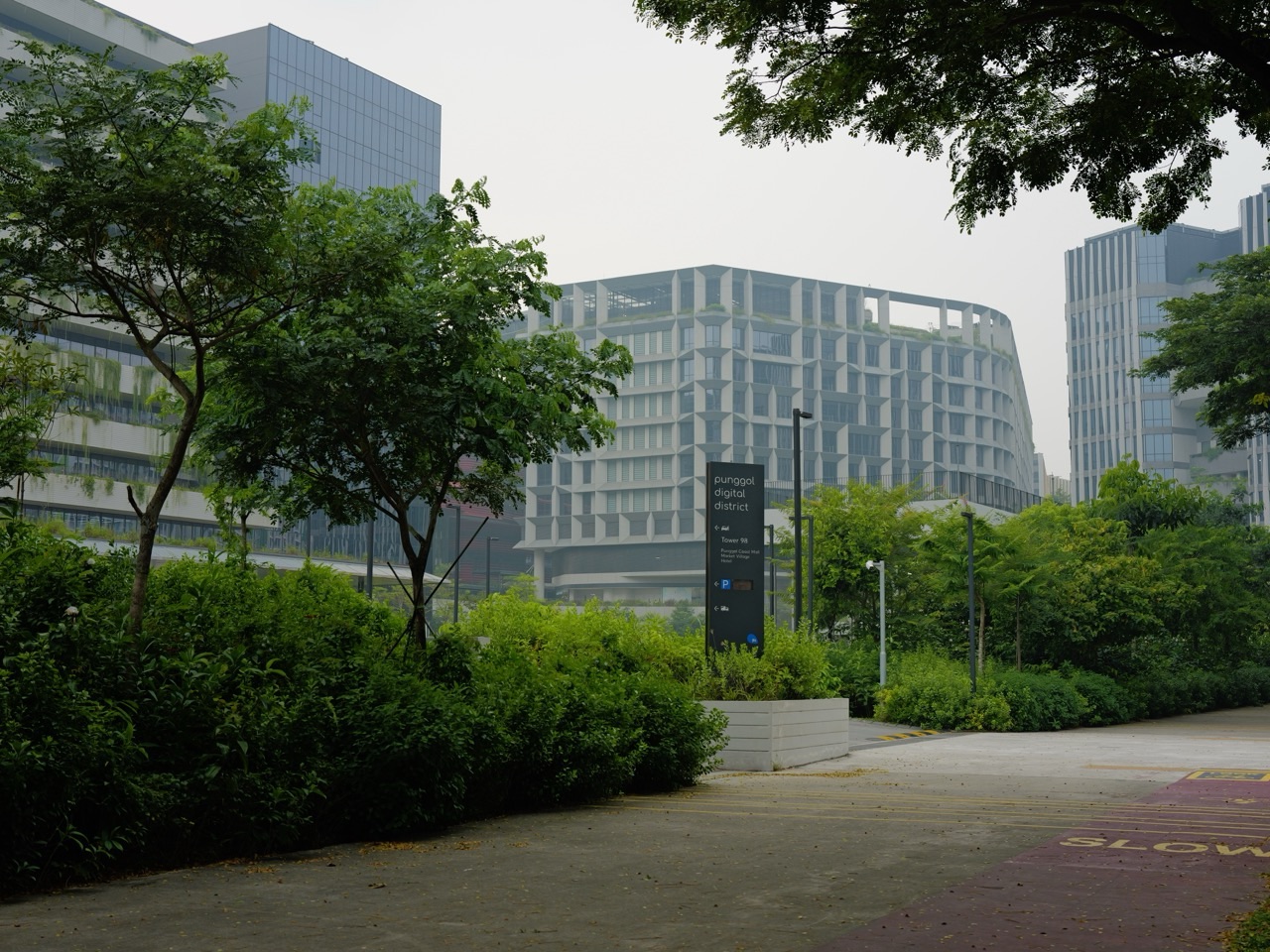
Why did Punggol Digital District plan to convert food scraps and horticultural waste into fertiliser, instead of sending all of that organic material away as general refuse? Food outlets, offices, university facilities and landscaped areas generate different kinds of waste. Some material cannot sensibly be avoided, but appropriately separated organic waste may be treated through managed processes that transform it into a useful soil-related product. JTC therefore made on-site organics recovery part of the district’s broader resource-efficiency design.
JTC’s 17 May 2024 Green Mark Platinum announcement describes an ambition to recycle 100% of Punggol Digital District’s food and horticultural waste into fertiliser using biodigesters, with an expected reduction of more than three tonnes of organic waste per day. JTC’s engineering partner Ramboll separately explains the concept as on-site treatment using composters and using the resulting compost as fertiliser for planting. These are published project objectives and design arrangements; the sources do not establish that exactly three tonnes were processed yesterday or that every tenant achieves 100% separation in November 2026. The value of the scheme lies in tracing what happens to an appropriate waste stream from collection through treatment and safe reuse.
- Where: Punggol Digital District, including JTC business-park developments and associated campus and commercial functions.
- Material: suitable food scraps and horticultural waste, kept separate from unsuitable general rubbish.
- Purpose: reduce the amount of organics needing ordinary waste disposal and recover an appropriate fertiliser or compost product.
- Design target: JTC’s 2024 announcement aimed for 100% recycling of food and horticulture waste through biodigesters, reducing over three tonnes of organic waste per day.
- Process: authorised collection, sorting, appropriate organic processing, quality control and managed use of the output.
- Different infrastructure: pneumatic waste conveyance and recycling chutes collect or transport waste; digesters or composters treat organics.
- Important qualification: a project target is not an audited current processing rate, and the equipment is not a public do-it-yourself compost bin.
- Learning goal: understand circular resource flows, contamination, biological decomposition, mass balance and the difference between plans and measured outcomes.
- Official references: JTC’s 2024 Green Mark District announcement and Ramboll’s PDD engineering account.
Why ordinary waste disposal has a resource cost
Food preparation and landscaping can produce material that is difficult to use for its original purpose. Discarded peelings, trimmings and leaves may still contain organic matter.
When mixed into general waste, these materials can be harder to recover and must be handled through the ordinary disposal chain. Singapore’s waste system remains important, but avoiding unnecessary disposal can offer resource and environmental benefits.
PDD’s concept asks whether some organic material can be processed appropriately near where it arises instead of treating everything as valueless rubbish.
Why an urban district produces several organic streams
A food outlet can create preparation scraps, while landscaping contractors produce leaves, grass clippings and suitable plant trimmings. These are different physical materials even though both are organic in origin.
The mix can change during the week with business activity and gardening schedules.
A useful recovery programme needs to identify the eligible inputs and manage them under suitable conditions rather than assume all materials behave the same way in treatment equipment.
Why the distinction between prevention and recycling matters
The best way to avoid unnecessary food waste is often to plan purchasing, portions and preparation so edible food is not discarded in the first place.
Treating unavoidable scraps can recover value, but it does not make wasteful buying or overproduction desirable.
A circular system should therefore address both preventing avoidable material and processing appropriate remaining organics. Recycling is not a licence to produce more food waste.
What JTC’s 100% ambition means
JTC’s 2024 press release says the district planned to recycle all food and horticultural waste into fertiliser using biodigesters.
This is a system-level target for the relevant waste categories, not a general claim that 100% of all building rubbish becomes fertiliser. Metal, plastics, glass and other materials follow different pathways.
The target should also be dated. A design objective is not a measured current performance result unless actual audits demonstrate it.
Why the three-tonne figure needs care
The announcement describes reducing over three tonnes of organic waste per day through the planned recovery system.
It indicates the anticipated scale of a district-level programme, not the daily weight of waste collected from one restaurant or the exact quantity of finished fertiliser produced.
Input waste mass, processing losses and output mass are different. A reader should not assume that three tonnes entering a digester results in three tonnes of finished compost.
Why the equipment is part of a wider Green Mark strategy
JTC presented PDD’s waste programme alongside energy efficiency, water conservation, landscape planning and public transport in its Green Mark Platinum District announcement.
That is meaningful because environmental performance involves multiple resource flows. Organic waste is only one of them.
A district can improve some waste practices while still needing electricity, transport and ongoing disposal of materials that cannot be appropriately recovered.
What a biodigester does in broad terms
A biodigester or organic-waste treatment system uses appropriate managed processes to break down eligible material. Specific technologies may use microorganisms, heat, mixing or other treatment conditions depending on the installed equipment.
JTC and its partners describe the PDD approach as converting suitable organics into compost or fertiliser.
A responsible explanation should not assume every unit uses the same biological method, retention time or additives as an unrelated machine in another JTC estate.
Why composting and anaerobic digestion are not identical
The word digester can describe different technologies, and ordinary composting generally involves controlled biological decomposition under suitable oxygen conditions.
Anaerobic digestion is a different process that occurs without oxygen and may produce biogas and digestate.
The PDD source describes composters and fertiliser output; it does not establish every technical feature of the actual installed units. Avoid inventing biogas generation merely because the word digester appears.
Why organic waste needs correct separation
A container of leftover food may also contain disposable packaging, plastic cutlery or other foreign materials. These contaminants can interfere with equipment or affect the quality of the recovered material.
Appropriate source separation helps a programme manage cleaner input streams.
The practical rule for tenants and staff comes from the specific operator’s posted instructions, not a blanket claim that every object with food on it belongs in the biodigester.
Why a recycling chute is a different device
JTC’s announcement identifies recycling chutes within buildings alongside the wider collection and organics-treatment programme.
A chute helps move material into an appropriate collection route. It does not necessarily transform the material into fertiliser inside the wall.
A digester performs treatment; a chute and associated waste system perform movement or collection. Their jobs are linked but are not interchangeable.
Why pneumatic waste pipes are not composters
PDD has an underground pneumatic waste conveyance system intended to centralise certain waste collection activities and reduce some heavy vehicle movements.
A vacuum-based system can move refuse through designated pipes; the organics recovery process is a separate stage with its own input rules.
The Northshore vacuum waste guide concerns another estate, while the PDD underground service guide explains the district’s physical infrastructure.
Why waste should not be mixed just because it travels underground
Different materials need different recovery or disposal routes. A pipe hidden from public view cannot automatically sort every material into the correct category.
The source of the waste and the separation system determine what processing is appropriate later.
A useful circular design keeps waste streams identifiable and manageable, rather than treating the underground network as a magical machine that recycles anything thrown into it.
Why food waste begins with people
Kitchen employees, cleaners and other authorised personnel influence whether suitable material enters the correct container.
Even advanced equipment may perform poorly if its input is contaminated or if staff have not been trained in the current sorting rules.
That makes human participation an essential part of an automated waste programme. Technology can help handle material after collection, but it cannot make source behaviour irrelevant.
Why kitchen routines are important
A busy food outlet has preparation, cooking, serving and cleaning tasks. Separating organics must fit into these routines without creating food-safety hazards.
An operator may need appropriate bins, collection timing and staff instructions for the eligible materials.
The specific procedure is a workplace management matter. A public guide should not invent PDD’s tenant collection times or recommend placing open waste containers near food preparation surfaces.
Why horticultural waste is a different material
Landscape maintenance produces suitable plant cuttings, grass or leaves rather than the same mixture as commercial food scraps.
Plant material may have different moisture, particle size and decomposition characteristics.
A professional treatment plan needs to consider the actual mix and equipment capability. The phrase food and horticultural waste identifies two categories, not proof that every garden clipping enters the machine unchanged.
Why woody branches can create problems
Some machines cannot process large hard branches or other bulky material in the same way as soft food scraps.
A waste management provider may need to prepare, size-reduce or reject particular inputs according to equipment specifications.
The local article should not encourage residents to feed random branches into a machine. Input eligibility is a technical and operational rule, not a guess based on whether the material came from a tree.
Why microorganisms are not the whole explanation
Microorganisms play important roles in biological decomposition. Under managed conditions, they help transform appropriate organic material.
But the finished product also depends on input composition, operating conditions, equipment and monitoring.
A catchy story that “microbes eat rubbish” can introduce the idea but is not a complete description of safe industrial organics recovery.
Why decomposition takes time
Organic material generally needs a suitable period and environment to break down. Different technologies can accelerate or manage this process.
JTC’s separate food-digester story in 2020 describes specific equipment at other estates processing some food waste within roughly 24 hours.
That figure should not be copied as the guaranteed processing time for PDD unless its actual equipment documentation confirms the same process. Technologies under one general label can differ.
Why the output needs an appropriate specification
A product described as compost or fertiliser is intended for plant-related use, but its quality depends on composition, contamination, stability and other relevant conditions.
The operator must ensure that recovered material is suitable for its actual approved use.
A resident should never assume every batch is safe for edible crops simply because a promotional article says the material becomes fertiliser. Safety requires appropriate standards and oversight.
Why fertiliser and soil are different
Fertiliser supplies nutrients or supports plant growth under its applicable formulation and use. Soil is a wider growing medium containing mineral and organic components, air, water and organisms.
Some recovered organics may be incorporated into soil management rather than replacing all soil.
This is a useful Science distinction: making a fertiliser product does not create a complete self-sustaining garden without water, light and suitable growing conditions.
Why rooftop farming relates to composting
PDD includes rooftop urban farming concepts and suitable landscaped areas as part of its district design.
Recovering appropriate organic material into a plant-related product can support a circular resource relationship, subject to the product’s quality and the receiving site’s needs.
The existence of both features does not prove every bag of recovered compost goes directly to one rooftop farm. Actual material flows require operator records.
Why a circular economy is not a perfect circle
A circular approach tries to retain value in materials instead of discarding them after one use.
Real processes still consume energy and may produce residue, losses or material that cannot be safely reused.
The appropriate claim is better resource recovery under managed conditions, not that every atom of food waste becomes useful fertiliser without any cost or by-product.
Why the mass of waste changes during treatment
Food scraps contain substantial water and different organic substances. Processing can alter moisture content and release gases or remove other fractions according to the technology.
The weight of finished product can therefore be lower than the mass of raw input.
A simple weight comparison must account for what enters and leaves the treatment process, rather than assume the mass recorded at collection equals the mass of compost delivered to a planter.
Why JTC’s 2020 food-digester story is useful but separate
JTC has documented food-waste treatment equipment deployed at industrial estates such as Bedok Food City and Gourmet East Kitchen.
That older programme demonstrates experience with organics recovery and practical tenant training, but the machines, inputs and performance at those other locations are not automatically identical to PDD’s.
The distinction helps avoid a common local-reporting mistake: using impressive technical results from one site as though they were measured at another.
Why ‘plug and play’ has limits
Some industrial equipment is designed to be installed and operated through relatively straightforward procedures when suitable infrastructure exists.
Even so, waste treatment requires correct inputs, occupational safety, maintenance and compliance with the relevant regulations.
A convenient equipment package does not remove the need for professional supervision or appropriate permits.
Why odour management matters
Food waste can produce unpleasant smells if left unmanaged or processed in unsuitable conditions.
A managed recovery system aims to address such operational issues, but the exact odour performance depends on design and maintenance.
A blanket claim that a district can never smell of waste would be unsupported. The relevant question is how the provider controls storage, movement and treatment under normal and abnormal conditions.
Why pests remain a practical concern
Exposed food waste can attract pests. Appropriate containers, separation and collection schedules are therefore important parts of a safe system.
JTC’s broader underground waste strategy explicitly aims to reduce some pest and odour issues associated with conventional waste collection.
That does not guarantee no pests can ever occur. Ordinary pest-prevention measures, cleaning and professional inspection remain necessary.
Why a treatment system may consume electricity
Motors, controls, mixing or other processes can require energy depending on the installed technology.
A programme that recovers useful material may still have operating energy and maintenance costs.
Environmental evaluation should compare the full system with realistic alternatives, not assume any machine called green uses no electricity.
Why transport savings should not be invented
On-site treatment can reduce some movements associated with taking organic waste elsewhere if the operational design actually accomplishes that.
But input collection, supplies, maintenance and distribution of finished material may still involve transportation.
The claimed benefit needs observed vehicle movement or lifecycle data, not simply the fact that a machine is inside the district.
Why collection data can help improve operations
JTC’s 2024 announcement includes monitoring waste disposal and recycling patterns to support resource deployment and encourage better recycling.
Data can show which streams are collected and when volumes change, allowing more informed planning of equipment and staff.
A dashboard still needs accurate measurements and definitions. It cannot produce useful conclusions if input categories are mixed or collection records are inconsistent.
Why weighing matters
Measuring collected material in kilograms or tonnes can establish how much enters the process over a defined period.
But a scale reading does not automatically measure contamination, the useful output’s quality or net environmental impact.
A proper evaluation uses several indicators rather than one impressive total.
Why a daily rate is not an annual guarantee
JTC’s three-tonne-per-day design statement suggests a possible scale of processing or diversion.
Multiplying that by 365 would create a hypothetical annual total under constant operation, not a verified yearly result. Actual activity can vary with tenancy, occupancy, maintenance and the relevant collection system.
Students should label such calculations as estimates with assumptions and avoid publishing them as audited facts.
Why the project could need different capacity as PDD grows
A developing district may gain more tenants, students, restaurants and landscaped areas over time. Organic waste volumes can change along with occupancy.
Equipment and collection arrangements should therefore be evaluated against actual demand rather than a static opening-day assumption.
A target planned for full development does not necessarily describe operations during an earlier phase.
Why compost needs plant demand to become useful
Even if suitable material is converted to a good fertiliser product, there must be a legitimate place for it to be used at an appropriate application rate.
Excessive fertiliser can create its own nutrient-management problems.
The goal is not to produce the maximum possible output without considering where it will go. A circular system must connect production to safe, useful demand.
Why a landscaping contractor remains important
A gardener must choose appropriate plants, growing media, watering and maintenance. Compost or fertiliser is one input into that work.
PDD’s landscape design includes green public areas and rooftop concepts, but different plantings may need different nutrients and procedures.
A professional application plan is more useful than indiscriminately spreading recovered material on every patch of ground.
Why the system does not make general waste disappear
Food and horticultural streams are only some of the materials generated in a district. Packaging, broken equipment, hazardous items and other waste follow separate pathways.
JTC’s sustainability programme includes both recycling infrastructure and organics processing.
A promise to recover eligible organics is not a promise that the whole district produces zero waste of every kind.
Why e-waste needs a separate route
Electrical equipment and batteries may contain materials and hazards that require specialist recycling or disposal.
They should not be placed in food-waste digesters simply because both categories appear in a sustainability brochure.
Correct segregation protects workers, equipment and downstream material quality.
Why the programme is relevant to food outlets
A hawker or food-service stall may create raw preparation waste and plate waste. The management of each stream depends on the operator’s waste arrangements and food-safety requirements.
PDD’s organics recovery target creates a system-level incentive to consider appropriate separation and collection.
It does not mean all stallholders must follow a procedure invented in this article. Their actual operating instructions remain authoritative.
Why businesses can learn from the shared system
A small food business may not be able to design an industrial-scale recovery facility alone.
A district-level programme can create opportunities for shared infrastructure and operating standards, subject to the actual agreements and costs.
The benefit lies in coordination rather than assuming the equipment is free to use or all tenants have identical waste arrangements.
Why a business park must consider workers
People who sort, collect and process waste need suitable protective equipment, training and safe working conditions.
An environmental system is not successful if it creates avoidable hazards for employees while producing a sustainability report.
Occupational responsibilities remain an essential part of the circularity programme.
Why maintenance matters after the opening
Digesters, composters, sensors and waste conveyance equipment can require cleaning, servicing and repair.
A machine may be temporarily unavailable, and appropriate fallback waste arrangements may be needed under the operator’s rules.
The existence of a system in a masterplan does not guarantee that every component runs uninterrupted throughout its life.
Why the published 2024 target should not be exaggerated
JTC used future-oriented language for the 100% recycling and more-than-three-tonnes-per-day ambition.
A responsible 2026 article should preserve that planning context unless newer audited data establish actual achieved results.
This is not a criticism of the programme. It recognises that design intentions, facilities brought online and measured outcomes are different stages.
Why a photograph of greenery cannot prove compost use
A planted roof or landscaped courtyard may appear healthy in a picture.
The image does not reveal which fertiliser, if any, was applied, or whether it came from PDD’s recovery process.
To claim a particular circular material pathway, a researcher needs credible operating records rather than visual inference.
Why this is an Education OS example of material flow
Students can trace an organic item from purchasing and use to separation, collection, transformation and an appropriate final use.
At each step, they identify what information and responsibility are needed.
The exercise teaches systems thinking: a material can have value at another stage, but only when quality, safety and demand make reuse appropriate.
A fictional mass-balance problem
Suppose an imaginary facility receives 100 kilograms of suitable food scraps and produces 15 kilograms of conditioned compost, with other mass leaving through permitted process pathways.
The input and output totals differ because processing can change water content and other fractions.
This is an illustrative problem, not a PDD production ratio. Students should not use it to calculate the real district’s daily fertiliser output.
A fictional source-separation error
A fictional tenant puts plastic forks and foil containers into the organics bin. A worker detects the contamination before treatment and routes the material through the correct approved process.
The exercise shows why segregation matters at the point of disposal.
The solution is not to run unknown plastics through the machine and hope the microbes solve the problem.
A fictional wrong-claim correction
A learner reads that JTC planned 100% food and horticultural waste recovery and writes that every PDD rubbish bin produces fertiliser today.
The class identifies the unsupported extensions: the source names only eligible organic categories and uses a design target, not a live universal measurement.
The corrected statement is both narrower and more reliable.
A fictional digestion-versus-transport diagram
Draw a food outlet, an authorised collection point, a waste-treatment unit, product testing and a suitable garden application.
Add a separate arrow for ordinary refuse that is not eligible for the organics system.
The diagram makes clear that moving waste, processing it and using its output are different tasks.
A fictional daily-rate exercise
Imagine a project with a target to treat three tonnes of appropriate organics per operating day. Students estimate a hypothetical weekly volume under five operating days.
The arithmetic gives fifteen tonnes in that invented case, not PDD’s actual weekly processing.
The important skill is to state the assumed number of days and distinguish a target from a measured result.
A fictional garden-use question
A gardener receives recovered material labelled as a fertiliser product but cannot verify its suitability for an edible garden.
The correct action is to check the supplier’s applicable specifications and approved use rather than spread it automatically.
The lesson is that the word recycled does not replace product quality and safety checks.
A fictional equipment-maintenance scenario
A treatment machine becomes unavailable during a busy period. Staff need to follow authorised contingency collection and handling arrangements.
The exercise shows why a district-level system must plan for exceptions rather than depend on perfect operation.
It deliberately avoids instructions for opening or repairing an industrial machine.
Teaching Guide: from food waste to useful planting material
Learning goal: explain why PDD planned organics recovery, distinguish collection from treatment and interpret design targets correctly.
Activity one: classify fictional food, horticultural and non-organic items using an operator-defined example list. Activity two: draw a material flow from source separation to appropriate treatment and output use.
Activity three: identify which stages could be contaminated or require human oversight. Activity four: explain why a daily input mass is not the same as finished product mass.
Activity five: compare the 2024 JTC target with what evidence would be needed for a current performance audit. Activity six: distinguish pneumatic transport from biological treatment.
Transfer test: evaluate an organics recovery proposal for a school canteen, identifying actual rules and controls needed before operating.
Frequently asked questions
Why does PDD plan to recover food waste? To reduce unnecessary disposal and create useful fertiliser-related material through managed organics processing.
What organic streams are named? Food and horticultural waste.
What is JTC’s 2024 target? Recycling 100% of eligible food and horticultural waste into fertiliser using biodigesters, with over three tonnes per day of organic diversion expected.
Is the target a measured 2026 result? Not on the basis of the cited planning announcement alone.
Do pneumatic pipes turn waste into compost? No. Conveyance and treatment are different functions.
Does all rubbish become fertiliser? No. The programme concerns eligible organic waste, not every category of refuse.
Is fertiliser the same as soil? No. Its role and appropriate use differ.
Can residents put random scraps into equipment? Follow the actual authorised waste-system instructions; do not access machinery.
Is this necessarily a biogas plant? The cited PDD material describes composting or fertiliser; do not infer an unverified biogas system.
Where is the official explanation? JTC’s Green Mark announcement and its engineering partner Ramboll’s PDD story.
Your Next Step
The primary references are JTC’s 17 May 2024 Green Mark Platinum District announcement, Ramboll’s PDD engineering account on JTC’s site and JTC’s explanation of its food digester experience at other industrial estates.
For complementary but non-identical systems, use Why Punggol | Digital District Puts Vehicle Servicing Beneath Public Streets and Why Punggol | Northshore Uses Vacuum Pipes to Move Rubbish.
The one idea to remember is that food and garden waste can become a useful resource only when it is separated correctly, processed safely and matched to a legitimate use. PDD’s circular-economy programme attempts to connect those steps at district scale, while actual results must be assessed with evidence.


