
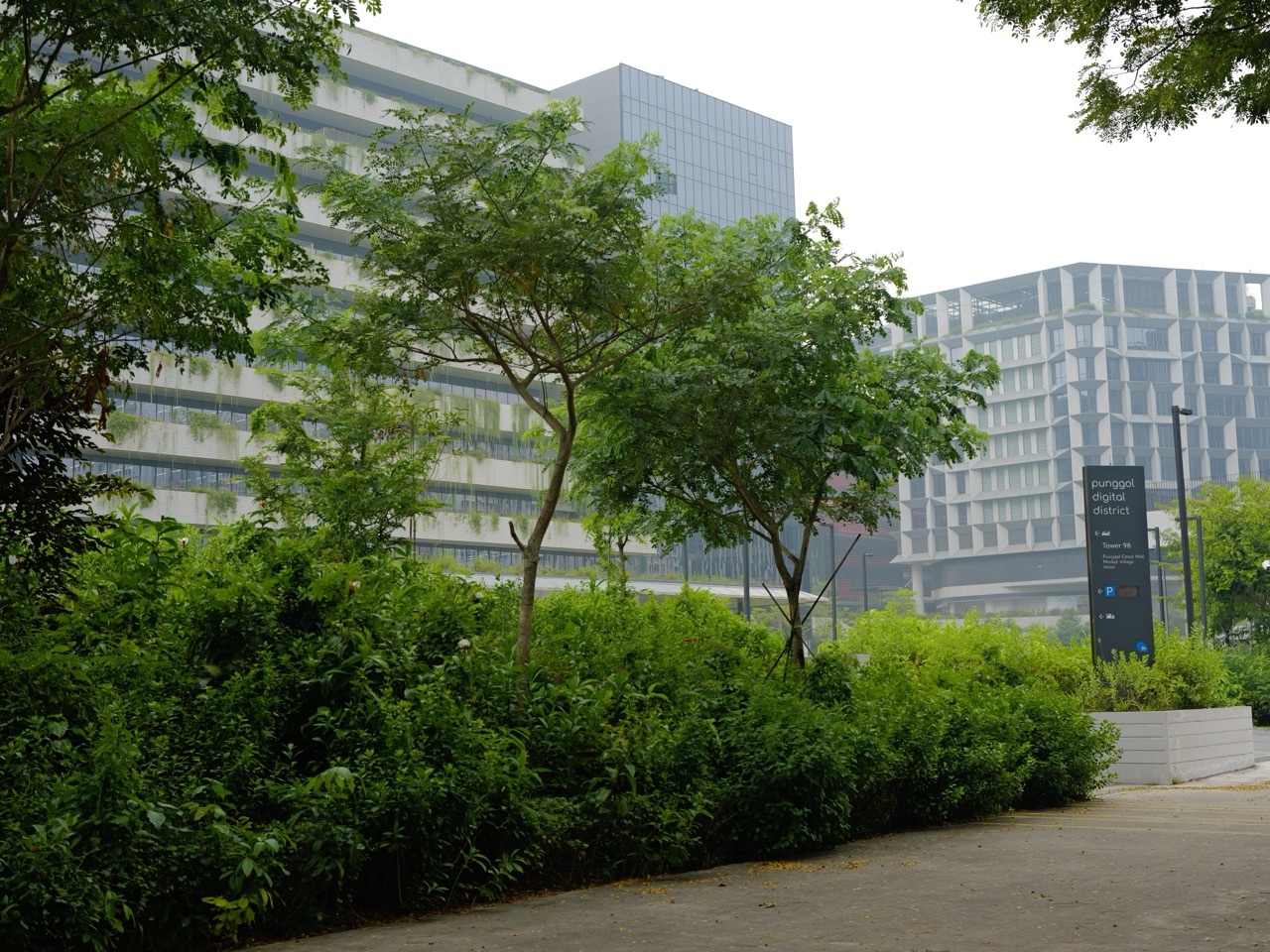
Why was Punggol Coast Bus Interchange built beside a North East Line MRT station and an adjoining mall rather than placed at a distant roadside terminal? The practical reason is that people rarely travel for the pleasure of changing vehicles. They take buses and trains because they need to reach work, lessons, shops or family activities. Combining important parts of the journey at one planned location can make those transfers more straightforward.
The Land Transport Authority opened Punggol Coast Bus Interchange on 29 June 2025 within Punggol Digital District. It is an Integrated Transport Hub linked with Punggol Coast MRT and Punggol Coast Mall. LTA identified connections to the Singapore Institute of Technology campus and JTC business-park facilities, while introducing features for families, seniors and commuters with mobility needs. The idea is not that every Punggol bus must stop there. It is that a growing northern district needs a convenient, connected place to change between relevant services.
- What: a working integrated bus interchange connected with Punggol Coast MRT and the adjoining mall.
- Opened: 29 June 2025; the MRT station itself had begun operations on 10 December 2024.
- Initial routes: Services 34 and 117/117M were extended to start from the new interchange in June 2025; current routes must be checked separately.
- Why integrated: to make suitable bus–rail transfers, everyday errands and access to the growing SIT and business district easier.
- Access features: barrier-free entrances, priority queue areas with seating, accessible toilets, baby care and a commuter care room.
- Important limit: one connected development does not make every transfer instantaneous or all services identical.
- Use today: confirm the live bus berth and service information before travelling.
Why ‘integrated’ means more than buildings close together
Two facilities can stand next to one another and still be inconvenient to use together. A road may separate them, entrances may face away from each other or the journey may require a long detour. Proximity is a map fact; integration is a design relationship between routes, entrances and services.
LTA defines Integrated Transport Hubs as developments with bus interchanges linked closely to MRT stations and adjoining buildings such as malls. The aim is to allow commuters to move between transport and everyday activities more conveniently. Read LTA’s official definition.
For Punggol Coast, the intended relationship is explicit: bus, North East Line rail and the mall form one connected development in the Digital District. That is more useful than merely counting the number of structures on the site.
Why the interchange came after the MRT station
Punggol Coast MRT opened for passenger service on 10 December 2024. The bus interchange began operating on 29 June 2025. The mall opened in 2025 as well. These are different milestones in an evolving district.
The staggered dates demonstrate why a large connected project may not begin every operation simultaneously. A railway, a bus interchange and a commercial building need different commissioning, operating and tenant-readiness arrangements.
An older article describing the future interchange as “opening soon” may have been accurate when published but is no longer current after June 2025. Chronology matters. Current commuter instructions should distinguish the long-established operations from announcements about later service amendments.
Why the bus interchange was placed in Punggol Digital District
The Digital District is not only an industrial park. It brings together the SIT Punggol campus, workplaces, commercial services and public transport. People arriving from other parts of Singapore need ways to complete the journey after the regional rail or bus portion.
LTA’s May 2025 opening announcement explicitly identifies improved connectivity to SIT and the JTC business parks. The interchange’s location therefore responds to actual and planned destinations rather than treating northern Punggol as merely an empty terminus on a map.
It would be misleading to claim that every student uses the same bus or that every business tenant occupies the district throughout the day. What matters is that varied destinations can generate different journeys, and a connected transport hub creates options for serving them.
Why a bus interchange still matters when MRT is nearby
An MRT train runs along a fixed corridor with widely spaced stations. A bus can serve different roads and destinations, including places not immediately next to a station. The two modes are not redundant just because their routes meet.
At Punggol Coast, the interchange connects suitable local and inter-town bus journeys with the North East Line. Passengers may use it for a transfer, or their journey may begin or end at the interchange itself.
The correct assessment is door-to-door usefulness. A commuter heading directly to an MRT-served destination may prefer rail; another may find a bus route more suitable because of where it begins or ends. Integration gives options instead of requiring one mode for everybody.
Why Services 34 and 117/117M moved in 2025
When the new interchange opened, LTA identified Services 34 and 117/117M as the first affected services. They were shifted from the existing Punggol Bus Interchange and their routes were extended to serve additional roads.
LTA described Service 34 as being extended through Punggol Central, Sumang Walk, Sumang Link and Punggol Way. Service 117/117M was extended via Punggol Place, Sentul Crescent and Sentul Walk. The original route announcement identifies these changes.
This is historical evidence of the interchange opening, not a claim that the initial route list is the complete set operating in November 2026. Public-transport services can change; always check the current operator’s official listing.
Why an extended route can serve people outside the new hub
A relocated interchange might otherwise help people at the new terminal while inconveniencing others. Extending a route through additional streets can create connections between the growing northern district and established neighbourhoods.
The 2025 changes illustrate that the operation involved both the terminal and the routes feeding it. A bus service is not just a vehicle assigned to one building; it is a path through many stops and transfer possibilities.
A student analysing the change should draw the old and new route conceptually, then check whether their comparison refers to actual 2025 service maps. The benefit or inconvenience to one household depends on its origin and destination, not simply on whether a new building opened.
Why Punggol Central’s interchange did not disappear
The opening of Punggol Coast did not mean that the original Punggol Bus Interchange suddenly ceased to be part of the transport network. LTA’s announcement describes some services being relocated while other services continued at their appropriate terminals.
This is a common mistake in new-town reporting. A second transport node can redistribute journeys without eliminating the role of the first. The older interchange remains relevant to Punggol town centre, the MRT/LRT interchange and nearby amenities.
A good travel guide must distinguish Punggol Bus Interchange from Punggol Coast Bus Interchange. The similar names identify different locations and should not be substituted in a meeting instruction.
Why station names alone can mislead
A visitor might type “Punggol interchange” into a message when intending to meet at the new coastal hub. Their friend could reasonably arrive near the town-centre bus interchange instead.
The correct instruction identifies the full bus-interchange name and the relevant MRT station. For Punggol Coast, it means the integrated development serving the North East Line’s northern terminal.
Before setting out, a family should verify the particular bus berth or meeting point on the current operator map. A good route plan includes a physical point at which the people will meet, not only a district-level name.
Why a transport hub is also a pedestrian design problem
Every bus passenger begins or ends the journey as a pedestrian. Even somebody who arrives by taxi has to move through walkways and entrances before reaching the right berth.
A hub needs circulation routes, legible signs, appropriate crossings and access between its different facilities. LTA’s description of the Punggol Coast interchange emphasises barrier-free entrances and priority arrangements. Those features support the basic journey rather than merely decorate it.
A safe interchange is therefore more than a row of bus platforms. It is an organised public space in which different users can move without unnecessary barriers and confusion.
Why a transfer is not just a change of vehicles
A transfer has several parts: alighting, locating the next service, moving through the built environment, checking its direction and boarding. A journey that looks like one point on a route diagram can require significant effort in practice.
Integrated development can reduce some travel friction, but it cannot guarantee zero walking time, no waiting or an available seat. The transfer’s real duration depends on the passenger, time and operating conditions.
A useful commuter estimate should add waiting and walking rather than assume that a bus connecting to an MRT station results in an instantaneous onward trip.
Why barrier-free access matters
A raised step, narrow turning area or poorly arranged entrance may be a minor inconvenience to one person and a major obstacle to another. Families with strollers, wheelchair users and people with mobility challenges therefore experience the same built environment differently.
LTA’s announcement identifies barrier-free access at all entrances, as well as facilities designed with these users in mind. That establishes a deliberate inclusion objective.
Yet access to a transport hub is only one stage of the journey. A person may still need to check the final destination’s lifts, crossings and entrances. The correct assessment is the whole route from origin to actual destination.
Why priority queue zones include seating
A queue can create physical demands beyond standing for a short time. Some passengers may need to sit, avoid crowds or board with additional assistance.
LTA says Punggol Coast has dedicated priority queue zones with seating at all boarding berths. These features help provide visible, designed support for passengers who may need it.
It would be wrong to present this as a licence to ignore the applicable queue or priority rules. The purpose is to make boarding more usable and orderly, with consideration for different passengers.
Why a baby care room is part of transport infrastructure
A parent travelling with a young child may need a suitable space for caregiving during a journey. The requirement is not a recreational extra; it can determine whether an outing or transfer is manageable.
LTA identifies a baby care room with touchless sliding-door arrangements at the interchange. A child-friendly transport system anticipates some needs that arise between boarding and arrival.
This does not mean all childcare, feeding or changing needs are automatically solved. Users should still follow facility rules and check availability. The larger lesson is that a complete service considers the person making the journey, not only the bus timetable.
Why the commuter care room is different from a lounge
Busy interchanges contain movement, announcements, bright signs and crowds. Some users may need a quieter or calmer space to manage sensory or other difficulties.
LTA lists a commuter care room at Punggol Coast for people who may require a quiet and calming environment. It is a specific accessibility feature rather than an ordinary waiting lounge everybody should occupy without regard for its purpose.
A public facility can be useful for some people precisely because others respect its intended use. Inclusive design combines a space with appropriate operating and behavioural expectations.
Why staff facilities affect the passenger experience
Buses and interchanges need people to operate, inspect, clean and manage them. A driver may need rest between shifts; operations staff need suitable working arrangements; cleaners need facilities and supplies.
LTA identifies dedicated staff rooms, a lounge, canteen, toilets and cleaning facilities in the Punggol Coast interchange. Their presence is not incidental. They support the workers who keep the service operating.
A hub designed only around the passenger-facing counters would overlook part of its real system. Good transport infrastructure provides conditions for the people delivering the service as well as those using it.
Why sustainable features belong in an interchange
Lighting, cooling and water use create operating costs in a public transport building. A well-designed interchange can reduce unnecessary energy or resource consumption while maintaining suitable comfort and access.
LTA listed LED lighting, energy-efficient air-conditioning, water-saving taps and motion-sensor lights among Punggol Coast’s environmental features. These are different mechanisms: one concerns efficient lighting equipment, another cooling, another water use and another responsive control.
They should not be compressed into the claim that a single “green AI” automatically makes all the facilities carbon neutral. Credible sustainability reporting identifies exactly what each feature does and how its performance would be measured.
Why being connected to a mall can help commuters
A commuter may need food, shopping or a household errand before returning home. A mall connected with a transport hub can let people combine these activities with a planned journey.
LTA explicitly identifies Punggol Coast Mall as an adjoining development. This is one reason integrated hubs differ from remote roadside terminals: suitable daily amenities become part of the walking network.
But a connected mall is a separate commercial operation. Its tenants, prices and opening hours can change independently of the buses and MRT. A mall link does not guarantee that every shop is open when the first morning bus arrives.
Why the university cannot be treated as the mall
Punggol Coast serves several nearby destinations, including SIT and JTC business parks. They have different purposes, access controls and operating schedules from retail facilities.
A student attending a class should identify the correct campus building, not simply follow a sign to the shopping mall. A visitor going to an office needs the proper entrance and access authorisation.
Integrated transport makes reaching the area easier. It does not erase the last step of navigation or turn private and institutional premises into unrestricted public corridors.
Why the first-and-last-mile journey still matters
An MRT and bus connection can shorten or simplify some journeys, but travel begins at a home and ends at an actual activity location. Walking from a bus stop to a building, finding a lift or crossing a road can remain significant.
Punggol’s paths may also change with construction, commercial opening stages and weather conditions. A fixed photograph cannot certify all future walking routes.
The right planning question is: how much effort does this person need to complete the whole journey? The hub’s value lies in reducing parts of that effort where possible, not promising that every origin and destination become equally convenient.
Why one hub can offer several modes without forcing a single route
Residents might compare a journey via Punggol Coast MRT, a bus using the new interchange, an LRT connection through the town centre or a combination of modes. The best choice depends on where the traveller begins and needs to finish.
A new interchange creates useful possibilities but does not make previous routes universally inferior. Someone living close to an existing LRT station may have a different best route from somebody working within the Digital District.
The network’s strength is choice. A family can compare alternatives using current travel information instead of assuming the newest infrastructure must be fastest in every circumstance.
Why bus berths need clear information
A bus interchange has multiple boarding points. A passenger arriving at the wrong berth may miss a service even while standing inside the correct building.
Clear berth signs, route information and staff assistance make the operational system understandable. The interchange’s physical layout only helps when people know where to go.
A good travel guide should never invent today’s berth numbers from an opening-day image. Service assignments can change. Check current operator information and the actual signs before boarding, especially when travelling with children.
Why a timetable is not the same as live arrival information
A scheduled departure describes the service plan. Actual bus arrival can be affected by traffic, weather, incidents and operational changes.
For time-sensitive travel, commuters should consult current information through the relevant transport operator and official tools. A historic description of the June 2025 launch is useful for understanding the change, not for guaranteeing an arrival at a specific minute today.
The distinction helps students understand that public systems use plans while also responding to real-world conditions. One number cannot answer every time-related question.
Why a transit hub does not solve every accessibility barrier
Providing a barrier-free entrance is important, but the full journey may still contain constraints at the receiving station, campus or building.
A parent with a stroller may need to locate an available lift. A person with a wheelchair may need to check the accessible route at the final destination. A traveller requiring a quiet space may also need support after leaving the interchange.
Inclusive planning is a chain of access. A strong link can make the system better, but cannot guarantee every other link is suitable without verification.
Why a new interchange needs operational learning
LTA’s May 2025 announcement explicitly acknowledged that operators would need time to familiarise themselves with the new interchange and said service performance would be monitored.
That is a realistic part of commissioning. New layouts, bus movements and passenger flows may require adjustments as the facility enters everyday use.
A new opening is not proof that all possible operating decisions were known in advance. Monitoring actual experience provides information that can improve the service without implying that the original plan was worthless.
Why mixed land uses affect bus demand
University teaching schedules, office hours, shopping visits and evening activities can generate different trip patterns. A transport hub in a mixed-use district may therefore serve different groups at different times.
However, the exact peak-load profile requires observed ridership and schedule information. A general description should not invent the number of people boarding after a particular lecture or office shift.
A student can understand the principle by drawing hypothetical demand curves for two nearby facilities. Their peaks may overlap or differ, creating a combined demand profile that planners need to study.
Why the opening date must not be confused with later service changes
Punggol Coast Bus Interchange opened on 29 June 2025. LTA’s announcement said further routes and enhancements would be introduced progressively as the district developed.
That means the opening day’s initial routes and a later current service list need not be identical. A newly announced route in 2026 would be a subsequent service development, not evidence that the interchange itself opened again.
Use absolute dates and check original sources. It is possible for an old news report to be correct about the first day and incomplete as a guide to present services.
Why a hub is not automatically the fastest way to Changi Airport
Service 34 is one of the bus routes associated with the 2025 relocation, with travel links towards Changi Airport and other destinations.
But a traveller’s fastest journey depends on origin, time, traffic, transfers and walking. A route having a particular destination does not establish that it is best for every passenger in Punggol.
A current journey comparison should use up-to-date service information. This article explains why the interchange exists, not a live ranking of airport routes.
Why passenger comfort needs more than air-conditioning
LTA’s integrated-hub design includes lighting, accessible toilets, priority seating and a commuter care room. These address needs different from the temperature of the waiting area.
A family may value a practical baby care room, while an older passenger may need seating near the correct berth. Someone unfamiliar with Punggol might primarily need clear wayfinding.
A successful facility therefore supports multiple tasks. One impressive feature cannot substitute for every other aspect of the journey.
A worked example: the student with a lecture in Punggol
In a fictional example, a student arrives by the North East Line and has an appointment in a particular SIT building. Their friend says, “Just go to Punggol Coast. Everything is connected.”
The advice identifies a useful transport node but not the complete route. The student checks the correct campus block and the actual walking connection before travelling. They distinguish the mall from the university entrance and allow time for a first visit.
The learning is that a connected interchange simplifies a section of the journey without eliminating the need for destination-specific navigation.
A worked example: the wrong bus interchange
A family agrees to meet at “Punggol Bus Interchange” for a planned trip. One person goes to the long-established town-centre interchange; another goes to Punggol Coast.
Both have interpreted an ambiguous message in a plausible way. The fix is to use the full facility name, route and meeting point, not to accuse one person of failing to understand the town.
This is an English communication lesson hiding inside a transport problem: precise nouns matter when similar places have different locations.
A worked example: two commuters with different mobility needs
A fictional student can navigate a route with stairs, while a relative using a wheelchair needs step-free access and more time for transfers.
They should not assume that the same quickest route is suitable for both. The family checks the actual accessible path and facilities, including the intended final destination.
The lesson is that transport efficiency should be considered for the person making the trip, not only for an idealised traveller with no constraints.
A worked example: combine an errand with a commute
A commuter leaves the office and wants to collect an item in the adjoining mall before taking a bus. The integrated development may make the combination convenient.
But the commuter must check the shop’s operating hours, the bus route and whether the relevant walking link is open. The existence of the mall does not guarantee the intended store is available or that the next bus arrives immediately.
The realistic outcome is improved choice, not a magical schedule in which every service is perfectly aligned.
A Mathematics exercise on transfer time
Imagine a fictional trip: a six-minute walk from a building to the MRT, a four-minute wait, a twelve-minute train journey and a five-minute onward walk. The complete trip is 27 minutes under those assumptions.
Now imagine an integrated connection reduces the first walk by three minutes but the wait increases by two. The net improvement is one minute, not three. The calculation shows why individual component benefits must be evaluated within the full trip.
These are invented classroom values, not Punggol Coast journey estimates. A real trip requires the current route and observed service conditions.
Teaching Guide: map an integrated bus and MRT journey
Draw a simple map with two residential precincts, a university, a business park, a shopping centre and one bus–rail interchange. Ask which journeys require a transfer and which can begin or end at the hub.
Then move the hub to a distant location and discuss the extra walking required. The goal is not to prove one site mathematically optimal; it is to show why integrating transport with actual destinations changes accessibility.
Older students can add hypothetical demand at different times of day to consider why the same hub may serve several kinds of trips.
Frequently asked questions
When did Punggol Coast Bus Interchange open? LTA says passenger operation began on 29 June 2025.
Is it the same as Punggol Bus Interchange? No. The older town-centre interchange and the Punggol Coast facility are distinct transport nodes.
What is an Integrated Transport Hub? LTA describes a bus interchange connected with MRT and other adjoining development so transfers and errands can be more convenient.
Which services moved first? Services 34 and 117/117M were relocated and extended at the June 2025 opening. The present complete list must be verified.
Is Punggol Coast MRT open? Yes. It began passenger service in December 2024, before the new bus interchange.
Are there priority seating areas? LTA identifies priority queue zones with seats at all boarding berths.
What is a commuter care room? A designated calmer space for users who may require a quiet environment, subject to the site’s current arrangements.
Does the mall connection mean every shop shares interchange opening hours? No. Commercial tenants follow their own actual operations.
Is the interchange best for every SIT class? No. Check the exact building and full journey before choosing the route.
How do I confirm the correct berth? Use current operator information and signs at the interchange, not an opening-day screenshot.
Your next step
A Punggol resident can begin by identifying one actual regular journey and drawing it from door to destination. Mark the bus, rail, walking and any errand stages separately. A shorter transfer is useful when it reduces the effort of the whole trip.
For official details, start with LTA’s interchange opening announcement and its Integrated Transport Hub overview. For a particular affected route, SBS Transit’s 117/117M extension notice provides a dated example.
The existing Punggol bus guide for Service 34 handles a different need: the particular destinations of one bus. This article explains why the hub connects bus, rail and mall in one place. The one idea to remember is that good integration makes separate journeys easier to join while respecting the distinct functions and constraints of each service.


