
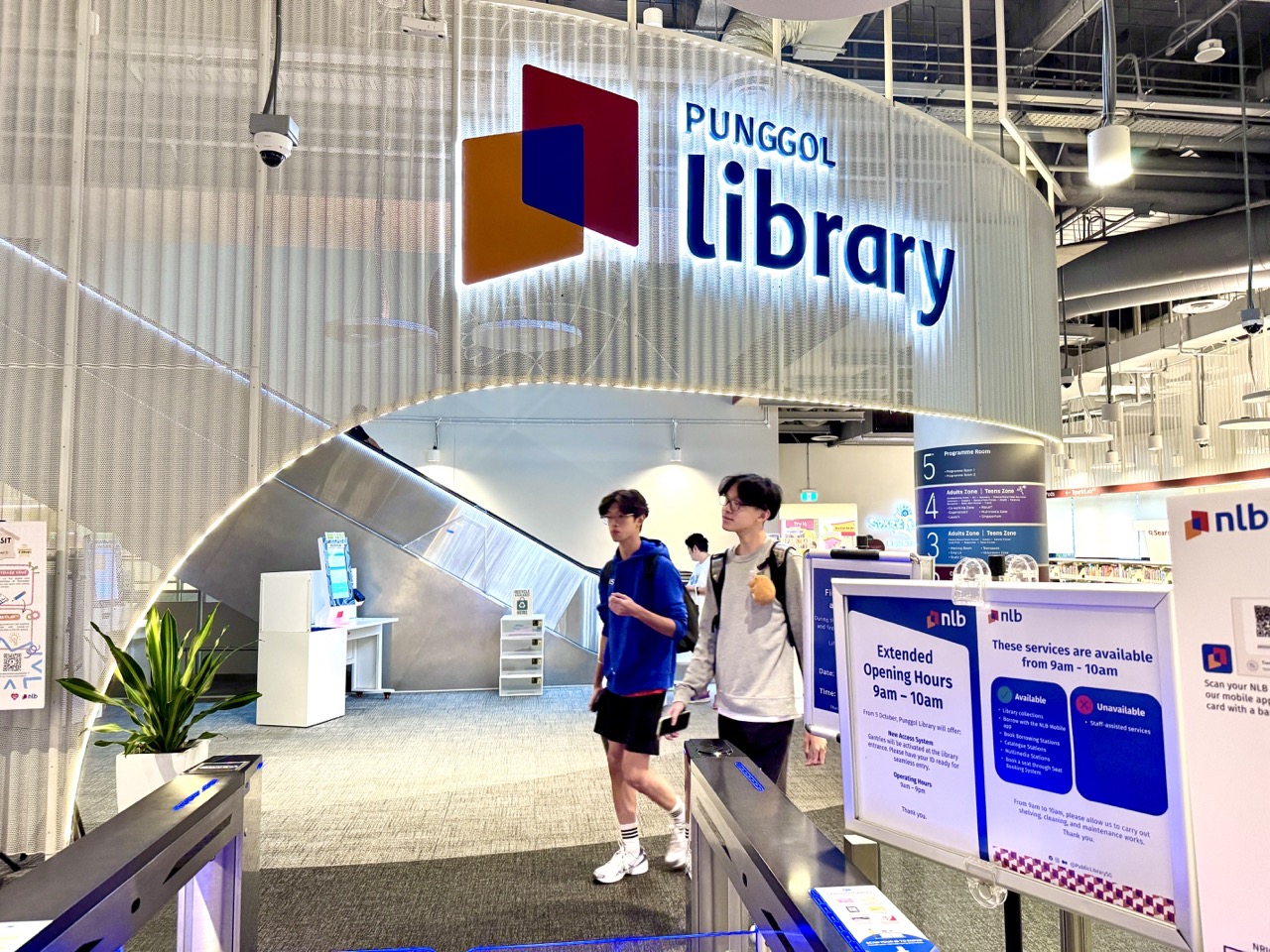
What to do in Punggol when a child wants a Chinese story at a comfortable reading level, a grandparent prefers a Malay novel, or someone in the family hopes to find a Tamil book without searching every shelf? Start with the National Library Board’s OneSearch portal. Search for a topic or title, use the Language filter to narrow the results, then open the actual record to confirm the language, format, reading suitability and branch availability. The language of a book’s cover or an online keyword is not sufficient proof of what is inside.
NLB’s official OneSearch FAQ confirms that searches can be refined by language as well as type, subject, publisher and other categories after a set of results is returned. It also explains that the same portal can find physical books, eBooks, audio-visual materials, archive records and other resources, and that access to some licensed digital collections requires an NLB account. Punggol Regional Library at One Punggol is a useful local destination, but a catalogue result anywhere in the national collection is not a promise that the book is on its shelves today.
**At a glance:** • Search a real topic or known title on OneSearch. • Narrow by the appropriate language rather than guessing from the cover. • Check the exact edition and physical or digital format. • Confirm reading level, publisher and item availability. • Use the correct NLB member service for borrowing or reservations. • Ask the intended reader whether the book actually suits their interests.
The six-step Mother Tongue book search
- Choose the reader and topic
- Open NLB OneSearch and search
- Use the correct language and item-type filters
- Check the exact edition, level and format
- Verify physical or digital access conditions
- Let the reader select the suitable title
The question is the book the reader wants
Mother Tongue reading improves when the selected material is relevant to the person, not simply because a book carries the language the school teaches. A child might enjoy an illustrated mystery, while a grandparent might prefer history or a familiar writer. Decide on the topic, length and intended reader before trying the search filters.
A language filter can narrow a catalogue, but it cannot establish that every remaining title will be enjoyable or suitable. A family should treat the results as candidates and ask the reader what they would genuinely like to explore. A short interesting story can be a better starting point than an impressive-looking difficult volume.
OneSearch is a discovery tool, not a branch shelf
The NLB OneSearch FAQ explains that the service searches library, archive and museum-linked materials across several repositories. The results can include physical items, digitised works and other resources whose access and borrowing rules differ.
When a family searches from Punggol, it should not treat all results as books waiting at Punggol Regional Library. Open the individual catalogue entry, examine its source and format and then check the relevant branch or digital access. The search result’s existence and the item’s present location are distinct facts.
Begin with a broad search term
A beginner may not know the full title in Chinese, Malay or Tamil. Searching an ordinary topic can produce several candidates, especially where a catalogue includes multilingual material or translated editions. Start with words you understand and then inspect the language information in the records.
Do not invent a translated title merely because an English phrase looks similar to a familiar book. The same topic can appear in many works. If the search is too broad, use the actual language filter and other available refinements instead of guessing what the library has.
Use the language refinement after results appear
NLB’s official FAQ says the refine-search tool appears on a result list and offers filters including language, type, subject and publisher. After choosing a filter, it becomes part of the active search; it may be removed when the reader wants to broaden the results.
The exact interface may change, so this article does not promise that a particular button remains at a permanent pixel location. The reliable method is to search first, examine the available filter group and select the intended language. If no useful option appears, try a different query or ask library staff.
Chinese, Malay and Tamil are different language choices
Singapore’s Mother Tongue learning environment includes Chinese, Malay and Tamil, among other languages and educational arrangements. A family may use OneSearch to explore materials in the language actually preferred by a reader, rather than treating every non-English result as one category.
Do not select the language merely by a surname or presumed ethnicity. Ask the person which language and script they want. Some readers are bilingual or prefer a particular mix of formats. The catalogue helps follow their choice, not assign an identity to them.
The reader may choose a different language for each task
A child may prefer an English nonfiction explanation when exploring science while reading fiction in Chinese, Malay or Tamil. A grandparent might choose a different language for poetry than for technology instructions. There is no requirement that one catalogue filter serve every reading purpose.
Ask which language makes the particular material useful. The family could search for two related books in different languages and compare them without claiming that one version is inherently easier or more authentic. The real learning question is how each helps the reader understand and enjoy the subject.
Search by author when the title is uncertain
The OneSearch advanced options include fields such as Title, Creator and Subject. A known author can be a more stable discovery clue than a remembered partial book title. Families can start with a writer’s actual name and then refine by language or item type.
Check the spelling of the author’s name as recorded in the catalogue. Transliterations can vary, and a family nickname may not be the published creator name. Do not assume a first result is the desired writer solely because a common name appears.
Search by a genuine exact phrase
OneSearch supports quotation marks around an exact phrase, according to its FAQ. This can help with a known title or distinctive phrase, particularly when unquoted words return many unrelated records. Exact searching narrows rather than expands the result set.
An exact phrase can also miss a catalogue entry with different punctuation, transliteration or translation. If no result appears, remove the quotation marks or try a shorter verified phrase. No match is a search limitation, not proof that the book has never existed.
Use Boolean OR thoughtfully
NLB’s search guide permits OR to broaden queries. A reader could use two authentic topic synonyms or spelling variants where their meaning is genuinely appropriate. This can help when an author or place appears under different catalogue terminology.
Do not insert random translations to inflate the result count. Keep the query understandable and record which words produced useful material. An oversized search with unrelated terms makes it harder for the family to recognise a suitable title.
Use NOT only when the exclusion is justified
The official FAQ also documents NOT for narrowing results. This may help exclude a genuinely unwanted topic from a large collection. However, removing a broad word can unintentionally hide books that discuss more than one subject.
Begin with the positive topic and language filter before excluding material. A family seeking introductory stories should not delete all books containing a school-related term merely because it appears in one irrelevant result. Filters work best when guided by a clear reading need.
Language metadata may need checking
A result’s language field helps classify the record, but real publications can contain bilingual text, parallel translations or introductions in a second language. A catalogue’s summary may also be written in English while the book itself is not.
Read the fuller record and any preview or sample legitimately provided. Do not claim the whole book is in one language just because its description uses that language. When a bilingual format matters, look for explicit supporting information and ask the library if the details remain unclear.
A bilingual book is a distinct learning option
Parallel-text or bilingual books may let a learner compare vocabulary and narrative across languages, but layouts vary. Some provide a full translation on the opposite page, while others include only selected glosses or explanations. A bilingual label should not be taken as a universal design specification.
Ask whether the reader wants support in a second language or uninterrupted reading in the first. Both are legitimate choices. The family can compare formats without declaring that bilingual resources always reduce effort or guarantee examination improvement.
Physical book and eBook are not interchangeable entries
NLB OneSearch includes physical library catalogue records and selected eBook resources. A title available digitally may not have a physical copy at Punggol, while a print edition may not exist as a licensed downloadable item.
Check the format field before planning a journey. A family cannot collect an eBook from a physical shelf, and an ordinary physical reservation does not automatically create a digital loan. Understanding the format prevents a frustrating trip.
A language filter does not guarantee an eBook
OneSearch can search multiple eBook databases, but access depends on the particular source and licence. Its FAQ notes that some digital collections require membership login and that not every database is included in the same search.
Do not tell a child that any print book found in OneSearch must also be available in Libby. Open the actual record’s borrowing or access path and read its conditions. If the family’s preferred digital format is absent, a different title may be more realistic.
Libby and OneSearch play different roles
The NLB eBooks guidance describes digital borrowing through supported services and membership arrangements. OneSearch helps discover material, while a designated eBook provider or app may control digital loans and holds.
Do not assume that a digital record is DRM-free or that it can be copied into any reader. Use the legitimate supported app and current lending terms. Language choice and digital access must both match the reader’s actual needs.
Some eResources require a login
OneSearch says most searches work without login, but access to subscribed eBook and eJournal databases is normally restricted to NLB members. A family can therefore discover a title yet still need a legitimate library account to open or borrow it.
Do not share somebody else’s membership password to bypass a licence. A parent can help a child use the appropriate authorised membership arrangement. The account’s actual privileges and privacy should be respected.
Punggol Regional Library is the local visit option
The NLB Punggol Regional Library page identifies the branch at One Punggol. Families can plan a visit after checking the physical title’s current location and whether it can be borrowed or accessed there.
Do not assume a result held by another branch will be waiting at Punggol. Borrowing availability can change between the search and the visit. A short independent browse is still worthwhile when the exact book is not essential, but a special collection trip requires stronger confirmation.
Availability may change after the search
A physical book can move from available to on loan while a family is planning travel. The catalogue records the collection but does not freeze an item for the first person who views the page. Reservations and holds are separate actions with their own terms.
If the book is essential, review NLB’s actual reservation option and confirmation process. Our Punggol library reservation guide addresses that separate workflow. Do not tell the family to collect before a genuine ready notice has been issued.
A call number helps after the title is chosen
A physical catalogue record may display a shelf or classification reference useful for locating the book. The family should distinguish this identifier from the title, ISBN and language metadata. Each performs a different purpose.
An existing guide, How to Find a Book at Punggol Library, covers catalogue and call-number navigation. This article’s distinct job is selecting the right language and edition before attempting the shelf search.
An ISBN identifies an edition, not a language preference
An International Standard Book Number distinguishes a particular publisher’s edition or format, but it does not by itself explain whether the language suits the reader. Two translations of a story can have different ISBNs, and a different binding may also receive a distinct identifier.
Check the title, language, edition, publisher and format together. A barcode-like number on a cover is useful for matching, but it is not a substitute for opening the catalogue record. Never guess which edition is in stock from a similar cover.
The publication year can change what is suitable
Older and newer editions may use different vocabulary, typefaces, illustrations or updated factual information. A classic story’s older translation may still be valuable, but a current science reference requires an additional accuracy check.
Do not treat the newest publication year as automatically best for every reading goal. A family’s interest in traditional tales or historical language can justify an older edition. State the goal before choosing on the basis of date.
The publisher field can help distinguish versions
A popular title may be issued by different publishers, including versions adapted for young readers. OneSearch’s refinements can include publisher details, and fuller records may identify the actual edition being borrowed.
Look for the intended publisher and level where they matter. A child who wants an illustrated beginner edition should not be handed an unabridged advanced translation simply because both share the same general story title.
A translated title can differ from the English title
Book titles do not always translate word for word. The local edition may use a different phrase for marketing, cultural context or literary style. A family can search by author or subject when the translated title is unknown.
Do not invent a supposedly official Chinese, Malay or Tamil title from a machine translation and present it as the book’s publication name. Use the library record’s actual wording, and note any uncertainty as a research question.
Original-language works can differ from translations
A reader may want a story originally written in the chosen language rather than a translated international bestseller. That is a meaningful preference that a basic Language filter alone may not identify. Author background, original publication details and catalogue notes may help.
Ask which experience matters: local voices, vocabulary practice, familiar characters or a parallel-text comparison. A suitable search may use subject or creator information as well as language. More filtered results do not necessarily mean a better book.
A summary is a clue, not the entire text
Catalogue annotations are designed for discovery. They may give a plot summary or subject description that is broader than the actual content or written for an adult selecting for a child. Reading the summary can help narrow options, but it is not a replacement for checking suitability.
Where an authorised preview or table of contents is available, use it. Do not copy the entire protected book into an unrelated online tool to judge level. The family can make a respectful reading decision with the information legitimately provided.
The title’s language is not the same as the reader’s proficiency
A Chinese-language book intended for advanced adults and one designed for a beginner can both be correctly identified as Chinese. The same holds for Malay and Tamil. Language metadata cannot tell the family which grammar, vocabulary or reading pace is appropriate.
Look for age information, level indicators, illustrations, length and sample passages where available. Ask the reader what feels comfortable. A person who needs more support should not be made to feel inferior because an adult-sized novel is difficult.
Children’s interests can guide the search
A child who loves animals may be more willing to attempt Mother Tongue reading with a short animal story than an unrelated formal text. A teenager fascinated by engineering may prefer an age-appropriate nonfiction book. Interest supplies motivation, not a guarantee of fluency.
Begin with a known subject and filter for language. Then inspect two or three candidate books rather than choose the first title returned. The child should help decide. A family reading plan works better when it is not experienced as another forced assessment.
Older relatives can help choose vocabulary and context
A grandparent may recognise a familiar author, script style or traditional story that a younger reader does not. That insight can guide an enjoyable intergenerational choice, especially where the household wants to discuss a shared topic in a Mother Tongue.
Do not require the older relative to teach a formal lesson or translate every paragraph. Ask whether they want to read aloud, tell their own memories or simply enjoy the material. A family library visit can be valuable without a fixed educational performance target.
A teenager can compare two language versions
An older learner can choose a short permitted excerpt and discuss how a translated version expresses a name, joke or cultural idea differently. The goal is noticing choices, not proving the two languages have identical word order.
Use only legitimately available extracts and keep the discussion private when necessary. A comparison may reveal that a phrase cannot be translated mechanically. Do not treat a machine-produced line as the official text of a published edition.
Language selection should respect identity
Many Singaporeans use more than one language and may not read the language someone assumes from their name or appearance. The library’s catalogue lets the person choose, while the family supports rather than imposes that choice.
Ask ‘Which language would you like to read for this topic?’ instead of declaring what the person should know. A reader can also change the preference for a different book. Respectful selection is part of an inclusive learning activity.
Children can start with pictures and a short passage
A younger learner may benefit from a picture book with relatively little text, repeated words and a familiar story pattern. The catalogue’s age and format clues may help, but opening the actual item or a legitimate preview gives a clearer sense of the experience.
Do not select a title solely because its cover shows a cartoon character. Ask the child to explain one page or word they recognise after reading. The goal is comprehension and interest, not finishing an arbitrary number of pages.
A book is not automatically suitable because it is bilingual
Two-language editions can support vocabulary but also become visually crowded or depend on translation quality. Some children may find alternating scripts confusing, while others enjoy comparing them. Suitability is individual.
Try a short section with the actual reader. If the format does not work, consider a different layout or a single-language story. There is no need to insist that one approach is the correct Singapore method for every child.
Mother Tongue learning is not only exam preparation
A family may be looking for a school text, but stories, comics, poetry, everyday nonfiction and culturally relevant material can also make language practice meaningful. The catalogue is a route to reading beyond a narrow vocabulary list.
Do not promise a certain PSLE or Secondary examination grade from borrowing one title. A short repeated reading habit can support exposure and interest, while actual proficiency depends on broader learning and the individual’s needs.
A short bilingual family book conversation
One person can read or summarise a few pages and another can ask what happened, where it happened and which word was unfamiliar. The questions should be friendly enough to invite explanation, not function as a surprise test.
Keep the conversation anchored in the real text. Do not invent events from a cover illustration and mark them as comprehension answers. A reader who says they are unsure can return to the passage or ask for help.
OneSearch includes more than books
Search results can include oral histories, images, newspapers and museum materials. That breadth is useful for some projects but can overwhelm a family looking for a physical storybook. The Content Type filter helps distinguish relevant categories.
Select Books when that is the actual goal, and then refine by language and format where available. Do not assume every result with a relevant language is an item that can be checked out from a public-library shelf.
Audio material may be useful for another reader
A person who prefers listening might look for an audiobook or other authorised audio resource in the chosen language. NLB’s catalogue includes audio-visual material and some digital reading options, subject to actual licensing and collection availability.
Check whether the record is an audiobook, video, CD or another format. Do not promise every title is available as a narrated copy, and do not use copyright-protected recordings in ways their terms prohibit.
An unavailable physical title need not end the activity
An exact book might be on loan, held at another branch or available only in another format. The family can choose an alternate title with a similar topic and language rather than travel unnecessarily for a specific edition.
Where the exact text is required for a lesson, follow the NLB reservation and collection process and wait for confirmation. A search result is not a collection appointment. Keep the two workflows distinct.
Do not borrow using someone else’s account without permission
NLB membership and loan conditions apply to the actual borrower. A parent may use an authorised child’s account arrangement, but should not casually share passwords or identify details with a stranger offering to collect books.
Use legitimate NLB Mobile and myLibrary channels. A book’s language is not a reason to bypass account security. The household can seek staff help if a digital login or item record is confusing.
Ask a Librarian is a documented help option
NLB’s OneSearch FAQ describes Ask a Librarian for questions about account services, programme facilities, reading advice and certain research enquiries. This is a useful next step when the family knows the topic but cannot find an appropriate book.
Ask a narrow question with the intended language and reader’s approximate interests, without sharing unnecessary personal data. The librarian can point towards collection options, but a title suggested by staff may still have changing stock or suitability.
Search filters may not have the same values every time
The OneSearch result interface can show different refinement counts depending on the query and underlying collection. A language may appear with very few hits for one subject and many for another. The number beside a filter describes the current result set, not the total number of books in that language held by NLB.
Do not publish a permanent claim that a particular query returns exactly a certain number of Malay or Tamil books. The data can change and may include several collections. Use the counts only as a navigation clue.
No result is not proof that no suitable book exists
A search may fail because of spelling, script differences, incomplete records, the chosen query’s wording or a filter that has narrowed too far. NLB explicitly recommends using refinements and search operators to adjust the result set.
Try a simpler subject, remove one filter, change to a known author or ask for help. Avoid telling a child that the library has no books in their preferred language based on a single unsuccessful search.
The language filter should be checked after changing the query
When a new keyword is entered, an earlier filter may remain active or be removed depending on interface behaviour. The family should inspect the visible active filters before interpreting the results.
A book list containing only one language may be the intended outcome or the unintended result of an old setting. Confirm the selected filter and current search query instead of assuming the catalogue made a mistake.
A library map does not decide reading suitability
A shelf diagram can help find an item after its physical location is known, but it cannot tell whether a book is interesting, too difficult or available to borrow. The reader’s preferences and the actual record answer those separate questions.
Use each piece of information for its purpose. OneSearch language and format fields guide selection, library locations guide collection, and discussion guides learning. A family that separates these tasks is less likely to waste time.
A Primary-level vocabulary exercise
A child can find a book in a chosen language, identify the title and one repeated word, then explain the word in context. The adult can support pronunciation or meaning where competent and use reliable sources for unfamiliar terms.
Do not turn the whole story into a list of words to memorise before the child can enjoy it. A simple comprehension conversation can reveal whether the chosen level is appropriate. If the text is too hard, selecting another edition is sensible.
A Secondary-level bibliography exercise
A teenager can record the title, author, publisher, publication year, language, format and ISBN of the chosen edition. Those fields help distinguish versions when citing or discussing a text.
Do not copy details from another edition merely because the titles look similar. Open the actual record and keep the citation accurate. A carefully matched bibliography is more valuable than a complicated list of uncertain book names.
A family comparing printed and digital editions
Imagine one story appears as a physical Chinese edition and a digital English edition. A family wants to support Chinese reading, so it does not assume the digital result meets the goal just because the story title matches.
The parent checks language and format separately and selects an appropriate available choice. This is a hypothetical catalogue exercise, not a statement that a particular real title is presently in stock.
A Malay reading project
A reader is interested in local history and prefers Malay-language material. They search by the subject, apply the Malay language refinement and examine the resulting titles for level, purpose and format.
They do not assume the first item is a children’s book or that every record is available at Punggol Regional Library. The family can shortlist several candidates and choose an appropriate item based on actual catalogue information.
A Tamil family storytelling project
A parent wants a Tamil story to read with a young child. The family searches a simple topic, narrows by Tamil where available and looks for a picture book or suitable children’s edition rather than a difficult adult reference volume.
The exercise respects the child’s interests and the parent’s reading comfort. It does not invent a specific current title or guarantee branch availability. If a good result is not found, the family can ask NLB for reading advice.
An English-language support comparison
A student working on a challenging nonfiction subject may want both an English explanation and a Mother Tongue text. They can use the language filter to identify alternatives and compare descriptions without expecting identical chapter content.
Different editions may adapt material for different audiences. A useful comparison asks what each actually covers and how the language affects understanding. It should not use an unrelated English book as proof of the contents of a Mother Tongue one.
The five-field family shortlist
Write a small shortlist containing the book’s real title, language, intended reader, physical or digital format and current availability or next action. Add publication year or publisher where editions could be confused.
Do not record children’s identity numbers, loan histories or passwords in a public worksheet. The family can make an informed selection without turning borrowing into a private data collection exercise.
The strongest outcome is a book chosen by the reader
A successful visit or search produces one title that genuinely suits the person, plus a clear legitimate route to access it. That may be borrowing a physical copy, opening an authorised digital loan or choosing a different title when the first is unavailable.
The habit is transferable: search thoughtfully, refine by language, verify the exact edition, check access and respect the reader’s preference. The process helps families use Punggol’s library resources without making unverified promises about stock.
Continue exploring Punggol
These three distinct practical Punggol activities are companions to this guide. Check the responsible source’s current dates, access rules and safety directions before acting on any service.
- Check a Home-Based Birthday Cake Seller’s SFA Rules Before Ordering
- Read a onePA Class Refund Rule Before Paying
- Report an Injured Wild Animal Without Picking It Up
Frequently asked questions
Can I filter NLB OneSearch results by language?
Yes. NLB’s official FAQ says the result refinement tool includes language alongside type, subject and publisher filters.
Does a Chinese-language filter guarantee the result is a children’s book?
No. Language and reading level are different attributes. Check the actual title, edition and audience.
Can I find Malay and Tamil material the same way?
Use the available language refinement and inspect the actual records; results depend on the query and collection.
Does OneSearch cover only physical books?
No. It also searches selected eBooks, images, archives, audiovisual materials and other collections.
Does every result exist at Punggol Regional Library?
No. Check the physical branch location, availability and format for the actual item.
Can I use OneSearch without logging in?
Most searches work without login, but access to some licensed digital material and borrowing features requires membership.
What if the exact title gives no results?
Try another verified spelling, a shorter phrase, author search or a broader subject, and check active filters.
What are quotation marks useful for?
OneSearch supports exact-phrase searching to narrow results when a phrase or title is known.
Can I search with OR or NOT?
Yes. NLB documents Boolean searching; use it only when the terms genuinely match the research goal.
Does a bilingual book always have two complete parallel texts?
Not necessarily. Check the actual edition’s description and format.
Is an eBook record a physical copy ready for collection?
No. Digital access and physical collection are different services and can have different loan conditions.
What is an ISBN for?
It helps identify a particular edition or format; it is not a reading-level certificate.
Is a book’s summary always in the same language as the book?
Not necessarily. Catalogue notes may use another language, so check the book’s actual language field.
Can the reader choose English even if they study a Mother Tongue?
Yes. Different reading purposes and individual preferences can justify different language choices.
Can a child borrow using any family member’s password?
Use proper authorised NLB account arrangements; do not casually share other people’s credentials.
What if the book is currently on loan?
Consider an appropriate alternative or follow NLB’s real reservation process and wait for confirmation.
Can Ask a Librarian help?
NLB’s FAQ describes it as a channel for book-reading suggestions and relevant account or research questions.
Does a filtered result count show all books of that language in Singapore?
No. It counts matches in the current search context, which depends on query and available collections.
Should children be forced to complete a difficult novel?
A more suitable shorter book can support interest; catalogue classification is not an examination result.
What is the main household habit?
Choose a relevant topic, refine by language, verify exact edition and format, then check real availability.
Official sources and related Punggol reading
- NLB OneSearch FAQ: language filters, advanced search, login and collections
- NLB OneSearch: official catalogue and discovery portal
- NLB: official Punggol Regional Library information
- NLB: eBooks and authorised digital borrowing
- NLB: myLibrary membership services
- NLB: eResources catalogue and access conditions
- eduKate Punggol: NLB book reservation without wasted trip
- eduKate Punggol: first accessible reading format at the library
- eduKate Punggol: local library book-finding guide
Editorial verification: 1 November 2026. The OneSearch language filter is documented by NLB; no named title or live Punggol Regional Library stock level is asserted. Licensed digital access, physical availability, account privileges and interfaces may change. This guide is educational and distinct from shelf call-number location and the formal reservation workflow.


