
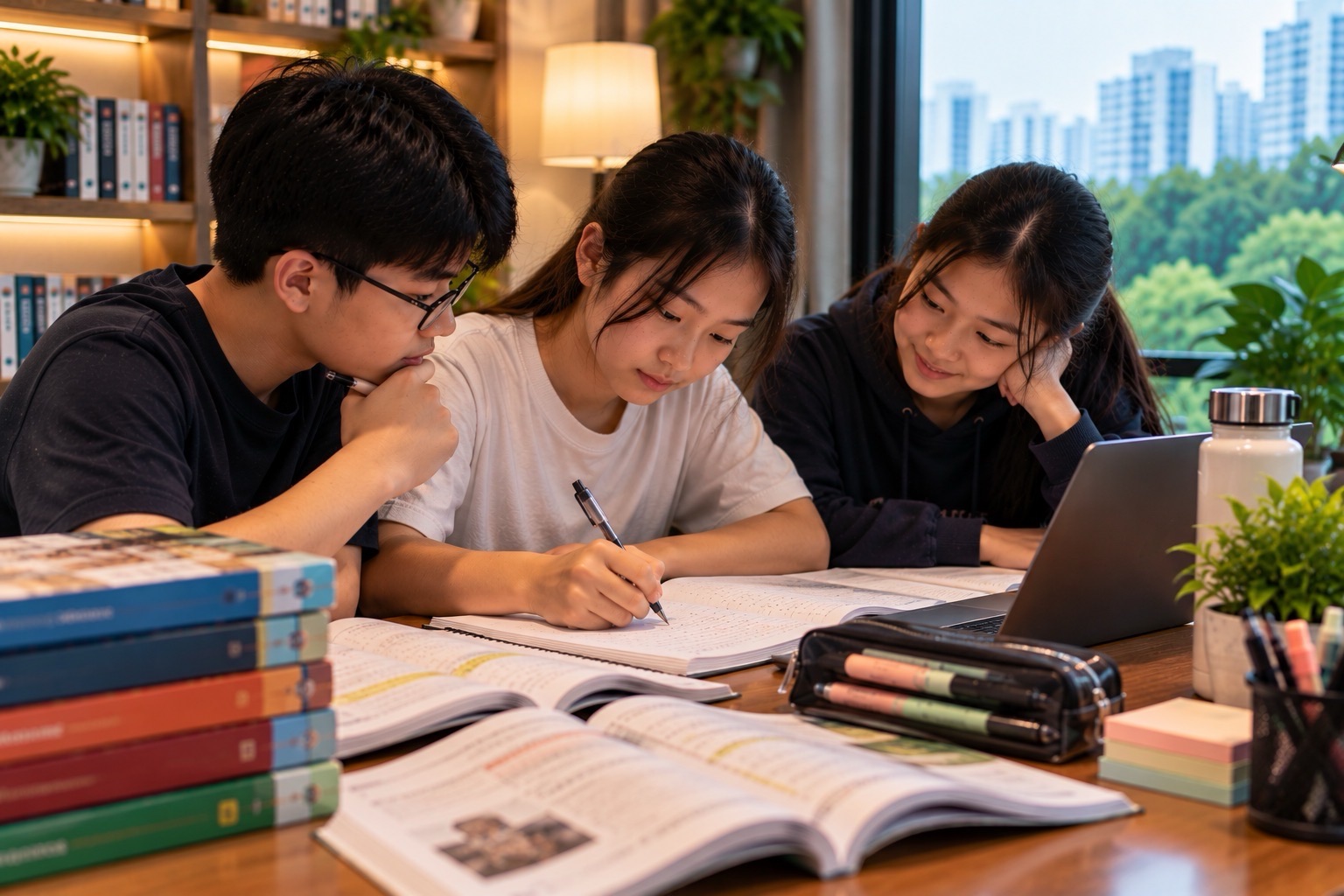
Pei Hwa Secondary School at 21 Fernvale Link, Singapore 797702, is a government co-educational school in Sengkang West that Punggol families can include in their Secondary 1 options when the child is eligible for Posting Group 2 (PG2). Its official 2026 Secondary 1 registration page records a historical PG2 PSLE Score range of 21–23, based on the preceding 2025 PSLE cohort. The last admitted PG2 pupil scored 23 in that completed exercise. It would be inaccurate to turn that number into a guaranteed 2027 cut-off: the new outcome depends on the pupils who apply, their choices and available places.
The school is distinctive for the Future Leaders Programme, integrating an Applied Learning Programme in Robotics and Programming with a Learning for Life Programme in Community Youth Leadership. Its 2026 description says Secondary 1 pupils use the Pei Hwa Innovation Cycle and basic micro:bit programming to investigate problems in the school, while Secondary 2 pupils extend the process to community and environmental challenges and explore Internet-of-Things concepts. Pei Hwa also offers interest-based making, selected robotics competitions and a separate Pei Hwa Talent Academy with explicit selection criteria. Parents should distinguish the school-wide curriculum from selective extension programmes before promising any particular opportunity to a PG2 child.
- School: Pei Hwa Secondary School, 21 Fernvale Link, Singapore 797702.
- 2026 historical PG2 range: PSLE Score 21–23; this is not a confirmed 2027 admission threshold.
- Posting Group: PG2 is the Secondary 1 entry group; G2 and G3 describe individual subjects under Full SBB.
- Future Leaders Programme: Combines the Robotics and Programming ALP with Community Youth Leadership LLP.
- Secondary 1 FLP: School-context problem solving, design thinking and introductory micro:bit programming.
- Secondary 2 FLP: Broader community/environmental problems, futures thinking and Internet-of-Things exposure.
- School-wide and interest-based making: Streamnovation Week, Maker Monday and STEM Playground opportunities under published programmes.
- Robotics Club: An extracurricular programme with platforms such as CoSpace and ESP32; actual CCA allocation and team selection apply.
- Pei Hwa Talent Academy: Selective academic enrichment with published entry routes; a PG2 placement does not automatically confer membership.
- Community Youth Leadership: Progresses from school-focused service to wider community projects and student-led initiatives.
- Parent action: Confirm MOE SchoolFinder eligibility, travel, school culture, subject-level offers and which programmes are core versus selective.
Definition lock: PG2 is admission, not a limit on curiosity or leadership
Posting Group 2 is used for Secondary 1 placement under Full Subject-Based Banding. Once a pupil enters school, individual subjects are offered at the relevant General levels, with possible differences across English, Mathematics, Science and other subjects according to the applicable school and MOE criteria. G2 is the curriculum level of a subject, not a label for every aspect of a person’s ability.
This distinction is particularly important at Pei Hwa because its applied and character programmes ask pupils to work across different strengths. A child who needs support with English writing may nevertheless have a strong instinct for designing an experiment. Another who is academically confident may need to learn patience when listening to users or collaborating with a less experienced teammate. The school should be understood as a place where academic and personal capabilities can develop together.
Parents should avoid the two extremes of claiming that PG2 means limited future opportunity, or claiming that entering a school with robotics means every child can automatically take demanding Computing or engineering qualifications. The actual subject offers, selective programmes and progression criteria must still be followed.
This guide owns Pei Hwa’s distinctive PG2 school profile. The wider Punggol school-choice article remains the owner of six-school posting decisions, and the general Full SBB pages explain the subject-level system.
The 2026 historical PG2 range is evidence, not a promise
Pei Hwa’s official December 2025 registration page for the 2026 Secondary 1 intake includes a chart showing PG3 7–14, PG2 21–23 and PG1 25–27. These are results for the completed posting exercise using the previous year’s PSLE performance. They are not targets set in advance for future applicants and should not be treated as predictions.
A parent whose child receives score 23 for the 2026 PSLE may note that the previous intake admitted PG2 pupils with that score. The family should still prepare a balanced shortlist. If many pupils with similar results prefer Pei Hwa in the next exercise, the outcome may differ. MOE also has tie-break procedures when applicants share a score at the point where places run out.
For a child with score 24, the fact that the previous PG2 cutoff was 23 should be understood carefully. It suggests the school was more competitive for that completed intake; it does not prove that the next cut-off cannot move. The family’s decision should be informed but not falsely certain.
A school profile is most useful when it labels the year and Posting Group explicitly. A headline that simply states “Pei Hwa score 23” is incomplete and can mislead parents who are comparing different groups or cohorts.

The actual location: Fernvale Link, not Punggol town centre
Pei Hwa is at 21 Fernvale Link in Sengkang West. That is farther from parts of Punggol than some schools in the two estates, although the actual journey depends on the home and transport connection. Families should not assume that every Sengkang school is located near Sengkang MRT or that any address in the neighbouring estate is convenient from their particular Punggol block.
The school’s 2026 registration instructions mention nearby car parks around Blocks 413, 416 and 417 and refer to Layar LRT. These are useful local orientation details, but the family should consult current travel and school drop-off guidance. The pupil may need a different route in the morning than after a late CCA.
A practical test includes the walk to the first stop, time spent waiting, any transfer, safe crossings and the journey after school. A short driving journey made by a parent on a Sunday is not the same as a teenager’s independent weekday commute. Practice can reduce uncertainty.
Travel is part of educational fit. A child who enjoys Pei Hwa’s robotics programme may find the journey worthwhile, but the family should know the actual cost in time and energy before ranking the school.
Pei Hwa’s educational history and programme identity
Pei Hwa Secondary traces its origins to the former Pei Hwa Public School and has developed its modern school identity through curriculum innovations and community activities. Its official history records participation in early Subject-Based Banding trials and an Applied Learning Programme in Robotics and Programming. The school also describes place-based and service-learning experiences, including community events.
This history is useful because it explains how the current Future Leaders Programme connects technical capability with social contribution. The approach is not simply to make pupils better at operating devices. It asks how technological understanding can be used to solve a meaningful human problem.
Still, a historical milestone is not proof that every current learner experiences a superior curriculum. Parents should ask what the pupil actually does in Secondary 1, how teachers respond to errors and what opportunities are available at later stages. The lived programme matters more than the length of the school timeline.
A parent may begin the school visit by asking which earlier initiative developed into the current Pei Hwa Innovation Cycle. That can lead to a concrete discussion of teaching practice rather than promotional claims.
The Future Leaders Programme: technology and service in one framework
Pei Hwa’s 2026 Future Leaders Programme integrates the school’s Robotics and Programming ALP with its Community Youth Leadership LLP. The stated aim is to nurture pupils who can use technology and futures thinking to propose innovative, sustainable solutions. This combination makes the school profile different from a campus that offers a purely technical club and a completely separate service programme.
The framework recognises that useful solutions begin with people. A pupil may want to create an app, robot or model, but should first identify who needs the product and what problem it actually addresses. Otherwise the project becomes an exercise in building technology for its own sake.
A child working through the programme can practise empathy, idea generation, prototyping, testing and revision. In a group, students may contribute different strengths. A practical builder may work with a strong writer who explains the problem and a careful observer who checks the testing evidence. Those contributions need not align perfectly with PSLE Posting Groups.
The family should ask which elements all Lower Secondary students experience and which external competitions or enrichment opportunities are selective. A school-wide framework is not an unlimited promise of every extension activity.
The Pei Hwa Innovation Cycle: understanding the person first
Pei Hwa describes its Innovation Cycle as influenced by design thinking and enriched by futures-thinking ideas. The process guides pupils through empathy, ideation, prototyping and testing. The word empathy is important because a solution may fail even when its code runs perfectly if it does not respond to the real needs of the people using it.
Take a hypothetical project involving the organisation of a shared school space. A pupil might propose a digital booking system, but should first ask what actually causes difficulty. Perhaps students cannot find information, or perhaps the resource is unavailable during certain periods. A booking app will not solve a shortage of equipment simply by displaying a polished interface.
After identifying the problem, pupils can generate several approaches, not only the first technological idea. The group can then test a simple prototype, gather appropriate feedback and revise it. The educational value lies in being willing to discover that the original assumption was wrong.
Parents can ask the child to explain one design decision and what evidence caused the team to change it. That is a stronger indicator of learning than the number of colourful screens in a project presentation.
Secondary 1: problems within the school community
The school’s 2026 FLP page says Secondary 1 pupils begin by identifying and addressing problems in their immediate school community. That is a sensible scale for young teenagers. The school environment is familiar enough that pupils can observe routines, speak with people appropriately and understand how their proposed solutions might affect others.
A useful problem might concern the clarity of directions, managing shared resources or helping students access information. The class can define the need without collecting unnecessary personal information about other pupils. Even a simple solution requires considering users, time, maintenance and whether the proposed change genuinely helps.
The school also describes introductory Code for Fun work involving a micro:bit microcontroller. This can be a tool for experimenting with inputs, outputs and programmable behaviour, but not every project must become a complex robot. A low-tech model can be educationally valuable when the reasoning is clear.
A PG2 pupil who is unfamiliar with coding can learn step by step. The objective is to understand how instructions produce results and how to check errors, not to pretend that every student is already an experienced programmer.
A micro:bit activity as a lesson in precise thinking
A micro:bit can make abstract ideas about sequences, conditions and signals more tangible. A student might programme a simple display that responds to a button or another input. If the result is unexpected, the pupil has to inspect the logic rather than guess until the system works.
This can support mathematical reasoning. A conditional statement requires the learner to understand what it means for a condition to be true or false. A sequence requires attention to order. A numerical threshold introduces measurement and comparison. These are valuable habits when the student can explain them independently.
However, a working program is not proof that the pupil understands every step. If the code was copied from a sample, ask the child to predict the effect of changing one condition. Then let the student test it and explain the observation. That encourages real learning rather than surface completion.
A parent should not rush to buy extra electronics before the school’s instructions establish what equipment is provided and what, if anything, a family needs to purchase.
Secondary 2: widening the problem to community and environment
Pei Hwa’s FLP extends in Secondary 2 to problems affecting the wider community and environment. The official 2026 page mentions Internet-of-Things concepts alongside Code for Fun and the school Innovation Cycle. This means students can begin considering how connected devices and collected information might support a useful outcome.
The wider scale makes ethical questions more important. If a proposed system gathers data about other people, what information is truly necessary? Who will use the result? What happens when the sensor or network fails? A project aimed at helping a community can cause inconvenience if its design is careless.
A learner might examine environmental monitoring as a hypothetical context. The pupil should distinguish actual measurements from assumptions and test whether an alert threshold is appropriate. The fact that a device can send information does not prove that the information is accurate or useful.
For parents, the interesting question is how the school helps pupils move from a technical demonstration to responsible problem-solving. A project should be judged by evidence of impact and thoughtful revision, not simply by the sophistication of its components.
Futures Thinking: preparing for uncertainty without pretending to predict
Pei Hwa’s programme combines design thinking with futures thinking, encouraging pupils to consider possible changes and their implications. A young teenager need not forecast technology or society accurately. The skill is to recognise uncertainty and explore how different conditions could affect a decision.
For example, imagine a school project about changes in daily commuting. A pupil might consider more digital information, weather disruptions or different accessibility needs. The group can identify what would make one solution reliable under several possible circumstances. This is stronger than declaring that one technology will certainly dominate ten years later.
A good futures exercise distinguishes a fact, a plausible assumption and a speculative possibility. The student should be able to say what is known today and what evidence would be needed to support a future claim. This is transferable to Science, Humanities and media literacy.
Parents should encourage curiosity without turning the exercise into anxiety about careers being replaced or one school choice deciding the child’s entire future. Uncertainty is a reason to develop adaptable skills.
The Robotics and Programming ALP: three tiers of opportunity
Pei Hwa’s official ALP page describes a tiered approach: school-wide experience, interest-based activities and talent development. This distinction is crucial for honest parent guidance. Every pupil may encounter elements of the school-wide curriculum, but selected enrichment and competitive opportunities have their own entry and participation criteria.
A family interested in robotics should ask which activities belong to the standard Future Leaders Programme, which require joining an interest group and which depend on specific talent selection. A project shown on a school website may have been completed by a highly trained team rather than a typical Secondary 1 class.
The educational value of this tiered approach is that students can discover an interest before committing to deeper training. Some may enjoy introductory coding but choose another CCA. Others may want to spend more time designing, debugging and building, and seek the appropriate extension opportunity.
A PG2 child should not feel excluded simply because the most advanced robotics examples involve selected pupils. The child can build genuine foundations and explore the actual options the school offers.
Streamnovation Week: making, reading and the arts
Pei Hwa describes Streamnovation Week as an immersion in STEM and innovation with reading and the arts integrated. Its official page mentions level-wide making challenges, learning journeys, speaker sessions and maker activities. This is a concrete example of the school’s attempt to connect technical work with a broader creative learning experience.
The educational question is whether students can explain the problem and evaluate their solution. A level-wide challenge can build collaboration, but it should not become a competition in decoration alone. The pupil ought to understand why a particular structure or procedure was chosen and which evidence would show it works.
Reading can strengthen technical projects because students need to interpret instructions and research claims accurately. Arts and design can improve the way a prototype communicates its purpose. Science and Mathematics support measurement, testing and reasoning. These are meaningful links when teachers make them explicit.
Parents can ask the teenager what part of the challenge required the most thought and which idea changed after feedback. The answer reveals more than the finished object’s appearance.
Maker Monday and the importance of curiosity
The school’s Maker Monday initiative is described as an interest group where students can explore tinkering and making. An interest-based activity can be valuable because it allows pupils to try something beyond the compulsory curriculum and discover what they genuinely enjoy.
A learner may find satisfaction in understanding why a component fails, improving a small construction or inventing a new use for an ordinary material. These experiences can develop confidence without needing an advanced national competition at every stage. The key is a supportive environment in which errors are examined rather than hidden.
Parents should ask about actual scheduling and membership. Not every student may be able to attend every maker session, especially when CCA, travel and academic work already occupy the week. The family should also avoid buying specialised equipment simply to keep up with an activity before the school confirms the need.
A hobby becomes a powerful learning experience when the pupil can describe what was attempted and how the next attempt improved.
The Pei Hwa Hackathon: learning through mentoring
Pei Hwa’s ALP page describes a hackathon for primary-school students in which trained secondary pupils can serve as assistant maker coaches. This is a distinctive extension because it asks older learners not only to code but also to explain, guide and troubleshoot for younger participants.
Teaching a concept to someone else can reveal the depth of one’s own understanding. A student who follows a robot-building recipe may struggle to explain why an input is not recognised. A capable assistant coach must diagnose the problem and communicate a useful next step rather than simply perform the entire task for the younger child.
This role also has a character dimension. The assistant needs patience, respect, clear instructions and awareness of the younger participant’s experience. A rushed response can make the learner dependent; a good hint helps the child discover the solution.
The role is not automatically awarded to every PG2 pupil. The school’s training and selection arrangements determine participation. Families should recognise the opportunity without promising it as a guaranteed element of the timetable.
Robotics Club: CoSpace, ESP32 and a genuine competitive pathway
Pei Hwa’s Robotics Club page describes work with CoSpace Rescue, autonomous driving and performance categories, along with platforms such as ESP32 and other programming systems. It also documents achievements in robotics competitions. These are legitimate examples of the school’s specialised extracurricular activities, not proof that every student will win an award.
An interested pupil should understand what regular training involves. Building and programming robots can require debugging, teamwork, patience and repeated testing. Competition preparation may add substantial hours. A child who enjoys technology videos may discover that writing and correcting instructions is less glamorous but more intellectually rewarding.
The parent should ask about CCA selection, session times, equipment and the pupil’s ability to manage homework. A child who is not selected for a competitive team can still benefit from the school-wide ALP and other available interests.
The aim of robotics learning is genuine technical understanding and responsible collaboration, not a collection of photographs beside trophies.
Community Youth Leadership: service before status
Pei Hwa’s LLP is in Community Youth Leadership. Its official page describes a tiered VIA approach in which all students receive foundational opportunities, while additional interest-based and talent-development experiences may deepen involvement. The school links the programme with innovation, especially through the Future Leaders Programme at lower secondary.
A service project is meaningful when it begins with a genuine need. A team may want to help a group of people or improve a shared environment, but should first listen and understand the problem. A solution that creates publicity for the students while doing little for participants is not necessarily a successful service experience.
A pupil should be able to explain who benefited, what the team actually contributed and which evidence shows the activity was useful. Ethical care also includes privacy and consent when photographing other people, particularly vulnerable participants.
PG2 does not prevent a child from developing leadership or community-mindedness. These capabilities can be practised in ordinary acts of reliability and cooperation long before a formal appointment.
The progression from school to wider community issues
Pei Hwa’s LLP description says Secondary 1 pupils focus on their immediate school context through FLP, while Secondary 2 pupils extend projects to a wider community or environmental scope. Secondary 3 pupils undertake student-initiated class projects, identifying community concerns and taking action.
This progression has an educational logic. Younger students begin with a setting they know well and can observe safely. As their skills develop, they learn to consider more complex needs and collaborate across a wider group. Later, they take greater responsibility for identifying a question rather than waiting for adults to supply every instruction.
Parents can ask the child what changed from one project to another. Did they learn to gather feedback, schedule tasks or consider alternative perspectives? A longer project is not automatically more meaningful; the quality of reasoning and service matters.
Actual project opportunities, external partners and dates should be confirmed with the school. Do not assume every cohort repeats the same service initiative or that participation automatically guarantees a specific LEAPS level.
The Pei Hwa Talent Academy has separate criteria
Pei Hwa’s Talent Academy is an academic enrichment programme described as a three-year differentiated curriculum in English, Mathematics, Science and Humanities for selected students. Its official eligibility page lists a PSLE Score of 12 or below for entry based on the 2025 PSLE, alongside a later entry route after Secondary 1 for students in the top 10% of the cohort who show strong interest and are endorsed by subject teachers.
This is essential information for a PG2 parent. A pupil admitted through PG2 with a typical score in the 21–23 range would not meet the published initial PSLE Score 12 threshold. The family should not interpret the presence of the Talent Academy on the website as automatic access. The later top-10% route is a distinct possibility, not a promise that every PG2 pupil can enter through effort alone.
The published criteria may change for a later cohort, and places and teacher endorsement are subject to the school’s decisions. Ask the school for the actual current process and what the enrichment demands. Parents should avoid making a teenager’s self-worth depend on receiving a selective invitation.
A child who does not enter the Academy can still learn meaningful skills, participate in FLP and progress academically through the regular school curriculum.
What academic enrichment should actually teach
The Talent Academy’s published aims include deeper subject study, problem-based learning, communication, collaboration, research and exposure to higher education. These can be valuable for a student ready for that level of challenge. However, the purpose of enrichment should be deeper capability, not simply more difficult worksheets.
A pupil may be asked to evaluate an unfamiliar argument, design an investigation or explain why a mathematical method works. The important outcome is the ability to reason independently, revise after feedback and communicate clearly. An advanced label without genuine understanding can create fragile confidence.
For a PG2 student who later becomes a strong performer, the appropriate next step is to explore school-defined opportunities and seek teacher advice. It would be misleading to promise the pupil a particular programme or subject level on the basis of one good test.
Parents should value progress across the student’s real academic and personal strengths. A selective enrichment programme is one possible opportunity, not the only way to become an independent learner.
Pei Hwa’s teaching approach and Habits of Learning
Pei Hwa’s 2026 instructional-programmes page describes purposeful classroom interaction, discussion, meaningful demonstrations of learning and timely feedback. It also identifies STEP UP with EdTech, Habits of Learning and the PERMA wellbeing framework. These features provide specific questions for parents who want to understand how teaching works beyond slogans.
A useful lesson gives pupils opportunities to think, attempt a problem and explain what they have learned. Feedback should identify a specific error or next action. A child who receives a corrected Mathematics solution but cannot reproduce the reasoning on a changed question has not yet secured the concept.
Habits of Learning such as curiosity, resilience and self-management can be taught through repeated practice. The pupil checks instructions, plans work, asks a clear question and revises after feedback. Those behaviours matter in school and later education.
Technology should support those habits rather than automate all student thinking. A confident AI answer is not proof that the child understands it. Parents can ask the teenager to explain the work without reopening the tool.
PERMA and the role of wellbeing
The school’s page refers to PERMA: Positive emotions, Engagement, Relationships, Meaning and Accomplishment. It is a positive-psychology framework used to inform school wellbeing and motivation. Families should understand it as an educational lens, not a medical diagnosis or guarantee that every pupil will always feel happy.
A teenager entering Secondary 1 may be excited about robotics but anxious about making new friends. The parent can acknowledge both feelings and help the student identify an appropriate school contact. A child who is overwhelmed by CCA and homework may need a better routine, more rest or school guidance rather than the command to “be more resilient”.
Relationships are particularly important in mixed form classes. Pupils should be able to cooperate across different subject levels without treating another child’s timetable as a social ranking. Good learning and character education support one another.
If distress becomes persistent or seriously affects daily functioning, the family should seek appropriate school and professional support. A framework for positive education is not a substitute for clinical care.
G2 English: communication within the Innovation Cycle
A design project begins with understanding a user, and that requires accurate listening, reading and language. A pupil may need to interpret feedback, explain the problem and present the findings. These are opportunities to practise G2 English skills in a meaningful context.
A common academic difficulty is giving a conclusion without evidence. In a prototype report, a student might claim that a device is easy to use because the team likes it. The explanation needs evidence from appropriate testing or feedback. Similarly, a comprehension inference must connect the claim to the actual passage.
For writing, teach purpose and audience. A message to a school user differs from a technical description to teachers or a reflection for classmates. Vocabulary should fit the task rather than be chosen only for sophistication.
An FLP presentation is most useful when the child can explain the idea in their own words, without an adult or AI tool generating the full script.
G2 Mathematics: using structure in coding and design
Robotics projects can make mathematics tangible, but the pupil still needs a secure understanding of algebra, ratios, measurement and graphs. If a code condition uses a threshold, the child should understand what the quantity represents and how it changes. A sensor value without the correct units or interpretation may mislead the project.
Consider 3(x + 5). A learner who writes 3x + 5 has not distributed the multiplier to both terms. A teacher should demonstrate three identical groups and explain why the correct expression is 3x + 15. The pupil then needs to solve a changed example independently to show transfer.
A different student may understand distribution but copy a negative sign incorrectly. The remedy is a checking strategy rather than another lengthy lesson on the same principle. A thoughtful tutor or parent identifies the first unstable step.
A practical design context can motivate mathematics learning; it does not remove the responsibility to demonstrate valid reasoning in formal assessments.
G2 Science: evidence, measurement and limitations
A school project about sensors, environmental monitoring or a practical device often requires scientific thinking. What is measured? What conditions change? Can the observation support the proposed explanation? A pupil should learn that a single successful test does not establish universal reliability.
Suppose a device appears to respond to a particular condition. The team should consider repeatability, sources of error and whether the measurements are appropriate. If the observed result differs from the prediction, students can revise a hypothesis rather than conceal the failure. This is scientific method applied to design.
Formal Science answers still require correct concepts and precise language. A polished prototype with a scientifically inaccurate explanation does not demonstrate mastery. Ask the pupil to state the mechanism and evidence separately.
Parents should encourage safe, school-approved experimentation. An online tutorial is not permission for a teenager to handle electrical or chemical equipment without supervision.
Full SBB and academic progression at Pei Hwa
Full SBB allows a pupil to offer subjects at levels that reflect the student’s actual eligibility and readiness, within the school’s arrangements. A PG2 child may share a form class with peers who have different subject-level profiles, while moving to levelled lessons for particular subjects. The school issues the actual timetable and current progression criteria.
A family should distinguish a formal subject-level offer from an enrichment opportunity. Attending a robotics workshop does not automatically confer G3 Computing or G3 Mathematics. Similarly, doing well in an ALP project does not override the school’s documented criteria for changing an academic level.
Parents can ask teachers what evidence demonstrates readiness: consistent performance, independent understanding and the ability to manage the demands of a more advanced course. A one-off external tuition mark is not a guarantee of an official change.
The goal is suitable challenge and genuine learning, not accumulating every possible advanced label.
CCAs, skills and a sustainable timetable
Pei Hwa publishes CCAs including Robotics and other sports, arts, uniformed and club activities. Students may discover interests through the school-wide FLP and then seek deeper involvement where appropriate. The actual CCA allocation, training schedule and selection criteria must be verified for the intake.
The family should calculate travel from Punggol to Fernvale Link, especially after late training. A student who enjoys robotics competitions may accept a demanding schedule, but the commitment should remain compatible with schoolwork, meals and sleep. The school’s published Robotics Club timetable is a 2026 reference and may not determine the next year’s schedule.
A thoughtful CCA choice also supports friendships and responsibility. The child should not choose an activity only because it looks prestigious or because another family claims it produces automatic admissions bonuses.
LEAPS 2.0 recognition follows formal criteria and school records, separate from the broader educational value of participating in a club.
The 2027 practical items already announced
Pei Hwa’s public announcements show that its MOE Financial Assistance Scheme application for 2027 began on 13 October 2026. The site also contains a 2027 booklist and uniform purchasing guide for Secondary 2 to 4 students as of October 2026. Families should note that these specific materials do not automatically serve as the complete new Secondary 1 registration kit for the 2027 cohort.
A parent preparing for S1 should follow the school-issued registration instructions once the child has actually been posted. Check which booklist applies to the pupil’s offered G levels, how uniforms are ordered and whether any device arrangements are prescribed. Do not buy textbooks from an old cohort list merely because it is visible online.
Families facing financial strain can ask about current FAS eligibility and school support. The child’s Posting Group is not an income category; financial assistance follows its own rules and application process.
An orderly transition begins with the correct documents, not a generic shopping checklist copied from another school.
Three hypothetical PG2 students at Pei Hwa
The curious beginning programmer. A child enjoys making simple digital projects but has never used micro:bit. The family learns that introductory programming forms part of the published FLP and asks how the school teaches beginners. The pupil develops logical thinking while continuing to repair ordinary Mathematics gaps. Enthusiasm does not need to be presented as an advanced qualification.
The community-minded designer. Another student wants to help classmates manage a shared resource. The Innovation Cycle encourages the pupil to listen to users, define a need, prototype and test a solution. The parent asks what evidence shows usefulness rather than praising the first idea uncritically.
The academically improving pupil. A PG2 student becomes a strong performer during Secondary 1 and asks about the Pei Hwa Talent Academy. The family reads the official later-entry requirements, recognises that teacher endorsement and top-cohort performance matter, and avoids promising selection. The student continues developing learning capability irrespective of the outcome.
These examples are fictional and do not imply that a named child has been admitted or selected.
How a family should use a school visit
Ask what ordinary Secondary 1 pupils do in the Future Leaders Programme and how the school distinguishes school-wide, interest-based and selected talent opportunities. Request an example of a project that began with a real user need, then ask how pupils were taught to test and improve it.
Ask about academic support, mixed form classes and individual subject offers under Full SBB. A family whose child is strong in one subject but uncertain in another should know how the school communicates teacher feedback and progression decisions.
Discuss CCA, student wellbeing and travel from Punggol. If the pupil is particularly interested in Robotics Club, ask about selection and realistic training time rather than assuming immediate admission to a competition team. If the child needs additional support, identify the appropriate school contact.
An open-house tour offers useful evidence of school life but is not an admissions reservation. Current MOE posting rules determine the final placement.
A realistic Secondary 1 learning plan
If the child receives a place at Pei Hwa, begin with the assigned timetable and registration materials. Establish one method for recording homework, one predictable time to review school notices and a manageable approach to preparing for each subject level. A newly admitted teenager needs time to learn the routine before adults add several unrelated enrichment commitments.
Encourage the pupil to talk about one design or service experience and explain what it taught. A useful reflection identifies the problem, action, evidence and next improvement. This is consistent with FLP’s educational aims and can strengthen communication.
For academic work, select one recurring mistake and repair its underlying cause. A student who repeatedly mishandles algebraic signs needs targeted instruction; a pupil whose English inference answers are unsupported needs evidence-based practice. The solution should be specific and checked through independent retry.
Rest, CCA and friendships are not distractions from education. They are part of a sustainable life in which serious learning can continue over four years.
Tuition should add value only when there is a defined need
A PG2 student does not automatically need tuition, and enrolment at a school with a robotics programme is not evidence of an academic deficit. If school lessons and independent practice are working, extra lessons may be unnecessary. If a persistent gap exists, additional teaching can help when it identifies and repairs the actual misconception.
The eduKate three-pupil tutorial model allows an educator to inspect working closely, ask why a step was chosen and provide targeted feedback. One Mathematics learner may need an algebra foundation, while another needs help interpreting word problems. In English, one pupil may need to select evidence and another may need to organise a situational writing response. Those are different needs.
A tutor cannot guarantee a Pei Hwa place, Talent Academy selection, official subject-level upgrade or future diploma admission. Responsible teaching makes the learner more independent rather than promising administrative outcomes outside the tutor’s control.
Parents should also consider the child’s total workload. The best intervention is sometimes a clear study routine, school consultation or adequate rest rather than another long evening class.
Frequently asked questions about Pei Hwa PG2
Does Pei Hwa Secondary accept PG2 pupils?
Yes. Its official 2026 Secondary 1 registration information lists a historical PG2 score range of 21–23. Check the latest MOE SchoolFinder and current posting rules for the new cohort.
Is PSLE Score 23 guaranteed admission for 2027?
No. It is the last admitted score from a previous completed exercise and may change with new preferences, applicants and vacancies.
Is Pei Hwa located in Punggol?
No. It is at 21 Fernvale Link in neighbouring Sengkang West. Punggol families should test the actual journey before ranking it.
What is the Future Leaders Programme?
A Lower Secondary initiative integrating the school’s Robotics and Programming ALP with Community Youth Leadership LLP and futures thinking.
What do Secondary 1 students learn in the programme?
The published 2026 framework includes school-community problem solving, the Innovation Cycle and basic micro:bit-related Code for Fun work. Check the current cohort’s actual schedule.
What changes in Secondary 2?
The published programme expands towards broader community and environmental issues, with more advanced coding and Internet-of-Things concepts.
Is Robotics Club compulsory for every pupil?
No. A club is a co-curricular activity with its own allocation and participation rules; school-wide ALP experiences are separate.
Can a PG2 child enter the Pei Hwa Talent Academy?
The current page lists a selective later-entry route after Secondary 1 based on top-cohort performance, interest and teacher endorsement. It is not automatic. The initial published PSLE threshold of 12 is not met by typical PG2 scores.
Does the Talent Academy change a pupil’s Posting Group?
No. It is an enrichment programme separate from original school posting and individual academic G levels.
Does a robotics project count as a G3 SEC subject?
No. Applied learning and formal examinable subjects have separate requirements and assessments.
Are the 2027 books and uniform instructions already fully available for Secondary 1?
The school has published some 2027 material, including a booklist for Secondary 2 to 4. New Secondary 1 parents must follow their own cohort’s registration and subject-level instructions.
Is a student guaranteed a robotics competition award or future diploma?
No. Competitions, programmes and later admissions have selection and eligibility conditions. School experience develops capabilities, not guaranteed external outcomes.
Your Next Step
Open Pei Hwa’s official Future Leaders, ALP, LLP and 2026 Secondary 1 registration pages. Check the historical PG2 reference against MOE SchoolFinder, confirm the 2027 options and calculate the real journey from your Punggol home. Let the teenager ask which opportunities they would genuinely enjoy, and distinguish the school-wide programme from selective robotics and Talent Academy extensions before ranking the school.
This is the Pei Hwa-specific PG2 school profile. Other pages in eduKatePunggol already explain Edgefield, Greendale, Compassvale, Seng Kang Secondary and North Vista, as well as the national PG2 posting system. Each profile should answer the relevant local decision without repeating the entire broader guide.
Official sources and related reading
- Pei Hwa Secondary: Contact and Fernvale Link address
- Pei Hwa Secondary: 2026 Secondary 1 registration and historical PG2 21–23 score chart
- Pei Hwa: Future Leaders Programme, updated August 2026
- Pei Hwa: Applied Learning Programme in Robotics and Programming
- Pei Hwa: Learning for Life Programme in Community Youth Leadership
- Pei Hwa: Robotics Club activities and achievements
- Pei Hwa: Talent Academy and eligibility
- Pei Hwa: Instructional Programmes, Habits of Learning and PERMA
- Pei Hwa: Current announcements for 2027 and registration
- MOE SchoolFinder
- MOE: Full Subject-Based Banding
- eduKatePunggol: PG2 Seng Kang Secondary school profile
- eduKatePunggol: PG2 North Vista Secondary school profile


