
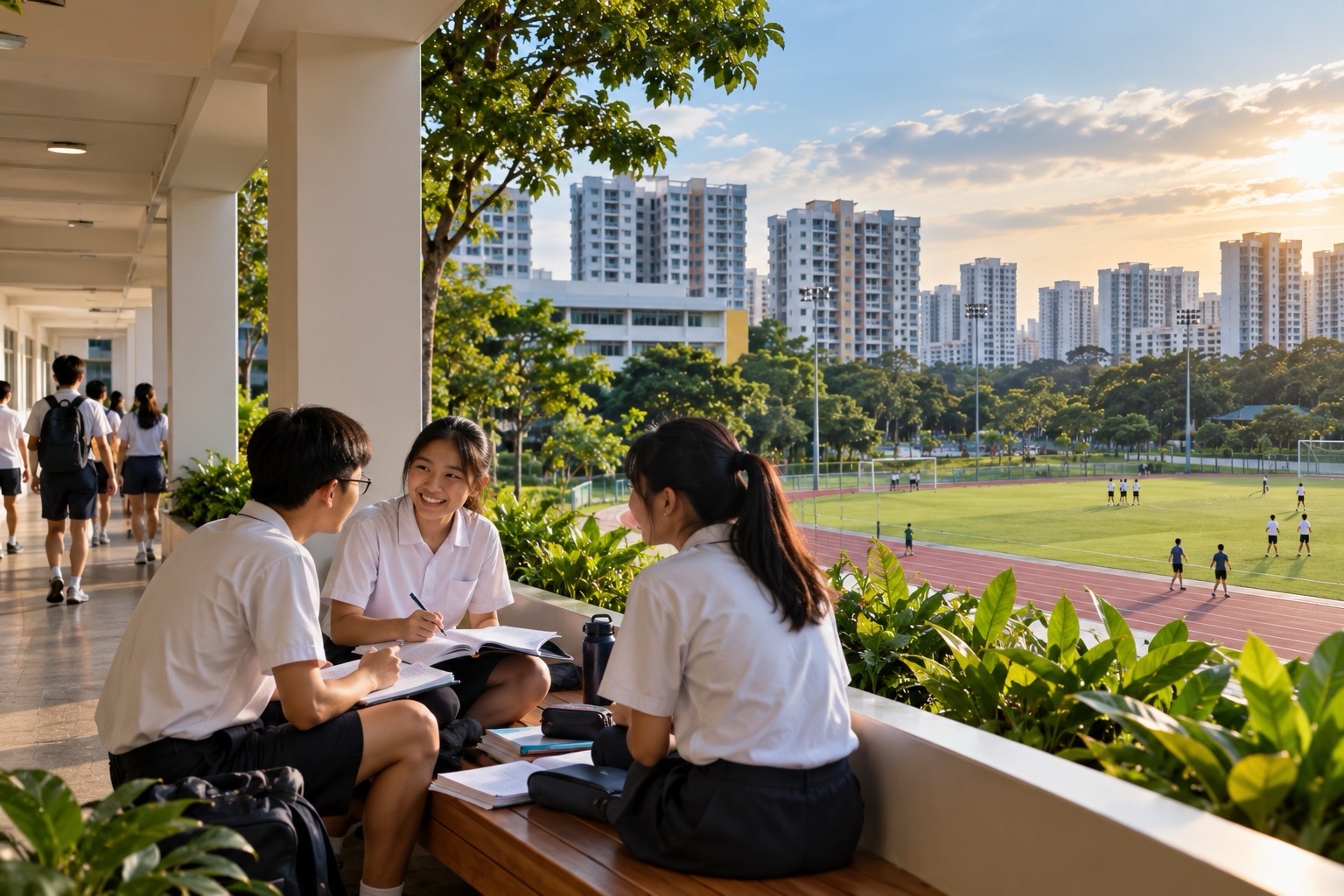
A pupil entering a Punggol secondary school through Posting Group 2 (PG2) joins the Full Subject-Based Banding (Full SBB) school experience, which includes mixed form classes rather than the old whole-student Express, Normal (Academic) and Normal (Technical) streams. A PG2 pupil may study English, Mathematics or another subject at G2 and an eligible subject at G3 while sharing common school experiences with classmates who have other subject-level combinations. That arrangement is designed to recognise different learning strengths; it does not make Posting Groups a social ranking.
For parents at Edgefield Secondary School, Greendale Secondary School, Punggol Secondary School, Yusof Ishak Secondary School or another nearby school, belonging and wellbeing require attention alongside grades. Ask how the student is settling into friendships, whether classroom comparisons are hurtful, who can receive concerns and how the school handles persistent bullying. MOE announced in 2026 that each school would have an online reporting platform for students and parents from 2027, but urgent concerns should still go directly to teachers and school leaders rather than wait in an online queue.
- PG2: A Secondary 1 admission group, not a statement of intelligence or social status.
- Form class: Students may share a common class despite studying certain academic subjects at different G levels.
- G levels: G1, G2 and G3 describe subject demands and can differ within one pupil’s timetable.
- Belonging: Look at friendships, safety, class participation, CCA experiences and respectful language.
- Help-seeking: Form teachers, trusted subject teachers, school counsellors and school leaders are important school contacts.
- Bullying: Report repeated hurtful behaviour using the school’s channels; for an urgent safety issue contact staff directly.
- 2027 reporting: MOE announced school-based online reporting platforms for students and parents, with current access details supplied by the school.
- Health: Persistent withdrawal, sleep changes, low mood or impaired daily functioning deserve a supportive conversation and appropriate professional advice.
- Home: Protect sleep, avoid ranking children by G levels and ask about actual experiences rather than labels.
- Practical next step: Make a one-page support map listing the pupil’s trusted adults, school reporting route and an ordinary weekly family check-in.
Definition lock: PG2 does not define the pupil’s social identity
Posting Group 2 was created for admission and for an indicative academic starting point. It is not a permanent social identity, a personality category or a reliable description of a child’s talents. Under Full SBB, schools organise form classes to include students with different academic profiles, while individual subjects may be taught in groups aligned with their levels. A child’s English timetable does not tell classmates whether the child is kind, funny, inventive, patient or dependable.
The distinction seems obvious on paper, yet adults sometimes erase it through casual language. A parent may say that a friend is “G3” while another is “only PG2,” as though the two terms measure the whole person. Children notice these comparisons. They may repeat them in class, use them as insults or quietly begin to believe them. A helpful school-home partnership begins by using correct language: a child entered via PG2 and currently takes specified subjects at certain levels.
Mixed form classes can create opportunities for friendship across diverse strengths, but design alone cannot guarantee that every pupil feels included. School culture, staff actions, peer behaviour and family messages affect the actual experience. A teenager needs to know that the adults around them will notice harm, explain expectations and respond fairly.
This article owns the social and wellbeing questions in the PG2 series. The first-100-days guide covers general settling-in routines; this page goes deeper into belonging, peer relationships, respectful behaviour and support when school does not feel safe.
Why mixed form classes matter beyond the curriculum
In the older structure, broad academic stream labels could shape how students were grouped and perceived. Full SBB changes that organising idea. Students share a form class while studying individual subjects at levels appropriate to their needs. Shared lessons and school experiences create ordinary reasons to work together, laugh, solve problems and discover that ability is not one-dimensional.
Consider a hypothetical group project. One classmate explains a complex idea in clear language, another organises materials carefully, a third thinks of an original design and a fourth notices an error everyone else missed. They may not all sit the same level of Mathematics examination. That fact has little relevance to the quality of their collaboration. The experience can teach respect for different forms of contribution.
The benefit is not achieved simply by seating pupils near one another. Teachers must set expectations about participation, respectful disagreement and fair group work. Students need opportunities to contribute without public embarrassment. Parents can reinforce the lesson by asking what each person added to a project rather than which Posting Group the other children entered through.
When a child describes a classmate using only a level label, invite a more informative description. What does the classmate enjoy? What did they help with? Are they reliable in group work? This small change in language can make an educational reform meaningful in the way children relate to one another.

School belonging is built through repeated small experiences
Belonging rarely appears instantly on the first day of secondary school. It grows when a pupil recognises familiar faces, knows where to find help, participates in a class activity and experiences being welcomed back after an awkward moment. Some teenagers make friends quickly; others take weeks or longer. A quieter start is not automatically proof that anything is wrong, but persistent loneliness should not be dismissed.
Ask concrete questions about the school day. Who did the pupil sit with? Did someone respond when they asked a question? Was there a group activity in which they had a role? What happened during recess? These details are more informative than asking, “Are you popular?” The aim is to understand whether the child has ordinary opportunities for connection.
A student can have several casual friends without one best friend. Another may be satisfied with one close relationship. Parents should avoid imposing an adult picture of the ideal social life. The more relevant question is whether the child feels safe, respected and able to take part in school. If the pupil is consistently alone and distressed, or appears excluded from routine group activities, it is appropriate to seek help.
CCAs, class projects and school events can create additional opportunities to meet peers. Encourage participation without forcing a shy student into endless public activities. A manageable invitation to join a club or speak with one person may be more effective than the command to “go make more friends.”
Learning to talk across different subject levels
A common worry is that classmates who take different G levels will compare results, boast or make dismissive comments. Such behaviour can occur in any learning environment. Adults should not pretend it is impossible merely because the structural reform aims to reduce labelling. The response is to teach accurate language and respectful boundaries.
A pupil may legitimately feel proud of performing well in a difficult subject. Pride does not require belittling someone else. Similarly, a student who struggles at one level may feel disappointed, but the result should not be treated as a measure of social worth. Parents can model this distinction by celebrating the work done without comparing the child’s qualification to an unrelated classmate.
Teach a simple response to an intrusive question: “That is the level I study for this subject; I am working on improving it.” The student does not need to disclose every mark to friends. If teasing becomes persistent or humiliating, the child should know how to report it to an appropriate adult. A clever comeback is not an adequate safety plan.
Peer culture grows through thousands of small remarks. Families can help by not turning the dinner table into a ranking exercise. Ask what was learned, what was difficult and how the child treated others. Respect becomes credible when it is practised at home.
Differences between teasing, conflict and bullying
Not every disagreement is bullying, and not every harmful comment can be excused as harmless fun. Two friends may argue about a group task and later reconcile. A classmate may make an insensitive remark once. Repeated, targeted humiliation or threatening behaviour raises a different concern, particularly when the affected pupil finds it difficult to protect themselves. The exact facts matter, and schools should investigate rather than assume.
A family should ask what happened, when it occurred, who was involved, whether it has happened before and how the child felt. Avoid writing a public verdict based on one message that might lack context. At the same time, a parent should never insist that a child endure persistent hurtful behaviour to become “tougher.” Safety and dignity are part of a school’s responsibilities.
A useful first conversation is calm and factual. “Tell me what happened from the beginning” is more likely to produce information than “Who did this to you? I am going to confront them tomorrow.” The latter may make a child afraid to disclose future incidents. Listen, record the concerns and involve the school when appropriate.
If the child is in immediate danger, prioritise safety and direct contact with staff or emergency services as required. Do not rely on ordinary complaint timelines when physical safety is at risk. Serious threats require a response proportionate to their urgency.
The 2026 anti-bullying changes and what 2027 parents should know
Singapore’s Ministry of Education reported in 2026 that schools would strengthen their anti-bullying policies and student reporting arrangements. In parliamentary explanations on 5 May 2026, MOE said all schools would develop school-specific anti-bullying policies by the end of 2026 based on its guidelines. It also said that an online reporting platform would be available in each school from 2027 for students and parents.
The reporting platform is intended to be accessible and familiar to the school community. However, MOE specifically explained that urgent cases should still be reported directly to teachers and school leaders so that immediate action can be taken. An online form is a useful route for some concerns; it is not a substitute for urgent human intervention. Parents should ask their own school where the current reporting option can be found.
The same parliamentary account emphasised communication with parents and the need for schools to investigate facts while prioritising safety. This balance is important. A family understandably wants a rapid answer, but a fair investigation may require speaking with several pupils and protecting the privacy of children involved. The school should still explain the safety measures and its approach to handling the concern.
Do not invent a Punggol-specific reporting URL. Edgefield, Greendale, Punggol Secondary and Yusof Ishak Secondary may present their channels differently. Obtain the current link or contact information from the actual school rather than an unrelated school’s example.
A safe reporting sequence when a pupil is hurt
Begin by making sure the child is safe. If there is an immediate threat, contact appropriate school staff directly and use emergency services if necessary. For a non-emergency concern, listen to the pupil, record the key facts and identify the school’s reporting route. The form teacher is often a sensible starting contact; a subject teacher, year head, school counsellor or school leader may also be appropriate depending on the situation.
Keep the record factual. Note what occurred, when, where, what the child saw or heard, whether there are witnesses and whether the behaviour has repeated. For online incidents, preserve necessary evidence privately and avoid reposting harmful content. Do not circulate a child’s photo or allegation through parent chat groups; public speculation can worsen distress and compromise a fair response.
When contacting the school, explain the observed impact and the help being requested. A useful message is: “My child says this happened repeatedly during recess and is now afraid to attend. Please advise how the school can ensure immediate safety and investigate.” This asks for action without inventing facts or attacking another family.
After reporting, ask how the school will keep the child safe while it establishes the facts, when a follow-up can occur and which adult the pupil can approach. If the school’s response is unclear, raise the concern respectfully through its appropriate leadership and feedback channels. The goal is protection and resolution, not an online contest.
What parents should do if their own child hurt someone
It can be difficult to hear that one’s child may have bullied or mistreated a classmate. The parent may feel defensive, embarrassed or afraid that the student has been permanently labelled. The most useful response is to examine the facts, set a clear expectation of respectful behaviour and cooperate with the school. Neither automatic denial nor public humiliation helps the teenager learn responsibility.
Ask the child to describe what happened, including their own actions. Explain why repetition, intimidation, sharing embarrassing content or humiliating remarks can cause harm. Focus on the behaviour and its consequences rather than describing the child as an irredeemably bad person. A student needs boundaries, accountability and a path to make better choices.
The school may apply its policies, including appropriate disciplinary and restorative approaches. Parents should not promise that a quick apology will end every matter. In a serious case, the affected student’s safety takes priority, and adults may need to maintain boundaries even while helping the young person learn. A repair process is meaningful only when it is safe and does not pressure a victim into premature reconciliation.
The conversation can continue at home through examples of ordinary respect: how to disagree, how to use group chats, why consent matters when sharing photographs and how to recognise a peer who is uncomfortable. Good character is developed through repeated practice, not a single punishment or lecture.
The form teacher as a partner, not a surveillance service
A form teacher can help a parent understand class adjustment and connect the family with appropriate school support. But it is unrealistic to expect one teacher to witness every lunchtime interaction or private message. Parents can be more effective partners by describing specific patterns instead of demanding that the school solve an undefined feeling immediately.
Suppose a PG2 pupil says the form class is uncomfortable. Ask what that means. Is the child unable to join group work? Are other students making remarks about subject levels? Is the timetable confusing? Does the pupil feel excluded from a particular group, or is the problem simply that friendships have not formed yet? The answer determines whether a class activity, a conversation, clearer instructions or a formal safety response is needed.
When a parent writes to the teacher, separate facts from interpretation. “My child has eaten alone most days for two weeks and seems upset” is a useful observation. “Everybody in the class hates my child” may be understandable emotion, but it is not evidence. The teacher can respond more constructively to the first statement.
Ask the school what support is realistic and when the family should review progress. Good communication does not mean sending daily messages about every small disagreement. It means knowing which patterns need attention and maintaining a working relationship when a significant concern arises.
School counsellors and professional support
School counsellors can help students manage emotions, social difficulties and stress, and can guide families towards further help when needed. A form teacher or another trusted staff member can assist a pupil who is unsure how to access the school counselling service. The exact procedures should be obtained from the school.
HealthHub’s MindSG resources describe warning signs that a teenager may be struggling, including frequent emotional outbursts, social withdrawal, significant sleep or appetite changes, persistent low mood and deterioration in day-to-day functioning. These signs do not establish a diagnosis. They are reasons to listen, observe patterns and seek appropriate guidance if concerns persist or intensify.
Parents should avoid interpreting every awkward adolescent week as a mental health condition. Adolescence includes ordinary stress, friendship changes and uncertainty. The important distinction is persistence, severity and impact on normal life. A child who is consistently distressed, unable to attend school or losing interest in usual activities deserves timely attention from a suitable professional.
If a young person expresses thoughts of self-harm or suicide, take the disclosure seriously. HealthHub advises seeking professional help and not leaving a person alone when there is immediate risk. In Singapore, urgent danger warrants 995 or 999; Samaritans of Singapore at 1767 and national mindline at 1771 are additional support resources. A school article must not substitute for urgent medical care.
Sleep, mood and the hidden cost of constant comparison
Some parents notice grades immediately but overlook a gradual loss of sleep. A teenager who stays up comparing results, reviewing class group chats or trying to complete every enrichment task may become irritable and forgetful. HealthHub’s teen sleep guidance recommends about nine to eleven hours for ages 11–13 and eight to ten hours for ages 14–17. Needs vary, but a persistent shortfall deserves attention.
Sleep affects emotional regulation as well as school concentration. A child who is exhausted may struggle to interpret a classmate’s remark fairly, recover from a disappointing mark or find the patience to finish an assignment. Improving the bedtime routine will not solve every social problem, but it can remove an avoidable source of stress.
Review the ordinary week, not just examination periods. What time does the pupil return after CCA? When does homework begin? Is travel longer than expected? Are unnecessary tuition sessions pushing the evening later? How much time is spent scrolling through school-related social media? These details may be more useful than a general instruction to “be more resilient.”
Parents can reduce unnecessary status comparisons by not asking daily who ranked highest in a class. Ask what the student learned, whether they had time to eat and rest, and whether a concern needs adult help. Emotional security creates room for academic ambition.
Punggol’s outdoor and community spaces as ordinary support
A child living in Punggol has opportunities for a walk, a cycle, casual movement or time outdoors, depending on access, weather and family circumstances. Places such as the Punggol Waterway area and local parks can provide an alternative to spending every afternoon inside a screen or over schoolwork. This is not a clinical treatment and should not be presented as one. It is an ordinary way to include rest and family connection in the week.
A parent can ask the teenager to choose a manageable non-academic activity. It might be a short walk after dinner, meeting a friend at a suitable public space or playing a sport. Do not insist on a highly structured fitness plan simply because the child has an academic label. The aim is sustainable enjoyment and a little time away from constant assessment.
Community activity can also help friendships develop outside narrow school groups. A student who feels uncertain in a new class may already have supportive relatives, neighbours or friends from primary school. Those relationships matter. A child does not need to obtain all social belonging from one form class.
However, outdoor time cannot replace a bullying report or professional help when needed. Keep the distinctions clear: normal routines can support wellbeing, school action addresses school harm, and healthcare professionals assess clinical concerns.
CCAs can create new friendships, but they are not a magic fix
Co-curricular activities can bring pupils together around shared interests rather than examination labels. A student might feel awkward in classroom discussions but confident in a sports team, uniformed group, performing arts activity or technical club. The experience can develop friendships, leadership, responsibility and a wider sense of identity.
Nevertheless, a CCA is not an automatic cure for isolation. Some activities have selection processes, demanding schedules or established groups that a newcomer must learn to join. Parents should ask the student what they genuinely enjoy and whether the activity feels welcoming. If the pupil is distressed in a CCA, listen and contact the relevant teacher when necessary.
Avoid using activities only to build a list of achievements. A teenager who likes music should be allowed to care about the music itself; a sports enthusiast should be allowed to enjoy play and improvement. Making every hobby another competition can reproduce the pressure parents wanted to avoid.
The best sign of a healthy CCA experience may be that the pupil looks forward to attending, contributes to the group and returns with a story about learning something with others. Those experiences have value whether the child entered through PG1, PG2 or PG3.
Online group chats: the school day now continues after school
Class and friendship conversations often move into messaging apps. A hurtful remark made at night can affect how a student feels entering class the next morning. Group chats may also spread rumours about which pupils take which subject levels. Parents should recognise that peer relationships are no longer confined to the school gate.
Teach children not to forward embarrassing images, reveal private information or respond to harassment by creating a bigger public argument. Where necessary, save relevant evidence, block or report harmful content through the platform and inform a trusted adult. Screenshots should be handled privately and shared only with people who need them to address the concern.
Not every group-chat disagreement needs a formal disciplinary response. Friends can misunderstand tone, exclude someone accidentally or argue about a game. Encourage an appropriate repair conversation where safe. But patterns of targeted threats, humiliation or persistent harassment are different. Those should be treated seriously and reported to the school or appropriate authority.
A family device agreement can protect sleep and attention: decide which channels are essential for school information, set sensible notification rules and keep personal conversations respectful. Parents should model the same conduct in their own group chats about schools and teachers.
Three hypothetical Punggol situations and what to do
Situation one: subject-level jokes. A pupil admitted through PG2 reports repeated jokes about being “only G2” during recess. The parent listens, records the specific remarks and asks whether they are repeated and targeted. The child is encouraged to report the issue to a trusted teacher if the behaviour persists. The school can explain expectations and investigate the behaviour. The goal is to stop humiliation, not to make a public argument about which group is superior.
Situation two: no close friends yet. A new secondary student is quiet after school and says there is nobody to talk to during lunch. The parent asks about the child’s actual day and whether there are classmates or CCA peers with shared interests. They encourage one manageable opportunity for connection and monitor whether the student is distressed or withdrawn over time. If the problem continues, they involve the form teacher. A quiet start is acknowledged without declaring a crisis.
Situation three: a hurtful group chat. A teenager sees an embarrassing image being circulated and fears that reporting it will make the situation worse. The parent advises against forwarding the image, helps preserve essential evidence privately and contacts school staff about safety and support. If threats or immediate danger are present, urgent channels take priority. A public confrontation on social media would expose more children and likely make the problem harder to resolve.
These examples are fictional and do not imply that any named Punggol school has a specific incident. They demonstrate proportionate responses and respectful handling of evidence.
A weekly family check-in that does not feel like an interrogation
Set aside a short, ordinary moment each week when the pupil can discuss school without being tested. The parent might ask: What was one good interaction? What was one difficult moment? Is there a person at school you can ask for help? Is anything happening repeatedly that you want an adult to know? The child can choose where to begin.
Listen without treating every statement as an instruction to intervene immediately. Some teenagers want space to describe an experience before deciding whether they need help. Parents can ask what kind of support would be useful: advice, help planning a conversation, or direct contact with a teacher. For a serious safety concern, adults must act even when the child is hesitant, but explain the action carefully.
Avoid making confidentiality promises that cannot be kept. Instead say that you will handle sensitive information thoughtfully and involve only people who need to help, while prioritising safety. The student is more likely to share important concerns when adult responses are calm and predictable.
End by noting one practical action, even if it is simply to check again the following week. A sustainable relationship of trust is more valuable than a dramatic conversation that never recurs.
What not to say about PG2 when other families are listening
Avoid statements such as “That is a low stream,” “Those children cannot cope,” or “Your friend is G3, so why are you not?” They are inaccurate descriptions of Full SBB and can undermine both the child and the peer community. A parent can discuss academic challenge without assigning moral value to a Posting Group.
Replace rankings with subject-specific questions. “Which part of algebra is difficult?” points towards an action. “What help would you need to manage more demanding reading?” begins a conversation about readiness. “How did your group work together?” recognises social and practical skills. The language is neither evasive nor falsely reassuring; it is more precise.
It is also unhelpful to use one pupil as a warning to another. Every student has a different combination of strengths and circumstances. Competition may motivate some children for a time, but persistent social comparison can become a source of shame or resentment. A healthy learning culture allows students to work hard while respecting peers.
Parents cannot control every remark at school, but they can ensure that home is not a second place where the student is reduced to a number.
Frequently asked questions about PG2 and wellbeing
Are PG2 students separated into their own permanent form classes?
Full SBB uses mixed form classes. Academic teaching groups may differ by individual subject level, and schools organise the practical timetable. Ask the student’s own school to explain its current arrangements.
Does taking G2 mean a child is less intelligent?
No. G2 is a subject-level demand. It does not measure every strength, skill or future ability, and the PG2 admission label is not a measure of personal worth.
Can mixed form classes prevent bullying on their own?
No. Shared classes can create opportunities for mutual understanding, but respectful conduct and effective school responses still matter. Parents and students should use school channels when harmful behaviour occurs.
Will Punggol schools have online bullying reporting in 2027?
MOE announced that each school would have an online reporting platform for students and parents from 2027. Families should obtain the current details from the school. Urgent safety concerns should be reported directly to staff.
What if my child does not want me to contact the school?
Listen to the reason and explain your concern. For ordinary friendship difficulties, agree on a proportionate plan together where possible. For serious or immediate safety risks, adults need to act to protect the child.
Can a school counsellor help with stress and friendships?
School counsellors can support students with emotional and social difficulties and guide further help where necessary. Ask a form teacher or the school how to access the service.
Is withdrawal after one bad day proof of a mental health problem?
No. One bad day is not a diagnosis. Look for persistent, severe or worsening changes, especially when sleep, attendance, relationships or daily functioning are affected, and seek professional guidance as appropriate.
What if a classmate uses PG2 as an insult?
Teach the child that the label is an admission category, not a verdict. If the remark is persistent, targeted or threatening, record the facts and raise it with school staff through appropriate channels.
Should I add tuition if my child becomes anxious about school?
Not automatically. Identify whether the problem is a specific learning gap, social difficulty, workload, sleep or emotional distress. Extra academic lessons can be irrelevant or burdensome when the underlying issue is not academic.
What if there are thoughts of self-harm or suicide?
Take the disclosure seriously and seek professional help promptly. For immediate danger in Singapore, call 995 or 999. HealthHub also lists SOS at 1767 and national mindline at 1771 for support.
The next useful step for families
Ask the student to identify two trusted adults at school, one possible friendship or activity opportunity, and the reporting route for concerns. Keep regular conversations about school, protect time for rest, and speak accurately about PG2 and G levels. When a problem is serious or persistent, involve school staff and suitable professionals instead of assuming that more practice papers will solve it.
This article is the wellbeing and respectful-community page in the Punggol PG2 series. For subject learning and academic readiness, read the dedicated PG2 G-level guide; for transport and general settling-in, read the first-100-days article. The separate jobs keep each guide useful without duplicating an entire introduction under every title.
Official resources and further reading
- MOE: Full Subject-Based Banding
- Singapore Parliament: Implementation of the 2026 anti-bullying review recommendations
- HealthHub MindSG: How to spot when a teenager is struggling
- HealthHub MindSG: Help-seeking and professional support
- HealthHub MindSG: Sleeping well for teenagers
- Edgefield Secondary School: Full SBB information
- What is PG2: The first 100 days at a Punggol secondary school
- What is PG2: G2 subjects and G3 opportunities


