
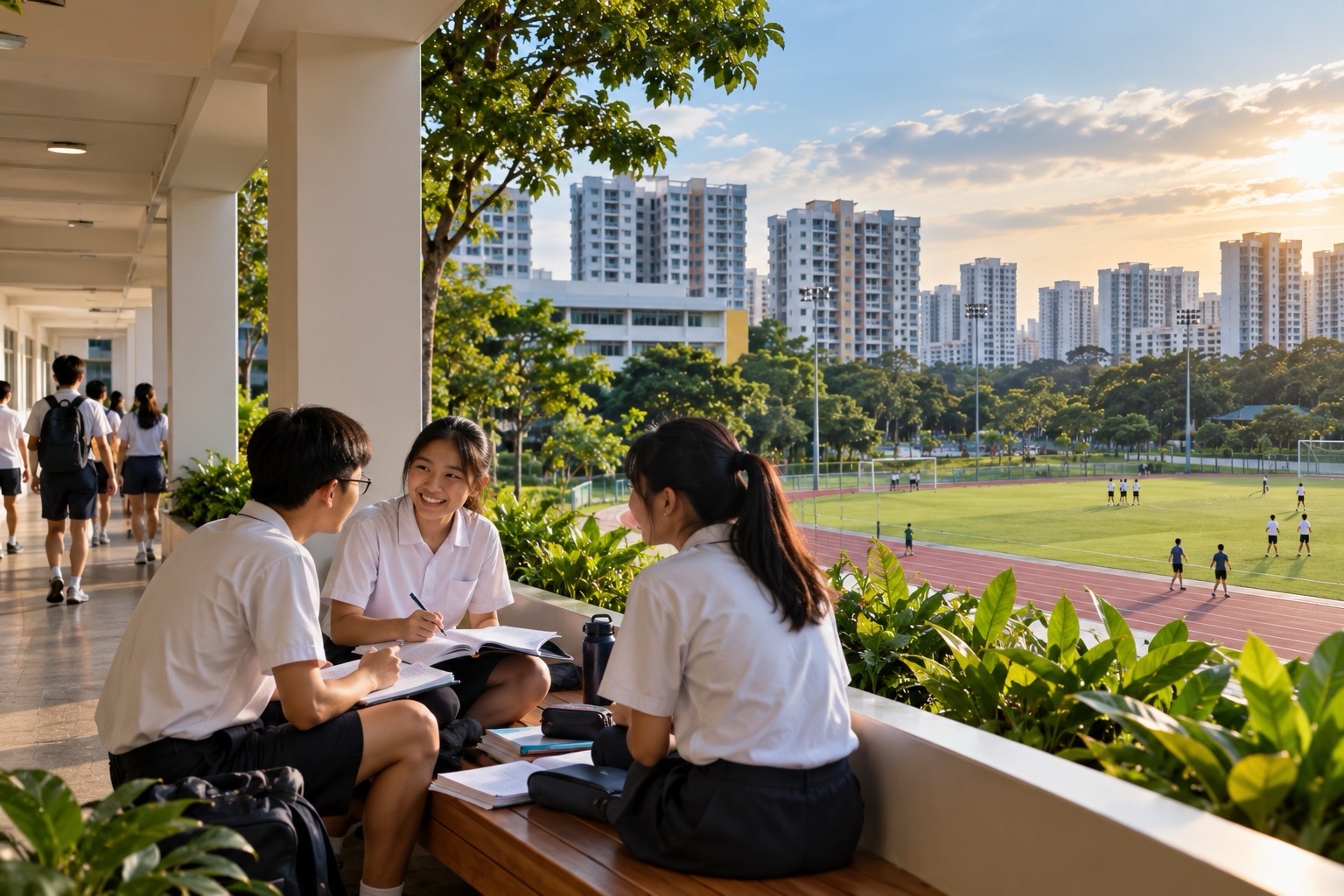
Holy Innocents’ High School is a Catholic co-educational secondary school at 1191 Upper Serangoon Road, Singapore 534786, with a Posting Group 1 (PG1) entry route and an affiliation to Holy Innocents’ Primary School. Its historical 2026 Secondary 1 admitted ranges for PG1 were 25–27 for non-affiliated applicants and 26–28 for affiliated applicants. The last admitted scores of 27 and 28 describe pupils who sat PSLE in 2025 and entered secondary school in 2026; neither result is a guaranteed 2027 cut-off. A family living in Punggol should check the child’s official Posting Group and actual affiliation eligibility, review MOE SchoolFinder and test the journey to Hougang MRT and Upper Serangoon Road before ranking the school.
Holy Innocents’ High’s signature learning combines Journalism and Broadcasting with its Good Samaritan Project in community leadership and service. Its official June 2026 Applied Learning Programme says all pupils receive foundational media literacy, interviewing, oracy, photography and videography, while selected interested pupils can pursue more advanced workshops, competitions and media roles. The Learning for Life Programme progressively develops compassion, values and student leadership through secondary-school service, including racial-harmony advocacy in Secondary 1, inclusion-focused work in Secondary 2, and community collaborations in upper secondary. The school’s Mustard Seed Project adds place-based interdisciplinary inquiry. Under Full Subject-Based Banding, PG1 describes the admission route and G1, G2 or G3 describe individual subject levels. This guide shows parents how to separate admissions, ordinary learning, talent opportunities and the child’s actual support needs.
- Holy Innocents’ High School: 1191 Upper Serangoon Road, Singapore 534786
- Co-educational government-aided Catholic secondary school in Hougang
- 2026 PG1 historical ranges: non-affiliated 25–27; Holy Innocents’ Primary affiliates 26–28
- Affiliation status and past scores do not guarantee a 2027 place
- ALP: Journalism and Broadcasting, focused on truthful, effective media communication
- Tier 1 for all students: interviewing, research, public speaking, photos and video journalism
- Tier 2 for interested or selected pupils: advanced media workshops and competitions
- LLP: The Good Samaritan Project, with service, compassion and leadership
- Secondary 1 VIA: school community, cultural respect and Racial Harmony Day advocacy booths
- Secondary 2 VIA: inclusion and Be Inclusive Day, with SEN-related awareness
- Secondary 3 and 4 service may involve community partners such as Morning Star, Good Shepherd and NKF
- Mustard Seed Project: interdisciplinary place-based learning and MuSP Canopy festival
- Formal Student Leadership Board roles are different from school-wide activities
- DSA 2026 talent domains include journalism/media, leadership, sports and performing arts
- Individual academic G levels and 2027 school notices require separate confirmation
Checked 1 November 2026. The two 2026 affiliated and non-affiliated ranges are historical. All admission, programme, selection and booklist decisions require current official confirmation.

Contents: Holy Innocents’ High PG1 and Media Learning Guide
- 1. Definition Lock: PG1, G1 and School Affiliation
- 2. Non-Affiliated 25–27 Versus Affiliated 26–28 in 2026
- 3. Holy Innocents’ Primary School and Affiliation
- 4. Understanding Historical Cut-Offs Without Guarantees
- 5. PSLE Score 25 and the Choice of Posting Group
- 6. The Campus at 1191 Upper Serangoon Road
- 7. The School’s Catholic and Co-Educational Identity
- 8. Journalism and Broadcasting as the ALP
- 9. Tier 1 Media Learning for All Students
- 10. Interviewing Begins With Listening
- 11. Media Literacy and Verifying a Claim
- 12. Photojournalism and Context
- 13. Videography and Responsible Editing
- 14. Oracy and Public Speaking for Beginners
- 15. Design Thinking in Media Reporting
- 16. Advanced Tier 2 Media Opportunities
- 17. Competitions and Media Recognition
- 18. Media Representatives and School Events
- 19. The Good Samaritan Project as the LLP
- 20. Four Levels of Service and Student Leadership
- 21. Secondary 1 VIA: Home and School Community
- 22. Racial Harmony Day Advocacy Booths
- 23. Secondary 2 VIA: Be Inclusive Day
- 24. Secondary 3 Service With Community Partners
- 25. Secondary 4 Service and the National Kidney Foundation
- 26. The Annual Teens Conference
- 27. Level Camps and Orientation
- 28. Mustard Seed Project: Interdisciplinary Inquiry
- 29. MuSP Place-Based Learning
- 30. Experts, Design Partners and Wider Perspectives
- 31. MuSP Canopy: Sharing Learning Responsibly
- 32. Learning Support Programme for Selected Pupils
- 33. Applied Learning Modules for Further Exploration
- 34. Arts@HIHS and Wider Creative Opportunities
- 35. DSA and Media-Journalism Talent
- 36. English and the Ability to Report Accurately
- 37. Mathematics and Reading Data in a News Story
- 38. Science and Evidence for Broadcasting
- 39. Mother Tongue and Cross-Cultural Communication
- 40. CCA Choices and the Return Journey
- 41. A Fictional Punggol Pupil Who Enjoys Interviews
- 42. A Fictional Class Learns About Inclusion
- 43. Compare Holy Innocents’ High With Nearby Schools
- 44. Your Next Step: Verify the Right Affiliation and Cohort
Definition Lock: PG1, G1 and School Affiliation
PG1 is the national Secondary 1 entry category used for pupils after the PSLE. G1 is the curriculum level of an individual academic subject under Full Subject-Based Banding, alongside G2 and G3. Affiliation is a separate recognition linking a particular primary school with a secondary school under MOE’s rules. These concepts must not be collapsed into one score or a statement about a child’s potential.
Parents should ask three different questions. Which Posting Groups does the actual result permit? Does a formal affiliation to Holy Innocents’ Primary School apply? Which subjects would the pupil study at which G levels after posting? The answers come from the official eligibility notice, MOE’s school information and the later school’s timetable. A child who enters through PG1 may have significant strengths in speaking, media or Mother Tongue while still needing support in another subject.
Non-Affiliated 25–27 Versus Affiliated 26–28 in 2026
The historical 2026 Secondary 1 PG1 admitted score range at Holy Innocents’ High was 25–27 for non-affiliated applicants and 26–28 for affiliated pupils. These are two different categories for the completed posting exercise based on PSLE 2025. The last admitted score was 27 in the non-affiliated group and 28 among affiliated pupils, according to published school records.
Parents must keep the correct category beside each score. A Punggol pupil without recognised affiliation cannot simply use the affiliated figure to infer a place. Equally, an eligible affiliate should not be guaranteed entry merely because the previous year’s range was more permissive. The next intake can have different preferences and vacancies. The formal MOE SchoolFinder data and official pupil result remain the relevant authorities.
Holy Innocents’ Primary School and Affiliation
Holy Innocents’ Primary School is the recognised feeder school for affiliation purposes, subject to MOE’s actual requirements. The relationship should not be inferred from sharing the words Catholic or Holy Innocents in a family history. Only a pupil who satisfies the formal conditions can be considered under the relevant affiliated category.
A parent should confirm how current national posting rules affect preference order and any applicable benefit. Do not rely on an older sibling’s experience or assume that all Catholic primary schools share the same priority. Affiliation can affect the allocation process but cannot determine whether the child’s learning environment is suitable. Families should still consider programmes, travel, subject support and the pupil’s own preference.
Understanding Historical Cut-Offs Without Guarantees
A Secondary 1 cut-off is the result of a completed school allocation involving pupils’ scores, school preferences and available places. It is not a qualification that automatically secures a seat for a future year. Meeting the last admitted score of 2026 may still leave uncertainty in 2027, particularly when multiple applicants compete at the same score and national tie-break rules apply.
Keep the intake year visible in a comparison table. If an online page lists only 28 without identifying affiliation, it is incomplete for a non-affiliated Punggol family. Likewise, a 27 headline should not be used to tell an eligible affiliate that affiliation is irrelevant. Correct interpretation prevents disappointment and helps families create a realistic set of genuinely acceptable schools.
PSLE Score 25 and the Choice of Posting Group
Under the current national framework, certain pupils with PSLE Score 25 are eligible to choose either PG1 or PG2. The decision changes how the child participates in ordinary S1 posting and can affect the starting academic demands. It should not be made solely to choose the number that sounds more prestigious.
At Holy Innocents’ High, the historical PG1 and PG2 affiliated and non-affiliated ranges differ. A family must therefore examine the exact row that applies rather than reuse the PG1 score for another group. Ask the primary school or MOE where the subject-level implications are unclear. The pupil’s individual readiness and the school choices available under each option are more useful than adult status concerns.
The Campus at 1191 Upper Serangoon Road
Holy Innocents’ High School’s official contact page lists 1191 Upper Serangoon Road, Singapore 534786. Its general office can be reached through the published telephone and email. The school is in Hougang rather than within Punggol. Its location should be distinguished from Holy Innocents’ Primary School, which has another address.
Test the actual commute from the Punggol home, including a weekday morning arrival and the return after CCA. Hougang MRT and nearby buses may be useful depending on the starting point, but no single travel time applies to everyone. Include the walk to the correct school gate and a plan for service disruption. Reliable travel, adequate rest and a manageable week matter to educational fit.
The School’s Catholic and Co-Educational Identity
Holy Innocents’ High is a government-aided Catholic co-educational secondary school. The school describes values including humility, integrity, respect and love and a mission of developing courageous and compassionate citizens. Parents should understand how the Catholic ethos informs character education and the school community, while recognising that national academic subjects are taught under the applicable MOE framework.
Ask whether the child can picture participating confidently in the school’s daily routines and values activities. A family’s choice should reflect actual learning needs and cultural fit rather than a simple ranking by religion or reputation. Good school experience is built through respectful teachers, friends and suitable programmes, not a promise that everyone shares the same personality.
Journalism and Broadcasting as the ALP
The school’s Applied Learning Programme is Journalism and Broadcasting, described in its June 2026 official page as preparing pupils to be innovators, effective communicators and leaders. Students learn to investigate issues and use media to express ideas in a clear and responsible way. This is a practical literacy programme, not merely teaching teenagers to operate expensive cameras.
A pupil can be curious about a community question but still need help reading sources accurately or writing a structured report. The ALP provides authentic contexts for communication, while subject teachers remain responsible for formal academic standards. Parents should ask how the child gathered evidence and why a particular media form was chosen.
Tier 1 Media Learning for All Students
Holy Innocents’ High explicitly describes Tier 1 as foundational learning for all pupils. It includes media literacy, research, interviewing, multidisciplinary design thinking, public speaking, photography and videography. This is important because a selected competition photograph on the school website should not be mistaken for the entire experience that an ordinary Secondary 1 pupil can expect.
Parents can ask which workshops are provided to the cohort in 2027 and what outcomes are assessed. A beginner does not need prior journalism experience to learn how to ask an accurate question or frame a photograph responsibly. School programmes can evolve, so exact media tools and schedules should come from current school notices rather than a historical activity photograph.
Interviewing Begins With Listening
An interview is not simply reading a prepared list of questions into a microphone. A student needs to understand whom they are interviewing, which information matters and how to listen to the answer. The school’s journalism ALP includes interviewing skills because accurate reporting depends on understanding what a person actually says rather than what the reporter hoped to hear.
A parent can ask the child what question would help clarify a claim and whether the answer should be quoted or paraphrased. Respect privacy and obtain suitable permission before recording people. A clear and accurate short interview can be more valuable than a dramatic piece edited to make someone seem to say something else.
Media Literacy and Verifying a Claim
A news report or social-media post can be persuasive while incomplete. Journalistic literacy involves comparing sources, identifying the origin of information and separating evidence from opinion. Holy Innocents’ High teaches media research as part of its foundational programme, offering teenagers a reason to question confident-looking claims.
Parents can discuss a suitable headline and ask where its supporting facts came from. Encourage pupils to identify what remains unknown. A dramatic image is not automatic proof of a general trend, and an AI-generated passage may contain fabricated details. Responsible information use develops through practice, not by assuming every online source is equally trustworthy or unreliable.
Photojournalism and Context
A photograph captures one viewpoint at one moment. Its framing and caption can influence how a reader interprets an event. Students learning photojournalism should understand that an image can be authentic yet still lack the context needed for a complete explanation. Their responsibility includes representing people accurately and respecting privacy.
Ask the pupil what lies outside the frame and what evidence supports the chosen caption. An image of a crowded corridor may not prove why the crowd formed. Good reporting distinguishes observation from inference. A teenager who learns to say what a photograph cannot establish is developing an important analytical skill.
Videography and Responsible Editing
Video journalism can involve planning scenes, recording sound, interviewing people and editing a sequence. These tools help communicate an issue when used accurately. Editing can also mislead if context is removed or an interviewee’s words are rearranged to create a meaning that was never intended.
Parents should ask the student what information the video should convey and what evidence is available. If a clip features classmates, appropriate school permission and privacy rules matter. A video can be creative and truthful simultaneously. Responsible production is more valuable than a viral result created through exaggeration or unauthorised sharing.
Oracy and Public Speaking for Beginners
Oracy is the ability to use spoken language effectively and to listen in different situations. Holy Innocents’ High includes public speaking in its foundational ALP. A student who hesitates in front of a group can develop confidence through appropriately supported practice and feedback. A strong reader may still find speaking difficult, and a fluent speaker may need help writing accurately.
Ask the child to explain one idea without memorising an adult-written speech. If the point is unclear, encourage a short structure: question, evidence, explanation and conclusion. It is reasonable to practise gradually. A pupil’s Posting Group does not determine whether they can become an effective communicator over time.
Design Thinking in Media Reporting
The school’s ALP includes multidisciplinary design thinking, which can help pupils identify a problem and consider a useful media response. A community issue may require information gathering before deciding whether to make a video, poster, interview or another format. The communication tool should serve the audience and the evidence, not be chosen only because it looks exciting.
Parents can ask who needs the information and which question remains unanswered. If the intended readers cannot understand the language, the student may need to revise. A good project involves listening, ideation, testing and explanation. Even a simple information leaflet can be effective when it is accurate and genuinely useful.
Advanced Tier 2 Media Opportunities
Holy Innocents’ High describes Tier 2 workshops and leadership opportunities for pupils with deeper interest or talent. The official list includes digital illustration, photography walks, videography, live sound and event management, student-led workshops and selected media competitions. These are additional opportunities rather than a promise that every new PG1 entrant will attend all of them.
Ask what selection, training or application procedures apply if the child is interested. A teenager may enjoy taking photos but prefer a different CCA after school, while another may want intensive media practice. Both choices are legitimate. The value of the broad ALP does not depend on a competition medal or specialist equipment access.
Competitions and Media Recognition
The school names platforms including a Singapore Youth Photography Competition, short-film competitions, news article writing, script writing and storytelling challenges. Such activities can motivate pupils to refine their work under clear constraints. A competition may also require careful research and accuracy rather than the ability to use the most sophisticated software.
Parents should not promise a selected place or award because the pupil attended an introductory journalism lesson. Ask teachers which opportunities genuinely exist for the new cohort and what skills should be built first. A thoughtful school report that was never entered in a competition can still demonstrate valuable media literacy.
Media Representatives and School Events
Holy Innocents’ High also offers opportunities to become a Media Representative, supporting school activities and developing journalism and broadcasting skills. Media work at an event can involve technical setup, interviewing, photography, sound or editing. These roles have real responsibilities and need suitable training, supervision and respect for others.
A pupil who hopes to take part should ask how the school selects or assigns roles. Not every student will operate a professional camera during a major ceremony. Behind-the-scenes preparation is valuable learning too. The most meaningful contribution is dependable, accurate work rather than being visible in every public photograph.
The Good Samaritan Project as the LLP
The school’s Learning for Life Programme is The Good Samaritan Project, focusing on compassionate student leadership and Values-in-Action. Its July 2026 official description aims to develop morally upright young people who recognise community needs and are willing to serve. The emphasis links humility, integrity, respect and love with real experience rather than merely reciting values.
A PG1 pupil can show compassion and leadership even while studying subjects at G1. Parents can ask what need the child noticed and how the action helped someone. A formal leadership badge is not required to demonstrate respect or responsibility. The programme is educational when students understand why their choices matter to other people.
Four Levels of Service and Student Leadership
Holy Innocents’ High uses a Levels of Service approach to develop leadership progressively. The school distinguishes broad experiences from more demanding responsibilities for formal student leaders. This recognises that an incoming Secondary 1 pupil is still learning how to participate and that different children are ready for different degrees of responsibility.
Parents should ask which VIA experiences are general and which involve Student Leadership Board selection. A quiet teenager may prefer joining a class activity before taking on a major event. Gradual development is meaningful. Requiring an official title immediately can distract from the basic skills of listening, planning and acting responsibly.

Secondary 1 VIA: Home and School Community
The school describes a service-learning progression beginning with the pupil’s immediate environment, including family and school in Secondary 1. This allows new teenagers to learn responsibility through familiar relationships. A project may involve organising a practical activity, promoting understanding or recognising needs that adults and pupils often overlook.
Ask the child what problem the group identified and whether others had a chance to contribute. Small changes in ordinary behaviour can be meaningful. A school-wide activity should not become an opportunity to shame classmates or publicise private circumstances. Responsible service begins with attention and respect close to home.
Racial Harmony Day Advocacy Booths
Holy Innocents’ High’s LLP page describes Secondary 1 pupils setting up booths with games and advocacy around Racial Harmony Day. These activities are intended to encourage appreciation of different communities and create a sense of belonging. Students must avoid reducing entire cultures to a single food or costume, even when an event is celebratory.
Parents can ask what the teenager learned that challenged an assumption and how the booth explained it accurately. A good activity invites respectful questions and interaction. The actual 2027 format may differ from past examples, but the educational principle is clear: citizenship involves learning with others rather than making quick judgments about them.
Secondary 2 VIA: Be Inclusive Day
The school’s LLP describes a Secondary 2 focus on understanding different special needs and organising Be Inclusive Day. Pupils can learn about accessibility, respect and participation through suitable lessons, activities and reflection. A school experience should not present one activity as a complete simulation of all disability experiences or make unsupported claims about other people’s abilities.
Ask the child whose perspectives were included and how they understood the needs. A pupil can develop empathy by listening and revising an assumption. The school provides suitable supervision and teaching context. Parents should encourage respectful language and protect the privacy of individuals represented in projects.
Secondary 3 Service With Community Partners
For Secondary 3, the school’s official page describes service-learning partnerships with organisations such as Morning Star and Good Shepherd under Caritas Singapore, including activities with children and families. The educational objective includes understanding needs, planning an age-appropriate response and working responsibly with community partners.
A pupil entering Secondary 1 in 2027 would normally reach this stage in 2029. Current partners or projects may change, so parents should not promise a particular placement now. The transferable skill is respectful service based on listening, preparation and reflection. A teenager can begin learning these habits through ordinary school interactions.
Secondary 4 Service and the National Kidney Foundation
The school’s published upper-secondary examples include collaborations with the National Kidney Foundation and related welfare organisations. Longer-term service can allow pupils to understand that meeting community needs requires consistent effort, not just a one-time visit. Student activity must take place under appropriate arrangements, particularly when health-related or personal information is involved.
Parents can ask how the pupil supported the agreed programme and what it taught them about dignity and care. A school visit does not confer medical qualifications or permission to discuss someone else’s health publicly. Meaningful service should respect the expertise of the organisation and the privacy of participants.
The Annual Teens Conference
Holy Innocents’ High’s Student Leadership Board has organised a Teens Conference inviting students from other secondary schools to discuss community issues with relevant organisations. Earlier events and online formats are documented, including a 2021 virtual conference. These show the kind of leadership opportunities available but are historical examples, not fixed invitations for every later pupil.
Ask whether current conference arrangements are offered and who may participate. A teenager can learn from understanding a social issue and discussing possible responses respectfully. The purpose is not simply to give an impressive public speech, but to encourage thoughtful action informed by people who know the issue firsthand.
Level Camps and Orientation
The school’s LLP describes student leaders helping plan activities for Secondary 1 to 3 camps and welcoming newcomers through group tasks. Camp experiences can support friendship, independence and appropriate challenge. School arrangements depend on the cohort, safety requirements and the particular activity. Old COVID-era descriptions should not be copied as current rules.
A parent can help the child prepare by checking the actual consent and packing instructions and discussing whom to approach if uncertain. Do not purchase specialist outdoor equipment without school advice. A camp’s educational value lies in safe participation, cooperation and reflection, not in forcing a teenager to demonstrate courage through unsafe behaviour.
Mustard Seed Project: Interdisciplinary Inquiry
Holy Innocents’ High’s Mustard Seed Project, known as MuSP, is a distinctive interdisciplinary learning programme. Its July 2026 page describes pupils investigating real-world issues through inquiry, reflection and authentic experiences. Examples include how Singapore manages change and continuity, how communities remain sustainable and how technology affects daily life.
The purpose is to connect knowledge across subjects rather than simply create a project with several labels. Students need to formulate a question, examine evidence and justify a response. A child who has practical insights may need help organising the written conclusion. Teachers can connect the project with formal language, Humanities, Science and Mathematics learning.
MuSP Place-Based Learning
The school describes place-based learning at venues including the Singapore Maritime Gallery, National Museum and National Gallery. Such visits can help pupils investigate ideas in real settings and use observations to develop understanding. The venue is a resource, not proof that a child understands a historical or social issue merely because they attended.
Ask the pupil what they noticed, what question the exhibit helped answer and which information remains uncertain. A school trip can create meaningful context for classroom learning when students reflect. Do not promise that every 2027 pupil will visit exactly the same locations; the school controls actual itineraries and availability.
Experts, Design Partners and Wider Perspectives
MuSP’s official page mentions collaborations with STUCK Design and the SUSS Success Centre, which can expose pupils to design thinking and industry perspectives. Such partners may show how real-world problem-solving involves constraints and consideration of users. It is not an automatic work attachment, professional certification or university admissions route.
Parents can ask what the student learned about how experts decide whether a proposed solution is suitable. A school programme should develop realistic curiosity about further study, not promise a specific job. The value is understanding how ideas are tested and applied, even if the pupil’s long-term interests change.
MuSP Canopy: Sharing Learning Responsibly
The Mustard Seed Project culminates in MuSP Canopy, a learning festival where pupils share insights and project work. A showcase can help students organise evidence, communicate findings and respond to questions. A polished display alone is not enough if the learner cannot explain its reasoning or limitations.
Ask what the child discovered and which piece of information changed their original view. Encourage recognition of teammates’ work and honest answers when something is not yet known. These are important academic and character skills. A school showcase should celebrate genuine learning rather than become an adult-designed marketing exhibition.
Learning Support Programme for Selected Pupils
Holy Innocents’ High publishes a Learning Support Programme for selected pupils, with teacher-coaches helping them develop good study habits, self-directed learning and core-subject understanding. The existence of such a programme does not mean every PG1 student automatically receives the same individual support or requires a formal diagnosis.
Parents with an actual concern should bring specific work samples or observations to the school. Is the pupil struggling to interpret instructions, organise assignments or calculate correctly? The right response depends on the barrier. A child may benefit from targeted guidance rather than multiple tuition classes added before school has diagnosed the need.
Applied Learning Modules for Further Exploration
The school’s programme listing includes Applied Learning Modules as opportunities for secondary pupils to explore real-world skills and interests. These can expand what students know about practical fields and later study routes. A module is not automatically open to every Secondary 1 entrant and may have an application, timetable or selection requirement.
Ask the relevant school contact about current modules and appropriate age or subject prerequisites. A teenager should explore interests while continuing to build academic foundations. Completion of a brief applied module does not guarantee an ITE, polytechnic or university place. It provides experience that can inform more realistic choices later.
Arts@HIHS and Wider Creative Opportunities
Holy Innocents’ High also describes Arts@HIHS, with performances, exhibitions and workshops in and beyond school. This is a useful complement to Journalism and Broadcasting because pupils can encounter creative expression alongside critical media research. A student may discover interest in music or visual storytelling without joining an elite competition group.
Parents can ask which experiences are broad and which require a selected CCA. A teenager who enjoys photography may still choose sport or a uniformed group for regular after-school activity. The school offers a wider environment, and a meaningful choice depends on real interest and sustainable commitment rather than a ranking of the most publicised club.
DSA and Media-Journalism Talent
Holy Innocents’ High’s 2026 Direct School Admission areas include media and journalism, sports, performing arts and leadership or uniformed group pathways. DSA follows a separate talent-selection process and requires applicants to meet the relevant PSLE Posting Group conditions. Participating in the school-wide Tier 1 journalism ALP after entry does not create a retrospective DSA offer.
Families with an actual DSA result should follow the relevant official preferences and commitment. In November, do not treat the earlier 2026 application window for 2027 entry as newly open. Other eligible families should use ordinary S1 posting. An impressive Primary 6 media video does not guarantee admission without the school’s assessment and academic conditions.
English and the Ability to Report Accurately
A pupil studying G1 English may be curious about media but need specific help with comprehension, inference or sentence organisation. Journalism gives a reason to read carefully and communicate accurately. It does not automatically teach all the grammar and writing skills of the formal syllabus without deliberate instruction and feedback.
Ask the teenager to summarise a short source, identify its main claim and distinguish supporting evidence from interpretation. If the response is unclear, repair that step instead of writing an adult-polished report. Strong media work depends on the student’s own judgment. A different academic G level requires the actual school and MOE eligibility criteria.
Mathematics and Reading Data in a News Story
Media reports can include charts, percentages and comparisons. A child studying G1 Mathematics needs foundations for interpreting such quantities accurately. A visually dramatic graph can be misleading when its axes or scale are misunderstood. Mathematical literacy supports responsible journalism and helps pupils avoid spreading numerical errors.
Parents can ask what the graph actually measures and whether the statement matches the numbers. If a fraction, unit or percentage is misunderstood, target the concept rather than demand unrelated advanced questions. A school media project offers a practical reason to improve numeracy without automatically changing the pupil’s subject level.
Science and Evidence for Broadcasting
A video explaining a scientific issue must be based on reliable evidence, not just a confident voice. Pupils should distinguish a tested observation from a possible explanation, recognise the limits of a demonstration and consider whether a source is trustworthy. The school’s applied programme can make these questions part of authentic communication.
Ask what evidence would change the pupil’s conclusion. Avoid encouraging unsafe experiments to create sensational footage. A careful answer that explains uncertainty is a better educational outcome than an exaggerated claim that goes viral. Responsible reporting and scientific inquiry reinforce each other.
Mother Tongue and Cross-Cultural Communication
Students entering through PG1 can have different strengths in Mother Tongue and English. Full Subject-Based Banding recognises subject-specific academic profiles where eligibility permits. A media project may also involve communicating across languages or explaining an unfamiliar cultural context accurately.
Parents can support appropriate reading and meaningful home conversation. Ask the school what actual language levels and resources apply. A pupil’s overall PSLE score does not establish every language ability. A suitable higher-level course should reflect readiness and a manageable timetable rather than the family’s social preference.
CCA Choices and the Return Journey
The school’s co-curricular opportunities include sports, performing arts, uniformed groups and media-related interests. A pupil attracted by Journalism and Broadcasting may still want to join a sport or choir. The school determines current options, trials and training schedules, and a selected CCA should not be confused with the general Tier 1 media programme.
For a Punggol household, test the trip home after a long CCA afternoon. The pupil needs meals, rest and time for homework. A schedule packed with multiple extra classes may make independence harder. Meaningful regular participation can build friendship and character without requiring every available activity or competition.
A Fictional Punggol Pupil Who Enjoys Interviews
Imagine a pupil with PG1 eligibility who is interested in asking questions and making short videos, but often misses important details when reading school instructions. The family researches Holy Innocents’ High’s ALP and checks both the child’s affiliation status and historical score data. They do not assume that an interest in media guarantees admission.
If the pupil attends, an interviewing task could reveal why listening and note-taking matter. The teenager can practise summarising a person’s response accurately and then review a written account. This fictional example is not a testimonial or a promise of a particular 2027 module. It illustrates how genuine interest can motivate precise academic learning.
A Fictional Class Learns About Inclusion
A fictional class prepares a booth for an inclusion activity. At first, students assume that one game can represent what every person with a disability experiences. A teacher helps them recognise that individuals have different needs and that respectful listening is essential. They revise the explanation and ask better questions.
The students learn that empathy requires more than a dramatic demonstration. This invented scenario illustrates the Good Samaritan Project’s educational direction, not an actual incident at the school. Parents can reinforce the same idea by discussing how to respect privacy and make a useful contribution without stereotyping others.
Compare Holy Innocents’ High With Nearby Schools
Punggol families can compare Holy Innocents’ High with schools in Punggol, Sengkang and Hougang using the same criteria: official PG1 eligibility, actual affiliation status, subject support, student culture, programmes and daily travel. Journalism and community leadership may suit one teenager, while another prefers robotics or outdoor learning. No programme is universally best.
Keep earlier admission ranges labelled by intake year and category. Ask what is offered to all pupils and which extensions depend on interest or selection. A good decision is one the family would be comfortable following after actual school allocation, not one built solely around reputation or a single historical number.
Your Next Step: Verify the Right Affiliation and Cohort
Check the pupil’s official PG1 eligibility and Holy Innocents’ High’s current MOE SchoolFinder profile. Verify whether the child actually qualifies for Holy Innocents’ Primary affiliation, then read the school’s Journalism and Broadcasting, Good Samaritan and Mustard Seed pages. Test the journey to Upper Serangoon Road and ask about actual 2027 subject and CCA arrangements.
Once a formal place is allocated, follow the school’s joining instructions, individual booklist and available academic support. Encourage the teenager to build friendships, ask teachers questions and contribute responsibly. PG1 is the entry route; the lasting educational result should be growth in accurate communication, knowledge, character and independence.
Frequently Asked Questions
Where is Holy Innocents’ High School?
1191 Upper Serangoon Road, Singapore 534786, in Hougang.
Is Holy Innocents’ High co-educational?
Yes, it is a government-aided Catholic co-educational secondary school.
What were the 2026 PG1 admitted ranges?
Non-affiliated 25–27 and affiliated 26–28, based on the 2025 PSLE cohort.
Which primary school is affiliated?
Holy Innocents’ Primary School, subject to current formal MOE rules.
Does Score 28 guarantee admission if affiliated?
No. The historic affiliated range is not a guarantee of the next year’s allocation.
What is the school’s ALP?
Journalism and Broadcasting, with media literacy, research, public speaking and photo/video communication.
Do all pupils join the media ALP?
Tier 1 is foundational learning for all pupils; advanced Tier 2 opportunities have distinct arrangements.
What is the Good Samaritan Project?
The school’s community leadership and VIA LLP, developing compassion and service.
What do Secondary 1 pupils do through VIA?
Its 2026 materials describe racial-harmony booths and school-focused service-learning.
What happens in Secondary 2?
Inclusion-focused learning and a Be Inclusive Day, according to school programme descriptions.
What is the Mustard Seed Project?
An interdisciplinary place-based inquiry programme that includes a MuSP Canopy sharing festival.
Does every pupil become a Media Representative?
No. This is an advanced interest or leadership opportunity, not an automatic admission outcome.
Can a child enter through DSA?
The school publishes media and journalism, arts, sport and leadership talent domains, with separate selection rules.
Does PG1 fix every subject at G1?
No. Individual academic subject levels and changes follow Full SBB eligibility and school arrangements.
What should a Punggol family verify first?
Actual PG1 and affiliation eligibility, current SchoolFinder data, daily transport and genuine learning fit.
Official Sources and Related Guides
- Holy Innocents’ High – Official Address and Contact
- Holy Innocents’ High – Journalism and Broadcasting ALP, June 2026
- Holy Innocents’ High – Good Samaritan Project LLP, July 2026
- Holy Innocents’ High – Mustard Seed Project
- Holy Innocents’ High – Learning Support and Other Programmes
- Holy Innocents’ High – Official Current Notices and DSA
- Historical PG1 2026 Affiliated and Open Score Ranges (independent reference)
- MOE SchoolFinder – Current PG1 and Affiliation Information
- MOE – Secondary 1 Posting
- Related: Serangoon Secondary PG1 (Separate Hougang Campus)
Your next step: Confirm actual PG1 and affiliation eligibility, read the school’s current media and Good Samaritan programmes, and test the commute from Punggol before ranking eligible choices.


