
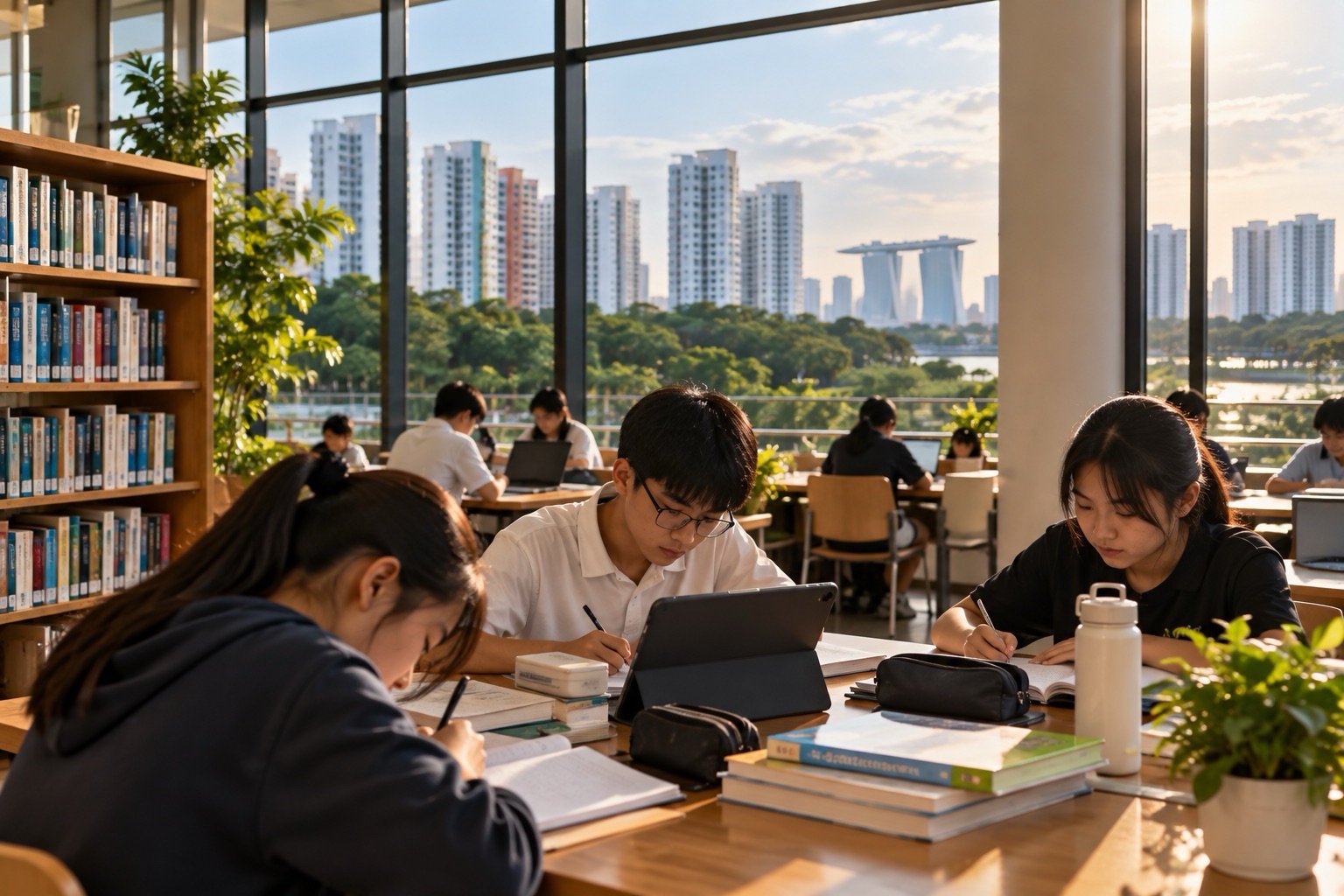
Serangoon Secondary School is at 11 Upper Serangoon View, Singapore 534237, in the Hougang area, and its historical 2026 Secondary 1 PG1 admitted PSLE Score range was 26–28. The last pupil posted through Posting Group 1 (PG1) in the 2026 intake had PSLE Score 28. That result describes the 2025 PSLE cohort and cannot guarantee 2027 admission at the same score. Punggol families should verify their child’s actual Posting Group eligibility, inspect the school’s current profile in MOE SchoolFinder, and plan the journey to Upper Serangoon View. The school lists Hougang MRT and Kangkar LRT as nearby transport references, and it is not the same institution as Serangoon Garden Secondary School.
The school’s distinctive learning combination is a STEM Applied Learning Programme around the Future of Transportation and a Community Youth Leadership Learning for Life Programme. Its September 2026 ALP guidance describes 3D Modelling and Printing for Secondary 1 and Drones Programming for Secondary 2; the school’s ICT department says these cohort activities involve all students at the relevant level, while selected Infocomm Club extensions provide more specialised opportunities. Its LLP progresses from caring for peers and school in Secondary 1 towards community service and leadership in later years, under the Project Ablaze identity. Under Full Subject-Based Banding, PG1 is an admission group, not a fixed stream or a guarantee of a particular G1, G2 or G3 subject combination. This guide helps parents compare the school’s real programmes, academic support, travel and future options without inventing a 2027 cut-off or a guaranteed drone club place.
- School: Serangoon Secondary School, 11 Upper Serangoon View, Singapore 534237.
- Historical 2026 PG1 admitted range: 26–28; final posted PSLE Score: 28.
- Historical last-admitted scores do not guarantee the outcome of the 2027 S1 posting.
- Official transport references: Hougang MRT, Kangkar LRT, buses 62, 74, 102, 113, 119, 136, 147, 324.
- STEM ALP: Future of Transportation, connecting Mathematics, Science, design and technology.
- All Secondary 1 pupils are described as doing 3D modelling and printing in 2026.
- All Secondary 2 pupils are described as learning drones programming in 2026.
- Selected Infocomm Club extensions are different from the ordinary cohort ALP.
- LLP: Community Youth Leadership and Project Ablaze, developing service and school values.
- Upper-secondary G1/G2/G3 Computing exists in the school’s 2026 programme, subject to eligibility; Mobile Robotics changes after 2026.
- Parents should check current 2027 books, individual subject levels, school reporting and actual commute.
Reviewed 1 November 2026. Historical PG1 data is the 2026 Secondary 1 intake, not the confirmed 2027 cut-off; individual academic options and programmes may change.

Contents: Serangoon Secondary PG1 School Guide
- 1. Definition Lock: PG1 and G1 Are Different at Serangoon
- 2. Why Serangoon Secondary Is in Hougang
- 3. The 2026 PG1 Range of 26–28
- 4. How PSLE Score 25 Creates a Posting Group Decision
- 5. Testing the Punggol-to-Hougang Route
- 6. What Future of Transportation Means as an ALP
- 7. Secondary 1 3D Modelling and Printing
- 8. Tinkercad and Designing With Constraints
- 9. A Design Prototype Is Not a Guaranteed Solution
- 10. Secondary 2 Drones Programming
- 11. Tynker and Block-Based Programming
- 12. Aerodynamics and Forces in Transportation
- 13. Infocomm Club Extensions Are Selective
- 14. G1, G2 and G3 Computing at Upper Secondary
- 15. Mobile Robotics: Beware Outdated Subject Lists
- 16. Project Ablaze: The Community Leadership LLP
- 17. Secondary 1: Caring for Peers and School
- 18. Secondary 2: Serving the Wider Community
- 19. Secondary 3: Building Community
- 20. Secondary 4 and 5: Shaping Society
- 21. SHINE Values and Daily School Conduct
- 22. Student Leadership Is Different From DSA Leadership Admission
- 23. English Reading and Explaining Designs
- 24. Mathematics for Scale and Measurements
- 25. Science and Computational Thinking
- 26. Mother Tongue and Subject-Specific Strengths
- 27. School Books and Uniforms for 2027
- 28. Home-Based Learning and Student Learning Space
- 29. CCAs and the Route Home
- 30. A Fictional Student Interested in 3D Modelling
- 31. A Fictional Student Learns Community Responsibility
- 32. Compare Serangoon With Punggol and Sengkang Schools
- 33. Your Next Step: Verify, Visit and Rank Responsibly
Definition Lock: PG1 and G1 Are Different at Serangoon
PG1 is the Secondary 1 admissions group based on the child’s official PSLE eligibility, while G1 describes the academic level of a particular subject. Under Full Subject-Based Banding, students can attend mixed form classes and take subjects at different appropriate levels where the rules and school arrangements permit. PG1 is not the former fixed Normal (Technical) stream renamed, and it does not determine whether a pupil can reason well, programme a simple device or contribute to a community project.
Keep admissions, subject allocation and CCA or ALP participation separate in the family’s records. A child might be eligible for a particular English level while still needing foundational Mathematics support. Another may enjoy practical computing without wanting a competitive technology CCA. The school should explain actual opportunities, and parents should avoid treating an administrative label as a comprehensive prediction of the teenager’s future.
Why Serangoon Secondary Is in Hougang
Although its name contains Serangoon, the school’s official address is 11 Upper Serangoon View, Singapore 534237, within the Hougang area. This is not Serangoon Garden Secondary at Serangoon North Avenue 1. Search results can place similarly named schools in different neighbourhoods, so the family should match the exact name, postcode and school website before planning a visit.
The contact page lists Hougang MRT and Kangkar LRT, together with several bus services. A Punggol parent should test the actual trip rather than assume the word Serangoon means it is far away or close. Geography is part of the daily experience: travelling time, reliable connections, walking routes and the pupil’s ability to arrive punctually matter regardless of the school’s name.
The 2026 PG1 Range of 26–28
Published records for Serangoon Secondary’s 2026 Secondary 1 intake show a PG1 admitted PSLE Score range of 26–28. The last admitted score was 28. These pupils sat PSLE in 2025; the data describes one completed posting exercise. A different cohort, different preferences or changes in available places can produce another cut-off. The lowest numerical score in the admitted range should not be confused with the score of the last admitted pupil.
For a family preparing a 2027 application, the correct use of 28 is historical comparison. It is not a guaranteed acceptance, and a child who scored 29 might still have PG1 eligibility nationally without a promise of entry here. Compare genuine options and follow MOE’s score, choice order and tie-break rules. Avoid using a website that turns last year’s number into a precise certainty.
How PSLE Score 25 Creates a Posting Group Decision
MOE permits an eligible student with PSLE Score 25 to consider PG1 or PG2, subject to the official framework. That means the family needs to choose an appropriate academic route and school list rather than assume all schools have the same score profiles. Serangoon’s previous PG1 admitted range starts at 26, reflecting actual allocations, while its PG2 range follows a separate posting history.
Parents should not use the PG1 cut-off 28 as evidence for a PG2 application. Read the child’s own eligibility notice and ask the primary school about the potential starting subject levels. The group selection in the ordinary S1 process follows specific rules and is not arbitrarily switched beside each of the six ranked schools. Choose based on academic fit and genuine options, not the perceived prestige of a group number.
Testing the Punggol-to-Hougang Route
A family’s route may involve Punggol LRT, the North East Line, buses or walking connections. The school’s September 2026 contact page provides the current address and transport references, but no fixed journey time can apply to every address in Punggol. The child should understand how to reach the correct gate and which route to use after a long CCA day.
Practice at the relevant morning reporting time with suitable supervision. Check safe crossings, waiting points and a plan for service disruptions. A convenient route can free time for reading and family life, while a difficult one may require an earlier sleep routine. Travel should be compared with other eligible schools as part of educational suitability, never presented as a replacement for national admission rules.
What Future of Transportation Means as an ALP
Serangoon Secondary’s Applied Learning Programme uses the Future of Transportation theme to connect Science and Mathematics with technology and engineering. The aim is for students to consider how transport systems operate and how they might be improved. It invites curiosity about a real-world field rather than treating coding and design as separate technical tricks without a purpose.
A child can explore a model and ask who would use it, which constraints matter and what evidence shows it works. For a PG1 student, this can be a motivating context for accurate measurement, logical reasoning and clear English explanation. The ALP should strengthen subject learning while giving students opportunities to notice problems and test solutions. It is not a promise of a transport engineering career.
Secondary 1 3D Modelling and Printing
The school’s 2026 ICT page says all Secondary 1 pupils experience 3D modelling and printing activities under Tier 1 of the STEM ALP. Its published programme uses Tinkercad and aims to develop basic design tools, prototype creation and problem-solving around the Future of Transportation. These are school curriculum experiences, not automatically selected robotics-club placements.
A parent should ask the teenager what the design was meant to do and how they knew the dimensions were correct. A printed object is not successful merely because the machine produced it. The pupil needs to learn why particular features were chosen and how they would evaluate the result. Specific software, resources and schedules may be updated for 2027, so the school notice takes precedence.
Tinkercad and Designing With Constraints
Tinkercad is a digital design environment the school identifies in its 2026 modelling programme. A pupil can use shapes and dimensions to represent an object before a physical prototype is produced. The educational lesson is understanding how design choices interact: changing width may alter strength, fit or material needs. A realistic model requires attention to the intended user and the constraints.
Encourage the child to explain the purpose of each major design element. If a dimension seems arbitrary, ask how it was selected. A student who learns to check their measurements is strengthening Mathematics and problem-solving. Parents should not take over the software project and produce a polished adult design; the learner needs to experience the reasoning and correction process firsthand.
A Design Prototype Is Not a Guaranteed Solution
An impressive-looking 3D print can still fail when it is used. The school programme introduces design and testing, helping students see that creating an object is only one stage of solving a problem. A prototype can reveal unexpected weaknesses, poor fit or a mismatch with the user’s actual need. This makes failure an opportunity for evidence-based improvement.
Ask what the pupil would change after observing the result. Did the model behave as predicted? Which assumption was wrong? Encourage honest reflection rather than demanding a trophy. That habit is useful in Science explanations, Mathematics checking and everyday decision-making. A prototype should be evaluated by what it teaches and how it is used, not by the number of photographs taken.
Secondary 2 Drones Programming
The school’s 2026 ICT information describes a Tier 1 Secondary 2 programme in which all pupils learn drones programming through block coding, including Tynker and simulated flight challenges. This develops understanding of algorithms, flight principles and debugging. A student entering Secondary 1 in 2027 would ordinarily reach the relevant stage in 2028, so the published 2026 module is a reference to the school’s current educational direction.
Parents should not promise every future pupil an identical drone model or activity schedule. Ask what students actually learn about safety, flight behaviour and programming choices. Do not encourage unsupervised flying in public spaces as preparation. The school’s controlled activities can help pupils understand technology without treating risk-taking as a measure of courage.
Tynker and Block-Based Programming
Block coding can make logical sequences visible to beginners. The school’s drone programming context allows students to predict how a command affects a simulated or appropriately supervised device. If the result is wrong, the learner can inspect a sequence or condition and correct it. This supports computational thinking even when the pupil has never written complex programming syntax.
A parent can ask the child to explain the program in ordinary language before executing it. Which instruction makes the drone turn? What would need to change to avoid an obstacle? The goal is reasoning and careful debugging, not pressing a button until something exciting happens. A suitable beginner programme can develop confidence while preserving the importance of safety and supervision.
Aerodynamics and Forces in Transportation
Serangoon’s ALP connects flight activities with ideas about forces and movement. A pupil may learn how different design choices can affect flight, and how models help test an explanation. This can introduce a richer understanding of science than memorising terms alone. Yet a simulation is still a model and has limitations compared with every real-world condition.
Encourage the learner to distinguish what a program predicts from what an experiment demonstrates. Ask what changed and which evidence supports the conclusion. Accurate reasoning matters more than complicated vocabulary. The academic Science syllabus provides the conceptual foundation, while the ALP creates a practical context for applying it at an appropriate level.
Infocomm Club Extensions Are Selective
The school’s STEM ALP overview distinguishes Tier 2 programmes for selected Secondary 2 and 3 students through the Infocomm Club. These can deepen interest in programming and emerging technologies. This selection is not the same as the Tier 1 activities described for all pupils. A new PG1 student should not be promised automatic access to every club project or competition.
Ask how pupils express interest, what level of preparation is expected and how club participation fits with other school responsibilities. A teenager who enjoys coding may be ready for further challenge, while another may prefer to explore technology through ordinary lessons. Both can develop useful skills. A selective extension should be an informed choice, not a marker of personal worth.
G1, G2 and G3 Computing at Upper Secondary
Serangoon’s ICT page provides 2026 information about Computing electives at G1, G2 and G3 for eligible upper-secondary pupils. This matters because students may pursue a real examined subject in a field they first encounter through the lower-secondary ALP. But the school also states that academic requirements and actual offerings determine access. An ALP lesson is not automatic entitlement to a G1 or higher Computing elective.
A pupil entering Secondary 1 in 2027 would usually make upper-secondary choices for a later year. Parents should ask for the current subject-combination booklet when the decision approaches. Do not assume the 2026 menu is fixed for 2029. Strong Computing requires logical reasoning, accuracy, reading instructions and sustained effort, not merely having enjoyed a short drone activity.
Mobile Robotics: Beware Outdated Subject Lists
The school’s 2026 ICT page specifically notes that its Mobile Robotics subject is to be discontinued from 2027. This is a useful example of why parents should read dates carefully. A historical upper-secondary subject list can be accurate for an older cohort yet inappropriate for a child entering Secondary 1 in 2027. National subject codes and available school subjects can change.
Do not buy a Mobile Robotics textbook or promise the pupil a particular 2029 examination simply because an old booklet mentions it. Ask the school which approved subjects remain available when the student reaches Secondary 3. The deeper interest in robotics may still be developed through other programmes or CCAs, but the exact credential must be verified.
Project Ablaze: The Community Leadership LLP
The school’s Learning for Life Programme focuses on Community Youth Leadership, with a distinctive identity called Project Ablaze. Its school information connects leadership with Values-in-Action and meaningful projects in the community. This is broader than formal prefect appointments. Every pupil can learn responsibility through class activities, peer support and service, while selected leadership opportunities have their own criteria.
A parent can ask what community problem the students tried to understand and how they decided on a helpful action. Encourage attention to the people being served rather than collecting photographs for an application portfolio. A PG1 pupil can make a thoughtful contribution even if they are still developing academic confidence. Character learning should be recognised through actual behaviour.
Secondary 1: Caring for Peers and School
Serangoon’s LLP progression starts in Secondary 1 with caring for peers and school. This suits pupils who are new to the campus and need to learn how their actions affect classmates. Small responsibilities—helping someone find a room, keeping a shared space organised or listening to a group member—can lay a foundation for later service and leadership.
Parents can ask the child to describe one helpful action they chose independently. Avoid demanding an official leadership badge in the first month. A new pupil may need time to settle in, make friends and understand routines. Respectful participation is meaningful even when it does not produce a certificate or public recognition.
Secondary 2: Serving the Wider Community
The published LLP progression moves from school-based care towards serving the community in Secondary 2. Pupils may encounter needs outside their own classroom and learn that a service activity should respond to people rather than an adult’s assumptions. Listening, preparation, teamwork and reflection are all important.
A student who is learning to communicate clearly can gain practice explaining a task to someone unfamiliar with it. Parents can ask what was learned from the people involved and how the pupil’s plan changed. Do not treat named service partners or past projects as guaranteed activities for every future cohort. The transferable goal is responsible participation and empathy.
Secondary 3: Building Community
Serangoon’s framework describes Secondary 3 as building community, an opportunity for older students to take greater responsibility for projects and work with different groups. The focus progresses beyond participating in an activity towards understanding how a team sustains positive impact. A student might have to organise information, invite others to contribute or assess whether an effort is useful.
Parents should value the ability to plan and follow through, not merely announce that the teenager is a leader. Ask whether they listened to feedback and considered long-term effects. A PG1 entrant may reach this stage after several years of academic and social development. Their original Posting Group does not establish the limit of responsibility they can learn to handle.

Secondary 4 and 5: Shaping Society
The school describes a later LLP focus on shaping society. By upper secondary, pupils can be encouraged to consider wider civic issues and the role young people play in them. This requires critical reading, fair-minded discussion and an understanding that one proposal may have trade-offs for different people.
A parent can support this development by asking for evidence and inviting a respectful alternative perspective. Do not require the teenager to hold an adult political position or perform grand claims about changing the world. The educational aim is thoughtful citizenship and the ability to contribute responsibly. The actual school programmes and subjects offered remain subject to the relevant cohort arrangements.
SHINE Values and Daily School Conduct
Serangoon’s LLP materials set out SHINE values: Self-Directedness, Harmony, Integrity, Resilience and Excellence. These describe the dispositions the school wants students to practise. They are more meaningful when attached to specific actions than when repeated as slogans. For example, self-directedness can mean checking an assignment independently; integrity can mean reporting what a project actually achieved.
Parents can ask what the child did when a task became difficult. Did they seek help, admit an error or listen to others? Formal school culture should create space for such decisions. A student does not need top academic marks to practise values, and a high PSLE score does not automatically prove strong character.
Student Leadership Is Different From DSA Leadership Admission
The school lists Community Youth Leadership as a DSA talent area, alongside Programming and 3D Modelling. DSA is a separate admissions process that assesses specific talent and includes academic Posting Group conditions. Ordinary LLP participation after entering the school does not mean every pupil has a DSA place or that every project is an admissions assessment.
Families should check the correct year’s DSA window and offer terms, particularly if the Primary 6 child has already applied. A final DSA allocation has its own commitment requirements. A pupil without DSA can still consider Serangoon through ordinary PG1 posting when eligible. Keeping these routes separate prevents false expectations and unnecessary paid portfolio preparations.
English Reading and Explaining Designs
A 3D printing task may be engaging, but the pupil still needs to read instructions and write a clear explanation. For a student taking G1 English, vocabulary and paragraph structure can be practical obstacles. A successful model does not necessarily prove that the child can describe why it works. The ALP offers a real context in which language development matters.
Ask the pupil to state the problem, explain the design choice and describe a test. If they simply copy a label from the screen, encourage a more independent answer. The English teacher can help identify which comprehension or writing skill needs support. Progress is genuine when the student communicates more accurately, not when an adult rewrites the report.
Mathematics for Scale and Measurements
3D models and transportation examples require understanding dimensions, units and sometimes ratios or simple graphs. These are valuable applications of Mathematics at G1 and other levels. A pupil may create an attractive object that cannot be printed correctly because measurements are inconsistent. Fixing the scale is a lesson in why accurate numerical reasoning matters.
Parents can ask the student what they measured and how they checked the output. If the unit conversion is wrong, repair that concept rather than demand advanced work unrelated to the actual difficulty. The school’s formal subject-level options depend on performance and MOE criteria, not on whether the child has completed a prototype.
Science and Computational Thinking
The STEM programme connects explanations of motion and flight with computational models. Students should distinguish a program’s intended behaviour from the evidence that it actually works. A simulated drone reaching its target is useful practice, but the pupil should still understand the assumptions and limits of the model.
Encourage the child to describe one test and one thing they would change. If the result was unexpected, ask what alternative explanation could fit. Such reflection develops careful scientific reasoning and helps pupils transfer learning between subjects. The goal is not to memorise fashionable technology phrases but to make thoughtful decisions with evidence.
Mother Tongue and Subject-Specific Strengths
A PG1 pupil can have strong Mother Tongue abilities while needing support in another subject. Full Subject-Based Banding recognises individual profiles, with school and MOE rules governing which levels may be offered. The child should not be described as equally strong or weak in every area simply because of the entry Posting Group.
Parents can support language through meaningful reading and conversation, then seek teacher feedback on formal writing and comprehension. An eligible more demanding level should be considered only where the pupil can manage it sustainably. A student’s interest in coding or service does not determine their Mother Tongue course; the subject deserves its own evidence.
School Books and Uniforms for 2027
Serangoon’s October 2026 event list includes information on the sale of books and uniforms for the 2027 school year. That can help families prepare after an actual posting result, but it does not mean every new pupil should buy materials before the school has confirmed the child’s G levels and enrollment instructions. Some textbook choices depend on the approved subject group.
Read the real school-issued booklist and ask which materials apply to the individual pupil. Keep records of purchases and inquire about financial assistance where necessary. An overloaded bag of speculative advanced textbooks is not a demonstration of ambition. Reliable access to the correct materials is more valuable for daily learning.
Home-Based Learning and Student Learning Space
The school’s official contact page provides Student Learning Space support details for Home-Based Learning, including school-based and central helpdesk channels. A new Secondary 1 pupil may need practice finding assignments, resetting access through authorised procedures and submitting work independently. Using school technology responsibly is part of learning to manage secondary education.
Parents can ask the child to show where the teacher’s task is posted and how they know a submission was completed. If access fails, use the school-approved support channel rather than share account credentials in a group chat. Digital literacy requires understanding and privacy, not merely possessing an expensive tablet.
CCAs and the Route Home
Serangoon Secondary’s school community includes a range of activities beyond the ALP and LLP. Pupils may be interested in sports, performing arts, uniformed groups or technology-oriented clubs, subject to current offerings and selection arrangements. A chosen CCA can build friendships and responsibility while academic lessons continue at the pupil’s individual subject levels.
Compare training days with the actual Punggol-to-Hougang journey, meals and homework. A student who is tired after a late activity may need a different weekly routine. Do not assume that joining a prestigious club guarantees LEAPS points or a future admissions place. Meaningful participation should be sustained and suitable.
A Fictional Student Interested in 3D Modelling
Imagine a child living in Punggol who enjoys designing objects in simple software but has difficulty interpreting written instructions. The family researches Serangoon’s Future of Transportation ALP, checks the actual PG1 eligibility and tests the journey to Upper Serangoon View. They understand that the 2026 last-posted score of 28 does not guarantee admission.
If the child attends, a 3D modelling task might create an opportunity to develop reading and measurement skills. A teacher could ask the pupil to explain why a prototype failed and how they would revise it. This fictional example does not guarantee a particular 2027 module. It illustrates how practical curiosity can motivate academic improvement.
A Fictional Student Learns Community Responsibility
Consider another pupil who rarely speaks during lessons but notices that a new classmate is struggling to join group activities. During a school-based service or leadership task, the student learns to invite participation and listen without dominating. Parents recognise the concrete behaviour instead of demanding a student council badge.
The child may still be developing foundational Mathematics or English, but their capacity to care for others is meaningful. This scenario illustrates the spirit of the school’s leadership programme rather than claiming any real student or guaranteed award. Formal selection and recognition remain separate decisions.
Compare Serangoon With Punggol and Sengkang Schools
Serangoon Secondary offers transportation-focused STEM and progressive community leadership. Another eligible school might emphasise environmental sustainability, entrepreneurship or health science. None is universally best. The useful comparison asks which real learning tasks appeal to the child and whether the school provides appropriate subject support and a manageable commute.
Rank schools you would genuinely accept and keep the admission years visible beside historical cut-offs. Avoid copying another family’s hierarchy of prestige. A thoughtful choice gives the child room to learn, form friendships and participate in activities without placing unnecessary pressure on the entry Posting Group.
Your Next Step: Verify, Visit and Rank Responsibly
First confirm the child’s official PG1 eligibility and current Serangoon Secondary SchoolFinder information. Read the school’s 2026 STEM and LLP descriptions, then seek any updated 2027 programme or joining details. Test the route to 11 Upper Serangoon View and ask how pupils access G1 teaching support, ordinary ALP modules and selected activities.
Next make a six-school list, where permitted, according to genuine preference and the current MOE posting instructions. After a formal allocation, use the school’s exact booklist and reporting information. PG1 is an admissions route; the meaningful long-term outcome is a child who becomes a more capable, responsible and confident learner.
Frequently Asked Questions
Where is Serangoon Secondary School?
11 Upper Serangoon View, Singapore 534237, in Hougang, according to the school’s official September 2026 contact page.
Is Serangoon Secondary the same as Serangoon Garden Secondary?
No. They are different schools at different addresses.
What was its 2026 PG1 cut-off?
The final posted score was 28, within the historical 2026 PG1 range of 26–28.
Does PSLE Score 28 guarantee a place in 2027?
No. Prior-year scores are not a future admissions guarantee.
What is its STEM ALP?
Future of Transportation, connecting 3D modelling, coding, drones, Mathematics and Science.
Do all Secondary 1 pupils learn 3D modelling?
The school’s published 2026 ICT curriculum describes that Tier 1 experience for all Secondary 1 pupils; check 2027 details when issued.
What do Secondary 2 pupils learn?
Its 2026 curriculum describes drone programming for all Secondary 2 pupils, subject to future changes.
Can PG1 pupils choose G1 Computing later?
Serangoon’s 2026 materials describe G1/G2/G3 Computing at upper secondary, subject to future offerings and eligibility.
Will Mobile Robotics remain an examined subject after 2026?
The school’s ICT page states Mobile Robotics is to be discontinued from 2027; do not rely on older booklets.
What is Project Ablaze?
The school’s Community Youth Leadership LLP identity, developing service and responsible leadership.
Does every pupil get into Infocomm Club projects?
No. Tier 2 programmes include selected students and have distinct participation requirements.
Can a child enter via DSA-Sec?
The school publishes DSA in Programming and 3D Modelling and Community Youth Leadership, with separate selection and PSLE conditions.
Does the school have a 2027 books notice?
Its October 2026 announcements include information about 2027 book and uniform sales; follow actual pupil instructions.
How should parents compare the school?
Use actual eligibility, the child’s learning interests and support needs, the programmes, and the tested Punggol commute.
Official Sources and Your Next Step
- Serangoon Secondary — Official Campus Address and Transport
- Serangoon Secondary — Future of Transportation STEM ALP
- Serangoon Secondary — Computing and 2026 ICT Subjects
- Serangoon Secondary — Community Youth Leadership LLP
- Serangoon Secondary — DSA Talent Areas
- Serangoon Secondary — 2027 Books and Uniform Announcements
- MOE SchoolFinder
- MOE — S1 Posting
- Serangoon Secondary 2026 PG1 Range (independent historical compilation)
- Related Guide — Compassvale PG1 and ACES
Your next step: Verify PG1 eligibility, current Serangoon Secondary SchoolFinder admission data and the actual journey to Upper Serangoon View. Ask how ordinary 3D, drones and leadership lessons differ from selected extensions, then rank genuine school choices.


