
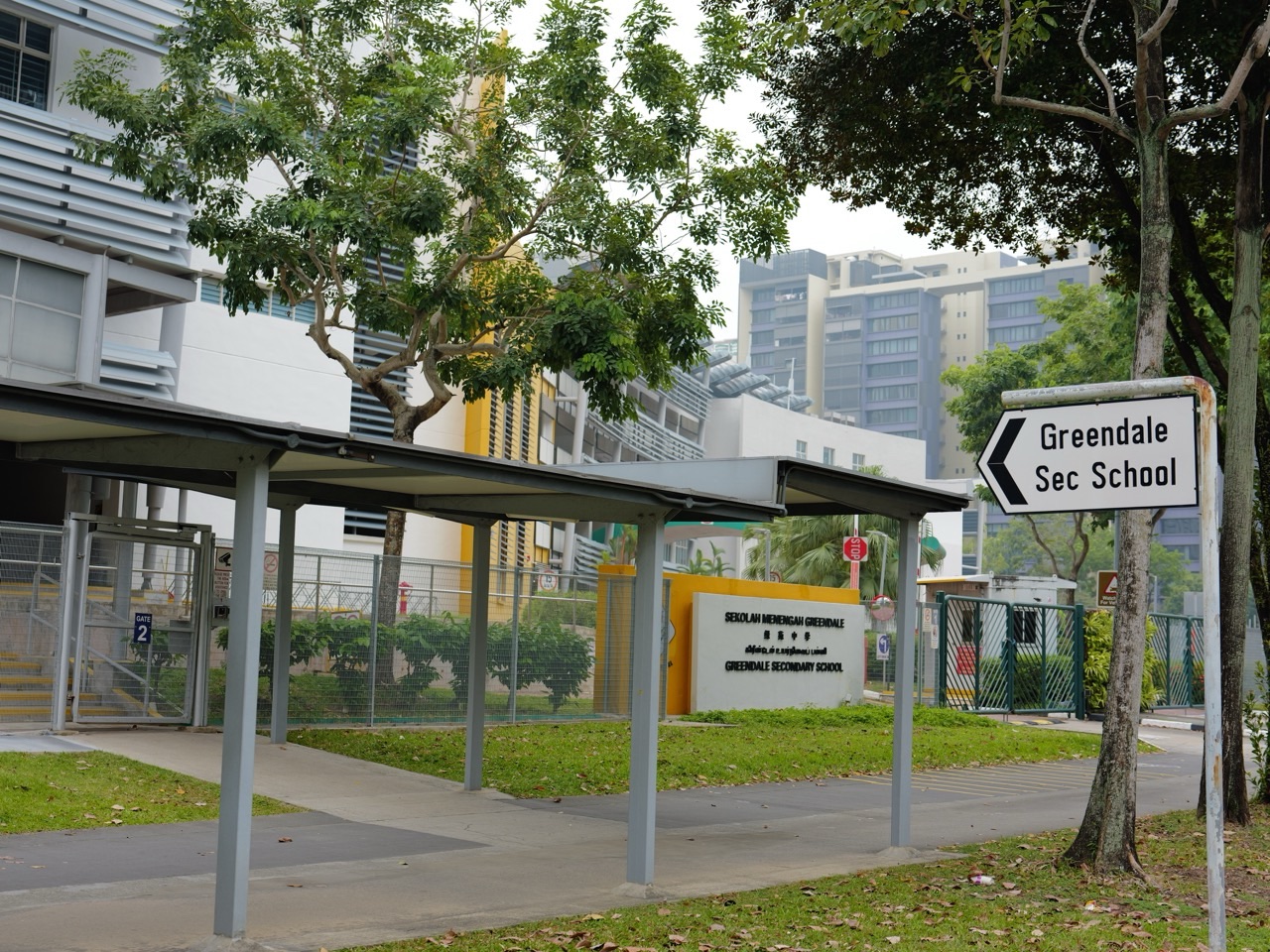
Greendale Secondary School is at 51 Edgedale Plains, Singapore 828866, and its published 2026 Secondary 1 Posting Group 1 (PG1) admission range was PSLE Scores 25–27. That range comes from the 2025 PSLE cohort entering in 2026, not from children who will enter Secondary 1 in 2027. The last admitted score of 27 is useful historical information but cannot guarantee a future place. Punggol parents preparing the ordinary six-school list should confirm the child’s official PG1 eligibility and use MOE SchoolFinder to review current school details rather than treating a prior cut-off as a fixed admissions rule. Greendale’s campus is near Meridian LRT, but families should still test the actual daily journey.
Greendale’s defining educational combination is its Design, Technology and Engineering (DTE) Applied Learning Programme and its Outdoor Adventure Learning for Life Programme. The school describes Secondary 1 experiences with coding, Arduino microcontrollers, CAD, 3D printing and sustainability, followed by more advanced design and community problem-solving in Secondary 2. Its outdoor approach builds practical judgement, collaboration and resilience. Under Full Subject-Based Banding, PG1 is an admission route, not a permanent academic stream or a restriction on every programme. This guide explains how those distinctive opportunities relate to the child’s actual subject levels, school choice, CCA commitments, transport and wellbeing, while distinguishing ordinary cohort learning from selective extensions and DSA pathways.
- School: Greendale Secondary School, 51 Edgedale Plains, Singapore 828866.
- Transport reference from the school’s website: Meridian LRT Exit B and local bus connections.
- 2026 PG1 historical admitted range: 25–27; last admitted PSLE Score: 27.
- Previous cut-offs are not guarantees for the 2027 Secondary 1 intake.
- ALP: Design, Technology and Engineering — design, code and build.
- Published Secondary 1 ALP experiences include Arduino, LEDs, servo motors, CAD and hydroponics.
- Published Secondary 2 extensions include mobile interfaces, AI/drones exposure and the SIT Community Challenge.
- LLP: Outdoor Adventure Education — safe challenge, teamwork, navigation and resilience.
- Greendale’s announced open house: 14 November 2026, 9 am–1 pm; check the school for updates.
- PG1 admission is distinct from the actual G1/G2/G3 subject combination and DSA selection.
Information checked 1 November 2026. Historical admission results reflect 2026 entry, not the unannounced 2027 allocation. Verify dates and arrangements through Greendale and MOE.

Contents: Greendale PG1 School and Family Guide
- 1. Definition Lock: Greendale, PG1 and G-Level Subjects
- 2. What Greendale’s 2026 PG1 Historical Scores Mean
- 3. Why a Score of 25 Can Create a Choice
- 4. Greendale’s Location and Meridian LRT
- 5. The DTE Applied Learning Programme in Plain English
- 6. Arduino, LEDs and Servo Motors in Secondary 1
- 7. Computer-Aided Design and 3D Printing
- 8. Hydroponics and Aquaponics: Why They Belong in DTE
- 9. What Secondary 2 Adds to the Design Programme
- 10. The SIT Community Challenge and Real Users
- 11. Outdoor Adventure as the Learning for Life Programme
- 12. Orienteering: More Than Following a Phone
- 13. Kayaking and Safety Requirements
- 14. Rock-Climbing and Managed Risk
- 15. What the 2026 Open House Offers Parents
- 16. Greendale’s Collaborative, Thinking and Safe Environment
- 17. What PG1 English Learning Can Look Like
- 18. Mathematics for Engineering: Units, Patterns and Checks
- 19. Science Reasoning and Experimental Evidence
- 20. Difference Between DTE ALP and Robotics CCA
- 21. Greendale’s DSA Is Different From PG1 Posting
- 22. How Greendale’s Subject Levels Are Determined
- 23. Learning Support and School Readiness
- 24. Outdoor Activities and a Realistic CCA Week
- 25. A Fictional Greendale Student Interested in Coding
- 26. A Fictional Greendale Student Excited by Outdoor Learning
- 27. Why 27 Does Not Mean Guaranteed Admission
- 28. A School-Choice Checklist Unique to Greendale
- 29. What a Meaningful First Year Could Look Like
Definition Lock: Greendale, PG1 and G-Level Subjects
Posting Group 1 is one of the categories used for Secondary 1 admissions under Full Subject-Based Banding. G1 describes a subject’s academic standard, while G2 and G3 describe others. A child entering Greendale through PG1 typically begins most examinable academic subjects at G1, but individual strengths and the prevailing school and MOE eligibility rules can lead to a different level for particular subjects. The Posting Group is therefore not a fixed stream and not a comprehensive description of the pupil’s abilities.
This distinction matters in a school that emphasises design and outdoor learning. A child may enjoy engineering projects while needing careful help with reading dense instructions. Another may be confident in English and nervous about a climbing activity. Both are ordinary differences that teachers can address. Parents should ask for the actual subject allocation and educational support instead of imagining that PG1 alone dictates every future experience or opportunity.
What Greendale’s 2026 PG1 Historical Scores Mean
Published admissions information for Greendale’s 2026 Secondary 1 intake shows a PG1 admitted range of 25–27. The score of the last student posted, 27, is commonly called the cut-off point. It was established by the previous cohort’s results and school-choice preferences, together with places available at that time. It does not fix the cut-off for the 2026 PSLE cohort entering school in 2027.
Families sometimes treat an historical score as a promise: “Your child has 27, so Greendale must admit them.” That is not correct. MOE’s current allocation rules and the next cohort’s choices will determine the result. Label every cut-off in the family worksheet with its correct intake year. Use it to understand past competition, not to invent a future acceptance percentage. Prepare several genuinely suitable choices rather than relying on one school’s previous outcome.
Why a Score of 25 Can Create a Choice
Students with PSLE Score 25 can have a choice between Posting Groups 1 and 2 under the current framework. That is a real school and learning decision, not a contest about which number sounds more prestigious. The selected group affects the school options the pupil is considered for, and the relevant official procedure does not let a parent freely switch group for each of the six school preferences.
If Greendale is being considered, examine the actual PG1 and PG2 information separately and ask the primary school for guidance where the pupil’s learning profile is uneven. A dual-eligible child may have different strengths across English, Mathematics and other subjects. The appropriate choice weighs actual eligible schools and a good starting pace. A parent should not convert a single year’s cut-off table into a universal instruction to choose one group.
Greendale’s Location and Meridian LRT
Greendale’s official contact page gives 51 Edgedale Plains, Singapore 828866. The school identifies Meridian LRT Exit B and nearby bus services as access points. This makes it relevant to families across Punggol, but the journey depends on the child’s home and the actual arrival time. A child living by Punggol Point may face different transfers from one living near Oasis or the Central area.
Test the school-day trip at a realistic hour, including station waiting, walking, crossings and the route to the correct school gate. Then test the return journey after an activity or CCA. An attractive engineering programme can still be a poor overall fit if the travel schedule is unsustainable for that family. A careful route audit protects time for sleep, meals and homework and should be recorded alongside other school-choice evidence.
The DTE Applied Learning Programme in Plain English
Greendale’s ALP is in Design, Technology and Engineering. Its school description uses a practical sequence: design, code and build. Students learn to notice a problem, represent a possible solution, test ideas and use suitable technology to implement them. The framework connects technology with empathy, creativity, critical thinking and collaboration rather than treating a device itself as the goal.
A PG1 pupil who enjoys making objects may find this approach motivating, but the learning still requires literacy and Mathematics. Describing what a device should do, calculating quantities and explaining a failed test are academic tasks as well as practical ones. Parents can ask the student what the design was meant to accomplish and what evidence showed it worked. That reflection helps separate genuine reasoning from simply following a demonstration.
Arduino, LEDs and Servo Motors in Secondary 1
Greendale’s published Secondary 1 ALP description includes basic electronics and Arduino microcontroller coding, such as making a buzzer sound, controlling LEDs and using servo motors. These examples help parents understand what the school means by technology learning: a pupil writes or follows a logical sequence and sees a physical response. The objective is to understand instructions and cause-and-effect relationships, not merely operate a toy.
At home, ask the child to explain what triggered the output and how they checked an unexpected result. Do not purchase expensive electronics kits without teacher guidance or allow unsafe electrical improvisation. Ordinary problem-solving can begin with paper flowcharts and carefully described sequences. The school provides the real teaching and approved equipment, while parents reinforce the habit of explaining why a result occurred.
Computer-Aided Design and 3D Printing
The school’s official ALP page also describes computer-aided design and rapid prototyping using technologies such as 3D printing and laser cutting. These allow students to move between an imagined object, a digital model and a physical version. The educational demands include measurement, constraints, design reasoning and awareness of equipment safety. A printed model is not necessarily successful simply because it looks impressive.
Parents can ask what measurements mattered and which design revision was necessary after testing. The student may discover that an object must fit a user, remain stable or be made from appropriate materials. Treat these discoveries as reasoning opportunities. Specialist equipment belongs under approved school supervision; a family need not recreate a fabrication workshop at home to support the child’s learning.
Hydroponics and Aquaponics: Why They Belong in DTE
Greendale describes hydroponics and aquaponics systems as contexts for sustainability and the application of microcontrollers. Students can connect sensors, observation, resource management and design decisions to something tangible, such as how plants grow and how a system is monitored. The aim is interdisciplinary reasoning, not proving that a single plant project makes a child a professional agricultural engineer.
A useful conversation asks what the system measures, how the reading informs a decision and what evidence would suggest the design needs improvement. Science and Mathematics come together in the explanation. Parents should avoid drawing conclusions from one observation or describing a demonstration as a formal experiment without controls. The best learning is accurate enough for the child to recognise both what they know and what remains uncertain.
What Secondary 2 Adds to the Design Programme
Greendale’s official description presents more advanced Arduino work in Secondary 2, including mobile or wireless interfaces, and exposure to emerging technologies such as AI and drone applications. It also highlights the SIT Community Challenge, in which students work with community problems through design thinking. This offers continuity from simple coding and prototyping towards more complex user needs.
A 2027 Secondary 1 pupil would ordinarily reach Secondary 2 in 2028, so the actual programme may change by then. Parents should treat current descriptions as evidence of the school’s direction rather than a binding future timetable. Ask what foundational habits make the next stage meaningful: understanding a problem, documenting work, testing ideas and collaborating. These skills remain useful even as software and technologies evolve.
The SIT Community Challenge and Real Users
Greendale’s school materials describe a collaboration with Singapore Institute of Technology in the SIT Community Challenge. Students apply design thinking to community issues, then present selected ideas and receive feedback. This is significant because a solution that looks clever to the designer may not actually meet the needs of the people affected. The process introduces real constraints and the need to revise assumptions.
For a student who is developing academic language, such a project can create an authentic reason to write clearly: who has the problem, what evidence was collected, what solution is proposed and how would it be tested? Parents can encourage a concise explanation and respectful feedback. Participation in a named competition or finals may be selective, so it should never be promised merely because the school runs the broader ALP.
Outdoor Adventure as the Learning for Life Programme
Greendale identifies Outdoor Adventure Education as its Learning for Life Programme. Its published approach uses concrete experiences to develop resilience, leadership, risk management and teamwork. Activities described by the school include orienteering, kayaking and rock-climbing. The programme aims to help young people learn through doing and reflection rather than hearing abstract speeches about character.
Parents should distinguish general LLP experiences from specific advanced or selected activities. Not every student must necessarily undertake the same water or climbing activity, and safety or access arrangements can matter. Ask the school what ordinary Secondary 1 pupils experience and how teachers assess risk. Responsible challenge should develop judgement and confidence, not push children into unsafe actions for the sake of a dramatic story.

Orienteering: More Than Following a Phone
Orienteering involves interpreting a map, understanding direction and making decisions about a route. Greendale’s outdoor emphasis includes such skills, and its DSA Outdoor Adventure materials describe additional competitions for selected students. Map-reading is valuable because a child must compare representations with the real ground and recognise when a chosen path does not fit the conditions.
Punggol families can discuss landmarks on an ordinary supervised walk. Ask how the child knows where they are and which route looks safer. Do not send students alone into unfamiliar terrain or treat a recreation outing as an unsupervised race. The same judgement used to navigate outdoors can support careful planning in school assignments: check the information, choose a method and revise when the evidence changes.
Kayaking and Safety Requirements
The school’s LLP and Outdoor Adventure DSA material mention kayaking as a possible learning activity. Water-based participation requires appropriate staff, equipment, risk assessment and any necessary readiness checks. The published DSA descriptions of certifications and expeditions concern particular pathways rather than a universal entitlement for every pupil admitted through ordinary PG1 posting.
Ask the school about its actual programme and how medical or mobility concerns are managed. Do not arrange independent kayaking as supposed preparation unless it is an appropriately supervised activity suitable for the child’s circumstances. Living in Punggol near a waterway does not confer water-safety competence. The educational value of adventure includes knowing when supervision and formal training are essential.
Rock-Climbing and Managed Risk
Climbing is another experience described by Greendale’s outdoor programmes. It can challenge coordination, problem-solving and communication, but safe participation depends on trained supervision and appropriate equipment. A child who is uncertain should be encouraged to ask questions and understand the safety procedure. The goal is not to prove that the most fearless pupil is the best student.
Parents should not encourage climbing on public structures or improvising safety equipment at home. If an activity is part of the school’s current programme, read the real participation instructions. A student can grow by managing an appropriately chosen challenge, listening to feedback and respecting others’ limitations. That learning can remain valuable even when the pupil is not selected for a competitive outdoor team.
What the 2026 Open House Offers Parents
Greendale’s official page announces an open house for Saturday, 14 November 2026, from 9 am to 1 pm, at 51 Edgedale Plains. It advertises student-guided or self-guided tours, learning spaces, CCAs, student performances and opportunities to speak with teachers and parents. As of 1 November 2026, this is a forthcoming event; families should check the school page for any update before travelling.
A useful visit has a research purpose. Ask about ordinary Secondary 1 DTE teaching, the school’s approach to safe outdoor learning and its provision for students studying academic subjects at G1. Let the child ask about a CCA or a practical project. Then assess the journey and whether the pupil can picture daily life there. An open house can inform a preference, but it is not an admissions interview or guarantee of a PG1 place.
Greendale’s Collaborative, Thinking and Safe Environment
The school’s 2026 open-house message describes a Collaborative, Thinking and Safe environment. These are useful claims to examine through actual routines: how do pupils ask for clarification, work in groups and report a safety concern? A school value becomes meaningful when a new student can describe what they do if a project goes wrong or a classmate needs help.
Parents should ask concrete questions rather than simply repeat the slogan. How is group work managed when students learn at different paces? Who supports a pupil who struggles to organise homework? How does the school communicate with families? The answers help evaluate whether the environment suits the child’s needs. No school can promise an absence of difficulty, but clear processes can make challenges easier to handle responsibly.
What PG1 English Learning Can Look Like
A student studying G1 English still needs accurate comprehension, appropriate vocabulary and clear written communication. Engineering lessons provide opportunities to explain procedures and project findings, but academic language does not improve automatically from touching equipment. A pupil may build a useful model but struggle to describe why it works. That is a specific learning difficulty worth identifying.
Ask the child to explain a project in four simple parts: purpose, method, evidence and conclusion. If the explanation is incomplete, ask which information is missing. The subject teacher can help connect this habit with school writing tasks. Avoid demanding higher-level English solely as a badge of status. The goal is the ability to read and communicate with growing independence at the actual appropriate level.
Mathematics for Engineering: Units, Patterns and Checks
Design and engineering activities create natural situations involving length, ratio, measurement, sequence and the interpretation of data. These rely on mathematical thinking even when the finished product is a robot rather than a worksheet. A pupil who makes persistent numerical errors needs to understand the relevant G1 concepts carefully before attempting more demanding calculations.
Parents can ask the student to estimate before calculating and check whether an answer fits the real object. If a component is measured in millimetres but a drawing uses centimetres, identifying the unit mismatch is a meaningful success. A practical context can motivate learning, but it cannot replace formal teaching. Any subject-level change from G1 to G2 depends on school and MOE criteria, not participation in a robotics project.
Science Reasoning and Experimental Evidence
Greendale’s technology and sustainability activities can involve comparing designs, measuring changes or interpreting environmental observations. The pupil should learn to distinguish what happened from a guess about why it happened. A model that works once has not necessarily been tested across relevant conditions. Such limitations are part of genuine scientific thinking.
Parents can encourage the child to describe which variable was adjusted and how the result was checked. Ask whether another explanation could fit the observation. Do not turn every project into a home experiment with hazardous equipment. The important connection between the ALP and Science is evidence-based reasoning, which can be developed at any academic subject level through carefully chosen tasks.
Difference Between DTE ALP and Robotics CCA
Greendale’s broad DTE ALP is not identical to membership of its Robotics CCA. The school has described a Robotics Club with its own programme and competitions, and its DSA-DTE pathway can involve specific CCA allocations for successful selected applicants. A family should not assume every student who learns basic Arduino in a cohort lesson will automatically join the competitive club.
Ask which activities are school-wide, which belong to an elective CCA and which require DSA or separate selection. The distinction matters for managing time and expectations. A student can enjoy introductory technology learning without wanting a four-year robotics competition commitment. Conversely, a highly motivated pupil can enquire about legitimate extension routes without assuming the child is automatically entitled to a place.
Greendale’s DSA Is Different From PG1 Posting
The school publishes DSA routes in Design, Technology and Engineering, Outdoor Adventure and Leadership. Each has its own selection criteria and official timeline. An applicant must still meet the PSLE eligibility requirements associated with an offer, and a successful DSA school allocation creates a commitment. These rules are separate from the ordinary six-school PG1 posting exercise.
Parents should not infer a DSA place from attendance at a school workshop or a positive open-house conversation. Read the specific programme requirements and offer type. For example, a child with an interest in outdoor navigation might explore the published Outdoor Adventure pathway, but selection is not automatic. The actual 2027 entry process belongs to the 2026 application cycle, with dates stated in that year’s official notice.
How Greendale’s Subject Levels Are Determined
Under Full SBB, PG1 guides initial academic subject levels, while individual PSLE subject results and school arrangements can create different levels where eligible. A pupil might have a strength in Mother Tongue that differs from their Mathematics readiness. The correct combination is issued by the school; it should not be guessed from the ALP’s technical emphasis.
A family should bring the child’s actual subject results and a few examples of work when seeking guidance. Higher-level study can be appropriate if the pupil meets the applicable criteria and can manage the workload. It is not an automatic reward for successful participation in a technical project. Conversely, studying one subject at G1 does not mean a child has no potential to contribute in engineering, leadership or outdoor education.
Learning Support and School Readiness
A teenager can struggle with executive routines even when they enjoy a programme. Remembering several teachers’ assignments, finding a classroom or organising a device takes practice. Greendale’s 2026 open-house information invites families to examine its learning and safe school environment; parents can use that opportunity to ask how the school supports new students and communicates instructions.
If the child has a persistent difficulty, describe it precisely: “They understand the Science demonstration but cannot write the conclusion,” or “They forget where assignments are posted.” Teachers can respond better to observed facts than to a blanket label of weak. Extra tuition should be considered only when it addresses an identified academic gap and fits a sustainable weekly routine.
Outdoor Activities and a Realistic CCA Week
An outdoor or robotics activity may extend beyond regular lesson hours and involve specialised training. A parent should check the current timetable, entry rules and practical responsibilities before promising the child access. A long CCA afternoon plus transport back to another part of Punggol can create a very different schedule from an ordinary school day.
Protect sleep, meals and time to complete schoolwork. A pupil who enjoys outdoor activities should not automatically be signed up for every available adventure extension. The best programme is one the child can participate in consistently while maintaining academic progress and wellbeing. Regular participation matters more than an impressive list of short-lived commitments.
A Fictional Greendale Student Interested in Coding
Imagine a Punggol pupil entering through PG1 who enjoys coding simple sequences but struggles to read lengthy English instructions. The family is attracted by Greendale’s design, code and build approach. They check the child’s eligibility, attend a suitable school event and ask what introductory technology lessons involve. They do not assume enthusiasm alone guarantees the school place.
If the pupil joins Greendale, a simple microcontroller task might provide a reason to understand instructions carefully and document steps. The family can support that learning by practising short explanations and asking the pupil to debug one changed example independently. This fictional story is not a testimonial or a guarantee of a particular module. It illustrates how practical interest and language development can support each other.
A Fictional Greendale Student Excited by Outdoor Learning
Consider another child who enjoys exploring parks but has never participated in a residential adventure programme. Their family likes Greendale’s LLP yet worries that the student will be expected to undertake every challenging activity without preparation. A useful school conversation distinguishes introductory cohort learning from selected advanced or DSA-specific experiences and explains the relevant safety arrangements.
The parents then discuss the actual programme with the child and practise simple independence: packing a bag, reading a route and asking for help. They do not arrange unsupervised climbing or kayaking. The scenario illustrates how to evaluate a school’s outdoor identity without either exaggerating danger or assuming all activities are compulsory for every pupil.
Why 27 Does Not Mean Guaranteed Admission
Greendale’s 2026 PG1 last posted score of 27 reflects one completed allocation exercise. The next cohort may have different school preferences and competition for places. A family can use previous figures to understand the school’s historical entry profile, but cannot convert them into an absolute guarantee for a child starting in 2027.
MOE’s S1 posting rules give preference to students according to the relevant score and tie-break processes, not simply to residents of a particular estate. If Greendale is a genuine first choice, rank it accordingly while including other schools the child could attend happily. A reliable plan does not require pretending that uncertainty has disappeared. It requires understanding the choices available and making a thoughtful preference list.
A School-Choice Checklist Unique to Greendale
Write down the correct PG1 admission group and intake year, tested route to 51 Edgedale Plains, actual DTE experiences, Outdoor Adventure opportunities, CCA interests and questions about academic subject levels. Note whether the child is drawn to technology, outdoor challenge, both or neither. The family’s preference should reflect what the student would experience repeatedly, not only a dramatic competition photograph.
Make a second column for information still unknown. Will a particular activity be offered in 2027? Does the child qualify for an advanced club? What documents are needed for the actual booklist? Those questions should go to the school rather than being filled with online assumptions. A good comparison preserves uncertainty where it exists and gives the child a genuine voice.
What a Meaningful First Year Could Look Like
A successful year at Greendale could involve improved reading accuracy, confident use of a school timetable, new friends, and thoughtful participation in a design or outdoor activity. A student may learn to explain why a simple circuit failed or how a safe route was chosen. These are worthwhile outcomes even if the child has not changed every subject level.
Compare evidence from the start and end of the year: corrected work, independent explanations and the ability to manage new responsibilities. Ask teachers about specific skills rather than demanding a single public verdict on PG1. Greendale’s stated vision of collaborative and thinking learners becomes meaningful when young people can learn, contribute and ask for help in ordinary daily situations.
Frequently Asked Questions
What was Greendale’s 2026 PG1 cut-off?
The last posted PG1 pupil for the 2026 Secondary 1 intake had PSLE Score 27, with a historical admitted range of 25–27.
Does 27 guarantee Greendale for 2027?
No. The completed 2026 intake cannot guarantee the following year’s allocation, vacancies or competition.
Where is Greendale Secondary School?
51 Edgedale Plains, Singapore 828866, near Meridian LRT according to school transport information.
What is its ALP?
Design, Technology and Engineering, introducing design thinking, coding, microcontrollers, models and sustainability.
What is its LLP?
Outdoor Adventure Education, developing teamwork, resilience and responsible risk awareness.
Will every Secondary 1 pupil join the Robotics CCA?
No such assumption is justified. Ordinary ALP experiences and the selected Robotics CCA are different programmes.
Does every pupil kayak or climb?
Actual cohort activities, suitability and selected pathways depend on school arrangements and safety requirements.
When is the announced 2026 open house?
Greendale has announced 14 November 2026, 9 am to 1 pm, subject to updates on its official page.
Is PG1 the same as G1 in every subject?
No. PG1 is the entry group; individual subjects follow Full SBB eligibility and school decisions.
Can a child apply to Greendale through DSA?
The school publishes DSA pathways for DTE, Outdoor Adventure and Leadership, with separate selection and PSLE eligibility conditions.
Does Punggol residence give S1 priority?
Ordinary S1 posting follows MOE academic and tie-break rules rather than a general distance entitlement.
What should parents verify before choosing Greendale?
Current PG1 eligibility, academic support, the child’s interests, DTE and outdoor programme details, CCA schedule and tested commute.
Official Sources and Your Next Step
- Greendale — Official Address and Contact
- Greendale — DTE Applied Learning Programme
- Greendale — Outdoor Adventure LLP
- Greendale — 14 November 2026 Open House
- Greendale — DSA Programmes
- MOE SchoolFinder — Posting Groups and School Profiles
- MOE — S1 Posting
- Greendale 2026 Historical Score Range (third party, verify through MOE)
- eduKatePunggol — PG1 School Comparisons
Your next step: Check your child’s PG1 eligibility and Greendale’s current SchoolFinder profile, then learn about its DTE and outdoor experiences and test the journey to Meridian. Rank the school according to genuine fit, not a guaranteed cut-off assumption.


