
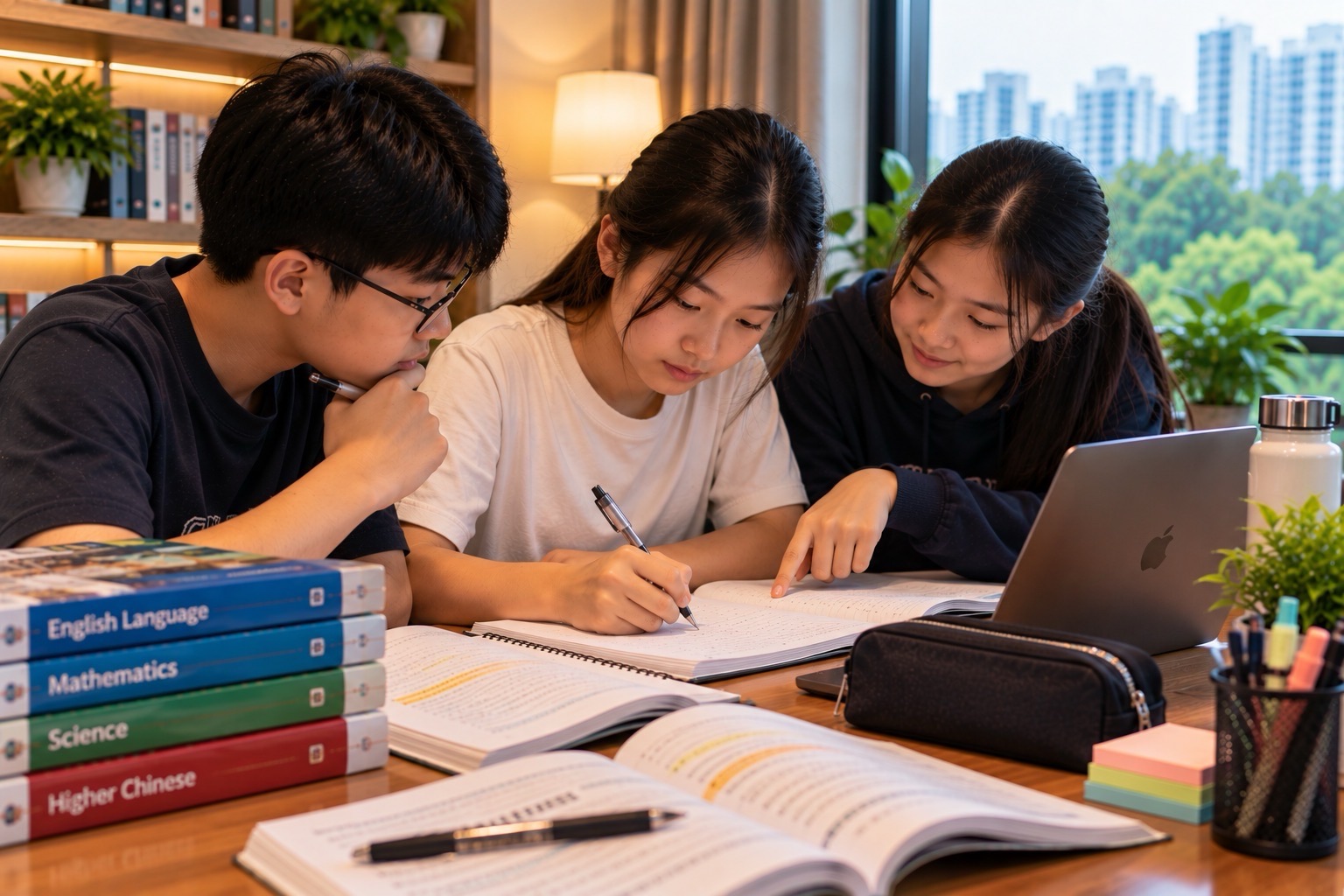
A pupil who enters a Punggol secondary school through Posting Group 1 (PG1) does not have their entire Secondary 3 subject combination fixed by the PSLE result. PG1 is the Secondary 1 admission group. Under Full Subject-Based Banding, students can offer individual subjects at G1, G2 or G3 when they meet the appropriate criteria, and schools also make upper-secondary subject offerings according to demand, resources and timetable arrangements. The actual combination chosen before Secondary 3 depends on the pupil’s lower-secondary learning, readiness, interests, approved subject options and the school’s selection process. A student who takes G1 Mathematics may have a different eligible level in another subject; the combination must be confirmed with the school.
For a student entering Secondary 1 in 2027, Secondary 3 would ordinarily begin in 2029, so a school publication titled “Secondary 3 Subject Options 2027” is not that child’s final selection booklet. It can illustrate how the system works but cannot promise the subjects that will be offered two years later. Parents in Punggol should start by learning the difference between compulsory academic subjects, electives, common curriculum and specialised offerings, then monitor the child’s work through Secondary 1 and Secondary 2. This guide explains practical subject-choice decisions under Full SBB, why school-specific criteria matter, and how to connect present competence with the eventual Singapore-Cambridge Secondary Education Certificate (SEC) without making unrealistic promises about future admissions.
- PG1 is used for Secondary 1 entry; G1/G2/G3 describe the academic standards of individual subjects.
- Upper-secondary subject combinations are selected through the student’s own school’s published process.
- Some academic core subjects continue at their approved lower-secondary levels unless an authorised change is made.
- Eligible students may have a mix of subject levels based on strengths, performance and school arrangements.
- Elective subjects, classes, teachers and timetables vary by school and demand.
- Do not assume G1 Computing, Design and Technology, EBS, Music, Art or POA is offered by every Punggol school.
- Individual school criteria may include results, preference order, aptitude, prerequisites and available places.
- Students entering Secondary 1 in 2027 will normally choose Secondary 3 subjects for 2029, not 2027.
- SEC records subject results at G1, G2 and G3 for graduating cohorts under the new examination framework.
- Choose a coherent, manageable programme, not the largest number of advanced-sounding subjects.
Information reviewed 1 November 2026. Examples from other schools illustrate the system; they do not establish a Punggol school’s 2029 course menu or an individual pupil’s eligibility.

Contents: PG1 to Upper-Secondary Subjects
- 1. Definition Lock: Posting Group Versus Upper-Secondary Subject Level
- 2. Why Secondary 3 Choices Matter
- 3. A 2027 Secondary 1 Entrant Reaches Secondary 3 Later
- 4. What the Core Subjects Look Like
- 5. G1 English Is Still a Foundation for Other Subjects
- 6. G1 Mathematics and Real-World Electives
- 7. Science Options Need Actual School Confirmation
- 8. Humanities and Social Studies Are Not an Afterthought
- 9. Elective Subjects Are Real Choices With Prerequisites
- 10. G1 Computing as a Concrete Example
- 11. Design and Technology: Explain the Thinking Behind Making
- 12. Elements of Business Skills and Similar Applied Choices
- 13. Art and Music at Upper Secondary
- 14. Principles of Accounts and Numerical Reasoning
- 15. What an Official Subject Combination Booklet Contains
- 16. How Merit, Demand and Timetable Capacity Interact
- 17. A Higher Subject Level Requires More Than a Wish
- 18. Why a Less Demanding Level Can Also Be Appropriate
- 19. Do Not Let One Elective Crowd Out English and Mathematics
- 20. How the SEC Records Mixed Subject Levels
- 21. Post-Secondary Interests Can Inform, Not Dictate, Selection
- 22. A Fictional Punggol Student Who Enjoys Building Devices
- 23. A Second Case: Strong Reading, Developing Mathematics
- 24. Questions to Bring to the Actual School Briefing
- 25. What to Do If a Preferred Combination Is Not Allocated
- 26. A Subject Decision Should Also Protect Wellbeing
- 27. Your Next Step: Build Evidence Before Choosing
Definition Lock: Posting Group Versus Upper-Secondary Subject Level
PG1 is a posting category based on the Primary School Leaving Examination and the national Secondary 1 admission rules. It is not a subject name and does not grant or prohibit a specific upper-secondary elective automatically. A subject taught at G1 is assessed at the G1 academic standard, while G2 and G3 have different demands. From the 2024 Secondary 1 cohort, the old fixed Express, Normal (Academic) and Normal (Technical) streams no longer define entrants’ entire academic programmes.
Parents should write the student’s actual subject levels separately on a sheet: English, Mathematics, Science, Mother Tongue and any relevant Humanities subjects. Then add a second column called “future subject options to confirm”. This avoids an error in which a PG1 label is treated as though it answers every question about G2 language study, an applied elective or the workload of a future upper-secondary programme. The school’s actual offering and the child’s eligibility must be checked individually.
Why Secondary 3 Choices Matter
Lower secondary offers a broad foundation and introduces pupils to several subjects, often alongside common curriculum learning in Art, Music, Design and Technology, Food and Consumer Education, Physical Education and Character and Citizenship Education. Before upper secondary, a student begins choosing among the approved combinations the school can actually offer. The decisions can affect the syllabus studied in Secondary 3 and 4 and the eventual examination subjects.
This is not the moment to select an attractive-sounding subject because an older cousin took it in a different stream. The child should understand what the subject teaches, which prerequisites matter and whether the weekly workload fits their learning. Subject selection is a real educational decision that should draw on several years of evidence. A family’s role is to help the teenager recognise strengths and limitations accurately, not simply demand whichever combination seems most prestigious.
A 2027 Secondary 1 Entrant Reaches Secondary 3 Later
A family reading an online “2027 Secondary 3 Subject Options” booklet may assume it is intended for their Primary 6 child. In fact, such a booklet generally describes pupils currently in Secondary 2 who will enter Secondary 3 in 2027. A child entering Secondary 1 in 2027 would ordinarily progress to Secondary 2 in 2028 and Secondary 3 in 2029, subject to their actual school pathway. The years are not interchangeable.
Use current school brochures to understand the range of subjects and selection process, but confirm all final choices when the child’s own school releases its relevant 2029 information. Offerings can change because of student interest, staff availability, resources or curriculum updates. The child’s performance and preferences may also change significantly during the next two years. Parents gain more by teaching a sound decision process now than by pretending the final 2029 combination is already fixed.
What the Core Subjects Look Like
Schools describe upper-secondary combinations around compulsory or core areas such as English Language, Mathematics, Science, Mother Tongue and Humanities, subject to the actual curriculum and any individual official arrangements. The exact subject titles, levels and components differ, so a broad list is not an individual prescription. A student who has a different approved academic level in one subject may continue with that combination where the school and MOE rules permit.
Ask the school to explain the required subjects first, before discussing electives. Then look at the weekly timetable and assessment load. If English demands more reading and written response practice, that must be recognised alongside any practical or technical elective. If Mathematics foundations remain insecure, adding difficult subjects may reduce the time available for repairing them. A coherent core is more useful than an elaborate subject menu the pupil cannot manage.
G1 English Is Still a Foundation for Other Subjects
G1 English supports reading instructions, responding to questions, speaking with clarity and writing understandable explanations. These capabilities are important in Humanities, Science and applied work, regardless of the pupil’s intended future route. A family might be tempted to focus entirely on elective subjects after discovering that the child enjoys technology or design, but English is not optional in most relevant educational pathways.
Assess the real issue: can the student read a problem independently, identify the requested information and structure an answer? A pupil who can discuss a project fluently but writes unclear paragraphs needs targeted instruction in expression. Another may write competently but misunderstand long task instructions. Each problem needs a different learning plan. A more demanding English subject level, where permitted, should reflect genuine sustained readiness rather than a wish to change the child’s status.
G1 Mathematics and Real-World Electives
Mathematics is useful even in an applied subject that does not appear to involve many calculations. Design tasks can require accurate measurement; business studies may involve prices and costs; computing can use logical sequences; Science requires interpretation of data. G1 Mathematics develops essential reasoning at its prescribed syllabus level. A child who studies at G1 should be encouraged to understand each operation rather than treat every mathematical task as memorisation.
If a technical elective appeals to the teenager, ask which mathematical skills will support it and which concepts remain difficult. Build practice around actual understanding. Using a harder textbook without permission is not the same as moving to another subject level, and an exciting elective does not guarantee a G2 or G3 change. School advice should connect the student’s current competence with the demands of the subject combination on offer.
Science Options Need Actual School Confirmation
Upper-secondary Science subjects may be organised in different forms and levels according to the school’s approved menu. Parents familiar with the old O-Level route may assume that every pupil can select any combination of separate sciences, while the actual subject prerequisites and available groups can differ. A student who entered through PG1 needs to understand the options their school makes available at the levels they are eligible to study.
Begin with the student’s evidence in lower-secondary Science: can they explain an observation, compare variables, interpret a graph and apply a concept in an unfamiliar context? Then ask which approved upper-secondary Science routes use those skills and at what pace. A coherent subject choice should strengthen a real interest without pretending that an advanced subject label guarantees a particular future diploma or career.
Humanities and Social Studies Are Not an Afterthought
Humanities involve understanding people, places, sources, decisions and explanations. The G1 Humanities Exposure Modules and G2/G3 Humanities arrangements at lower secondary can create different preparatory experiences. Some students may be eligible for more demanding Humanities study from Secondary 2 where the relevant criteria apply. The details of upper-secondary Humanities and Social Studies offerings depend on the school.
Parents should ask which skills the pupil demonstrates, not merely which subject seems easier to score. History may require careful interpretation of sources, Geography may involve understanding relationships and evidence, and social questions require clear explanations. A pupil who enjoys discussing community problems may find a motivating route into Humanities. A good choice recognises both interest and the student’s ability to cope with written demands.
Elective Subjects Are Real Choices With Prerequisites
Electives can include subjects connected to design, art, accounting, computing, music, business or other domains, but the national list of subject syllabuses is not a guarantee that the child’s school offers each one. Schools assess demand, academic performance, available classrooms and staff, timetable compatibility and their own approved options. A subject may appear in the previous year’s booklet yet not run for a later cohort.
During subject-choice briefings, ask the school which electives a pupil with the child’s academic combination may actually choose, whether a prerequisite grade or prior learning is required, and which preferences are ranked. Do not advise the child to select three different electives that the school explicitly says cannot be combined. The best way to prevent disappointment is to understand the real menu before writing the preferred order.
G1 Computing as a Concrete Example
Pasir Ris Secondary School’s official 2027 Secondary 3 options provide an illustrative G1 combination that includes G1 Computing. This example is useful because it shows that applied or digital subjects can appear in a formal upper-secondary programme. It does not imply that all four Punggol secondary schools offer the same subject, that computing is compulsory for PG1 students, or that a school outside the town must accept a particular pupil.
Computing can teach structured thinking, recognising patterns, building sequences and testing solutions. A student who enjoys digital tools should also understand the difference between using an app and learning how a system works. Parents can encourage logical explanation and responsible digital behaviour without claiming that a coding club automatically qualifies the student for an examined subject. Confirm the current school programme and actual entry requirements before treating the subject as a planned option.
Design and Technology: Explain the Thinking Behind Making
Design and Technology can connect planning, material choices, measurement, safety and testing. It gives students a reason to articulate why a solution meets a need rather than merely make an attractive object. The subject may appear at different academic levels or as part of a common lower-secondary curriculum, while upper-secondary examination offerings must be confirmed with the school.
A pupil who enjoys making things should be encouraged to document the process. What was the problem? Why choose this material? How was the result tested? What safety precautions mattered? Those questions reveal readiness better than a photograph of a finished product. Where the child needs stronger written explanation, practical experience can motivate more precise use of English without substituting for the formal syllabus.
Elements of Business Skills and Similar Applied Choices
Some official school combinations include business-related applied subjects at the relevant G level. Such subjects may address practical operations, workplace decision-making, customer situations and basic financial reasoning, depending on the published syllabus. The title should not be confused with a promise of future business ownership or guaranteed ITE admission. Actual upper-secondary subject offerings and codes can change by cohort.
Parents should encourage the child to identify which tasks they find meaningful: reading a customer instruction, organising a simple inventory, comparing costs or explaining a workplace decision. These require numeracy, literacy and reliability. An interest in business is a useful starting point, but it must be matched against the actual school option and the pupil’s ability to work through its assessments. A relevant subject is not automatically an easy examination.
Art and Music at Upper Secondary
Art and Music can become formal examinable options in some secondary pathways, but not every school provides every level or specialised combination. The lower-secondary common curriculum experiences can help pupils recognise an interest before they face elective decisions. A pupil who enjoys creative work should learn that an examined arts subject involves sustained development, feedback and work to deadlines, not only spontaneous inspiration.
Ask the child whether they like the practice process and can manage the required commitments alongside core subjects. A strong CCA performance does not automatically establish eligibility for an examined Music syllabus. Similarly, enjoyment of drawing may not reveal the demands of a formal Art course. Speak to the school about portfolios, prerequisites and subject-specific expectations when the choice becomes real.
Principles of Accounts and Numerical Reasoning
Principles of Accounts may appear among upper-secondary electives at relevant levels in some schools. It involves structured financial information, interpretation and careful application of accounting concepts. Parents sometimes assume that an accounting subject is simply arithmetic and therefore naturally suited to any pupil who enjoys calculating. In practice, understanding the rules and communicating explanations can matter as much as number accuracy.
A student who is interested should examine examples of the actual syllabus and ask the school’s subject teacher what preparation is needed. Do not confuse a practical family budgeting activity with the full academic subject. If the school does not offer the relevant option, discuss what other subjects may develop similar logical habits. The educational aim is to build competence, not to collect a subject name associated with a fashionable career.
What an Official Subject Combination Booklet Contains
School selection booklets may show compulsory subjects, elective options, eligibility criteria, timetable rules and how pupils submit their ranked preferences. They may also describe likely numbers of classes or state that offerings are tentative. This is not meaningless fine print. It explains why one pupil may not receive their preferred combination even when the subject is listed in the national syllabus.
Parents should read the document with the child, making notes on terms they do not understand. Ask whether a choice depends on passing a prerequisite, achieving a defined standard, meeting a selection assessment or obtaining a place where demand exceeds resources. Then separate choices the student actually qualifies for from possibilities that are not yet available. A clear shortlist prevents the family from ranking options that the school cannot realistically allocate.
How Merit, Demand and Timetable Capacity Interact
Pasir Ris Secondary’s published 2027 options state that subject allocation depends on student performance and aptitude, the number of available vacancies and school resources. Such statements illustrate a general planning reality: classrooms and teachers are finite, and combinations cannot always run in every possible pairing. Each school’s current policy must determine the actual allocation rules for its pupils.
A family should avoid treating preference order as a guaranteed purchase. If a student narrowly meets a threshold, competition or timetable constraints may still matter. Ask the school what happens when an option is oversubscribed and whether alternative combinations are offered. Explain the uncertainty to the child before submission. The aim is to make thoughtful choices and maintain a workable second option rather than treating any deviation from first preference as unfairness.
A Higher Subject Level Requires More Than a Wish
Students who demonstrate appropriate competence may be able to offer selected subjects at more demanding levels under Full SBB, subject to official rules and the school’s readiness assessment. Some school documents describe specific grade thresholds or review points, but parents must not copy one institution’s number into another school’s policy. The demands of a G2 or G3 syllabus differ in content, pace and assessment.
Ask whether the child can explain concepts independently across several tasks and manage the workload sustainably. If the next level requires significant reading or mathematical foundations, identify the missing prerequisite before making the decision. A higher level may widen some options, but a fragile understanding can make the transition harder. The right educational ambition is to learn well at an appropriate level and seek further challenge when the evidence supports it.

Why a Less Demanding Level Can Also Be Appropriate
Full SBB recognises that students may need adjustments in different directions at appropriate stages. A pupil who is finding one subject overwhelming should not be required to struggle indefinitely merely to maintain the appearance of a particular level. School guidance can help families discuss whether a different syllabus demand or better targeted support is suitable, within the available policies.
This decision deserves care. It should not be framed as a permanent declaration about intelligence or character. Ask what the student has actually learned, why the current demands are difficult and which options are open. Sometimes focused support within the present level is best; in other cases an approved adjustment may help. The school must explain the real implications for later subjects and post-secondary prerequisites before a family agrees.
Do Not Let One Elective Crowd Out English and Mathematics
A child may become enthusiastic about computing, art, engineering or a business subject and want to devote all study time to it. Interest is valuable, but English and Mathematics still support the ability to read instructions, calculate, communicate and proceed to many further courses. An upper-secondary combination should be balanced around the entire week, not a single exciting component.
Ask the pupil how much homework and independent practice they already manage, including CCA afternoons and travel. Compare the actual school timetable when available rather than assuming all electives have the same workload. The best route leaves enough capacity to understand compulsory subjects and enjoy school life. A demanding elective can be worthwhile when the child is prepared, but excessive overload is not evidence of higher ambition.
How the SEC Records Mixed Subject Levels
From the 2027 graduating cohort, the Singapore-Cambridge Secondary Education Certificate (SEC) records examination subjects at their relevant G1, G2 and G3 levels. The common certificate does not make the academic standards identical. Different subject levels continue to have their own requirements and grading arrangements. Pupils should understand that their final certificate reflects the subjects and levels actually offered and examined.
For a 2027 Secondary 1 entrant, the eventual examination is normally years later. Families can learn the structure now without pretending to know every course entry requirement in that future year. When post-secondary applications become relevant, refer to the latest MOE, SEAB and institution criteria. A combination should serve real learning and intended pathways, not an imagined guaranteed aggregate produced years in advance.
Post-Secondary Interests Can Inform, Not Dictate, Selection
A pupil interested in engineering, design, healthcare, arts or service should learn what education those routes require. But a thirteen-year-old may change interests repeatedly. The useful decision is to preserve realistic options where possible, considering their actual subject strengths and the programmes the school offers. It is unwise to close off every alternative based on a career video watched last weekend.
Ask which skills the child enjoys using and which courses appear genuinely interesting after reading official descriptions. Then discuss the associated subject requirements with teachers. If a particular pathway needs stronger Mathematics or English, that is useful information for learning priorities. It is not a promise that taking a named elective automatically grants admission to the corresponding diploma or employer.
A Fictional Punggol Student Who Enjoys Building Devices
Imagine a student entering through PG1 who enjoys building simple models in Design and Technology. During Secondary 1, they discover a need for more accurate measurement and clearer written explanations. Their family helps identify those skills rather than buying an advanced computing textbook immediately. In Secondary 2, the student asks teachers about the school’s actual upper-secondary options and the evidence needed for a relevant elective.
If the school’s available menu fits their interests and readiness, they can rank the approved choices accordingly. If the preferred subject is not offered, they investigate alternatives that build useful related skills. This invented example shows why a child’s interest is a starting point, while syllabus eligibility and school capacity determine the actual combination. It does not claim that any named Punggol campus guarantees a computing seat.
A Second Case: Strong Reading, Developing Mathematics
Consider a fictional pupil who reads and discusses complex ideas confidently but still makes recurring errors with fractions and negative numbers. The family wants the highest possible combination because the child excels in one domain. A more useful approach is to distinguish subject strengths: discuss appropriate Humanities or language opportunities where eligibility permits, while repairing the Mathematics foundation before demanding greater syllabus depth.
The school explains which changes and electives are available. The student participates in the decision rather than being described as “PG1 overall” in every conversation. They may develop a combination that recognises reading strength without creating avoidable overload. The example has no guaranteed promotion; its value is showing how Full SBB encourages accurate decisions about separate subjects.
Questions to Bring to the Actual School Briefing
A productive subject-choice briefing should resolve four kinds of uncertainty: what is available, who is eligible, how places are allocated and what future consequences the choice has. Ask which subjects are compulsory, how electives are ranked, whether any combinations clash in the timetable and when the school confirms outcomes. Also ask which teacher can explain a course’s actual learning demands.
If the family hears that a subject is not offered for the coming cohort, avoid arguing that it appears in a national syllabus list. Schools operate with real resource and demand constraints. Ask what the closest approved alternative might be and whether it meets the child’s learning goals. Take notes and discuss the options calmly at home. The child should leave understanding why each selected combination is meaningful.
What to Do If a Preferred Combination Is Not Allocated
Subject allocation can be disappointing when an attractive elective is oversubscribed or the student’s current prerequisites are not sufficient. Parents should read the official result and ask the school about any appropriate review or clarification process. Avoid promising a successful appeal when the school has already explained a legitimate resource or academic constraint.
Then help the student explore the combination actually available. Identify skills it can develop and which related interests can continue through CCAs, clubs or appropriate activities. One subject choice does not define an entire career. Respectful engagement with school staff and a constructive plan for the learner are more useful than turning an allocation issue into a public argument about prestige.
A Subject Decision Should Also Protect Wellbeing
The pupil who carries the textbooks and completes the assignments should have a meaningful voice. Some combinations may be academically suitable but unsustainable if they create a long daily workload on top of CCA, family responsibilities and commuting. Parents should distinguish healthy challenge from chronic exhaustion. The student’s wellbeing matters alongside grades and future aspirations.
Plan the ordinary school week rather than only the examination months. How much independent work is expected? Can the teenager ask questions without fear? Is there time for meals and sleep? If significant support needs exist, involve the relevant teachers or professionals. A sound combination is one in which the child can participate fully and develop competence, not simply accumulate the maximum number of difficult subjects.
Your Next Step: Build Evidence Before Choosing
For a student entering Secondary 1 in 2027, a subject-choice decision for Secondary 3 is still ahead. Begin now by observing which subjects the pupil understands independently, which activities interest them and how they handle responsibility. Keep a concise record of teacher feedback and corrected work, not a binder filled with every worksheet. Review the school’s current options only as a guide to the structure.
When the actual selection year approaches, read the relevant school’s new booklet, compare approved combinations and ask teachers about eligibility and workload. Verify course prerequisites nearer any future post-secondary application. PG1 is the beginning of a school journey, not the complete answer to which subjects a teenager will study. The best plan becomes more precise as the student’s actual strengths and interests become clearer.
Frequently Asked Questions
Can a PG1 pupil take G2 subjects by Secondary 3?
Possibly where individual subject eligibility and school arrangements allow. PG1 itself does not automatically determine every later subject level.
Do all Punggol schools offer the same upper-secondary electives?
No. Subject menus differ and may change by year, demand, staffing and timetable capacity.
If my child enters Secondary 1 in 2027, do they choose Secondary 3 subjects in 2027?
Ordinarily not. The 2027 entrant generally reaches Secondary 3 in 2029; the current Sec 3 2027 booklets are for an older cohort.
Does G1 Computing exist?
It appears in some official upper-secondary subject combinations. This does not mean every school offers it or every student is eligible.
Is an elective automatically easier than a core subject?
No. Electives have real syllabus, assessment and practical demands; suitability depends on the student’s strengths and readiness.
Can I use another school’s 75% criterion?
Do not treat an individual school’s published threshold as a universal rule. Ask the pupil’s own school for the current criteria.
Do subject levels affect SEC results?
Yes. SEC records the actual subjects and their G1, G2 or G3 levels, which have different assessment demands.
Is the old Normal (Technical) subject menu still the correct guide?
Not by itself. New secondary cohorts are educated under Full SBB and current G-level subject offerings.
Can a pupil offer Art and Computing simultaneously?
Only if the specific school offers that combination and the pupil meets its prerequisites; timetable constraints may apply.
Should parents select the subject with the most impressive title?
No. Consider learning goals, interest, ability, school availability and sustainable workload.
What if a preferred combination is oversubscribed?
Ask the school about its formal allocation and review process, then consider appropriate alternatives.
Does ALP or CCA participation guarantee an upper-secondary elective?
No. School programmes and academic subject selection have separate eligibility and allocation arrangements.
Can a student take a less demanding subject level?
Full SBB includes suitable flexibility at defined junctures; the school’s formal advice and criteria determine individual options.
Where should parents verify the final programme?
Use the student’s school-issued subject-combination guide and the current MOE and SEAB information for the relevant cohort.
Official Sources and Related Guidance
- MOE — Full Subject-Based Banding
- Pasir Ris Secondary — Official 2027 Sec 3 G1/G2/G3 Subject Combinations (illustrative)
- Bedok South Secondary — Full SBB and upper-secondary options
- SEAB — SEC Certificate and Levels
- MOE — SchoolFinder
- What is PG1 — Secondary 2 Progression and Subject Reviews
- What is PG1 — Future SEC, ITE and Polytechnic Pathways
Your next step: Keep a subject-by-subject record of what the child can actually learn, then consult the correct school’s updated Secondary 3 selection guide in the relevant year. Rank real, eligible combinations according to interest, readiness and workload.


