
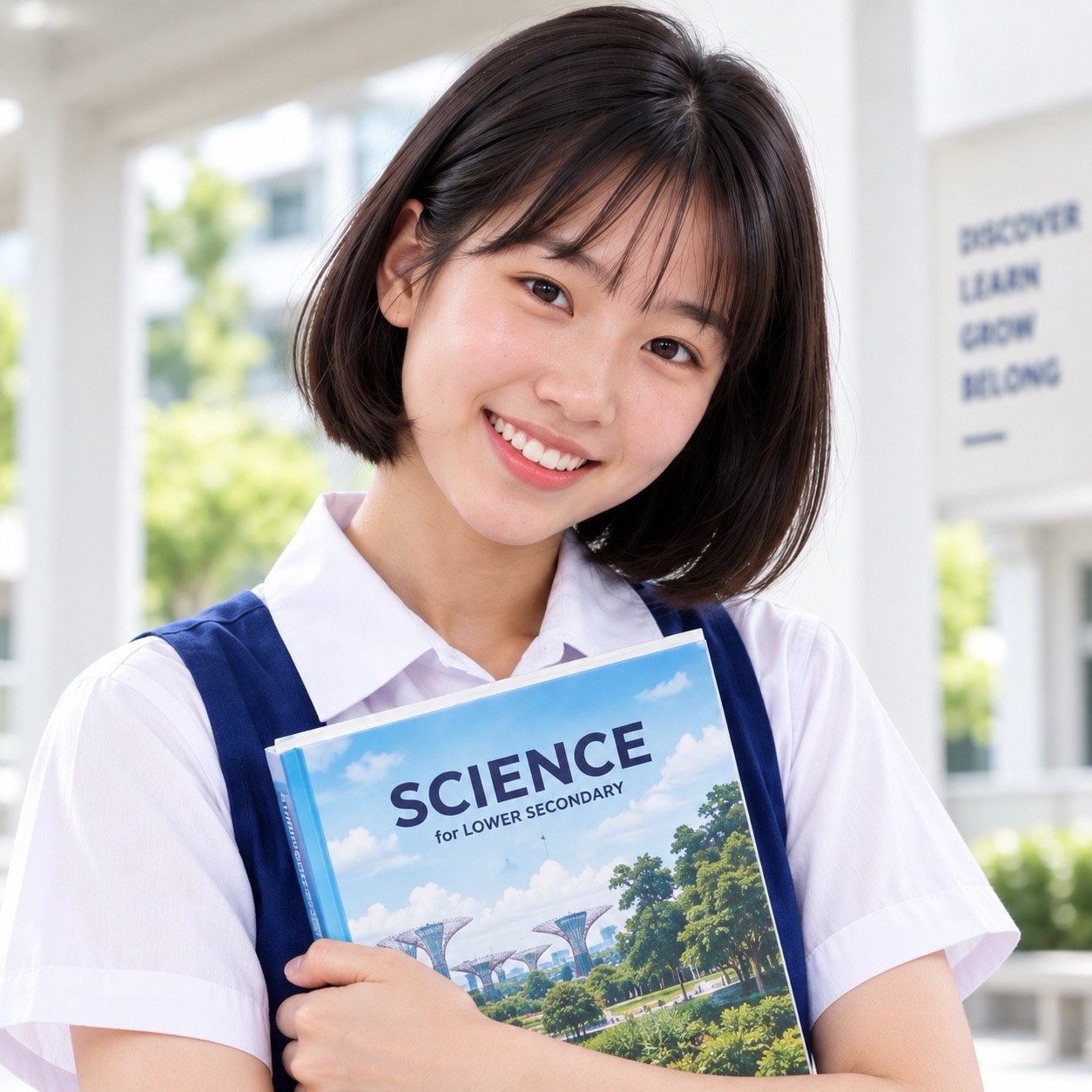
G1 Science is the General 1 level of lower-secondary Science within Singapore’s Full Subject-Based Banding system. It develops practical scientific literacy through safe observation, measurement, evidence, everyday machines, environmental issues and the human body. For Punggol families entering Secondary 1 in 2027, G1 Science is not a separate school stream or a promise that a student must remain at one subject level forever. It is a learning level designed to make scientific ideas usable, understandable and relevant to daily decisions.
The Ministry of Education’s G1 lower-secondary Science syllabus includes Laboratory Measurements and Procedures and the modules Machines Around Us (I), Our Environment, and Our Body and Health (I). Schools may vary the order of delivery; the syllabus notes that Secondary 1 may cover laboratory work, Our Environment and part of Machines Around Us. Parents comparing Punggol secondary schools should check each school’s latest offerings and support arrangements, then help the child practise explaining observations rather than memorising scientific keywords without meaning.
- Definition: G1 Science is a General 1 subject level under Full SBB, not a whole-child classification.
- Official module structure: laboratory measurements and procedures; Machines Around Us (I); Our Environment; Our Body and Health (I).
- Illustrative topics: forces, energy, electricity, heat, matter, water and air pollution, cells, nutrition, reproduction and personal health.
- Teaching sequence: schools can vary module order; do not assume every listed topic is taught in Secondary 1.
- Core habits: safe observation, fair comparisons, accurate measurement, evidence-based explanations and responsible environmental decisions.
- Punggol learning: discuss everyday heat, rain, energy use, transport and waterways without collecting unsafe samples or conducting unsupervised experiments.
- School options: verify current curriculum, practical facilities and learning support using MOE SchoolFinder and the individual schools.
- Progression: students may discuss more demanding subject levels at suitable checkpoints if eligible; this is not automatic.
- 2027 SEC: students in graduating cohorts take the new Singapore-Cambridge Secondary Education Certificate.
- Home support: a ten-minute observation and explanation is often more helpful than copying a chapter summary.
Definition lock: what is G1 Science?
G1 Science is Science studied at General 1 subject level under Singapore’s Full Subject-Based Banding. The level corresponds broadly to the former N(T) standard, while the wider school structure now includes mixed form classes and different subject levels according to individual readiness and applicable arrangements. Science at this level asks students to make sense of the world through accessible, practical scientific ideas, not merely to recognise a list of terms.
G1 should not be treated as shorthand for limited ambition. A student can enjoy asking questions about the environment yet find a dense textbook difficult to read. Another learner may know many facts but be unable to separate an observation from an explanation. These are teachable difficulties. Science learning becomes more effective when a teacher identifies the exact thinking step that is missing, provides an appropriate example and checks whether the idea transfers to a new situation.
What the official MOE G1 Science syllabus actually contains
MOE’s published lower-secondary G1 Science syllabus names an introductory topic, Laboratory Measurements and Procedures, and three major modules: Machines Around Us (I), Our Environment, and Our Body and Health (I). Within those modules, the published overview includes force, energy, electricity and heat; matter, water pollution and air pollution; and cells, nutrition and energy from food, human reproduction and caring for the body. This is the official structural starting point, rather than a guessed list borrowed from G2 or G3 textbooks.
The syllabus also states that there is no compulsory universal order for all modules and notes a possible Secondary 1 progression covering laboratory procedures, Our Environment and part of Machines Around Us. School teachers choose suitable sequencing to make links between ideas and support subject banding. Families should read the MOE lower-secondary G1 Science syllabus alongside the school plan, especially when buying materials or planning tuition.
Why science should begin with a question, not a definition
A student may remember that ‘evaporation’ is a process without knowing why wet clothes dry. Begin with a phenomenon the child recognises and ask what is happening. Which observations are available? What could explain them? What information is still needed? The definition can then name a relationship the learner already understands. This order makes vocabulary useful. It also reveals misconceptions that memorised notes often hide.
For example, water left in a shallow dish may disappear gradually as some water molecules enter the air as vapour. The student should not claim that the water was destroyed. This simple idea can connect matter and changes in state, provided it fits the school’s sequence. A successful Science response is not the longest answer. It is one that distinguishes what was observed from the explanation supported by scientific knowledge.
Full SBB: science is a subject level, not a permanent stream
Singapore implemented Full SBB for the Secondary 1 cohort beginning in 2024. Students are placed in mixed form classes and study relevant subjects at G1, G2 or G3 levels according to their arrangements. Posting Groups guide school admissions; they do not amount to three rigid secondary-school streams. A child might study Science at G1 and a different subject at another level. That combination reflects a current learning profile, not the whole of the child’s future.
This difference matters at school briefings. Ask what level of Science the child would actually offer, what support is available for practical lessons and how the school reviews readiness for more demanding work. Movement is subject to school criteria and is not guaranteed by a tuition centre. The national framework is explained by MOE’s Full SBB resources. Parents can encourage progress while avoiding comparisons that turn one subject designation into an identity.
Scientific literacy: what should a student be able to do?
Scientific literacy means more than remembering that a battery stores energy or that clean water matters. It includes asking a testable question, identifying an observation, recognising what a measurement represents and considering the evidence behind a claim. A G1 learner should practise communicating these ideas using accurate everyday language before adding more technical terms. Pictures, physical models and familiar examples can make abstract concepts visible.
A practical prompt is ‘Why does a metal spoon feel different from a wooden spoon in the same room?’ The student may initially say the metal is colder. Ask what was observed and whether both objects might have the same temperature. This opens a discussion about heat transfer without requiring an advanced formula. It is the thinking process—question, explanation, evidence and possible checking—that matters, not an impressive recital of terminology.
Laboratory safety is part of scientific thinking
A laboratory is a controlled learning space with procedures that protect students and help produce reliable evidence. Before practical work, students should learn to listen to instructions, identify hazards, handle equipment as directed, keep their workspace orderly and report accidents promptly. Safety is not an optional preface to the real lesson. It is one of the skills that makes practical Science possible.
Parents should not recreate school experiments involving chemicals, flames, mains electricity or unknown samples at home. Instead, reinforce safe habits: read instructions before acting, describe a hazard and ask a responsible adult for guidance. A learner who wants to test a dramatic internet experiment should be taught to question its safety and reliability first. Scientific curiosity and caution belong together; neither needs to cancel the other.
Measurement: the difference between looking and recording
Observation tells us that a cup of water appears warmer or a paper plane travelled farther. Measurement adds a quantity and unit. Students need to understand why tools, scales and consistent methods matter. When reading a ruler, align the starting point. When reading a thermometer, identify the unit. When comparing two results, ensure that the same quantities and conditions are being compared. These are foundations for every later practical topic.
A safe home example is measuring the lengths of three books with the same ruler. Record each length in centimetres, state whether the cover or the pages were measured and note how the ruler was positioned. Different answers may result from different methods rather than a change in the book. Discuss that measurement is always connected to a procedure. The aim is not perfection but honest, repeatable recording.
Fair testing: change one condition deliberately
Students often claim to have ‘proved’ something after one uncontrolled comparison. To begin learning about fair tests, ask what is being changed, what is being observed and which conditions should remain the same. For a safe model, compare how long the same amount of water takes to spread across two types of clean paper, using ordinary room-temperature water and parental supervision. The focus is on controlling quantities and observing, not on any dramatic experiment.
If several conditions change together, the result may be difficult to interpret. A good learner notices that uncertainty instead of inventing a conclusion. Also explain why repetition may be helpful: one unusual measurement may be a mistake or simply variation. Keep the activity within household safety limits and check the school’s guidance before attempting experiments. Science is a method for improving explanations, not a contest to find the most exciting result.
Matter: what substances are made of and how they behave
In everyday language, ‘matter’ refers to materials around us. Students can begin by comparing solids, liquids and gases through properties and observable changes. A solid generally keeps its shape, a liquid takes the shape of its container while keeping a volume, and a gas can spread to fill available space. These ideas should be taught using familiar examples without implying that all substances behave identically under every condition.
Ask students to describe ice, liquid water and water vapour as forms of the same chemical substance. Then separate an observation from a claim. We can observe a puddle shrinking; understanding evaporation explains where the water goes. Avoid saying that water ‘turns into air’, because water vapour and the surrounding air are not the same substance. Accurate language can be simple; simplicity should never mean teaching a false idea.
Water pollution: learning from Punggol without unsafe sampling
Punggol’s waterfront and waterways provide a natural context for discussing why water quality matters, but a public waterbody is not a school laboratory. Students can observe from permitted, safe public areas and discuss visible litter, runoff and community efforts without entering water, handling unknown materials or collecting samples. A clear-looking surface does not prove that water is chemically or microbiologically safe.
Teach the distinction between a source of pollution, a possible consequence and an action that reduces risk. Litter can be carried into drains, while other pollutants may be invisible. A child might suggest using bins properly, reporting obvious illegal dumping through appropriate channels and avoiding unverified claims about particular locations. The important learning is systems thinking: actions on land can affect water, wildlife and people elsewhere.
Air pollution: evidence rather than dramatic assumptions
Students may notice haze, traffic exhaust or an unpleasant smell and conclude that air quality must be dangerous. Those observations justify attention but do not provide a numerical pollutant concentration. Teach the difference between what is sensed, what is measured and what authorities report. Air pollution involves different substances and sources, and an accurate discussion should not pretend that one smell proves the presence of a particular harmful chemical.
For local observations, check official environmental advisories when relevant and follow public-health guidance rather than conducting improvised tests. The class can discuss how wind, weather, activity and emissions influence air quality while recognising uncertainty. A Science learner should be comfortable saying ‘I do not have enough data yet’. That sentence is not a weakness; it is often the first honest step toward a better investigation.
Forces: pushes, pulls and changes in motion
A force can be understood initially as a push or pull that may change an object’s motion or shape. Use safe examples such as sliding a lightweight object across a table. Ask what happened when it was pushed and why it eventually slowed. A student may answer that objects naturally stop ‘because they are tired’, revealing a misconception. Guide them toward the role of friction rather than simply supplying the vocabulary.
The concept becomes more meaningful when examples vary. A door opens, a wheel turns and a spring changes shape, but each situation includes an interaction. Students should distinguish the object being discussed from the force acting on it. If diagrams are used, keep arrows clear and meaningful at a level appropriate to the school sequence. The purpose is explanatory control, not drawing elaborate physics diagrams before the learner understands the action.
Energy: follow the transfer or conversion
Energy is often taught as a word that appears in every sentence without clear meaning. Start with practical devices: a battery-powered torch, a fan or a moving toy. Ask what provides the energy, what useful effect occurs and where some energy may end up as heat or sound. Students should learn that energy can be transferred or converted rather than being created whenever a machine is switched on.
For example, a battery-powered lamp converts stored chemical energy through electrical processes into light and heat. The explanation can be adjusted to the student’s level without being misleading. Connect this to the idea of reducing unnecessary energy use in homes and public spaces. Switch appliances off appropriately, compare efficient choices using reliable labels and ask why an action matters. Practical relevance helps students remember ideas beyond the examination.
Electricity: useful, powerful and deserving of caution
Electricity allows lights, communications and devices to operate, but it also carries serious hazards. At G1 level, students can learn about simple circuits, components and safe use of electrical appliances in appropriate school-supervised settings. Emphasise that switches, batteries and conductors have different roles. A complete working circuit is a useful model, but households should not dismantle mains-powered devices to illustrate it.
A safe reasoning question is: Why does a torch fail when the battery is missing, the switch is off or the circuit has a break? Ask students to compare the conditions and explain why current would not flow through an open circuit. Do not use wall sockets, damaged wires or improvised electrical experiments at home. Scientific understanding should increase respect for hazards, not encourage risky demonstrations.
Heat: observe change without mixing heat and temperature
Heat and temperature are related but not interchangeable. Temperature describes how hot or cold something is on a defined scale; heat is energy transferred because of a temperature difference. Students can begin with safe, non-heated observations such as how shaded surfaces feel compared with sunlit surfaces, while remembering that touch alone is not a precise thermometer.
Discuss why metal may feel cooler than wood at the same room temperature and why insulation is useful in everyday objects. A student who says ‘the cold moved into my hand’ may need a clearer account of thermal transfer. Introduce the appropriate terminology at the level the class is learning. Avoid scalding liquids and hot appliances in unsupervised home activities. The explanation, not a dramatic demonstration, is the educational reward.
Cells: a useful model of living things
Cells are often introduced as building blocks of living organisms. Students benefit from clear diagrams that show parts and functions without pretending that every cell looks exactly like a neat textbook cartoon. Begin with the distinction between an organism, a tissue and a cell at a suitable level. Explain that microscopes and diagrams help reveal structures too small to see with the unaided eye.
A useful practice task is to label a simple provided diagram and describe one function in plain language. Then ask what the illustration leaves out or simplifies. This helps students see models as helpful representations rather than photographs of reality. Avoid forcing advanced biology onto a learner who still struggles to understand what a cell is. Good scientific drawing and explanation should clarify an idea, not overwhelm it.
Food, nutrients and the body’s energy needs
The topic of nutrition can help students connect Science to ordinary decisions. Food supplies nutrients and energy required for growth, repair and activity; different nutrients have different functions. Teach students to interpret general food information sensibly without moralising about individual bodies or treating one meal as proof of a person’s health. A balanced diet is about overall patterns, not branding particular foods as magical or dangerous.
A practical exercise is comparing the stated serving sizes on two food labels. Ask what is being measured and whether the quantities are comparable. Students should learn that a nutrition claim needs evidence and context. For personal dietary questions or medical conditions, families should use qualified health guidance. A Science lesson should build understanding, not pressure students into body-focused judgments.
Human reproduction and respectful science education
The official G1 lower-secondary syllabus includes human reproduction within the Our Body and Health module. Schools teach age-appropriate content using the relevant curriculum and professional guidance. Students need accurate biological vocabulary, respectful questions and a classroom environment in which uncertainty can be addressed appropriately. Families should not assume that every listed subtopic is taught in Secondary 1; the sequencing may differ.
Parents can support learning by speaking without embarrassment about body changes, privacy, boundaries and reliable information. If a child asks a question beyond the parent’s knowledge, it is better to consult an appropriate school or health source than invent an explanation. Respect for personal dignity is consistent with scientific accuracy. The goal is understanding the body and making responsible decisions, not sensationalising a topic that many adolescents already find sensitive.
Taking good care of the body
Everyday health choices illustrate the link between evidence and action. Sleep, hygiene, movement, hydration and safety all influence wellbeing, but a Science classroom should avoid making personal medical diagnoses. Teach students to distinguish a generally sound habit from a specific treatment recommendation. They can consider why handwashing matters and how germs can spread without being asked to conduct unsafe investigations.
Use examples from the school day: drinking water after outdoor activity, planning adequate rest before an assessment or following safety guidance during PE. Ask what the evidence supports and what remains uncertain for an individual. If a student reports significant symptoms, seek appropriate healthcare rather than turning the problem into a science exercise. Responsible scientific learning includes recognising where classroom knowledge ends and professional care begins.
Graphs, tables and scientific communication
Science frequently uses tables, drawings and graphs to organise evidence. Students should label the quantity, unit and conditions of an observation. A graph with two variables can show a pattern, but a pattern does not always establish the cause. Teach this carefully: two things changing together may reflect several factors. Good explanation acknowledges what the data actually show and avoids adding a conclusion that the measurement cannot justify.
Give the student a small invented dataset, clearly labelled as practice, such as the cooling of a harmless room-temperature object over time within safe conditions. Ask for a sentence describing the trend and a separate sentence explaining what cannot be concluded. This trains honest interpretation. It also protects the learner from a common test error: copying values correctly while describing the wrong relationship.
Observation, inference and evidence: three different jobs
An observation reports something detected or measured: the puddle became smaller, a thermometer showed a reading, or a leaf appeared discoloured. An inference offers an explanation: perhaps the water evaporated or the plant experienced stress. Evidence is the information used to support or challenge that inference. Students should practise placing statements into these categories, because mixing them leads to overconfident scientific answers.
A helpful home activity uses everyday photographs rather than experiments. Look at a picture of a wet pavement and a cloudy sky. What is visible? What might have happened? What cannot be known from the image alone? The exercise teaches restraint as well as curiosity. It is especially useful in the age of viral online images, when confident captions can outrun the available evidence.
Machines around us: useful questions for a modern town
An escalator, bicycle, lift and fan can introduce questions about forces, energy use, electricity and safety. Punggol’s transport connections and household appliances offer familiar contexts, but students should not inspect working machinery or interfere with public equipment. Observation from a safe distance is enough to ask what motion occurs, what energy source is involved and how design reduces risk.
A child might ask why bicycle brakes slow motion or why a fan needs electricity. Encourage a simple, accurate explanation followed by one more question. Where does friction act? What would happen if the device were switched off? The lesson should not become a tour of technical specifications. It should strengthen the student’s ability to connect two scientific ideas to a familiar object.
Environmental decisions: systems and trade-offs
Environmental Science is not simply a list of instructions to ‘be green’. It asks where materials come from, how energy is used, how waste travels and who is affected by different choices. A student can compare reusable and disposable products, for example, while noticing that environmental impacts depend on materials, usage and disposal. Teach that a worthwhile question may have several factors rather than one easy answer.
Near Punggol’s parks and waterways, families can discuss litter prevention and stewardship without inventing facts about local pollution levels. Ask what a claim would require as evidence and which authority supplies reliable information. A scientifically literate student can care about the environment while refusing to spread an unverified claim. That combination of concern and intellectual discipline is an important goal of the syllabus.
Learning from mistakes in a Science explanation
Science mistakes often fall into different categories: incorrect fact, unclear term, missing causal link, invalid inference, unsuitable unit or poorly described observation. A student might write ‘the plant grew because it was happy’. That answer communicates a feeling but not a scientific explanation. Rather than merely crossing it out, ask what factors influence plant growth and which were actually measured. The repair is to connect a supported cause with an observed effect.
Maintain an error log where each entry includes the original statement, the missing idea and a corrected explanation on a new example. Encourage the student to use ordinary words first, then add the scientific term. Revisiting the error after a week checks whether the understanding has survived. Copying a polished model answer immediately after marking may produce neat notes without changing the student’s underlying reasoning.
How the Fencing Method can help G1 Science
A clear progression teaches one scientific relationship at a time before adding complexity. For forces, begin with a single push and the resulting motion, then introduce friction and competing influences. For environmental topics, start by distinguishing visible litter from invisible pollutants before asking about ecosystems. For body systems, establish what a cell is before linking cells to larger structures. This is the logic of Fencing difficulty: build a stable boundary, then deliberately widen it.
The method should never turn into endless easy work. As understanding grows, ask unfamiliar questions that connect modules: how energy, heat and material choice affect the design of an everyday machine; or how choices on land relate to waterways. This gradually moves learners toward real scientific thinking. The measure of mastery is the ability to explain a new situation without the teacher announcing which memorised sentence to use.
What a helpful practical-learning session may look like
An effective lesson could start with a question about a familiar phenomenon, move into a safe demonstration, ask students to record observations and end with an evidence-based explanation. A teacher may adapt this order to equipment, safety requirements and student readiness. A large, dramatic demonstration is not automatically better than a small experiment in which every student knows what was controlled and what was measured.
For a learner who struggles with reading, diagrams and short procedural sentences can make instructions accessible. For a student who understands the procedure but makes unsupported claims, the teacher may spend more time asking ‘How do you know?’ Small-group tuition can provide individual feedback, but only when the educator actually observes reasoning and corrects it. Families should ask prospective providers how their support aligns with the relevant G1 syllabus.
Choosing secondary school options in Punggol
Schools that families might research include Punggol Secondary, Edgefield Secondary, Greendale Secondary and Yusof Ishak Secondary, together with suitable schools in nearby areas. The list is not a ranking and does not imply that every school offers an identical G1 Science timetable, practical facility or learning programme in 2027. Verify each school through MOE SchoolFinder, official school information and direct enquiries.
A useful comparison includes the route to school, CCA commitments, laboratory access, teacher feedback, student wellbeing and learning support. Ask how practical activities are organised and what happens when a learner struggles with scientific language. The shortest route may be beneficial, but a school environment that fits the child also matters. Avoid assumptions based on past admission trends or unverified anecdotes; actual school arrangements can change.
Questions to ask teachers about G1 Science
Ask what modules the school plans to teach in Secondary 1, how students are taught safe measurement, whether observations and explanations receive separate feedback, and how families can reinforce learning without conducting unsafe experiments. Ask which concepts are prerequisites for current topics. This gives a clearer picture than asking only how many chapters will be completed before the next test.
For a student interested in offering Science at a more demanding level, ask about appropriate review points and readiness criteria. Schools make these decisions under applicable policies. It is reasonable to discuss sustained understanding, assessment evidence and overall workload, but not to demand a guaranteed timetable for movement. The strongest conversation focuses on what the learner can demonstrate and what support is needed next.
A four-week Science foundation plan for home
In week one, read a short Science passage and ask the learner to separate an observation from an explanation. In week two, practise recognising measurements and units using safe household objects. In week three, select one topic from the student’s actual school module and explain it with a diagram or a simple real-life example. In week four, mix earlier questions so that the child must recall ideas without seeing the original notes. This is an illustrative routine, not official school sequencing.
Keep sessions short and give the child time to describe an idea aloud. If an answer contains a scientific misconception, return to a suitable model rather than immediately demanding a longer explanation. Use the school notebook, MOE materials and teacher comments as the anchor. Many families gain more from five accurate, understood questions than from a large set completed with an answer key open beside the child.
How to prepare for assessments without memorising blindly
For Science, a good revision question tests both knowledge and application. Rather than only asking ‘Define energy’, ask a learner to identify energy changes in a simple device. Rather than copying a paragraph about pollution, present a short scenario and ask which claim is supported by the information. Include graphs, labelled diagrams and short explanations when those match the school’s current assessment. Confirm the actual school expectations first.
After marking, identify whether the error came from missing knowledge, weak reading, an invalid inference, a confused diagram or a careless transcription. The remedy should match the cause. Re-reading an entire chapter may be unnecessary if the student understands the content but misreads a graph scale. Conversely, repeated timed tests will not fix an underlying misconception. Effective revision creates better explanations, not simply more pages of marked work.
Science progress can be seen before a grade improves
A learner may begin asking more specific questions, using measurements correctly, distinguishing a cause from a coincidence or explaining a diagram without copying the textbook. These are meaningful signs of development. Keep a dated example of one early explanation and one later explanation. Compare evidence, clarity and independent reasoning. The student should be able to say what changed and why the new explanation is stronger.
Assessment marks still matter as feedback, but they are not the sole indicator of learning. Some topics are unfamiliar, and practical confidence can develop at a different pace from written responses. Review the pattern over several weeks and adjust support when progress stalls. Avoid guaranteed-grade claims. Good teaching can strengthen the conditions for improvement, but it cannot promise an identical timeline for every student.
G1, G2 and G3 Science: possibility without pressure
The subject-level system is designed to provide a closer match between learning needs and challenge. Movement to a more demanding level may be available at appropriate checkpoints, depending on the student’s progress and the school’s criteria. Families should distinguish genuine readiness from a wish to escape a label. A learner who can answer routine questions but cannot explain experiments may need a stronger conceptual foundation before taking on more abstract material.
If a student is doing well, ask the school what additional opportunities exist and how progress is assessed. If the child needs more time, keep expectations high for understanding and safe practice without insisting that only a change of level counts as success. Scientific curiosity is useful across technical education, daily life and many careers. A respectful, evidence-based approach to learning is a valuable outcome in its own right.
The Singapore-Cambridge SEC from 2027
The new Singapore-Cambridge Secondary Education Certificate replaces separate N- and O-Level examinations for graduating cohorts from 2027. Students take examinations at the relevant subject levels, and later pathway options depend on applicable admissions criteria. Parents of students entering Secondary 1 in 2027 should not assume that every entry rule applying to the first SEC cohort will remain unchanged until their child graduates.
Use the MOE SEC announcements for the nationwide starting point and revisit MOE and SEAB sources at the relevant future intake. The immediate scientific-learning priority is not guessing a 2030 examination paper. It is learning how to read an instruction, observe carefully, measure consistently and defend a conclusion with evidence.
Worked example: observation does not equal a conclusion
Imagine a student notices that an indoor plant looks droopy at the end of a warm day. The observation is that the leaves appear to be drooping. The statement ‘the plant needs more water’ is a possible explanation, not a proven diagnosis from that observation alone. Other conditions could matter. Ask the student what additional information would help and what observations could be recorded safely.
This exercise builds an intellectual habit that goes beyond plant biology. When students encounter a health advertisement, a dramatic video or an online environmental claim, they should ask what was measured and whether alternative explanations have been considered. They do not need advanced statistics to begin thinking this way. They need permission to separate a claim from its evidence.
Worked example: comparing materials responsibly
Suppose two paper samples absorb a small quantity of room-temperature water differently. A student might say one paper is ‘better’. Ask ‘better for what purpose?’ A paper that absorbs more may be useful for wiping a spill, but less useful for protecting a document from rain. Scientific observation informs a decision only after the purpose is stated.
Next ask whether the test was fair: Were the pieces the same size? Was the same water quantity used? Was the method repeated? The lesson is not to declare one material universally superior, but to describe a property under stated conditions. This kind of careful comparison connects laboratory reasoning to everyday choices about products and materials.
Worked example: recognising a misleading environmental claim
An advertisement may say a product is ‘100% eco-friendly’ without explaining how the claim was measured. A G1 Science student can begin by asking what material it contains, how it is used and what happens after disposal. They may not have enough evidence to decide. That is an acceptable outcome. The ability to request relevant information is a success in scientific literacy.
Teachers can model a balanced answer: ‘The claim could be true in a particular respect, but the statement gives no measurable criterion, so I cannot verify it from this information.’ Students learn that scientific reasoning does not require cynicism or automatic trust. It requires proportional confidence—strong claims need suitable evidence.
Frequently asked questions about G1 Science
Does G1 Science include laboratory work? The published lower-secondary syllabus includes Laboratory Measurements and Procedures. Actual school lesson plans and facilities should be checked with the school.
Are all G1 Science topics taught in Secondary 1? No uniform order is required by the syllabus. Schools may sequence modules differently, and some topics may be taught later.
Can my child offer Science at G2 later? Possibilities depend on eligibility, performance, school processes and readiness. Discuss with the school; do not assume an automatic transfer.
Is practical Science more important than definitions? Both matter. Practical understanding gives scientific words meaning, while accurate terminology helps students communicate explanations.
Should families buy G2 Science textbooks immediately? Usually a better first step is to confirm the student’s current G1 topic sequence and repair any gaps. Introduce more demanding material when readiness is clear.
Can we do experiments at home? Use only age-appropriate, genuinely safe activities. Do not recreate chemical, electrical, fire, biological-sample or other hazardous laboratory procedures.
What if my child memorises answers but cannot apply them? Use an unfamiliar everyday scenario and ask for evidence. Return to the concept if the learner can only repeat the model answer.
How should a Science question be answered? Identify what is observed or given, apply the relevant concept and state a conclusion supported by the information available.
Do parks and waterways count as learning settings? They can inspire observation and discussion from permitted safe areas. Do not assume a public site permits sampling or invasive experiments.
What if my child wants a Science-related career? Support curiosity, good core skills and informed pathway planning. A current subject level does not by itself predict every future opportunity.
Your next step: make Science useful and safe
Open the learner’s current Science notebook and select one explanation that they do not understand. Ask what was observed, which scientific idea applies and what evidence supports the answer. If the student cannot make the link, provide a simple model or safe familiar example, then try a different scenario. Record the change in understanding. That is the beginning of a scientific learning routine worth keeping.
To compare Punggol-area school choices, begin with MOE SchoolFinder and individual school sources. For more local study advice visit eduKate Punggol. Scientific education succeeds when a student becomes more observant, more careful with evidence and better equipped to make decisions—not when they merely collect a larger stack of definitions.


