
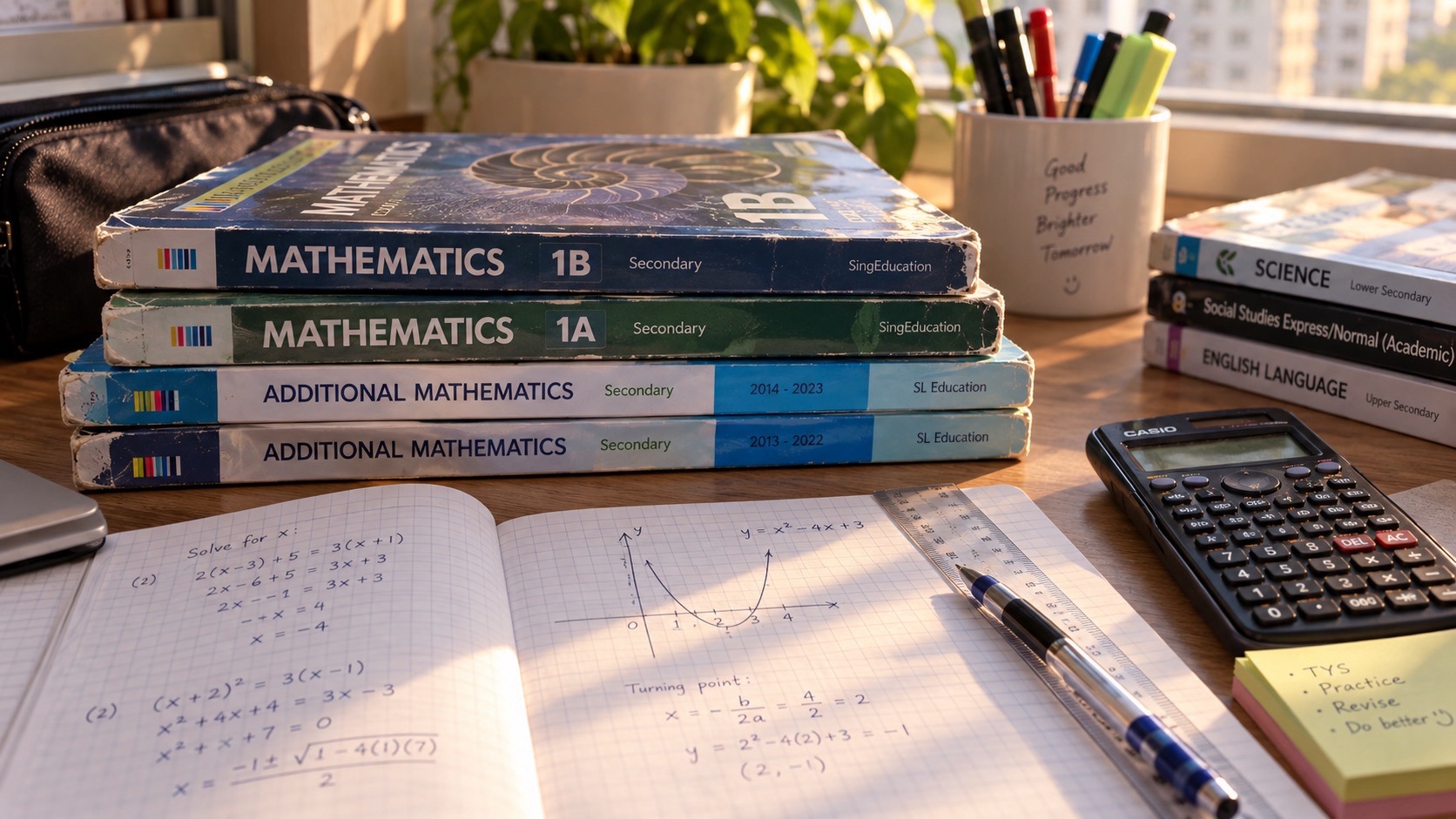
Schools and education at Punggol teach Mathematics as a way of reasoning about quantities, relationships, shapes and information, not merely as a race to complete sums. Singapore’s Primary Mathematics syllabus for Primary 1 to Primary 6 makes mathematical problem solving its central focus, combining concepts, skills, processes, metacognition and attitudes. For a Punggol family, that means asking a child to explain why a calculation works, notice whether a number is reasonable and recognise the same relationship when a question looks unfamiliar.
This guide shows how primary pupils can connect school Mathematics to familiar situations such as reading prices, measuring a study space, comparing quantities, interpreting a table and checking a result. It uses original worked problems with clear assumptions, rather than suggesting that public places are classrooms or that any named school teaches a particular worksheet. Parents can use the examples as short learning conversations while following the child’s actual MOE syllabus, level, school assessment instructions and teacher feedback.
- Curriculum: MOE 2021 Primary Mathematics syllabus, updated October 2025, applies through Primary 6 from 2026.
- Focus: concepts, mathematical processes, fluency, reasoning, application and checking one’s thinking.
- Begin with number meaning and place value before demanding a complicated problem-solving technique.
- Estimate before calculating to catch impossible or unreasonable results.
- Use real-world contexts only when prices, units and assumptions are stated accurately.
- Represent fractions and ratios visually before relying on memorised rules.
- Read axes, scales, labels and time periods when interpreting data.
- Separate errors in reading, concept, calculation and presentation.
- Independent practice on a changed problem is stronger evidence than copying a worked example.
- Check the school timetable and syllabus: this is an educational guide, not a school-specific lesson schedule.
Quick navigation: what a Punggol parent or student needs to know
- 1. Numbers should mean quantities, not only symbols
- 2. Estimation is a mathematical habit, not an optional extra
- 3. Money, change and unit price teach careful comparisons
- 4. Fractions describe a relationship between part and whole
- 5. Ratio compares quantities, but the order matters
- 6. Shapes and measurements turn geometry into decisions
- 7. Data tables and graphs need questions before conclusions
- 8. Word problems should be represented before they are solved
- 9. Error analysis should identify the stage that failed
- 10. The strongest progress test is an unfamiliar but fair question
Definition lock: the actual learning goal
Mathematical reasoning means using valid relationships, representations and justifications to decide what an answer should be and whether it makes sense. Numeracy means using number understanding in suitable contexts, but Mathematics also includes geometry, measurement, data, algebraic patterns and problem-solving strategies. A correct number reached by an accidental guess is not the same evidence of understanding as an answer supported by a clear method.
This article concentrates on primary-level reasoning in everyday settings, rather than promising PSLE score improvements, ranking Punggol schools or duplicating the site’s grade-by-grade Mathematics tuition and examination guides. In 2026 the 2021 Primary Mathematics syllabus has reached Primary 6. Specific content at each school level still matters: a Primary 1 child is not expected to complete an upper-primary ratio task.
| Learning question | Useful evidence | Unhelpful shortcut |
|---|---|---|
| Does the child understand the quantity? | Objects, a place-value representation and an oral explanation | Memorising digit strings without meaning |
| Can the child choose a method? | A drawing, equation or reasoned estimate | Copying the teacher’s worked model verbatim |
| Is the result plausible? | Units, magnitude and a reverse check | Writing the answer and stopping |
| Will the idea transfer? | A fresh problem with one changed condition | Repeated success on the exact same worksheet |

1. Numbers should mean quantities, not only symbols
Before a child can manipulate numbers confidently, the digits must connect to amount, order and comparison. A pupil who can read ‘304’ aloud may still be unsure why it is more than 299. That is not always a multiplication-table problem. It may be an incomplete understanding of hundreds, tens and ones. In the early years, counting objects, bundling groups and comparing sets are concrete ways to establish what the symbols mean. Later, the same understanding helps students judge estimates and place digits correctly in longer calculations.
A practical example that exposes the reasoning
Imagine an imaginary Punggol classroom collecting 32 paper tokens for an activity. The child groups them into three bundles of ten and two singles. Add one more bundle: the total is 42, not 312. Ask the learner to draw the tens and ones, then describe the exact change. The point is not to memorise the number forty-two but to recognise that one ten changes the tens place, whereas one single changes the ones place.
A teaching method a parent can actually try
Begin with objects or a simple sketch, then use a place-value chart and finally write the number. Reverse that process by giving the written number and asking the child to make it. This two-way movement matters. A learner who only sees the answer after every example may learn a visual routine without grasping what the digits represent. Keep the task at an age-appropriate level and let the student explain the choice of representation in their own words.
The mistake that deserves a better explanation
An error such as treating 402 as forty-two can reflect confusion about the zero as a placeholder. Simply telling the child to ‘count carefully’ may not help. Build the number with four hundreds, zero tens and two ones; compare it with forty-two built from four tens and two ones. The difference is structural and should be made visible.
How to test understanding in a changed situation
Transfer to a different situation: show 530, 503 and 350 in mixed order. Ask which is greatest and why, before doing any arithmetic. The learner should refer to hundreds and tens, not the number of characters or the sound of the word.
After the activity, ask what the child will check the next time a digit appears in an unexpected place. Such a question turns a one-off correction into a method for learning new number content.
2. Estimation is a mathematical habit, not an optional extra
Estimation lets a child decide whether an answer is in the right neighbourhood of magnitude. It is a defence against misplaced zeros, misunderstood units and calculator mistakes. Rounding is one useful estimation technique, but children also need benchmarks: a hundred is far closer to ninety-eight than to a thousand. A good estimate describes the expected size of an answer without pretending to be the exact value.
A practical example that exposes the reasoning
Suppose a family buys three items priced at $4.80, $5.20 and $3.90 in a hypothetical shopping exercise. Before adding, the pupil estimates about $5 + $5 + $4, or $14. The precise total is $13.90. If a written solution produces $139, the estimate alerts the child that a decimal point or place value has gone wrong. This is a training example, not a report of current shop prices.
A teaching method a parent can actually try
Teach estimation before showing the written algorithm. Ask, ‘Should the result be nearer ten dollars or a hundred?’ Then calculate exactly and compare the difference. The estimate does not have to be identical to the total; it must be plausible for the task. In later years, pupils can discuss how rounding choices affect whether an estimate is above or below the actual value.
The mistake that deserves a better explanation
Some students think an estimate is a failed exact answer. Explain its different purpose. If the child’s estimate is $14 and the exact answer is $13.90, the estimate has succeeded because it provided a sensible magnitude check. Conversely, ‘about $100’ is not useful for the same three items; it tells us the number sense needs repair.
How to test understanding in a changed situation
Now change the amounts to $48, $52 and $39 and ask for an estimate before the exact total. Can the pupil adjust from single-digit dollar thinking to amounts in the tens without needing the original example beside them?
Parents should state clearly when prices are invented and avoid implying the values are live Punggol merchant prices. The learning is about magnitude, not shopping recommendations.
3. Money, change and unit price teach careful comparisons
Money problems bring number sense into decisions that families already understand. Yet a price comparison is only fair when the item, quantity, units and conditions are comparable. Younger pupils may practise counting money and finding change. Older pupils can compare cost per unit and explain why a larger package is not automatically cheaper. These are distinct skills, so the learning task must fit the child’s level.
A practical example that exposes the reasoning
Use an invented supermarket problem: a 500 g pack of rice costs $2.50 and a 1 kg pack costs $4.60. Since one kilogram is 1,000 g, two small packs would cost $5.00; the larger pack is $0.40 less for the same mass. That is a mathematical comparison, not a claim that either product exists at that price today. The result assumes the items are otherwise comparable in quality and suitability.
A teaching method a parent can actually try
For younger learners, start with coins and notes on paper. For older pupils, write the quantity and unit beside each price and divide or scale both to a common amount. Ask the student to explain the assumption before concluding that a product offers better value. Real shopping decisions can involve quality, shelf life, availability and waste, which a simple equation may not capture.
The mistake that deserves a better explanation
A common mistake is to compare ‘2.50’ with ‘4.60’ and announce that the first is better value, forgetting that one pack contains half as much. The correction is to standardise units, not to practise more subtraction. Another mistake is to say that a cheaper unit price automatically saves money when the household will not use the larger quantity.
How to test understanding in a changed situation
Transfer to exercise-book prices: one invented pack has 4 books for $6 and another has 6 books for $8.40. Ask which has the lower cost per book and explain why. The numbers and product type change, but the comparison method survives.
Use cash or a paper budget rather than inviting a child to make an actual purchase. Discuss privacy and safe payment behaviour separately from the arithmetic.
4. Fractions describe a relationship between part and whole
A fraction can be represented by a region, a collection, a number line or a division. The visual variety matters because children sometimes learn to shade one familiar rectangle but cannot identify the same fraction in a new form. The denominator describes how the whole is partitioned into equal parts; the numerator counts how many of those parts are selected. The phrase ‘equal parts’ carries much of the concept.
A practical example that exposes the reasoning
Suppose a paper strip is folded into eight equal sections, and three are coloured. The coloured part is three eighths of that strip. Draw another strip of the same length and fold it into four equal sections. Colour two sections. The second shaded amount is one half. The child can compare the amounts visually without concluding that eighths are always smaller than quarters regardless of how many are selected.
A teaching method a parent can actually try
Ask the learner to identify the whole before writing the fraction. If the whole changes, the same fraction label does not necessarily represent the same physical length or amount. Use a number line as well as area models: zero and one are endpoints, and the intervals must be equal. Then introduce the symbolic notation only after the partitions are meaningful.
The mistake that deserves a better explanation
A child may add the numerator and denominator separately when combining unlike fractions. Before giving the written rule, return to comparable strips or equivalent fractions to show why the denominators must refer to the same-sized parts. Blindly applying a procedure can hide the absence of a unit in the student’s thinking.
How to test understanding in a changed situation
Change from a strip to a collection of twelve counters. Ask what one third of the set means and whether four counters are correct. The representation differs but the equal-part principle remains.
Simple shared-food stories can help, but real food does not have to be cut or wasted for practice. Paper is an accurate and less distracting model.
5. Ratio compares quantities, but the order matters
Upper-primary Mathematics introduces relationships such as ratio and percentage. Students need to know what is being compared and in which direction. ‘Three to two’ and ‘two to three’ describe different relationships, even when the same two quantities are involved. Concrete diagrams reduce the temptation to manipulate numbers while forgetting their meanings.
A practical example that exposes the reasoning
Imagine a class project uses three blue tiles for every two yellow tiles. A drawing with 6 blue tiles and 4 yellow tiles keeps the same ratio, 3:2, because both amounts are doubled. A drawing with 6 blue tiles and 2 yellow tiles does not. Ask how the relationship changed, and whether ‘blue to yellow’ has been written in that order.
A teaching method a parent can actually try
Use paired strips or groups before introducing algebraic multipliers. Let the pupil build a second equivalent pair, then explain that the comparison is preserved by scaling both quantities together. This is a good place to distinguish an additive change from a multiplicative relationship: adding two to both quantities does not always preserve the ratio.
The mistake that deserves a better explanation
A frequent error is to treat the ratio 3:2 as the total number of items, instead of a relationship between two parts. Another is to apply a multiplier to only one side. The correction is to label each quantity explicitly and check the new pair against the original comparison.
How to test understanding in a changed situation
Change the context to two types of stationery in an imaginary container and ask whether 9 pencils to 6 erasers matches the original tile ratio. Can the student justify without drawing the same colours?
Parents should not rush a lower-primary student into ratio worksheets because they look advanced. The relevant foundations are multiplication, division, units and consistent comparison.
6. Shapes and measurements turn geometry into decisions
Geometry is not just naming triangles and rectangles. It involves properties, position, spatial relationships and measurement. Children can use ordinary surroundings to notice parallel lines, right angles and symmetry, but they must distinguish an approximate appearance from a geometric claim that requires proof or measurement. Visual intuition starts the question; careful reasoning completes it.
A practical example that exposes the reasoning
Imagine a child looking at a photograph of a Punggol walkway canopy. They notice supports that appear vertical and roof edges that appear parallel. Ask what the image lets them observe and what cannot be established precisely without measurements. Perspective can make parallel edges converge in a photograph, so the image is useful for asking questions rather than proving a structure’s exact geometry.
A teaching method a parent can actually try
Start with a ruler and shapes on paper before going outside. Teach the purpose of the units and why measurement should begin at the correct zero mark. For area, use equal square units; for perimeter, follow the boundary. Name the property before selecting a formula so the learner knows whether they are measuring inside space or edge length.
The mistake that deserves a better explanation
One common error is writing ’12 cm’ for an area that should be expressed in square centimetres. Another is multiplying length and width when the task asks for the distance around the edge. These are different misconceptions and should not both be labelled ‘careless’.
How to test understanding in a changed situation
Change to an imaginary study table measuring 120 cm by 60 cm. Ask for the perimeter and area, then explain why one answer uses centimetres and the other square centimetres. The numbers are not actual dimensions of a Punggol facility.
Any outside observation should stay on permitted paths without blocking movement or using school buildings as measuring objects. Drawings and public photographs are often sufficient.
7. Data tables and graphs need questions before conclusions
Graphs are compressed arguments about quantities. Labels, scale, source and the period covered decide what can be concluded. A taller bar does not automatically represent a dramatic difference if the axis has been manipulated or the categories are incomparable. Pupils should learn to read what the graph actually measures before inventing a narrative around it.
A practical example that exposes the reasoning
Consider a fictional class survey of preferred library-book topics: adventure 12, animals 8 and science 10. A correct bar chart needs a zero baseline and consistent increments. The total is 30 responses, assuming one choice per pupil. If the chart shows a very large visual gap between 12 and 10, the pupil should inspect the scale. This example uses invented figures rather than actual Punggol library data.
A teaching method a parent can actually try
Have the learner say the question, unit and data source aloud before reading a graph. Ask for one statement directly supported by the bars and one tempting statement not supported. ‘Adventure was selected by 12 respondents’ is supported. ‘All children in Punggol prefer adventure’ is not.
The mistake that deserves a better explanation
Children may confuse number of responses with number of people when the survey allows multiple choices. Others omit a unit and treat a number of books as a number of minutes. Fix the data description first; otherwise the arithmetic can be flawless but the conclusion wrong.
How to test understanding in a changed situation
Use a second invented table about weekly reading minutes instead of book preferences. Which parts of the graph-reading process stay the same, and what units have changed?
Explain the limitations of samples and privacy. Children need not survey strangers or collect identifiable data to learn to read charts.
8. Word problems should be represented before they are solved
Word problems demand translation from language to mathematics. Students must identify relationships, choose a representation, compute and return to the question. The difficulty may be in interpreting ‘remaining’, ‘more than’ or ‘twice’ rather than calculating. A good teaching sequence makes the underlying quantities visible before the first operation is selected.
A practical example that exposes the reasoning
A hypothetical family buys 4 identical notebooks and 2 pens for a total of $18. The two pens together cost $6. How much does each notebook cost? First remove the pen cost: $18 minus $6 leaves $12 for four notebooks. Then divide: $12 divided by 4 gives $3 per notebook. The diagram should show four equal notebook groups and the separate pen cost; it should not require guessing the answer from keywords.
A teaching method a parent can actually try
Teach pupils to draw only the information needed, label what each quantity refers to and explain the order of operations. The representation can be a bar model, table or equation, depending on the level and the problem. Ask why $6 is subtracted before dividing by four instead of telling the child to memorise a ‘model method’.
The mistake that deserves a better explanation
A child may divide $18 by six because there are six objects in total, forgetting that notebooks and pens have different prices. This is not solved by repeating division drills. It needs a clearer representation of equal and unequal groups.
How to test understanding in a changed situation
Change the context to three equal-priced markers plus a ruler; provide a different total and ruler price. Can the student isolate the unknown grouped cost independently?
Use fresh small problems in moderation. A workbook full of nearly identical questions can build recognition without teaching the learner how to begin unfamiliar problems.
9. Error analysis should identify the stage that failed
Not every incorrect answer is a computational slip. A learner can misunderstand the question, choose the wrong model, perform a correct operation on inappropriate numbers or forget a unit. Repair requires knowing which stage caused the result. A parent who only asks for another page of practice may give more work without addressing the actual obstacle.
A practical example that exposes the reasoning
Take a fictional mistake: a pupil says that a 2 m by 3 m rectangle has area 10 square metres. The computation 2 × 3 should produce 6, while 10 is the perimeter if the units are metres. The likely issue could be confusing area with perimeter, or miscopying the question. Ask the child to draw and explain both measures before assigning further practice.
A teaching method a parent can actually try
Use a simple error log with four labels: reading, concept, calculation and communication. After each problem, ask the pupil to identify the evidence for the label. If the child correctly set up an equation and made one arithmetic error, practise accuracy; if the model was inappropriate, teach the relationship.
The mistake that deserves a better explanation
Calling every error ‘careless’ is tempting because it sounds easy to fix. It also prevents careful teaching. A repeated negative-sign error in later algebra, for example, may require conceptual work with directed numbers rather than merely a reminder to check.
How to test understanding in a changed situation
Offer a new rectangle, with dimensions 5 m and 2 m, and ask for area and perimeter with units. An independent explanation shows whether the underlying distinction is secure.
Teachers and parents can communicate more efficiently when they share one representative example of a recurring difficulty instead of a vague claim that the pupil is weak at Maths.
10. The strongest progress test is an unfamiliar but fair question
Fluency matters: a pupil should eventually perform routine calculations accurately without excessive effort. Yet speed alone does not establish reasoning. A child may recognise a memorised worksheet pattern and then struggle when the quantities are rearranged or the same relationship appears in a new form. The educational challenge is to combine reliable methods with flexible thinking.
A practical example that exposes the reasoning
A student learns to compare unit prices using two rice packets. Later, the teacher presents a puzzle about the cost of exercise books. The pupil should recognise the common comparison principle even though the visual story and units differ. Ask not simply for an answer but for a reason why the method is appropriate.
A teaching method a parent can actually try
Plan short cycles: identify the target, model one example, practise a near example, wait briefly and then use a changed-context problem. Remove the original model from sight for the last step. Keep the change fair: an early-primary pupil should not be punished with an unrelated upper-primary concept.
The mistake that deserves a better explanation
A common false signal is a perfect sheet completed immediately after watching a demonstration. The child may be reproducing surface features. A delayed new task reveals whether the idea can be reconstructed without the exact cues.
How to test understanding in a changed situation
Invite the pupil to invent an original example of the same mathematical relationship and solve it. The ability to generate a valid problem is often stronger evidence than repeating an answer.
Use progress evidence to decide whether practice, explanation, retrieval or teacher consultation is needed. Tuition may help when a specific gap persists, but extra lessons are not automatically necessary for every child.
Three complete worked situations
1. A change calculation that looked right
An imaginary child buys a $6.80 item and pays with $10. The correct change is $3.20. A student writes $4.20, perhaps from lining up decimals incorrectly or confusing a digit. Instead of simply writing ‘wrong’, ask the child to estimate roughly three dollars, draw a money number line from $6.80 to $10, and identify the amount that closes the gap.
After correction, change the amount to $7.35. The child may count $0.65 to $8 and $2 to $10, obtaining $2.65. Their explanation and the reverse addition give more reliable evidence than the original corrected number alone.
2. A rectangle with two different measures
A Primary pupil is asked for the space inside a rectangle measuring 4 cm by 7 cm. They add all four sides and report 22. Their work may be logically consistent for perimeter, but it answers the wrong question. Show 28 square centimetres as a grid of four rows of seven, then trace the boundary for 22 cm.
On another day, offer a 3 cm by 8 cm rectangle. Ask the child to name both measures before calculating, and explain why the units change. The point is not which formula is faster but whether the child knows what each one measures.
3. A graph that overclaimed
A hypothetical chart shows that 18 of 30 classmates selected a science-themed school-library display. A pupil concludes that ‘all Punggol children prefer science’. The data support the claim that 18 of those 30 responses selected that display, assuming one response per person. They do not support a statement about the whole town.
Ask for a revised sentence, the sample size and a follow-up question that would require broader evidence. This develops mathematical precision and critical literacy together without making students collect private information.
Four-week family teaching plan
Use four short weeks instead of an exhausting revision campaign. In the first week, select one concrete skill—for example, distinguishing area from perimeter or estimating money totals—and ask for an independent baseline attempt. In the second, teach with a clear representation and allow a fresh example. In the third, vary one condition and see whether the idea transfers. In the fourth, test after a short delay and discuss the evidence with the child. Keep ordinary schoolwork and rest intact; a family learning routine should be sustainable rather than another source of pressure.
| Week | Learning move | Evidence to keep | Decision after reviewing |
|---|---|---|---|
| 1 | Notice a current strength and one precise gap | One independent baseline example | Select a single manageable target |
| 2 | Teach the underlying idea and model one step | Child’s own explanation and a new attempt | Correct a cause, not just the answer |
| 3 | Vary the setting, problem, partner or language | A fresh response without copying the model | Check whether understanding transferred |
| 4 | Repeat after a delay, reflect and choose the next goal | One new independent task and honest self-assessment | Continue, adapt or consult the school |
How schools, teachers and parents can coordinate
A helpful conversation with the class teacher concerns the exact learning obstacle, the level of the curriculum and the evidence from the child’s work. Bring one or two representative attempts showing the misunderstanding and ask what to practise next. The purpose is to support school teaching, not to demand a different syllabus or to infer a school’s quality from one assignment. Parents should be open to the possibility that the child is progressing well and needs no additional tuition.
- Which Primary Mathematics strand is my child currently learning, and what prior idea does it depend on?
- Does the child struggle more with understanding the relationship or executing a correct method?
- Is the issue with word-problem reading, operations, units or checking?
- Can the teacher show one example of successful independent working?
- What home practice would complement the current class task without teaching conflicting methods?
- How will we know if the understanding has transferred to a new problem?
- Does my child need a simpler foundation or appropriately challenging extension?
- How can we protect confidence while correcting persistent misconceptions?
Frequently asked questions
Is everyday Mathematics a replacement for the school syllabus?
No. Everyday settings provide accessible examples, but the official MOE syllabus determines the knowledge and skills for the level. Practical problems should support—not replace—systematic teaching and school guidance.
Which Mathematics syllabus applies to Primary 6 in 2026?
MOE’s 2021 Primary Mathematics syllabus, updated in October 2025, applies to Primary 6 from 2026. The current document should be checked for exact learning outcomes.
Is estimating an answer the same as guessing?
No. An estimate uses number sense, approximation or benchmarks to predict a plausible range. It is a method of checking and reasoning even when an exact calculation is still needed.
Why does my child know a formula but fail a word problem?
The student may not understand the relationship represented by the formula, may miss a condition in the wording or may apply the method to the wrong quantities. Examine the setup and explanation before assigning more routine calculations.
Can younger primary pupils study ratios early?
They should first build the relevant multiplication, division and comparison foundations. This guide includes upper-primary examples for families with older learners; it is not a recommendation to accelerate every child into topics above their level.
Does a correct answer prove mathematical understanding?
Not by itself. Ask for a meaningful explanation and a fresh task in a different form. A correct answer may be guessed or copied, just as a wrong answer may conceal a largely sound method with one slip.
Are prices in the examples current Punggol shop prices?
No. All commercial prices in the worked exercises are invented so the mathematics is clear. Actual prices and promotions would need independent verification at the time of purchase.
Do all Punggol schools use identical practice sheets?
No. MOE sets curricular frameworks, while teaching tasks, school assessments and additional programmes can differ. Consult the child’s actual school for specific instructions.
When is extra Maths support useful?
When a specific recurring gap affects current learning and suitable school or home support has not resolved it, structured help may be useful. It should target the cause rather than promise guaranteed grade changes.
What is and is not promised
Mathematical reasoning practice can build confidence and understanding, but this article makes no guarantee of grades, PSLE outcomes, admission or future career performance. It also does not rank local schools. The child’s actual work, syllabus, wellbeing and teacher feedback are better starting points than a generic prediction.
A learning activity in the Punggol neighbourhood is not automatically a school activity, an officially prescribed worksheet, an assessment or evidence of what any particular school does. School admissions, CCA places, programmes, examination requirements and individual support arrangements must be checked directly with the responsible institution. The examples here are educational illustrations, not invented reports about students or teachers.
Your Next Step
Choose one recent Mathematics question and ask the child for an estimate, a representation, a calculation and a check. If one part breaks, focus the next practice on that exact step. A small independently understood correction is worth more than twenty copied answers.
MOE references and further reading
- MOE 2021 Primary Mathematics syllabus, updated October 2025
- Schools and Education at Punggol | Building a Reading Culture from School Library to Home
- Schools and Education at Punggol | Understanding School Feedback, Progress Reports and Learning Gaps
- Schools and Education at Punggol | What School Spaces Teach Beyond the Classroom
- MOE SchoolFinder
- MOE primary syllabuses
Editorial review: 1 November 2026. Official syllabus documents are referenced for curriculum alignment; original examples are created for this guide. Local facilities and schools may change programme availability, so consult current primary sources before making decisions.


