
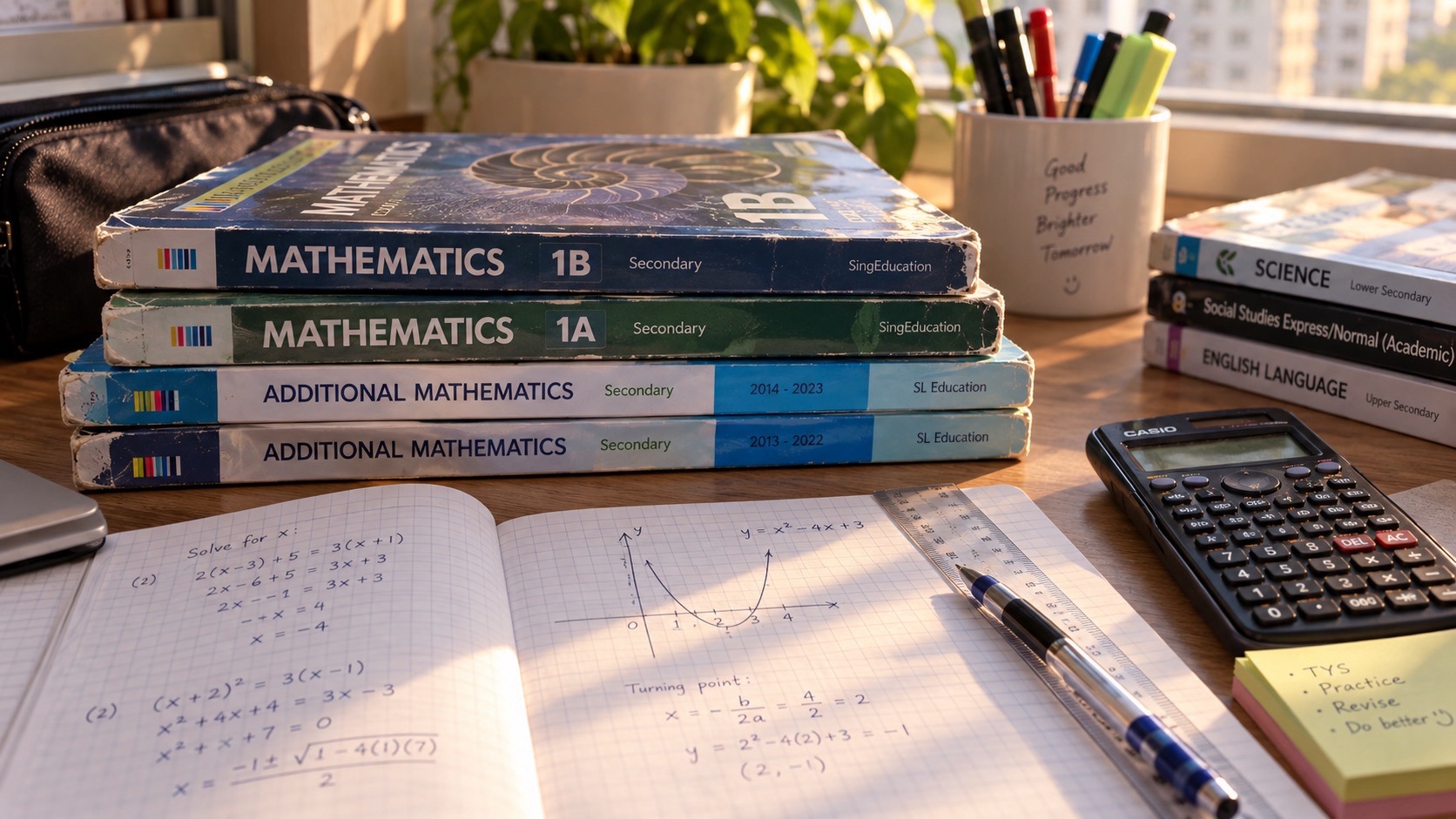
A Punggol student who entered secondary school through Posting Group 2 (PG2) can improve G2 Mathematics geometry by learning when two figures are congruent, when they are merely similar, how to match corresponding sides and angles, and what an enlargement or reduction does to lengths and areas. PG2 is a school-admission group; G2 Mathematics is the level of an individual subject under Full Subject-Based Banding. A correct comparison needs a geometric reason: similar figures have equal corresponding angles and proportional corresponding sides, while congruent figures have matching shape and size.
The 2027 Singapore-Cambridge Secondary Education Certificate G2 Mathematics syllabus K210 includes congruent and similar figures, enlargement and reduction, scale drawings, basic bisector constructions and problems involving similarity or congruence. It is a graduating-cohort reference, not a declaration that every child entering Secondary 1 in 2027 studies the whole topic immediately. Families at Edgefield, Greendale, Punggol Secondary and Yusof Ishak Secondary should use the actual classroom sequence. This guide explains how to read diagram markings, identify corresponding vertices, choose a consistent scale factor, calculate unknown lengths and distinguish a straight-line scaled drawing from a real walking route in Punggol.
- PG2 and G2: admission and subject level are not the same.
- Congruence: same shape and size, allowing rotation, translation or reflection.
- Similarity: same shape with corresponding angles equal and sides in one consistent proportion.
- Correspondence: match vertices by geometric relationship, not by where a diagram is placed on the page.
- Scale factor: image length divided by corresponding original length, using consistent units.
- Area: for similar plane figures, area changes by the square of the linear scale factor.
- Scale drawing: interpret the stated map or plan ratio and its date, purpose and assumptions.
- Constructions: bisectors and perpendicular bisectors have distinct geometric meanings.
- Next step: justify one similar-triangle comparison before finding an unknown length.
Definition lock: admission group does not determine geometry knowledge
Posting Group 2 helps determine a student’s Secondary 1 placement. G2 Mathematics describes the individual subject level taught under Full SBB. The student may be offered subjects at different levels, and a pupil’s geometric understanding may differ from their skills in algebra or statistics. Similarity and congruence are concepts in Mathematics, not streams or rankings of learners. Parents should check the actual current topic and teacher’s assignment before choosing practice.
If a teenager confuses corresponding sides, adding difficult calculations may only hide the basic mistake. If the child recognises similar figures but cannot simplify ratios, the prerequisite may be numerical reasoning. A good correction begins where the logic fails. The teaching goal is to understand the invariants of shape and size and then apply appropriate ratios, rather than memorising a picture that looks like the examination example.

What congruence means
Congruent plane figures have the same shape and size. One can be moved, rotated or reflected to coincide with the other without changing lengths or angles. Congruence is not restricted to shapes that have the same orientation on the page. A triangle reflected across a line can still be congruent to the original. Its corresponding side lengths and angles remain equal.
Ask the learner what characteristics are preserved. If two figures look different only because one is upside down, that does not invalidate congruence. Conversely, two triangles with the same general appearance but different side lengths are not congruent. A child should explain the properties rather than rely solely on visual intuition. A correctly marked diagram gives stronger evidence than a rough sketch that appears to match.
What similarity means
Similar figures have the same shape but may have different sizes. Their corresponding angles are equal, and their corresponding side lengths share a single constant ratio. If one triangle has sides 3, 4 and 5 centimetres and another has sides 6, 8 and 10 centimetres, the second is a scale-two enlargement of the first. The side ratios are all 2:1, and the corresponding angles match.
A student should verify one common factor across every appropriate side, not find a convenient ratio between unrelated edges. If the first two sides seem proportional but the third does not, the shapes may not be similar. The exact criteria can depend on the type of figure. Similarity is a relationship to be justified rather than a label assigned because one drawing happens to look larger.
Congruent figures are a special case of similarity
Congruent figures can be considered similar with linear scale factor of magnitude one. The figures have no change in size, only possible position or orientation. Similar figures with scale factor two have matching shape but not the same size, so they are not congruent. Students sometimes reverse this relationship and claim that every similar pair must be congruent.
Ask the learner to draw a rectangle, make a same-size rotated copy and then make a uniformly enlarged copy. Which are congruent, and which are only similar? The answer reveals how scale and rigid transformations differ. This small comparison is more reliable than memorising two definitions without applying them.
Matching corresponding vertices comes before calculation
A similarity ratio depends on which side corresponds to which. The order in which vertices are named can communicate the matching. If triangle ABC is similar to triangle DEF in that order, A matches D, B matches E and C matches F. Therefore AB corresponds to DE, BC to EF and AC to DF. Reversing these relationships produces incorrect scale ratios even if the arithmetic is flawless.
A simple marking system can help: use one mark on a matched pair of angles, two on another and consistent colours or symbols on corresponding sides. Ask the student to explain why the matches follow from equal angles or geometry, not from which two edges happen to be on the left of the page. Once the pairing is secure, a proportion becomes meaningful.
Rotation does not change the correspondences
A triangle may be rotated, reflected or placed in an unfamiliar orientation. Students who compare top edges with top edges automatically can match the wrong sides. Equal angles and the relationships among vertices are more reliable than the direction of the sketch. For a pair of triangles, identify the angle that is largest and the side opposite it, then use the other information to establish correspondence.
A learner can practice with paper triangles drawn at different orientations, but should not rely on measuring inaccurate printed lengths. The diagrams may not be to scale. Ask what is established through labels, markings and statements. A mathematical argument survives a rotation; a memorised picture may not.
The scale factor has a direction
If an original length of 4 cm becomes 10 cm in an enlargement, the image-to-original scale factor is 10/4 = 2.5. If a 10 cm figure is reduced to 4 cm, the new-to-original factor is 4/10 = 0.4. Both figures may be similar, but the direction of the described transformation changes the numerical factor. Students should not assume the larger number always goes on top regardless of the question.
Write ‘image length divided by original length’ or the equivalent relationship before calculating. Then check whether the result is plausible: an enlargement should have a factor greater than one in the ordinary positive-length sense, while a reduction has a factor between zero and one. The factor communicates how lengths are transformed. It is not automatically the ratio of perimeters or areas without further interpretation.
All corresponding side ratios must agree
Take two fictional triangles with sides 3, 4, 5 and 9, 12, 15. Every corresponding side is multiplied by three, so the triangles are similar. If the final side of the second were 14 instead of 15, the three pairs would no longer share one factor. A student who checks only the first pair may declare similarity too early.
Ask the child to list the side correspondence and simplify each ratio. If a side length is unknown, set up a proportion using valid matches. The method should make clear why the chosen equation is true. Geometry becomes more reliable when every number has a role in the corresponding shapes.
Solve an unknown side in similar triangles
Suppose two similar triangles have corresponding sides 4 cm and 10 cm, while another side of the smaller triangle measures 6 cm. The enlargement factor is 10/4 = 2.5, so the corresponding larger side is 6 × 2.5 = 15 cm. State which side is matched before writing the multiplication. A child who inadvertently pairs a 6 cm side with an unrelated edge may produce a precise-looking but invalid answer.
Check the ratios: 10/4 = 15/6 = 2.5. The equality verifies consistency. If the question requires an unknown smaller side instead, divide the corresponding larger side by the enlargement factor. This is a meaningful use of proportional reasoning rather than a rule that every new length must be multiplied.
Similar triangles preserve angles
Similarity includes equality of corresponding angles. If a triangle is enlarged uniformly, its interior angles do not change. A triangle with angles of 40, 60 and 80 degrees remains a 40–60–80 triangle after enlargement, provided the vertices are correctly matched. Students sometimes expect a larger triangle to have larger angles, confusing linear size with angular shape.
Ask the child to compare two labelled sketches and explain why a scale enlargement affects side lengths but not angles. A geometry question may provide angle conditions sufficient to establish triangle similarity, after which side proportions can be applied. The key is not merely finding two identical numbers; it is showing that the geometric relationship supports the similarity conclusion.
Angle–angle similarity is a useful triangle property
If two angles of one triangle match two angles of another, the third pair matches because each triangle has an interior-angle sum of 180 degrees. This establishes similarity under the familiar angle–angle criterion. The side lengths may still differ by a consistent factor. Students should not infer congruence merely because all the angles agree; triangles of many sizes can share the same shape.
A practice question could provide two 35-degree angles and two 75-degree angles in matched triangles. The remaining angles are 70 degrees. The student should state why the triangles are similar and then use provided lengths to calculate a factor if requested. The method demonstrates that angle information has a different role from length information.
Congruence criteria require sufficient information
School geometry may use criteria such as side–side–side, side–angle–side and angle–side–angle to show that triangles are congruent when the specified relationships apply. The right-angle–hypotenuse–side condition is another familiar valid criterion for suitable right triangles. The naming and detail should follow the current class syllabus. The important idea is that enough appropriate information is needed to fix both shape and size.
A student who sees two matching sides but has no angle information cannot automatically conclude congruence. Likewise, matching all three angles proves similarity but not necessarily equality of size. Ask which data the condition supplies and why it is sufficient or insufficient. Teaching the logic behind criteria prevents pupils from applying acronyms as magic words.
Side–side–angle can be ambiguous
Two side lengths and a non-included angle do not generally guarantee a unique congruent triangle under the ordinary SSA arrangement. Depending on the values, more than one triangle may satisfy the information. This is a useful example of why a familiar-looking three-letter condition should not be assumed valid. The issue is geometric possibility, not simply the number of measurements provided.
Parents need not teach an advanced proof immediately. Ask whether a side can swing into more than one position while preserving the supplied measurements. A suitable school-approved diagram can make the ambiguity visible. The learner should become comfortable saying the evidence is insufficient when that is the mathematically correct conclusion. More confident guessing is not a substitute for a valid criterion.
Perimeter changes by the linear scale factor
If a triangle has perimeter 12 cm and is enlarged by factor 2, the new perimeter is 24 cm. Every corresponding side length doubles, so their sum doubles as well. For similar figures, the ratio of perimeters matches the ratio of corresponding linear dimensions. A student might incorrectly square the scale factor because they have memorised that areas change with its square.
Ask what perimeter measures: a total length around the boundary. Since each segment is a length, it changes linearly. A simple comparison between a small and large triangle can demonstrate the result. Units remain linear, such as centimetres or metres. This prepares the learner to distinguish perimeter scaling from area and volume scaling.
Area changes by the square of the scale factor
Suppose a triangle with side lengths 3, 4 and 5 cm has area 6 cm². Enlarge all lengths by factor 2 to obtain sides 6, 8 and 10 cm. The new area is 24 cm², four times the original. In general, a similar plane figure enlarged by positive scale factor k has area multiplied by k². This follows because two independent linear dimensions are scaled.
A learner who multiplies the area only by 2 will get 12 cm² and confuse length scaling with surface scaling. Use a square grid or a rectangular example to make the relationship visible: doubling width and height creates four times as many unit squares. The rule is a consequence of geometry, not an arbitrary formula to memorise.
Reducing an area can produce a fraction of the original
If a plane figure is reduced with linear factor one-half, its area becomes one-quarter of the original. A 48 cm² region would become 12 cm² in a truly similar reduction. Students sometimes expect the new area to be 24 cm² because the lengths have halved. The missing idea is that both width-like dimensions are reduced.
Ask the child to predict the area ratio before calculating a numerical example. A square four units by four units has area sixteen, whereas the similar square two by two has area four. The reasoning is immediately visible. The same relationship holds for other similar plane shapes, provided the entire figure is scaled uniformly. A cropped drawing or nonuniform stretch is a different operation.
Volume scaling is a separate three-dimensional extension
For similar three-dimensional solids enlarged by a positive linear factor k, volume scales by k³. Doubling the lengths of a cube increases its volume eightfold, while its surface area becomes four times as large. This is a useful conceptual extension but may go beyond the current lower-secondary question, so it should be taught only where suitable. The 2027 G2 similarity topic focuses on relevant plane figures and the school’s actual sequence governs what is required.
Use the relationship to clarify dimension. Length involves one factor, area involves two and volume involves three. A student who understands the unit dimensions can often reconstruct the scaling without memorising three disconnected rules. Do not present the extension as mandatory for every Secondary 1 PG2 pupil.
Enlargement is not stretching in only one direction
Uniform enlargement multiplies corresponding lengths by the same factor. If a rectangle becomes twice as wide but remains the same height, its proportions change and it is not similar to the original rectangle unless the initial geometry has special conditions that restore correspondence through orientation. A child may assume anything drawn larger counts as a similarity transformation.
Ask the student to compare width-to-height ratios. If the ratios differ, the rectangles do not have the same shape. This simple check is valuable for image resizing, maps and diagram interpretation. A design that is enlarged without preserving proportions may be visually distorted. Mathematical similarity requires consistency, not merely more space on the page.
A scale drawing has a stated ratio
A scale drawing represents dimensions at a fixed ratio to the actual dimensions in the stated model. At scale 1:2,500, one unit on the drawing represents 2,500 of the same units in reality. Thus 1 cm on the drawing corresponds to 2,500 cm, or 25 m. If a straight segment measures 4 cm on that drawing, the modelled corresponding length is 100 m. The conversion is valid under the given scale.
However, scale drawings may be schematics, historical maps or simplified plans with different conventions. The student should check the publisher, date and whether the plan is truly drawn to the advertised linear scale. A visually stretched screenshot can make manual measurements unreliable. Scale arithmetic and trustworthy mapping are related but separate tasks.
Map distance is not always walking distance
A scaled straight-line segment may measure the geometric separation between two points without showing the path a person can legally or safely use. In Punggol, waterways, roads, buildings and crossings can affect actual walking routes. A calculation from a fictional 1:2,500 plan should not be presented as a verified journey distance or ETA. Travel time additionally depends on route, waiting, speed and accessibility conditions.
Teach the child to state exactly which distance the diagram supplies. If a problem asks for the length of a straight line in a scale drawing, calculate that length. If it asks for travel time, additional route and speed information is required. Knowing what the model cannot establish is part of mathematical competence. A neat answer should not turn a paper exercise into misleading local directions.
Scale factors can be reversed accidentally
Suppose a model is 5 cm long and the corresponding real object is 200 cm long. The drawing-to-real scale is 5:200 = 1:40. If the task asks instead for the real-to-model factor, the relationship is 40:1. A pupil who does not label direction may write the correct numbers in the wrong order and misinterpret what the scale means.
Write both quantities with consistent units before simplifying. Then ask which side of the ratio corresponds to the drawing. A scale 1:40 should mean the represented object is forty times longer than the drawing in the simple context. This reasonableness check is valuable and prevents numerical inversion from contaminating later calculations.
A fractional scale factor is a reduction, not a negative length
An ordinary positive linear scale factor of 0.4 describes a reduction to forty percent of each corresponding length. It does not mean the image has negative dimensions. Negative scale factors arise in some coordinate transformations but require a different geometric interpretation and are not necessary for every introductory plane-figure scale problem. Parents should follow the school’s notation and scope.
A student can compute 0.4 × 15 cm = 6 cm and check that the resulting image is shorter. Ask what happens to its area under uniform reduction: the area factor is 0.16. This reinforces the distinction between lengths and areas without introducing unnecessary symbolic complexity. The learner should be able to explain what the number means.
Scale drawing problems need unit consistency
If one length is given in millimetres and another in metres, convert before computing a ratio. A plan distance of 20 mm and a real distance of 10 m correspond to 2 cm and 1,000 cm. The ratio is 2:1,000 = 1:500. Computing 20:10 directly without unit conversion would be meaningless. The calculation uses numbers that refer to the same kind of measurement.
Ask the teenager to label every number with its unit and write the conversion explicitly. Then test whether the ratio is plausible. This is numerical discipline across geometry and measurement. Unit errors often create answers that look precise but represent the wrong physical size by a factor of ten, hundred or thousand.
A model can be scaled correctly while its real-world assumption is wrong
An architect’s illustration or student map may be proportional in the dimensions it includes, yet use outdated site information or omit obstacles. Mathematical similarity cannot validate the underlying facts about a location. A school exercise may state a fictional playground size, and the scale calculation can be correct within that scenario. It remains fictional if no real measurement was supplied.
Ask what the source actually establishes. If a plan is labelled proposed, do not treat it as proof that construction is complete. If the drawing is not verified as being to scale, refrain from measuring real distances from its appearance. Good mathematical education joins correct ratios to careful evidence, especially when familiar Punggol places are used as contexts.
A similar triangle can help solve inaccessible lengths conceptually
Similarity can model a height or width indirectly when sufficient corresponding measurements and angle conditions are known. A diagram may show two triangles sharing a verified angle and another pair of equal angles, allowing proportional sides. The mathematics can then find an unknown length without directly measuring that segment. But school word problems must supply enough information to establish the similarity.
Parents should avoid encouraging students to climb structures, trespass or perform unsupervised physical measurements to replicate the example. A paper-based problem with stated dimensions and verified geometric relationships is sufficient. The educational skill is identifying corresponding triangles and using the correct proportion, not collecting impressive outdoor measurements at personal risk.
Constructing a perpendicular bisector
The perpendicular bisector of a line segment passes through its midpoint and meets it at a right angle. Points on that bisector are equidistant from the segment’s endpoints. These properties are included in the broader congruence and similarity topic. A student should understand the geometry behind the construction, not just remember a sequence of compass movements.
For safe home practice, use a school-approved ruler, pencil and compass under ordinary stationery precautions, if the teacher has introduced the activity. Ask the learner why the line must be perpendicular and pass through the midpoint. The construction makes the equal-distance relationship visible. A careless line that is merely close to the midpoint may not satisfy the mathematical condition exactly.
An angle bisector has a different job
An angle bisector divides an angle into two equal angles. It need not pass through the midpoint of an unrelated side or be perpendicular to a boundary. Students sometimes confuse it with the perpendicular bisector because the names sound similar. Ask what is being divided: an angle measure or a segment length. The defining objects are different.
Draw an angle of 80 degrees and a suitable bisector, producing two angles of 40 degrees in the ideal construction. Then contrast with a line-segment perpendicular bisector. A learner who explains both can choose the correct construction when a task asks for it. Do not substitute one method for the other because a diagram happens to look symmetrical.
Why a rotated enlargement can still be similar
Figures may be enlarged and then rotated or reflected while preserving similarity. The correspondence may be harder to see because the sides no longer point in matching directions. A student should use angle relationships, proportional sides and vertex order rather than the figure’s visual orientation. This is especially important in unfamiliar word problems or multi-part diagrams.
Give two paper triangles with sides proportional but one rotated. Ask the child to mark corresponding vertices and verify a common ratio. If the pupil matches top edges without looking at angles, the ratio may be wrong. Learning to reason invariantly under rotation is a valuable step towards more formal geometry and proof.
A fictional Punggol display-design exercise
Imagine a fictional school display panel whose original drawing is 8 cm wide and 5 cm high. A student wants a uniformly enlarged version twice the size in each linear dimension. The correct new dimensions are 16 cm by 10 cm, and the area increases from 40 cm² to 160 cm². The enlarged panel remains similar to the original because the width-to-height ratio is preserved.
This is a made-up school design problem, not information about a real Punggol building or exhibition. The parent can ask the student to justify why both dimensions must double and why the area becomes four times larger. Then vary the scale factor and ask for an independent solution. That tests understanding rather than memory of the first numbers.
A fictional student mixes up matching sides
Imagine a PG2-entry student, Amir, looking at two similar triangles drawn in opposite orientations. He compares the longest side of one with the shortest side of the other simply because both lie at the top of the page. His teacher asks him to match angles first and then trace the sides between corresponding vertices. Amir now identifies the correct ratio and finds the unknown length.
On a new rotated pair of triangles, he repeats the method without prompts. The learning lies in understanding correspondence, not in performing division faster. The scenario is fictional and is not a testimonial about any Punggol student. Parents should recognise this type of conceptual correction because an accurate ratio with the wrong side pairing is still geometrically invalid.
Another fictional student squares the wrong factor
Imagine a pupil, Mei, working with similar figures whose linear scale factor is three. She says the new area is three times the old area. Her teacher asks her to consider a square of side two and a similar square of side six. The areas are four and thirty-six, demonstrating a factor of nine. Mei understands why an area requires two scaled dimensions rather than one.
She then solves a reduction example independently. The two comparisons establish that the squared factor works in both enlargement and reduction. The story is invented for teaching. The important concept is dimensional reasoning: the units and the structure of the formula explain why area changes differently from length.
A seven-day similarity practice routine
On day one, distinguish same size from same shape. Day two can focus on identifying corresponding sides and angles under rotation. Day three compares side ratios and finds unknown lengths. Day four links linear scale factors with perimeter. Day five covers area factors and unit consistency. Day six uses a clearly fictional scale drawing, and day seven asks the learner to explain a new mixed question without a template.
This sequence is optional and should follow the student’s actual G2 syllabus and school timetable. If fractions or ratios remain unstable, spend longer on those foundations. Avoid racing into complex constructions or advanced proofs before the basics are secure. Progress is visible when the child can select a correct correspondence and justify a proportion independently.
What a tutor should diagnose
A wrong similarity answer may come from misreading a diagram, choosing unrelated sides, reversing the ratio, confusing congruence with similarity, forgetting the area-square relationship or making a unit conversion error. Those mistakes require different teaching. A responsible tutor locates the first invalid reasoning step, explains why it fails and gives a fresh example with a different orientation or scale.
A corrected worksheet is not proof of mastery if the learner only copied the answer. Ask the child to explain the correspondence and check the ratio after help has been withdrawn. A student who can do that on an unfamiliar diagram is developing real geometric capability. This is the spirit of clear, closely observed small-group teaching rather than sheer volume of repetitive exercises.
The 2027 K210 content must be used with the correct cohort
SEAB’s 2027 G2 Mathematics K210 syllabus specifically lists congruent and similar figures, equal corresponding angles, proportional corresponding sides, enlargement, reduction, scale drawings and simple problems. That confirms the broader graduation-level content. It does not mean every Secondary 1 pupil is examined on all those topics immediately or that the same document governs an entirely later graduating cohort without future updates.
Families should consult the assigned Punggol school’s actual programme and teacher guidance. If the student is just beginning ratio language, stabilise that before advanced similarity. When the topic arrives, use relevant textbook problems and clear diagrams. Ambition is served by accuracy and transfer, not by treating the national graduating syllabus as a race to finish chapters early.
Sources, related guides and Your Next Step
SEAB’s 2027 G2 Mathematics K210 syllabus lists the specific congruence and similarity outcomes, while MOE’s G2/G3 Mathematics syllabus reference provides curriculum context. For subject-level flexibility, see MOE Full Subject-Based Banding. The school’s current class sequence remains the authority for present work.
For the distinct geometry skills of angles, perimeter, area and volume, read the PG2 Geometry guide. For numerical ratios and percentage calculations, see the ratio guide. This article is specifically about proving similarity and using consistent scale factors. Your next step is to give the child two labelled triangles, ask them to pair corresponding sides and explain how a length and an area change under the stated enlargement.
Frequently asked questions about G2 Mathematics similarity and congruence
Is PG2 the same as G2 Mathematics?
No. PG2 concerns admission; G2 is the level of a particular subject under Full SBB.
What makes two figures congruent?
They have the same shape and size, allowing rigid movements, rotations and reflections.
What makes two figures similar?
Corresponding angles are equal and corresponding side lengths have a consistent proportion.
Are all similar figures congruent?
No. Congruence is the same-size case; similar figures may be enlarged or reduced.
Does rotating a triangle change similarity?
No. The geometric relationships remain; corresponding vertices must be matched correctly.
If the linear scale factor is three, what happens to area?
For similar plane figures, area becomes nine times the original, because the factor is squared.
How is map scale 1:2,500 interpreted?
One unit on the drawing represents 2,500 of the same units in the mapped reality, under the scale assumption.
Can a scale drawing alone give a real Punggol walking time?
No. Route, crossings, speed, access and transport conditions require additional information.
How do angle and perpendicular bisectors differ?
An angle bisector divides an angle equally; a perpendicular bisector crosses a segment at its midpoint at 90 degrees.
What is the most useful first practice?
Match corresponding vertices, justify the similarity and use one scale factor to solve an unfamiliar side length.
Editorial note, 1 November 2026: Numerical lengths, scale drawings, student scenarios and school displays are hypothetical learning examples, not actual dimensions of Punggol places. The 2027 K210 syllabus concerns that year’s graduating SEC candidates; the assigned school determines the current lower-secondary sequence.


