
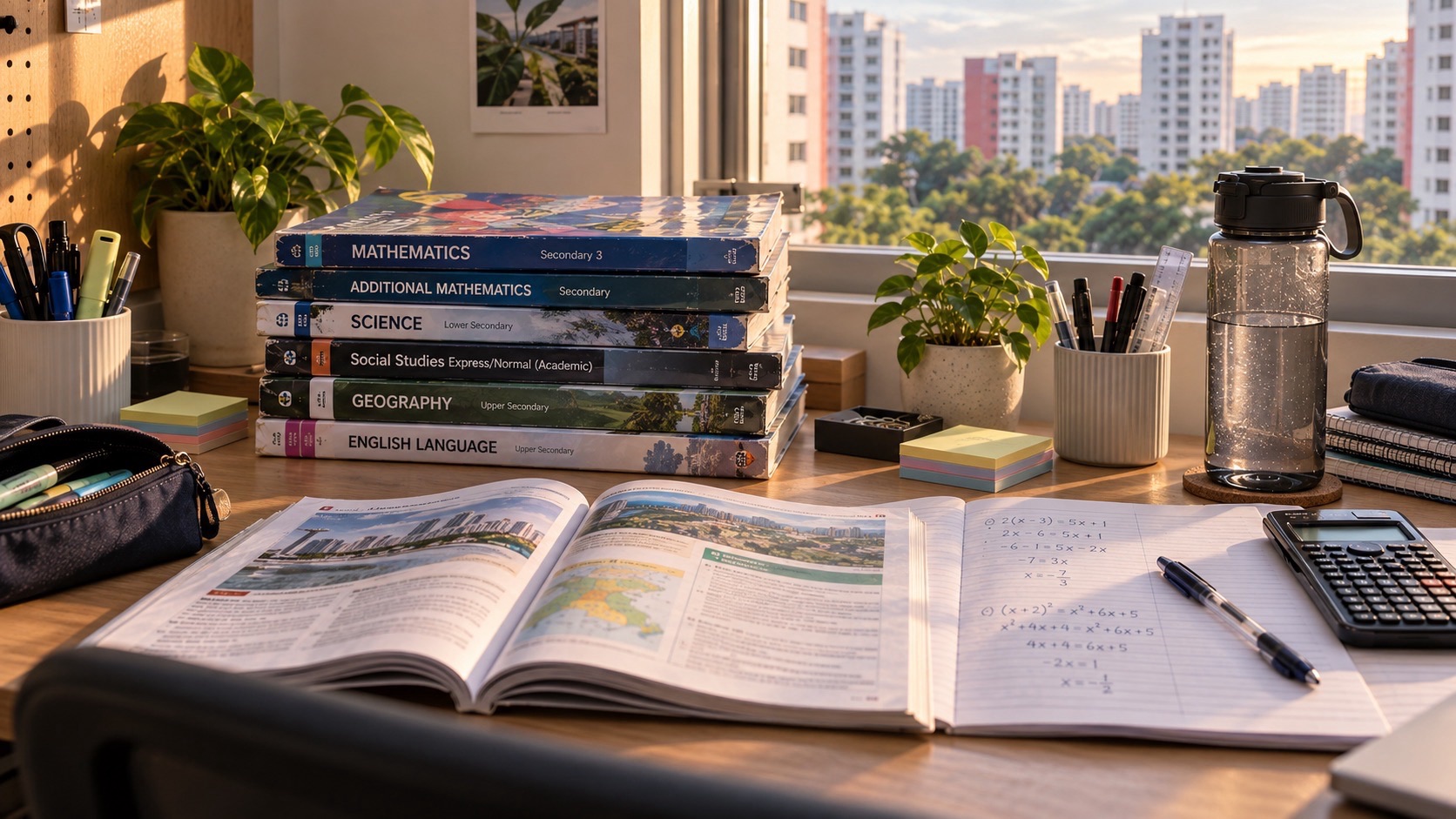
A Punggol secondary-school student admitted through Posting Group 2 (PG2) can improve G2 Mathematics geometry by learning to identify the property shown in a diagram, explain why it applies and use correct measurements and units to find angles, lengths, areas or volumes. PG2 is an admission grouping under Full Subject-Based Banding; G2 Mathematics is an individual subject level, so parents should check the child’s actual timetable and syllabus. A correct-looking formula is not enough if the student chooses the wrong dimensions, assumes lines are parallel without evidence or confuses area with volume.
MOE’s secondary Mathematics curriculum emphasises mathematical problem solving, reasoning and representations, including geometry and measurement. For families at Edgefield, Greendale, Punggol Secondary and Yusof Ishak Secondary, the practical way to help is to start with one genuine school problem, mark what is given, identify the appropriate property and ask the child to justify each step. This guide includes clear worked examples of straight-line and triangle angles, perimeter, area, composite shapes and rectangular-prism volume, alongside safe Punggol-inspired illustrations that do not pretend to be real building measurements. The specific topics and depth should follow the student’s confirmed G2 course and school sequence.
- Posting versus subject: PG2 concerns Secondary 1 admission; G2 describes a Mathematics curriculum level.
- Read the diagram: distinguish what is given from what merely looks true.
- Angles: justify properties of straight lines, triangles, intersecting lines and parallel lines where applicable.
- Perimeter: total length around a boundary, with linear units.
- Area: amount of surface covered, with squared units.
- Volume: space occupied by a solid, with cubic units.
- Composite shapes: divide into valid components and avoid double-counting.
- Check: label dimensions, convert units and estimate whether results make sense.
- Next step: solve one diagram with a written reason before each calculation.
Definition lock: PG2 and geometry ability are not the same
Posting Group 2 helps determine admission to a secondary school. A student’s subjects are taught at G1, G2 or G3 levels as applicable under Full Subject-Based Banding. A PG2 entrant may study G2 Mathematics or another offered level; the actual school record is therefore the correct reference for choosing geometry questions. The posting group itself does not say whether a pupil understands triangles, spatial relationships or the use of units.
Geometry develops an ability to reason from specific information. A child who can identify a property and defend the calculation is learning more than one who memorises a formula and applies it indiscriminately. The family should begin with the school’s present content and a real example of difficulty. If the issue is reading an angle diagram, teaching volume formulae will not resolve it. A targeted explanation reduces effort and builds confidence more reliably than a random collection of hard questions.

What makes geometry different from arithmetic
In arithmetic, a student may be given numbers and asked to calculate directly. Geometry often requires identifying which numbers and relationships matter before calculating. A diagram may contain extra lengths, hidden angle relationships or lines whose appearance suggests a property that has not been established. The learner has to interpret the drawing as mathematical evidence, not merely as a picture.
A good geometry answer explains the reason for using a property. If two marked angles lie on a straight line, their sum is 180 degrees. If a triangle’s three interior angles are given, their sum is 180 degrees. A student who knows both properties must still identify which is relevant to the task. This step of classification is central to geometry and makes later proof-based reasoning possible.
Do not assume a diagram is drawn to scale
Some diagrams are intended to illustrate relationships and are explicitly not drawn to scale. Even when a drawing looks symmetrical, the problem may not state that two sides are equal. A line may appear horizontal without establishing parallelism with another line. Students should avoid measuring a printed angle with their eyes or ruler and treating the result as exact when the task supplies mathematical properties instead.
Ask the learner to highlight what has been given: a parallel-line symbol, an equal-side mark, a labelled angle or a specific dimension. Then circle what must be found. This distinction protects against a common mistake: introducing an unproven property based on appearance. Geometry depends on conditions that can be stated and justified. A persuasive drawing cannot replace information the question never supplied.
Angles on a straight line add to 180 degrees
Consider a fictional diagram with adjacent angles measuring 58 degrees, 37 degrees and x degrees along a straight line. Since angles on a straight line sum to 180 degrees, x equals 180 minus 58 minus 37, which is 85 degrees. The answer is correct because the diagram establishes the straight-line relationship, not because the remaining angle happens to look roughly like a right angle.
Ask the student to state the reason in words before writing the calculation. Then check the total: 58 + 37 + 85 = 180. Use a second example with different numbers and another drawing orientation. Rotating a line should not change the mathematical property. A learner who understands that remains accurate when the diagram looks unfamiliar.

Angles around a point total 360 degrees
When angles fill a complete turn around a point without overlapping, their sum is 360 degrees. Suppose a practice diagram shows four angles of 100, 85, 70 and x degrees. The remaining angle is 360 minus 255, or 105 degrees. The calculation should be performed only when the labelled angles actually form the full turn. A student who assumes an incomplete diagram shows the whole point may be using the property without enough information.
Ask the learner to trace the complete turn and identify whether any region is missing. This connects the numerical sum with the geometry. Students can practise with printed diagrams without needing specialised equipment. The key is understanding what condition makes the rule valid. A correct number reached from an unjustified property should still be examined.
Vertically opposite angles are equal
When two straight lines intersect, the vertically opposite angles are equal. This property can help find an unknown angle without measuring it. If one angle at the intersection is 72 degrees, the opposite angle is also 72 degrees. Each adjacent angle is 108 degrees because it forms a straight-line pair with the 72-degree angle. The relationships fit together consistently.
A common mistake is to label adjacent angles as vertically opposite. Ask the child to trace which rays form each angle and locate the angle directly across the intersection. Then ask for a numerical check using the straight-line property. Geometry is more reliable when one result supports another. A student who can explain both relationships has developed structural understanding rather than memorised two isolated slogans.
Triangle interior angles total 180 degrees
A triangle’s three interior angles sum to 180 degrees. For a hypothetical triangle with interior angles of 45 degrees, 65 degrees and x degrees, x is 70 degrees. The calculation is straightforward, but students must recognise that the angles shown are the interior ones. If one labelled angle is exterior, the same calculation may not apply directly without further reasoning.
Ask the teenager to mark the three interior corners before solving. Then change the orientation or shape of the triangle and try again. A tall narrow triangle and a wide flat one obey the same sum property. The student should not be deceived by the visual proportions. The aim is to identify the figure and its given relationships, not to estimate angles from how a drawing looks.
An isosceles triangle has specific equal angles
In an isosceles triangle with two equal sides, the angles opposite those equal sides are equal. If the vertex angle between the equal sides is 40 degrees, the two base angles sum to 140 degrees and are 70 degrees each. But the student must first identify which sides are marked equal. A figure that merely appears isosceles does not supply enough information unless the problem states or marks the equality.
Ask why the two base angles can be treated as equal. A complete explanation cites the equal sides and the isosceles triangle property. Then check the sum of all three angles. Teaching this connection prevents the learner from treating every triangle with a horizontal base as though it had equal base angles. Mathematical marking usually rewards the relevant justified steps, not the visual neatness of the diagram.
Exterior angles of triangles require careful identification
An exterior angle can be formed by extending one side of a triangle. Under the relevant conditions, it equals the sum of the two opposite interior angles. For instance, if the remote interior angles are 50 degrees and 65 degrees, the corresponding exterior angle is 115 degrees. The adjacent interior angle is 65 degrees, since the two along the extended straight line sum to 180.
A student might get the right exterior angle by adding unrelated labels. Ask which angle is actually exterior and which interior angles are remote. Trace the extension carefully. The property should be explained with the diagram rather than applied to every angle outside a triangle. Use different orientations to test whether the learner understands the structure, not just a familiar drawing.
Parallel-line angles need a reason for parallelism
Corresponding, alternate and interior-angle relationships can be useful when a transversal crosses parallel lines. These properties require the relevant lines to be parallel, which should be indicated or established. A pupil may see two nearly horizontal lines and apply alternate-angle equality even though no parallel marking is given. That is a reasoning error even if the drawing makes the answer look plausible.
Teach the student to check for the symbol or statement before selecting a property. Then identify the relationship of the particular angles. Use colour or tracing to show whether they are on corresponding sides or alternating sides of the transversal. A written reason matters: ‘alternate interior angles on parallel lines’ is different from ‘they look the same’. This foundation also helps with more formal geometric arguments later.
A quadrilateral’s interior angles sum to 360 degrees
A quadrilateral can be divided into two triangles, each with an interior angle sum of 180 degrees. Therefore its four interior angles total 360 degrees. Suppose a fictional quadrilateral has angles of 90, 110, 75 and x degrees. The remaining angle is 85 degrees because the known angles sum to 275. The result can be checked by addition.
The learner should understand why this rule follows from triangle geometry rather than treat 360 as another fact to memorise. Drawing a diagonal across a simple quadrilateral makes the two triangles visible. If a figure is more complex, the student must be careful about what kind of quadrilateral is involved. The goal is to reason from valid decomposition rather than guess from appearance.
Angles can connect to algebra
Some diagrams label an angle as x degrees and another as 2x + 30 degrees. If the angles are adjacent on a straight line, x + (2x + 30) = 180. Solving gives 3x = 150 and x = 50 degrees, so the second angle is 130 degrees. The algebra is correct only because the geometric relationship was identified correctly first.
Ask the student to complete the diagram-to-equation translation in words. Which angles add to 180 and why? What does x represent? Then solve using balanced steps and verify both the algebra and geometry. A learner who can bridge the two subjects is less likely to treat angle word problems as isolated arithmetic tricks. This approach links the preceding PG2 algebra guide with spatial reasoning.
Perimeter describes a boundary
Perimeter is the total length around a two-dimensional shape. A rectangle that is 8 centimetres long and 5 centimetres wide has perimeter 2(8 + 5) = 26 centimetres. The units are linear because the quantity measures length. Students sometimes multiply the sides and label the result a perimeter, confusing it with area. Ask them to imagine tracing the boundary with a string.
The practical meaning makes the formula easier to remember. For a rectangle, two lengths and two widths form the outer edge. A different shape may need individual side lengths summed rather than forcing the rectangle formula onto it. The learner should read the figure and select the appropriate strategy. An accurate unit tells the reader what has been measured.
Area describes a surface
Area measures the amount of two-dimensional surface covered. A rectangle 8 centimetres by 5 centimetres has area 40 square centimetres. The square unit matters because the surface can be understood as a grid of unit squares. A student who writes 40 cm instead of 40 cm² has omitted an important part of the answer. The same number without the correct dimension describes something different.
Compare perimeter and area for the same rectangle: 26 cm and 40 cm². The two cannot be added or compared as though they were identical quantities. Ask the student to draw a rectangle and explain which calculation relates to the boundary and which to the interior. This visual distinction is foundational for more complicated figures.
Triangle area uses perpendicular height
The area of a triangle is one-half times its base times the corresponding perpendicular height. The word perpendicular is essential: a sloping side is not automatically the height for the chosen base. In a practice triangle with base 8 cm and perpendicular height 4 cm, the area is 16 cm². The result can be visualised as half the area of a rectangle of matching base and height.
Ask the learner to identify the right-angle relationship in the diagram. If the height falls outside an obtuse triangle, it is still the perpendicular distance to the base line. Students should not select the longest side or any nearby number as the height. The geometric meaning of the formula protects against this common error.
Parallelogram area also uses perpendicular height
A parallelogram’s area is base multiplied by the corresponding perpendicular height, not base multiplied by the sloping side unless those lengths happen to be perpendicular. A practice parallelogram with base 10 cm and perpendicular height 6 cm has area 60 cm². Its slanted edges may be longer than 6 cm but should not replace the height in the formula.
Use a simple diagram showing the perpendicular distance between the parallel sides. Ask what would happen if the shape were sheared while the base and perpendicular height remained the same. The area would remain unchanged. That observation helps learners understand why the sloping edge is not the relevant measurement. Good geometry links formulae to shapes rather than treating each as a memorised string of symbols.
Trapezium area depends on parallel sides
The area of a trapezium can be calculated as one-half times the sum of the two parallel sides times the perpendicular height. Suppose the parallel sides measure 8 cm and 12 cm and the height is 5 cm. The area is (8 + 12) × 5 ÷ 2 = 50 cm². If a student substitutes one nonparallel side for the height, the calculation no longer represents the correct surface.
Ask which pair of sides is parallel and how the perpendicular distance is shown. The formula reflects the average length of the two parallel sides multiplied by the height. Understanding that relationship makes the rule easier to reconstruct. A small labelled sketch is more helpful than a memory phrase repeated without connection to the diagram.
Circle calculations require identifying radius and diameter
In relevant school topics, circumference and area of a circle depend on its radius. The diameter is twice the radius. A student may be given a diameter of 10 cm and incorrectly substitute 10 as the radius. The actual radius is 5 cm, giving area 25π cm² and circumference 10π cm. The exact form and permitted approximation for π should follow the task instructions.
Ask the child to draw a line from the centre to the edge and compare it with a line passing through the centre from one side to the other. These represent radius and diameter respectively. The relationship is simple but easy to misread under pressure. Units again matter: circumference is linear, while area is squared. A correct formula with the wrong input remains an incorrect model.
Composite shapes can be divided or subtracted
An L-shaped region may be decomposed into rectangles or treated as a larger rectangle with a smaller part removed. Both approaches can be valid when the dimensions are known and no region is counted twice. Imagine a large 10 cm by 8 cm rectangle with a 4 cm by 3 cm corner removed. Its remaining area is 80 − 12 = 68 cm². The answer should be accompanied by a sketch showing what was removed.
Students commonly subtract the wrong smaller region or forget that the outside boundary contains extra segments. Ask the learner to shade the intended area, mark all needed dimensions and decide whether addition or subtraction is clearer. Then verify whether the components reconstruct the original shape without gaps or overlaps. Geometry becomes a problem of representing the region accurately before calculating.
Composite perimeter is not the same as composite area
Removing a rectangular corner from another rectangle changes the area and may change the arrangement of boundary segments. The perimeter requires tracing the entire new outside edge, including edges introduced by the cutout. A student who calculates the large rectangle’s perimeter and merely subtracts the removed rectangle’s perimeter is usually applying an invalid shortcut. The new boundary must be examined.
Ask the child to place a finger on one starting corner and trace every external segment once. Write down the length of each relevant side, using relationships to infer missing dimensions only when justified. This method is deliberate and understandable. A perimeter answer should be in linear units, not square units. The exercise teaches careful diagram reading as much as arithmetic.
Volume adds a third dimension
Volume measures space occupied by a three-dimensional object. A rectangular prism with length 8 cm, width 5 cm and height 3 cm has volume 8 × 5 × 3 = 120 cm³. The cubic unit represents a count of unit cubes, unlike the square unit used for area. If a student simply multiplies two dimensions, they have calculated an area rather than the full volume.
Use a box diagram to identify all three mutually perpendicular dimensions. Ask what happens when height doubles while the base remains unchanged; volume doubles. This relationship helps the learner see the structure instead of memorising a formula in isolation. Real storage containers may have walls or unusable spaces, so a simple rectangular-prism model should be interpreted as the idealised geometry stated by the question.
Surface area and volume answer different questions
Surface area concerns the total area of faces forming the outside of a solid, while volume concerns the space inside or occupied by it. A rectangular prism may have a volume of 120 cm³ while its surface area has a different numerical result in cm². A packaging problem may ask how much material covers the exterior, while a capacity question concerns three-dimensional space. The context tells the learner which quantity matters.
Ask the child whether the question is about covering, wrapping, painting or filling. These verbs can provide useful clues, but they must be interpreted with the actual geometry and conditions. A box without a lid has a different exterior surface to cover than a fully closed cuboid. A student should draw or list the included faces rather than apply one formula automatically to every package.
Conversion of units must happen before formula substitution
A shape may give lengths in centimetres and millimetres. Before calculating an area or volume, convert the measurements to consistent units. For example, 50 mm equals 5 cm. A rectangle measuring 50 mm by 8 cm has area 5 × 8 = 40 cm², not 400 square centimetres. A learner who multiplies 50 by 8 without checking units produces a numerical answer that misrepresents the surface.
After calculating, label the result according to the chosen units. When converting square or cubic units, the scale factor also changes dimension: 1 cm² equals 100 mm², and 1 cm³ equals 1,000 mm³. These relationships should be taught from grids or unit cubes where possible. They are not simply the linear factor repeated without considering dimension.
Estimation can catch a misplaced unit or decimal
Before using a calculator, estimate the magnitude of the expected result. A rectangle about 10 cm by 5 cm should have area around 50 cm², not 5,000 cm². A box with three dimensions of a few centimetres should have a volume measured in hundreds, not millions, of cubic centimetres unless the dimensions warrant it. Estimation gives the student a reason to question an implausible result.
Ask how the child knows the estimate is reasonable. Rounding dimensions can create a rough comparison. The purpose is not to replace the exact calculation but to provide an error check. If the final answer differs dramatically, revisit the input dimensions, formula, conversion and calculator entry before accepting it. A good mathematician interprets results rather than treating the display as infallible.
A Punggol-inspired map problem should not be mistaken for a survey
Imagine a fictional park diagram in which a rectangular section is 12 metres by 8 metres. Its mathematical area is 96 m² under the scenario’s assumptions. This provides area practice but does not establish the actual dimension of any Punggol Waterway Park section. An illustration inspired by a real neighbourhood must be labelled hypothetical when its measurements are invented.
If a school project genuinely uses a map, check its scale, date and purpose. A straight-line representation is not automatically an accessible walking route, and an aerial image alone may not provide reliable dimensions. Parents can support a safe desk-based calculation without taking a teenager to measure restricted or unsafe infrastructure. The educational goal is accurate geometry, not creating unverified local facts.
A fictional pupil misreads a triangular height
Imagine a fictional Secondary 1 student, Nisha, who sees an obtuse triangle with a sloping side labelled 7 cm and a perpendicular height labelled 4 cm. She uses 7 as the height because it looks longer and more prominent. Her teacher asks her to locate the right-angle mark and explain which distance is perpendicular to the chosen base. Nisha identifies the correct height and recalculates the area.
On a second triangle whose height lies outside the shape, she successfully applies the same principle. This fictional example illustrates transfer: the student has learned what height means rather than memorised the appearance of one diagram. A useful correction connects the visual property, the formula and the chosen dimensions. It does not merely replace an incorrect number in the answer key.
Another fictional pupil confuses volume with capacity
Consider a fictional learner, Daniel, given a rectangular solid’s dimensions and asked for volume. He multiplies two dimensions and obtains a surface area because he has not identified what the question measures. His parent asks him to draw the object’s length, width and height and explain the idea of unit cubes. Daniel then computes all three dimensions and labels the result in cubic units.
The next question concerns a container with an explicit wall thickness, which may require a different calculation for usable internal capacity. That detail shows why the idealised solid’s outside dimensions cannot always be used for real storage. The example is a teaching scenario, not an engineering claim about actual Punggol facilities. Good modelling always asks which physical space the problem refers to.
Geometry working should name the relevant property
A well-organised solution states the given information, identifies the appropriate geometric property and then performs the calculation. A line such as ‘x = 180 − 58 − 37’ may be mathematically correct, but explaining ‘angles on a straight line sum to 180 degrees’ demonstrates the reason. Similarly, a triangle-area calculation should identify the corresponding perpendicular height. Writing the reason helps teachers diagnose whether the student understands the step.
Do not encourage pages of unnecessary prose for a simple calculation. Concise correct justification is sufficient when it communicates the method. A child who can explain why the property applies has acquired a stronger skill than one who recognises only a familiar diagram. Geometry learning involves choosing and defending methods, not merely executing calculations.
A geometry correction notebook can stay small
Select a few recurring mistakes: assuming parallel lines without markings, using a sloping side as triangle height, confusing radius and diameter or omitting squared units. For each, keep the original error, a short explanation of the correct idea and a new problem solved independently. Avoid copying dozens of correct worked examples without attempting an unfamiliar diagram. Learning becomes visible through changed behaviour, not notebook thickness.
A week later, ask the teenager to explain the same property with a rotated diagram or different dimensions. If the error returns, revisit the underlying visual concept. If the student solves it without hints, choose the next target. The purpose is precision and independence. Small carefully chosen corrections can strengthen understanding faster than indiscriminate worksheet repetition.
When a learner cannot visualise a figure
Some students struggle to imagine three-dimensional shapes from a flat diagram. Begin with simple safe objects such as a closed rectangular box and identify faces, edges and vertices. The student need not dismantle packaging or handle tools to learn these terms. A drawing or foldable paper net can also support understanding when permitted by the teacher. The objective is to connect two-dimensional representations with spatial structure.
Ask which edges belong to length, width and height, and how a face’s area differs from the solid’s volume. If the learner cannot identify these features, formula practice may be premature. Build the representation first, then calculate. A student who understands the object is less likely to substitute the wrong dimension or confuse the quantity being measured.
Check the lower-secondary sequence before extending to harder topics
MOE’s secondary Mathematics syllabus and the relevant 2027 G2 K210 SEC course include a range of geometry and mensuration ideas, but the graduating examination syllabus should not be treated as the week-by-week plan for a new Secondary 1 pupil. Schools organise learning progressively. Some properties or solids may be introduced later than the first lesson. A child who is still learning fundamental angles does not benefit from being forced into advanced formulae without adequate preparation.
Ask the subject teacher which geometric foundations matter most for the current term. Focus on accurate diagrams, property identification and units. Later topics can be introduced when the prerequisite ideas are secure. Ambition is served by durable understanding, not by checking off difficult chapter titles before the student can explain the basics.
A twelve-day geometry practice routine
Begin with straight-line, point and intersection angles using printed diagrams. Next, use triangle properties and one simple algebraic angle question. Then practise distinguishing perimeter and area, followed by triangle area with perpendicular height. Introduce a composite rectangle after the simpler shapes are secure. End with rectangular-prism volume and a mixed exercise that asks the student to choose the appropriate quantity and unit independently.
This is an optional home-learning illustration. Follow the child’s school sequence and stop to repair prerequisite errors as needed. A session can be short but should contain a reasoned explanation and an independent retry. Avoid practising only diagrams with the same orientation. Change the appearance while preserving the property, so the learner acquires geometric understanding rather than a visual memory of one worksheet.
How good tutoring helps with geometry
A tutor can observe whether a student fails because they misread the diagram, forgot a property, chose the wrong dimension or made an arithmetic error. Those causes call for different teaching. A careful tutor asks the learner to point to the relevant markings, state a property and solve a similar new problem without hints. In a small group, students may also hear classmates explain the same relationship differently.
The goal is not to provide increasingly difficult questions while old misconceptions remain unresolved. A tutor should match the confirmed subject level and present school work. Families should ask whether the child can explain the reason for each calculation after help is withdrawn. That is a more credible sign of progress than claims of guaranteed marks or effortless promotion to a more demanding subject.
The final answer needs both a number and a meaning
If a question asks for the area of a fictional triangular region, a result of 16 is incomplete without indicating the correct squared unit. If it asks for an unknown angle, the result should be in degrees. If it asks for storage volume, cubic units matter. The learner should also check that the result matches the expected size and the figure’s constraints. A negative area or an angle larger than a full turn in an ordinary interior-angle question signals a likely error.
Ask the child to read the question again after solving. What exactly was requested, and does the answer address it? This is the final bridge between symbolic Mathematics and practical meaning. Clear interpretation is part of being mathematically correct, not an optional sentence added for presentation.
Sources, related articles and your next step
Use MOE’s secondary Mathematics syllabus framework for mathematical reasoning and geometry context, and SEAB’s 2027 G2 subject index for the graduating K210 Mathematics syllabus. The current teacher’s topic list and actual G2 offer govern the child’s lower-secondary practice. For related algebra reasoning, see the PG2 algebra guide.
This article concentrates on geometric properties, area and volume rather than the earlier ratios, percentages and graphs guide. Your next step is to show your child one actual school diagram and ask three questions before calculation: what information is given, which property makes the next step valid and what unit will the final answer require? Then change the diagram to test independent understanding.
Frequently asked questions: PG2 G2 Mathematics Geometry
Does PG2 automatically mean G2 Mathematics?
No. PG2 is the admission group and subject-level offers can differ under Full SBB. Confirm the student’s actual class.
Why should students not measure diagrams by eye?
The figure may not be drawn to scale. Mathematical statements and markings establish valid properties.
What is the sum of angles on a straight line?
180 degrees, when the indicated adjacent angles truly form a straight line.
What is the sum of triangle interior angles?
180 degrees for an ordinary Euclidean triangle.
Why must triangle height be perpendicular?
The area formula uses the perpendicular distance from the base to the opposite vertex or its line.
How are perimeter and area different?
Perimeter is boundary length with linear units; area is covered surface with square units.
How are area and volume different?
Area measures two-dimensional surface; volume measures three-dimensional space and uses cubic units.
Should a sloping parallelogram side be used as the height?
Only if it is perpendicular to the chosen base; otherwise use the actual perpendicular height.
Can children practise volume with ordinary packaging?
A safe rectangular box can illustrate length, width and height, while actual school tasks determine the required calculations.
What proves that the child understands geometry?
They can identify valid markings, justify a property, choose the right measurements and solve a changed example without prompts.
Editorial note, 1 November 2026: All hypothetical measurements and student scenarios are teaching illustrations, not survey measurements of Punggol places. The current school syllabus and actual subject level determine suitable practice topics.


