
How PG1 works at Punggol for Physical Education (PE) is straightforward: Posting Group 1 is used for Secondary 1 admission under Singapore’s Full Subject-Based Banding (Full SBB), but PE is a common lower-secondary curriculum experience rather than a separate academic G1 examination paper. Students with different academic subject levels can learn together while developing movement skills, fitness awareness, safe physical habits and responsible participation. MOE’s updated Physical Education syllabus began implementation at secondary and pre-university levels in 2025. It organises PE around three interconnected learning areas: Physical Activity, Outdoor Education, and Physical Health and Safety.
For Punggol families planning the 2027 Secondary 1 transition, PE should not be confused with selection for a competitive sports CCA or an expectation that every child must be a strong athlete. The school teaches age-appropriate movement and health knowledge while helping students participate safely. Parents can support this by reading the school’s PE instructions, preparing the required attire and equipment, discussing any individual access or health needs privately with school staff, and helping the child choose suitable activities outside school. A useful goal is a teenager who understands safe movement and can remain active with confidence, not one who treats every lesson as a competition for prestige.
- PG1 meaning: the student’s admission Posting Group; academic levels such as G1, G2 and G3 should not be confused with PE class membership.
- Current national basis: the MOE 2024 PE syllabus, implemented for secondary schools from 2025.
- Three learning areas: Physical Activity; Outdoor Education; Physical Health and Safety.
- Physical Activity: develop movement competence, tactics and enjoyment through age-appropriate activities rather than demand universal competitive ability.
- Outdoor Education: learn to prepare, navigate and evaluate risks under school supervision.
- Health and safety: build knowledge about fitness, nutrition, hygiene, safe participation and healthy routines without using appearance or body size as a ranking system.
- Punggol application: parks, community courts and walking paths may support recreational activity; they are not substitutes for supervised school lessons.
- Practical parent action: confirm school-specific PE attire, safety procedures, participation arrangements and suitable support for individual needs.
- Important distinction: PE is a curriculum subject; CCA selection, LEAPS recognition and external sports lessons follow separate rules.

What Physical Education is actually trying to achieve
It is tempting to judge a PE lesson by which student runs fastest or scores the most goals. That misses much of its educational purpose. MOE’s PE framework aims to develop physically competent and confident people who enjoy active and healthy living safely and responsibly. Students learn to move, make judgments, collaborate and appreciate participation in ways that can be sustained beyond school. A capable lifelong participant does not need to be an elite athlete. They do need enough confidence, knowledge and opportunity to take part in appropriate activities.
This distinction matters for a PG1 pupil who may already feel compared through academic scores. PE should not become another place where adults assume that a single performance result describes the whole student. One teenager may have quick reactions in a game but still be learning how to cooperate. Another may show careful safety judgment, persistence or progress in a skill that initially felt difficult. Recognising these dimensions encourages meaningful participation. The relevant question is how the child learns and improves, not how they rank in one isolated race.
The three learning areas in the 2025 secondary PE syllabus
The current MOE syllabus describes Physical Activity, Outdoor Education, and Physical Health and Safety. These areas work together rather than functioning as unrelated activities. Physical Activity develops movement skills and concepts. Outdoor Education builds competence and judgment in outdoor environments. Physical Health and Safety brings attention to active living, fitness, nutrition, risk management, personal hygiene and self-care.
Parents can use these three headings when talking with the school. A lesson involving a ball game may teach technical movement and teamwork. An outdoor task may teach route decisions and hazard awareness. A health discussion may explain why rest, safe preparation and suitable physical activity matter. The school’s exact sequence and sports depend on its programme, facilities and student needs. No family should assume that the same activity runs on the same date across all Punggol secondary schools.
Why PE sits in mixed form-class learning
Under Full SBB, the form class can include students who offer academic subjects at various G1, G2 or G3 levels. Shared curriculum subjects provide opportunities to learn and collaborate outside the academic subject grouping. PE is among these experiences. The physical and social abilities pupils bring to class will vary widely, just as their academic strengths differ.
A parent can explain this simply: “Your Mathematics subject level says what kind of Mathematics you are learning. It does not tell us everything about your movement, interests or teamwork.” Students should also be taught not to assume that high academic results make someone automatically better at sports, or that an accomplished athlete is therefore superior as a person. The purpose of the shared experience is to practise skills and respect. Teachers remain responsible for making appropriate learning and safety arrangements.
Physical Activity is more than football and running
The secondary PE syllabus aims to build competence across a range of physical activities. The national framework identifies movement skill, application of concepts and confidence in continued participation. A school’s timetable may include games, dance, athletics or other suitable activities according to its curriculum and facilities. An article should not promise that every incoming pupil will take exactly the same five sports or name an activity that the school has not confirmed.
A useful home conversation asks which activity the child actually experienced, what movement skill it involved and how they improved. For example, a student learning a racket sport may need to position their body before striking rather than swing harder. A student in a team game may need to watch the movement of teammates. The goal is to identify teachable actions. When an activity is unfamiliar, improvement can be measured relative to the learner’s starting point, not the performance of a particularly experienced peer.
Fundamental movement skills still matter in secondary school
Some teenagers enter Secondary 1 with uneven experience in running, jumping, throwing, catching or balancing. These are not moral failings. They may reflect different opportunities, confidence or physical circumstances. A PE teacher can adapt instruction so students develop increasingly controlled and effective movement. Parents should avoid labelling a child “hopeless at sports” because of one awkward performance.
At home, choose suitable activities that fit the child’s needs and preferences, such as walking, playing an age-appropriate ball game or practising basic coordination in a safe area. The family should not replicate risky school exercises or force a child to train through pain. Ask the child what felt difficult and what instruction helped. This is the movement equivalent of correcting a Maths misconception: identify the exact part of the skill rather than criticise the entire person.
Games teach decisions as well as techniques
In a game, executing a technical skill is only part of success. Students must notice space, respond to changing situations, follow rules and consider teammates. A player who can pass accurately during isolated practice may still be learning when a pass is useful during play. PE allows teachers to connect movement mechanics with tactical understanding and responsible behaviour.
A family can use a simple example. In a small passing game, ask why the player chose one teammate rather than another. Perhaps one person had more space or was in a safer position to receive. That is tactical reasoning, not merely a test of strength. The child can explain the decision, receive feedback and try again. Such thinking can also support confidence in unfamiliar situations. Good instruction helps pupils understand what to look for, not simply repeat the teacher’s demonstration.
Respect is part of successful participation
School games can generate excitement and disappointment. Students need to learn how to respect opponents, follow agreed rules and respond appropriately to decisions. Winning should not become a reason to mock a classmate who is still developing a skill. Losing should not become an excuse for abusive behaviour. MOE’s PE framework places values such as respect, responsibility, resilience, integrity, care and harmony within physical activity and healthy living.
Parents can reinforce these principles through questions after a game: “Did everyone get a chance to participate?” “How did you respond when the score changed?” “What could your team do differently?” These conversations are not about forcing children to say they enjoyed everything. They help a young person reflect on conduct and learning. Physical competence and character can be developed together when feedback is specific and respectful.
PE and a sports CCA are not interchangeable
A compulsory or timetabled PE lesson develops broad physical competencies and health understanding. A sports CCA may offer greater depth, regular training and opportunities for school representation. Selection, equipment, training times and LEAPS 2.0 recognition depend on separate school and national arrangements. A pupil does not need to join a competitive sports team to learn from PE.
This distinction protects choice. A student may enjoy PE and prefer Music or Art as a CCA. Another may love a school sport and train more intensively. The best decision considers actual interests, readiness, access and time. Parents should not assume that a public court session counts automatically as CCA attendance or that participation in PE earns a competitive sports selection place. Ask the school to explain its current options clearly.
Fitness should be understood through function, not appearance
Fitness is often discussed in terms of how someone looks. PE provides a better educational opportunity: understand how fitness relates to movement, endurance and wellbeing. The syllabus addresses health- and skill-related fitness, along with responsible active living. Students can learn to notice how consistent practice affects their ability to participate in suitable activities.
Parents should avoid making a child’s body shape, weight or appearance the measure of PE success. Such comparisons can be harmful and are not a sound substitute for appropriate assessment. Individual development, disability, health circumstances and growth patterns differ. If a teenager has a medical concern about exercise or weight, seek guidance from an appropriate healthcare professional. In ordinary family conversation, focus on how movement feels, what skill is becoming more manageable and what forms of activity the child genuinely enjoys.
Warm-ups are preparation, not punishment
Before physical activity, students may be taught appropriate preparation, including movements related to the planned task. The exact warm-up depends on activity, intensity and the school’s teaching. The point is to prepare the body and attention for movement, not to make the child exhausted before the lesson begins. A well-structured warm-up can also rehearse relevant movement patterns.
Parents can encourage the child to listen to the PE teacher’s explanations and ask why a movement is useful. Avoid copying demanding warm-up routines found in unverified videos or treating them as universal. What is suitable for an adult athlete may not be appropriate for a particular teenager. A safe session is designed for the participants and context. When uncertain, follow the teacher’s guidance and any advice needed for individual health conditions.
Physical activity should not ignore recovery
A young teenager may have PE, a sports CCA, an active commute and other commitments on the same day. Recovery, food, hydration, rest and sleep are part of responsible participation. A child who returns exhausted after an activity may need a manageable homework plan, not an immediate demand for prolonged revision. Families should look at the whole week when judging whether the timetable is sustainable.
A useful evening conversation can identify when the student feels most alert, what tasks remain essential and where a short break would help. This is not medical training advice or a prescribed exercise programme. It is ordinary planning that acknowledges physical activity has demands. If the child develops persistent pain, unusual exhaustion or another health concern, seek appropriate help rather than pushing through it to preserve attendance or a performance target.
Physical Health and Safety includes nutrition
The PE syllabus includes nutrition within Physical Health and Safety. The educational purpose is to help students make informed, appropriate decisions about food in the context of active living. This relates to, but is not identical with, the lower-secondary Food and Consumer Education curriculum. PE can connect health concepts with movement, fitness and personal care.
Parents can use general resources such as Health Promotion Board guidance to discuss balanced meals, while recognising that teenagers’ needs vary. Avoid calorie-counting challenges, body-shaming or strict dietary rules disguised as homework. A schoolchild should not have to prove fitness by adopting an extreme diet. When individual dietary or health advice is needed, a qualified professional is the relevant source. The general learning target is sensible understanding of nourishment, activity and wellbeing.
Personal hygiene and self-care matter after PE
Physical activity may involve perspiration, shared facilities and a return to academic lessons. Students should follow school guidance on appropriate attire, hygiene, equipment handling and cleaning. A forgotten towel, damaged shoe or missing uniform can create unnecessary stress. Parents can help establish a simple packing and after-lesson routine, then gradually let the teenager manage it independently.
The child should know where to store used items, when to wash hands, how to care for footwear and how to respond to a minor equipment problem. Avoid treating hygiene as a reason to ridicule a pupil who is still learning routines. Good habits are taught through clear explanation and consistent practice. They also contribute to consideration for classmates who share spaces and equipment.
Outdoor Education is about judgment in real environments
Outdoor Education develops skills, confidence and responsibility beyond a conventional indoor classroom. The MOE syllabus includes outdoor living, sense of place, and risk assessment and management. At secondary level, opportunities may involve navigation, trip planning and other outdoor competencies under qualified supervision. The precise activities depend on the school and programme, and should not be assumed from an old photograph of a camp.
A useful parent question is not merely “Will my child attend camp?” It is “What will students learn about preparing, making safe decisions and respecting the environment?” A successful outdoor experience might involve navigating a planned route, recognising hazards and cooperating with others. It should not require reckless exposure to danger. Responsible adventurous learning balances challenge with sound preparation.
Navigation is a useful everyday capability
Reading directions, interpreting a map and noticing landmarks can help students become more independent. Punggol’s transport and walking networks provide familiar contexts for basic route planning, but a family should not confuse everyday navigation with specialist outdoor training. Start with safe, supervised tasks. Ask the child to identify a destination, compare two possible routes and explain which one is practical under the given circumstances.
A route may be shorter on paper but less suitable because of crossings, weather or accessibility. Teach the student to name assumptions and check current conditions. Do not invent travel times or send a young child alone into an unfamiliar area for an educational challenge. The purpose is careful judgment and understanding of place. A school outdoor activity will have its own supervision and safety requirements.
Outdoor safety begins before leaving
Risk management includes recognising hazards and planning suitable responses. Students should learn to follow school instructions, prepare required equipment, remain with authorised groups and report concerns. Adults should not encourage unsupervised outdoor cooking, shelter-building experiments in unsafe locations or exploration of restricted areas. School-organised outdoor experiences involve arrangements that cannot be replaced by a casual home imitation.
A simple paper exercise is enough to teach the principle. Imagine planning an outdoor activity on a hot afternoon. Ask what information the organisers need about weather, water, shade, route and participants’ needs. Which changes would make the activity inappropriate? What is the backup plan? The learner practises thinking ahead without being exposed to avoidable risk. This habit also transfers to travel, Science practical work and everyday decision-making.
A sense of place is more than enjoying scenery
The PE syllabus includes forming meaningful connections with outdoor places. For a Punggol student, this can begin with observing how people use parks, footpaths and shared outdoor spaces. The child can consider what makes a place comfortable, accessible and worth caring for. Outdoor education should promote responsible use of the environment, not only personal recreation.
A parent might ask which features make a neighbourhood walking path suitable for different users, or how litter affects a shared area. Avoid assuming one short observation explains every environmental issue. A good response identifies what is visible and what further information would be needed. Respect signage, wildlife and other visitors. A sense of place grows when students recognise that their behaviour affects the environment and the people who share it.
Accessibility and inclusion need specific conversations
Students have different physical abilities, medical histories and access requirements. PE should be approached with dignity and appropriate individual arrangements, not blanket assumptions. Parents whose child needs adjustments should communicate privately with the school and relevant professionals. They can ask how the student may participate safely and meaningfully and what alternatives exist where a particular activity is unsuitable.
Do not infer that a pupil must sit out every lesson merely because one movement is difficult. Equally, do not pressure a student with a genuine restriction to participate against professional advice. The appropriate response is specific to the learner and task. A responsible school conversation should identify the activity, the concern, the support needed and the applicable procedures. Inclusion means thoughtful participation, not pretending that everyone has identical capabilities.
The role of confidence in trying an unfamiliar activity
Some students avoid a new activity because they fear looking clumsy in front of classmates. A beginner can feel especially exposed when peers have played the sport for years. Teachers can help by structuring practice so learners acquire the basic skill before being asked to perform under pressure. Parents can reinforce effort without insisting that the child immediately enjoys every challenge.
Ask what part felt difficult and whether the student improved between attempts. Avoid statements such as “You are not sporty” or “Everyone else can do it.” A more useful question is “What did the teacher show you that helped?” This shifts attention to the learning method. Confidence often follows successful experience rather than appearing before it. A child who learns to persist safely through a new task gains a useful habit beyond sport.
How to interpret a PE report or teacher comment
A PE report may describe skill, participation, understanding or other school-defined criteria. Parents should ask what the school actually measures, rather than assume the grade is based only on speed or strength. The national syllabus provides goals and learning areas, while individual schools determine appropriate evidence and assessment practices. One disappointing performance should not be treated as a complete judgment of the child’s potential.
If a comment says a student needs to participate more consistently, find out what is happening. Are instructions unclear? Does the child lack required equipment? Are they anxious in group settings? Is there a health concern? Different causes call for different responses. Once the family understands the obstacle, one practical adjustment may be more useful than an extra weekend of demanding exercise.
Using community sports spaces responsibly
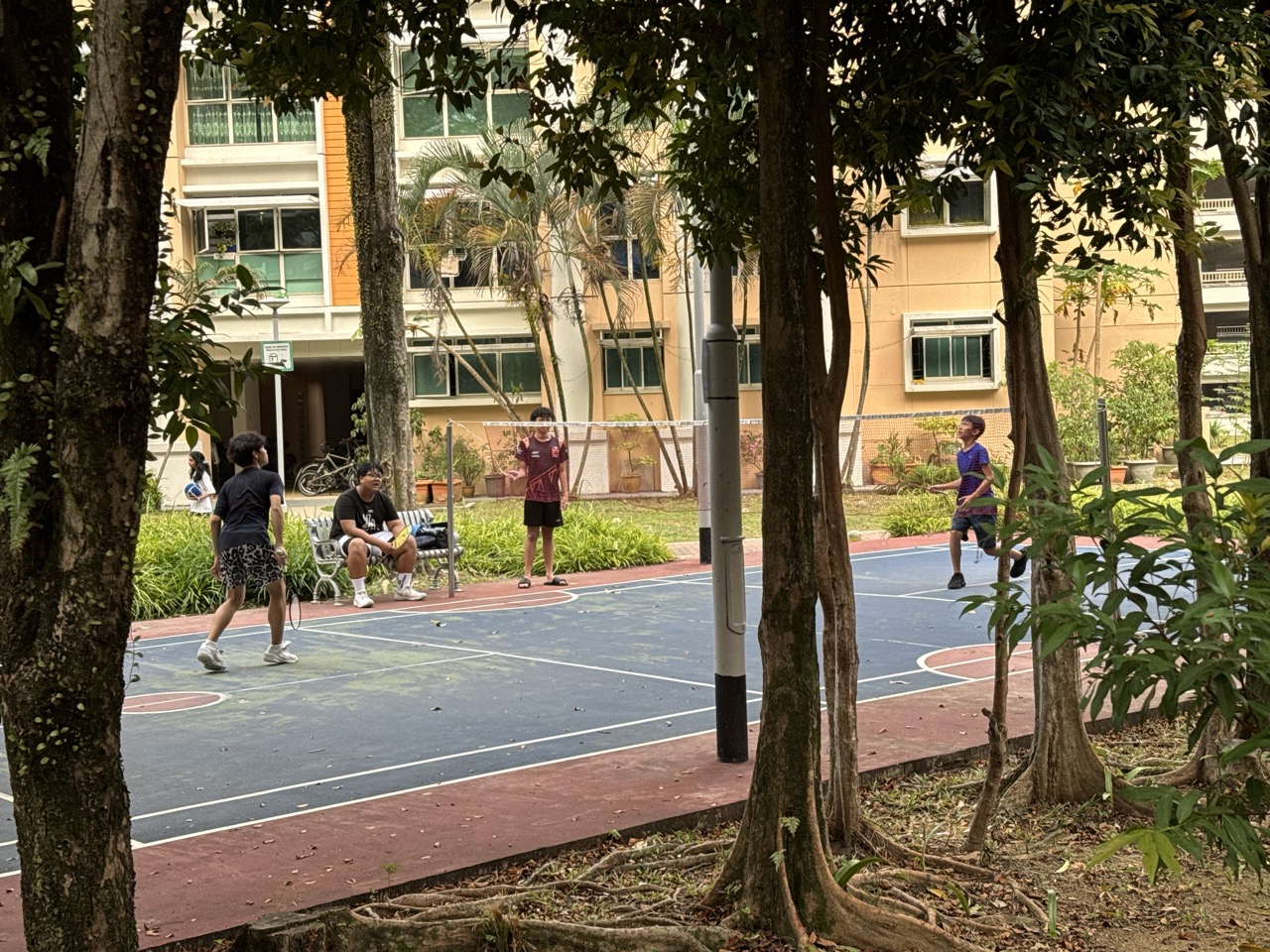
Punggol has neighbourhood sports courts and public recreation spaces that families may use where current rules permit. A basketball or badminton court can provide an accessible setting for enjoyable practice. But public facilities have shared-use etiquette and availability constraints. Parents should check signage and booking or access requirements rather than assume a photographed court is always open or that every activity is permitted.
A child can practise a simple appropriate movement, spend time with friends or explore a new interest under suitable supervision. The activity need not count toward school PE grades or CCA attendance to be worthwhile. It may simply help the teenager enjoy being active. Protect other users’ space and safety; avoid aggressive practice in crowded areas. Sustainable participation begins with respect for the people who share a facility.
School PE versus ActiveSG classes
Community coaching, ActiveSG programmes and school PE can all offer opportunities for movement, but they serve different roles. School PE is part of the national curriculum. A community class may offer optional instruction in a particular activity. Joining an external programme does not automatically replace a school’s PE requirement or guarantee selection for a CCA. Families should check actual provider schedules, ages, costs and safety arrangements before enrolling.
If a student enjoys a sport encountered in school, an external activity may help them explore further. That should remain a family choice based on interest, access and a manageable timetable. The child should not be pressured into expensive training simply because they were slower than a peer during one lesson. Confidence and healthy activity can develop through many pathways, including informal recreation where appropriate.
Why PE and school stress influence one another
Exercise, sleep and emotional wellbeing are connected aspects of a student’s daily life, but families should avoid simplistic promises that one sports session cures anxiety or guarantees better exam results. Physical activity can be enjoyable, social and restorative, while some competitive experiences can also feel demanding. The student’s response matters. Ask what kinds of movement they enjoy and how the activity affects the rest of the day.
For a teenager under academic pressure, a sustainable movement routine can provide variety and connection. If distress becomes persistent or severe, seek suitable professional or school support rather than treating PE as a standalone remedy. Good educational planning recognises the whole child. Homework, friendships, food, rest and movement each deserve attention. None should be used as punishment for difficulty in another domain.
A four-week family PE learning plan
Week one can focus on recognising the three syllabus learning areas and the child’s actual school expectations. Check attire, timetable, equipment and any relevant health information. Week two can emphasise one suitable movement skill, observing what changes after practice. Week three can explore safe route planning or an outdoor observation with adult supervision. Week four can ask the child to reflect on which activity is enjoyable and how safety and teamwork affected participation.
This is an illustrative home routine, not a replacement for school instruction or a physical training prescription. Keep the tasks gentle and appropriate. A brief conversation after PE may be more valuable than forcing extra drills. The aim is to help the learner describe a skill, recognise a risk and develop an informed preference. If the school requires specific preparation, follow that guidance rather than improvising a separate curriculum.
Worked example: a child who fears ball games
Imagine a fictional Secondary 1 student, Aisha, who becomes anxious when classmates play a fast ball game. She is afraid of missing a pass and attracting laughter. Her parent initially considers avoiding all physical activity. A more useful response is to speak with the teacher, understand the relevant skill and discuss how Aisha can practise it safely at an appropriate level.
She begins by learning how to position herself and receive a gentle pass in a suitable setting. As her control improves, the task becomes more complex. The aim is not instant team selection. It is developing a skill and confidence while maintaining safety and respect. If the anxiety or physical concern is more significant, the school can advise on appropriate support. This example shows how small, specific improvements can be more meaningful than broad judgments.
Worked example: strong athlete, weak teamwork
Imagine another fictional student, Ben, who runs quickly and dominates a game but repeatedly ignores less experienced teammates. His athletic ability is real, yet his PE learning is incomplete. A teacher asks him to make decisions that involve the whole team and to reflect on how cooperation affected the outcome. Ben begins to understand that a successful game is not only an individual performance.
At home, parents can reinforce the same idea by asking whether teammates were included and what the child learned about communication. They need not deny Ben’s strength. They can help him apply it responsibly. Physical education develops competence alongside values. The child’s growth appears when skill, judgment and respect begin to work together.
The later SEC does not replace lower-secondary PE
The Singapore-Cambridge Secondary Education Certificate begins in 2027 for graduating students, with G1, G2 and G3 levels for relevant examinable subjects. Lower-secondary PE remains a common curriculum experience; it should not be described as a separate “G1 PE SEC paper.” A student entering Secondary 1 in 2027 would ordinarily be in Secondary 4 in 2030, and the applicable national examination syllabus for their graduating year should be checked separately.
This is an important administrative distinction for parents who see “PG1” attached to every school question. Not every valuable area of learning is measured through a national written examination. Physical capability, healthy habits, responsible risk management and respect for teammates have educational worth independently. The absence of a G1 PE SEC paper does not make PE unimportant.
What to ask the receiving Punggol secondary school
Ask how the PE programme covers the national learning areas, which activities are offered at the child’s year level and how the school evaluates development. Ask about attire, equipment, outdoor learning, access arrangements and communication of safety concerns. If the child has a particular health or disability-related need, discuss it with authorised staff rather than assuming one online article describes the correct accommodation.
When comparing schools, also ask how PE fits the full timetable and how students can explore interests through CCAs or recreation. The school may have distinctive facilities or programmes, but do not infer guaranteed access from an old photograph or web page. A good choice provides an environment where the child can participate safely, build confidence and develop a sustainable relationship with physical activity.
Frequently asked questions about PG1 PE
Does PG1 mean PE is taught at G1? No. PG1 is the admission group. PE is part of the shared lower-secondary common curriculum under Full SBB, rather than a separate subject-level national examination in the same sense as G1 Mathematics.
Does every PG1 pupil have to become good at team sport? No. The national PE curriculum supports broad movement competence, healthy habits, outdoor skills and safe participation. Individual starting abilities and suitable support matter.
Is PE the same as a sports CCA? No. PE is a curriculum subject. A sports CCA can involve additional training, selection and co-curricular recognition under separate arrangements.
Should students train through pain to keep up? No. Follow the school’s safety instructions, report relevant concerns and seek appropriate healthcare advice for injuries or individual health conditions.
Can public courts in Punggol replace school PE? No. Community activity can support recreation and skill development but does not automatically meet the school’s curriculum or assessment requirements.
What is the simplest family action? Ask the child which movement skill they are learning, why the teacher’s instructions matter and how they can participate responsibly and safely.
Official references and the next useful step
Read the MOE Physical Education syllabus, implemented at secondary level from 2025, MOE Full Subject-Based Banding and MOE SchoolFinder. For local context, see Punggol Secondary School’s PE programme and the connected eduKate Punggol guides on PG1 CCAs and LEAPS 2.0 and mixed form classes.
This article uses information available in November 2026. It is not an individual exercise prescription or a promise about the activity schedule at any school. The next step is to ask your child to explain one PE skill they are developing, one relevant safety rule and one kind of physical activity they might genuinely enjoy continuing.


