
How PG1 works at Punggol for G1 Elements of Business Skills (EBS) is about learning to understand a real service business and make evidence-based recommendations. PG1 is the Secondary 1 admission Posting Group under Full Subject-Based Banding (Full SBB); G1 EBS is a distinct upper-secondary examinable subject that a school must actually offer before a pupil can study it. Under the published 2027 Singapore-Cambridge Secondary Education Certificate (SEC), EBS carries syllabus code K129 and covers four connected units: Understanding Business Activities, Basic Marketing, Customer Relations and Business Investigation. Its examples come from the service industries of Retail, Hospitality, and Travel and Tourism. A Punggol parent should not assume that lower-secondary common curriculum subjects, a school enterprise club or everyday shopping are automatically the same as the formal EBS course.
The 2027 K129 scheme gives Paper 1, a compulsory written examination, 60% of the overall result and Paper 2, supervised business-investigation coursework, 40%. In that year’s coursework, candidates investigate a business with a physical location in Singapore within the specified service industry, gather relevant primary and secondary information and make a justified recommendation about the marketing mix and customer experience. SEAB specifies 20 hours of supervised computer-laboratory curriculum time for coursework tasks, with relevant primary information gathering expected outside those sessions according to the examination instructions and school supervision. Parents can help students understand concepts, build accurate reading and numeracy, and practise ethical observation. They should not write the coursework, fabricate surveys or promise that a business will grant interview access.
- PG1 versus G1 EBS: PG1 concerns Secondary 1 admission; G1 Elements of Business Skills is a separate upper-secondary subject with school-specific availability.
- 2027 SEC subject: Elements of Business Skills, K129, identified by SEAB as a refined syllabus with changes to content but no change in assessment scheme.
- Four units: Understanding Business Activities; Basic Marketing; Customer Relations; Business Investigation.
- Industries: Retail, Hospitality, and Travel and Tourism in the Singapore service context.
- Paper 1: written examination, 60%, compulsory structured and short responses based on business contexts from the first three units.
- Paper 2: coursework, 40%, based on an investigation into a business in the designated industry, with evidence, evaluation and a reasoned recommendation.
- 2027 coursework time: 20 hours of supervised computer-laboratory curriculum time across the specified school coursework process; follow the actual examination instructions.
- Research ethics: do not invent data, photograph customers without permission, pressure employees for interviews or submit adult-written work as the student’s own.
- Punggol examples: retail outlets and food-service businesses can inspire questions, but a specific business must be eligible and approved for the actual coursework task.
- 2027–2030 caution: the published 2027 syllabus belongs to that year’s graduating cohort; a student entering Secondary 1 in 2027 would ordinarily reach Secondary 4 in 2030.

What Elements of Business Skills is trying to teach
Many teenagers encounter businesses only as customers. They buy a drink, visit a shop, compare products and decide whether the service was satisfactory. EBS asks the student to look behind that experience. What needs is the business trying to meet? Who are the customers? Why is one product priced or displayed differently from another? How does staff communication influence the experience? How can the business improve responsibly?
The aim is not to turn every student into an entrepreneur before graduation. It is to build foundational business knowledge, decision-making, communication and an enterprising mindset. A pupil who can observe a problem carefully and justify a practical improvement has learned a valuable transferable skill. The subject also develops the ability to interpret information rather than rely on a first impression. These capabilities can be useful in later education, community projects and everyday consumer decisions.
Why the subject should not be confused with a generic business club
A school might have an enterprise-focused Applied Learning Programme, fundraising activity or student club. Those activities can be worthwhile without following the formal SEC EBS assessment requirements. G1 EBS has published content, papers and coursework rules. A pupil may enjoy running a small school activity yet still need to study marketing concepts, customer relations and evidence-based business investigation to succeed in the examinable subject.
When a parent investigates an upper-secondary option, ask whether the school actually offers G1 EBS and how it is timetabled. A national syllabus listing is not a guarantee of local availability. Confirm prerequisites, number of places, current teachers and support for coursework. The school should explain whether the course aligns with the child’s academic levels and interests. Do not plan around a subject merely because its title appears in an old handbook.
The four-unit structure gives the subject a clear logic
The first unit introduces the purposes and activities of service businesses. The second considers how a business identifies customers and makes marketing decisions. The third examines customer relations and the role of effective service. The fourth brings the knowledge together in a real-world investigation. The units reinforce one another rather than existing as four unrelated collections of facts.
A student studying a retail store might first identify what it sells and why people buy there. Next they examine its product, price, distribution and promotion choices. Then they consider how customers are greeted or assisted. Finally they use evidence to propose a sensible improvement. This sequence helps parents see why understanding must precede the final recommendation. A beautifully formatted report cannot compensate for weak knowledge or fabricated evidence.
Unit 1: understanding why businesses exist
A business provides products or services to meet customers’ wants and needs while operating within economic and other constraints. Service businesses differ in what they provide, how they deliver value and whom they serve. A hotel, a travel service and a retail outlet may all serve customers, but their operations and competitive pressures are not identical. Students should learn to explain the specific business context rather than use the same memorised paragraph for every example.
A useful home exercise is to choose a fictional service business and ask what problem it solves. Who might use it? What resources would it need? What would happen if customers did not find its offering useful? The child should explain the connection between customer needs and business decisions. This develops understanding without requiring a real purchase or visit.
The distinction between a product and a service
A physical product is something a customer can usually purchase or possess, while a service often involves an activity, experience or assistance. Many businesses combine both. A café sells food and drinks but also provides ordering, seating and a service experience. A tourist attraction may sell admission and provide a designed visitor experience. Students should avoid assuming every service business fits a simple one-word category.
Ask the child to identify what is actually being offered and which part of the customer experience depends on staff or processes. The answer affects marketing and service recommendations. Improving a product label is different from reducing confusion in the ordering queue. A strong EBS answer identifies the relevant part of the business rather than offering a generic suggestion to “be better”.
Service industries have different operating conditions
Retail, Hospitality, and Travel and Tourism involve different customer purposes, service situations and patterns of demand. A retail outlet may compete through selection, access and pricing. A hotel may need to consider check-in, room service or guest expectations. Travel-related businesses may be affected by seasonality, itinerary planning and visitor needs. These are illustrative considerations, not a claim that every company in an industry operates identically.
The learner should ask what is typical and what is particular to the chosen business. The industry context helps identify relevant questions, but it should not become a stereotype. A small independent retail store may serve a different target market from a large chain. A Singapore-based hospitality venue may have different constraints from an overseas example. Contextual reasoning is central to the syllabus.
Unit 2: marketing begins with the customer
Students often equate marketing with attractive advertising. EBS takes a broader view: businesses need to understand the people they want to serve and decide how to present an appropriate offering. Customer research can inform product choices, price, place and promotion. A business that advertises effectively but fails to meet customer needs may still perform poorly. The first step is to ask who the target customers are and what matters to them.
A Punggol pupil can discuss a hypothetical school supply store. Some customers prioritise low prices; others may value convenient access or a broad selection. Ask how the business could learn which needs are most important. The exercise teaches that marketing decisions should be based on evidence and realistic constraints, not a student’s personal preference alone.
Needs, wants and target customers
A need is not always the same as a want, and different customers may make different trade-offs. Someone buying a school notebook needs a suitable place to write; they may also want a particular design or brand. A business chooses which customers to serve and how to meet their expectations. The student should be able to describe a target customer group without making demeaning assumptions about people.
Use neutral, invented personas where helpful. One hypothetical customer might be a busy parent seeking quick, convenient service; another might be a student comparing prices. Ask what evidence would support the business’s assumptions. Do not treat a fictional persona as a real customer survey. It is a planning tool. The student must distinguish imagined needs from observed or reported information in any genuine investigation.
The marketing mix is a set of connected decisions
The familiar four-part marketing mix includes product, price, place and promotion. These decisions influence one another. A convenience product may be offered at a location where customers can easily reach it. A price strategy may reflect the target market and competitive environment. Promotions need to communicate the offering accurately and reach suitable customers.
Students should avoid memorising four definitions and then listing arbitrary changes to each. A strong answer explains which element matters in the specific business problem and why. If customers cannot locate a product, a place or display recommendation may be more relevant than offering another discount. If the product fails to meet the stated need, increasing advertising could simply bring more dissatisfied visitors. Reasoning begins with diagnosis.
Product decisions depend on usefulness
A business’s product or service offering should meet a real customer expectation. Product decisions can involve variety, quality, features, packaging or related service support. For a fictional retail shop, students might ask whether the available stationery types match what its customers need. A shop serving secondary students could require different products from one aimed at office employees.
The child should avoid claiming that a larger range is always better. More stock can also create cost and storage problems. Ask how the business would decide which changes are worthwhile and what information would be needed. This introduces trade-offs. A recommendation that considers feasibility is more useful than simply insisting the business sell everything.
Price decisions must be explained carefully
Price affects customers’ choices and a business’s ability to cover costs. A student may recommend cutting prices immediately because cheaper products seem attractive. But lower prices can reduce revenue per item and may not be sustainable. Pricing decisions also depend on the customer’s perceived value, competition and the nature of the offering. The syllabus encourages decision-making rather than unqualified claims.
A simple fictional example can compare two prices and ask what the difference means for a customer. Then introduce a constraint: the business still needs to cover its operating expenses. Students should understand that a discount is not automatically an improvement. A recommendation should describe both potential benefits and relevant costs or risks.
Place is more than the address on a map
The “place” element concerns how the offering reaches the customer, including location and delivery or distribution arrangements. A shop next to a busy station may benefit from accessibility, while another business may reach customers through different channels. Place decisions must match the actual business model and target market.
Punggol’s transport connections and retail spaces provide useful observational context, but students should not infer actual customer numbers or sales from one photograph. A location can be described accurately using available evidence, while its business performance requires further information. Ask how a customer finds and receives the offering. The student can then evaluate whether the arrangement creates unnecessary friction.
Promotion should inform, not deceive
Promotion communicates an offering to potential customers. It can include advertising, displays or other forms of marketing, depending on the business. A good promotion is appropriate to the audience and truthful about the product, price and conditions. Students should learn to recognise exaggerated promises and the difference between persuasive language and verifiable facts.
A safe exercise can compare two fictional advertisements. Which states the offer clearly? Which hides a condition? Which speaks to the intended customer? The goal is not to create manipulative marketing. It is to understand how communication choices affect expectations and trust. EBS should help a pupil become a more responsible communicator as well as a more informed consumer.
Customer surveys are tools, not proof by themselves
A survey can help identify preferences or experiences, but results depend on who was asked, how questions were worded and the size and composition of the sample. A student who asks three friends may learn something about those friends, not about every customer of the business. A leading question such as “Don’t you agree that the service is excellent?” may distort responses.
Teach neutral wording and appropriate scope. A genuine school coursework survey must follow the teacher’s instructions, any applicable privacy requirements and permissions. Parents should not encourage students to approach strangers unsupervised or collect identifying information unnecessarily. If data collection is not authorised, practise with fictional sample responses clearly labelled as a classroom illustration. The integrity of the evidence matters more than its apparent quantity.
Unit 3: customer relations begins with listening
Customer relations involves how people experience communication and service before, during and after a purchase. A customer may have a question, a request or a problem to resolve. The person serving them needs to understand the issue, communicate clearly and follow appropriate business procedures. Good service is not simply smiling or repeating a memorised greeting.
A student can practise through a fictional role-play. One person plays a customer confused about a product; another asks a clear question, listens and explains a suitable next step. Discuss what made the interaction helpful. Was the response relevant? Did the employee promise something they could not deliver? Were boundaries and policies respected? This develops communication and practical judgment.
Why empathy is not the same as agreeing to every demand
A customer may be frustrated, but a business cannot necessarily grant every request. Empathy means recognising the customer’s concern and responding respectfully while following valid policies. A student might propose an unauthorised refund as a universal solution. That is not responsible customer service. Staff need to know what is within their role and when to escalate.
Teach an appropriate sequence: listen, clarify, explain the available options and seek a supervisor or authorised channel if necessary. Do not invent a company’s refund policy for a coursework answer. A real investigation should use documented information or accurately qualified observations. Good customer relations balance care with honesty and operational constraints.
The quality of an explanation affects customer trust
A technically correct policy can still be communicated confusingly. Customers may become frustrated when instructions are vague or contradictory. EBS can help students see that plain language, a suitable tone and clear sequence matter. These are skills that connect directly to English Language lessons and future workplace communication.
A hypothetical scenario might involve telling a customer how to collect an online order. Ask the learner to state the location, required information and next step without unnecessary jargon. Then ask another person whether the instructions are understandable. If not, revise the wording. Good communication is a design problem with a human audience. Clarity can improve experience even when the underlying business process is unchanged.
Unit 4: business investigation brings the other units together
The 2027 K129 coursework requires candidates to investigate a business in a specified service industry and recommend a marketing-mix improvement to enhance customer experience. The work depends on understanding the business, its customers, marketing choices, service arrangements and competitive environment. Students must use information responsibly and justify conclusions.
This is not a general invitation to write a promotional article praising a favourite shop. A business investigation begins with questions and may reveal strengths as well as limitations. A recommendation must be proportionate to the evidence. The assessment is interested in reasoning, not how dramatically the student can describe a business. The teacher and official coursework instructions determine the appropriate scope.
The business must match the specified industry
SEAB’s published 2027 coursework description states that one service industry—Travel and Tourism, Hospitality or Retail—is specified for the investigation. Candidates then choose a business within that industry that has a physical location in Singapore accessible to customers. The task’s actual scope and approval requirements should be read from the assigned coursework document.
A student should not choose any business at random before seeing the question paper. A nearby stall may be familiar but may not meet the specified industry or assignment conditions. A business may also be unsuitable because information or permitted observations are limited. Ask the teacher to clarify eligibility. Selecting the right investigation subject is part of the process, not a detail that can be fixed casually after the report is almost finished.
A physical location is not permission to interview everyone
The fact that a business is open to customers does not grant unlimited permission to photograph, survey or interview employees and visitors. Students must follow the coursework instructions, school safeguarding requirements and reasonable privacy expectations. A parent should not organise a surprise interview and pressure workers to answer detailed questions while they are serving customers.
If an interview or survey is permitted, explain the school purpose respectfully and obtain appropriate consent. Avoid collecting unnecessary personal information. A business may decline, and that response must be respected. Students should not fabricate an interview to fill a missing data field. Good research values accurate limitations more than a falsely complete report.
Secondary sources are useful but need checking
Secondary sources include business websites, official brochures, published news and other relevant information. They may help a student understand an offering, target customers or marketing strategy. But a business’s own website is primarily a source for what it publicly claims; it does not necessarily prove customer satisfaction or actual sales performance. The date of the material matters.
Ask what question each source answers. A current menu can establish stated products or prices at a particular time. It may not prove which item sells most. A promotional poster shows a campaign, not its effectiveness. A student should separate facts, company claims and interpretations. Accurate sourcing prevents the report from presenting assumptions as observations.
Primary sources require a clear method
Primary information may come from permitted observation, survey or interview activity, as described by the coursework instructions. The student should know why the evidence is being collected and what the method can reasonably establish. One visit may show a queue at a particular moment but cannot prove that the business is always crowded. An interview with one employee may describe their experience without representing the entire company.
Encourage the learner to record the date, context and limitations of any authorised observation. Avoid personal photographs or identifiable customer information unless properly permitted and necessary. A good investigation should acknowledge uncertainty. The student is learning to make responsible decisions from evidence, not to imitate professional market research without appropriate safeguards.
The twenty supervised hours have a specific role
For the 2027 K129 coursework, SEAB allocates 20 hours of curriculum time in the computer laboratory. These sessions support the organised investigation, research, coursework tasks and teacher-supervised reviews. The official specimen paper describes completion over 10 to 14 weeks under supervised conditions. The school’s assessment arrangements and current instructions determine exactly how candidates must work.
Parents should not mistake the 20 hours for a licence to complete the assessed report at home. Nor should they assume that the student can use those sessions however they choose. The coursework requirements distinguish supervised work from suitable primary information gathering outside those sessions. The teacher should explain permitted assistance and storage of assessed materials. A family’s role is to support understanding and responsible organisation, not become an undisclosed co-author.
Coursework authenticity is not optional
An assessed business report must represent the student’s own work under the applicable supervision rules. Parents may be tempted to rewrite explanations, design a polished presentation or provide invented figures to make the project look professional. This undermines the validity of the assessment and the student’s learning. A report with honest limitations and reasoned recommendations is more educational than an elaborate adult-produced presentation.
If a learner struggles with writing, teach the underlying skill through a separate practice task. For assessed coursework, follow the teacher’s instructions about acceptable feedback and drafting. If AI tools are involved, school and examination academic-integrity requirements take precedence. Never assume that public availability of an AI tool makes it permitted for an assessed task.
The marketing recommendation must answer a real problem
A weak recommendation is “advertise more” or “lower prices” without identifying what evidence supports the change. A stronger response explains a specific customer problem and proposes an improvement to the relevant marketing-mix element. For example, if permitted observations suggest customers cannot find product information, clearer display or communication may be worth investigating. The conclusion should identify the evidence and limits.
Students should also consider feasibility. Would the proposed change fit the business’s size, target customers and available resources? Does it create a new difficulty? An ambitious plan that requires unlimited money or staffing is not automatically better. EBS teaches an enterprising mindset through reasoned improvement rather than exaggerated promises.
Competition matters, but it must be described fairly
Businesses operate among alternatives, and changes in consumer behaviour or technology can affect them. A coursework investigation may consider competition and trends within the specified industry. This does not justify making negative, unsupported claims about competing businesses. A student should use verifiable information and describe relevant differences without inventing confidential sales figures.
A simple comparison could examine public information about two fictional retail concepts. One may emphasise convenience, another a specialised range. Ask which customer needs each appears to address. Then discuss what additional evidence would be needed to draw a conclusion about competitive performance. The goal is analytical judgment, not a promotional ranking of local firms.
Digital trends change service expectations
Online ordering, cashless payment, social media and other digital tools can alter how customers find and use services. But a technology recommendation should match the actual problem. Not every business needs a complicated app, and introducing a new platform may create costs or access difficulties. A student should understand the intended customer before suggesting a digital solution.
Ask how a particular service feature would improve convenience or communication and what evidence is needed to support that claim. Also consider users who may find digital-only arrangements difficult. A recommendation that recognises different customer needs is more thoughtful than one that assumes every person wants the newest technology. Good business skills combine innovation with practical judgment.
How the 60% written and 40% coursework components differ
The 2027 assessment scheme gives 60% to Paper 1 and 40% to Paper 2. Paper 1 tests knowledge, application and analysis through compulsory questions based on business contexts. Paper 2 requires a real-world investigation with information gathering, explanation, evaluation and recommendation. Both assess understanding, but they demand different preparations.
A student who memorises definitions without understanding service scenarios may struggle with the written paper. A student who enjoys fieldwork but cannot organise evidence into a reasoned answer may struggle with coursework. The right learning plan addresses both. Parents should not assume that the larger written percentage makes the investigation unimportant or that a polished report can compensate for weak conceptual learning.
Writing a structured business answer
A useful short response begins by identifying what the question asks and which business context it provides. If a question asks why a retailer should understand target customers, the student needs to connect customer information with decisions rather than repeat a dictionary definition. A clear answer might explain how knowledge of customer preferences informs product selection or promotion.
Teach the pupil to make the relationship explicit. Avoid unnecessary jargon and use only details supported by the question. A response that sounds sophisticated but refers to the wrong industry is not effective. Practise with a new fictional scenario after explaining the first. This builds transfer and prepares the learner for unfamiliar contexts in written assessment.
Case-study questions require careful reading
EBS questions may describe a business, a customer problem or a decision point. Students often rush to the familiar term instead of reading the entire scenario. A strong first step is identifying the industry, customers and the specific issue. Next, select the relevant concept and apply it to the facts given. Finally, explain the consequence or improvement.
A student might see a complaint about delayed collection and recommend a lower price, simply because they recently studied pricing. But the problem may concern information or service processes. Teaching accurate interpretation is therefore as important as memorising marketing-mix vocabulary. The right concept must be chosen for the situation.
Numeracy is useful in business investigation
Simple calculations can help interpret prices, discounts, proportions or survey responses. A student who confuses a percentage of respondents with an absolute count may misrepresent customer evidence. If ten of twenty fictional survey respondents prefer one service feature, the proportion is one half or 50%. But that does not mean half of every customer in Singapore holds the same preference.
Teach the learner to identify the denominator, sample and limitations. Unit prices and promotional offers should also be read accurately. EBS can reinforce G1 Mathematics through meaningful problems, but numerical evidence must be interpreted responsibly. A correct calculation cannot fix an unrepresentative sample or a poorly worded question.
English communication supports EBS across every unit
Service businesses use language to describe offerings, respond to questions and resolve problems. An EBS student therefore benefits from clear reading, concise explanation and appropriate spoken interaction. A pupil may understand the marketing concept but struggle to express it in a structured answer. This is a teachable communication problem, not evidence that the whole subject is unsuitable.
Parents can practise with fictional customer scenarios. Ask the child to explain a product feature, clarify a misunderstanding or justify a business choice. Then focus on one improvement: precise vocabulary, a clearer sequence or stronger evidence. These exercises support both subject learning and real-world communication without requiring contact with actual customers.
Punggol as a setting for business curiosity
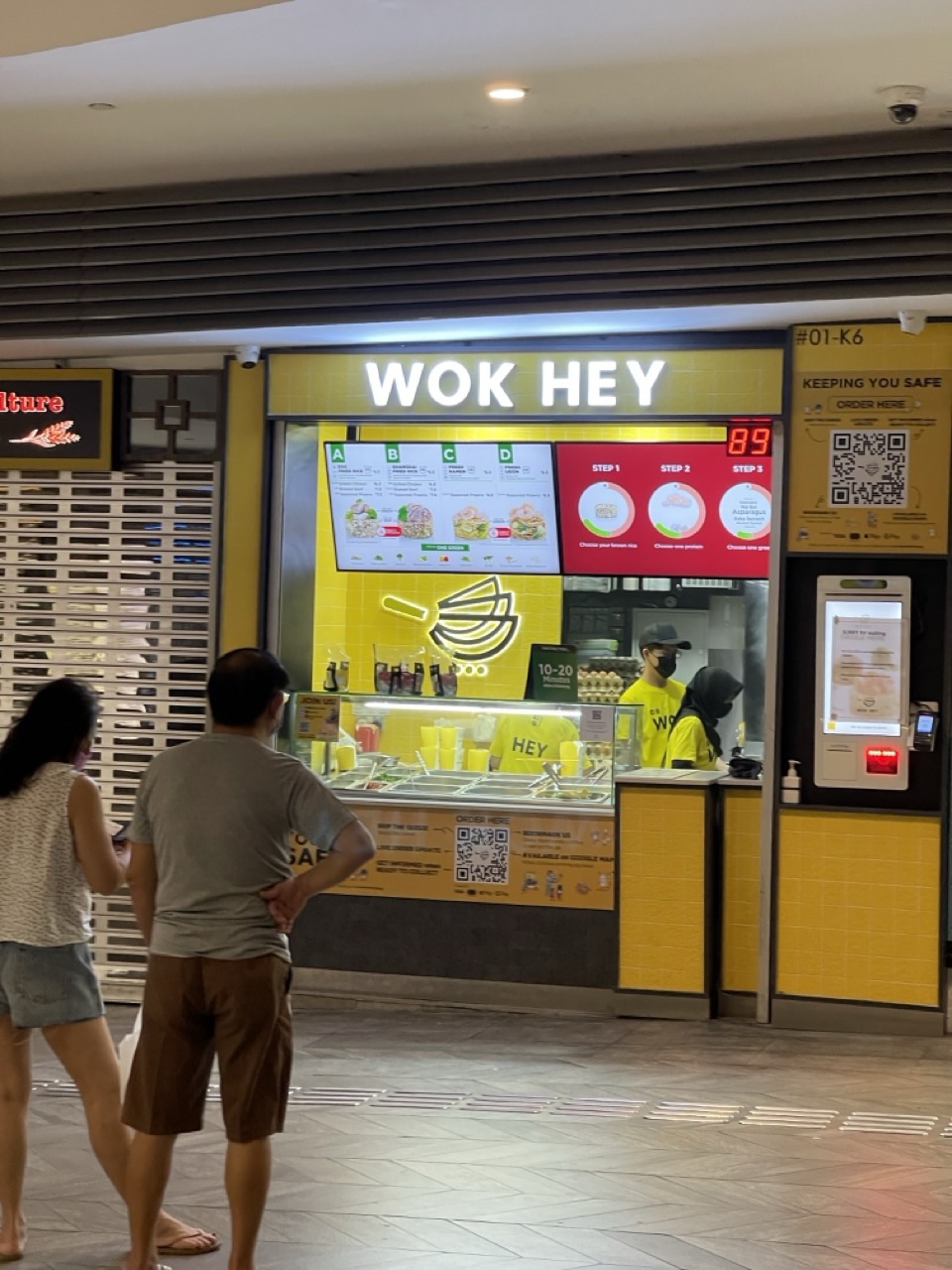
Waterway Point, One Punggol and other local retail or service locations provide visible examples of how businesses arrange products, communicate and serve people. A family can discuss general observations without conducting a formal coursework investigation. For example, why might a takeaway outlet use prominent menu signs? How can clear queue information help? What questions would a customer need answered before buying?
These are educational prompts, not claims about a named shop’s internal performance. The student should not infer sales data, customer satisfaction or staffing decisions from a photograph. If school coursework requires a business with a physical location and the task specifies an industry, the teacher must confirm suitability. Local familiarity can support curiosity, but it does not replace the assessment rules.
A photographic reference cannot prove customer satisfaction
A photo of a queue at a hawker stall can establish that people were waiting at the photographed moment. It does not prove that the business earns high profits, that customers are satisfied or that the queue is always long. The student should distinguish the observable detail from the conclusion they are tempted to draw.
This is a useful lesson for modern media literacy. Businesses and reviewers may select images to create a particular impression. An EBS pupil should ask what the photograph can reliably tell us and what information remains missing. Careful reasoning protects both the research and the reputation of people being described. It is better to make a small accurate claim than a dramatic unsupported one.
What should not happen during independent fieldwork
A student should not secretly record customers, collect identifying details without a valid reason, disturb employees during service or claim that a worker agreed to an interview when they did not. Public access to a shopping area does not mean every type of research is permitted. Some facilities have photography or survey restrictions. School supervision and consent requirements must be respected.
Parents can help by checking whether the proposed activity is authorised and safe, then allowing the student to carry out the permitted educational work independently. If access is denied, contact the teacher about an appropriate alternative. Fabricated responses are never a responsible solution. Coursework should reflect genuine research conditions, including limitations.
Responsible use of AI during EBS
AI tools may generate polished marketing recommendations or invented survey findings. For assessed coursework, the school’s and SEAB’s academic-integrity rules govern permitted use. Parents should not ask AI to produce an entire business investigation and then submit it as the student’s work. Even when an AI explanation is allowed for learning, factual claims need verification and the student’s own understanding must remain visible.
A safe practice exercise outside assessed coursework could ask the learner to critique a fictional recommendation. Does it identify a customer need? Which evidence supports it? What assumption is uncertain? This helps develop reasoning without outsourcing the work. Digital assistance should serve learning rather than obscure it.
A four-week conceptual EBS preparation plan
Week one can introduce different service industries and why businesses meet customer needs. Week two can explore the four marketing-mix decisions using a fictional business. Week three can practise customer communication and an appropriate complaint response through role-play. Week four can analyse a small set of invented research data and justify one practical recommendation. This is a family practice plan, not the official assessed coursework.
Keep tasks short and require the student to explain the thinking. A parent can ask, “Why this change rather than another?” and “What evidence would you need?” Such questions cultivate an enterprising mindset. The student’s school syllabus and teacher instructions remain the practical authority, particularly when the formal investigation begins.
A worked example: the queue that needs a better explanation
Imagine a fictional Punggol takeaway business where new customers cannot easily identify the collection area. A student immediately recommends hiring several more employees. But the observation concerns confusion about directions, and there is no evidence that staffing levels are the cause. A more measured proposal might investigate clearer signs and collection instructions before advocating an expensive change.
The student explains what evidence would support the proposal and what remains uncertain. They do not pretend to know the business’s internal budget. This example shows the difference between a plausible recommendation and a confident guess. Good EBS teaching makes the student’s assumptions visible and encourages practical judgment.
A worked example: a survey that cannot support a large conclusion
Imagine another fictional learner surveying eight friends about a retail display. Seven prefer one colour, and the student concludes that 87.5% of all Singapore shoppers would prefer it. The calculation is numerically correct for those eight responses, but the broader claim is unsupported. The sample was small and not necessarily representative of the target market.
The teacher asks the pupil to describe the result accurately and recognise its limitation. The student then considers what a better research design might require, subject to school permissions. This is a valuable lesson: good business analysis depends on both arithmetic and the quality of the evidence. A polished pie chart does not create validity that the underlying research lacks.
A worked example: courtesy without an impossible promise
Imagine a fictional hotel customer requesting an arrangement that staff cannot authorise. A student writing a role-play assumes good customer service means saying yes to everything. The teacher explains that respectful service also involves accurate information and following the business’s valid procedures. The response can acknowledge the concern, explain available options and seek an authorised supervisor where appropriate.
This develops realistic workplace communication. It also teaches that customer relations are not about pleasing everyone through false promises. Trust can depend on honesty even when the answer is disappointing. The student’s explanation should consider both the customer’s needs and the business’s responsibilities.
The choice of EBS should be made with the whole timetable in mind
A pupil may enjoy enterprise-related activities but still need to manage core academic subjects, CCA commitments and future course prerequisites. EBS has both conceptual and practical demands. Parents should examine the actual upper-secondary combination, school timetable, assessment weighting and student readiness before selecting it. Choosing a subject solely because it sounds easier than another is not a sound educational strategy.
Ask whether the child likes observing service problems, interpreting information and making reasoned choices. Can they write clear explanations and work independently? These abilities can be developed, but the course still requires commitment. If the school does not offer it, explore related learning opportunities without pretending a club activity is the same qualification.
Future education and employment are not guaranteed by one subject
EBS can introduce transferable knowledge and skills relevant to service industries and later study. It does not automatically certify a student for a job or guarantee admission to a specific post-secondary programme. Qualifications, results, prerequisites and the actual admissions framework matter. The child’s interests may also change as they encounter other subjects.
A teenager fascinated by hospitality might later explore operations, design, languages or business studies. Another might discover that they enjoy customer research more than direct service. ECG can help distinguish those preferences. Early learning is useful when it expands informed possibilities rather than forces a fixed career choice.
The 2027 assessment is not automatically the 2030 assessment
The SEC begins for the graduating cohort in 2027. A student entering Secondary 1 in 2027 would ordinarily reach Secondary 4 in 2030, and the syllabus and school offering applying then must be checked. The detailed K129 scheme described here is specific to the published 2027 examination year. It should be presented as a useful reference, not a promise that every percentage, coursework method or industry selection will remain unchanged.
Families can nevertheless learn durable principles now: understand customers, research responsibly, communicate clearly and make justified recommendations. These skills will remain useful even when particular curriculum details evolve. Read the relevant SEAB and school documents again before the student’s actual upper-secondary selection and examination period.
Frequently asked questions about PG1 and G1 EBS
Is Elements of Business Skills compulsory for all PG1 students? No. It is a distinct examinable subject, and school availability and student eligibility govern whether it can be selected.
What is the 2027 K129 Paper 1 weighting? The published scheme assigns 60% to the written paper. Students need knowledge, application and analysis within business contexts.
What is the 2027 coursework weighting? Paper 2 business-investigation coursework contributes 40%. It requires a real-world investigation under the specified task and supervision rules.
Can my child interview staff at any Punggol shop? Do not assume permission. Follow school guidance, the approved task, business rules and appropriate consent and privacy procedures.
Does a good-looking report guarantee a strong coursework result? No. Accuracy, relevant evidence, explanation, evaluation and a justified recommendation matter, and the report must be authentically completed.
Is the 2027 syllabus guaranteed for a Secondary 1 entrant in 2027? No. That pupil would ordinarily sit the national examination later, around 2030 on a normal four-year path. Verify the applicable future syllabus.
Official sources and the next useful learning step
Read SEAB’s 2027 G1 school-candidate subject list, the 2027 G1 EBS K129 syllabus, the K129 Paper 2 specimen coursework, MOE Full SBB and MOE SchoolFinder. For the local setting, see PG1 Secondary 3 subject choices and PG1 Education and Career Guidance.
This November 2026 guide explains the published 2027 K129 syllabus and a responsible approach to business investigation. It is not coursework authorisation, a promise of school subject availability or a substitute for the current teacher’s examination instructions. A useful next step is to choose a fictional service business and ask the student to explain one real customer need, two possible marketing choices and the evidence needed before recommending a change.


