
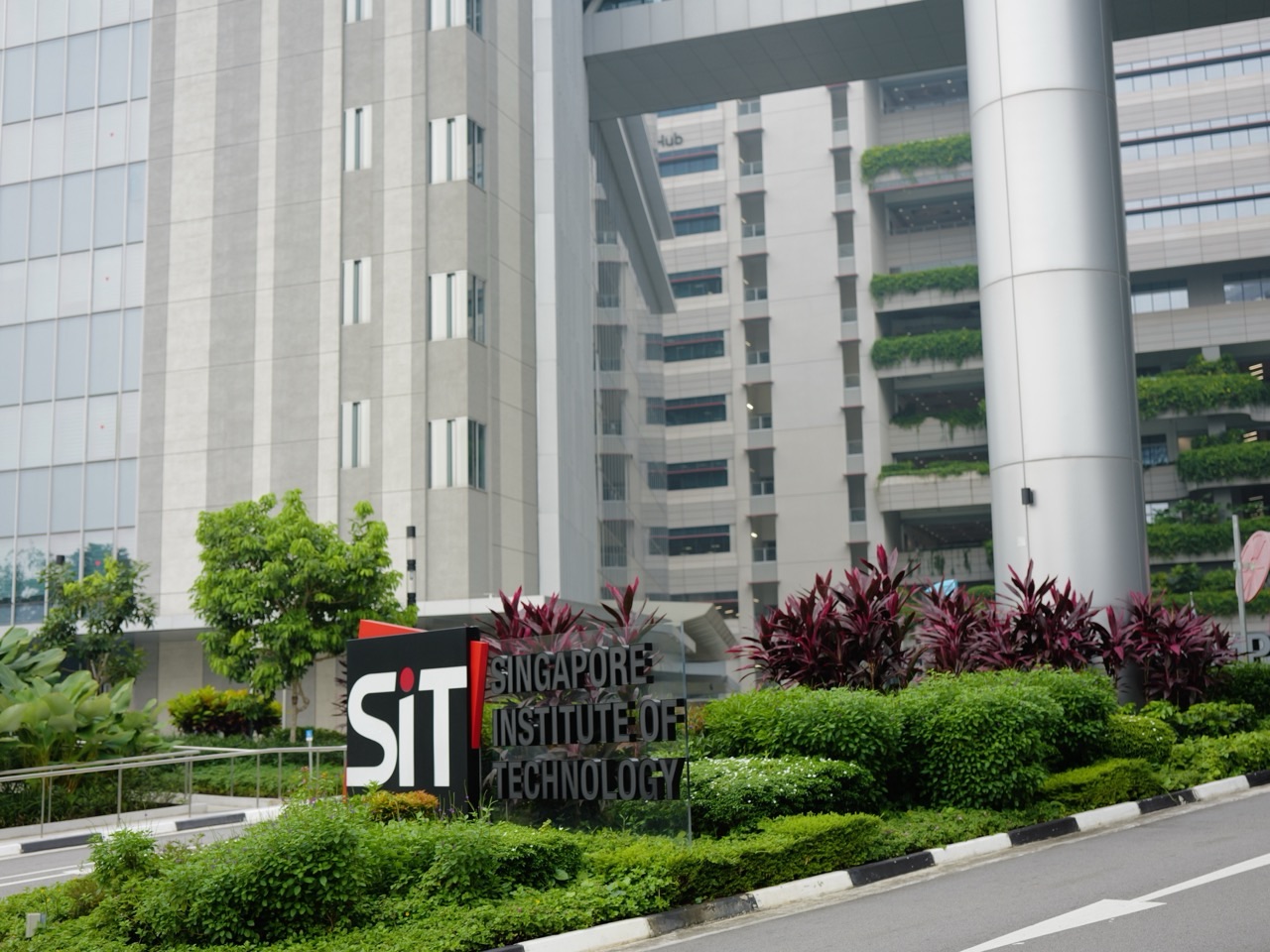
Punggol Events 2027 includes an engineering course with a specific published application deadline, not merely a general promise about future robotics. Singapore Institute of Technology’s Sensing and Actuation Specialist Certificate is listed for 4 January–11 April 2027 in a blended format, with in-person activities at SIT Punggol Campus, 1 Punggol Coast Road, Singapore 828608. The active Course Runs panel states Apply By: 23 November 2026, 11.59pm and provides an Apply Now link. The learning addresses sensors, signals, feedback control and embedded systems. Official SITLEARN course.
Did you know? The programme uses a self-balancing robot as a demonstrator for how measurement, mathematical modelling, control and actual hardware fit together. Its three six-credit modules are ENG2202C Sensors and Signal Processing, ENG3204C Control Systems and ENG3205C Embedded Systems, totalling 18 credits. This is not a general school robotics trial: SIT expects foundations in C programming, engineering mathematics, computational thinking and electrical/electronic principles. Learners undertake written tests and projects, and need 75% attendance and passing credit-bearing assessments for the Specialist Certificate.
The published full fee is S$10,006.20 including GST, with conditional after-funding categories showing S$3,001.86 or S$1,165.86 for eligible learners. There is also a S$54.50 one-time non-refundable matriculation fee. The exact timing of individual lectures, labs, consultations and assessments remains TBC in the detailed schedule, despite the confirmed overall course-run dates. This guide, checked 30 October 2026, explains what the technology does, how the credential might support a career, what the family and financial commitments are, and which details must still be verified before accepting a place.
The 2027 intake: deadline, three engineering modules and fee table
- SIT programme: Sensing and Actuation Specialist Certificate
- 2027 course-run window: 4 January–11 April 2027
- Application deadline: 23 November 2026, 23:59
- Booking panel: January 2027 blended intake listed with Apply Now
- Institution: Singapore Institute of Technology, SITLEARN
- In-person location: SIT Punggol Campus, 1 Punggol Coast Road, Singapore 828608
- Teaching mode: Self-paced online, online consultations, selected in-person classes
- Precise individual session times: TBC on the course teaching table
- Module 1: ENG2202C Sensors and Signal Processing, 6 credits
- Module 2: ENG3204C Control Systems, 6 credits
- Module 3: ENG3205C Embedded Systems, 6 credits
- Credits: 18 total
- Demonstrator: Self-balancing robot supported by MATLAB and embedded programming
- Preparation: Basic C programming, computational reasoning, EE foundations
- Learners: Equipment, electronics, integration, manufacturing and product engineers
- Course full fee: S$10,006.20 including GST
- Conditional 70% funded amount: S$3,001.86
- Conditional enhanced funded amount: S$1,165.86
- Separate matriculation: S$54.50, non-refundable
- Assessment: Written tests and practical projects
- Certificate: 75% attendance and pass all credit-bearing assessments
- Stacking: Selected SIT Electrical/Electronic Engineering, Infrastructure/Systems Engineering and Technology/Management routes, subject to conditions
- Primary official source: SIT Sensing and Actuation
The 50-second answer for Punggol residents
The official SIT course runs 4 January–11 April 2027 with a published 23 November 2026 application deadline. It provides eighteen academic credits across sensing, control and embedded technology, culminating in hands-on work such as a self-balancing robot. The full price is S$10,006.20 plus separate matriculation, while lower displayed fees are conditional on funding approval. The overall dates and campus are confirmed in the active Course Runs panel, but individual teaching times remain to be advised. It is suitable for technically prepared adult learners, not an automatically open holiday class for children. Apply through the university and wait for actual acceptance.
What sensing and actuation mean
A sensor obtains information about an aspect of a system; an actuator produces an intended physical response under appropriate control. Between them sit the measurement, computation, decisions and electronics that make an automated system behave usefully. A mobile robot may measure motion and command an electric motor; a manufacturing system may measure a process state and respond through an approved controller. These are broad examples, not schematics or operating instructions. The important educational distinction is that observing a system is different from changing it, and the latter requires carefully designed safeguards.
Why this is not simply a course about robots
The self-balancing robot is a teaching platform, but the underlying reasoning extends to manufacturing equipment, electronics, smart devices and some transport-related technologies. Learners must understand the measurement chain, signal quality, dynamics, control objectives and the limits of physical actuators. A robot that stays upright briefly is not automatically a well-engineered system. The goal is to connect a model with tested real behaviour under appropriate conditions. SIT advertises the robot as an integrative demonstrator, not a guarantee that every learner graduates with a commercially viable autonomous vehicle.
Three modules, six credits each
The programme comprises ENG2202C Sensors and Signal Processing, ENG3204C Control Systems and ENG3205C Embedded Systems, each worth six credits. Together they form an 18-credit Specialist Certificate. A learner should not treat each module as a completed independent degree, nor assume that the number of credits guarantees admission to a particular bachelor’s programme without meeting separate SIT requirements. The sequence makes educational sense: learn to obtain meaningful signals, understand how a dynamic system behaves, then connect a control strategy to actual embedded hardware.
ENG2202C: why sensors do not tell the whole truth
A sensor produces measurements subject to its range, calibration, noise, resolution and environmental limits. An accelerometer may provide useful information about motion, yet a single reading is not the same as perfect knowledge of position or orientation. SIT specifically names accelerometers and gyroscopes as examples. A responsible engineer asks what is being measured, which errors are possible and whether the sensor can support the intended decision. Before adding an AI algorithm, it can be more useful to establish that the underlying measurement is appropriate and reliable.
What is an accelerometer?
An accelerometer provides a measurement related to acceleration and can contribute information about motion and orientation under the right modelling assumptions. In an educational system, it may be one input for interpreting the behaviour of a robot. But raw acceleration is not automatically a complete measure of speed or position. The relationship depends on integration, reference frames, noise and other considerations. This is why SIT teaches signal processing rather than treating hardware values as self-explanatory. The actual experimental setup belongs to supervised university teaching.
What is a gyroscope?
A gyroscope sensor can measure angular-rate information used to understand changes in orientation. Combining observations from different sensors may improve an estimate under suitable methods, but does not eliminate all errors. Drift, noise and imperfect calibration can affect results. A learner should know how to interpret a specification and identify what a device can reasonably infer. The course mentions gyroscopes as an example of sensor limitations. It does not authorise students to modify vehicle or industrial safety controls using an untested phone-sensor script.
Signal noise is an engineering issue
Measurements can fluctuate because of electronic noise, vibration, environmental influences or the limitations of the sensor itself. A noisy value may cause an automated system to react unnecessarily if it is treated as an exact state. A filter can reduce selected unwanted variation, but that may introduce delay or remove useful information. The right solution depends on the signal and the system’s response requirements. SIT includes digital filters and their simulation because a measurement is only useful when its quality and timing are understood.
What is a digital low-pass filter?
A low-pass filter is a method that generally retains slower-changing components of a signal while reducing selected higher-frequency variation. This can make some measurements easier to interpret, but it does not distinguish all noise from all useful information automatically. Filtering a rapidly changing real event too aggressively could conceal it. An engineering learner should evaluate both the improvement and the cost in delay or lost detail. The course uses MATLAB to develop and simulate filters in an appropriate educational environment rather than claim one universal setting works everywhere.
Why sampling matters
A physical system changes continuously in time, while a digital controller observes measurements at discrete intervals. The timing and frequency of those observations can affect what the controller sees. Too little information may miss important behaviour; adding more data is not necessarily helpful if the hardware or algorithm cannot use it reliably. SIT explicitly covers continuous-time and discrete-time signals. A professional should understand what a sample represents and how timing enters the design rather than assume a faster processor always corrects a poor measurement strategy.
Motion prediction is not certainty
SIT teaches using MATLAB to estimate orientation or velocity from sensor data. Such estimates depend on the model, sensor accuracy and assumptions. Even a mathematically elegant method may drift or respond poorly outside the conditions in which it was tested. A sensible project documents the experiment and compares estimated behaviour with a suitable reference. It would be misleading to call a model infallible because it worked during one classroom demonstration. Engineering progress is measured through appropriate evaluation, not the confidence of a software display.
ENG3204C: modelling dynamic systems
A dynamic system evolves over time in response to influences and control actions. An engineer may use mathematical representations to understand how changes at the input affect future behaviour. SIT explicitly teaches transfer functions and state-space representations. Those terms can sound abstract, but their purpose is practical: make behaviour analyzable and allow predictions to be tested. A model simplifies reality and therefore has limits. A learner needs to understand which assumptions were included and what a simulation cannot establish about an actual physical system.
Transfer functions in everyday language
A transfer function is one way engineers describe how a system responds to an input under defined modelling assumptions. It can help analyse stability, frequency response and control behaviour. This does not mean every real machine is accurately described by a single simple formula. Physical limits, nonlinear effects and changing operating conditions can matter. SIT’s course teaches modelling as a tool for reasoning about dynamic behaviour, not as a shortcut for declaring a device safe without experiments and independent engineering checks.
What is state-space modelling?
State-space modelling represents a system using variables that describe its internal condition and how that condition evolves with inputs. It is useful in many control and estimation problems, but choosing an appropriate state and model requires understanding of the actual system. A mathematical description can be tested against measured behaviour and refined. The course provides this foundation so learners can connect control objectives to a technical model. A resident curious about robotics can appreciate the concept without needing to operate a real controller from a general blog article.
Open-loop and closed-loop control
An open-loop action is issued without using ongoing feedback to correct the result, while a closed-loop controller responds to measurements of the system’s behaviour. Both can have appropriate applications. Feedback can help correct disturbances, but poor feedback design can also create instability. The important question is whether the system observes the right information and responds within suitable constraints. SIT teaches closed-loop controller design because feedback is powerful when grounded in an accurate model, valid measurements and rigorous testing.
Why a balancing robot illustrates feedback
Imagine a robot that starts to tilt. It needs to detect the change, estimate its state and command its motors appropriately to return toward the intended position. Those steps illustrate sensing, computation, control and actuation together. The example also shows why delayed or noisy measurements can cause trouble. SIT uses a self-balancing demonstrator precisely because the interactions are observable. It is not a recommendation to build or modify potentially hazardous machinery unsupervised. Physical prototypes require proper equipment, safety procedures and qualified teaching oversight.
What is a PID controller?
PID stands for proportional, integral and derivative control, a widely used family of feedback-control ideas. In broad terms, a controller may respond to present error, accumulated error and the rate of change. The correct design and tuning depend on the specific system and performance goals. A controller that responds faster is not automatically safer or more stable. SIT includes PID design and tuning so learners can judge stability, responsiveness and robustness in simulations and under appropriate supervised conditions, rather than copy arbitrary parameters from a video.
Stability is more than holding still
A system is stable under a defined engineering criterion when its behaviour responds appropriately to disturbances or input changes. Stability is a mathematical and physical property to analyse, not simply whether a robot appears stationary in a short clip. A controller can oscillate, overshoot or react too slowly under different conditions. The proper evaluation considers relevant scenarios and the design’s limits. SIT uses MATLAB simulations to help students examine responses before applying appropriate controller strategies to a prototype.
Responsiveness and robustness can conflict
An extremely fast response may look impressive but can be sensitive to noisy measurements or model errors. A slower response may be more robust in some contexts, though it might not meet another requirement. An engineer must define the intended performance and assess trade-offs. SIT names stability, responsiveness and robustness as objectives for controller design. That is why responsible control engineering is not a contest to maximise one number without considering the whole system. The valid decision depends on evidence, not marketing about instant reaction speed.
What is model validation?
Validation asks whether a mathematical or simulated representation is suitable for its intended purpose under relevant conditions. A model can be internally consistent yet differ significantly from real behaviour. A learner should compare predictions with appropriate observations and identify uncertainty. SIT includes interpreting system responses under different conditions, encouraging more than a single success case. A professional can use such methods to explain where a design works and where further testing is required. This is essential when automation affects people or valuable equipment.
ENG3205C: embedded systems
An embedded system uses computing hardware and software as part of a larger device. A microcontroller may interact with sensors, actuators and communication interfaces rather than simply run an application on a laptop. SIT teaches programming these interactions in real time, with the self-balancing robot as one demonstration. The challenge is coordinating data, timing, constraints and safe operation. A learner cannot assume code that works on a desktop will behave identically on limited hardware. Embedded engineering connects software design to physical consequences.
Microcontrollers have real constraints
Microcontrollers may have limited memory, processing capacity, connectivity and power compared with general-purpose computers. A design that seems straightforward in a desktop simulation might fail when deployed without attention to timing and resources. The course expects C programming foundations because embedded programming involves close interaction with hardware and reliable computation. The exact platform and device models are not specified in the public summary, so this guide does not invent a component shopping list or promise participants take a robot home.
Why real-time behaviour matters
Some systems need to respond within an appropriate time window. A correct decision made too late may be functionally useless, while an overly hasty one based on poor data may be harmful. Embedded control therefore requires attention to when measurements arrive, how computation is scheduled and when actuators respond. SIT teaches real-time sensor and actuator integration under supervised conditions. The concept is broader than a fast CPU: reliable timing, error handling and tested system limits are crucial. A course graduate should know how to ask whether time requirements were actually met.
Internet of Things does not mean unrestricted access
The programme includes using an Internet of Things (IoT) framework for remote monitoring and control. IoT connects devices and information systems so that authorised users can observe or influence behaviour. That also creates questions about connectivity, authentication, privacy and failure conditions. A classroom IoT demonstration should use appropriate access controls and an approved environment. Training does not authorise learners to connect to other people’s smart devices or industrial networks. The useful professional principle is that remote convenience must be balanced with secure, dependable control.
How the three modules fit together
Sensing provides information, signal processing makes it interpretable, control models guide decisions and embedded hardware carries out authorised actions. Each stage depends on the quality of the others. A powerful controller cannot fully compensate for an unsuitable sensor; accurate measurements are not useful if the actuator cannot respond appropriately. The self-balancing robot brings that chain together. SIT’s 18-credit sequence is educationally distinct from a stand-alone coding tutorial, because learners must understand how physical, mathematical and digital components interact.
The course is not a licence to test live industrial controls
Robots and automation can be safety-critical. A learner should use authorised laboratory equipment and follow the university’s risk assessment and instructor directions. Completing a simulation or a prototype does not grant permission to connect experimental controllers to machinery, vehicles or public infrastructure. Real deployments require qualified review, appropriate regulation and organisational approval. This guide explains learning concepts without giving step-by-step instructions for altering live safety systems. Responsible innovation begins with recognising limits and verifying that the proposed change is legitimate and safe.
The confirmed 2027 application deadline
The current individual SIT Course Runs section explicitly lists 4 January–11 April 2027, SIT Punggol Campus, and 23 November 2026 at 23:59 as the application closing time. It also provides an authorised Apply Now route. This is more specific than the general engineering catalogue’s Jan–Apr statement and stronger evidence than a guessed intake. However, a published application deadline does not guarantee acceptance or a free seat until the final minute. Apply through official systems and retain written confirmation before arranging irreversible commitments.
The exact individual timetable remains unconfirmed
Although the overall course run is listed, the detailed weekly teaching table marks self-directed learning, in-person training, online consultation and assessments TBC. A working adult should not invent a recurring Tuesday evening class or guarantee that all in-person instruction happens on weekends. Ask SIT which dates must be attended physically and which online activities have fixed times. The blended label allows flexibility but does not mean every assessment is optional. Planning around the actual timetable is part of deciding whether the course suits work and caregiving obligations.
Who is the intended learner?
SIT identifies equipment engineers, electronics engineers, integration engineers and product engineers in manufacturing or electronics. These roles may need to understand sensors, data acquisition, motion control and embedded devices. The course is a specialist professional pathway rather than a beginner workshop for Primary school pupils. Other technically prepared adults may enquire about suitability, but the university determines individual admissions. The best reason to apply is a credible learning need in modelling and control, not merely the popularity of robotics or AI.
Why C programming and electrical basics are important
The course assumes basic C programming, computational thinking and electrical/electronic knowledge. A learner unfamiliar with variables, functions, signals or fundamental circuits may find the programme challenging. The official site does not publish a fixed entrance examination in the reviewed details, but it does name these foundations. Prospective students should describe their background accurately and ask which preparation would be suitable. It can be better to build basics first than enroll in eighteen credits while unable to understand the initial laboratory or mathematical examples.
The full S$10,006.20 fee
SIT lists S$10,006.20 including GST as the full fee. Its fee table shows S$3,001.86 for certain eligible 70%-funded learners and S$1,165.86 for the specified enhanced-subsidy category. These are conditional displayed amounts, not proof that every Singapore citizen or Punggol resident personally qualifies. Actual residency, age, scheme conditions and payment arrangements require university approval. A household should distinguish the real full price from the number it hopes to pay after funding. Do not rely solely on a screenshot of somebody else’s eligibility.
The separate S$54.50 matriculation amount
The detailed SIT page states a one-time non-refundable matriculation fee of S$54.50 before commencement. Adding it to the published S$3,001.86 payable category gives an illustrative S$3,056.36. Adding it to S$1,165.86 gives S$1,220.36. Those are arithmetic planning totals, not final individual invoices. Equipment, transport and time away from work may also matter, but the public course page does not quote a mandatory robot purchase. Ask what the fee includes and whether any other approved charge applies before committing.
SkillsFuture and training-allowance caution
SIT says eligible learners may use relevant SkillsFuture Credit and describes a potential S$300 per month part-time Mid-Career Training Allowance for qualifying Singapore citizens aged forty and above, subject to requirements and approval. An allowance is not the same as an automatic course-fee discount or guaranteed household income. A person should check their own available credit and official approval rather than assume all funding sources can be combined freely. Some aid may carry attendance or completion obligations that affect the financial risk of withdrawal.
The consequences of withdrawal or failure
The programme FAQ warns that learners who fail or withdraw without a valid reason may need to repay subsidies. This is important for a three-plus-month engineering course involving mathematical models, labs and assessed projects. A reduced up-front fee does not mean the commitment is risk-free. Clarify withdrawal, attendance and assessment requirements before accepting an offer. If current work or family obligations make completion unrealistic, a future intake or preparatory study may be a wiser decision than enrolling solely to benefit from a promotional funding percentage.
Attendance and academic assessment
The Specialist Certificate requires at least 75% attendance and passing all credit-bearing assessments. SIT lists written tests and projects. A learner who completes only the recorded videos or successfully assembles a robot demonstration without meeting assessment rules may not qualify for the same award. Exact rubrics and dates belong to the university. A real qualification is useful when it shows demonstrated capability, not merely proof of payment. Students should plan for independent technical reasoning, clear documentation and iterative testing.
Stacking toward a bachelor’s degree
SIT says the eighteen-credit Specialist Certificate can contribute toward selected Electrical and Electronic Engineering, Infrastructure and Systems Engineering and Technology and Management with Supply Chain specialisation pathways, subject to their admission and credit rules. It is not a completed bachelor’s degree after April 2027. The CSM framework describes a five-year credit-validity period for stacking, and learners may keep the standalone certificate without pursuing a degree. A person should check the intended programme’s requirements before assuming that any combination of micro-credentials automatically qualifies them for admission.
Comparison with Smart Maintenance
The [SIT Smart Maintenance programme] (https://www.singaporetech.edu.sg/sitlearn/competency-based-stackable-micro-credential-pathway/engineering/smart-maintenance-micro-credential) also covers sensors, data and engineering systems but focuses on equipment reliability, condition monitoring and maintenance decisions. Sensing and Actuation emphasises how an active system senses, models and controls its behaviour. The distinctions matter for career fit. An automation engineer developing feedback control may need one set of competencies, while a maintenance engineer predicting equipment problems may need another. The published dates and admissions status should also be checked independently, even when both appear in the same engineering catalogue.
Comparison with Operational Excellence
The recently published SIT Operational Excellence January–April guide discusses process management, quality, Lean Six Sigma and inventory decisions. That programme addresses organisational workflow and management, not the design of feedback controllers and embedded hardware. Sensing and Actuation is more directly technical and mathematical. A Punggol professional should choose by actual job responsibilities rather than assuming every engineering Specialist Certificate teaches the same skills. Both can be useful, but they are separate bookings and qualifications.
Comparison with Machine Learning
The SIT Machine Learning 2027 programme focuses on supervised and unsupervised models and recommendation systems in Python. Sensing and Actuation involves physical sensors, modelling, feedback control and embedded programming. Some advanced robotic systems use machine learning, but an introductory controller is not automatically a machine-learning model. The subjects intersect without being identical. The right foundation depends on whether the learner wants to build intelligent data models or control real-world dynamic equipment.
A fictional factory equipment scenario
Imagine a manufacturing line that uses a sensor to measure motion and a controller to maintain an intended process condition. A responsible engineering team verifies what the sensor reports, whether the model predicts behaviour and how the actuator responds under approved test conditions. If the readings become unreliable, simply increasing motor response may not solve the problem. This hypothetical example illustrates the sensing-to-control chain, not an instruction to alter real factory equipment. Actual intervention requires qualified review and permitted maintenance procedures.
A fictional household robot example
A toy robot may appear straightforward until it must balance on an uneven surface or respond when somebody moves nearby. Such behaviour demonstrates why sensor noise, physical modelling and control timing matter. A classroom demonstrator can help learners reason about those concepts safely under appropriate supervision. That does not mean a home-made robot can be used on public walkways, around small children or alongside vehicles without further testing. The value of the exercise lies in knowing which assumptions and controls make a particular performance possible.
The Punggol campus versus community clubs
The published in-person institution is SIT Punggol Campus, 1 Punggol Coast Road, Singapore 828608. This is not One Punggol Community Club at 1 Punggol Drive or Punggol 21 CC on Punggol Field. A course applicant should plan around the exact campus and obtain individual lab-room directions after acceptance. The current teaching table does not specify every 2027 visit time, so a resident should not arrive expecting unrestricted laboratory access. Transport convenience is a benefit only when it aligns with the authorised timetable.
What success coaching does and does not promise
The official page describes success coaches who can help learners develop study strategies and suitable plans. This can matter for adults balancing work with technical education, but it does not guarantee that coaches will complete projects, provide unlimited tutoring or secure employment. The learner must still understand the engineering and pass assessments. If programming or mathematics are unstable, ask what support is actually available and make a realistic preparation plan. Coaching supports learning ownership; it is not a substitute for it.
Quick test: does this course fit your goal?
Ask four questions. First, do you want to understand the behaviour and control of physical systems rather than only analyse business data? Second, do you already have basic C, electrical and mathematical preparation? Third, can you commit through 11 April 2027, including in-person sessions whose individual times remain TBC? Fourth, have you received an actual funding quotation and admission confirmation? If any answer is uncertain, ask SIT before paying. This quick test is a decision aid, not a university eligibility assessment.
Reality check: what is guaranteed and what is not
The published overall 4 January–11 April window, 23 November application cut-off, three module names, fee table and campus are evidence from SIT’s current page. An individual place, the exact weekly timetable, funding, project equipment ownership, degree admission and future salary are not guaranteed by that listing. The main practical uncertainty is less about whether the course exists and more about which real commitments apply to a particular learner. A responsible applicant resolves that through the university instead of filling the gaps with guesswork.
Frequently asked questions
When? 4 January–11 April 2027. Apply by? 23 November 2026, 11.59pm. Where? Blended, with in-person activities at SIT Punggol Campus. Credits? Eighteen, six each across Sensors and Signal Processing, Control Systems and Embedded Systems. Demonstrator? A self-balancing robot. Prerequisites? Basic C programming and electrical/electronics foundations. Full fee? S$10,006.20, plus separate S$54.50 matriculation. Funded prices? Conditional S$3,001.86 or S$1,165.86. Certificate? 75% attendance and passing assessments. Exact class days? Detailed schedule TBC. Job or degree guaranteed? No.
Official proof pack and further Punggol reading
Primary programme: SIT Sensing and Actuation, establishing the active 2027 course run, deadline, price table, modules, robotics demonstrator, assumed knowledge and assessment rules. Catalogue: Engineering Specialist Certificates, listing the January–April 2027 programme family. Qualification framework: SIT Competency-based Stackable Micro-credentials. Related Punggol: Operational Excellence, Machine Learning and Punggol Events. Verified 30 October 2026; SIT controls any subsequent changes or personal eligibility decisions.
Final thought: measure, understand, then act
SIT’s Sensing and Actuation intake is a genuine scheduled Punggol professional-learning opportunity with a specific 23 November 2026 deadline, eighteen credits and an engineering challenge that brings sensing and feedback together. Its larger lesson is relevant to many technologies: a reliable response requires credible measurements, an appropriate model, tested control and safe hardware. The programme’s cost and workload are substantial, and individual class times still need confirmation. Choose the course for its real technical skills and formal requirements, not because robotics sounds exciting or a subsidy looks automatically available.


