
Punggol Education 2027 landscape management, horticulture and urban farming courses connect learning to what residents can see every day: parks, rain gardens, roadside trees, skyrise greenery and green corridors. Yet a teenager who likes plants may prefer horticultural science, landscape design, conservation or an engineering-related urban-farming system. Those careers require different qualifications and working conditions, and not every programme labelled ‘agriculture’ is accepting students in 2027.
Did you know? ITE College East lists Higher Nitec in Landscape Management & Design in both 24-month and 36-month structures. Singapore Polytechnic offers a Diploma in Landscape Architecture with studio work, skyrise greenery, urban biodiversity and a 22-week internship. ITE’s 2027 Work-Study Diploma listing includes Arboriculture & Horticulture (DPABH), but explicitly marks Agriculture & Aquaculture Technology (DPAAT) as not offered for 2027. Both titles may appear on older course pages, so a family must understand the difference between a progression possibility and an actual active intake.
This guide helps Punggol residents connect Primary and Secondary English, Mathematics and Science with ITE, Polytechnic, university-level environmental study and adult training. It explains real course content, safe local learning activities, 2027 admission rules, career fit and the decisions parents should not make from a single attractive brochure. The information is current to 28 October 2026; later changes must be confirmed with each institution.
Quick answer: what does the student actually want to do with plants and places?
| Direction | Typical work | Useful foundations |
|---|---|---|
| Horticulture | Understand plants, growing media, nursery operations and health | Biology, observation, measurements |
| Arboriculture | Assess and maintain trees with safety and professional methods | Plant science, risk, authorised practical training |
| Landscape management | Implement and maintain green spaces and teams | Planning, maintenance, communication |
| Landscape architecture | Design spaces for people, climate, ecology and experience | Drawing, site analysis, design studio, technical documentation |
| Urban farming | Study controlled growing systems and resource use | Biology, data, energy, production knowledge |
| Nature conservation | Monitor habitats, restore ecosystems, document changes | Ecology, statistics, scientific reporting |
A person who loves drawing accessible parks may prefer a design studio to nursery operations. Another who likes tree health and outdoor work could prefer horticultural maintenance. A third might enjoy sensors and water-based crop systems without wanting to become an architect. Good education advice avoids forcing these into one profession.
What Punggol can teach about a City in Nature
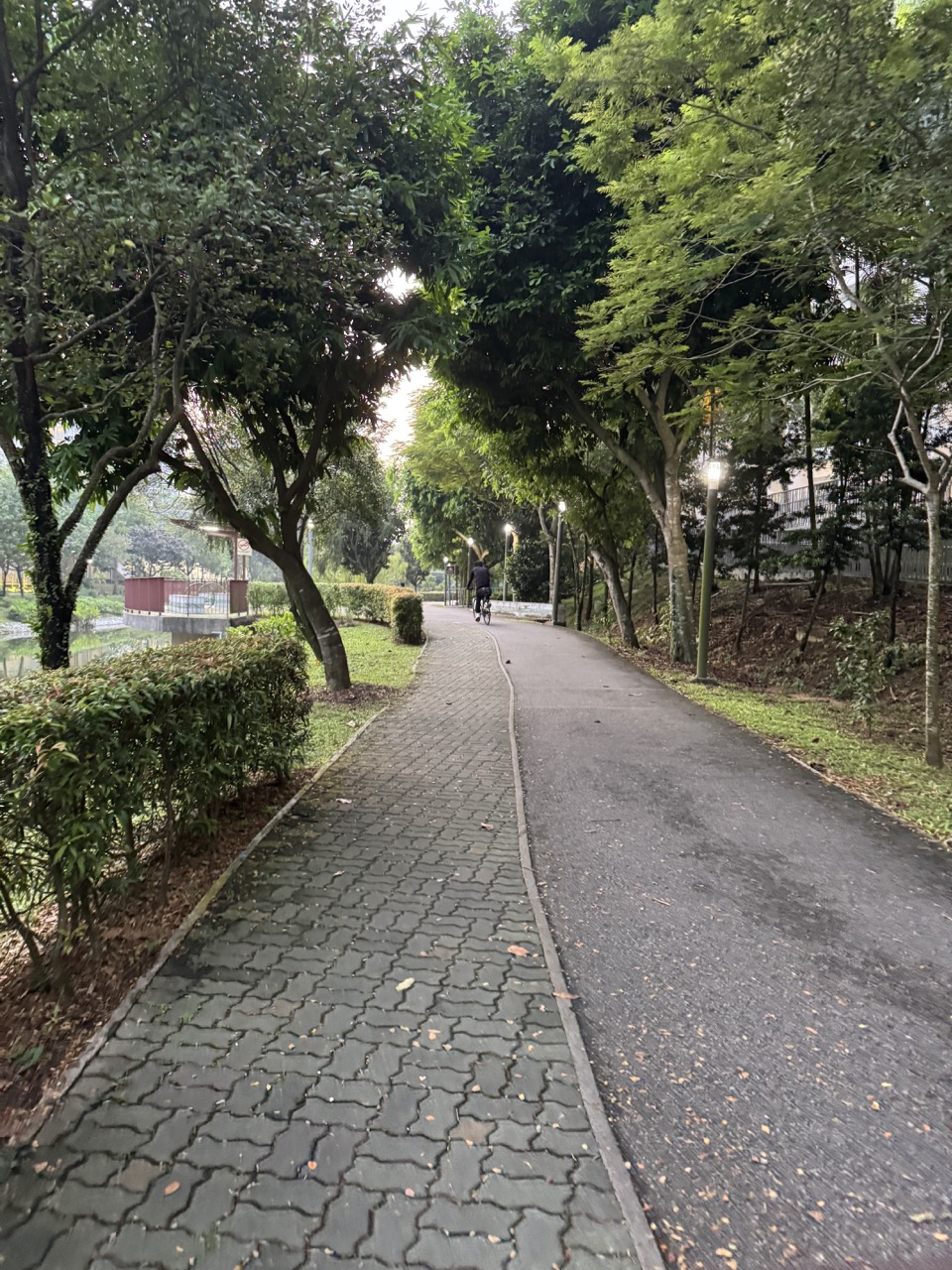
Public routes along Punggol Waterway, estate parks and neighbourhood greenery allow families to observe shade, rainwater movement, vegetation and people using the same space. Ask how a tree helps a pedestrian, whether a planted area has a defined maintenance plan and how seasonal weather may affect growth. These are learning questions, not proof of measured cooling or biodiversity benefits from one walk.
Students should not climb trees, remove plants, use pesticides, enter construction areas, collect rare species or attempt tree-risk inspections. Arboriculture requires appropriate training and authorised worksite arrangements. The public can learn the questions and scientific vocabulary without performing professional tasks.
Primary school: make observation and arithmetic useful
Primary Science introduces life cycles, diversity, plant reproduction and environmental relationships. Mathematics helps with area, volume, percentages, charts and ratios. English enables precise distinctions among ‘healthy’, ‘growing’, ‘wilting’ and ‘damaged’ rather than vague impressions.
For a fictional garden measuring 4 metres by 3 metres, area is 12 square metres. If one-quarter of the illustration is reserved as a walking surface, 3 square metres is allocated to that surface and 9 square metres remains. This arithmetic does not establish that the layout meets real accessibility or construction standards. Ask the child to explain what further evidence a landscape designer would require.
A safe home or classroom activity is a small supervised observation diary on an ordinary potted plant. Record dates, measurable changes and uncertainty. Do not treat one week of observations as proof of a scientifically established growth method, and do not create unsafe chemicals or pest-management mixtures.
Secondary G1/G2/G3: Science, Maths, English and Art work together
Under Full Subject-Based Banding, pupils may take English, Mathematics, Science and electives at G1, G2 or G3. The first SEC graduating cohort completes examinations in 2027 and enters the new 2028 post-secondary admissions exercise. That is distinct from the 2027 intake using 2026 O-Level qualifications.
Biology supports plant science and ecosystems, Mathematics supports irrigation and area measurements, English supports instructions and project reports, and Art or Design & Technology can strengthen observation and spatial ideas. Actual admission depends on the named programme and intake; no parent should claim that every horticultural course requires the same exact elective.
Our 2027 manufacturing guide provides a contrasting technical pathway, while MOE CourseFinder and the live institutional pages determine the precise entry requirements.
ITE Landscape Management & Design: the 24-month programme
ITE’s Higher Nitec in Landscape Management & Design is a 24-month full-time programme at ITE College East. Its published competencies include plant propagation and nurseries, skyrise greenery installation, arboriculture support, turf and park maintenance, landscape design drawings, workforce coordination and plant health programmes.
The O-Level entry route lists minimum grade requirements in English, Mathematics and an approved Science or technical subject; ITE also has an applicable Nitec progression route. Students need a laptop beyond course fees, with assistance possible through official schemes subject to eligibility. The institution must decide the actual applicant’s eligibility.
This course’s job examples include Assistant Landscape Supervisor, Landscape Specialist, Assistant Designer and Project Coordinator. A qualification may support practical responsibility, but it is not an unrestricted authorisation to carry out hazardous tree work alone.
The 36-month course has another entry structure
ITE publishes a three-year Higher Nitec in Landscape Management & Design at the same College East, serving other prior qualification profiles. It covers plant nurseries, green infrastructure, maintenance, design communication and safe work practices through a longer foundation.
Parents must not assume they may freely select 24 or 36 months irrespective of the child’s qualification. Read the actual ITE route and any direct-entry scheme for that year. If the child prefers applied learning, longer preparatory teaching may be a useful fit; if they already hold the required qualification, the shorter programme may be appropriate.
From ITE to Polytechnic: the AY2027 minimum is not an offer
The Landscape Management & Design course pages say that from the AY2027 Polytechnic intake, relevant Higher Nitec graduates with net GPA 2.5 or above may apply for first-year admission into a related diploma. This does not guarantee a course place, and specific diploma matching and merit selection still apply.
One programme to investigate is SP Landscape Architecture, but the applicant must check whether their exact Higher Nitec appears in the current related-course map and what prerequisites apply. A profession and programme sharing the word ‘landscape’ are not proof of automatic advanced standing.
Singapore Polytechnic Diploma in Landscape Architecture
Singapore Polytechnic’s Diploma in Landscape Architecture develops design studio thinking, plant and site knowledge, manual and digital presentation, user experience, skyrise greenery, biophilic design and urban biodiversity. The published curriculum includes a 22-week enhanced internship and a final-year project.
SP’s Year 1 design modules develop drawing, model making, introductory technical studies and climate-responsive design. Later studios consider greenery on buildings, larger urban sites, plant selection and statutory context. The course is not identical to professional tree maintenance or farming management, although the fields can collaborate.
When choosing between ITE landscape and SP’s diploma, ask the student whether they want to operate and maintain landscapes or spend substantial time exploring and revising design ideas. Both demand communication and knowledge of real site constraints.
ITE Work-Study Diploma in Arboriculture & Horticulture
ITE’s Work-Study Diploma in Arboriculture & Horticulture is a 30-month employer-based programme at College East. Its curriculum addresses plant-health programmes, inventories, landscape projects, arboriculture maintenance, growing media and equipment. The training uses a hybrid release pattern: alternating classroom blocks and one or two classroom days in some weeks, with the rest of the work-week at the employer.
The official 2027 WSDip list specifically includes Arboriculture & Horticulture — DPABH. ITE describes an entry route for relevant ITE graduates, including selected Nitec qualifications with GPA 2.0 or Higher Nitec, or eligible in-service workers at least 18 with relevant experience, accepted equivalent qualifications and strong employer endorsement.
ITE also lists an occupational colour-appreciation condition. All applicants should ask about genuine safety requirements, interview procedures and eligibility instead of assuming an automatic place because a Higher Nitec mentioned this WSDip as a possible progression.
2027 correction: Agriculture & Aquaculture WSDip is not offered
The ITE 2027 Work-Study Diploma course list, updated 13 October 2026, marks Agriculture & Aquaculture Technology — not offered for the 2027 intake. Its specialisation code DPAAT remains visible for reference. It should not be advertised as a 2027 open alternative just because an older Landscape Higher Nitec page links to it.
The same course list identifies DPABH as offered. A careful student must check both the course catalogue and the year-specific availability table. The ITE admissions page said the 2027 WSDip applications had not commenced at the October 2026 research cut-off, so do not invent an open window.
What about a three-hour urban farming course?
ITE lists a short Introduction to Urban Farming course of about three hours at College East, with no listed entry qualification. This may be useful for a hobbyist learning common plant, soil, compost and pest concepts. But a short introductory course is not equivalent to a Higher Nitec, Polytechnic diploma or employer-based Work-Study Diploma.
A parent should ask why the adult wants the course: home gardening, professional nursery work, landscaping supervision or environmental design? Spending a small amount on introductory learning could help explore interest, while a regulated job may require much more training and supervised experience.
Three different Punggol learner journeys
A Secondary pupil who loves drawing parks
This pupil uses Mathematics, Art and Science to draw a fictional accessible garden and reflects on feedback. They investigate SP Landscape Architecture alongside ITE Landscape Management. The choice depends on actual academic eligibility and whether they prefer design studies or applied landscape operations.
A hands-on learner interested in plant health
This student enjoys observation, practical biology and structured work. The ITE Higher Nitec may offer relevant applied foundations, with later Work-Study or Polytechnic applications subject to conditions. The student should take serious interest in plant health and safe maintenance rather than assume the course is merely outdoor leisure.
A mid-career parent switching to greenery management
This adult checks existing technical qualifications, employer interest and family finances. A genuine WSDip may be possible under the in-service route if the employer endorses the applicant and eligibility is met. A short gardening course can help explore interest but should not be presented as a professional qualification.
A practical six-week school project
- Week 1: choose one public green-space question about shade, access or plant diversity.
- Week 2: read two appropriate official environmental or planning sources and identify what is fact versus proposal.
- Week 3: draw a fictional planting area at a labelled scale.
- Week 4: make hypothetical measurement and resource calculations using clearly stated units.
- Week 5: ask how safe maintenance, accessibility and rainfall might affect the plan.
- Week 6: revise the plan and write an honest reflection on what remains untested.
No child needs to use pesticide, inspect a real tree for safety or collect protected organisms to complete the exercise. Students should learn when scientific curiosity must stop and authorised practical competence must begin.
What Punggol parents should do, avoid and think about
Do
- Separate horticulture, arboriculture, urban farming, conservation and landscape design.
- Check ITE’s two-year and three-year Landscape programme requirements.
- Use SP Landscape Architecture for a genuinely design-oriented comparison.
- Identify DPABH as the listed 2027 Arboriculture & Horticulture WSDip.
- Note that DPAAT Agriculture & Aquaculture is expressly not offered in 2027.
- Consider real travel, fieldwork, safe practical training, devices and employment schedules.
- Encourage accurate measurements and interest in living systems.
Do not
- Assume all agriculture or WSDip courses listed on older programme pages are taking a 2027 cohort.
- Treat net Higher Nitec GPA 2.5 as a guaranteed Polytechnic place.
- Call a short urban-farming workshop a professional diploma.
- Carry out hazardous pruning, tree climbing or chemical pest-control experiments without training.
- Assume SP landscape design and ITE landscape maintenance prepare for identical jobs.
- Present a proposed Punggol green project as a verified government development decision.
- Promise a landscaping job merely because Punggol has attractive parks.
Think about
Would the learner rather design spaces for people, understand plant systems or operate and maintain landscapes? Do they enjoy working outside in difficult weather and following safety rules? Can they use Maths and English to explain decisions? A good pathway balances love of nature with the professional methods used to care for it.
Frequently asked questions
Does ITE offer Landscape Management & Design at College East?
Yes, the official two-year and three-year Higher Nitec pages list College East. They have different entry profiles.
Can a Higher Nitec Landscape graduate apply to Polytechnic in AY2027?
Qualifying relevant graduates with net GPA of at least 2.5 may apply to related diplomas, subject to mapping, selection and places. This is not guaranteed admission.
Is Arboriculture & Horticulture a 2027 Work-Study Diploma option?
Yes. ITE’s 2027 course list names Arboriculture & Horticulture with code DPABH. Admissions timing and employer availability must be checked.
Is the ITE Agriculture & Aquaculture WSDip offered for 2027?
No. ITE’s official 2027 list explicitly marks that programme as not offered for the intake.
Is a three-hour urban farming workshop equivalent to a landscape diploma?
No. It introduces basic interest-level concepts and does not award the same qualification or professional training.
Official sources and other Punggol guides
- ITE Landscape Management & Design — 24 months.
- ITE Landscape Management & Design — 36 months.
- SP Diploma in Landscape Architecture.
- ITE Arboriculture & Horticulture WSDip.
- ITE 2027 WSDip availability list — DPABH and DPAAT.
- ITE introductory Urban Farming short course.
- Punggol Green Engineering courses.
- Punggol Education & Town-Life Article Index.
Research checked 28 October 2026. Academic eligibility, professional work, WSDip employer placement and live intake status depend on the official provider. Do not infer course availability from an older related-course link.


