
Educate Punggol 2027: Did you know that Singapore Management University (SMU) opened applications for its 13th Lee Kuan Yew Global Business Plan Competition (LKYGBPC) on 27 October 2026, with a final submission deadline of 31 March 2027? The competition focuses on university-linked founders building new technologies and businesses in urban solutions and sustainability. For Punggol diploma students, university students and recent graduates interested in design, engineering or entrepreneurship, this is a concrete opportunity to learn what makes a solution worth building—not merely how to deliver a dramatic startup pitch.
Quick answer: The official SMU Institute of Innovation & Entrepreneurship competition page gives a 31 January 2027 early-bird deadline and a 31 March 2027 final deadline at 11.59 pm Singapore time. Applications are free. Teams need at least one qualifying founder who is a current student or sufficiently recent alumnus of tertiary education under the exact category rules. Organisers plan to select 50 finalists during April–June and hold Grand Finals Week at SMU from 28 September to 1 October 2027.
The event’s S$2.5 million-plus prize and benefit headline combines cash, investment, grants and professional services; it is not a guaranteed S$2.5 million cash payment to every participating team. Awards are highly selective, and some financing or acceleration offers may have separate terms. This guide helps readers distinguish the credible educational opportunity from exaggerated expectations.
The four official milestones
- 27 October 2026: applications open online; no application fee
- 31 January 2027, 11.59 pm SGT: early-bird submission deadline for eligible additional opportunities
- 31 March 2027, 11.59 pm SGT: final deadline for completed entries
- April–June 2027: organisers shortlist finalists, with 50 teams expected across the tracks and announcement in July
- 28 September–1 October 2027: Grand Finals Week in Singapore, with in-person pitching, mentorship and ecosystem events
The deadlines and programme structure come from SMU’s official competition hub and its detailed rules. The schedule may receive operational updates. A founder should follow the official application portal and save the confirmation email rather than relying on an old entrepreneurship social-media poster.
What the competition is trying to encourage
LKYGBPC is a biennial global competition founded by SMU in 2002 to encourage entrepreneurship, particularly ventures that tackle difficult urban and sustainability challenges. The 2027 edition has two tracks, described as Beta (0→1) and Infinity (1→∞). One track addresses early ideas or prototypes, and the other addresses revenue-generating ventures seeking growth.
Both require evidence that a team is addressing a meaningful problem. A clever demo can generate enthusiasm, but a credible business plan also asks who needs the solution, what alternatives already exist, which technical claims have been tested, what the risks are and what money is genuinely required.
This is different from a school science fair or a Primary 6 innovation challenge. An ordinary Punggol secondary student cannot simply enter alone because they have drawn an impressive invention. The competition is framed around qualifying tertiary-linked founders and genuine startup ventures.
Who may be eligible—and an inconsistency worth checking
The 2027 competition’s detailed rules require at least one founder who is a current student or a recent alumnus under the stated conditions. In some sections, current student explicitly includes full-time polytechnic, undergraduate, postgraduate or PhD programmes, while its homepage describes university-linked founders more narrowly. The official page also contains examples with different legacy graduation-date cutoffs in older FAQ text.
For practical planning, treat the updated 2027 category descriptions and the online application rules as controlling, and ask SMU to confirm borderline eligibility, especially for a polytechnic founder or alumni close to the five-year cutoff. The core principle is not vague: at least one qualifying founder must meet the current tertiary education connection. But a reader should not invent a universal eligibility answer from inconsistent archived FAQ wording.
A recent alumnus who completed a degree more than five years ago should not assume eligibility merely because the company is less than five years old. Equally, a young founder still studying at a polytechnic should look at the detailed current-student rule instead of dismissing the opportunity solely because the homepage uses the phrase ‘university’.
Beta category: 0 to 1
Beta is intended for founders developing pre-revenue ideas, deep-tech research or a minimum viable product that has not fully launched. At this stage, the evidence could be a validated need, a working laboratory concept, an appropriate prototype or a thoughtful business model under testing.
A team does not need to pretend it already has thousands of customers. Its responsibility is to distinguish what has been demonstrated from what remains a hypothesis. If a water-monitoring sensor was only tested in a classroom container, it would be misleading to claim it will work reliably in every reservoir or industrial process.
The best pitch here may be modest about current results while clear about the important problem, why the approach could work and what validation is required before wider deployment.
Infinity category: 1 to infinity
Infinity is for companies already generating revenue or beginning to scale, with a launched product or service and interest in new customers or markets. That changes the questions investors may ask. A founder must discuss real customers, operating costs, retention, unit economics, regulatory needs and reliable deployment—not simply future potential.
For a Punggol university graduate building a service for smart buildings, a few paid deployments may be valuable evidence. But revenue by itself does not establish long-term profit, environmental benefit or technical effectiveness. The team should be able to explain limitations and the next economic or engineering barrier.
A startup that belongs in a growth category should not conceal its sales simply to present itself as an unlaunched idea. Follow the organiser’s truthful category rules.
The 12 focus areas are broader than ‘AI startups’
- Carbon technology and climate technology
- Emerging technologies including AI, robotics, synthetic biology, quantum computing and cybersecurity
- Energy solutions
- Food systems and land-use innovation
- Green buildings and construction
- Longevity and health technology
- Sustainable materials and circularity
- Transport and logistics
- Urban mobility
- Urban security
- Water solutions
Those represent the official competition focus areas. A Punggol student may be drawn to environmental materials, digital services, transport access or engineering. Yet an idea being ‘green’ or ‘AI-powered’ is not enough; it must address a worthwhile problem and be capable of honest evaluation.
Why Punggol is an interesting learning environment
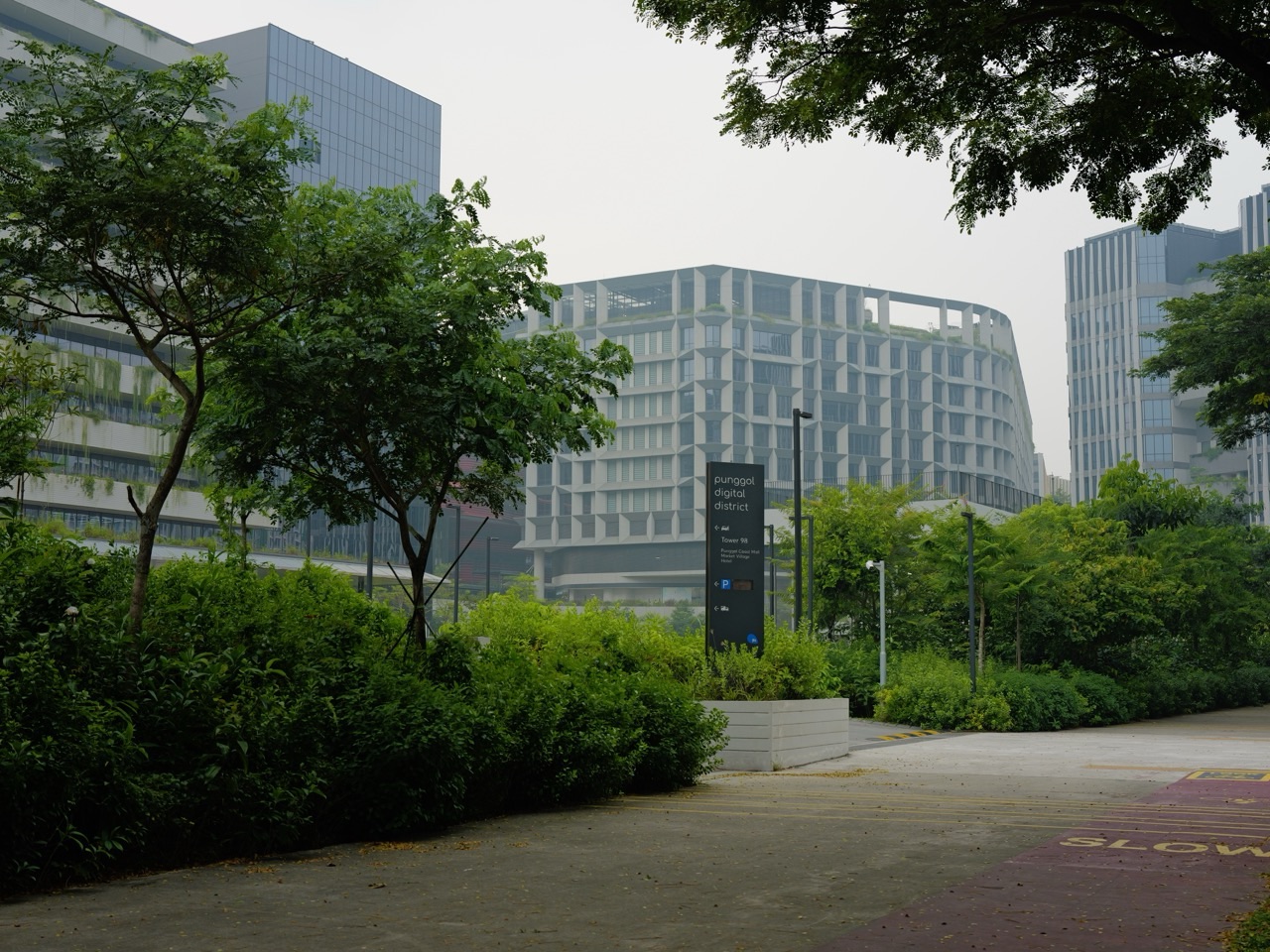
Punggol is home to Punggol Digital District and the Singapore Institute of Technology, where students and professionals may observe or study smart infrastructure, software, built-environment systems and applied innovation. Nearby examples can help founders identify useful questions about cooling, water, mobility, maintenance, accessibility and safe technology.
But the presence of a digital district does not grant startups permission to access operational sensors, private building data, residents’ movements or experimental infrastructure. Any deployment, pilot or data collaboration requires actual partner agreement and appropriate safeguards. A competition entry does not create those rights.
The educational step is to turn a familiar neighbourhood problem into a carefully specified product concept and then determine whether someone genuinely needs or is willing to use it.
An original Punggol startup example: a better energy dashboard
Imagine a hypothetical startup proposing a dashboard that helps building staff identify unusually high energy consumption. The pitch might show an example of electricity usage changing through the day, but an attractive graph is not enough. The team must ask who uses the dashboard, which data is legitimately accessible, which changes can be acted upon and how errors or false alarms would be resolved.
If a model predicts that changing an operating schedule will reduce electricity use by 15%, that figure is a forecast until properly tested. The founder should show the assumptions and comparison conditions, not announce a verified environmental saving merely because a simulation generated a number.
This illustrative business is not an official Punggol Digital District tenant or submitted LKYGBPC finalist. Its purpose is to show how a precise claim can become a research and customer-validation plan.
An original materials startup example: recycled plastic claims
A second fictional team explores recycled polymer material for non-critical 3D-printed products. The team should identify the exact input material, contamination risk, process energy use, mechanical properties and intended safe application. A product may be visually compelling yet inconsistent or unsafe under stress.
The scientific question is whether repeated material testing supports a defined use. The commercial question is whether collection, sorting and processing costs can be sustained. Neither can be answered by displaying only one successful printed sample.
For educational context, explore the NUS sustainable materials project guide. That earlier article concerns university student learning, not an announced joint application or endorsement by SMU.
An original mobility startup example: accessible wayfinding
A founder might propose clear public-transport directions for people with different mobility needs. Before building a navigation application, ask whose problem is being solved: commuters using mobility aids, older people, parents with strollers or unfamiliar visitors? How is accessible-route information validated? What happens if a lift or path is unavailable?
A system that provides false confidence about an accessible route could expose someone to real difficulty or harm. The company must establish a reliable update and feedback process and avoid collecting sensitive location histories without justification.
Such a project also needs to distinguish user testing with volunteers from permission to use transit-operator data or facilities. Responsible innovation includes consent, accuracy and cooperation with the relevant operators.
An original financial example: price is not profit
Suppose a fictional startup sells a smart device for S$120 per unit. Direct manufacturing, packing and delivery cost S$75. Its gross contribution before additional company costs is S$45 per unit, or a 37.5% contribution margin on the selling price. Selling 100 units yields S$4,500 contribution before staff, premises, research, warranty costs, customer support and taxes.
A student who describes the S$4,500 as net profit may mislead investors. The exercise reveals why precise financial vocabulary matters alongside product engineering. The founders should also ask whether the unit cost rises or falls with production volume and how returns or replacements change the model.
The numbers are original classroom examples, not figures from a real LKYGBPC applicant.
What a 2027 application must contain
- Official application form: complete the required online submission through the linked platform
- Executive summary: no more than 500 words, submitted in PDF
- Pitch deck: up to 20 slides, submitted in PDF
- Optional video: up to five minutes, preferably in MP4 format
- English submission: the detailed rules say pitch decks must be in English
- Originality: team-submitted materials must be the participating team’s own original work
The organiser uses specific file-naming conventions and an application platform. Those details matter when a deadline approaches. Founders should open the current official FAQ and confirm any updated file requirements rather than relying on a generic startup-advice template.
What judges say they evaluate
SMU names four broad evaluation themes: innovativeness, commercial feasibility, impact of ideas and capability to execute. These work together. A technically impressive invention with no credible user need may be difficult to deploy. A compelling public benefit without a feasible technology or operations plan may remain aspirational.
Students should prepare to answer, ‘What is your evidence that this problem exists?’ ‘Why will your approach improve on alternatives?’ ‘Which assumptions remain uncertain?’ and ‘What will you do if a pilot fails?’ A good founder can name the limits of present knowledge.
A six-week planning sequence before a competition deadline
Week 1 — Verify eligibility and choose the correct track
Check at least one founder’s education or recent-alumni status and the venture’s actual stage. Ask the organiser to clarify any rule ambiguity before investing in a long application.
Week 2 — Validate the problem ethically
Speak with authorised potential users and review relevant public information. Do not gather customer personal data or workplace records without consent, confidentiality protections and the appropriate legal basis.
Week 3 — Build a defensible evidence map
Separate demonstrated prototype results, user feedback, financial estimates and speculative projections. The team must know the source of each number.
Week 4 — Explain the technology clearly
Describe how the product works in language a non-specialist can understand, while retaining enough technical precision to withstand examination.
Week 5 — Construct the executive summary and pitch
Create a concise 500-word summary and a PDF deck within the official limit. Link every major claim to evidence, customer need, feasibility or a measured result.
Week 6 — Challenge the proposal
Invite tough but fair questions about product limitations, customer access, cost, safety, market alternatives and execution. Use feedback to repair weaknesses rather than merely polish transitions.
This is an original planning sequence, not an organiser-provided compulsory workshop schedule. A team applying after the 31 January early-bird date can still meet the 31 March final deadline, subject to current rules.
Early-bird participation does not mean early guaranteed selection
SMU says applying by 31 January 2027 provides access to an extra opportunity: five early-bird applicants not chosen among the top 50 finalists may be selected for travel and Grand Finals Week access. That is a selective benefit. It is not an automatic trip for every team that submits early.
For finalists, organiser support may cover some travel, accommodation and programme meals under specific conditions. Personal expenses, visa requirements, travel insurance and incidental expenses may remain the team’s responsibility. Punggol-based founders should not assume that costs they have not yet incurred will be reimbursed without agreement.
What about the S$2.5 million-plus prize pool?
The official headline combines cash, investment and professional services. Individual competition categories list specific awards such as two S$100,000 category-winner prizes, with other awards and benefits subject to their own eligibility. A startup should not build its survival budget on winning a selective competition.
Likewise, access to a venture accelerator or a fund is an opportunity to apply or be assessed, not a deposit automatically credited to every finalist. Financing may involve commercial terms and due diligence. Students should seek informed advice before making commitments they do not understand.
Academic integrity, research ethics and intellectual property
A university research result may have been developed with supervisors, laboratories, external partners or other students. A founder must establish who owns the technology and whether permission exists to commercialise or publicly disclose it. Competition eligibility is not a substitute for intellectual-property permission.
Students should also be honest about AI-assisted research, generated pitch text and fabricated product demonstrations. A model showing fictional customers or false test data can mislead reviewers. The official rules require original team submissions; a strong application should clearly distinguish simulated models from actual performance.
For technologies involving health, security, energy, public transport or personal information, regulatory and safety issues may be central rather than peripheral. A pitch does not exempt a team from these duties.
Frequently asked questions
Is LKYGBPC 2027 open already?
Yes. SMU’s official application window opened on 27 October 2026 and runs through 31 March 2027, subject to current rules.
Is there an application fee?
The SMU main competition page says online entry is free.
Can a Secondary 3 student enter alone?
The competition requires at least one qualifying tertiary-linked student or recent-alumni founder. A school-age pupil alone should not assume they meet that criterion.
Can a polytechnic student qualify?
The detailed competition rules include full-time polytechnic learners in the current-student definition in some sections, while other text is more narrowly worded. Confirm the applicable 2027 category with SMU.
Does a startup need to be incorporated before applying?
The organiser’s FAQ says incorporation is not required at application for the relevant competition; other eligibility and legal responsibilities still apply.
What is the difference between Beta and Infinity?
Beta covers early ideas or prototypes; Infinity covers launched, revenue-generating ventures with growth ambitions. Select according to the business’s actual stage.
Are all S$2.5 million of prizes cash?
No. The published combined pool includes investment and professional services as well as cash awards.
Where are the 2027 finals?
Grand Finals Week is scheduled at Singapore Management University in Singapore from 28 September to 1 October 2027.
Official sources and connected Punggol learning
SMU official 2027 LKYGBPC rules, categories, eligibility, submissions and deadlines; SMU competition hub and 13th-edition programme; Singapore Management University. Related Punggol learning: NUS materials innovation; NYC Young ChangeMakers community projects; learning entrepreneurship through prototypes near Punggol Digital District.
Checked on 28 October 2026 against SMU’s 13th-edition competition pages. Sample startup cases and calculations are original educational examples. Mixed wording in the official alumni/current-student FAQ is flagged for verification; prizes, selection, venue arrangements and accelerator access are not guaranteed.


