
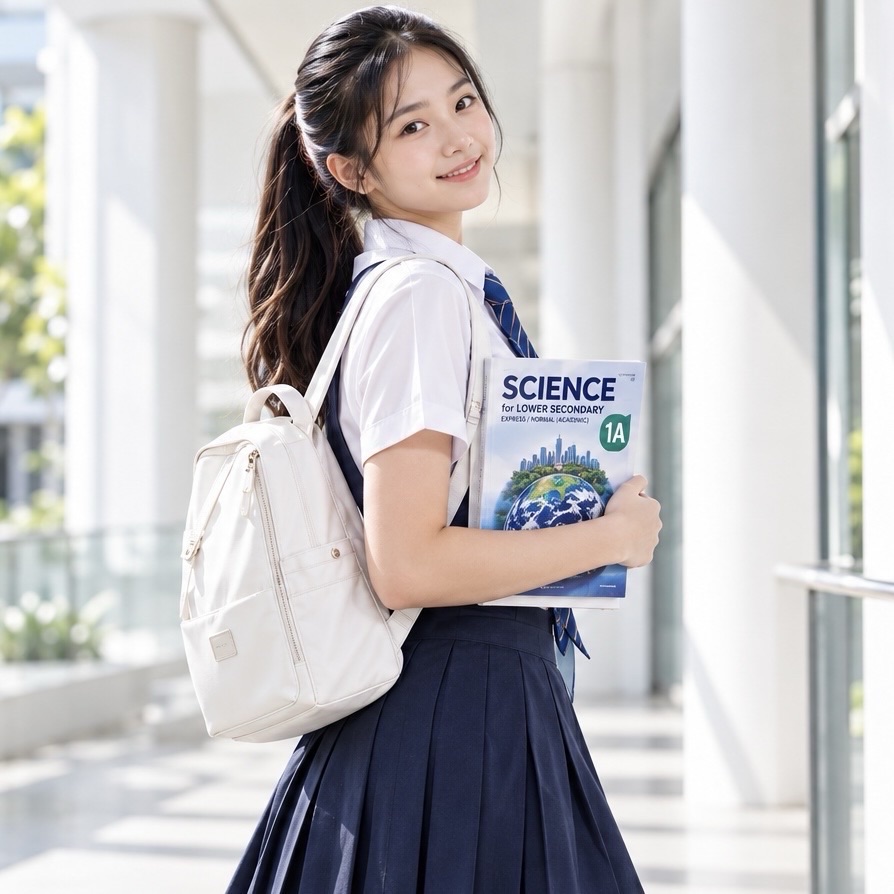
Did you know? Primary 5 Science is not just Primary 4 Science with more keywords. A child can memorise “evaporation”, “respiration”, “reproduction” and “electrical circuit” and still struggle to explain what changes when a condition is altered. For Punggol families planning Primary 5 Science tuition in 2027, the important skill is explaining a system through causes, observations and evidence.
MOE’s 2023 Primary Science Syllabus places reproduction in plants and animals, the water cycle, plant and human respiratory/circulatory systems, and the electrical system in Primary 5. These topics make the classroom increasingly connected: water moves through physical systems, materials participate in changes, and energy or substances may move through living or electrical systems.
A Punggol Primary 5 student in 2027 is normally preparing towards the 2028 PSLE, not sitting PSLE Science in 2027. This article explains what to learn, what not to overclaim, how to interpret a fair test and what parents should look for in school-aligned, true 3-pax tuition. It separates national MOE syllabus information from illustrative examples and family advice.
The published Primary 5 Science topic map
Use MOE’s 2023 Primary Science Syllabus as the source of truth. MOE organises Primary Science through the themes Diversity, Cycles, Systems, Interactions and Energy. Table 2 of the syllabus maps specific topics across Primary 3, 4, 5 and 6. For Primary 5, the published coverage comprises Cycles in Plants and Animals (Reproduction), Cycles in Matter and Water (Water), Plant System (Respiratory and Circulatory Systems), Human System (Respiratory and Circulatory Systems), and Electrical System.
- Reproduction: how living things produce offspring and how structures or conditions contribute to life cycles.
- Water cycle: evaporation, condensation, collection and related transfers in the environment.
- Plant systems: movement of water, dissolved substances and other resources through relevant plant structures.
- Human systems: respiratory and circulatory functions and how they support the body’s needs.
- Electricity: simple circuits, components, conductive pathways and what changes when circuits are open or closed.
- Scientific inquiry: careful observation, a fair comparison, accurate recording, and an explanation that does not exceed the evidence.
The school may sequence units differently. Some lessons may revisit earlier P3 or P4 concepts before entering a P5 unit. Families should not assume a particular topic is missing simply because the teacher has not covered it by March. Ask for the school’s current teaching outline.
Why P5 Science feels harder than memorising chapter notes
A Primary 4 learner might explain that water can become water vapour. At Primary 5, the same idea may appear in a garden, a clothes-drying problem or a diagram of water in the environment. The child must recognise that the words are used to describe a process that can be observed under different conditions.
A student may know that a bulb lights in a complete circuit, but may still predict that two wires touching the same side of the bulb will work. That suggests the circuit has not been understood as a connected pathway involving the appropriate contacts and a source.
The tutor should look for what the learner believes is happening, rather than merely count the number of missing terms in a written answer.
Worked example 1: evaporation is not the same as boiling
Illustrative question: A damp cloth dries on a cool but breezy afternoon. How can it dry if its temperature is below boiling point? Water can evaporate from the cloth’s exposed surface without the liquid reaching its boiling point. Evaporation can take place at different temperatures, with rate affected by conditions.
Possible influences include the movement of air, humidity, exposed surface area and temperature. A pupil who writes “the water boiled away” has chosen the wrong process for the situation. A pupil who simply says “because of the wind” may have noticed one factor but not explained how water leaves the cloth.
The stronger explanation connects the concept to the circumstance: moving air can carry water vapour away from the cloth’s surface, supporting further evaporation where other conditions allow. The student should avoid claiming that the presence of any wind will always make every object dry in exactly the same time.
Worked example 2: read a water-cycle diagram as a process
A simple diagram might show water evaporating from a water body, vapour cooling and condensing to form droplets in clouds, precipitation bringing water back to the surface, and water returning through surface and other pathways. A student should be able to describe the role of each labelled arrow, not just chant a list of four words.
Ask: Which arrows describe a change in state, and which describe movement of water between locations? Evaporation and condensation involve changes between liquid water and water vapour. Precipitation describes water falling from clouds; it should not be confused with a single named state change. This question reveals whether a learner has read the diagram or only memorised its labels.
If a child believes water must boil to evaporate, show the drying-cloth example again. If they believe clouds are containers of steam that simply pour out their contents, discuss the role of condensed droplets using age-appropriate explanations. Scientific diagrams simplify real systems but should not create false mechanisms.
Worked example 3: the circulatory system is a transport system
A P5 child may correctly say the heart pumps blood, then struggle to explain why the pumping matters. A useful explanation connects the heart to blood movement through vessels and to the transport of materials around the body. Within syllabus scope, pupils should also connect the respiratory system with taking in oxygen and removing carbon dioxide.
Illustrative scenario: Mira has just finished running and is breathing faster. Why? Her working muscles require more energy during exercise, and her body needs to deliver the necessary oxygen and remove carbon dioxide produced by respiration. The response should be aligned with the child’s taught syllabus and not drift into unsupported medical diagnosis.
Be careful with the everyday word “breathing” and the scientific idea of “respiration”. Breathing refers to taking air into and out of the lungs. Cellular respiration refers to processes that release energy from nutrients. Children often use the terms interchangeably; the tutor can clarify the distinction at the level required by their school.
Likewise, the heart does not create oxygen or food. It contributes to transport through blood circulation. The student must identify the function of each part accurately.
Worked example 4: a complete circuit is more than two wires
Imagine a simple battery, a small bulb and connecting wires. A bulb can light when an appropriate closed conducting path is formed between the cell’s terminals through the bulb’s relevant contacts. If the circuit is open, current does not flow through that complete path and the bulb does not light.
A strong learner can inspect a labelled circuit diagram and explain why it works or does not work. A weak explanation might be “it needs more electricity” when the actual problem is a missing connection. Before adding components, the tutor should ask the child to trace the path with a finger.
Safety matters. Children should never experiment with Singapore household mains electricity, plug sockets or damaged power supplies. Use only school-approved low-voltage equipment under appropriate supervision. Do not attempt short circuits or handle leaking or damaged cells.
Worked example 5: a science claim needs measured evidence
Fictional data: Two identical cloth samples are hung indoors after being wet with the same amount of water. In a simplified exercise, Sample A is near a gentle fan and takes 35 minutes to reach a specified dry mass; Sample B is kept without that airflow and takes 55 minutes. Can we conclude airflow made the sample near the fan dry faster? The data are consistent with that conclusion if relevant factors were appropriately controlled.
The changed factor is airflow. Controls should include cloth type, size and thickness, starting water content, room temperature, humidity, and the way dryness is measured, as far as practical. If the fan also warms the air, or one sample begins much wetter, the interpretation becomes less certain.
A student who writes “fans cause evaporation in every situation, without exception” has moved beyond the measurements. A better conclusion says that the cloth near the fan dried faster under the stated conditions, and provides a plausible reason connected to evaporation.
How to design a fair comparison
- Question: what relationship are you trying to investigate?
- Changed variable: which one factor is deliberately altered?
- Measured outcome: what numerical or observable result answers the question?
- Controlled factors: which conditions must remain similar?
- Procedure: what steps, time intervals and measuring instruments make results comparable?
- Repeated checks: can you notice variation or a potentially mistaken reading?
- Conclusion: does the explanation follow from the observations and taught concept?
A useful P5 Science lesson moves from a clear question to a plan, evidence and a defensible statement. Pupils benefit from making claims that are neither too vague nor too sweeping. This skill remains valuable in upper-primary and later secondary Science.
Reproduction: structure, process and respectful vocabulary
The reproduction unit can be taught through plant structures and appropriate animal life-cycle examples. For flowering plants, pupils may examine how pollen transfer relates to reproductive processes and how seeds develop. For animals, different reproductive strategies and developmental patterns should be considered within the school’s syllabus.
A child might learn that a flower has different parts but be unsure how those parts participate in reproduction. Asking only “Name the stigma” tests a label; asking “How might transfer of pollen contribute to the plant producing seeds?” tests a relationship. Both are needed, but they accomplish different things.
Parents can explore flowering plants with pictures or responsible observations in permitted public spaces. Avoid picking or damaging plants for an unsupervised investigation. Respect wildlife and do not handle nests or eggs as a teaching activity.
What students often get wrong
- Water-cycle language: saying evaporation is boiling, or treating condensation as water merely “appearing”.
- System function: knowing an organ’s name but assigning it the role of a different organ.
- Circulation: saying blood itself produces oxygen or that the heart performs digestion.
- Electric circuits: assuming a nearby wire is enough, without checking a complete pathway.
- Reproduction: reciting flower part labels but failing to connect their functions to the process.
- Inquiry: changing two variables yet claiming one caused the result.
- Evidence: presenting a tendency observed once as an exception-free universal law.
An error log should show the original incorrect belief, a clear correction and a changed application question. If the same error returns, the pupil needs a different explanation or representation, not only another instruction to memorise.
A 2027 term-by-term pathway towards PSLE 2028
Term 1 — identify science foundations
Check retained understanding of primary-school classification, life cycles, matter, light and heat. Link these to the first current P5 topics. Use school feedback and small diagnostics to locate misconceptions instead of assuming a low mark means all Science is weak.
Term 2 — learn systems through diagrams
Practise reading plant, human and circuit diagrams. Ask pupils to identify which part performs which role, and what changes when a component is removed or interrupted. Keep the explanation within the level prescribed by the school.
Term 3 — practise data and investigation questions
Give tables with units, one controlled change and one short inference question. Require the child to explain the relationship between the observation and a relevant science concept. Include some unfamiliar examples to test whether knowledge transfers.
Term 4 — build the P6 handover
Review the highest-impact weak concepts and preserve a small bank of independently solved new questions. Plan the first quarter of Primary 6 in 2028 using this evidence. Do not treat the 2027 final school assessment as a substitute for the eventual 2028 PSLE information.
Why true 3-pax Science tuition is different from copying a model answer
In a three-student class, one pupil may draw the system, another identify the changed factor and the third explain the expected result. The tutor can observe all three explanations and then ask each student to solve a new question independently. The peer discussion is useful only when it strengthens individual understanding.
A focused 1.5-hour lesson should allow retrieval, explanation, guided practice, feedback and a short independent check. The appropriate difficulty should reflect the individual student’s understanding and school sequence; group size does not automatically guarantee a learning outcome.
For related Punggol material, see Primary 5 Science: Reproduction, Water, Circuits and Transport, the Primary 5 Science tuition pathway, and eduKatePunggol’s true 3-pax tutorial approach.
Questions for parents choosing a Science tutor
- Can the tutor show the exact Primary 5 topics in the MOE 2023 Science syllabus?
- Will my child distinguish breathing from the energy-related concept of respiration when appropriate?
- Can the child trace an electric circuit and explain the consequence of an open path?
- Are investigations safe, fair and clearly recorded?
- How does the tutor help distinguish an observation from an unsupported explanation?
- Does tuition prepare the child for Primary 6 in 2028 rather than pretend that PSLE is in 2027?
- What improvement can the pupil demonstrate independently after four to six weeks?
Frequently asked questions
Are photosynthesis, energy conversion and friction part of the P5 topic table?
MOE’s published Primary Science topic overview places photosynthesis, energy conversion and selected forces primarily in the Primary 6 row. School teachers may revisit foundational related concepts in other years, but families should not confuse a P6 topic map with the designated P5 topic list.
Is understanding electric circuits the same as memorising a switch diagram?
No. A pupil should be able to interpret whether a circuit has a complete conducting path and what each component does within that setup. A copied symbol sheet is useful only when the student can apply it correctly.
Should parents start PSLE timed papers in Primary 5?
Not automatically. Full papers are most useful after concepts and structured explanations are sufficiently stable. Start with targeted practice, then mixed applications and timed work according to readiness and school guidance.
Can a child revise water and human systems together?
They are different scientific systems, but comparing what moves, how pathways function and how evidence supports an explanation can develop helpful reasoning. Do not force false analogies or ignore topic-specific facts.
What if Science vocabulary is strong but application marks remain weak?
Ask the child to identify the relevant change in a diagram or experiment, point to the evidence, state a relevant concept and connect them in a sentence. A student may know the term while missing the mechanism.
The Punggol family takeaway
Primary 5 Science in 2027 is a year to connect facts into systems. Study the correct topics, build clear cause-and-effect explanations, learn to read data without overclaiming and enter Primary 6 in 2028 with strong foundations. The most useful progress is when the child can explain unfamiliar but appropriate situations without prompts.
Official syllabus: MOE’s 2023 Primary Science Syllabus. Related local guides: the eduKatePunggol education pathways guide · Primary 5 Science Tuition. Information reviewed 27 October 2026; check the latest MOE and school updates for the child’s year.


