
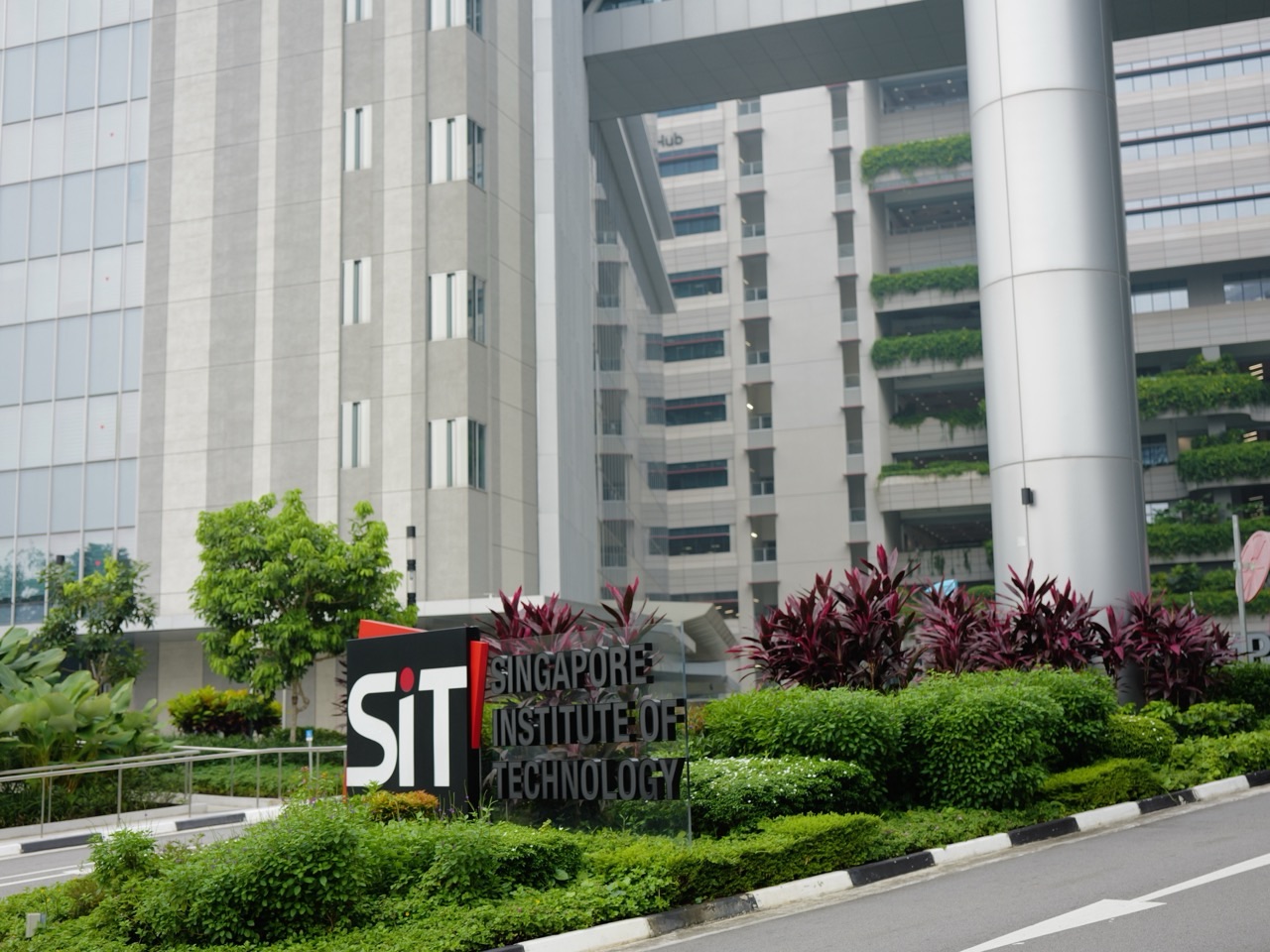
Quick answer — 23 October 2026. The Singapore Institute of Technology (SIT), whose main campus is in Punggol Digital District, announced on 3 September 2026 a pilot “2+2” work-study model. The first planned pilot begins in September 2027 for selected students and employer partners. Participants spend their initial two years building academic foundations, then undertake an extended Integrated Work Study Programme (IWSP) lasting one year and eight months, or 20 months, beginning in Year 3. They continue selected campus learning, micro-credentials and capstone work while attached to industry. The university says the longer industry phase will not increase the overall degree duration. This is an announced pilot, not an automatic requirement for every SIT student or a job guarantee.
The announcement names degrees including Information and Communications Technology (Information Security), Information and Communications Technology (Software Engineering), Electrical and Electronic Engineering, and Mechanical Engineering among those intended for the initial pilot. Details on eligibility, employer matching, placement offers and individual timetables should be checked with SIT as implementation develops. The authoritative starting point is SIT’s 3 September 2026 announcement; do not confuse this news with a general promise that every secondary-school student living in Punggol will receive a future industry placement.
This article explains the practical education implications for Punggol families, including how a young learner can prepare for longer workplace learning without prematurely selecting a career. It is deliberately more specific than our general guide to SIT living labs, work-study and industry learning: the subject here is one dated 2027 pilot, its operational design, its limits and the skills it requires.
The 2+2 pilot at a glance
- Announcement date: 3 September 2026, in SIT’s official press release.
- Pilot start targeted: September 2027, involving selected industry partners and students.
- First phase: two years focused on building disciplinary foundations on campus.
- Second phase: an extended IWSP of one year and eight months (20 months), integrated with remaining academic work.
- Degree programmes named: ICT (Information Security), ICT (Software Engineering), Electrical and Electronic Engineering, and Mechanical Engineering.
- During the work-study phase: industry experience, selected university learning and capstone activity continue together.
- Duration of degree: SIT says the model is designed within the existing programme length, not an added two-year internship after graduation.
- Who may participate: selected students and companies in a pilot; no universal entitlement has been announced.
- Evidence of outcome: future pilot results will matter; the press release cannot establish employment results for a scheme not yet started.
What SIT means by 2+2—and what the name can mislead families into thinking
The title sounds like two years of lessons followed by two years of work. It is a useful shorthand but not an exact calendar division. SIT specifies a workplace-learning period of one year and eight months, approximately twenty months. Students also return for learning and complete assessed academic work during that phase. The precise programme calendar must be read from the university rather than deduced from a slogan.
A degree student is still a learner during an IWSP. Workplace attendance does not mean the academic part has vanished, and performing useful employer tasks is not the same as receiving a guaranteed permanent job. In a well-designed integrated model, university teaching provides the principles and the employer environment tests whether those principles survive the friction of real equipment, people, deadlines, imperfect information and changing requirements.
The announcement says participating ICT students will begin their extended IWSP in the first trimester of Year 3. During the initial eight months they return to campus one day a week, with some learning delivered flexibly. They then continue workplace learning alongside a capstone project. Engineering students also begin their extended phase in Year 3 after foundational study and undertake micro-credentials and capstone work. These specifics must not be copied indiscriminately into other SIT programmes.
Twenty months versus the earlier eight-to-twelve-month model
SIT describes the existing IWSP duration for relevant comparisons as eight to twelve months. The pilot expands the workplace component to twenty months. The difference is therefore approximately eight to twelve additional months of workplace exposure, depending on which prior comparison is used. Do not present the change as a universal doubling because the baseline is a range.
Why might this matter? A conventional internship may allow a learner to complete a defined assignment, write up findings and leave. Twenty months can potentially expose a student to more than one project cycle: a problem is discovered, a proposal approved, a prototype produced, failures found, a revised design tested, and a functioning method handed over. That is a more complex educational sequence than a single summer task—but it is an opportunity, not an outcome guaranteed in every team.
Imagine a software student joining a security project. In an early stage, the student learns the system and follows established tests. Months later, the student may understand why incidents recur, propose a change to validation logic, help document test results and explain a risk to non-technical colleagues. A short placement can teach a technique; a sustained placement can reveal why technique must fit an organisation. The university and employers still need to protect meaningful supervision, assessment and safety.
Why Punggol is important to this education story
SIT’s campus is located within Punggol Digital District, where university facilities are physically near businesses and applied research projects. The district combines an academic institution with JTC’s business-park ecosystem. This is meaningful because work-study needs an operating environment, not simply a presentation about the labour market. Proximity can make a collaboration easier to organise, although the particular pilot employer need not be located in Punggol.
Punggol families should treat this geographic advantage carefully. A nearby campus does not alter national admissions criteria, create preferential access for residents or guarantee a placement at a nearby company. What it can do is make industry-centred learning more visible: a teenager may see an engineer commuting to work, a student carrying a project prototype or a public space designed to connect campuses and workplaces.
There is a valuable difference between motivation and certainty. Seeing the district grow can motivate a child to develop mathematical and language foundations. It does not tell the family which career will exist ten years from now or whether a specific graduate will secure it. An accurate local guide must protect that distinction because exaggerated promises distort education decisions.
Which students are named in the proposed pilot?
Information Security
An information-security learner may study networks, software systems, authentication, secure design, threat modelling, risk management and the careful handling of data. An extended placement could involve learning how a real organisation inventories systems, controls permissions, documents incidents or validates fixes. The employer’s security rules and the student’s authorised role determine what tasks are appropriate; never assume that an intern can freely access confidential systems.
A useful preparation activity for a secondary student is analysing a fictional phishing email. Ask who claims to be the sender, what action is being requested, whether the link matches the stated organisation and what independent channel could verify the request. The exercise develops scepticism, reading accuracy and disciplined decision-making without requiring access to a protected network.
Software Engineering
Software engineering is not only writing code quickly. A system must be understandable, testable, maintainable, useful to people and robust when an input is unexpected. A longer attachment can expose students to a codebase shaped by years of decisions. Reading another developer’s documentation and producing a careful bug report are legitimate technical skills, even if they look less glamorous than a new application.
A teenager interested in the pathway could create a simple programme that converts a measurement, then test it with normal, boundary and invalid values. For example, converting a temperature value should not silently accept alphabetic text as a number. The learning lies in writing down the intended behaviour, seeing a failure and improving the design. It is this habit of verification—not merely knowing a programming language—that is portable between tools.
Electrical and Electronic Engineering
Electrical and electronic engineering connects physical quantities with circuits, sensing, control and systems. In workplaces, a technically correct component may fail because of heat, vibration, manufacturing tolerance, communication timing, maintenance practice or the way people use the system. Longer immersion can help a student recognise those interacting constraints.
At school level, the preparation is not to copy advanced university circuit calculations. Focus on units, ratio, algebra, graphs and careful experiment design. Suppose a safe classroom circuit gives readings of 2 V at 0.10 A and 4 V at 0.20 A. The ratio V/I is 20 ohms in both cases, consistent with constant resistance in this simplified example. Ask what could disturb that relationship and which conditions need to be controlled.
Mechanical Engineering
Mechanical engineering involves loads, motion, energy, materials, manufacturing, fluids, thermal systems and design trade-offs. An industry placement may confront reliability, maintenance and safety questions that are hidden in tidy textbook drawings. A design might work in a simulation yet be difficult to manufacture, inspect, repair or operate consistently.
A Punggol student can begin thinking like an engineer by comparing two designs under the same load with a clear measurement method, recording what changed and refusing to treat one good result as proof. Documenting a failed prototype is not embarrassment; it helps explain the next design. Those habits are valuable whether the student eventually works in marine technology, robotics, buildings, transport or another sector.
How the educational responsibilities are divided
The university provides the structured academic curriculum, learning outcomes, assessment system and support processes. An industry partner provides authentic work, equipment, workplace context and suitably supervised tasks. The student remains responsible for communicating uncertainty, completing work honestly, following safety and confidentiality rules and connecting practical experience to assessed learning.
A parent may ask, “Will the company be teaching the degree?” The more useful question is how academic and workplace components are aligned. Theory and practice have different strengths. A university can explain why a method works across many conditions; a workplace reveals which conditions an organisation actually encounters. Strong work-study should use both rather than replacing one with the other.
SIT says industry partners will help co-develop talent through the pilot. That language describes an intention to shape skills and workplace learning, not a transfer of responsibility away from students or the university. If a future student is offered a place, they should read the relevant contractual, academic and administrative arrangements rather than relying on a public press release for terms.
What the micro-credential component changes
The announcement mentions returning to campus for micro-credentials alongside work. A micro-credential generally recognises a bounded set of learning outcomes rather than an entire degree. Its value depends on the awarding institution, syllabus, evidence of assessment, relevance to the student’s work and how it fits the overall qualification. Avoid assuming every short course is equivalent to an academic module.
An engineering student who spends part of the week working with a machine could study a tightly scoped topic, apply it in an approved project and reflect on evidence of competence. That is conceptually different from collecting certificates because they sound employable. The important questions are: what can the student now do, how was it assessed, and can the capability be reproduced without a template?
Families should not buy third-party certificates in anticipation of SIT admissions simply because the pilot mentions micro-credentials. The announcement discusses educational elements inside a university programme; it does not list pre-enrolment certificate requirements for secondary or polytechnic applicants. Official admissions information should always take precedence.
The capstone project matters as much as the job title
A capstone project asks a learner to integrate knowledge rather than answer isolated questions. During a long work-study phase, the student may have access to an authentic problem, but turning it into an assessable project requires a carefully chosen scope, a defensible method, ethical data access and a coherent explanation of results. University approval and employer permission are especially important when a project involves internal systems or commercially sensitive information.
For illustration, a student might investigate how a routine maintenance workflow could be made more reliable. A valid project would define the performance measure, describe the existing process, identify confounding variables, test an improvement safely and acknowledge what the data cannot show. A weak project would claim success after one favourable observation. The educational difference is in evidence and reasoning, not the length of the report.
Capstone writing also demonstrates why English remains important in technology careers. A technically capable engineer must explain assumptions, uncertainty and consequences to people who do not share the same specialism. A poorly phrased instruction or an unclear graph can create misunderstandings that a correct calculation alone will not repair.
What does the 48.6% employment-offer figure actually say?
SIT reports that 48.6% of its IWSP interns received advance full-time employment offers from their placement employers, according to its 2025 Graduate Employment Survey. This is a historical measure from an earlier context. It is not the 2027 pilot’s placement-to-employment conversion rate, and it is not a guarantee that one in two future participants in the new model will receive an offer.
The distinction matters because statistics are easy to misread. The numerator is interns who received advance offers, and the denominator is the relevant group of interns measured in that survey. A reader also needs to know the population, timeframe, methodology and whether offers were accepted to make stronger claims. A student should never choose a degree solely because a single percentage looks promising.
A good family conversation uses the statistic as one piece of context: sustained, relevant workplace engagement can connect learning and hiring. It should then return to what the student controls—technical preparation, professional behaviour, reflection and integrity—and what they do not control, such as employer hiring plans, market cycles and the number of pilot places.
A worked timeline for a hypothetical university student
Consider a fictional learner beginning Year 1 under a programme participating in the model. During Years 1 and 2, the learner completes foundational modules, practises technical communication, uses campus laboratories and learns how to assess evidence. The student then applies for and is considered for an industry partner under applicable arrangements. This is an illustrative sequence, not an announced personal assignment or guaranteed admission route.
During Year 3, a participating ICT student could follow the announced design of working with the company while returning to campus one day weekly for the initial eight months. Later stages can integrate capstone work and continuing professional learning. For a student who struggles with unstructured tasks, the key adaptation may be writing weekly progress notes and raising obstacles early, rather than pretending to understand the system.
The employer may not need the learner to perform a sophisticated role immediately. Responsible progression is often observation, closely supervised practice, independent performance of bounded tasks, measured improvement and careful handover. Some tasks may remain prohibited. The model is educational only if growing autonomy is matched by feedback and safety.
What a workplace-learning journal could look like
- Problem statement: the genuine workplace task, written without confidential client or system details.
- Observation: what the student actually saw, rather than what a supervisor was assumed to mean.
- Evidence: lawful, approved measures or non-sensitive examples supporting the observation.
- Decision: which method was chosen, why, and which alternatives were considered.
- Uncertainty: what remains unknown or was not tested.
- Feedback: the supervisor’s comments and the student’s interpretation.
- Revision: what changed after feedback, and how the student verified that the change helped.
- Transfer: which broader principle could be used in a new problem.
- Professional conduct: how privacy, safety, attribution and team responsibilities were handled.
That journal is not a recommendation to copy company documents into a personal account or generative AI tool. Workplace policies govern information, intellectual property and permitted systems. The idea is to build the habit of reflecting on legitimate learning evidence. Students can use anonymised summaries when authorised, or discuss protected details only through employer-approved channels.
How parents can judge whether a long attachment is going well
The usual question, “Are you enjoying your internship?” is too broad. A student may enjoy colleagues while learning little, or find a demanding task difficult while developing valuable competence. Ask instead: “What did you learn to do this month that you could not do last month?” Then ask for an example, the evidence and the next challenge. This helps distinguish meaningful progress from vague impressions.
Other signs include a clear supervisor, a realistic work plan, opportunities to ask questions, feedback that changes the student’s method, tasks appropriate for their preparation and a process for reporting concerns. These are principles for evaluating workplace learning, not statements that every pilot employer already meets a particular checklist. The pilot’s performance should be judged on evidence as it begins.
Parents should also respect the growing adult independence of university students. A learner who is old enough to work in a professional environment needs room to communicate directly with supervisors and university staff. Support should make decision-making stronger, not create a private intervention every time the student faces a difficult assignment.
Wages, hours, insurance and placement terms: what is not confirmed here
The public September 2026 announcement describes the educational design but is not an employment contract. It should not be used to invent a uniform pay rate, allowance, leave entitlement, worksite, daily schedule, employer list, transport subsidy or insurance arrangement. Actual terms may differ by employer, programme and university rules. Verify the specific agreement before accepting any placement.
Students should check who supervises work, how grievances are handled, how academic assessments interact with employer duties and what happens if a placement cannot continue. There should also be clarity on safety training, confidentiality, approved devices and methods for requesting reasonable support. These questions do not imply a problem exists; they are normal due diligence for a long learning arrangement.
A Punggol resident should not assume the worksite is next to SIT. Local industry integration is a useful district feature, but the announced pilot includes selected partners rather than a residence-based company assignment scheme. Commuting, accessibility and living arrangements must be considered once a concrete placement is known.
Secondary school preparation: why the foundations are not optional
A Secondary 1 or 2 student intrigued by this future should not leap straight into a trendy specialised course. Strong upper-secondary and post-secondary pathways begin with reliable understanding of mathematical structure, careful reading, scientific reasoning, communication and work habits. Digital tools change more quickly than these foundations.
For Mathematics, an important skill is explaining the meaning of a variable. A child may be able to solve 2x + 5 = 17 by memorising operations, but can they explain why subtracting five from both sides preserves equality? If x = 6, can they substitute to check? The ability to defend a method matters later when an engineer must explain a specification or a programmer must locate a failing assumption.
The eduKate Secondary 1 Mathematics small-group tutorial example in Clementi is our immutable teaching-method benchmark: diagnose an exact misunderstanding, explain the principle, practise with feedback, ask the learner to retry independently, and verify transfer in a slightly changed problem. It is not a claim that the tutorial’s location or enrolment arrangements apply to SIT.
Polytechnic and JC students: preparing without choosing a narrow destiny
For students considering a route toward an applied degree, the most useful next step is to investigate the actual entry requirements of the relevant SIT programme, which can change by admission cycle. Polytechnic projects, laboratory work, relevant internship experience and well-explained portfolio evidence may develop useful skills, but should not be falsely represented as automatic admissions criteria unless SIT states them.
A JC student can build a similar foundation through disciplined scientific reports, mathematics, writing and informed exploration of applied disciplines. Neither JC nor polytechnic students should assume the advertised work-study pilot applies to all disciplines, or that entering any SIT course guarantees a place in the pilot. Degree selection should first reflect genuine academic fit and informed understanding of future work.
A useful exploratory task is to interview an authorised professional about a routine problem, then write a one-page explanation that separates what is known, what the professional believes, what would need measuring and which safety considerations matter. This develops practical curiosity without trespassing on a company’s confidential work.
A practical progression map from Primary School to university
Primary years: observe, describe, measure
At primary level, children can measure a walking route, keep a simple data table, read instructions carefully, make a prediction and explain a discrepancy. Building a paper structure and testing it with consistent weights illustrates the distinction between a fair comparison and a lucky result. The goal is not early professionalisation; it is curiosity disciplined by evidence.
Lower secondary: build abstract reasoning
By Secondary 1 and 2, algebra, proportional reasoning, graphs, science investigations, English inference and collaborative projects create a more flexible foundation. A student should learn to say, “Here is my assumption and how I checked it.” This is the language needed later when a workplace problem does not match a textbook template.
Upper secondary: deepen and communicate
In Secondary 3 and 4, additional mathematics, sciences, humanities and design-related experiences can provide useful depth when they suit the student’s programme and readiness. Choosing the most demanding combination without sufficient foundation is not itself a sign of ambition. Good choices preserve progress and the student’s ability to learn independently.
Post-secondary: test fit against real work
At JC, polytechnic, ITE and other recognised pathways, learners can explore through approved projects, career guidance, institution-run open houses and placements where available. The route to SIT is governed by programme-specific admissions processes, not by the family’s proximity to the campus. Learning about a professional field should include the everyday tasks, not only its most impressive advertisements.
University: connect knowledge with accountable performance
At university, the questions become more integrated. Can the learner use theory on a messy problem, document a decision, assess risk, communicate with colleagues and improve after review? These competencies are the reason an institution would consider a longer work-study arrangement. The model does not eliminate the need for teaching; it changes where part of that teaching can happen.
An algebra-to-workplace example: quantities, units and hidden assumptions
Suppose a fictional workshop makes 80 components per hour under ideal conditions. A learner asked to estimate one shift’s output might multiply 80 by eight and announce 640. But what if setup takes half an hour, checks take another half-hour and the machine has an unexpected stoppage? The arithmetic is correct for an assumption the problem did not justify.
A better answer starts by distinguishing gross capacity from usable production time. If planned production time is seven hours after the scheduled non-production periods, the simple upper estimate is 80 × 7 = 560 components, before any additional rejection or downtime. If an average five per cent were rejected in a clearly labelled hypothetical scenario, 560 × 0.95 = 532 acceptable components. The calculation is basic; the professional competence is naming every assumption.
The point is not that children must learn manufacturing. It is that mathematics becomes more reliable when the student asks what a number means, which units it uses, and whether an apparent precision is supported by the evidence. That ability transfers naturally from school word problems to industry work.
A software-to-workplace example: a test should be able to fail
A learner creates a simple calculator for delivery cost: a fixed fee plus a distance rate. If the fixed fee is $2 and the distance rate is $0.80 per kilometre, a five-kilometre delivery costs $6.00. That calculation is not enough to validate the programme. What if the user enters zero, a negative number, text, or an unusually large value? The student’s job is to decide what is valid and test the implementation against the decision.
A simple test table may include a typical case, a boundary case and invalid input. For each, record the expected result before running the program. Otherwise, students may change the expected answer to match a faulty output. In a workplace, similar discipline protects users and exposes misunderstandings early.
A longer attachment could provide time for the learner to understand why a system must be maintained, not merely built. This example is illustrative, not a description of any selected partner’s proprietary work.
A physical-engineering example: design with safety margins
An engineering sketch may show a shelf supporting a particular load, but the visible load is only part of the design question. The materials, joints, support conditions, changing forces and consequences of failure matter. A school exercise can use a safe paper-model structure to explore relative behaviour; children should not build or alter load-bearing installations as a home experiment.
The educational method is to define a repeatable test. If two paper beams are compared, use the same span, paper type, load position and measurement rule. Change only the intended design feature. Repeat the test where feasible and record unexpected results instead of discarding them. That is how scientific inquiry becomes engineering judgement.
Longer work-study exposes students to stronger professional obligations: safety approvals, quality systems and design reviews. Those obligations are not shortcuts; they are what makes applied learning accountable to people affected by the final product.
What students should record in an application or portfolio
- One problem you tried to solve, described clearly in everyday language.
- Your starting assumption and why you made it.
- The first method attempted and the actual evidence from it.
- What did not work and how you recognised that failure.
- Feedback from a teacher, mentor or collaborator.
- Your revised approach and the result of a fairer test.
- What you would do next if more time were available.
- A reflection on teamwork, responsible data handling or safety where relevant.
- A concise description of your contribution without claiming the whole team’s work.
- A note identifying any material you are not authorised to share.
This is not a secret formula for SIT admissions. It is an ethical way to make learning visible. Portfolios are strongest when they show an actual learner understanding and improving their own work. Artificially polished claims with no reproducible reasoning do little to prepare someone for a genuine assessment or placement interview.
What employers might gain—and what remains unknown
SIT describes employer benefits in terms of nurturing a talent pipeline, seeing students work on genuine problems and developing capabilities over a longer period. Those are plausible reasons to join a pilot. Companies can observe growth over time; students can understand the organisation and contribute beyond narrow introductory tasks. The relationship requires investment from both sides.
However, the public announcement is not a completed impact study. We do not yet know the new pilot’s eventual completion rate, student satisfaction, distribution of employers, long-term employment conversion or outcomes across different backgrounds. A careful future audit should compare observed outcomes with the intended learning benefits and listen to both students and supervisors.
One metric is not enough. A pilot might produce strong technical outputs but impose excessive pressure, or provide pleasant experiences without sufficient academic transfer. Indicators could include supervised learning quality, capstone assessment, technical competence, workplace safety, reasonable workload, graduate pathways and fair access to opportunities.
A family checklist for the 2026–2027 planning period
- Read the official SIT announcement and note the date rather than a rumoured start date.
- Check whether the degree under consideration is one of the named intended pilot programmes.
- Distinguish entry to an SIT degree from later selection for a specific work-study pilot.
- Compare published university admissions requirements with the student’s actual qualifications.
- Ask about academic foundations: Mathematics, English, science and disciplinary problem-solving.
- Request official details of any industry-matching, supervision or timetable arrangement when issued.
- Verify placement terms rather than assume pay, transport, schedule or employment guarantees.
- Look for valid opportunities to practise documentation, feedback and teamwork now.
- Maintain realistic rest, health and commuting expectations while planning any future timetable.
- Recheck SIT’s programme pages before taking action because a pilot can be refined.
Frequently asked questions
Is SIT converting all degrees into the 2+2 format?
No. The 2026 announcement is about a pilot with selected students, employers and degree programmes. An expansion may eventually be considered, but its scope and dates cannot be assumed from this announcement. Families should read current programme information rather than treat the pilot label as an institution-wide rule.
Does a Punggol student have priority because the campus is in the town?
No resident-priority claim is made by SIT in the announcement. The campus location gives a local setting for university and business integration; admissions and pilot eligibility follow the institution’s rules. Being able to see a campus from home is not a substitute for meeting admission requirements.
Does 2+2 add two extra years to a degree?
No. SIT explicitly states that the longer industry period is incorporated without lengthening the overall degree duration for the participating pilot design. Specific module schedules must still be checked. The 20-month period is not an extra programme appended after graduation.
Is a student in Year 1 guaranteed the same company for twenty months?
The announcement outlines an intended model, not every individual’s future employer or exact placement terms. Students should request the applicable operational details once officially available. Avoid making housing or financial commitments on an assumed placement location.
Will every student receive a job offer at the end?
No. Work-study is education and industry exposure. The 48.6% historical advance-offer figure in SIT’s 2025 survey cannot be rebranded as a forecast for the new pilot. Hiring depends on employer needs, performance and wider conditions.
Does AI remove the need to learn code or mathematics?
No. AI tools can assist with certain tasks, but responsible engineering still requires problem definition, correct assumptions, testing and accountability. A student who cannot explain why a tool’s output is plausible will struggle to verify it in a demanding environment.
Should a Primary 6 pupil choose a secondary school solely to reach SIT?
No. The pupil should consider school fit, learning needs, curriculum options, commute and future flexibility. Pathways after secondary school remain varied. It is more useful to establish deep literacy, numeracy and a capacity to learn than to treat a single university as an unavoidable destination at age twelve.
Is the 20-month model the same as a conventional internship?
It resembles an internship in its workplace setting but is more formally integrated into the participating degree’s educational design, with continuing academic elements. The precise learning outcomes and conditions belong to SIT’s future programme instructions. Longer duration alone does not prove higher quality.
Can families tour or enrol in the pilot now?
A press release is not an admission portal. Consult SIT’s official programme, open-house, admissions and work-study channels for opportunities and instructions. The September 2027 pilot target does not by itself establish that general public registration is open in October 2026.
What to watch next
- SIT’s detailed participating-degree and student-selection notices.
- Confirmed employer participation and placement arrangements for the inaugural cohort.
- Published programme calendars that show how campus and workplace time interleave.
- How micro-credentials are assessed and recorded within each programme.
- Capstone supervision rules and workplace confidentiality safeguards.
- The pilot’s eventual student, employer and academic outcomes once it begins.
This matters to Punggol because education is becoming more intertwined with a working district. But the headline should lead to sharper questions, not grand predictions. Look for dated primary-source updates, watch the gap between a pilot design and what is actually implemented, and help young people develop the fundamentals that make them adaptable.
Sources and further reading
- SIT, 3 September 2026: Official 2+2 work-study pilot announcement
- SIT: Official Punggol Campus information
- eduKatePunggol: SIT living labs, work-study and industry learning overview
- eduKateSG: The immutable Clementi small-group Mathematics learning-method baseline
- SIT: Undergraduate admissions information
Last checked 23 October 2026. Announced future pilot details can change. Confirm enrolment, employer selection, programme duration and work conditions directly with SIT. This is independent education commentary for Punggol readers, not an official university circular.


