
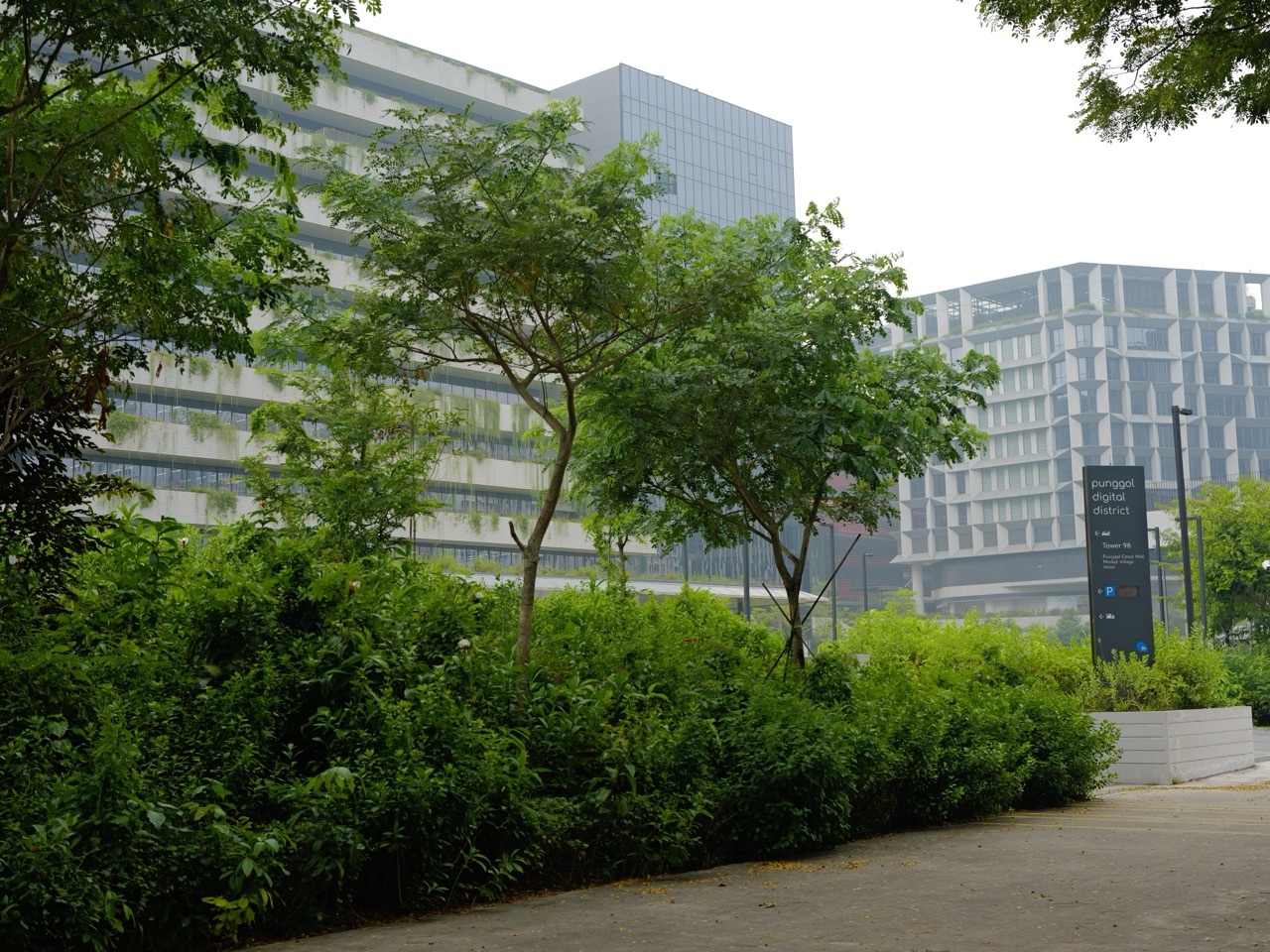
Quick answer, checked 23 October 2026: E-Bridge Pre-School has published a new Punggol Digital District location at 82 Punggol Way, #03-27 to #03-38, Singapore 829910, with a planned November 2026 opening. Its own registration-of-interest page states an estimated commencement date of 16 November 2026. The centre gives weekday operating hours of 7 am to 7 pm, a contact number of 6028 5530 and email pdd@e-bridge.edu.sg. This is a planned opening and an enquiry opportunity; it is not confirmation that the centre is already operating, that a place is available or that any particular child’s enrolment is secured.
There is a second, wider piece of news. JTC’s official Punggol Digital District community page describes three childcare centres as upcoming. The newly named E-Bridge centre gives families a concrete provider and estimated start to investigate, while the broader three-centre statement remains a development plan requiring separate centre-by-centre verification. Parents should not assume every planned site opens in November or that the other operators, prices or exact opening dates have been announced.
The facts come from the E-Bridge Punggol Digital District location page, its registration-of-interest information, JTC’s district community page and the government LifeSG preschool search service. This guide explains what is confirmed, what remains uncertain and how to make a sound preschool decision while a development is still opening.
What has changed, exactly?
The most valuable new information is not simply that Punggol may have more childcare capacity in the future. A prospective operator now publishes a specific address, a direct contact and a planned November 2026 commencement. That makes the practical questions different. A family can contact E-Bridge about programmes, available spaces and visits instead of relying on architectural plans or assuming all future centres are anonymous.
E-Bridge’s page describes its location as a learning environment within a smart and sustainable district, using a Reggio Emilia-inspired, inquiry-led approach. The operator describes itself as an ECDA-appointed Anchor Operator. These descriptions tell a parent about the philosophy and operator category, but they do not by themselves establish whether a child’s required class level is already open, whether a vacancy exists or what the exact family’s monthly payment will be.
As of this fact check, do not use a sentence such as ‘Punggol Digital District’s three childcare centres are open’. The district source labels the three as upcoming, while E-Bridge separately provides an estimated start date. Accurate local news must allow both statements to coexist until newer institution-specific status updates clarify them.
The essential verified information
- Operator: E-Bridge Pre-School, Punggol Digital District campus.
- Address: 82 Punggol Way, #03-27 to #03-36, #03-37 and #03-38, Singapore 829910, as published by the operator.
- Opening: November 2026, with 16 November given as the estimated commencement date in its registration information; actual first day remains subject to confirmation.
- Published weekday operating hours: Monday to Friday, 7 am to 7 pm; Saturdays and Sundays closed.
- Published centre contact: +65 6028 5530, pdd@e-bridge.edu.sg.
- Registration: the operator provides a way to register interest; a submitted expression of interest is not a guaranteed place.
- District context: JTC describes a wider plan for three upcoming childcare centres, without using its brief community list to provide all three centres’ individual admission details.
The address can help a family assess a commute, but a planned centre’s public page is not a substitute for written confirmation of the start date, the child’s group placement, fee schedule and care arrangements. Ask for those separately and preserve the centre’s written reply.
How to express interest without confusing it with enrolment
Start with the centre’s official contact or registration channel. Provide only the information required for an enquiry and check that the website belongs to E-Bridge. State your child’s age at the intended start, the programme required, preferred commencement date and any care arrangements that materially affect suitability. For an infant, ask specifically about infant-care provision at this location; do not infer it merely because the operator runs infant-care services elsewhere.
The registration-of-interest stage is a way to begin a conversation. Ask what additional documentation and conditions apply before admission, when a confirmed offer is issued, how acceptance is documented and whether a deposit or fee is due. Written clarity is especially important when a centre has an estimated opening rather than a completed operating history.
Singapore’s current LifeSG preschool search guidance points parents toward direct centre contact for enrolment. Search results and vacancy data may change, so a screen showing availability is not itself a reserved place. In fact, a family should treat the official centre’s direct confirmation as the decisive evidence for its individual enrolment.
You can check the current landscape through LifeSG Search for Preschools and ECDA’s upcoming-preschools information. The services help distinguish current providers, listed vacancies and future locations. They should be rechecked near your child’s intended start date.
Are there really three new childcare centres at Punggol Digital District?
JTC’s own district community page uses the wording ‘Upcoming: Three childcare centres’. That is a useful official description of planned amenities. It is not a table of names, opening dates, enrolment ages or vacancies. The separate E-Bridge material identifies one real operator in this setting. The correct reading is that the district’s broader childcare provision is being developed in phases and specific facilities must be assessed individually.
A 13 October 2026 report summarising ECDA’s upcoming-preschools list identified a Punggol Digital District location among centres expected in the fourth quarter of 2026 and another district site expected in the second quarter of 2027. The underlying future openings are subject to confirmation and the public ECDA listing should take priority over a summary when details change. Do not convert a projected quarter into a guaranteed opening day.
One more important boundary: a preschool appearing near Punggol Regional Sport Centre is a separate physical site, not automatically one of JTC’s three PDD centres. The terms ‘Punggol’, ‘Punggol Coast’ and ‘Punggol Digital District’ overlap in casual discussion but do not identify an identical address. Exact building, floor and unit matter to a parent who will be travelling with a child.
When comparing press statements, planning pages and a centre’s registration materials, prioritise the most specific current information for the decision being made. JTC can describe district plans; ECDA and LifeSG can describe preschool listings and vacancies; the operator can confirm its own enrolment terms. Each source answers a different question.
What is special about the location at 82 Punggol Way?
Punggol Digital District combines the SIT campus, business spaces, public amenities and transport connections near Punggol Coast MRT. The area is intended to link employment, education and neighbourhood life. A preschool in the same environment may be convenient for parents working, studying or travelling through the district. But convenience depends on an actual family route, not a promotional statement about walkability.
Imagine two parents. One works near Punggol Coast and uses the same district daily; a centre at 82 Punggol Way may fit a practical drop-off and collection routine. The other works near Punggol Town Centre and has a grandparent helping with pick-up; a centre close to home or to the grandparent may offer more reliable arrangements. The ‘best’ centre is not necessarily the newest or closest to a workplace on a map.
A parent carrying a toddler and bags should assess the door-to-door route, lifts, shelter during rain, safe road crossings, stroller access and the building’s actual drop-off procedure. A route that seems short to an adult walking alone can be difficult during a thunderstorm or when a child refuses to walk.
Do not infer that all adjacent office buildings, laboratories, classrooms or restricted campus areas are available for preschool activities. Any actual outing or visitor programme depends on safety, permissions and centre policy.
The published weekday hours—and the time you actually need
E-Bridge lists weekday operating hours from 7 am to 7 pm. That does not automatically mean every age group can attend any length of time or that late collection carries no conditions. Families must ask whether the particular infant-care, childcare or kindergarten programme has different session arrangements, and what collection, cut-off, holiday and late-fee rules apply.
Construct the real schedule backward from pick-up. Suppose a parent’s last regular meeting ends at 5.30 pm and the commute takes 40 minutes. An optimistic arrival might be 6.10 pm, leaving less than an hour before the stated 7 pm closing time. Add five minutes to collect belongings, ten minutes for unexpected travel disruption and a longer rainy-day delay. Suddenly a superficially comfortable schedule needs a backup caregiver.
Use actual travel observations at the same time of day, not only route-planner estimates. Ask a second authorised adult whether they can collect the child when work runs late. Clarify the centre’s process for authorising an alternative pick-up person and any required identification. A good child-care plan includes occasional failures of the normal routine.
Parents who work shifts, evenings, weekends or unpredictable hours should not assume a weekday centre solves every care need. Saturday and Sunday operations are listed as closed for this E-Bridge location.
How to compare a proposed 2026 opening with an existing preschool
New facilities may be attractive because of their design and convenient location. Established centres may have demonstrated routines and a familiar teaching community. The more useful question is how each centre meets the child’s needs, given the evidence available now. An opening date is only one of many considerations.
- Actual vacancy and confirmed start date for the child’s age and required care category.
- Drop-off and pick-up route, including shelter, traffic and alternative transport.
- Published schedule and how closures, public holidays and illness are handled.
- Teaching approach in day-to-day practice, not only the brochure’s philosophy.
- Educator communication, child-safeguarding arrangements and first-week adjustment support.
- Full written fees, deposits, additional charges, possible subsidies and payment timing.
- Food and allergies, nap and toileting arrangements, especially for younger children.
- Authorised collection procedure, emergency contacts and how medical needs are managed.
- A workable backup plan if the opening is delayed or a place is not secured.
A new centre might not be able to show a long record of operation at that particular site. In that situation, distinguish the operator’s wider experience from the new centre’s specific team, management and readiness. A strong parent enquiry is curious and respectful: ‘Which routines are confirmed for this location, and which will be communicated closer to opening?’
What Reggio Emilia-inspired learning can mean for your child
E-Bridge describes its approach as guided inquiry inspired by Reggio Emilia. At a practical level, this means children can be encouraged to notice, ask, investigate, represent ideas and revisit their thinking, with educators structuring experiences around development and curiosity. It should not be interpreted as a promise that every activity is child-selected or that formal safety and learning routines disappear.
Imagine children exploring shadows on a sunny day. They might notice that one shadow is long in the morning and shorter later. An educator can invite careful observation, vocabulary such as ‘longer’ and ‘shorter’, drawing, simple comparisons and discussion of what changed. The activity integrates early language, numeracy, Science habits and expression without turning preschool into a Secondary school lecture.
Or consider a child who is fascinated by buses near a transport interchange. An educator might encourage counting wheels, grouping vehicles by purpose, drawing routes with blocks and explaining rules for waiting safely. The setting provides meaningful prompts, but the educational value comes from careful adult interaction rather than merely living near modern infrastructure.
Families should ask how the educators observe individual development and respond to a child who is shy, speech-delayed, sensitive to noise, exceptionally active or not yet confident with group routines. Different children benefit from different forms of scaffolding even under the same philosophical approach.
Early Mathematics: build a foundation without premature exam pressure
Punggol’s future school system will reward strong thinking in language, Mathematics and Science, but a child entering childcare should not be treated as a miniature PSLE candidate. At preschool age, number sense grows through sorting, comparing, pairing, counting, patterns, shapes and meaningful quantities. Confidence and conceptual language matter more than racing to complete primary-level worksheets.
Worked example: give a child four red blocks and three blue blocks. Ask for the total number only after the child has touched or counted the groups. The child can combine them to find seven. Then ask how many blocks remain if two are moved away. Allow the child to demonstrate with objects. The point is to connect the story, the objects and the words, not demand the fastest answer.
A second task develops comparison: place five toy cars on one mat and three on another. Ask which group has more and how the child knows. A learner might pair each car from the smaller group with one from the larger group and notice two extra. This is early relational reasoning—the same habit that becomes important in subtraction, ratio and algebra years later.
If the child makes an error, ask what they saw. Perhaps an object was counted twice, or the child confused order with quantity. Help them reconstruct the idea. It is better to correct the exact misunderstanding than to repeat twenty unrelated sums.
Early English: talk, listen, describe and read together
Children develop language in conversations where adults respond to what they mean, extend vocabulary and invite them to explain events. A preschool’s reading corner is useful, but it cannot replace the social experience of a caregiver listening to a child’s question. The highest-value activity may be ten minutes of unhurried shared reading rather than elaborate preparation for a school entrance test.
Try a sequence of questions after a short story: ‘Who was in the story?’, ‘What happened first?’, ‘How did that character feel?’ and ‘What might happen next?’ Accept partial responses and ask one follow-up. The aim is to connect events, develop expressive language and model curiosity.
Words learned on the commute matter too. A parent can talk about rain, puddles, lifts, bridges, stations, queues and signs. Use an ordinary short trip as a language opportunity: describe what you see, explain a choice, let the child take a turn, and respond to a surprising observation.
Bilingual development deserves respect. A child may draw on different languages at home and school. Talk to educators about language exposure, the child’s communication needs and how the family can support understanding without making language a source of anxiety.
Social and emotional readiness: what the first two weeks could involve
Even a cheerful, curious child may cry at drop-off. Moving into group care changes people, surroundings, noise, routines and separation expectations. A new centre can also be settling its own internal processes. Parents should ask how staff introduce a child, communicate about meals and naps, and report significant concerns.
Build a calm, predictable goodbye routine. Tell the child where they will go, who will be there and when a trusted adult will return. Avoid promises you cannot keep. If separation is especially difficult, discuss a tailored settling-in plan with the centre rather than interpreting every tear as proof the arrangement is wrong.
At home, protect rest and connection. Children who spend much of the day learning to participate in a new group may need quieter evenings. A short familiar story, outdoor play where safe and a stable bedtime often serve them better than an extra timetable of classes.
For children with disabilities, developmental differences, significant allergies or medical needs, use a direct, confidential conversation with the provider about support, safety and practical procedures. Do not assume that a brand-wide brochure answers every centre-specific question.
Fees and subsidies: why the advertised figure is not the full answer
Preschool costs vary by programme, care hours, operator arrangements and subsidies. The LifeSG preschool search service distinguishes listed fees from an estimated subsidised payment when personal eligibility information is available. It says published fees can be before subsidies; a family should obtain the official breakdown for its own situation.
Ask for the base monthly fee, what is included, deposits, uniforms and materials, meals if charged separately, insurance or registration charges if applicable, and rules concerning withdrawal or delayed opening. Then ask which government subsidies may apply and who verifies the amount. Use written figures rather than a neighbour’s older invoice.
Consider a hypothetical budget: a family expects S$900 in gross monthly preschool costs and thinks a subsidy might reduce that amount by S$300. The estimated outlay would be S$600, but only if that precise subsidy is confirmed and there are no additional applicable charges. This is an illustration of the calculation, not a fee or subsidy claim about E-Bridge PDD. Actual figures must come from the operator and relevant government assessment.
A parent should also estimate transport and opportunity costs. A centre that is marginally cheaper but requires a lengthy additional commute may create more household disruption. The relevant comparison is the whole care arrangement, not simply the top line in an advertisement.
How to assess a future opening without overcommitting
Treat the estimated November date as a planning input, not a guarantee. A family planning to return to work or begin a course in late November should ask what happens if the opening moves. Is there another confirmed place? Can a grandparent or other caregiver help? Would a different existing centre be a safer interim option?
One way to make the decision calmer is to build two parallel tracks. The first is a preferred new-centre enquiry, including discussions with E-Bridge and written confirmation of eligibility and vacancy. The second is a fallback search using LifeSG for existing centres whose present admission arrangements are confirmed. A family can value the new opportunity without making all of its finances depend on one uncertain date.
Recheck the official location page near the planned commencement. A photograph of a completed building, a name on a map or a marketing offer is not itself confirmation of operational readiness for an enrolled child. Actual commencement and accepted enrolment should be verified directly.
A three-step LifeSG search that parents can perform today
- Search by the required area, such as Punggol Coast or the family’s home/workplace route, and set the age and care needs accurately.
- Review centre details, hours and reported vacancy availability; use the map to compare actual journeys, not only straight-line distances.
- Contact the operator directly to confirm current vacancies, start dates, registration documents, fees and any conditions not resolved by the listing.
LifeSG notes that vacancy statuses are dynamic and centres may report openings in different time windows. For a parent needing care within the next six months, a search can be filtered accordingly, but a future plan beyond that horizon should not be mistaken for a vacancy available today. If no nearby results appear, widening the range or checking centres near work or a trusted caregiver can reveal workable alternatives.
The site’s government guidance also explains that parents contact the selected centre directly about enrolment, rather than treating an earlier centralised ‘indication of interest’ as a confirmed seat. This is especially important when comparing a not-yet-open location with already operating childcare providers.
Five questions to ask E-Bridge about this particular location
1. Is the estimated 16 November opening still the current plan?
Ask for the updated expected commencement and whether the particular programme you need will operate from the same date. The operator’s estimate is meaningful, but the family needs a current answer tied to the child’s start.
2. Which age groups and places can be confirmed?
Do not extrapolate the whole operator’s infant-to-kindergarten range to an individual site without checking. Ask about the child’s actual age group, current enrolment status and how a vacancy is offered or reserved.
3. Who are the centre leaders and how will families receive updates?
Ask how parent communication, settling in, incident reporting and educator handovers will work. A simple, reliable communication process is often more useful than a glossy brochure.
4. What is the exact fee after the family’s applicable assessment?
Request written programme fees, additional charges and the process for confirming subsidies. Ask about deposit and cancellation conditions, particularly for a site still preparing to open.
5. What happens if we need a different pickup person or the opening shifts?
A clear alternative-care plan can prevent a difficult month. Ask how pickups are authorised and how any delay or operational change will be communicated.
A six-week family preparation routine
If a family has been given a confirmed commencement arrangement, a short preparation routine can help. The following is an illustration, not a required process from E-Bridge or ECDA.
- Week 1: collect the written enrolment terms and confirm the intended start date, age group and operating hours.
- Week 2: practise the route at the expected morning drop-off and evening pickup times, noting lifts, shelter and traffic.
- Week 3: talk through the child’s meals, naps, allergies, languages and comfort routines with the centre.
- Week 4: make a list of authorised caregivers and emergency contacts, and check how each person can be reached.
- Week 5: begin a predictable morning and bedtime rhythm; read stories about school and friendship without pressuring the child.
- Week 6: prepare the permitted supplies, agree on a goodbye routine, and verify that the opening and first-day instructions remain current.
When a new school day begins, expect some adjustment. Progress might look like a child remembering a teacher’s name, eating a familiar meal, joining a song or greeting another child. These small indicators tell a parent much more than asking whether the child learned a particular letter on day one.
Connecting preschool to Punggol’s future education pathways
The preschool stage is the first part of a much longer development story. Punggol families will later consider Primary 1 registration, school transport, reading fluency, Mathematics foundations, interest in Science, post-secondary pathways and potentially university or lifelong learning. None of those decisions should be imposed on a two-year-old.
What can connect the stages is a stable habit of enquiry. A child notices something; an adult listens and asks a useful question; the child experiments; the adult helps name the outcome. That pattern can begin with blocks and water play, continue through Primary Science and mathematical reasoning, and eventually support independent projects at institutions such as SIT.
The district’s technology businesses are a backdrop, not an automatic early-learning curriculum. A child does not need a ‘coding for future AI jobs’ programme in the nursery to benefit from growing up in a smart district. They need responsive educators, secure relationships, language, movement, opportunities to play and the pleasure of making sense of their world.
The eduKatePunggol explanation of preschool, childcare and MOE Kindergarten covers the general system. The earlier guide to checking upcoming Punggol preschools explains how to verify future sites. The present article is a dated update about one named provider’s November 2026 estimate and JTC’s separate three-centre PDD plan.
Does living near the centre give a child automatic admission?
Do not assume so. Preschool admission is based on the provider’s actual places, programme rules and applicable arrangements. Proximity can make a journey easier, but living within a particular distance is not in itself proof of a confirmed seat. Ask the centre about its allocation and waiting-list practices, and do not mistake a transport advantage for an admissions entitlement.
What might change between October and November?
The operator could publish further information about readiness, admissions, visits, age-group availability or fees. The government preschool search may update the location’s listing or vacancy status. JTC may update its district amenities as projects open. These are possibilities, not predictions of specific changes. Readers should check named sources rather than treat a dated article as an indefinitely live registration service.
A useful local information record contains the URL of the provider page, the date checked, the specific claim you used, and any direct written response. It avoids spreading a viral poster with no operator name, confirmation or update date. Accurate information is especially valuable when parents must make decisions quickly and cannot afford a sudden gap in childcare.
Questions parents are asking about the November 2026 E-Bridge opening
Is the Punggol Digital District E-Bridge centre open on 23 October 2026?
The operator’s current information describes it as opening in November 2026, with 16 November an estimated commencement date. It should be treated as planned rather than already operating on 23 October.
What is its address and phone number?
E-Bridge lists 82 Punggol Way, Level 3 units #03-27 through #03-38, Singapore 829910; the centre contact number is +65 6028 5530 and the email is pdd@e-bridge.edu.sg. Verify contact details on the official site before sharing sensitive enrolment information.
Does it take infants as well as children in nursery and kindergarten?
E-Bridge provides infant-to-kindergarten education across its operator network, but families should confirm this location’s programme availability and opening sequence directly. A general operator description is not a child-specific offer.
What are the opening hours?
The published hours are Monday through Friday, 7 am to 7 pm, with weekends closed. Confirm the applicable age group’s session and collection rules.
Does JTC guarantee three preschools are opening together?
No. JTC’s community page describes three childcare centres as upcoming. It does not provide a single common opening day or a complete set of confirmed admission arrangements for all three. Separate providers and premises may follow different schedules.
Are fees and vacancies already guaranteed?
No general guarantee follows from a registration-of-interest page. Obtain a written fee schedule and a confirmed enrolment offer for the actual child’s programme. LifeSG vacancy indications should be confirmed with the centre.
Should we wait for all three childcare centres?
That depends on the child’s required start and the family’s flexibility. Waiting might be reasonable if existing care is secure, but a family that needs childcare in a fixed month should also look at current places and backup options. Future capacity is helpful news, not a reason to abandon confirmed arrangements prematurely.
Does the centre’s location mean children will attend SIT lectures?
No. The proximity of SIT and technology businesses does not confer access to university facilities or programmes. Any activity involving another organisation would require an actual arrangement, age-appropriate supervision and permission.
What is established and what remains uncertain
Established on public primary-source pages as of 23 October 2026: E-Bridge has named a Punggol Digital District preschool, published its 82 Punggol Way address and contact, provided a planned November opening and an estimated 16 November commencement; JTC publicly describes three childcare centres as upcoming; LifeSG provides a government-backed route to compare providers and contact them. Not established by those facts: that the centre is already open, that each age group has vacant places, that a particular fee or subsidy applies to the reader, or that all three JTC sites share the same opening date.
This separation is the most helpful thing a local news-and-education article can provide. Families can celebrate the widening early-childhood ecosystem while making only those commitments supported by current, specific evidence.
Sources and helpful local guides
- E-Bridge Pre-School: Punggol Digital District official location, hours and contact
- E-Bridge: Registration of interest, estimated 16 November 2026 commencement
- JTC: Punggol Digital District community, three upcoming childcare centres
- LifeSG: Search and compare preschools, vacancies and enquiry information
- ECDA: Upcoming preschools listing
- LifeSG: How centre enquiries and preschool enrolment work
- eduKatePunggol: General future-preschool verification guide
- eduKatePunggol: Understanding preschool, childcare and MOE Kindergarten
- eduKatePunggol: Education and Town-Life Article Index
Editorial fact-check: 23 October 2026. E-Bridge’s commencement date is an estimate, not a guarantee. Centre places, programmes and fees require direct confirmation. This independent eduKatePunggol article is not an operator announcement and does not take registrations on E-Bridge’s behalf.


