
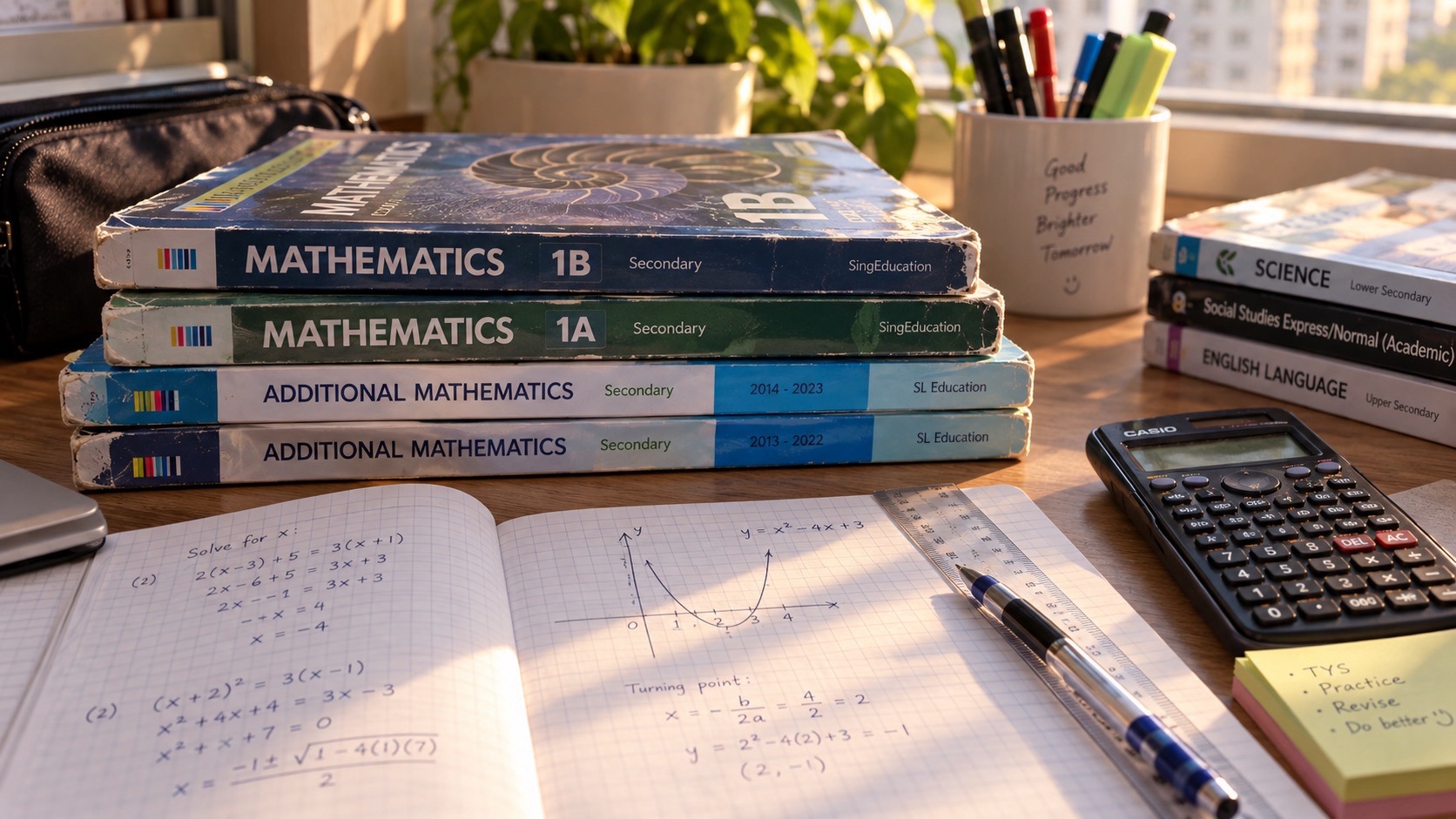
Quick answer. Parametric curves describe coordinates using a parameter; polar coordinates describe position using radius and direction. This guide explains the topic for Punggol families in the wider Singapore Mathematics education pathway, distinguishing current school syllabus requirements from optional advanced enrichment.
Every example is original. A learner should explain a method, identify its assumptions, verify a result and solve a changed question independently. This is not a guarantee of any PSLE, SEC, A-Level or university outcome.
Key facts
- Identify the mathematical statement and its domain.
- State what is assumed and what needs proving or estimating.
- Choose a diagram, table, equation or model.
- Check each transformation.
- Find a counterexample to an invalid universal claim.
- Use an unseen variation to test transfer.
Topic index
- 1. Parameters
- 2. Eliminating parameters
- 3. Restricted parameters
- 4. Parametric lines
- 5. Velocity components
- 6. Circle parametrisation
- 7. Tangent gradient
- 8. Polar conversion
- 9. Quadrants
- 10. Polar circles
- 11. Polar rays
- 12. Polar area
1. Parameters
Understand the principle. Parameters must be connected to its definition and conditions. Parametric curves describe coordinates using a parameter; polar coordinates describe position using radius and direction. A symbolic calculation can be correct yet irrelevant when the learner has chosen the wrong domain, parameter, reference population or assumption. At earlier school levels, concrete examples can prepare reasoning; the full formal treatment belongs to appropriate advanced courses.
Worked illustration. For x=3cos t and y=3sin t, squaring and adding gives x²+y²=9, a circle of radius three. Explain the meaning of every variable and why each transformation is valid. Where the example is statistical, distinguish the model’s assumptions from an observed fact; where it is a proof, distinguish logical deduction from numerical pattern spotting.
Wrong first step. Assuming sin²t+cos²t equals two instead of one. This misconception may recur in parameters when a student memorises the operation without identifying the statement it is meant to establish. Ask them to point to the exact step where the conclusion stopped following from the premises.
Changed independent task. For x=5cos t and y=5sin t, obtain x²+y²=25. Hide the original worked solution and ask the learner to reconstruct the argument, calculate, and verify the changed result. Use the actual course syllabus for further topic-specific practice.
Deeper check. Compare an example, a general statement and a counterexample. An example shows one instance; a proof establishes a claim under its assumptions; a counterexample refutes a universal claim. In statistics, a sample estimate is neither a proof about every individual nor a guarantee of future observations. These distinctions protect mathematical communication.
Parent observation. Record whether the learner could begin without a cue, define the mathematical objects, explain the method, detect a false conclusion and check a new problem after several days. A missing prerequisite needs targeted teaching rather than simply more timed worksheets.
2. Eliminating parameters
Understand the principle. Eliminating parameters must be connected to its definition and conditions. Parametric curves describe coordinates using a parameter; polar coordinates describe position using radius and direction. A symbolic calculation can be correct yet irrelevant when the learner has chosen the wrong domain, parameter, reference population or assumption. At earlier school levels, concrete examples can prepare reasoning; the full formal treatment belongs to appropriate advanced courses.
Worked illustration. For x=3cos t and y=3sin t, squaring and adding gives x²+y²=9, a circle of radius three. Explain the meaning of every variable and why each transformation is valid. Where the example is statistical, distinguish the model’s assumptions from an observed fact; where it is a proof, distinguish logical deduction from numerical pattern spotting.
Wrong first step. Assuming sin²t+cos²t equals two instead of one. This misconception may recur in eliminating parameters when a student memorises the operation without identifying the statement it is meant to establish. Ask them to point to the exact step where the conclusion stopped following from the premises.
Changed independent task. For x=5cos t and y=5sin t, obtain x²+y²=25. Hide the original worked solution and ask the learner to reconstruct the argument, calculate, and verify the changed result. Use the actual course syllabus for further topic-specific practice.
Deeper check. Compare an example, a general statement and a counterexample. An example shows one instance; a proof establishes a claim under its assumptions; a counterexample refutes a universal claim. In statistics, a sample estimate is neither a proof about every individual nor a guarantee of future observations. These distinctions protect mathematical communication.
Parent observation. Record whether the learner could begin without a cue, define the mathematical objects, explain the method, detect a false conclusion and check a new problem after several days. A missing prerequisite needs targeted teaching rather than simply more timed worksheets.
3. Restricted parameters
Understand the principle. Restricted parameters must be connected to its definition and conditions. Parametric curves describe coordinates using a parameter; polar coordinates describe position using radius and direction. A symbolic calculation can be correct yet irrelevant when the learner has chosen the wrong domain, parameter, reference population or assumption. At earlier school levels, concrete examples can prepare reasoning; the full formal treatment belongs to appropriate advanced courses.
Worked illustration. For x=3cos t and y=3sin t, squaring and adding gives x²+y²=9, a circle of radius three. Explain the meaning of every variable and why each transformation is valid. Where the example is statistical, distinguish the model’s assumptions from an observed fact; where it is a proof, distinguish logical deduction from numerical pattern spotting.
Wrong first step. Assuming sin²t+cos²t equals two instead of one. This misconception may recur in restricted parameters when a student memorises the operation without identifying the statement it is meant to establish. Ask them to point to the exact step where the conclusion stopped following from the premises.
Changed independent task. For x=5cos t and y=5sin t, obtain x²+y²=25. Hide the original worked solution and ask the learner to reconstruct the argument, calculate, and verify the changed result. Use the actual course syllabus for further topic-specific practice.
Deeper check. Compare an example, a general statement and a counterexample. An example shows one instance; a proof establishes a claim under its assumptions; a counterexample refutes a universal claim. In statistics, a sample estimate is neither a proof about every individual nor a guarantee of future observations. These distinctions protect mathematical communication.
Parent observation. Record whether the learner could begin without a cue, define the mathematical objects, explain the method, detect a false conclusion and check a new problem after several days. A missing prerequisite needs targeted teaching rather than simply more timed worksheets.
4. Parametric lines
Understand the principle. Parametric lines must be connected to its definition and conditions. Parametric curves describe coordinates using a parameter; polar coordinates describe position using radius and direction. A symbolic calculation can be correct yet irrelevant when the learner has chosen the wrong domain, parameter, reference population or assumption. At earlier school levels, concrete examples can prepare reasoning; the full formal treatment belongs to appropriate advanced courses.
Worked illustration. For x=3cos t and y=3sin t, squaring and adding gives x²+y²=9, a circle of radius three. Explain the meaning of every variable and why each transformation is valid. Where the example is statistical, distinguish the model’s assumptions from an observed fact; where it is a proof, distinguish logical deduction from numerical pattern spotting.
Wrong first step. Assuming sin²t+cos²t equals two instead of one. This misconception may recur in parametric lines when a student memorises the operation without identifying the statement it is meant to establish. Ask them to point to the exact step where the conclusion stopped following from the premises.
Changed independent task. For x=5cos t and y=5sin t, obtain x²+y²=25. Hide the original worked solution and ask the learner to reconstruct the argument, calculate, and verify the changed result. Use the actual course syllabus for further topic-specific practice.
Deeper check. Compare an example, a general statement and a counterexample. An example shows one instance; a proof establishes a claim under its assumptions; a counterexample refutes a universal claim. In statistics, a sample estimate is neither a proof about every individual nor a guarantee of future observations. These distinctions protect mathematical communication.
Parent observation. Record whether the learner could begin without a cue, define the mathematical objects, explain the method, detect a false conclusion and check a new problem after several days. A missing prerequisite needs targeted teaching rather than simply more timed worksheets.
5. Velocity components
Understand the principle. Velocity components must be connected to its definition and conditions. Parametric curves describe coordinates using a parameter; polar coordinates describe position using radius and direction. A symbolic calculation can be correct yet irrelevant when the learner has chosen the wrong domain, parameter, reference population or assumption. At earlier school levels, concrete examples can prepare reasoning; the full formal treatment belongs to appropriate advanced courses.
Worked illustration. For x=3cos t and y=3sin t, squaring and adding gives x²+y²=9, a circle of radius three. Explain the meaning of every variable and why each transformation is valid. Where the example is statistical, distinguish the model’s assumptions from an observed fact; where it is a proof, distinguish logical deduction from numerical pattern spotting.
Wrong first step. Assuming sin²t+cos²t equals two instead of one. This misconception may recur in velocity components when a student memorises the operation without identifying the statement it is meant to establish. Ask them to point to the exact step where the conclusion stopped following from the premises.
Changed independent task. For x=5cos t and y=5sin t, obtain x²+y²=25. Hide the original worked solution and ask the learner to reconstruct the argument, calculate, and verify the changed result. Use the actual course syllabus for further topic-specific practice.
Deeper check. Compare an example, a general statement and a counterexample. An example shows one instance; a proof establishes a claim under its assumptions; a counterexample refutes a universal claim. In statistics, a sample estimate is neither a proof about every individual nor a guarantee of future observations. These distinctions protect mathematical communication.
Parent observation. Record whether the learner could begin without a cue, define the mathematical objects, explain the method, detect a false conclusion and check a new problem after several days. A missing prerequisite needs targeted teaching rather than simply more timed worksheets.
6. Circle parametrisation
Understand the principle. Circle parametrisation must be connected to its definition and conditions. Parametric curves describe coordinates using a parameter; polar coordinates describe position using radius and direction. A symbolic calculation can be correct yet irrelevant when the learner has chosen the wrong domain, parameter, reference population or assumption. At earlier school levels, concrete examples can prepare reasoning; the full formal treatment belongs to appropriate advanced courses.
Worked illustration. For x=3cos t and y=3sin t, squaring and adding gives x²+y²=9, a circle of radius three. Explain the meaning of every variable and why each transformation is valid. Where the example is statistical, distinguish the model’s assumptions from an observed fact; where it is a proof, distinguish logical deduction from numerical pattern spotting.
Wrong first step. Assuming sin²t+cos²t equals two instead of one. This misconception may recur in circle parametrisation when a student memorises the operation without identifying the statement it is meant to establish. Ask them to point to the exact step where the conclusion stopped following from the premises.
Changed independent task. For x=5cos t and y=5sin t, obtain x²+y²=25. Hide the original worked solution and ask the learner to reconstruct the argument, calculate, and verify the changed result. Use the actual course syllabus for further topic-specific practice.
Deeper check. Compare an example, a general statement and a counterexample. An example shows one instance; a proof establishes a claim under its assumptions; a counterexample refutes a universal claim. In statistics, a sample estimate is neither a proof about every individual nor a guarantee of future observations. These distinctions protect mathematical communication.
Parent observation. Record whether the learner could begin without a cue, define the mathematical objects, explain the method, detect a false conclusion and check a new problem after several days. A missing prerequisite needs targeted teaching rather than simply more timed worksheets.
7. Tangent gradient
Understand the principle. Tangent gradient must be connected to its definition and conditions. Parametric curves describe coordinates using a parameter; polar coordinates describe position using radius and direction. A symbolic calculation can be correct yet irrelevant when the learner has chosen the wrong domain, parameter, reference population or assumption. At earlier school levels, concrete examples can prepare reasoning; the full formal treatment belongs to appropriate advanced courses.
Worked illustration. For x=3cos t and y=3sin t, squaring and adding gives x²+y²=9, a circle of radius three. Explain the meaning of every variable and why each transformation is valid. Where the example is statistical, distinguish the model’s assumptions from an observed fact; where it is a proof, distinguish logical deduction from numerical pattern spotting.
Wrong first step. Assuming sin²t+cos²t equals two instead of one. This misconception may recur in tangent gradient when a student memorises the operation without identifying the statement it is meant to establish. Ask them to point to the exact step where the conclusion stopped following from the premises.
Changed independent task. For x=5cos t and y=5sin t, obtain x²+y²=25. Hide the original worked solution and ask the learner to reconstruct the argument, calculate, and verify the changed result. Use the actual course syllabus for further topic-specific practice.
Deeper check. Compare an example, a general statement and a counterexample. An example shows one instance; a proof establishes a claim under its assumptions; a counterexample refutes a universal claim. In statistics, a sample estimate is neither a proof about every individual nor a guarantee of future observations. These distinctions protect mathematical communication.
Parent observation. Record whether the learner could begin without a cue, define the mathematical objects, explain the method, detect a false conclusion and check a new problem after several days. A missing prerequisite needs targeted teaching rather than simply more timed worksheets.
8. Polar conversion
Understand the principle. Polar conversion must be connected to its definition and conditions. Parametric curves describe coordinates using a parameter; polar coordinates describe position using radius and direction. A symbolic calculation can be correct yet irrelevant when the learner has chosen the wrong domain, parameter, reference population or assumption. At earlier school levels, concrete examples can prepare reasoning; the full formal treatment belongs to appropriate advanced courses.
Worked illustration. For x=3cos t and y=3sin t, squaring and adding gives x²+y²=9, a circle of radius three. Explain the meaning of every variable and why each transformation is valid. Where the example is statistical, distinguish the model’s assumptions from an observed fact; where it is a proof, distinguish logical deduction from numerical pattern spotting.
Wrong first step. Assuming sin²t+cos²t equals two instead of one. This misconception may recur in polar conversion when a student memorises the operation without identifying the statement it is meant to establish. Ask them to point to the exact step where the conclusion stopped following from the premises.
Changed independent task. For x=5cos t and y=5sin t, obtain x²+y²=25. Hide the original worked solution and ask the learner to reconstruct the argument, calculate, and verify the changed result. Use the actual course syllabus for further topic-specific practice.
Deeper check. Compare an example, a general statement and a counterexample. An example shows one instance; a proof establishes a claim under its assumptions; a counterexample refutes a universal claim. In statistics, a sample estimate is neither a proof about every individual nor a guarantee of future observations. These distinctions protect mathematical communication.
Parent observation. Record whether the learner could begin without a cue, define the mathematical objects, explain the method, detect a false conclusion and check a new problem after several days. A missing prerequisite needs targeted teaching rather than simply more timed worksheets.
9. Quadrants
Understand the principle. Quadrants must be connected to its definition and conditions. Parametric curves describe coordinates using a parameter; polar coordinates describe position using radius and direction. A symbolic calculation can be correct yet irrelevant when the learner has chosen the wrong domain, parameter, reference population or assumption. At earlier school levels, concrete examples can prepare reasoning; the full formal treatment belongs to appropriate advanced courses.
Worked illustration. For x=3cos t and y=3sin t, squaring and adding gives x²+y²=9, a circle of radius three. Explain the meaning of every variable and why each transformation is valid. Where the example is statistical, distinguish the model’s assumptions from an observed fact; where it is a proof, distinguish logical deduction from numerical pattern spotting.
Wrong first step. Assuming sin²t+cos²t equals two instead of one. This misconception may recur in quadrants when a student memorises the operation without identifying the statement it is meant to establish. Ask them to point to the exact step where the conclusion stopped following from the premises.
Changed independent task. For x=5cos t and y=5sin t, obtain x²+y²=25. Hide the original worked solution and ask the learner to reconstruct the argument, calculate, and verify the changed result. Use the actual course syllabus for further topic-specific practice.
Deeper check. Compare an example, a general statement and a counterexample. An example shows one instance; a proof establishes a claim under its assumptions; a counterexample refutes a universal claim. In statistics, a sample estimate is neither a proof about every individual nor a guarantee of future observations. These distinctions protect mathematical communication.
Parent observation. Record whether the learner could begin without a cue, define the mathematical objects, explain the method, detect a false conclusion and check a new problem after several days. A missing prerequisite needs targeted teaching rather than simply more timed worksheets.
10. Polar circles
Understand the principle. Polar circles must be connected to its definition and conditions. Parametric curves describe coordinates using a parameter; polar coordinates describe position using radius and direction. A symbolic calculation can be correct yet irrelevant when the learner has chosen the wrong domain, parameter, reference population or assumption. At earlier school levels, concrete examples can prepare reasoning; the full formal treatment belongs to appropriate advanced courses.
Worked illustration. For x=3cos t and y=3sin t, squaring and adding gives x²+y²=9, a circle of radius three. Explain the meaning of every variable and why each transformation is valid. Where the example is statistical, distinguish the model’s assumptions from an observed fact; where it is a proof, distinguish logical deduction from numerical pattern spotting.
Wrong first step. Assuming sin²t+cos²t equals two instead of one. This misconception may recur in polar circles when a student memorises the operation without identifying the statement it is meant to establish. Ask them to point to the exact step where the conclusion stopped following from the premises.
Changed independent task. For x=5cos t and y=5sin t, obtain x²+y²=25. Hide the original worked solution and ask the learner to reconstruct the argument, calculate, and verify the changed result. Use the actual course syllabus for further topic-specific practice.
Deeper check. Compare an example, a general statement and a counterexample. An example shows one instance; a proof establishes a claim under its assumptions; a counterexample refutes a universal claim. In statistics, a sample estimate is neither a proof about every individual nor a guarantee of future observations. These distinctions protect mathematical communication.
Parent observation. Record whether the learner could begin without a cue, define the mathematical objects, explain the method, detect a false conclusion and check a new problem after several days. A missing prerequisite needs targeted teaching rather than simply more timed worksheets.
11. Polar rays
Understand the principle. Polar rays must be connected to its definition and conditions. Parametric curves describe coordinates using a parameter; polar coordinates describe position using radius and direction. A symbolic calculation can be correct yet irrelevant when the learner has chosen the wrong domain, parameter, reference population or assumption. At earlier school levels, concrete examples can prepare reasoning; the full formal treatment belongs to appropriate advanced courses.
Worked illustration. For x=3cos t and y=3sin t, squaring and adding gives x²+y²=9, a circle of radius three. Explain the meaning of every variable and why each transformation is valid. Where the example is statistical, distinguish the model’s assumptions from an observed fact; where it is a proof, distinguish logical deduction from numerical pattern spotting.
Wrong first step. Assuming sin²t+cos²t equals two instead of one. This misconception may recur in polar rays when a student memorises the operation without identifying the statement it is meant to establish. Ask them to point to the exact step where the conclusion stopped following from the premises.
Changed independent task. For x=5cos t and y=5sin t, obtain x²+y²=25. Hide the original worked solution and ask the learner to reconstruct the argument, calculate, and verify the changed result. Use the actual course syllabus for further topic-specific practice.
Deeper check. Compare an example, a general statement and a counterexample. An example shows one instance; a proof establishes a claim under its assumptions; a counterexample refutes a universal claim. In statistics, a sample estimate is neither a proof about every individual nor a guarantee of future observations. These distinctions protect mathematical communication.
Parent observation. Record whether the learner could begin without a cue, define the mathematical objects, explain the method, detect a false conclusion and check a new problem after several days. A missing prerequisite needs targeted teaching rather than simply more timed worksheets.
12. Polar area
Understand the principle. Polar area must be connected to its definition and conditions. Parametric curves describe coordinates using a parameter; polar coordinates describe position using radius and direction. A symbolic calculation can be correct yet irrelevant when the learner has chosen the wrong domain, parameter, reference population or assumption. At earlier school levels, concrete examples can prepare reasoning; the full formal treatment belongs to appropriate advanced courses.
Worked illustration. For x=3cos t and y=3sin t, squaring and adding gives x²+y²=9, a circle of radius three. Explain the meaning of every variable and why each transformation is valid. Where the example is statistical, distinguish the model’s assumptions from an observed fact; where it is a proof, distinguish logical deduction from numerical pattern spotting.
Wrong first step. Assuming sin²t+cos²t equals two instead of one. This misconception may recur in polar area when a student memorises the operation without identifying the statement it is meant to establish. Ask them to point to the exact step where the conclusion stopped following from the premises.
Changed independent task. For x=5cos t and y=5sin t, obtain x²+y²=25. Hide the original worked solution and ask the learner to reconstruct the argument, calculate, and verify the changed result. Use the actual course syllabus for further topic-specific practice.
Deeper check. Compare an example, a general statement and a counterexample. An example shows one instance; a proof establishes a claim under its assumptions; a counterexample refutes a universal claim. In statistics, a sample estimate is neither a proof about every individual nor a guarantee of future observations. These distinctions protect mathematical communication.
Parent observation. Record whether the learner could begin without a cue, define the mathematical objects, explain the method, detect a false conclusion and check a new problem after several days. A missing prerequisite needs targeted teaching rather than simply more timed worksheets.
Four independent reasoning checks
Check 1. For x=3cos t and y=3sin t, squaring and adding gives x²+y²=9, a circle of radius three. Explain why the reasoning is valid or invalid, identify a restriction, and create a second example that changes one assumption. Discuss how the conclusion changes and whether the claim remains supported.
Check 2. Assuming sin²t+cos²t equals two instead of one. Explain why the reasoning is valid or invalid, identify a restriction, and create a second example that changes one assumption. Discuss how the conclusion changes and whether the claim remains supported.
Check 3. For x=5cos t and y=5sin t, obtain x²+y²=25. Explain why the reasoning is valid or invalid, identify a restriction, and create a second example that changes one assumption. Discuss how the conclusion changes and whether the claim remains supported.
Check 4. For x=3cos t and y=3sin t, squaring and adding gives x²+y²=9, a circle of radius three. Explain why the reasoning is valid or invalid, identify a restriction, and create a second example that changes one assumption. Discuss how the conclusion changes and whether the claim remains supported.
Six-week learning sequence
Week 1. Confirm the current course and diagnose prerequisites. Keep the workload proportionate to the learner’s school commitments.
Week 2. Teach the definition with a complete worked example. Keep the workload proportionate to the learner’s school commitments.
Week 3. Compare a correct method with a plausible incorrect one. Keep the workload proportionate to the learner’s school commitments.
Week 4. Revisit after a delay with altered numbers and conditions. Keep the workload proportionate to the learner’s school commitments.
Week 5. Mix the concept with two previously secure topics. Keep the workload proportionate to the learner’s school commitments.
Week 6. Assess an unseen independent solution and agree on the next learning goal. Keep the workload proportionate to the learner’s school commitments.
Frequently asked questions
Is this compulsory for every Primary pupil? No. Formal advanced treatment depends on the actual school or university course.
Is Punggol governed by a separate Maths syllabus? No. Relevant national MOE and SEAB requirements apply.
Can examples prove every case? No. Finite examples alone cannot prove an unrestricted universal statement.
How should an incorrect answer be repaired? Find the first invalid step and practise a changed independent question.
Does a mathematical model guarantee reality? No. Its conclusions depend on data, assumptions and conditions.
Can this guide guarantee a grade? No. Examination and admission outcomes cannot be guaranteed.


