
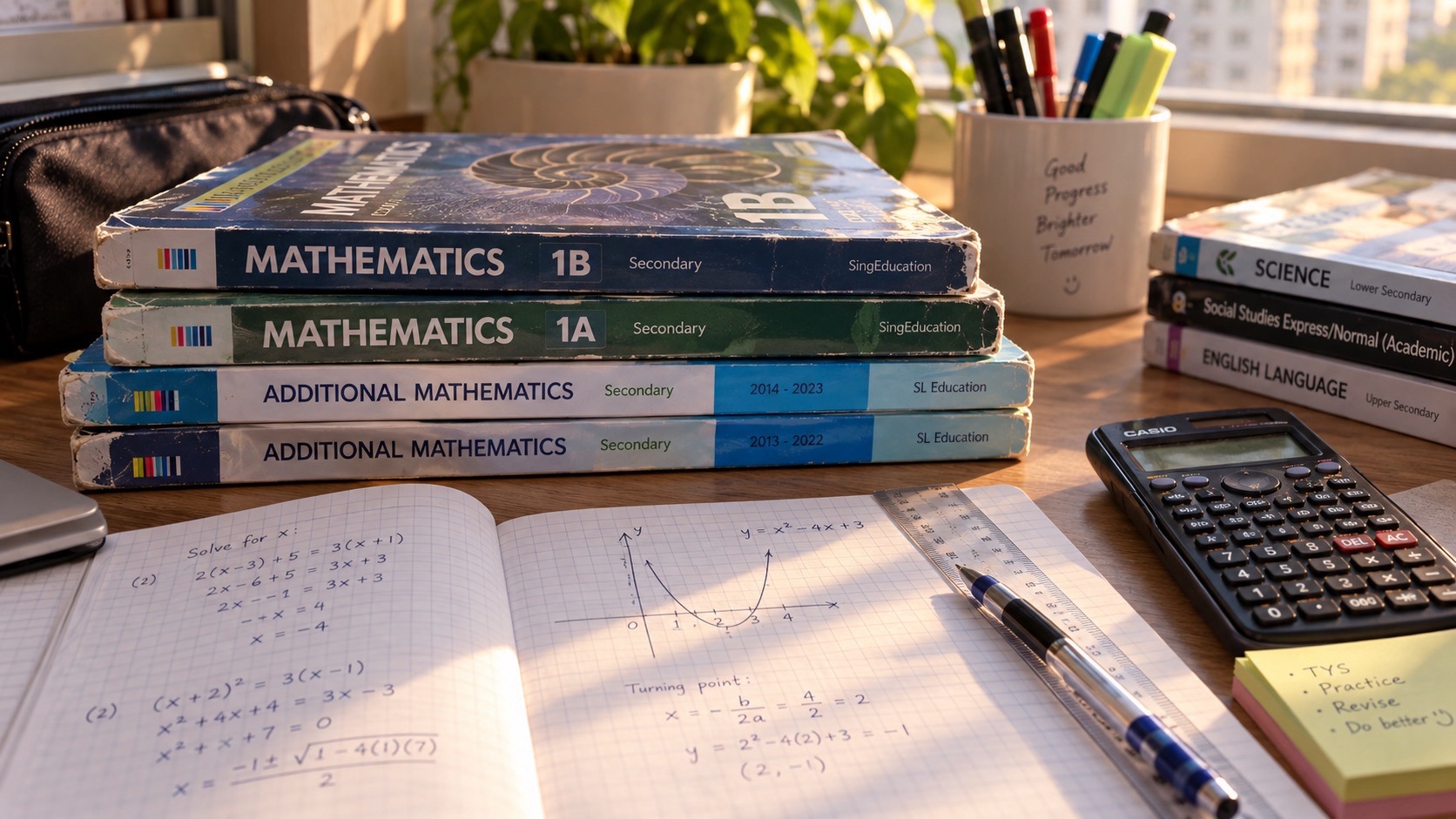
Quick answer. Numerical Methods, Approximation and Error Analysis develops mathematical reasoning beyond routine arithmetic. Punggol learners should use the applicable MOE, SEAB or higher-education syllabus, because these ideas appear at different levels and not all are compulsory in Primary school. This guide explains the concepts with original worked calculations, misconceptions, checks and an age-appropriate learning progression.
The important habit is to identify what each quantity means and what assumptions make the model valid. A solution can contain correct arithmetic but still answer the wrong question when the reference set, unit, domain or condition is mistaken. Understanding is demonstrated by explaining the result and solving a changed example independently after a delay.
Reviewed October 2026. All illustrative data and mathematical tasks are newly constructed. Local modelling examples are hypothetical and do not assert actual Punggol travel times, rainfall, transport schedules or infrastructure performance. National examination coverage follows current official syllabuses.
Key facts for quick reading
- Define the objects, variables and unknowns.
- Identify units, sample space, domain or other conditions.
- Represent the relationship through a diagram, table or equation.
- Calculate with justified transformations.
- Check results using substitution, estimation or a second method.
- Distinguish an illustrative model from verified local observations.
- Retest changed questions after a gap without hints.
Find the mathematical concept
- 1. Exact versus approximate
- 2. Decimal rounding
- 3. Significant figures
- 4. Absolute error
- 5. Relative error
- 6. Bounds
- 7. Estimation
- 8. Bisection
- 9. Iteration
- 10. Newton method
- 11. Convergence
- 12. Stopping criteria
- 13. Floating-point representation
- 14. Error propagation
- 15. Numerical integration
- 16. Checking results
1. Exact versus approximate
Concept and definition. Exact versus approximate requires the student to understand the quantities or mathematical objects before choosing a formula. A table, labelled picture, graph or symbolic expression can show different parts of the same relationship. State which conditions must hold and what the output represents. At advanced levels, an explicit counterexample can show why a proposed rule is too broad.
Original worked example. If the true length is 10 cm and an estimate is 9.8 cm, absolute error is |9.8−10|=0.2 cm. The solution identifies the relevant quantities and applies a valid calculation. It should be read together with its conditions and not copied as an automatic procedure for every exact versus approximate question.
Common misconception. Reporting a signed difference as the magnitude of error. An incorrect first step may reveal confusion about a denominator, set membership, measurement unit, sign or model assumption. Identify the earliest invalid reasoning step before repeating arithmetic drills.
Independent retest. If true value 20 and estimate 20.3, absolute error 0.3. Give this after a short delay without the earlier solution in view. Then select a level-appropriate exact versus approximate problem with different numbers, conditions or a changed unknown, and ask for a mathematical explanation.
Foundation and transfer. Consider 3 equal groups containing 2 objects each, total 6. Adding one whole group changes the total to 8, while rearranging existing objects leaves it unchanged. This simple contrast between an invariant and a changed quantity supports later understanding of set operations, algorithms, error models and real-world modelling. Ask which features are invariant in the present problem.
Teaching check. Record whether the learner could identify the unknown, choose the method, calculate, justify the conditions and check without a hint. If the method was wrong, rebuild the concept. If only a copying slip occurred, teach an appropriate verification habit. Retain one representative first attempt and a dated changed attempt.
2. Decimal rounding
Concept and definition. Decimal rounding requires the student to understand the quantities or mathematical objects before choosing a formula. A table, labelled picture, graph or symbolic expression can show different parts of the same relationship. State which conditions must hold and what the output represents. At advanced levels, an explicit counterexample can show why a proposed rule is too broad.
Original worked example. For true value ten and estimate 9.8, relative error is 0.2/10=0.02, or 2%. The solution identifies the relevant quantities and applies a valid calculation. It should be read together with its conditions and not copied as an automatic procedure for every decimal rounding question.
Common misconception. Dividing error by the estimate without specifying a different definition. An incorrect first step may reveal confusion about a denominator, set membership, measurement unit, sign or model assumption. Identify the earliest invalid reasoning step before repeating arithmetic drills.
Independent retest. True 50, estimate 49 gives relative error 2%. Give this after a short delay without the earlier solution in view. Then select a level-appropriate decimal rounding problem with different numbers, conditions or a changed unknown, and ask for a mathematical explanation.
Foundation and transfer. Consider 4 equal groups containing 3 objects each, total 12. Adding one whole group changes the total to 15, while rearranging existing objects leaves it unchanged. This simple contrast between an invariant and a changed quantity supports later understanding of set operations, algorithms, error models and real-world modelling. Ask which features are invariant in the present problem.
Teaching check. Record whether the learner could identify the unknown, choose the method, calculate, justify the conditions and check without a hint. If the method was wrong, rebuild the concept. If only a copying slip occurred, teach an appropriate verification habit. Retain one representative first attempt and a dated changed attempt.
3. Significant figures
Concept and definition. Significant figures requires the student to understand the quantities or mathematical objects before choosing a formula. A table, labelled picture, graph or symbolic expression can show different parts of the same relationship. State which conditions must hold and what the output represents. At advanced levels, an explicit counterexample can show why a proposed rule is too broad.
Original worked example. For f(x)=x²−2, f(1)=−1 and f(2)=2, so a root lies between one and two. Midpoint 1.5 has f=0.25, narrowing the bracket to [1,1.5]. The solution identifies the relevant quantities and applies a valid calculation. It should be read together with its conditions and not copied as an automatic procedure for every significant figures question.
Common misconception. Choosing a new interval without checking sign changes. An incorrect first step may reveal confusion about a denominator, set membership, measurement unit, sign or model assumption. Identify the earliest invalid reasoning step before repeating arithmetic drills.
Independent retest. Next midpoint 1.25 has f=−0.4375, giving bracket [1.25,1.5]. Give this after a short delay without the earlier solution in view. Then select a level-appropriate significant figures problem with different numbers, conditions or a changed unknown, and ask for a mathematical explanation.
Foundation and transfer. Consider 5 equal groups containing 4 objects each, total 20. Adding one whole group changes the total to 24, while rearranging existing objects leaves it unchanged. This simple contrast between an invariant and a changed quantity supports later understanding of set operations, algorithms, error models and real-world modelling. Ask which features are invariant in the present problem.
Teaching check. Record whether the learner could identify the unknown, choose the method, calculate, justify the conditions and check without a hint. If the method was wrong, rebuild the concept. If only a copying slip occurred, teach an appropriate verification habit. Retain one representative first attempt and a dated changed attempt.
4. Absolute error
Concept and definition. Absolute error requires the student to understand the quantities or mathematical objects before choosing a formula. A table, labelled picture, graph or symbolic expression can show different parts of the same relationship. State which conditions must hold and what the output represents. At advanced levels, an explicit counterexample can show why a proposed rule is too broad.
Original worked example. Round 0.004567 to two significant figures: 0.0046. Leading zeros do not count as significant digits. The solution identifies the relevant quantities and applies a valid calculation. It should be read together with its conditions and not copied as an automatic procedure for every absolute error question.
Common misconception. Counting the zeros before four as significant. An incorrect first step may reveal confusion about a denominator, set membership, measurement unit, sign or model assumption. Identify the earliest invalid reasoning step before repeating arithmetic drills.
Independent retest. Round 12345 to three significant figures: 12300. Give this after a short delay without the earlier solution in view. Then select a level-appropriate absolute error problem with different numbers, conditions or a changed unknown, and ask for a mathematical explanation.
Foundation and transfer. Consider 6 equal groups containing 5 objects each, total 30. Adding one whole group changes the total to 35, while rearranging existing objects leaves it unchanged. This simple contrast between an invariant and a changed quantity supports later understanding of set operations, algorithms, error models and real-world modelling. Ask which features are invariant in the present problem.
Teaching check. Record whether the learner could identify the unknown, choose the method, calculate, justify the conditions and check without a hint. If the method was wrong, rebuild the concept. If only a copying slip occurred, teach an appropriate verification habit. Retain one representative first attempt and a dated changed attempt.
5. Relative error
Concept and definition. Relative error requires the student to understand the quantities or mathematical objects before choosing a formula. A table, labelled picture, graph or symbolic expression can show different parts of the same relationship. State which conditions must hold and what the output represents. At advanced levels, an explicit counterexample can show why a proposed rule is too broad.
Original worked example. If the true length is 10 cm and an estimate is 9.8 cm, absolute error is |9.8−10|=0.2 cm. The solution identifies the relevant quantities and applies a valid calculation. It should be read together with its conditions and not copied as an automatic procedure for every relative error question.
Common misconception. Reporting a signed difference as the magnitude of error. An incorrect first step may reveal confusion about a denominator, set membership, measurement unit, sign or model assumption. Identify the earliest invalid reasoning step before repeating arithmetic drills.
Independent retest. If true value 20 and estimate 20.3, absolute error 0.3. Give this after a short delay without the earlier solution in view. Then select a level-appropriate relative error problem with different numbers, conditions or a changed unknown, and ask for a mathematical explanation.
Foundation and transfer. Consider 7 equal groups containing 6 objects each, total 42. Adding one whole group changes the total to 48, while rearranging existing objects leaves it unchanged. This simple contrast between an invariant and a changed quantity supports later understanding of set operations, algorithms, error models and real-world modelling. Ask which features are invariant in the present problem.
Teaching check. Record whether the learner could identify the unknown, choose the method, calculate, justify the conditions and check without a hint. If the method was wrong, rebuild the concept. If only a copying slip occurred, teach an appropriate verification habit. Retain one representative first attempt and a dated changed attempt.
6. Bounds
Concept and definition. Bounds requires the student to understand the quantities or mathematical objects before choosing a formula. A table, labelled picture, graph or symbolic expression can show different parts of the same relationship. State which conditions must hold and what the output represents. At advanced levels, an explicit counterexample can show why a proposed rule is too broad.
Original worked example. For true value ten and estimate 9.8, relative error is 0.2/10=0.02, or 2%. The solution identifies the relevant quantities and applies a valid calculation. It should be read together with its conditions and not copied as an automatic procedure for every bounds question.
Common misconception. Dividing error by the estimate without specifying a different definition. An incorrect first step may reveal confusion about a denominator, set membership, measurement unit, sign or model assumption. Identify the earliest invalid reasoning step before repeating arithmetic drills.
Independent retest. True 50, estimate 49 gives relative error 2%. Give this after a short delay without the earlier solution in view. Then select a level-appropriate bounds problem with different numbers, conditions or a changed unknown, and ask for a mathematical explanation.
Foundation and transfer. Consider 8 equal groups containing 2 objects each, total 16. Adding one whole group changes the total to 18, while rearranging existing objects leaves it unchanged. This simple contrast between an invariant and a changed quantity supports later understanding of set operations, algorithms, error models and real-world modelling. Ask which features are invariant in the present problem.
Teaching check. Record whether the learner could identify the unknown, choose the method, calculate, justify the conditions and check without a hint. If the method was wrong, rebuild the concept. If only a copying slip occurred, teach an appropriate verification habit. Retain one representative first attempt and a dated changed attempt.
7. Estimation
Concept and definition. Estimation requires the student to understand the quantities or mathematical objects before choosing a formula. A table, labelled picture, graph or symbolic expression can show different parts of the same relationship. State which conditions must hold and what the output represents. At advanced levels, an explicit counterexample can show why a proposed rule is too broad.
Original worked example. For f(x)=x²−2, f(1)=−1 and f(2)=2, so a root lies between one and two. Midpoint 1.5 has f=0.25, narrowing the bracket to [1,1.5]. The solution identifies the relevant quantities and applies a valid calculation. It should be read together with its conditions and not copied as an automatic procedure for every estimation question.
Common misconception. Choosing a new interval without checking sign changes. An incorrect first step may reveal confusion about a denominator, set membership, measurement unit, sign or model assumption. Identify the earliest invalid reasoning step before repeating arithmetic drills.
Independent retest. Next midpoint 1.25 has f=−0.4375, giving bracket [1.25,1.5]. Give this after a short delay without the earlier solution in view. Then select a level-appropriate estimation problem with different numbers, conditions or a changed unknown, and ask for a mathematical explanation.
Foundation and transfer. Consider 9 equal groups containing 3 objects each, total 27. Adding one whole group changes the total to 30, while rearranging existing objects leaves it unchanged. This simple contrast between an invariant and a changed quantity supports later understanding of set operations, algorithms, error models and real-world modelling. Ask which features are invariant in the present problem.
Teaching check. Record whether the learner could identify the unknown, choose the method, calculate, justify the conditions and check without a hint. If the method was wrong, rebuild the concept. If only a copying slip occurred, teach an appropriate verification habit. Retain one representative first attempt and a dated changed attempt.
8. Bisection
Concept and definition. Bisection requires the student to understand the quantities or mathematical objects before choosing a formula. A table, labelled picture, graph or symbolic expression can show different parts of the same relationship. State which conditions must hold and what the output represents. At advanced levels, an explicit counterexample can show why a proposed rule is too broad.
Original worked example. Round 0.004567 to two significant figures: 0.0046. Leading zeros do not count as significant digits. The solution identifies the relevant quantities and applies a valid calculation. It should be read together with its conditions and not copied as an automatic procedure for every bisection question.
Common misconception. Counting the zeros before four as significant. An incorrect first step may reveal confusion about a denominator, set membership, measurement unit, sign or model assumption. Identify the earliest invalid reasoning step before repeating arithmetic drills.
Independent retest. Round 12345 to three significant figures: 12300. Give this after a short delay without the earlier solution in view. Then select a level-appropriate bisection problem with different numbers, conditions or a changed unknown, and ask for a mathematical explanation.
Foundation and transfer. Consider 10 equal groups containing 4 objects each, total 40. Adding one whole group changes the total to 44, while rearranging existing objects leaves it unchanged. This simple contrast between an invariant and a changed quantity supports later understanding of set operations, algorithms, error models and real-world modelling. Ask which features are invariant in the present problem.
Teaching check. Record whether the learner could identify the unknown, choose the method, calculate, justify the conditions and check without a hint. If the method was wrong, rebuild the concept. If only a copying slip occurred, teach an appropriate verification habit. Retain one representative first attempt and a dated changed attempt.
9. Iteration
Concept and definition. Iteration requires the student to understand the quantities or mathematical objects before choosing a formula. A table, labelled picture, graph or symbolic expression can show different parts of the same relationship. State which conditions must hold and what the output represents. At advanced levels, an explicit counterexample can show why a proposed rule is too broad.
Original worked example. If the true length is 10 cm and an estimate is 9.8 cm, absolute error is |9.8−10|=0.2 cm. The solution identifies the relevant quantities and applies a valid calculation. It should be read together with its conditions and not copied as an automatic procedure for every iteration question.
Common misconception. Reporting a signed difference as the magnitude of error. An incorrect first step may reveal confusion about a denominator, set membership, measurement unit, sign or model assumption. Identify the earliest invalid reasoning step before repeating arithmetic drills.
Independent retest. If true value 20 and estimate 20.3, absolute error 0.3. Give this after a short delay without the earlier solution in view. Then select a level-appropriate iteration problem with different numbers, conditions or a changed unknown, and ask for a mathematical explanation.
Foundation and transfer. Consider 11 equal groups containing 5 objects each, total 55. Adding one whole group changes the total to 60, while rearranging existing objects leaves it unchanged. This simple contrast between an invariant and a changed quantity supports later understanding of set operations, algorithms, error models and real-world modelling. Ask which features are invariant in the present problem.
Teaching check. Record whether the learner could identify the unknown, choose the method, calculate, justify the conditions and check without a hint. If the method was wrong, rebuild the concept. If only a copying slip occurred, teach an appropriate verification habit. Retain one representative first attempt and a dated changed attempt.
10. Newton method
Concept and definition. Newton method requires the student to understand the quantities or mathematical objects before choosing a formula. A table, labelled picture, graph or symbolic expression can show different parts of the same relationship. State which conditions must hold and what the output represents. At advanced levels, an explicit counterexample can show why a proposed rule is too broad.
Original worked example. For true value ten and estimate 9.8, relative error is 0.2/10=0.02, or 2%. The solution identifies the relevant quantities and applies a valid calculation. It should be read together with its conditions and not copied as an automatic procedure for every newton method question.
Common misconception. Dividing error by the estimate without specifying a different definition. An incorrect first step may reveal confusion about a denominator, set membership, measurement unit, sign or model assumption. Identify the earliest invalid reasoning step before repeating arithmetic drills.
Independent retest. True 50, estimate 49 gives relative error 2%. Give this after a short delay without the earlier solution in view. Then select a level-appropriate newton method problem with different numbers, conditions or a changed unknown, and ask for a mathematical explanation.
Foundation and transfer. Consider 12 equal groups containing 6 objects each, total 72. Adding one whole group changes the total to 78, while rearranging existing objects leaves it unchanged. This simple contrast between an invariant and a changed quantity supports later understanding of set operations, algorithms, error models and real-world modelling. Ask which features are invariant in the present problem.
Teaching check. Record whether the learner could identify the unknown, choose the method, calculate, justify the conditions and check without a hint. If the method was wrong, rebuild the concept. If only a copying slip occurred, teach an appropriate verification habit. Retain one representative first attempt and a dated changed attempt.
11. Convergence
Concept and definition. Convergence requires the student to understand the quantities or mathematical objects before choosing a formula. A table, labelled picture, graph or symbolic expression can show different parts of the same relationship. State which conditions must hold and what the output represents. At advanced levels, an explicit counterexample can show why a proposed rule is too broad.
Original worked example. For f(x)=x²−2, f(1)=−1 and f(2)=2, so a root lies between one and two. Midpoint 1.5 has f=0.25, narrowing the bracket to [1,1.5]. The solution identifies the relevant quantities and applies a valid calculation. It should be read together with its conditions and not copied as an automatic procedure for every convergence question.
Common misconception. Choosing a new interval without checking sign changes. An incorrect first step may reveal confusion about a denominator, set membership, measurement unit, sign or model assumption. Identify the earliest invalid reasoning step before repeating arithmetic drills.
Independent retest. Next midpoint 1.25 has f=−0.4375, giving bracket [1.25,1.5]. Give this after a short delay without the earlier solution in view. Then select a level-appropriate convergence problem with different numbers, conditions or a changed unknown, and ask for a mathematical explanation.
Foundation and transfer. Consider 13 equal groups containing 2 objects each, total 26. Adding one whole group changes the total to 28, while rearranging existing objects leaves it unchanged. This simple contrast between an invariant and a changed quantity supports later understanding of set operations, algorithms, error models and real-world modelling. Ask which features are invariant in the present problem.
Teaching check. Record whether the learner could identify the unknown, choose the method, calculate, justify the conditions and check without a hint. If the method was wrong, rebuild the concept. If only a copying slip occurred, teach an appropriate verification habit. Retain one representative first attempt and a dated changed attempt.
12. Stopping criteria
Concept and definition. Stopping criteria requires the student to understand the quantities or mathematical objects before choosing a formula. A table, labelled picture, graph or symbolic expression can show different parts of the same relationship. State which conditions must hold and what the output represents. At advanced levels, an explicit counterexample can show why a proposed rule is too broad.
Original worked example. Round 0.004567 to two significant figures: 0.0046. Leading zeros do not count as significant digits. The solution identifies the relevant quantities and applies a valid calculation. It should be read together with its conditions and not copied as an automatic procedure for every stopping criteria question.
Common misconception. Counting the zeros before four as significant. An incorrect first step may reveal confusion about a denominator, set membership, measurement unit, sign or model assumption. Identify the earliest invalid reasoning step before repeating arithmetic drills.
Independent retest. Round 12345 to three significant figures: 12300. Give this after a short delay without the earlier solution in view. Then select a level-appropriate stopping criteria problem with different numbers, conditions or a changed unknown, and ask for a mathematical explanation.
Foundation and transfer. Consider 14 equal groups containing 3 objects each, total 42. Adding one whole group changes the total to 45, while rearranging existing objects leaves it unchanged. This simple contrast between an invariant and a changed quantity supports later understanding of set operations, algorithms, error models and real-world modelling. Ask which features are invariant in the present problem.
Teaching check. Record whether the learner could identify the unknown, choose the method, calculate, justify the conditions and check without a hint. If the method was wrong, rebuild the concept. If only a copying slip occurred, teach an appropriate verification habit. Retain one representative first attempt and a dated changed attempt.
13. Floating-point representation
Concept and definition. Floating-point representation requires the student to understand the quantities or mathematical objects before choosing a formula. A table, labelled picture, graph or symbolic expression can show different parts of the same relationship. State which conditions must hold and what the output represents. At advanced levels, an explicit counterexample can show why a proposed rule is too broad.
Original worked example. If the true length is 10 cm and an estimate is 9.8 cm, absolute error is |9.8−10|=0.2 cm. The solution identifies the relevant quantities and applies a valid calculation. It should be read together with its conditions and not copied as an automatic procedure for every floating-point representation question.
Common misconception. Reporting a signed difference as the magnitude of error. An incorrect first step may reveal confusion about a denominator, set membership, measurement unit, sign or model assumption. Identify the earliest invalid reasoning step before repeating arithmetic drills.
Independent retest. If true value 20 and estimate 20.3, absolute error 0.3. Give this after a short delay without the earlier solution in view. Then select a level-appropriate floating-point representation problem with different numbers, conditions or a changed unknown, and ask for a mathematical explanation.
Foundation and transfer. Consider 15 equal groups containing 4 objects each, total 60. Adding one whole group changes the total to 64, while rearranging existing objects leaves it unchanged. This simple contrast between an invariant and a changed quantity supports later understanding of set operations, algorithms, error models and real-world modelling. Ask which features are invariant in the present problem.
Teaching check. Record whether the learner could identify the unknown, choose the method, calculate, justify the conditions and check without a hint. If the method was wrong, rebuild the concept. If only a copying slip occurred, teach an appropriate verification habit. Retain one representative first attempt and a dated changed attempt.
14. Error propagation
Concept and definition. Error propagation requires the student to understand the quantities or mathematical objects before choosing a formula. A table, labelled picture, graph or symbolic expression can show different parts of the same relationship. State which conditions must hold and what the output represents. At advanced levels, an explicit counterexample can show why a proposed rule is too broad.
Original worked example. For true value ten and estimate 9.8, relative error is 0.2/10=0.02, or 2%. The solution identifies the relevant quantities and applies a valid calculation. It should be read together with its conditions and not copied as an automatic procedure for every error propagation question.
Common misconception. Dividing error by the estimate without specifying a different definition. An incorrect first step may reveal confusion about a denominator, set membership, measurement unit, sign or model assumption. Identify the earliest invalid reasoning step before repeating arithmetic drills.
Independent retest. True 50, estimate 49 gives relative error 2%. Give this after a short delay without the earlier solution in view. Then select a level-appropriate error propagation problem with different numbers, conditions or a changed unknown, and ask for a mathematical explanation.
Foundation and transfer. Consider 16 equal groups containing 5 objects each, total 80. Adding one whole group changes the total to 85, while rearranging existing objects leaves it unchanged. This simple contrast between an invariant and a changed quantity supports later understanding of set operations, algorithms, error models and real-world modelling. Ask which features are invariant in the present problem.
Teaching check. Record whether the learner could identify the unknown, choose the method, calculate, justify the conditions and check without a hint. If the method was wrong, rebuild the concept. If only a copying slip occurred, teach an appropriate verification habit. Retain one representative first attempt and a dated changed attempt.
15. Numerical integration
Concept and definition. Numerical integration requires the student to understand the quantities or mathematical objects before choosing a formula. A table, labelled picture, graph or symbolic expression can show different parts of the same relationship. State which conditions must hold and what the output represents. At advanced levels, an explicit counterexample can show why a proposed rule is too broad.
Original worked example. For f(x)=x²−2, f(1)=−1 and f(2)=2, so a root lies between one and two. Midpoint 1.5 has f=0.25, narrowing the bracket to [1,1.5]. The solution identifies the relevant quantities and applies a valid calculation. It should be read together with its conditions and not copied as an automatic procedure for every numerical integration question.
Common misconception. Choosing a new interval without checking sign changes. An incorrect first step may reveal confusion about a denominator, set membership, measurement unit, sign or model assumption. Identify the earliest invalid reasoning step before repeating arithmetic drills.
Independent retest. Next midpoint 1.25 has f=−0.4375, giving bracket [1.25,1.5]. Give this after a short delay without the earlier solution in view. Then select a level-appropriate numerical integration problem with different numbers, conditions or a changed unknown, and ask for a mathematical explanation.
Foundation and transfer. Consider 17 equal groups containing 6 objects each, total 102. Adding one whole group changes the total to 108, while rearranging existing objects leaves it unchanged. This simple contrast between an invariant and a changed quantity supports later understanding of set operations, algorithms, error models and real-world modelling. Ask which features are invariant in the present problem.
Teaching check. Record whether the learner could identify the unknown, choose the method, calculate, justify the conditions and check without a hint. If the method was wrong, rebuild the concept. If only a copying slip occurred, teach an appropriate verification habit. Retain one representative first attempt and a dated changed attempt.
16. Checking results
Concept and definition. Checking results requires the student to understand the quantities or mathematical objects before choosing a formula. A table, labelled picture, graph or symbolic expression can show different parts of the same relationship. State which conditions must hold and what the output represents. At advanced levels, an explicit counterexample can show why a proposed rule is too broad.
Original worked example. Round 0.004567 to two significant figures: 0.0046. Leading zeros do not count as significant digits. The solution identifies the relevant quantities and applies a valid calculation. It should be read together with its conditions and not copied as an automatic procedure for every checking results question.
Common misconception. Counting the zeros before four as significant. An incorrect first step may reveal confusion about a denominator, set membership, measurement unit, sign or model assumption. Identify the earliest invalid reasoning step before repeating arithmetic drills.
Independent retest. Round 12345 to three significant figures: 12300. Give this after a short delay without the earlier solution in view. Then select a level-appropriate checking results problem with different numbers, conditions or a changed unknown, and ask for a mathematical explanation.
Foundation and transfer. Consider 18 equal groups containing 2 objects each, total 36. Adding one whole group changes the total to 38, while rearranging existing objects leaves it unchanged. This simple contrast between an invariant and a changed quantity supports later understanding of set operations, algorithms, error models and real-world modelling. Ask which features are invariant in the present problem.
Teaching check. Record whether the learner could identify the unknown, choose the method, calculate, justify the conditions and check without a hint. If the method was wrong, rebuild the concept. If only a copying slip occurred, teach an appropriate verification habit. Retain one representative first attempt and a dated changed attempt.
Four complete worked mathematical clinics
Absolute error
Worked explanation. If the true length is 10 cm and an estimate is 9.8 cm, absolute error is |9.8−10|=0.2 cm.
Incorrect approach. Reporting a signed difference as the magnitude of error.
Changed independent question. If true value 20 and estimate 20.3, absolute error 0.3.
The learner should explain why the original method is valid and what would change if a key assumption changed.
Relative error
Worked explanation. For true value ten and estimate 9.8, relative error is 0.2/10=0.02, or 2%.
Incorrect approach. Dividing error by the estimate without specifying a different definition.
Changed independent question. True 50, estimate 49 gives relative error 2%.
The learner should explain why the original method is valid and what would change if a key assumption changed.
Bisection
Worked explanation. For f(x)=x²−2, f(1)=−1 and f(2)=2, so a root lies between one and two. Midpoint 1.5 has f=0.25, narrowing the bracket to [1,1.5].
Incorrect approach. Choosing a new interval without checking sign changes.
Changed independent question. Next midpoint 1.25 has f=−0.4375, giving bracket [1.25,1.5].
The learner should explain why the original method is valid and what would change if a key assumption changed.
Significant figures
Worked explanation. Round 0.004567 to two significant figures: 0.0046. Leading zeros do not count as significant digits.
Incorrect approach. Counting the zeros before four as significant.
Changed independent question. Round 12345 to three significant figures: 12300.
The learner should explain why the original method is valid and what would change if a key assumption changed.
Six-week learning and review sequence
Week 1. Check the current school syllabus and diagnose prerequisite knowledge. Keep practice sustainable and use actual school feedback where possible.
Week 2. Teach the definitions and representations with one complete worked example. Keep practice sustainable and use actual school feedback where possible.
Week 3. Use partially worked examples and gradually remove prompts. Keep practice sustainable and use actual school feedback where possible.
Week 4. Revisit the idea after a delay using different numbers or a new diagram. Keep practice sustainable and use actual school feedback where possible.
Week 5. Mix this topic with two secure concepts and ask the student to choose a method. Keep practice sustainable and use actual school feedback where possible.
Week 6. Check a fresh independent solution, discuss errors and select the next learning goal. Keep practice sustainable and use actual school feedback where possible.
Frequently asked questions
Is this compulsory for every Punggol pupil? No. Different concepts belong to different school stages and qualifications.
Does Punggol have a separate Mathematics syllabus? No. Relevant mainstream schools follow Singapore national curriculum requirements.
Can a correct number be an incorrect answer? Yes. The wrong unit, reference set, domain or model can make a numerical result irrelevant.
How should I check understanding? Ask for a changed problem after a delay and require a justified independent solution.
Should children memorise a formula first? Begin with mathematical meaning and a representation, then build fluency with valid formulas.
Can these exercises guarantee examination grades? No. Educational examples do not guarantee PSLE, SEC, A-Level or university outcomes.
What if a misconception persists? Discuss authentic work with the teacher and target the specific prerequisite.
Can hypothetical Punggol data be treated as real? No. Illustrative travel, water and population figures are not measured local observations.
Official references and further reading
- MOE Primary Mathematics curriculum
- SEAB SEC Mathematics syllabuses
- SEAB A-Level examinations
- Immutable Mathematics teaching reference
- Discrete Mathematics and algorithms
- Calculus and modelling
- Revision and spaced retrieval
Mathematical progress is demonstrated when a student can define the problem, choose a valid model, calculate, interpret limitations and solve an unfamiliar version independently. That is a useful foundation throughout the Primary-to-university education system.


