
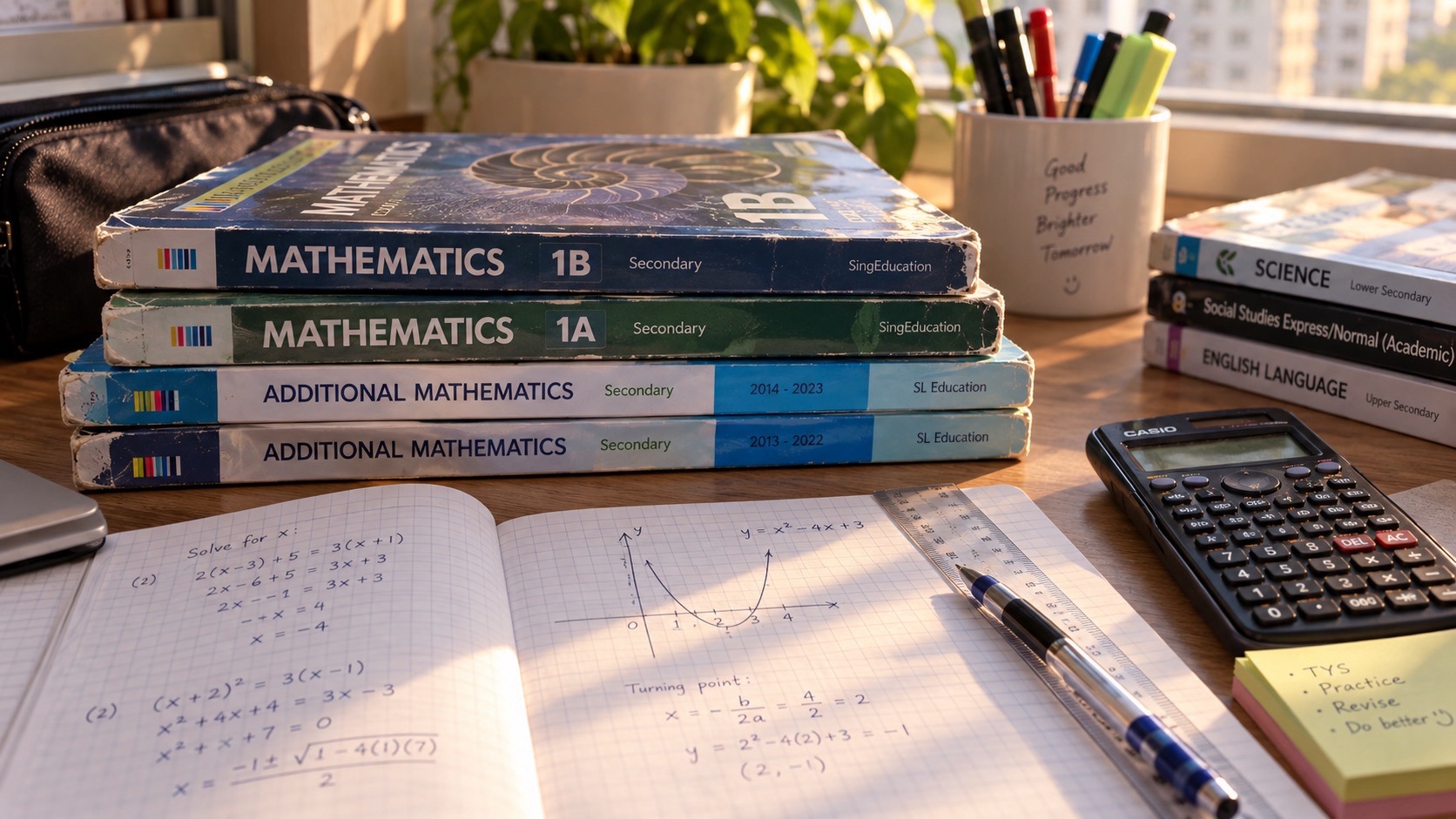
Quick answer. Discrete Mathematics, Graphs and Algorithms introduces higher mathematical reasoning that may appear in suitable pre-university, university or specialist programmes. It is not a compulsory subject for every Punggol Primary or Secondary pupil. Students should use their actual MOE, SEAB or university syllabus to identify the relevant topics and prerequisites. This guide provides original worked examples, misconception analysis and independent retests.
Mathematical symbols are meaningful only when the learner can name their quantities and conditions. A correct-looking calculation can fail when a domain, unit, sign or model assumption is wrong. A strong student explains why a method applies, verifies it and can solve an altered problem without being told the first step.
Reviewed October 2026. All numeric examples are hypothetical educational illustrations, not copied examination items, product quotations or guarantees of national examination results.
The essentials
- Name the mathematical objects and unknowns.
- Identify the domain, reference quantity, unit and assumptions.
- Choose a valid representation or equation.
- Show the essential transformations clearly.
- Check by substitution, reconstruction or a second method.
- Locate the first incorrect step before prescribing more practice.
- Retest a changed problem after a delay to demonstrate independence.
Jump to a topic
- 1. Discrete structures
- 2. Sets
- 3. Logic
- 4. Vertices and edges
- 5. Degree of a vertex
- 6. Paths
- 7. Cycles
- 8. Trees
- 9. Connected graphs
- 10. Shortest paths
- 11. Weighted graphs
- 12. Networks
- 13. Graph colouring
- 14. Algorithm correctness
- 15. Complexity
- 16. Applications
1. Discrete structures
Concept and interpretation. Discrete structures must be linked to an explicit mathematical definition and its conditions. The learner should state what the input represents, what the output means, and which transformations preserve the relevant relationship. A table, diagram, graph or algebraic expression can make different aspects visible. More advanced work also requires recognising what the chosen model does not describe.
Original worked example. An undirected graph has four vertices and three edges forming a chain. Its vertex degrees are 1,2,2,1, summing to six, twice the number of edges. This calculation illustrates the importance of a complete chain of reasoning rather than an unexplained numerical answer. The student should be able to reproduce the justification and check the result against the starting conditions.
Common misconception. Counting each edge only once in the degree sum. Similar errors in discrete structures may arise from the wrong mathematical object, an omitted sign, a misread graph, a missing restriction or an assumption that was never stated. Identify the first invalid decision before repeating the procedure.
Independent changed question. A triangle has three vertices of degree two, total degree six. After a short gap, give an additional level-appropriate problem about discrete structures, change the unknown or input, and ask the learner to select and explain a method without the worked answer in view.
Foundational representation. Imagine 3 equal groups with 2 objects each. The total is 6; adding one group gives 8, while rearranging existing objects leaves the total unchanged. This elementary example distinguishes a transformation that preserves a quantity from one that changes it. In discrete structures, the learner should likewise identify which mathematical features remain invariant under the proposed operation.
Teaching and feedback. Note whether the student could start independently, name a correct model, show valid calculations, interpret the answer and detect an error. A missing concept needs an explanation; a calculation slip needs a different checking strategy. Preserve the original attempt and a later independent variation as evidence of progress.
2. Sets
Concept and interpretation. Sets must be linked to an explicit mathematical definition and its conditions. The learner should state what the input represents, what the output means, and which transformations preserve the relevant relationship. A table, diagram, graph or algebraic expression can make different aspects visible. More advanced work also requires recognising what the chosen model does not describe.
Original worked example. A weighted graph has A–B cost 2, B–C cost 3 and A–C cost 8. The path A–B–C costs five, shorter than direct A–C cost eight. This calculation illustrates the importance of a complete chain of reasoning rather than an unexplained numerical answer. The student should be able to reproduce the justification and check the result against the starting conditions.
Common misconception. Assuming fewer edges always means lower total weight. Similar errors in sets may arise from the wrong mathematical object, an omitted sign, a misread graph, a missing restriction or an assumption that was never stated. Identify the first invalid decision before repeating the procedure.
Independent changed question. If direct A–C cost four, the direct path is shorter than the five-cost detour. After a short gap, give an additional level-appropriate problem about sets, change the unknown or input, and ask the learner to select and explain a method without the worked answer in view.
Foundational representation. Imagine 4 equal groups with 3 objects each. The total is 12; adding one group gives 15, while rearranging existing objects leaves the total unchanged. This elementary example distinguishes a transformation that preserves a quantity from one that changes it. In sets, the learner should likewise identify which mathematical features remain invariant under the proposed operation.
Teaching and feedback. Note whether the student could start independently, name a correct model, show valid calculations, interpret the answer and detect an error. A missing concept needs an explanation; a calculation slip needs a different checking strategy. Preserve the original attempt and a later independent variation as evidence of progress.
3. Logic
Concept and interpretation. Logic must be linked to an explicit mathematical definition and its conditions. The learner should state what the input represents, what the output means, and which transformations preserve the relevant relationship. A table, diagram, graph or algebraic expression can make different aspects visible. More advanced work also requires recognising what the chosen model does not describe.
Original worked example. A connected acyclic graph with five vertices has four edges. Adding an edge between already connected vertices creates a cycle. This calculation illustrates the importance of a complete chain of reasoning rather than an unexplained numerical answer. The student should be able to reproduce the justification and check the result against the starting conditions.
Common misconception. Believing any connected graph is automatically a tree. Similar errors in logic may arise from the wrong mathematical object, an omitted sign, a misread graph, a missing restriction or an assumption that was never stated. Identify the first invalid decision before repeating the procedure.
Independent changed question. A tree with eight vertices has seven edges. After a short gap, give an additional level-appropriate problem about logic, change the unknown or input, and ask the learner to select and explain a method without the worked answer in view.
Foundational representation. Imagine 5 equal groups with 4 objects each. The total is 20; adding one group gives 24, while rearranging existing objects leaves the total unchanged. This elementary example distinguishes a transformation that preserves a quantity from one that changes it. In logic, the learner should likewise identify which mathematical features remain invariant under the proposed operation.
Teaching and feedback. Note whether the student could start independently, name a correct model, show valid calculations, interpret the answer and detect an error. A missing concept needs an explanation; a calculation slip needs a different checking strategy. Preserve the original attempt and a later independent variation as evidence of progress.
4. Vertices and edges
Concept and interpretation. Vertices and edges must be linked to an explicit mathematical definition and its conditions. The learner should state what the input represents, what the output means, and which transformations preserve the relevant relationship. A table, diagram, graph or algebraic expression can make different aspects visible. More advanced work also requires recognising what the chosen model does not describe.
Original worked example. If A={1,2,3} and B={3,4}, their union is {1,2,3,4}, while intersection is {3}. Cardinality of union is 3+2−1=4. This calculation illustrates the importance of a complete chain of reasoning rather than an unexplained numerical answer. The student should be able to reproduce the justification and check the result against the starting conditions.
Common misconception. Counting the shared element twice. Similar errors in vertices and edges may arise from the wrong mathematical object, an omitted sign, a misread graph, a missing restriction or an assumption that was never stated. Identify the first invalid decision before repeating the procedure.
Independent changed question. For A={1,2}, B={2,3,4}, union has four elements. After a short gap, give an additional level-appropriate problem about vertices and edges, change the unknown or input, and ask the learner to select and explain a method without the worked answer in view.
Foundational representation. Imagine 6 equal groups with 5 objects each. The total is 30; adding one group gives 35, while rearranging existing objects leaves the total unchanged. This elementary example distinguishes a transformation that preserves a quantity from one that changes it. In vertices and edges, the learner should likewise identify which mathematical features remain invariant under the proposed operation.
Teaching and feedback. Note whether the student could start independently, name a correct model, show valid calculations, interpret the answer and detect an error. A missing concept needs an explanation; a calculation slip needs a different checking strategy. Preserve the original attempt and a later independent variation as evidence of progress.
5. Degree of a vertex
Concept and interpretation. Degree of a vertex must be linked to an explicit mathematical definition and its conditions. The learner should state what the input represents, what the output means, and which transformations preserve the relevant relationship. A table, diagram, graph or algebraic expression can make different aspects visible. More advanced work also requires recognising what the chosen model does not describe.
Original worked example. An undirected graph has four vertices and three edges forming a chain. Its vertex degrees are 1,2,2,1, summing to six, twice the number of edges. This calculation illustrates the importance of a complete chain of reasoning rather than an unexplained numerical answer. The student should be able to reproduce the justification and check the result against the starting conditions.
Common misconception. Counting each edge only once in the degree sum. Similar errors in degree of a vertex may arise from the wrong mathematical object, an omitted sign, a misread graph, a missing restriction or an assumption that was never stated. Identify the first invalid decision before repeating the procedure.
Independent changed question. A triangle has three vertices of degree two, total degree six. After a short gap, give an additional level-appropriate problem about degree of a vertex, change the unknown or input, and ask the learner to select and explain a method without the worked answer in view.
Foundational representation. Imagine 7 equal groups with 6 objects each. The total is 42; adding one group gives 48, while rearranging existing objects leaves the total unchanged. This elementary example distinguishes a transformation that preserves a quantity from one that changes it. In degree of a vertex, the learner should likewise identify which mathematical features remain invariant under the proposed operation.
Teaching and feedback. Note whether the student could start independently, name a correct model, show valid calculations, interpret the answer and detect an error. A missing concept needs an explanation; a calculation slip needs a different checking strategy. Preserve the original attempt and a later independent variation as evidence of progress.
6. Paths
Concept and interpretation. Paths must be linked to an explicit mathematical definition and its conditions. The learner should state what the input represents, what the output means, and which transformations preserve the relevant relationship. A table, diagram, graph or algebraic expression can make different aspects visible. More advanced work also requires recognising what the chosen model does not describe.
Original worked example. A weighted graph has A–B cost 2, B–C cost 3 and A–C cost 8. The path A–B–C costs five, shorter than direct A–C cost eight. This calculation illustrates the importance of a complete chain of reasoning rather than an unexplained numerical answer. The student should be able to reproduce the justification and check the result against the starting conditions.
Common misconception. Assuming fewer edges always means lower total weight. Similar errors in paths may arise from the wrong mathematical object, an omitted sign, a misread graph, a missing restriction or an assumption that was never stated. Identify the first invalid decision before repeating the procedure.
Independent changed question. If direct A–C cost four, the direct path is shorter than the five-cost detour. After a short gap, give an additional level-appropriate problem about paths, change the unknown or input, and ask the learner to select and explain a method without the worked answer in view.
Foundational representation. Imagine 8 equal groups with 2 objects each. The total is 16; adding one group gives 18, while rearranging existing objects leaves the total unchanged. This elementary example distinguishes a transformation that preserves a quantity from one that changes it. In paths, the learner should likewise identify which mathematical features remain invariant under the proposed operation.
Teaching and feedback. Note whether the student could start independently, name a correct model, show valid calculations, interpret the answer and detect an error. A missing concept needs an explanation; a calculation slip needs a different checking strategy. Preserve the original attempt and a later independent variation as evidence of progress.
7. Cycles
Concept and interpretation. Cycles must be linked to an explicit mathematical definition and its conditions. The learner should state what the input represents, what the output means, and which transformations preserve the relevant relationship. A table, diagram, graph or algebraic expression can make different aspects visible. More advanced work also requires recognising what the chosen model does not describe.
Original worked example. A connected acyclic graph with five vertices has four edges. Adding an edge between already connected vertices creates a cycle. This calculation illustrates the importance of a complete chain of reasoning rather than an unexplained numerical answer. The student should be able to reproduce the justification and check the result against the starting conditions.
Common misconception. Believing any connected graph is automatically a tree. Similar errors in cycles may arise from the wrong mathematical object, an omitted sign, a misread graph, a missing restriction or an assumption that was never stated. Identify the first invalid decision before repeating the procedure.
Independent changed question. A tree with eight vertices has seven edges. After a short gap, give an additional level-appropriate problem about cycles, change the unknown or input, and ask the learner to select and explain a method without the worked answer in view.
Foundational representation. Imagine 9 equal groups with 3 objects each. The total is 27; adding one group gives 30, while rearranging existing objects leaves the total unchanged. This elementary example distinguishes a transformation that preserves a quantity from one that changes it. In cycles, the learner should likewise identify which mathematical features remain invariant under the proposed operation.
Teaching and feedback. Note whether the student could start independently, name a correct model, show valid calculations, interpret the answer and detect an error. A missing concept needs an explanation; a calculation slip needs a different checking strategy. Preserve the original attempt and a later independent variation as evidence of progress.
8. Trees
Concept and interpretation. Trees must be linked to an explicit mathematical definition and its conditions. The learner should state what the input represents, what the output means, and which transformations preserve the relevant relationship. A table, diagram, graph or algebraic expression can make different aspects visible. More advanced work also requires recognising what the chosen model does not describe.
Original worked example. If A={1,2,3} and B={3,4}, their union is {1,2,3,4}, while intersection is {3}. Cardinality of union is 3+2−1=4. This calculation illustrates the importance of a complete chain of reasoning rather than an unexplained numerical answer. The student should be able to reproduce the justification and check the result against the starting conditions.
Common misconception. Counting the shared element twice. Similar errors in trees may arise from the wrong mathematical object, an omitted sign, a misread graph, a missing restriction or an assumption that was never stated. Identify the first invalid decision before repeating the procedure.
Independent changed question. For A={1,2}, B={2,3,4}, union has four elements. After a short gap, give an additional level-appropriate problem about trees, change the unknown or input, and ask the learner to select and explain a method without the worked answer in view.
Foundational representation. Imagine 10 equal groups with 4 objects each. The total is 40; adding one group gives 44, while rearranging existing objects leaves the total unchanged. This elementary example distinguishes a transformation that preserves a quantity from one that changes it. In trees, the learner should likewise identify which mathematical features remain invariant under the proposed operation.
Teaching and feedback. Note whether the student could start independently, name a correct model, show valid calculations, interpret the answer and detect an error. A missing concept needs an explanation; a calculation slip needs a different checking strategy. Preserve the original attempt and a later independent variation as evidence of progress.
9. Connected graphs
Concept and interpretation. Connected graphs must be linked to an explicit mathematical definition and its conditions. The learner should state what the input represents, what the output means, and which transformations preserve the relevant relationship. A table, diagram, graph or algebraic expression can make different aspects visible. More advanced work also requires recognising what the chosen model does not describe.
Original worked example. An undirected graph has four vertices and three edges forming a chain. Its vertex degrees are 1,2,2,1, summing to six, twice the number of edges. This calculation illustrates the importance of a complete chain of reasoning rather than an unexplained numerical answer. The student should be able to reproduce the justification and check the result against the starting conditions.
Common misconception. Counting each edge only once in the degree sum. Similar errors in connected graphs may arise from the wrong mathematical object, an omitted sign, a misread graph, a missing restriction or an assumption that was never stated. Identify the first invalid decision before repeating the procedure.
Independent changed question. A triangle has three vertices of degree two, total degree six. After a short gap, give an additional level-appropriate problem about connected graphs, change the unknown or input, and ask the learner to select and explain a method without the worked answer in view.
Foundational representation. Imagine 11 equal groups with 5 objects each. The total is 55; adding one group gives 60, while rearranging existing objects leaves the total unchanged. This elementary example distinguishes a transformation that preserves a quantity from one that changes it. In connected graphs, the learner should likewise identify which mathematical features remain invariant under the proposed operation.
Teaching and feedback. Note whether the student could start independently, name a correct model, show valid calculations, interpret the answer and detect an error. A missing concept needs an explanation; a calculation slip needs a different checking strategy. Preserve the original attempt and a later independent variation as evidence of progress.
10. Shortest paths
Concept and interpretation. Shortest paths must be linked to an explicit mathematical definition and its conditions. The learner should state what the input represents, what the output means, and which transformations preserve the relevant relationship. A table, diagram, graph or algebraic expression can make different aspects visible. More advanced work also requires recognising what the chosen model does not describe.
Original worked example. A weighted graph has A–B cost 2, B–C cost 3 and A–C cost 8. The path A–B–C costs five, shorter than direct A–C cost eight. This calculation illustrates the importance of a complete chain of reasoning rather than an unexplained numerical answer. The student should be able to reproduce the justification and check the result against the starting conditions.
Common misconception. Assuming fewer edges always means lower total weight. Similar errors in shortest paths may arise from the wrong mathematical object, an omitted sign, a misread graph, a missing restriction or an assumption that was never stated. Identify the first invalid decision before repeating the procedure.
Independent changed question. If direct A–C cost four, the direct path is shorter than the five-cost detour. After a short gap, give an additional level-appropriate problem about shortest paths, change the unknown or input, and ask the learner to select and explain a method without the worked answer in view.
Foundational representation. Imagine 12 equal groups with 6 objects each. The total is 72; adding one group gives 78, while rearranging existing objects leaves the total unchanged. This elementary example distinguishes a transformation that preserves a quantity from one that changes it. In shortest paths, the learner should likewise identify which mathematical features remain invariant under the proposed operation.
Teaching and feedback. Note whether the student could start independently, name a correct model, show valid calculations, interpret the answer and detect an error. A missing concept needs an explanation; a calculation slip needs a different checking strategy. Preserve the original attempt and a later independent variation as evidence of progress.
11. Weighted graphs
Concept and interpretation. Weighted graphs must be linked to an explicit mathematical definition and its conditions. The learner should state what the input represents, what the output means, and which transformations preserve the relevant relationship. A table, diagram, graph or algebraic expression can make different aspects visible. More advanced work also requires recognising what the chosen model does not describe.
Original worked example. A connected acyclic graph with five vertices has four edges. Adding an edge between already connected vertices creates a cycle. This calculation illustrates the importance of a complete chain of reasoning rather than an unexplained numerical answer. The student should be able to reproduce the justification and check the result against the starting conditions.
Common misconception. Believing any connected graph is automatically a tree. Similar errors in weighted graphs may arise from the wrong mathematical object, an omitted sign, a misread graph, a missing restriction or an assumption that was never stated. Identify the first invalid decision before repeating the procedure.
Independent changed question. A tree with eight vertices has seven edges. After a short gap, give an additional level-appropriate problem about weighted graphs, change the unknown or input, and ask the learner to select and explain a method without the worked answer in view.
Foundational representation. Imagine 13 equal groups with 2 objects each. The total is 26; adding one group gives 28, while rearranging existing objects leaves the total unchanged. This elementary example distinguishes a transformation that preserves a quantity from one that changes it. In weighted graphs, the learner should likewise identify which mathematical features remain invariant under the proposed operation.
Teaching and feedback. Note whether the student could start independently, name a correct model, show valid calculations, interpret the answer and detect an error. A missing concept needs an explanation; a calculation slip needs a different checking strategy. Preserve the original attempt and a later independent variation as evidence of progress.
12. Networks
Concept and interpretation. Networks must be linked to an explicit mathematical definition and its conditions. The learner should state what the input represents, what the output means, and which transformations preserve the relevant relationship. A table, diagram, graph or algebraic expression can make different aspects visible. More advanced work also requires recognising what the chosen model does not describe.
Original worked example. If A={1,2,3} and B={3,4}, their union is {1,2,3,4}, while intersection is {3}. Cardinality of union is 3+2−1=4. This calculation illustrates the importance of a complete chain of reasoning rather than an unexplained numerical answer. The student should be able to reproduce the justification and check the result against the starting conditions.
Common misconception. Counting the shared element twice. Similar errors in networks may arise from the wrong mathematical object, an omitted sign, a misread graph, a missing restriction or an assumption that was never stated. Identify the first invalid decision before repeating the procedure.
Independent changed question. For A={1,2}, B={2,3,4}, union has four elements. After a short gap, give an additional level-appropriate problem about networks, change the unknown or input, and ask the learner to select and explain a method without the worked answer in view.
Foundational representation. Imagine 14 equal groups with 3 objects each. The total is 42; adding one group gives 45, while rearranging existing objects leaves the total unchanged. This elementary example distinguishes a transformation that preserves a quantity from one that changes it. In networks, the learner should likewise identify which mathematical features remain invariant under the proposed operation.
Teaching and feedback. Note whether the student could start independently, name a correct model, show valid calculations, interpret the answer and detect an error. A missing concept needs an explanation; a calculation slip needs a different checking strategy. Preserve the original attempt and a later independent variation as evidence of progress.
13. Graph colouring
Concept and interpretation. Graph colouring must be linked to an explicit mathematical definition and its conditions. The learner should state what the input represents, what the output means, and which transformations preserve the relevant relationship. A table, diagram, graph or algebraic expression can make different aspects visible. More advanced work also requires recognising what the chosen model does not describe.
Original worked example. An undirected graph has four vertices and three edges forming a chain. Its vertex degrees are 1,2,2,1, summing to six, twice the number of edges. This calculation illustrates the importance of a complete chain of reasoning rather than an unexplained numerical answer. The student should be able to reproduce the justification and check the result against the starting conditions.
Common misconception. Counting each edge only once in the degree sum. Similar errors in graph colouring may arise from the wrong mathematical object, an omitted sign, a misread graph, a missing restriction or an assumption that was never stated. Identify the first invalid decision before repeating the procedure.
Independent changed question. A triangle has three vertices of degree two, total degree six. After a short gap, give an additional level-appropriate problem about graph colouring, change the unknown or input, and ask the learner to select and explain a method without the worked answer in view.
Foundational representation. Imagine 15 equal groups with 4 objects each. The total is 60; adding one group gives 64, while rearranging existing objects leaves the total unchanged. This elementary example distinguishes a transformation that preserves a quantity from one that changes it. In graph colouring, the learner should likewise identify which mathematical features remain invariant under the proposed operation.
Teaching and feedback. Note whether the student could start independently, name a correct model, show valid calculations, interpret the answer and detect an error. A missing concept needs an explanation; a calculation slip needs a different checking strategy. Preserve the original attempt and a later independent variation as evidence of progress.
14. Algorithm correctness
Concept and interpretation. Algorithm correctness must be linked to an explicit mathematical definition and its conditions. The learner should state what the input represents, what the output means, and which transformations preserve the relevant relationship. A table, diagram, graph or algebraic expression can make different aspects visible. More advanced work also requires recognising what the chosen model does not describe.
Original worked example. A weighted graph has A–B cost 2, B–C cost 3 and A–C cost 8. The path A–B–C costs five, shorter than direct A–C cost eight. This calculation illustrates the importance of a complete chain of reasoning rather than an unexplained numerical answer. The student should be able to reproduce the justification and check the result against the starting conditions.
Common misconception. Assuming fewer edges always means lower total weight. Similar errors in algorithm correctness may arise from the wrong mathematical object, an omitted sign, a misread graph, a missing restriction or an assumption that was never stated. Identify the first invalid decision before repeating the procedure.
Independent changed question. If direct A–C cost four, the direct path is shorter than the five-cost detour. After a short gap, give an additional level-appropriate problem about algorithm correctness, change the unknown or input, and ask the learner to select and explain a method without the worked answer in view.
Foundational representation. Imagine 16 equal groups with 5 objects each. The total is 80; adding one group gives 85, while rearranging existing objects leaves the total unchanged. This elementary example distinguishes a transformation that preserves a quantity from one that changes it. In algorithm correctness, the learner should likewise identify which mathematical features remain invariant under the proposed operation.
Teaching and feedback. Note whether the student could start independently, name a correct model, show valid calculations, interpret the answer and detect an error. A missing concept needs an explanation; a calculation slip needs a different checking strategy. Preserve the original attempt and a later independent variation as evidence of progress.
15. Complexity
Concept and interpretation. Complexity must be linked to an explicit mathematical definition and its conditions. The learner should state what the input represents, what the output means, and which transformations preserve the relevant relationship. A table, diagram, graph or algebraic expression can make different aspects visible. More advanced work also requires recognising what the chosen model does not describe.
Original worked example. A connected acyclic graph with five vertices has four edges. Adding an edge between already connected vertices creates a cycle. This calculation illustrates the importance of a complete chain of reasoning rather than an unexplained numerical answer. The student should be able to reproduce the justification and check the result against the starting conditions.
Common misconception. Believing any connected graph is automatically a tree. Similar errors in complexity may arise from the wrong mathematical object, an omitted sign, a misread graph, a missing restriction or an assumption that was never stated. Identify the first invalid decision before repeating the procedure.
Independent changed question. A tree with eight vertices has seven edges. After a short gap, give an additional level-appropriate problem about complexity, change the unknown or input, and ask the learner to select and explain a method without the worked answer in view.
Foundational representation. Imagine 17 equal groups with 6 objects each. The total is 102; adding one group gives 108, while rearranging existing objects leaves the total unchanged. This elementary example distinguishes a transformation that preserves a quantity from one that changes it. In complexity, the learner should likewise identify which mathematical features remain invariant under the proposed operation.
Teaching and feedback. Note whether the student could start independently, name a correct model, show valid calculations, interpret the answer and detect an error. A missing concept needs an explanation; a calculation slip needs a different checking strategy. Preserve the original attempt and a later independent variation as evidence of progress.
16. Applications
Concept and interpretation. Applications must be linked to an explicit mathematical definition and its conditions. The learner should state what the input represents, what the output means, and which transformations preserve the relevant relationship. A table, diagram, graph or algebraic expression can make different aspects visible. More advanced work also requires recognising what the chosen model does not describe.
Original worked example. If A={1,2,3} and B={3,4}, their union is {1,2,3,4}, while intersection is {3}. Cardinality of union is 3+2−1=4. This calculation illustrates the importance of a complete chain of reasoning rather than an unexplained numerical answer. The student should be able to reproduce the justification and check the result against the starting conditions.
Common misconception. Counting the shared element twice. Similar errors in applications may arise from the wrong mathematical object, an omitted sign, a misread graph, a missing restriction or an assumption that was never stated. Identify the first invalid decision before repeating the procedure.
Independent changed question. For A={1,2}, B={2,3,4}, union has four elements. After a short gap, give an additional level-appropriate problem about applications, change the unknown or input, and ask the learner to select and explain a method without the worked answer in view.
Foundational representation. Imagine 18 equal groups with 2 objects each. The total is 36; adding one group gives 38, while rearranging existing objects leaves the total unchanged. This elementary example distinguishes a transformation that preserves a quantity from one that changes it. In applications, the learner should likewise identify which mathematical features remain invariant under the proposed operation.
Teaching and feedback. Note whether the student could start independently, name a correct model, show valid calculations, interpret the answer and detect an error. A missing concept needs an explanation; a calculation slip needs a different checking strategy. Preserve the original attempt and a later independent variation as evidence of progress.
Four complete worked clinics
Graph degree
Problem and solution. An undirected graph has four vertices and three edges forming a chain. Its vertex degrees are 1,2,2,1, summing to six, twice the number of edges.
Wrong approach. Counting each edge only once in the degree sum.
Changed independent check. A triangle has three vertices of degree two, total degree six.
The final result should be checked against the defining mathematical relationship and its assumptions.
Shortest path
Problem and solution. A weighted graph has A–B cost 2, B–C cost 3 and A–C cost 8. The path A–B–C costs five, shorter than direct A–C cost eight.
Wrong approach. Assuming fewer edges always means lower total weight.
Changed independent check. If direct A–C cost four, the direct path is shorter than the five-cost detour.
The final result should be checked against the defining mathematical relationship and its assumptions.
Trees
Problem and solution. A connected acyclic graph with five vertices has four edges. Adding an edge between already connected vertices creates a cycle.
Wrong approach. Believing any connected graph is automatically a tree.
Changed independent check. A tree with eight vertices has seven edges.
The final result should be checked against the defining mathematical relationship and its assumptions.
Set union
Problem and solution. If A={1,2,3} and B={3,4}, their union is {1,2,3,4}, while intersection is {3}. Cardinality of union is 3+2−1=4.
Wrong approach. Counting the shared element twice.
Changed independent check. For A={1,2}, B={2,3,4}, union has four elements.
The final result should be checked against the defining mathematical relationship and its assumptions.
Six-week learning plan
Week 1. Confirm the student’s actual course and prerequisites, then diagnose two errors. Protect time for school commitments, sleep and other activities.
Week 2. Teach definitions and representations with a clear worked example. Protect time for school commitments, sleep and other activities.
Week 3. Use a partially completed example, then remove the prompts. Protect time for school commitments, sleep and other activities.
Week 4. Revisit the concept after a delay with changed numbers or assumptions. Protect time for school commitments, sleep and other activities.
Week 5. Mix the topic with previously secure ideas and require method selection. Protect time for school commitments, sleep and other activities.
Week 6. Complete a new independent problem, analyse the first wrong step and choose the next goal. Protect time for school commitments, sleep and other activities.
Frequently asked questions
Is this compulsory for every Punggol student? No. These are advanced concepts for appropriate courses and learners, not a universal Primary curriculum.
Does Punggol have a different Mathematics examination? No. Mainstream national syllabuses and the student’s actual programme determine assessment.
Is memorising a formula sufficient? No. The learner should know its meaning, domain, assumptions and how to verify the result.
What if a correct answer has no explanation? Use a changed question and ask for a mathematical justification to assess transfer.
Should every learner begin with advanced questions? No. Diagnose prerequisites and establish sound foundational representations first.
Can tuition guarantee an A-Level or university result? No. Neither examination outcomes nor admission decisions can be guaranteed.
What is the best way to correct an error? Find the earliest invalid step, explain the missing relationship and retest independently.
How can parents help? Review authentic work, ask clear questions and coordinate with the student’s teacher or course guidance.
Official references and connected guides
- MOE Mathematics curriculum
- SEAB Secondary Education Certificate syllabuses
- SEAB A-Level examinations
- Immutable Mathematics teaching reference
- Calculus and mathematical modelling
- Matrices and linear algebra
- Logarithms and exponential change
A good mathematical education develops independent reasoning: define the quantity, choose an appropriate method, justify each transformation, recognise limitations and check an unfamiliar problem without prompts.


