
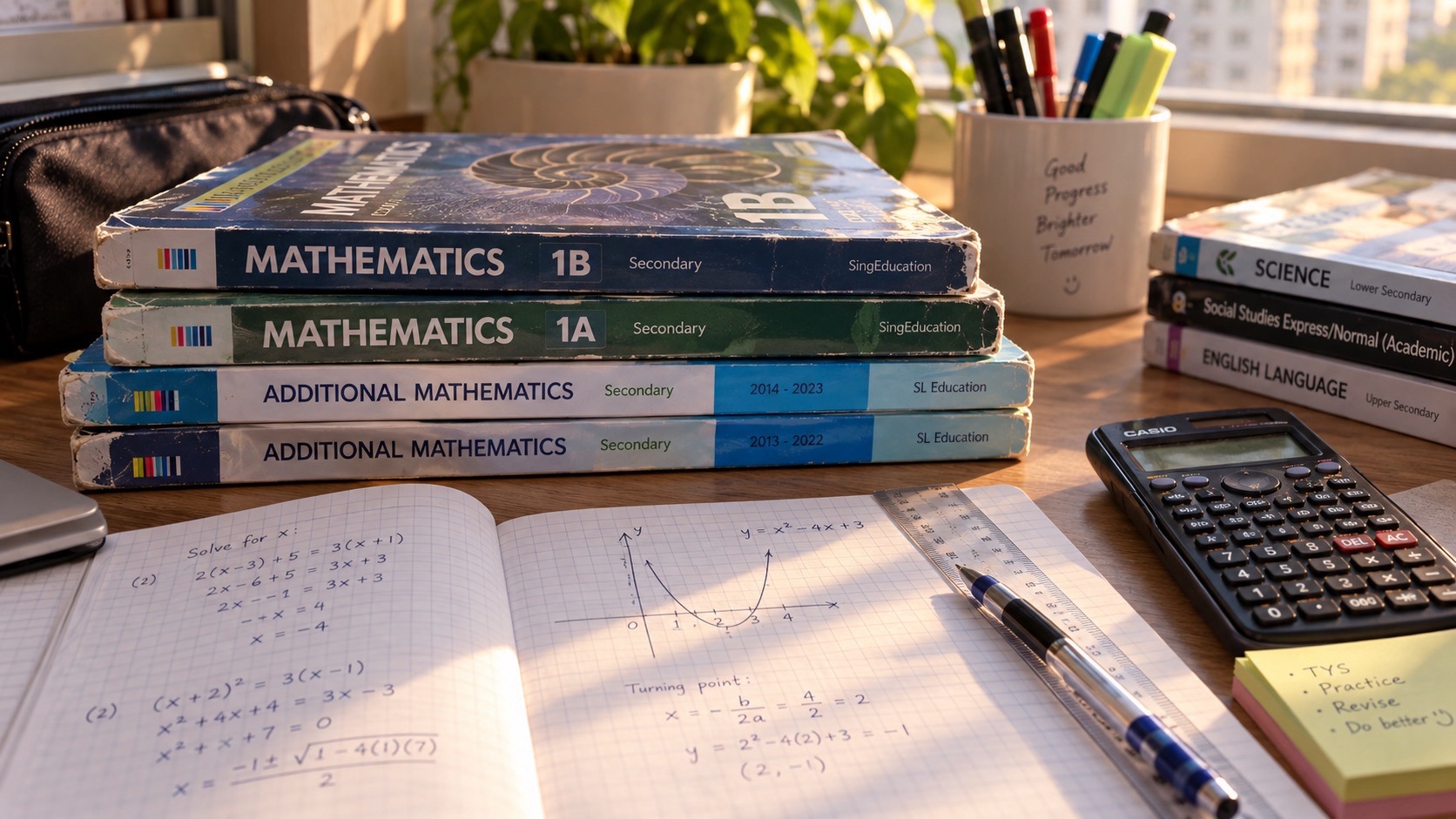
Quick answer. Matrices, Linear Algebra and Transformations connects Secondary and pre-university Mathematics with more advanced quantitative study. Punggol families should identify the student’s actual syllabus and school subject level before selecting material. This article gives definitions, complete worked examples, common mistakes, independent retests and a sustainable learning sequence. Not every topic is compulsory for every Primary or Secondary student.
Mathematics works best when each symbol represents a named quantity or relationship. A calculation can be mechanically correct but irrelevant if the learner has chosen the wrong model, sign, reference base or unit. A reliable student explains why a method applies, checks its conditions and solves a changed example without prompts after a gap.
Reviewed October 2026. Refer to MOE and SEAB for actual Singapore national syllabus and examination requirements. All mathematical examples are original teaching illustrations, not copied examination items or promises of grades.
Key ideas at a glance
- Identify the unknown and what each symbol represents.
- Distinguish a scalar, rate, quantity, coordinate or modelled objective as appropriate.
- State domain, units and assumptions.
- Choose an appropriate representation before calculating.
- Use a second method or substitution to verify the result.
- Locate the first invalid step in an incorrect solution.
- Revisit changed problems after a delay to check independent transfer.
Jump to the relevant topic
- 1. Matrix notation
- 2. Dimensions
- 3. Matrix addition
- 4. Scalar multiplication
- 5. Matrix multiplication
- 6. Identity matrix
- 7. Determinant
- 8. Inverse matrix
- 9. Linear systems
- 10. Column vectors
- 11. Linear transformations
- 12. Rotations
- 13. Reflections
- 14. Scaling
- 15. Eigenvalues as extension
- 16. Applications
1. Matrix notation
Concept and meaning. Matrix notation involves a relationship that must be interpreted before any numerical procedure is chosen. Start by naming the mathematical object and its conditions. A table, graph, diagram or equation can represent the same relationship in different ways. A strong explanation connects these representations and distinguishes the quantity being found from the input or intermediate values.
Worked example. A=[[1,2],[3,4]] and B=[[2,0],[1,5]]. A+B=[[3,2],[4,9]]. This illustrates a complete mathematical statement: quantities are defined, a valid operation is applied and the result is interpreted. The method should be checked against its assumptions rather than copied solely because it resembles a familiar textbook example.
Common incorrect step. Adding rows as single numbers instead of corresponding entries. In matrix notation, similar mistakes may arise from a sign, missing condition, wrong unit or confusion between a value and its rate of change. The first wrong decision is more useful diagnostically than the final incorrect answer.
Independent changed question. Add [[1,0],[2,3]] and [[3,4],[0,1]] to get [[4,4],[2,4]]. The student should attempt this without looking at the preceding solution, then verify by substitution, reconstruction or a suitable second method. A later school-level matrix notation question should change the unknown or presentation to check genuine transfer.
Foundation check. Consider 2 groups of 3 objects each. Their total is 6. Adding one group gives 9; merely rearranging the objects leaves the total 6. This basic distinction between an operation that changes a quantity and a transformation that preserves it is useful when moving into advanced algebra and modelling. Ask which properties of the present problem are invariant.
Teaching decision. Record whether the learner could begin independently, justify the chosen mathematical model, compute accurately, label the result and recognise a mismatch. A missing prerequisite needs instruction; a simple copying slip needs a checking habit. Do not assume both require more timed worksheets.
2. Dimensions
Concept and meaning. Dimensions involves a relationship that must be interpreted before any numerical procedure is chosen. Start by naming the mathematical object and its conditions. A table, graph, diagram or equation can represent the same relationship in different ways. A strong explanation connects these representations and distinguishes the quantity being found from the input or intermediate values.
Worked example. A=[[1,2],[3,4]], B=[[2,0],[1,5]]. AB=[[4,10],[10,20]]. Each entry is a row-column dot product. This illustrates a complete mathematical statement: quantities are defined, a valid operation is applied and the result is interpreted. The method should be checked against its assumptions rather than copied solely because it resembles a familiar textbook example.
Common incorrect step. Multiplying corresponding entries rather than row by column. In dimensions, similar mistakes may arise from a sign, missing condition, wrong unit or confusion between a value and its rate of change. The first wrong decision is more useful diagnostically than the final incorrect answer.
Independent changed question. Multiply [[1,1],[0,1]] by [[2,0],[3,4]] to get [[5,4],[3,4]]. The student should attempt this without looking at the preceding solution, then verify by substitution, reconstruction or a suitable second method. A later school-level dimensions question should change the unknown or presentation to check genuine transfer.
Foundation check. Consider 3 groups of 4 objects each. Their total is 12. Adding one group gives 16; merely rearranging the objects leaves the total 12. This basic distinction between an operation that changes a quantity and a transformation that preserves it is useful when moving into advanced algebra and modelling. Ask which properties of the present problem are invariant.
Teaching decision. Record whether the learner could begin independently, justify the chosen mathematical model, compute accurately, label the result and recognise a mismatch. A missing prerequisite needs instruction; a simple copying slip needs a checking habit. Do not assume both require more timed worksheets.
3. Matrix addition
Concept and meaning. Matrix addition involves a relationship that must be interpreted before any numerical procedure is chosen. Start by naming the mathematical object and its conditions. A table, graph, diagram or equation can represent the same relationship in different ways. A strong explanation connects these representations and distinguishes the quantity being found from the input or intermediate values.
Worked example. For A=[[2,1],[3,4]], det(A)=2×4−1×3=5. A nonzero determinant means the square matrix is invertible. This illustrates a complete mathematical statement: quantities are defined, a valid operation is applied and the result is interpreted. The method should be checked against its assumptions rather than copied solely because it resembles a familiar textbook example.
Common incorrect step. Adding diagonal products instead of subtracting. In matrix addition, similar mistakes may arise from a sign, missing condition, wrong unit or confusion between a value and its rate of change. The first wrong decision is more useful diagnostically than the final incorrect answer.
Independent changed question. For [[3,1],[2,2]], determinant four. The student should attempt this without looking at the preceding solution, then verify by substitution, reconstruction or a suitable second method. A later school-level matrix addition question should change the unknown or presentation to check genuine transfer.
Foundation check. Consider 4 groups of 5 objects each. Their total is 20. Adding one group gives 25; merely rearranging the objects leaves the total 20. This basic distinction between an operation that changes a quantity and a transformation that preserves it is useful when moving into advanced algebra and modelling. Ask which properties of the present problem are invariant.
Teaching decision. Record whether the learner could begin independently, justify the chosen mathematical model, compute accurately, label the result and recognise a mismatch. A missing prerequisite needs instruction; a simple copying slip needs a checking habit. Do not assume both require more timed worksheets.
4. Scalar multiplication
Concept and meaning. Scalar multiplication involves a relationship that must be interpreted before any numerical procedure is chosen. Start by naming the mathematical object and its conditions. A table, graph, diagram or equation can represent the same relationship in different ways. A strong explanation connects these representations and distinguishes the quantity being found from the input or intermediate values.
Worked example. Solve x+y=5 and x−y=1. Adding gives 2x=6, so x=3 and y=2. Substitution verifies both equations. This illustrates a complete mathematical statement: quantities are defined, a valid operation is applied and the result is interpreted. The method should be checked against its assumptions rather than copied solely because it resembles a familiar textbook example.
Common incorrect step. Adding equations but forgetting to divide by two. In scalar multiplication, similar mistakes may arise from a sign, missing condition, wrong unit or confusion between a value and its rate of change. The first wrong decision is more useful diagnostically than the final incorrect answer.
Independent changed question. Solve x+y=7, x−y=3 to obtain x=5, y=2. The student should attempt this without looking at the preceding solution, then verify by substitution, reconstruction or a suitable second method. A later school-level scalar multiplication question should change the unknown or presentation to check genuine transfer.
Foundation check. Consider 5 groups of 6 objects each. Their total is 30. Adding one group gives 36; merely rearranging the objects leaves the total 30. This basic distinction between an operation that changes a quantity and a transformation that preserves it is useful when moving into advanced algebra and modelling. Ask which properties of the present problem are invariant.
Teaching decision. Record whether the learner could begin independently, justify the chosen mathematical model, compute accurately, label the result and recognise a mismatch. A missing prerequisite needs instruction; a simple copying slip needs a checking habit. Do not assume both require more timed worksheets.
5. Matrix multiplication
Concept and meaning. Matrix multiplication involves a relationship that must be interpreted before any numerical procedure is chosen. Start by naming the mathematical object and its conditions. A table, graph, diagram or equation can represent the same relationship in different ways. A strong explanation connects these representations and distinguishes the quantity being found from the input or intermediate values.
Worked example. A=[[1,2],[3,4]] and B=[[2,0],[1,5]]. A+B=[[3,2],[4,9]]. This illustrates a complete mathematical statement: quantities are defined, a valid operation is applied and the result is interpreted. The method should be checked against its assumptions rather than copied solely because it resembles a familiar textbook example.
Common incorrect step. Adding rows as single numbers instead of corresponding entries. In matrix multiplication, similar mistakes may arise from a sign, missing condition, wrong unit or confusion between a value and its rate of change. The first wrong decision is more useful diagnostically than the final incorrect answer.
Independent changed question. Add [[1,0],[2,3]] and [[3,4],[0,1]] to get [[4,4],[2,4]]. The student should attempt this without looking at the preceding solution, then verify by substitution, reconstruction or a suitable second method. A later school-level matrix multiplication question should change the unknown or presentation to check genuine transfer.
Foundation check. Consider 6 groups of 7 objects each. Their total is 42. Adding one group gives 49; merely rearranging the objects leaves the total 42. This basic distinction between an operation that changes a quantity and a transformation that preserves it is useful when moving into advanced algebra and modelling. Ask which properties of the present problem are invariant.
Teaching decision. Record whether the learner could begin independently, justify the chosen mathematical model, compute accurately, label the result and recognise a mismatch. A missing prerequisite needs instruction; a simple copying slip needs a checking habit. Do not assume both require more timed worksheets.
6. Identity matrix
Concept and meaning. Identity matrix involves a relationship that must be interpreted before any numerical procedure is chosen. Start by naming the mathematical object and its conditions. A table, graph, diagram or equation can represent the same relationship in different ways. A strong explanation connects these representations and distinguishes the quantity being found from the input or intermediate values.
Worked example. A=[[1,2],[3,4]], B=[[2,0],[1,5]]. AB=[[4,10],[10,20]]. Each entry is a row-column dot product. This illustrates a complete mathematical statement: quantities are defined, a valid operation is applied and the result is interpreted. The method should be checked against its assumptions rather than copied solely because it resembles a familiar textbook example.
Common incorrect step. Multiplying corresponding entries rather than row by column. In identity matrix, similar mistakes may arise from a sign, missing condition, wrong unit or confusion between a value and its rate of change. The first wrong decision is more useful diagnostically than the final incorrect answer.
Independent changed question. Multiply [[1,1],[0,1]] by [[2,0],[3,4]] to get [[5,4],[3,4]]. The student should attempt this without looking at the preceding solution, then verify by substitution, reconstruction or a suitable second method. A later school-level identity matrix question should change the unknown or presentation to check genuine transfer.
Foundation check. Consider 7 groups of 8 objects each. Their total is 56. Adding one group gives 64; merely rearranging the objects leaves the total 56. This basic distinction between an operation that changes a quantity and a transformation that preserves it is useful when moving into advanced algebra and modelling. Ask which properties of the present problem are invariant.
Teaching decision. Record whether the learner could begin independently, justify the chosen mathematical model, compute accurately, label the result and recognise a mismatch. A missing prerequisite needs instruction; a simple copying slip needs a checking habit. Do not assume both require more timed worksheets.
7. Determinant
Concept and meaning. Determinant involves a relationship that must be interpreted before any numerical procedure is chosen. Start by naming the mathematical object and its conditions. A table, graph, diagram or equation can represent the same relationship in different ways. A strong explanation connects these representations and distinguishes the quantity being found from the input or intermediate values.
Worked example. For A=[[2,1],[3,4]], det(A)=2×4−1×3=5. A nonzero determinant means the square matrix is invertible. This illustrates a complete mathematical statement: quantities are defined, a valid operation is applied and the result is interpreted. The method should be checked against its assumptions rather than copied solely because it resembles a familiar textbook example.
Common incorrect step. Adding diagonal products instead of subtracting. In determinant, similar mistakes may arise from a sign, missing condition, wrong unit or confusion between a value and its rate of change. The first wrong decision is more useful diagnostically than the final incorrect answer.
Independent changed question. For [[3,1],[2,2]], determinant four. The student should attempt this without looking at the preceding solution, then verify by substitution, reconstruction or a suitable second method. A later school-level determinant question should change the unknown or presentation to check genuine transfer.
Foundation check. Consider 8 groups of 3 objects each. Their total is 24. Adding one group gives 27; merely rearranging the objects leaves the total 24. This basic distinction between an operation that changes a quantity and a transformation that preserves it is useful when moving into advanced algebra and modelling. Ask which properties of the present problem are invariant.
Teaching decision. Record whether the learner could begin independently, justify the chosen mathematical model, compute accurately, label the result and recognise a mismatch. A missing prerequisite needs instruction; a simple copying slip needs a checking habit. Do not assume both require more timed worksheets.
8. Inverse matrix
Concept and meaning. Inverse matrix involves a relationship that must be interpreted before any numerical procedure is chosen. Start by naming the mathematical object and its conditions. A table, graph, diagram or equation can represent the same relationship in different ways. A strong explanation connects these representations and distinguishes the quantity being found from the input or intermediate values.
Worked example. Solve x+y=5 and x−y=1. Adding gives 2x=6, so x=3 and y=2. Substitution verifies both equations. This illustrates a complete mathematical statement: quantities are defined, a valid operation is applied and the result is interpreted. The method should be checked against its assumptions rather than copied solely because it resembles a familiar textbook example.
Common incorrect step. Adding equations but forgetting to divide by two. In inverse matrix, similar mistakes may arise from a sign, missing condition, wrong unit or confusion between a value and its rate of change. The first wrong decision is more useful diagnostically than the final incorrect answer.
Independent changed question. Solve x+y=7, x−y=3 to obtain x=5, y=2. The student should attempt this without looking at the preceding solution, then verify by substitution, reconstruction or a suitable second method. A later school-level inverse matrix question should change the unknown or presentation to check genuine transfer.
Foundation check. Consider 9 groups of 4 objects each. Their total is 36. Adding one group gives 40; merely rearranging the objects leaves the total 36. This basic distinction between an operation that changes a quantity and a transformation that preserves it is useful when moving into advanced algebra and modelling. Ask which properties of the present problem are invariant.
Teaching decision. Record whether the learner could begin independently, justify the chosen mathematical model, compute accurately, label the result and recognise a mismatch. A missing prerequisite needs instruction; a simple copying slip needs a checking habit. Do not assume both require more timed worksheets.
9. Linear systems
Concept and meaning. Linear systems involves a relationship that must be interpreted before any numerical procedure is chosen. Start by naming the mathematical object and its conditions. A table, graph, diagram or equation can represent the same relationship in different ways. A strong explanation connects these representations and distinguishes the quantity being found from the input or intermediate values.
Worked example. A=[[1,2],[3,4]] and B=[[2,0],[1,5]]. A+B=[[3,2],[4,9]]. This illustrates a complete mathematical statement: quantities are defined, a valid operation is applied and the result is interpreted. The method should be checked against its assumptions rather than copied solely because it resembles a familiar textbook example.
Common incorrect step. Adding rows as single numbers instead of corresponding entries. In linear systems, similar mistakes may arise from a sign, missing condition, wrong unit or confusion between a value and its rate of change. The first wrong decision is more useful diagnostically than the final incorrect answer.
Independent changed question. Add [[1,0],[2,3]] and [[3,4],[0,1]] to get [[4,4],[2,4]]. The student should attempt this without looking at the preceding solution, then verify by substitution, reconstruction or a suitable second method. A later school-level linear systems question should change the unknown or presentation to check genuine transfer.
Foundation check. Consider 10 groups of 5 objects each. Their total is 50. Adding one group gives 55; merely rearranging the objects leaves the total 50. This basic distinction between an operation that changes a quantity and a transformation that preserves it is useful when moving into advanced algebra and modelling. Ask which properties of the present problem are invariant.
Teaching decision. Record whether the learner could begin independently, justify the chosen mathematical model, compute accurately, label the result and recognise a mismatch. A missing prerequisite needs instruction; a simple copying slip needs a checking habit. Do not assume both require more timed worksheets.
10. Column vectors
Concept and meaning. Column vectors involves a relationship that must be interpreted before any numerical procedure is chosen. Start by naming the mathematical object and its conditions. A table, graph, diagram or equation can represent the same relationship in different ways. A strong explanation connects these representations and distinguishes the quantity being found from the input or intermediate values.
Worked example. A=[[1,2],[3,4]], B=[[2,0],[1,5]]. AB=[[4,10],[10,20]]. Each entry is a row-column dot product. This illustrates a complete mathematical statement: quantities are defined, a valid operation is applied and the result is interpreted. The method should be checked against its assumptions rather than copied solely because it resembles a familiar textbook example.
Common incorrect step. Multiplying corresponding entries rather than row by column. In column vectors, similar mistakes may arise from a sign, missing condition, wrong unit or confusion between a value and its rate of change. The first wrong decision is more useful diagnostically than the final incorrect answer.
Independent changed question. Multiply [[1,1],[0,1]] by [[2,0],[3,4]] to get [[5,4],[3,4]]. The student should attempt this without looking at the preceding solution, then verify by substitution, reconstruction or a suitable second method. A later school-level column vectors question should change the unknown or presentation to check genuine transfer.
Foundation check. Consider 11 groups of 6 objects each. Their total is 66. Adding one group gives 72; merely rearranging the objects leaves the total 66. This basic distinction between an operation that changes a quantity and a transformation that preserves it is useful when moving into advanced algebra and modelling. Ask which properties of the present problem are invariant.
Teaching decision. Record whether the learner could begin independently, justify the chosen mathematical model, compute accurately, label the result and recognise a mismatch. A missing prerequisite needs instruction; a simple copying slip needs a checking habit. Do not assume both require more timed worksheets.
11. Linear transformations
Concept and meaning. Linear transformations involves a relationship that must be interpreted before any numerical procedure is chosen. Start by naming the mathematical object and its conditions. A table, graph, diagram or equation can represent the same relationship in different ways. A strong explanation connects these representations and distinguishes the quantity being found from the input or intermediate values.
Worked example. For A=[[2,1],[3,4]], det(A)=2×4−1×3=5. A nonzero determinant means the square matrix is invertible. This illustrates a complete mathematical statement: quantities are defined, a valid operation is applied and the result is interpreted. The method should be checked against its assumptions rather than copied solely because it resembles a familiar textbook example.
Common incorrect step. Adding diagonal products instead of subtracting. In linear transformations, similar mistakes may arise from a sign, missing condition, wrong unit or confusion between a value and its rate of change. The first wrong decision is more useful diagnostically than the final incorrect answer.
Independent changed question. For [[3,1],[2,2]], determinant four. The student should attempt this without looking at the preceding solution, then verify by substitution, reconstruction or a suitable second method. A later school-level linear transformations question should change the unknown or presentation to check genuine transfer.
Foundation check. Consider 12 groups of 7 objects each. Their total is 84. Adding one group gives 91; merely rearranging the objects leaves the total 84. This basic distinction between an operation that changes a quantity and a transformation that preserves it is useful when moving into advanced algebra and modelling. Ask which properties of the present problem are invariant.
Teaching decision. Record whether the learner could begin independently, justify the chosen mathematical model, compute accurately, label the result and recognise a mismatch. A missing prerequisite needs instruction; a simple copying slip needs a checking habit. Do not assume both require more timed worksheets.
12. Rotations
Concept and meaning. Rotations involves a relationship that must be interpreted before any numerical procedure is chosen. Start by naming the mathematical object and its conditions. A table, graph, diagram or equation can represent the same relationship in different ways. A strong explanation connects these representations and distinguishes the quantity being found from the input or intermediate values.
Worked example. Solve x+y=5 and x−y=1. Adding gives 2x=6, so x=3 and y=2. Substitution verifies both equations. This illustrates a complete mathematical statement: quantities are defined, a valid operation is applied and the result is interpreted. The method should be checked against its assumptions rather than copied solely because it resembles a familiar textbook example.
Common incorrect step. Adding equations but forgetting to divide by two. In rotations, similar mistakes may arise from a sign, missing condition, wrong unit or confusion between a value and its rate of change. The first wrong decision is more useful diagnostically than the final incorrect answer.
Independent changed question. Solve x+y=7, x−y=3 to obtain x=5, y=2. The student should attempt this without looking at the preceding solution, then verify by substitution, reconstruction or a suitable second method. A later school-level rotations question should change the unknown or presentation to check genuine transfer.
Foundation check. Consider 13 groups of 8 objects each. Their total is 104. Adding one group gives 112; merely rearranging the objects leaves the total 104. This basic distinction between an operation that changes a quantity and a transformation that preserves it is useful when moving into advanced algebra and modelling. Ask which properties of the present problem are invariant.
Teaching decision. Record whether the learner could begin independently, justify the chosen mathematical model, compute accurately, label the result and recognise a mismatch. A missing prerequisite needs instruction; a simple copying slip needs a checking habit. Do not assume both require more timed worksheets.
13. Reflections
Concept and meaning. Reflections involves a relationship that must be interpreted before any numerical procedure is chosen. Start by naming the mathematical object and its conditions. A table, graph, diagram or equation can represent the same relationship in different ways. A strong explanation connects these representations and distinguishes the quantity being found from the input or intermediate values.
Worked example. A=[[1,2],[3,4]] and B=[[2,0],[1,5]]. A+B=[[3,2],[4,9]]. This illustrates a complete mathematical statement: quantities are defined, a valid operation is applied and the result is interpreted. The method should be checked against its assumptions rather than copied solely because it resembles a familiar textbook example.
Common incorrect step. Adding rows as single numbers instead of corresponding entries. In reflections, similar mistakes may arise from a sign, missing condition, wrong unit or confusion between a value and its rate of change. The first wrong decision is more useful diagnostically than the final incorrect answer.
Independent changed question. Add [[1,0],[2,3]] and [[3,4],[0,1]] to get [[4,4],[2,4]]. The student should attempt this without looking at the preceding solution, then verify by substitution, reconstruction or a suitable second method. A later school-level reflections question should change the unknown or presentation to check genuine transfer.
Foundation check. Consider 14 groups of 3 objects each. Their total is 42. Adding one group gives 45; merely rearranging the objects leaves the total 42. This basic distinction between an operation that changes a quantity and a transformation that preserves it is useful when moving into advanced algebra and modelling. Ask which properties of the present problem are invariant.
Teaching decision. Record whether the learner could begin independently, justify the chosen mathematical model, compute accurately, label the result and recognise a mismatch. A missing prerequisite needs instruction; a simple copying slip needs a checking habit. Do not assume both require more timed worksheets.
14. Scaling
Concept and meaning. Scaling involves a relationship that must be interpreted before any numerical procedure is chosen. Start by naming the mathematical object and its conditions. A table, graph, diagram or equation can represent the same relationship in different ways. A strong explanation connects these representations and distinguishes the quantity being found from the input or intermediate values.
Worked example. A=[[1,2],[3,4]], B=[[2,0],[1,5]]. AB=[[4,10],[10,20]]. Each entry is a row-column dot product. This illustrates a complete mathematical statement: quantities are defined, a valid operation is applied and the result is interpreted. The method should be checked against its assumptions rather than copied solely because it resembles a familiar textbook example.
Common incorrect step. Multiplying corresponding entries rather than row by column. In scaling, similar mistakes may arise from a sign, missing condition, wrong unit or confusion between a value and its rate of change. The first wrong decision is more useful diagnostically than the final incorrect answer.
Independent changed question. Multiply [[1,1],[0,1]] by [[2,0],[3,4]] to get [[5,4],[3,4]]. The student should attempt this without looking at the preceding solution, then verify by substitution, reconstruction or a suitable second method. A later school-level scaling question should change the unknown or presentation to check genuine transfer.
Foundation check. Consider 15 groups of 4 objects each. Their total is 60. Adding one group gives 64; merely rearranging the objects leaves the total 60. This basic distinction between an operation that changes a quantity and a transformation that preserves it is useful when moving into advanced algebra and modelling. Ask which properties of the present problem are invariant.
Teaching decision. Record whether the learner could begin independently, justify the chosen mathematical model, compute accurately, label the result and recognise a mismatch. A missing prerequisite needs instruction; a simple copying slip needs a checking habit. Do not assume both require more timed worksheets.
15. Eigenvalues as extension
Concept and meaning. Eigenvalues as extension involves a relationship that must be interpreted before any numerical procedure is chosen. Start by naming the mathematical object and its conditions. A table, graph, diagram or equation can represent the same relationship in different ways. A strong explanation connects these representations and distinguishes the quantity being found from the input or intermediate values.
Worked example. For A=[[2,1],[3,4]], det(A)=2×4−1×3=5. A nonzero determinant means the square matrix is invertible. This illustrates a complete mathematical statement: quantities are defined, a valid operation is applied and the result is interpreted. The method should be checked against its assumptions rather than copied solely because it resembles a familiar textbook example.
Common incorrect step. Adding diagonal products instead of subtracting. In eigenvalues as extension, similar mistakes may arise from a sign, missing condition, wrong unit or confusion between a value and its rate of change. The first wrong decision is more useful diagnostically than the final incorrect answer.
Independent changed question. For [[3,1],[2,2]], determinant four. The student should attempt this without looking at the preceding solution, then verify by substitution, reconstruction or a suitable second method. A later school-level eigenvalues as extension question should change the unknown or presentation to check genuine transfer.
Foundation check. Consider 16 groups of 5 objects each. Their total is 80. Adding one group gives 85; merely rearranging the objects leaves the total 80. This basic distinction between an operation that changes a quantity and a transformation that preserves it is useful when moving into advanced algebra and modelling. Ask which properties of the present problem are invariant.
Teaching decision. Record whether the learner could begin independently, justify the chosen mathematical model, compute accurately, label the result and recognise a mismatch. A missing prerequisite needs instruction; a simple copying slip needs a checking habit. Do not assume both require more timed worksheets.
16. Applications
Concept and meaning. Applications involves a relationship that must be interpreted before any numerical procedure is chosen. Start by naming the mathematical object and its conditions. A table, graph, diagram or equation can represent the same relationship in different ways. A strong explanation connects these representations and distinguishes the quantity being found from the input or intermediate values.
Worked example. Solve x+y=5 and x−y=1. Adding gives 2x=6, so x=3 and y=2. Substitution verifies both equations. This illustrates a complete mathematical statement: quantities are defined, a valid operation is applied and the result is interpreted. The method should be checked against its assumptions rather than copied solely because it resembles a familiar textbook example.
Common incorrect step. Adding equations but forgetting to divide by two. In applications, similar mistakes may arise from a sign, missing condition, wrong unit or confusion between a value and its rate of change. The first wrong decision is more useful diagnostically than the final incorrect answer.
Independent changed question. Solve x+y=7, x−y=3 to obtain x=5, y=2. The student should attempt this without looking at the preceding solution, then verify by substitution, reconstruction or a suitable second method. A later school-level applications question should change the unknown or presentation to check genuine transfer.
Foundation check. Consider 17 groups of 6 objects each. Their total is 102. Adding one group gives 108; merely rearranging the objects leaves the total 102. This basic distinction between an operation that changes a quantity and a transformation that preserves it is useful when moving into advanced algebra and modelling. Ask which properties of the present problem are invariant.
Teaching decision. Record whether the learner could begin independently, justify the chosen mathematical model, compute accurately, label the result and recognise a mismatch. A missing prerequisite needs instruction; a simple copying slip needs a checking habit. Do not assume both require more timed worksheets.
Four integrated worked examples
Matrix addition
Original calculation and explanation. A=[[1,2],[3,4]] and B=[[2,0],[1,5]]. A+B=[[3,2],[4,9]].
Typical misconception. Adding rows as single numbers instead of corresponding entries.
Changed independent retest. Add [[1,0],[2,3]] and [[3,4],[0,1]] to get [[4,4],[2,4]].
A complete solution includes a reason why the mathematical method applies and an independent check of the result.
Matrix multiplication
Original calculation and explanation. A=[[1,2],[3,4]], B=[[2,0],[1,5]]. AB=[[4,10],[10,20]]. Each entry is a row-column dot product.
Typical misconception. Multiplying corresponding entries rather than row by column.
Changed independent retest. Multiply [[1,1],[0,1]] by [[2,0],[3,4]] to get [[5,4],[3,4]].
A complete solution includes a reason why the mathematical method applies and an independent check of the result.
Determinant
Original calculation and explanation. For A=[[2,1],[3,4]], det(A)=2×4−1×3=5. A nonzero determinant means the square matrix is invertible.
Typical misconception. Adding diagonal products instead of subtracting.
Changed independent retest. For [[3,1],[2,2]], determinant four.
A complete solution includes a reason why the mathematical method applies and an independent check of the result.
Linear system
Original calculation and explanation. Solve x+y=5 and x−y=1. Adding gives 2x=6, so x=3 and y=2. Substitution verifies both equations.
Typical misconception. Adding equations but forgetting to divide by two.
Changed independent retest. Solve x+y=7, x−y=3 to obtain x=5, y=2.
A complete solution includes a reason why the mathematical method applies and an independent check of the result.
Six-week study sequence
Week 1. Confirm the current school syllabus and diagnose prerequisite gaps from written work. Preserve time for schoolwork, sleep and other activities rather than treating practice volume as a guarantee of success.
Week 2. Rebuild definitions and representations with two clearly explained examples. Preserve time for schoolwork, sleep and other activities rather than treating practice volume as a guarantee of success.
Week 3. Fade the worked solution and ask the student to complete the remaining steps. Preserve time for schoolwork, sleep and other activities rather than treating practice volume as a guarantee of success.
Week 4. Revisit with altered coefficients, conditions or diagrams after a gap. Preserve time for schoolwork, sleep and other activities rather than treating practice volume as a guarantee of success.
Week 5. Mix the topic with two secure ideas and practise choosing a strategy. Preserve time for schoolwork, sleep and other activities rather than treating practice volume as a guarantee of success.
Week 6. Review the first wrong steps and complete a new independent problem before planning the next goal. Preserve time for schoolwork, sleep and other activities rather than treating practice volume as a guarantee of success.
Frequently asked questions
Is this required for every Primary pupil? No. Many sections are later-stage extensions. Use the learner’s current school syllabus and readiness.
Does Punggol have a separate national Mathematics syllabus? No. Relevant mainstream schools use the national MOE and SEAB curriculum and examination frameworks.
Can a correct numerical answer still be misleading? Yes. It may describe the wrong quantity, violate a domain restriction or rely on an unsupported assumption.
What is the best way to check understanding? Ask for a new problem after a delay, with changed numbers or conditions, and require an explanation.
Should students memorise every formula? Students need appropriate fluency but should also understand when formulas apply and how to check them.
Can tuition guarantee a particular grade? No. Learning support cannot guarantee national examination or admission outcomes.
What if the learner cannot start a problem? Identify the missing concept or representation and provide targeted teaching before independent practice.
How does this connect to university? Clear definitions, justified transformations and checked assumptions are foundational to higher mathematics.
MOE and SEAB sources and connected guides
- MOE Primary Mathematics curriculum
- SEAB SEC syllabuses
- SEAB A-Level syllabuses
- Mathematics teaching reference
- Coordinate geometry guide
- Calculus guide
- Spaced retrieval and revision
The lasting aim is independent mathematical reasoning: understand the quantity, choose a valid model, justify each operation, check the conclusion and transfer the method to a new question.


