
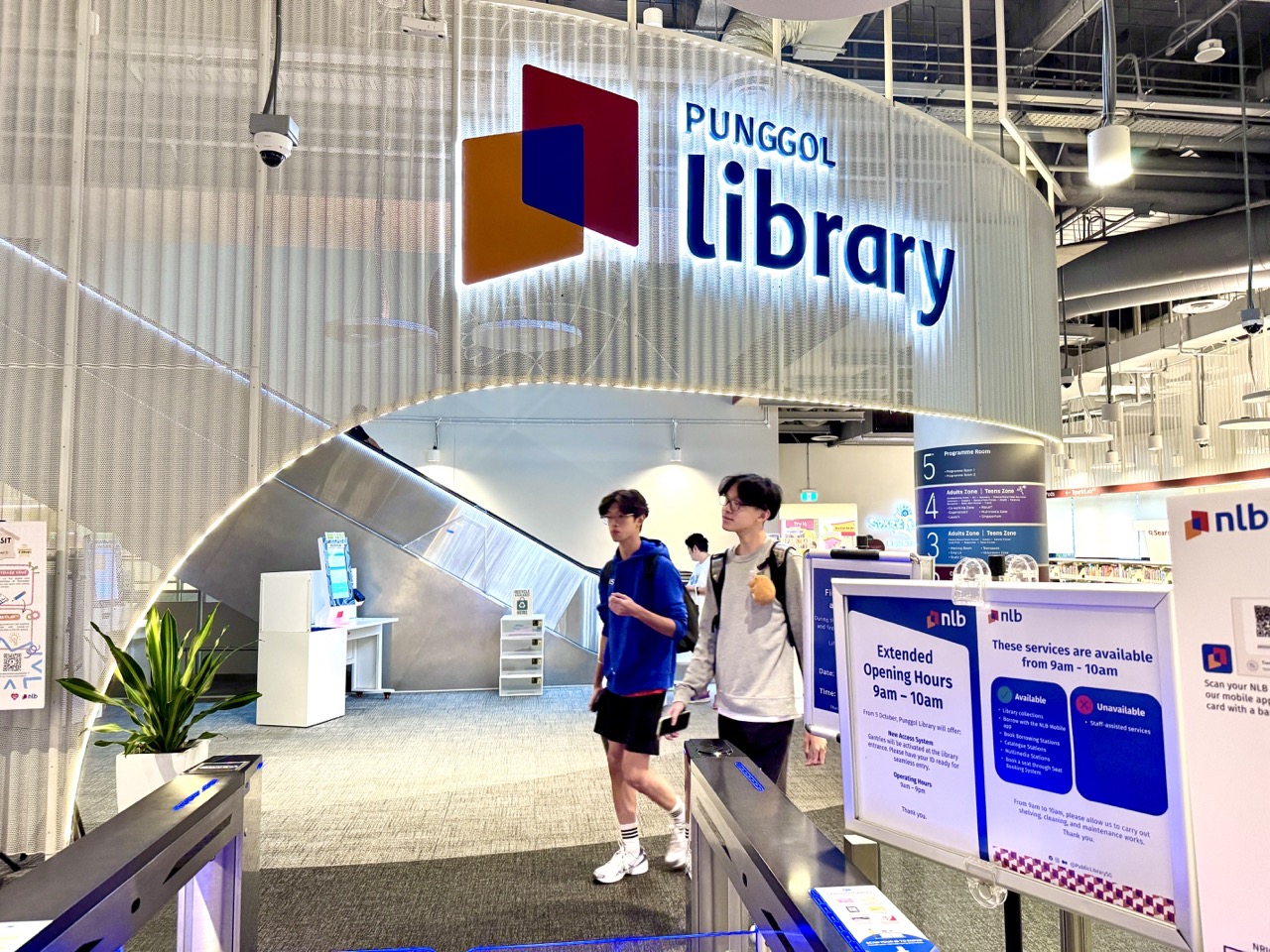
A family does not need to finish a book, test ten vocabulary words or spend an entire afternoon at Punggol Regional Library to make reading meaningful. Begin with a book your child wants to explore, read a little together and let one conversation grow from the story. Our new October 2026 photo shows Punggol Regional Library at One Punggol. The National Library Board places the library at 1 Punggol Drive, One Punggol, Singapore 828629. Its physical collections and reading spaces make it a useful place to choose the next book, but the habit continues most easily when the family can also read at home.
Singapore’s ReadSG movement launched on 6 September 2026 and encourages the public to build reading into everyday life, using fifteen minutes a day as an approachable goal. Fifteen minutes is not a minimum requirement for every child, a measured cure for poor English marks or an instruction to persist when a young reader is distressed. It’s a helpful starting invitation. A parent can turn it into a gentle routine: two minutes to choose what to read, ten minutes of shared reading and three minutes to talk about it.

Fifteen-minute read-aloud: quick guide
- Where: Punggol Regional Library inside One Punggol, at 1 Punggol Drive, Singapore 828629.
- Official context: NLB’s national ReadSG initiative began in September 2026 and proposes 15 minutes a day as a starting reading habit.
- At the library: let a child browse suitable books and follow current NLB signs and programme information rather than assume any facilitated activity is always running.
- At home: repeat the same book if the child wants to; familiarity can support attention and discussion.
- Read-aloud method: pause occasionally for one natural question about a picture, a character’s choice or what might happen next.
- Comprehension method: listen for an answer tied to the story rather than accept an invented detail as fact.
- Language method: choose a manageable new word, discuss its meaning in context and use it in a fresh sentence.
- Privacy and access: do not photograph other children without appropriate consent; adapt the pace and space to the reader’s actual needs.
This is a parent-and-child reading-method guide, not a replacement for the existing Punggol Regional Library directory, Storyteller Cove visitor guide, or formal PSLE oral examination guide. Those pages own facilities and assessment formats. Here, the aim is to make ordinary shared reading easier for the adult and more enjoyable for the child.
Minute 0–2: let the reader choose
Offer two or three age-appropriate books rather than dictate a title from a school reading list. Invite the child to look at the covers and choose whichever sparks curiosity. A child interested in animals may pick an information book; another might want a familiar fictional character. A parent can guide choices without making every visit a test of reading level.
If a book is too difficult, try reading it aloud together or choosing another one without criticism. Reading ability and interest are not identical. A child may want a story with more complex ideas than they can decode independently, and that is a legitimate reason for shared reading. The first two minutes should create ownership, not anxiety.
Minute 2–12: read, pause and notice
Read at a comfortable pace. Point to an interesting detail when it naturally matters and ask one question that helps the child make sense of it. ‘Why is the character carrying the umbrella?’ could be followed by ‘What do you see in the picture that supports that?’ Then listen. A thoughtful response may be only a few words, especially for a younger child.
Do not interrupt every sentence with a comprehension quiz. A continuous story has a rhythm and a child needs space to enjoy it. Pauses are most helpful at a meaningful change: a surprising choice, a new problem or an illustration that adds information. The adult should sound curious rather than like an examiner.
Minute 12–15: finish with one small conversation
Ask the child what they want to remember: a funny line, a character’s decision, a new fact or a question for tomorrow. They may prefer to continue reading, repeat the favourite page or close the book and play. A brief conversation can be enough. The family does not need an elaborate worksheet to prove the fifteen minutes mattered.
An older child might explain one cause-and-effect link. A younger one may point at a picture. Either response can be meaningful when it reflects the actual book. If the child is tired after school, a much shorter reading together may be more sustainable than insisting on an exact clock target.
Picture books aren’t only for children who cannot read
Illustrations can carry plot, emotion and information that isn’t stated in words. A Primary 3 or Primary 4 child may enjoy examining how an illustrator reveals a character’s mistake or hides a clue. A picture-book discussion can therefore involve genuine inference, even when the printed text is short. Choosing one is not a sign that the child should be ‘past this level’.
Parents can ask a reader to identify what the words explain and what only the picture shows. For example, the text may say a character left home, while the picture shows dark clouds. The child can predict a possible problem and explain the visual evidence. This is a powerful reading habit because it connects claims to sources rather than rewarding guesses.
Let interest lead, then add variety
A child who repeatedly borrows books about one subject may be building valuable background knowledge. Do not force variety by rejecting every preferred book. Instead, offer a related title that expands the topic: a favourite dinosaur story might lead to a factual book about fossils, or a sports story might lead to a biography suitable for the reader’s age.
Variety is useful when it feels like discovery rather than punishment. A gentle approach might be to select one book the child is excited about and a second that introduces something new. Borrowing arrangements, available titles and loan limits should be checked from NLB rather than invented in this article.
A ‘just right’ reading challenge is individual
Children of the same school year can have different reading confidence and interests. A book that one pupil reads fluently may be tiring for another; a very easy text can still provoke worthwhile discussion. Parents can listen to a short passage and ask whether the reader understands the main idea without trying to assign a professional reading level from one page.
If a child struggles to decode almost every sentence, an adult can take the reading role or choose a more accessible text. That is not a failure. Shared reading involves listening and meaning-making as well as independent decoding. A sustained habit is more valuable than a performance built around books that are repeatedly frustrating.
Read a story twice without apologising
Some children ask for the same story again and again. Adults may worry that repetition is a waste of time. But the second reading can focus on something new: a clue missed earlier, a character’s changing feelings, or one new word. The book is familiar, so the discussion can become deeper without raising the difficulty.
Keep the repeated reading pleasant. Ask the child whether they want to find a favourite detail or simply hear the story. The parent does not need to extract a new lesson every time. Enjoyment is part of why someone returns to a book voluntarily. The habit should leave the child wanting another opportunity rather than dreading it.
A nonfiction page needs a different kind of question
A book about animals, transport or Singapore history does not necessarily contain a fictional conflict. Instead of asking ‘Why did the character do that?’, ask ‘What is the main fact on this page?’ and ‘Which diagram or sentence supports it?’ A child may enjoy comparing the information with something seen in Punggol, such as an LRT train or a local bird.
Be careful about verifying claims. A beautiful nonfiction illustration can simplify scale or omit details. Readers should learn to distinguish a labelled diagram from an artistic picture and to check dates on historical information. The habit of asking where a claim comes from connects a short family reading activity to strong research skills.
A comic can be a bridge, not a lesser form of reading
Panels require readers to follow sequences, dialogue and visual changes. A child might infer that time has passed between frames or that a character is surprised without the emotion being named in the text. That is meaningful comprehension. A family can discuss what one panel adds that another leaves out.
For older children who enjoy comics, use one short sequence to practise retelling cause and consequence. The official NLB Comics & Games Library information describes a separate facility at Punggol Coast Mall; it is not the same as Punggol Regional Library at One Punggol. Keep those destinations distinct if planning an outing.
Multilingual reading belongs in the routine too
Punggol families may read in English, Chinese, Malay, Tamil or other home languages. The adult’s most comfortable language can help children understand ideas, stories and family memories. A parent does not need to use awkward English for every conversation if another language produces richer discussion. Reading across languages can be part of a family’s ordinary cultural life.
However, translation is not always word-for-word. The child can compare the way an idea is expressed in two languages without treating either as inferior. NLB’s Punggol Stories information documents literature and heritage experiences in English and Singapore’s other official languages. Actual book availability should still be checked in the catalogue.
A child who likes facts can start with real Punggol
A young reader curious about trains might enjoy a suitable transport book; another may prefer nature, maps or stories of Singapore’s past. These interests connect to things they can see around Punggol, but books should not be chosen solely to serve a curriculum objective. Let the real question lead: ‘How does a train know where to stop?’ or ‘How did this town look before the flats were built?’
Use a book to explore an answer and distinguish it from unsupported claims about current operations. The library’s Punggol Stories exhibition includes historical themes for older or interested readers, but an exhibition programme is separate from an ordinary read-aloud routine. Choose the appropriate experience for the child’s energy and curiosity.
When the book has very few words
Wordless and nearly wordless books invite the reader to construct a narrative from pictures. An adult can begin with, ‘What changed between these pages?’ The child may identify the character, setting or problem. Instead of demanding a complete sentence immediately, build from the child’s observation: ‘The dog is looking under the bench—perhaps it lost something.’
Label imagination clearly. The picture may show a dog beside a bench; the reason for its behaviour might be open to interpretation. That is a chance to practise ‘I think… because…’ rather than state every inference as fact. This skill transfers to visual comprehension, oral discussion and everyday critical thinking.
What if the child wants to read silently instead?
An older pupil may be comfortable reading independently and may not want an adult voicing every line. The fifteen-minute habit can adapt: read separately for a while, then invite a short conversation about something interesting. The adult can read their own book alongside the child, modelling the same choice.
Respect privacy and autonomy. A child reading a more personal story should not be required to summarise every chapter for a parent. An invitation such as ‘Would you like to tell me about one part?’ keeps the door open. The aim is a relationship with reading, not an ongoing interrogation.
Preschool children: point, name and connect
A very young child may engage mainly through pictures, pointing, naming objects and reacting to a familiar phrase. The adult can read briefly, describe one illustration and give the child time to answer or gesture. There is no requirement that a preschooler sit motionless for fifteen continuous minutes.
Try a playful exchange: ‘Where is the red boat?’ and after the child points, ‘Yes, it’s beside the bridge.’ Then continue the story. The adult is supplying language in context without turning the book into a vocabulary flashcard drill. If the child walks away, the family can stop and try another time.
Primary 1–2: connect sentences to story meaning
A P1 or P2 reader may begin decoding more text independently, but comprehension still needs attention. When a simple story introduces a new problem, ask who wants what and what might happen next. Encourage the child to use a detail in the text or picture, even if the explanation is brief.
Do not make speed the sole objective. A child who reads slowly but understands the character’s decision may be making meaningful progress. If the adult corrects every pronunciation immediately, the story can lose its flow. Select a few important moments for support and praise specific understanding instead of generic speed.
Primary 3–4: make an inference and support it
At this stage, try asking ‘How do we know the character is worried if the story doesn’t say worried?’ A good answer points to behaviour, dialogue or other evidence. For example, ‘She checks the clock three times’ is stronger than ‘because she is worried’ with no explanation.
Teach the simple structure ‘I think… because the text says/shows…’. It is not a rigid script for every reading moment, but a useful way to move from guessing to reasoning. A short reading session can practise it gently before a child encounters more demanding school comprehension passages.
Primary 5–6: distinguish theme from a plot summary
Older primary pupils can read a paragraph and retell what happened, but explaining the larger idea requires another step. A story about sharing a limited resource might explore fairness, generosity or competing responsibilities. Ask the child which action best illustrates the idea and whether another interpretation is possible.
Avoid insisting that every story has one correct moral statement. The book’s language, events and conclusion should support the answer. For a child approaching PSLE, careful reasoning about evidence and precise wording is more helpful than memorising a generic list of themes detached from an actual text.
Secondary readers: discuss disagreement fairly
An older student may enjoy books that offer several credible viewpoints. Ask them to represent a character’s decision sympathetically before criticising it. What did the person know? What choices were available? Which consequences followed? This can develop analytical reading without demanding an academic essay after every chapter.
Some days the teenager may prefer silent reading and no discussion. A successful family habit can respect that. Adults can model their own curiosity by saying what they are reading and why, without expecting a child to mirror the choice. Reading is a relationship that grows with independence.
Three questions that won’t turn the book into an exam
Use one of these at a meaningful moment: ‘What do you notice?’ ‘What makes you think that?’ ‘What do you wonder about next?’ The first invites observation, the second connects thinking to evidence and the third keeps curiosity alive. None requires a lengthy answer or a specific score.
If the child responds with something imaginative, separate speculation from evidence without dismissing it. ‘That’s a creative possibility. What clue supports it?’ lets the learner refine reasoning while keeping the conversation welcoming. A parent can ask just one question in an entire session and still help the child read attentively.
A complete original microstory for practice
Here is a fictional four-sentence practice story, written for this article: ‘Asha carried her library book to the bus stop. Dark clouds gathered, but she had forgotten her umbrella. Her brother opened his bag and offered to share his raincoat. Asha tucked the book inside her bag before they hurried to the shelter.’ No real child, school or library incident is being reported.
Ask: What problem does Asha face? What evidence suggests rain may arrive? What does her brother do to help? Why does Asha put the book away? A useful answer points to forgotten rain protection, dark clouds, an offered raincoat and keeping the book dry. The exercise connects clues, actions and reasonable inference without needing to quote a copyrighted book.
What a weak answer looks like and how to improve it
Suppose a child answers, ‘Asha is sad because the bus was late.’ Nothing in the original microstory mentions sadness or a late bus. Rather than announce ‘Wrong!’ immediately, ask which sentence supports the answer. The child may realise that they added details the text did not give. The corrected answer might be, ‘Asha is unprepared for possible rain because she forgot her umbrella.’
This is a practical lesson in reading evidence. In school comprehension, an invented explanation can lose marks even when it sounds plausible. At home, the same correction can remain friendly and curious. The goal is to make the learner better at checking the story rather than fearful of taking an interpretive risk.
A vocabulary example with a meaningful choice
Take the word ‘shelter’ from the fictional story. Ask the child what it means in that sentence. The clues are the dark clouds and the people hurrying towards a protected place. Then invite a fresh sentence, perhaps about waiting under a suitable shelter during rain. This builds meaning through context and transfer.
Do not turn every unfamiliar word into a ten-minute dictionary task. Pick one useful word, clarify it and move on. If the child wants to explore synonyms, compare them carefully: ‘cover’, ‘shelter’ and ‘refuge’ have overlapping meanings but are not interchangeable in every sentence. Precision develops through examples, not isolated memorisation alone.
A retelling with beginning, middle and end
Ask a P1–P3 child to retell the invented Asha story in three steps. Beginning: Asha is going towards the bus stop with a library book. Middle: the weather threatens and she has no umbrella. End: her brother offers help, and she protects the book. The retelling should preserve the causal sequence rather than repeat every original word.
A parent can scaffold with ‘First…’, ‘Then…’ and ‘Finally…’ without insisting on those words for every story. Once the sequence makes sense, encourage the child to explain why the last action follows the problem. A strong retelling is coherent, not necessarily long.
How to practise summarising without copying
An older primary pupil can reduce the story to one sentence: ‘When rain seemed likely, Asha and her brother worked together to protect her and her library book.’ This identifies the problem and the main response without repeating every detail. It is a model answer for the original fictional text, not an official PSLE item.
Then ask which detail can be omitted from a short summary. The bus stop may be context, but the central relationship is rain preparation and help. Students should learn to justify relevance rather than delete information mechanically. Summarising is about preserving meaning, not merely making a sentence shorter.
A nonfiction read-aloud with a diagram
Imagine opening a child-friendly book about the water cycle. The main paragraph introduces evaporation, while the accompanying diagram shows arrows from water to clouds. Ask the child what the arrows represent and whether the words confirm that interpretation. If a diagram uses symbolic arrows, explain their meaning rather than treat them as objects physically floating in the sky.
Stay with the science source rather than invent a local water-quality claim. The fact that Punggol has a waterway does not make a book illustration a measurement of the actual waterway. A responsible reader can connect ideas to familiar places while retaining the distinction between a scientific explanation and local observations.
Why one relevant book is better than a pile chosen at random
Borrowing several books can be enjoyable, but carrying home a large stack is not proof of a reading habit. A young child might explore one title deeply over several evenings. Another reader may prefer a few short books. The useful measure is willingness and comprehension, not a public photograph of books arranged on a table.
If a family wants to record reading, use a simple private note: title, date and one thought. Avoid turning the record into a competition between siblings. Children read at different speeds and have different school demands. A routine should help them return to stories voluntarily.
What the adult should do while the child thinks
When asking a question, leave a little silence. Children may need time to look back at the picture or choose words. Jumping in with the correct answer after one second teaches them to wait for the adult rather than reason. A friendly pause signals that the child’s thinking is valued.
If the child remains unsure, offer a smaller question: ‘Which page shows the character’s problem?’ or ‘Can you find the sentence about the rain?’ This is scaffolding, not giving away the whole answer. After the child responds, return to the story’s flow. Reading together does not have to sound like a lesson plan.
Avoid asking five questions on every page
An adult eager to help may ask who, what, where, when and why on every illustration. The child then spends more energy responding than enjoying the narrative. Choose moments that really benefit from attention: a surprising choice, a hidden clue or a connection the reader has volunteered.
A useful rule of thumb is to match the frequency of questions to the child’s engagement, not to an arbitrary checklist. Some evenings one natural question is enough. Another evening the child may ask dozens of their own. The adult should follow that curiosity rather than force a standard number.
A child who resists reading may need a different doorway
Resistance can arise for many reasons: tiredness, an unsuitable book, difficulty with decoding, prior pressure or simply a stronger interest in something else at that moment. Do not diagnose the cause from one refused reading session. Ask what the child would enjoy and consider a shorter, supported approach.
Some learners may engage better when an adult reads aloud first or when the topic relates to a real interest. Others may prefer audiobooks or accessible formats; NLB provides a range of digital and inclusive resources. If a child has persistent reading difficulties that affect daily learning, appropriate school or professional advice is more useful than escalating the pressure at home.
Respect a child’s sensory and accessibility needs
Punggol Regional Library has been described by NLB as an inclusive public library offering accessible resources and different types of spaces. That does not mean one area is comfortable for everybody or that all special facilities are available without conditions. A child who finds crowded or noisy environments difficult may benefit from a shorter, predictable visit or an accessible reading format.
Ask the learner what works and follow current NLB guidance. The site also links to the official Punggol Library social story preparation guide for families who need a clearer first-visit sequence. A family reading routine should be adaptable, not a rigid benchmark everyone must meet.
A visit to Storyteller Cove is a separate choice
NLB has described Storyteller Cove as a Level 2 space for school-age children to explore story creation through interactive experiences. It may be an enjoyable companion to reading, but using that space is not necessary for a fifteen-minute family read-aloud. Nor does an advertisement for a past workshop guarantee the same activity is available today.
For current opening, access and facilitated sessions, check NLB’s programme listing and actual signs. Our Storyteller Cove guide owns those visitor questions. This article concentrates on selecting, reading, discussing and returning to books.
Borrowing and returning are practical parts of the habit
Families who borrow physical books need to follow current NLB membership, due-date and return arrangements. The NLB Mobile app and official website offer account and eResource functions, but fees, eligibility and loan periods must be checked directly. A photograph of the library entrance does not explain an individual member’s borrowing rights.
A child can take age-appropriate responsibility: remember which book was chosen, keep it dry and return it when due. These small tasks make reading part of everyday life. But parents should not turn borrowing into an anxiety-producing audit. The shared story remains more important than achieving a perfect spreadsheet of books.
One Punggol makes reading easier to combine with ordinary errands
The library is within One Punggol, alongside other community services and a hawker centre. A family may visit for a book and then choose to eat, or come for an errand and browse a title. The integrated hub is useful because the reading visit need not require a separate long trip for some households. Different services still have their own operating hours and rules.
That convenience is an opportunity, not a command to fill the day. If a young child has had enough stimulation, go home with the book rather than add another activity. The One Punggol three-generation family day guide addresses broader logistics. This page deliberately keeps the reading activity small.
Do not mistake library etiquette for silence at any cost
Reading aloud requires a voice, but public libraries also contain users studying, browsing and working quietly. Choose a suitable space and use a comfortable low voice according to current library signs. Do not assume every reading zone is intended for an animated group session, and avoid blocking shelves or aisles.
A child who becomes excited by a story can be guided warmly rather than shamed. If the family needs a louder conversation, consider continuing at home or in an appropriate activity space. Respect for others is one more benefit of visiting a shared reading institution: children learn that curiosity and consideration can coexist.
What reading fifteen minutes a day really means
ReadSG’s public information presents fifteen minutes as an approachable habit-building target. It is not a scientific guarantee that every child will improve by a fixed exam grade after a set number of days. A child who reads enthusiastically for ten minutes may be doing well; an older reader may spend much longer with a book without needing an adult to time it.
Instead of measuring success solely by the clock, ask whether reading is becoming more voluntary, whether the child talks about ideas and whether suitable books are within reach. Those observations do not constitute a clinical or educational assessment, but they can guide a family towards sustainable routines.
A five-day family reading experiment
Day one: let the child choose a title. Day two: return to a favourite passage. Day three: ask one inference question. Day four: notice a new word and use it in a fresh sentence. Day five: have the child share a thought or recommend the book. Repeat or adapt the cycle depending on interest and energy.
This is an original family routine, not a formal NLB programme or evidence-backed intervention guaranteed to change test scores. Its value is simplicity. It gives the family several low-pressure ways to notice meaning without turning every evening into the same worksheet. If a task feels forced, discard it and simply read together.
A four-week progression without turning it into tuition
In week one, focus on choosing and enjoying books. In week two, experiment with occasional pictures-and-evidence questions. In week three, allow the child to retell one important event. In week four, encourage them to make a connection to another text, a personal experience or a real-world question. These are suggestions, not mandatory stages or a measured developmental timetable.
Different readers may already use all these skills or need more time with one of them. An adult can support quietly and adjust. The child should emerge with greater confidence to explore books, not a fear that reading only counts when a rubric is completed.
A parent reading in another language can still support thinking
If a parent expresses complex ideas more naturally in another language, that can make the conversation richer. For example, discuss an English story in the family’s preferred language, then invite the child to express one short idea in English if appropriate. The goal is to understand the content, not to judge the adult’s accent or vocabulary.
Families should follow the child’s specific language-learning goals and school context rather than adopt a blanket rule. NLB’s collections and Punggol Stories exhibition include multilingual materials. A reading habit can honour family languages while still offering opportunities to practise precise English.
The difference between reading practice and an English exam
PSLE English assesses several skills under defined conditions. A relaxed family read-aloud is not the same as an oral examination, comprehension paper or formal performance task. It can support language attention and discussion, but should not be sold as a replacement for syllabus-specific preparation or appropriate learning support.
For students who need exam-specific information, use the relevant MOE or SEAB syllabus and the site’s dedicated guides. Keep home reading protected as a pleasurable part of life whenever possible. A child deserves access to stories even if there is no immediate test to prepare for.
Why copying model answers can defeat the purpose
Parents sometimes provide a polished response before a child has thought. The child may then learn to repeat adult wording rather than understand the story. A stronger approach is to ask the child for their own first answer, invite a supporting clue and help make the explanation clearer.
Consider the Asha microstory. Instead of dictating, ‘She was worried because the weather was inclement,’ ask, ‘What made rain seem possible?’ If the child answers ‘dark clouds’, build from that observation. Vocabulary and precision can grow after meaning has been established, not before.
Let siblings read differently
Two children in the same family may have different strengths, interests and attention spans. One might love wordless picture books; another may prefer facts about sports. Do not compare pages per minute as if both were competing in the same event. Choose tasks each can complete with dignity.
A short shared session could involve one sibling describing a picture while another reads a sentence, but only if both enjoy the arrangement. Parents should avoid making the older child the permanent unpaid tutor. Each reader needs some ownership and appropriate support.
How grandparents can be part of the story
An older relative may enjoy telling a story from their childhood, reading in a home language or listening to a child explain a favourite book. This can turn a library visit into a connection across generations without requiring every participant to read at the same level or share the same preferences.
Ask the grandparent what they would enjoy and keep the visit suitable for their mobility and comfort. A child’s curiosity about old Punggol can lead to a family conversation that complements NLB’s documented local-history exhibits. But personal memories should be respectfully labelled as recollections, not automatically treated as verified historical records.
The photo’s job is to show the place, not the reading result
Our original October image records the entrance or visible presence of Punggol Regional Library. It does not show a particular child reading, participating in a Storyteller Cove programme or improving their exam marks. Those would be unsupported claims if attached to the photograph.
A good image caption says where the library is and when the photo was uploaded. The article’s reading method comes from sound instructional reasoning and explicit practice examples; its facility facts come from NLB. Keeping those sources separate makes a photo-led neighbourhood guide more credible over time.
The one change to make this week
Choose one convenient moment when a book could fit into the family’s routine—after an evening meal, before bed or after a library visit. Offer a suitable book and read together until a natural pause. Ask one thoughtful question only if the child is engaged. Then leave the next opportunity open.
The important habit is returning. It is better to make reading a small experience the child welcomes than to create an elaborate schedule that nobody can sustain. Punggol Regional Library offers the public collection and space; the family supplies time, interest and a conversational relationship with the story.

Where is Punggol Regional Library?
At One Punggol, 1 Punggol Drive, Singapore 828629, according to NLB.
What is the fifteen-minute idea?
NLB’s September 2026 ReadSG movement encourages a simple daily reading habit using fifteen minutes as an approachable starting point.
Must every child read for exactly fifteen minutes?
No. Adjust to age, needs, attention, comfort and interest.
Is reading aloud useful for a child who can already read independently?
It can support shared discussion and enjoyment; older children may also choose silent reading and a short follow-up conversation.
Do parents need to ask questions on every page?
No. Pause occasionally at a meaningful moment and prioritise the story’s flow.
What is a good first question?
What do you notice? A follow-up can ask which word or picture supports the answer.
What if my child chooses a book that seems easy?
Interest and understanding still matter. You can offer another book for variety without dismissing the chosen one.
What if the chosen book is too difficult?
Read it aloud together or offer an accessible alternative without treating it as failure.
Can we read the same book again?
Yes. Familiarity may help the child notice details or ask different questions.
Are picture books only for preschool children?
No. Older readers can practise inference, sequencing and analysis through illustrations.
Can comic books support reading?
They involve sequences, words and visual storytelling. The reading conversation can focus on cause and consequence.
Does a child need an NLB Storyteller Cove booking for this routine?
No. This is an independent family reading idea. NLB programmes and space access are separate.
Is Storyteller Cove inside Punggol Regional Library?
Yes. The dedicated site guide describes its Level 2 story-making purpose. Check current NLB arrangements.
Can we practise in Chinese, Malay or Tamil?
Families can use suitable languages and books, adapting the conversation to their learning goals.
Can this replace PSLE English tuition or examination practice?
No. Shared reading is not a substitute for individual learning support or assessment-specific preparation where required.
How do we support a child who dislikes reading?
Start with curiosity, manageable books and low-pressure shared time; ask why the activity feels difficult.
How should we handle an unfamiliar vocabulary word?
Choose one useful word, use context clues and try it in a fresh sentence, rather than turning every page into a drill.
What does a strong inference sound like?
I think this because the text says or shows a particular clue.
Does NLB provide accessible resources?
Yes, it offers inclusive collections and services, although individual arrangements should be checked for current access.
Can we take pictures of other children inside the library?
Respect privacy and current NLB policies; do not photograph identifiable visitors without appropriate permission.
Where can I find library opening hours and borrowing rules?
Use NLB’s current public library and membership information rather than rely on an old screenshot.
What if our family misses several reading days?
Resume with a manageable book when possible. A reading habit does not need a perfect record to be worthwhile.
Sources and useful next reading
- ReadSG — NLB’s September 2026 Reading Movement and Fifteen-Minute Habit.
- MDDI — 7 October 2026 Written Reply on ReadSG and Reading Habits.
- NLB — Public Library Network, Collections and Digital Resources.
- NLB — Interactive Read-Aloud and Book Discussion.
- NLB — Punggol Stories at Punggol Regional Library.
- Punggol Regional Library 2026 — Practical Visitor Guide.
- Storyteller Cove — Story Creation for Children at Punggol Library.
- Punggol Library Social Story — Preparing for a First Visit.
- One Punggol for Three Generations — A Comfortable Family Day.
- Complete Punggol Guide
Editorial and photographic record: 23 October 2026. The original photo of Punggol Regional Library at One Punggol comes from eduKatePunggol’s newly uploaded October collection. The fifteen-minute habit is presented as NLB’s ReadSG suggestion, not a guaranteed education outcome or inflexible requirement. Conversation routines, fictional practice text and worked answers are original illustrative teaching examples, not official NLB tests or claims about photographed library visitors. Current NLB programme, membership and access details should be checked directly.


