
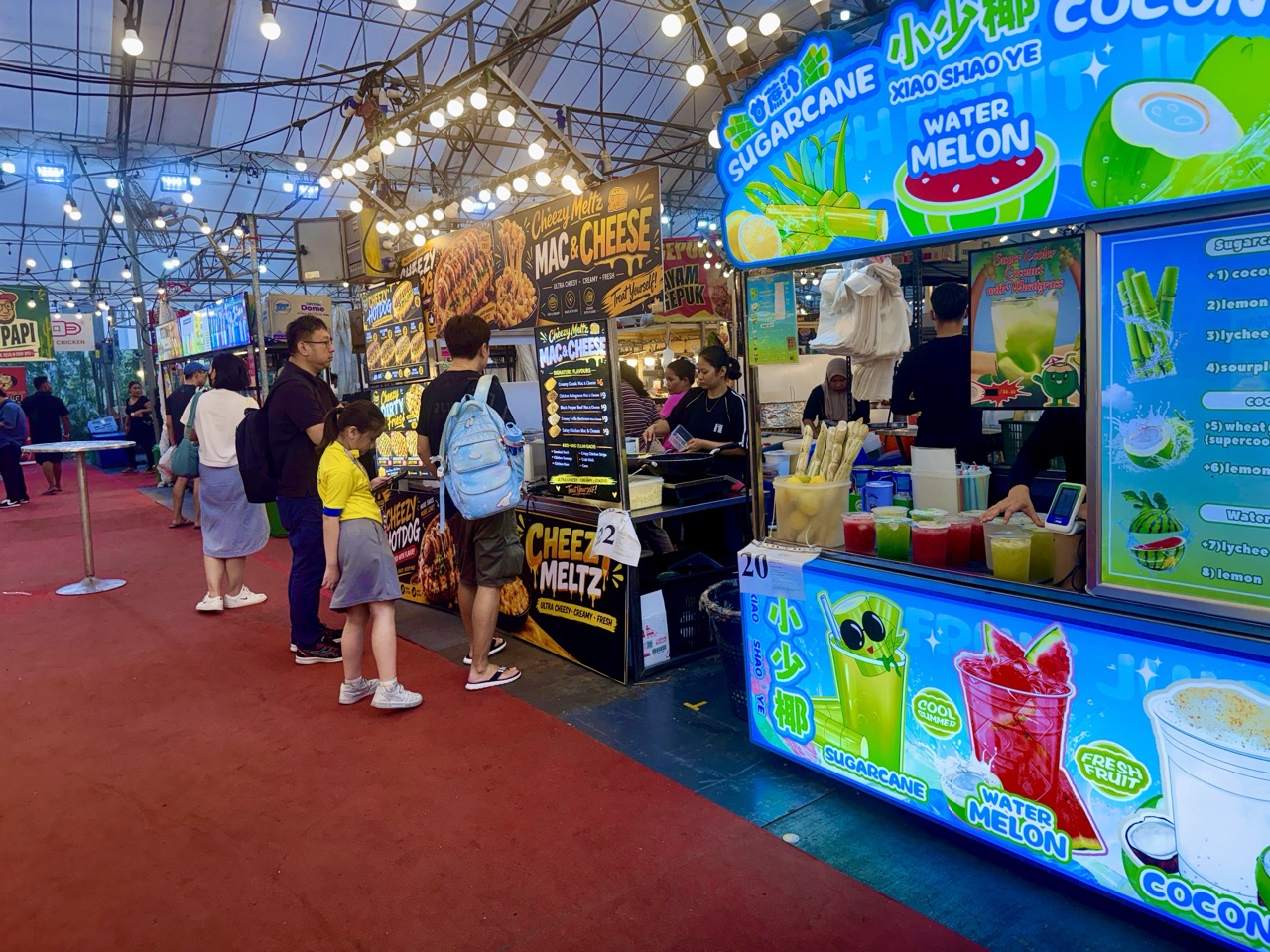
How can a family make safer food choices at the October 2026 Punggol pasar malam? Start with the basics: look at current food-handling conditions, ask about ingredients when needed, choose appropriately cooked and stored food, and eat promptly rather than leaving prepared meals in the heat. Our freshly uploaded Punggol photographs show a sugarcane drink counter, macaroni and cheese, Ramly burgers and queues for biryani. These are useful scenes for explaining real food-safety principles, but they are not inspection photographs and cannot establish whether any named stall has complied with, or breached, a particular requirement.
The photographed Punggol night market was reported to run from 30 September to 31 October 2026 beside Waterway Point near Punggol MRT Exit B, with daily hours advertised as noon to 10pm. This article is a dated food-safety and consumer-education companion, not a live stall directory. For food choices, directions and family budgets, use the Punggol Pasar Malam Visitor Guide. For the small-business economics of the same images, use our Punggol pasar malam economics guide. Here the priority is food handling, temperature, allergies and how to interpret what a photo can tell you.

Food safety at a Punggol pasar malam: direct answers
- Official regulator: Singapore Food Agency (SFA), which publishes food-safety and temporary-fair permit requirements.
- Temperature danger zone: SFA identifies 5°C to 60°C as a range in which foodborne bacteria can multiply more readily.
- Hot and cold holding: SFA consumer advice says keep hot cooked foods above 60°C and chilled foods at around 4°C or lower when storage is needed.
- Separate duties: a qualifying fair organiser needs a permit and stalls that prepare or handle food require relevant temporary-fair food-stall licences coordinated through the organiser.
- Allergies and dietary requirements: ask the actual vendor and check current certification or ingredient information. A photo cannot establish cross-contact safety or halal status.
- Food-handler masks in 2026: the general SFA policy ended mandatory mask/spit-guard use on 1 January 2026; a temporary-fair webpage still contains older compulsory language, so specific licensing questions should be clarified with SFA.
- After purchase: eat prepared food promptly or handle storage and transport appropriately; don’t leave perishable takeaway sitting for hours in Singapore’s heat.
- Responsible reporting: observe before choosing food, but do not accuse a business of noncompliance based on a wide photograph.
The primary sources are SFA’s temporary-fair requirements, Temperature Control in Cooked Food, SFA Food Safety Tips and the 2026 food-handler face-covering guidance. Where an official rule changes, the newer current guidance should be checked with SFA rather than silently copying an outdated claim.
A market counter is more than its displayed food
A visitor first notices the dish, price and queue. Food safety involves a much longer route: sourcing ingredients, transporting them, storing them, preparing them, serving and disposing of waste. Problems at any stage can affect the final meal. A busy outdoor fair still requires deliberate control over these steps. Temporary does not mean exempt from food safety.
However, an ordinary photograph captures only a portion of the process. It cannot prove how meat was stored before opening, how often utensils were sanitised or whether a worker completed the required training. The responsible writer identifies what SFA requires without transforming every unseen step into an accusation against a pictured business.
Why the 5°C–60°C range matters
SFA describes 5°C to 60°C as the temperature danger zone, where many foodborne bacteria can multiply more readily. Perishable food held in this range for too long may become unsafe even when it initially looked and smelled normal. Hot cooked dishes intended for holding should generally be kept above 60°C, while chilled foods need suitable refrigeration. SFA’s general guidance recommends chillers at 4°C or lower.
A parent does not need to carry a thermometer through the night market to understand the principle. The practical question is whether food that should be hot is being handled and served appropriately, and whether cold food is kept in suitable chilled conditions. We cannot diagnose storage temperature by looking at a glossy photo or the colour of food.
Food temperature and serving temperature are different questions
A dish may be served warm enough to feel pleasant while having spent too long at an unsafe holding temperature before service. Conversely, a freshly cooked meal can cool slightly between the counter and a family table. Food-safety assessment depends on the full time-and-temperature history, not simply how warm the spoon feels at the end.
SFA advises consuming cooked food soon after preparation and maintaining appropriate storage when serving is delayed. A family should avoid leaving a perishable takeaway meal in a hot car or carrying it around for hours before eating. If a serious storage concern arises and the vendor cannot clarify it, choosing another food is sensible without making a public allegation.
Biryani and the special importance of rice handling
Our photographs show people queueing for biryani. Rice and starchy cooked foods can be relevant to food safety because SFA discusses Bacillus cereus, a spore-forming bacterium associated with certain foodborne illnesses. Cooking may not eliminate every resistant spore, so safe handling and temperature control after cooking matter.
This is a general scientific principle, not evidence of a problem at the pictured biryani stall. A freshly served, properly handled rice meal may be an ordinary safe choice. The photograph tells us customers were waiting; it does not tell us the batch’s temperature history. Responsible education explains the risk mechanism without implying a named business caused an illness.
Why some bacterial toxins complicate reheating
SFA notes that thorough cooking removes many bacteria but may not eliminate all bacterial spores or toxins produced after improper storage. That is why reheating is not a guaranteed rescue strategy for food left in unsuitable conditions. The best protection is preventing improper time and temperature management in the first place.
Do not ask a vendor to reheat visibly questionable food and assume it must become safe. If you cannot establish that a perishable item has been properly handled, declining the purchase is a reasonable consumer choice. Families should also follow similar principles when storing leftovers at home.
The Ramly burger photo and the distinction between raw and ready-to-eat
The burger counter photograph is a useful way to discuss cross-contamination. Raw ingredients may carry microorganisms that should not transfer to cooked, ready-to-eat portions. Food businesses need appropriate handling and separation practices, including clean equipment and hands. SFA’s food safety advice emphasises keeping raw food separate from cooked food and using proper utensils.
A photo of a person cooking does not show every part of their workflow. It cannot prove that raw and cooked ingredients were handled incorrectly. A customer can pay attention to obvious conditions, but formal compliance conclusions require appropriate evidence. Parents can explain the principle using safe food preparation at home instead of scrutinising individual workers as though they were being examined.
Why a cooked burger still needs safe handling
A patty may be thoroughly cooked and then placed with other ingredients, sauces and bread before serving. The final portion can come into contact with utensils, hands and surfaces after cooking. This is why handling ready-to-eat food carefully matters, rather than assuming heat at one earlier stage makes all subsequent practices irrelevant.
At home, children can practise the same reasoning without preparing risky food themselves. Wash hands appropriately, keep clean preparation areas and don’t reuse a utensil that has touched raw meat on ready-to-eat food. The general rule helps explain what trained food handlers aim to prevent in a commercial setting.
Why minced-meat patties deserve proper cooking
SFA’s Food Safety Tips note that minced meat patties deserve special attention because mincing can expose more of the meat to bacteria. Thorough cooking is important, especially for people more vulnerable to foodborne illness. A burger’s exterior appearance is not a reliable substitute for appropriate cooking throughout.
This is not a claim that any photographed burger is undercooked. The media does not include food-temperature measurements or an internal cut of a specific patty. The useful consumer response is to request properly cooked food and raise a concern directly with the vendor when necessary, rather than publish accusations from a wide-angle stall image.
Macaroni and cheese: dairy and prepared sauces
Macaroni-and-cheese dishes can contain dairy products and cooked sauces, depending on the recipe. Perishable ingredients and prepared servings require appropriate handling and storage. A sauce that looks creamy does not reveal whether it is freshly cooked, held warm or chilled before service. Nor does its appearance tell you whether the recipe contains dairy or any particular allergen.
If a child has a milk allergy, the safe question is whether the actual current dish contains milk or may have relevant cross-contact. An adult should not assume that cheese can simply be removed from a prepared dish to make it suitable. When the vendor cannot confirm a medically important restriction, choose an alternative.
Sugarcane drinks and processing equipment
Our Punggol image includes a sugarcane drink counter. Fresh drinks may require washing ingredients, maintaining equipment and serving in clean cups. Their preparation workflow differs from heating food in a wok, but food hygiene and safe sourcing remain relevant. SFA’s temporary-fair requirements apply to qualifying drink preparation stalls, just as they do to relevant cooked-food stalls.
We cannot inspect milling equipment through a distant image. A glossy or bright machine is not proof of sanitary handling, and an unfamiliar arrangement is not proof of misconduct. A thoughtful guide encourages questions about safe processing while leaving official compliance assessments to verifiable sources.
What ice and water have to do with drink safety
Drinks can include ice or water, and those ingredients must be suitable for consumption. Handling ice with clean utensils and avoiding contaminated surfaces are standard food hygiene concerns. Warm outdoor temperatures also mean perishable ingredients should not be left unprotected. The safest information about a particular drink comes from the vendor and the stall’s actual conditions.
A parent may choose a bottled alternative if a child has a particular restriction or if questions cannot be answered. That choice need not be framed as an accusation against a sugarcane seller. Different products meet different needs, and sensible consumer caution can be expressed courteously.
A clean cup does not tell the whole story
Customers often judge a beverage by the cup, lid and appearance of the stall. These details matter to perception but do not cover ingredient sourcing, cold storage, equipment sanitation or the food handler’s actions. Packaging can protect a drink during movement, yet a sealed cup alone cannot certify every earlier step.
Ask children to distinguish observable and hidden controls. They might see a cup with a lid; they cannot see whether a chiller held ingredients at an appropriate temperature yesterday. A good Science answer identifies the missing evidence instead of pretending the object can be fully evaluated by its appearance.
Why a menu description may not be enough for allergies
An item named ‘macaroni and cheese’ clearly suggests some ingredients, but toppings, sauces or preparation equipment can introduce others. A dish with a familiar name may also use a recipe different from the one a family makes at home. The same is true for burgers, rice dishes and drinks. Do not rely on assumptions when a serious allergy is involved.
Ask about the relevant ingredient and possible cross-contact rather than merely asking whether something is ‘safe’. If the staff cannot confirm, the family should not be pressured into buying. The goal is a suitable meal for the individual, not a verdict about the vendor’s general quality.
Halal, vegetarian and other dietary claims require current evidence
A Ramly-style burger photograph does not automatically establish halal certification. A vegetable-looking pasta dish does not establish vegetarian preparation, and a drink may contain additives beyond the obvious ingredient. Certification and specific dietary suitability must be checked against the actual stall and relevant current information.
This is a general rule of honest food writing. Do not place badges or claims in a local guide that the photographer did not verify. Respect both the customer’s dietary requirements and the business’s right not to have unsupported labels assigned to its products.
The difference between a fair permit and an individual stall licence
SFA requires organisers of qualifying temporary fairs to obtain a permit. For stalls preparing or handling food and drinks at those fairs, the operator coordinates the applicable individual stall licences. The application rules also call for the necessary site documentation and descriptions of food-handling facilities. A customer sees a market of small counters; legally and operationally it is an organised event with defined responsibilities.
Understanding this structure is useful when a reader asks who to contact about a question. The organiser oversees the fair, while stallholders handle their individual food service within the required framework. Current SFA and event information should decide the appropriate contact, not guesses based on which counter appears closest to the entrance.
Can a passer-by verify a licence from a photograph?
No. SFA requires display of the relevant approval materials according to applicable rules, and its consumer advice explains how licence information and QR codes may help customers check food-business records. But a low-resolution wide view of a fair does not identify every displayed document or its validity. An unseen licence in the image is not proof that none exists.
If a genuine licensing question matters, look at current on-site information and appropriate official records or contact SFA. Avoid public claims that could damage a business based on speculation. Regulatory systems exist precisely so important findings need not be invented by casual observers.
Why official mask guidance deserves a careful 2026 reading
SFA’s newer general guidance says face masks or spit guards ceased to be mandatory for food handlers from 1 January 2026, while remaining encouraged as a good practice. However, the current temporary-fair requirements webpage still displays mandatory wording about face coverings. Those two texts are not fully aligned in presentation, so anyone operating a fair should seek clarification from SFA about the specific applicable condition.
For customers, the practical lesson is not to decide compliance from a photo showing a worker with or without a mask. Clean handling, time-and-temperature control and appropriate food preparation remain important. A single visible garment does not tell the entire story, especially while official pages contain wording that needs reconciliation.
Training food handlers matters beyond appearance
SFA’s temporary fair guidance requires relevant food handlers to complete the specified food-safety training and be registered where applicable. This reflects the fact that risks often come from practices not visible to consumers. Proper training covers ways of preventing contamination and handling food safely during busy service.
A family cannot verify every worker’s training by looking at a uniform or whether they are smiling. A photograph is a record of a scene, not a personnel file. Readers who need formal assurance should use appropriate official business information rather than confront staff with unverified allegations.
What should a customer notice before ordering?
Start with general visible conditions: is the stall’s food protected from unnecessary exposure, does the counter look orderly, and is there an appropriate place to queue without bumping into hot equipment? Those observations can inform a customer’s choice, but they are not a full inspection. A food business can meet or fail a particular requirement in ways not apparent from a casual glance.
Ask short questions when something matters to you. If the vendor cannot explain an essential ingredient or storage detail, selecting another item is sensible. The aim is to make a decision without making false public claims. Consumer judgement and formal enforcement serve different roles.
Protecting children near hot food preparation
A food stall may use griddles, hot oil, steam or heavy pots. At a busy temporary fair, a child can become interested and step too near the counter while adults are paying. Keep appropriate supervision, choose a safe waiting position and avoid reaching past the vendor into the work area.
Safety is not only about microbes. A hot container can spill during collection, and a child carrying a large drink through a crowd may lose their grip. One adult can collect hot items while another supervises younger children when the arrangement is safe and practical. With one caregiver, choose a simpler ordering plan rather than trying to manage several counters at once.
Why large queues require practical care
A popular counter may attract a line that bends around neighbouring stalls. People can become distracted while looking at menus, choosing payment methods or taking photos. Give workers room, keep walkways clear and avoid queuing in front of another stall’s preparation area. If the crowd feels unsuitable for a young child or someone who cannot stand for long, change the plan.
Queue length is not a food-safety grade. It could reflect demand or preparation time. Do not choose food solely because the longest line looks like a reliable public endorsement. Food safety, taste, suitability and convenience are different considerations.
Why waste bins belong to food safety
SFA’s fair requirements call for adequate lined litter receptacles, appropriate waste collection and clean site conditions. Waste management helps prevent problems from accumulating around food preparation and public circulation. A temporary event may require special logistical arrangements to keep the venue suitable throughout its run.
Visitors can help by disposing of wrappers, napkins and containers properly. If a bin is overflowing, use another suitable receptacle or keep your rubbish temporarily rather than adding to a spill. This does not make the customer responsible for the organiser’s entire sanitation system, but it acknowledges that public hygiene is shared.
What if the weather changes during the visit?
An outdoor pasar malam is affected by rain, humidity and heat. Food stalls have to operate within safe conditions, while visitors must consider their own safety. A tarpaulin or tent does not make an outdoor area safe during a thunderstorm. Follow official warnings and site staff directions if activities are paused or a route is closed.
Do not assume a stall’s normal advertised hours mean it will continue operating under every weather condition. A family plan should allow for postponement, an alternative meal or a shorter visit. People can enjoy a market without treating the last scheduled hour as a guarantee of service.
Takeaway food should not become a long warm-storage experiment
After purchasing a perishable cooked meal, eating it promptly is usually more sensible than carrying it around for a long shopping trip in Singapore’s heat. SFA explains the risk of leaving cooked food within the 5°C–60°C danger zone. If food is for later, appropriate temperature management is necessary; ordinary room-temperature holding may not be suitable.
A child may ask why food that was cooked properly could become risky later. Explain that cooking and later storage are different stages. Some organisms or toxins create problems when cooked food is mishandled after preparation. The safe habit is to plan when the meal will be eaten, not rely on repeated reheating as a universal remedy.
What about food left in a car?
A hot parked car is not a refrigerator or a safe holding cabinet. Perishable meals and milk-based drinks should not be left there for extended periods. If a family buys takeaway before another long outing, it should consider whether the meal can be transported and consumed under suitable conditions instead of buying too early.
We cannot provide a universal safe time for every dish without knowing ingredients and temperature history. SFA’s current food-safety guidance remains the primary reference. When a family is uncertain whether a perishable item has been kept safely, caution is more important than avoiding food waste at any cost.
Understanding foodborne illness without frightening children
Foodborne illness can involve stomach cramps, vomiting, diarrhoea and other symptoms. SFA explains that young children, older people and those with weakened immune systems may be more vulnerable. This is a reason for practical hygiene and food-handling decisions, not a reason to portray every street-food experience as dangerous.
If someone develops severe symptoms or is particularly vulnerable, obtain appropriate medical advice. Do not try to identify a culprit from photographs or speculate online that a particular vendor caused illness. Genuine public-health investigations depend on evidence and official procedures.
How to make a family food-safety checklist useful
Before buying, identify any allergy or dietary need, check the current stall’s information and choose a meal suited to the person. During ordering, keep children clear of hot preparation areas and follow the queue. On collection, confirm the order and handle hot items carefully. After purchase, eat perishable food promptly or store and transport it appropriately.
This checklist is intentionally practical. It cannot replace the business’s legal duties, and it does not make a customer a food inspector. It helps a family make everyday decisions while respecting the venue and the staff whose work makes the meal possible.
A short Primary Science question: what causes germs to grow?
A pupil can learn that temperature, time and suitable conditions affect the growth of many microorganisms. Using SFA’s 5°C–60°C danger-zone guidance, ask why hot dishes should be held hot and cold dishes cold. Avoid conducting unsafe experiments with cooked rice or meat to prove the concept. Explain the idea using verified examples instead.
For younger pupils, the useful sentence is: ‘We keep food at suitable temperatures because some germs can multiply when food is left in the wrong conditions.’ A child does not need to memorise pathogen names to understand the safety purpose. The scientific language can deepen as the pupil grows older.
An upper-primary fair-test discussion
Imagine two sealed, hypothetical model containers representing food at different temperatures. A teacher could use a chart of safe storage rules rather than actual risky food samples. Ask which variable differs and what conclusion the student would be allowed to draw. A fair test controls other conditions, and safety must never be compromised for a classroom demonstration.
A photograph of a sugarcane stall is not a controlled experiment. It provides a prompt to ask which evidence would be needed to evaluate handling. The student should distinguish observation, test design and official food-safety instruction. This is a transferable Science skill.
A Secondary Science explanation of risk
Food safety is not one single property. Risk can depend on microbial contamination, temperature, time, ingredients, handling and the consumer’s vulnerability. A particular bacterium may behave differently from another, which is why one blanket shortcut cannot replace validated safety guidance. SFA’s explanation of resistant spores in cooked rice illustrates this complexity.
An older student can construct a causal chain: inappropriate storage allows growth, increased contamination may raise illness risk, and prompt correct storage reduces that risk. They should avoid claiming any named Punggol stall followed the harmful chain. The exercise is about mechanisms, not an investigation of a real individual.
What a photograph cannot verify
The images can show a counter, food type, people waiting and some equipment. They cannot verify the internal temperature of a dish, training records, water quality, the true ingredient list or a licence’s validity. They also cannot establish what happened before or after the exposure. That evidential limit applies equally to attractive clean-looking counters and untidy-looking snapshots.
Treat photographs as scene-setting evidence and use authoritative food-safety sources for technical claims. A caption like ‘Macaroni and cheese stall at Punggol night market’ is grounded. ‘This stall was hygienic’ or ‘This vendor violated SFA rules’ requires information the picture does not supply. Accuracy protects both readers and businesses.
A short English activity: explain rather than accuse
Ask a child to write one sentence observing the market and another explaining a general safety habit. The first might say, ‘A vendor is serving food while customers wait.’ The second could say, ‘Food handlers should prevent raw ingredients from contaminating ready-to-eat food.’ Neither needs to invent what an identifiable person was doing outside the frame.
This is useful source-aware writing. The child practises forming an explanation while keeping fact and inference separate. A parent can praise careful wording rather than reward dramatic claims. Responsible storytelling is part of practical information literacy.
The 10-cent beverage deposit is not automatically part of sugarcane juice
Singapore’s Beverage Container Return Scheme began on 1 April 2026 and applies to eligible pre-packaged plastic and metal drink containers bearing the Deposit Mark. A freshly prepared sugarcane drink served in an ordinary cup does not automatically become a marked scheme container merely because it is a beverage.
Check the actual packaging before claiming that a deposit applies or can be refunded. NEA’s Beverage Container Return Scheme guide explains which containers are covered and how return points work. This is another example of why appearance and category matter: not every ‘drink’ uses the same packaging or recycling process.
Food waste and environmental responsibility
Families may want to reduce packaging or leftovers while still choosing hygienic food. Those goals can reinforce one another but occasionally require trade-offs. Some packaging helps transport prepared food safely; reusable options must also be clean and appropriate. Avoid pressuring vendors to accept unsuitable containers or change procedures in ways that compromise safety.
A good outing ends with leftover handling, proper disposal and respect for the site. Children can learn to buy portions that fit their appetite and leave the market clean. Environmental responsibility is more useful when it aligns with food safety rather than trying to ignore it.
When a specific concern requires official help
If you believe food is unsafe, stop eating it and consider appropriate medical guidance if needed. For a genuine business or public-health complaint, use SFA’s official channels and provide relevant, factual information. Avoid posting accusations based on a distant photograph or making allegations about workers’ identities or motives.
Public reporting can be important, but credible reporting depends on evidence, appropriate authority and proportional response. A consumer can choose not to buy an item without conducting a public trial of the vendor. Protecting health and treating people fairly are compatible responsibilities.
After October, what remains useful?
The photographed Punggol edition was advertised through 31 October 2026. Once it ends, this article continues as a dated record and an explanation of general food-safety principles. It should not be read as an assurance that the same stalls are still trading at the same field on a later date.
The science of time, temperature, contamination and careful consumer choice continues to apply. Event locations and specific regulations can change. When a family plans a future market visit, the current organiser, SFA and on-site information must be checked. A good local guide remains useful by distinguishing lasting principles from time-limited particulars.


Frequently asked questions
Is the October 2026 Punggol pasar malam permanent?
No. The documented edition was advertised from 30 September through 31 October near Punggol MRT Exit B.
Who regulates temporary food fairs?
SFA publishes requirements for applicable fair permits and food-preparation stall licences.
What is the food temperature danger zone?
SFA identifies 5°C–60°C as a temperature range in which many foodborne bacteria can multiply readily.
How hot should hot-held cooked food be?
SFA consumer guidance advises holding hot cooked food above 60°C when it will not be served immediately.
How cold should chilled food be?
SFA generally recommends refrigerator and chiller temperatures of 4°C or lower.
Can cooked rice cause foodborne illness if mishandled?
Yes. SFA discusses Bacillus cereus and the importance of safe handling after cooking. This is a general fact, not an allegation about a photographed stall.
Is a reheated meal always safe?
No. Some pathogens form spores or toxins, and reheating cannot be assumed to reverse every risk caused by improper storage.
Does a burger photo prove its meat was fully cooked?
No. Appearance at a distance does not measure internal cooking temperature.
Are macaroni and cheese dishes always safe for milk allergies?
No. Confirm ingredients and cross-contact concerns directly with the stall when allergy safety matters.
Is sugarcane juice subject to food-handling rules?
Relevant temporary-fair food and beverage preparation falls under SFA’s applicable stall rules.
Does an uncovered drink automatically prove an offence?
No. Formal compliance conclusions require the specific rule, actual circumstances and appropriate evidence.
Must every food handler wear a face mask in 2026?
SFA’s updated general guidance ended the broad mandate in January 2026, while a temporary-fair page still carries older language. Specific licence obligations should be clarified directly with SFA.
Can I infer halal certification from a Ramly burger sign?
No. Verify current certification and relevant vendor information.
Does a visible long queue mean the food is hygienic?
No. Queue size is not a food-safety grade.
What if I plan to eat takeaway later?
Keep perishable food within appropriate time-and-temperature conditions rather than leaving it in a warm environment for hours.
What does the 10-cent deposit scheme cover?
Eligible pre-packaged plastic and metal beverage containers carrying the Deposit Mark, not every fresh drink sold in a cup.
Are photographs proof of licences?
No. Verify actual displayed information or contact the relevant official authority for material questions.
Should children investigate real food stalls for Science homework?
Use safe theoretical exercises and authoritative information. Do not conduct risky food experiments or intrude on workers.
What should I do if I suspect food poisoning?
Seek appropriate medical advice for symptoms and use SFA’s official reporting channels for genuine food-safety concerns.
Can this guide guarantee a particular stall’s safety?
No. It explains general principles from official sources and treats the October photos as scene records.
Official food-safety sources and related Punggol articles
- SFA — Temporary Fair and Food Stall Requirements.
- SFA — Temporary Fair Application Process.
- SFA — Temperature Control in Cooked Food.
- SFA — Food Safety Tips for Consumers.
- SFA — Wearing of Masks or Spit Guards by Food Handlers, Updated 2026.
- NEA — Beverage Container Return Scheme.
- SethLui — Punggol Pasar Malam October 2026 Date and Location.
- Punggol Pasar Malam: Visitor and Food Guide.
- Punggol Pasar Malam: Food-Stall Economics.
- Hand Hygiene in Punggol.
Photo and editorial record: 23 October 2026. These photos were uploaded to eduKatePunggol in October 2026 and are used only to document visible food counters and crowds. No assertion about an individual vendor’s compliance, licence, worker credentials or food temperatures is made. The discussion of conflicting mask language highlights a source discrepancy; operators should consult SFA for applicable terms. This article does not replace current regulatory guidance or individual medical advice.


