
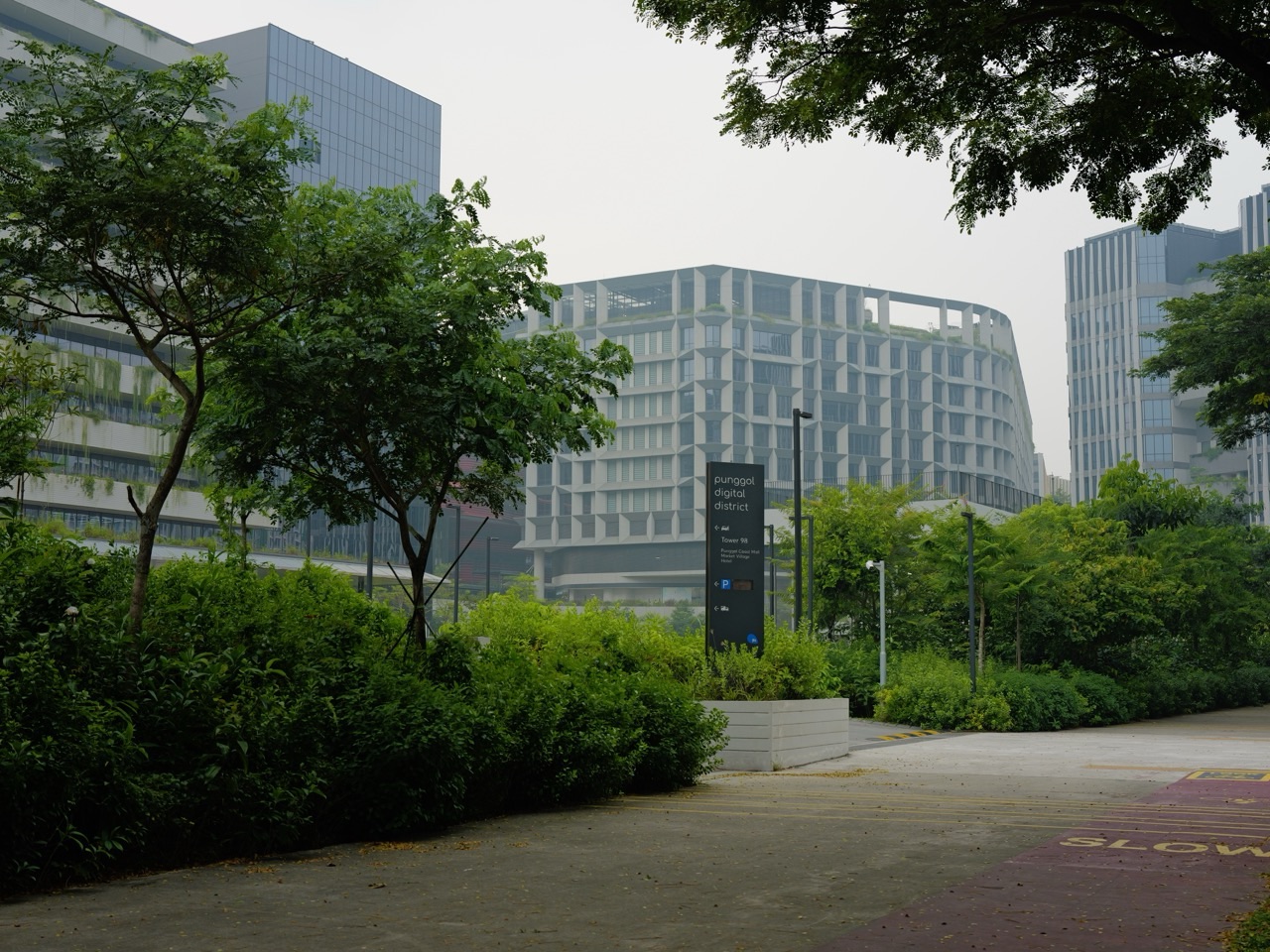
Punggol’s future is arriving in stages. One of its most consequential milestones has already happened: UOB began operating its global technology and innovation centre at Tower 80 in May 2026. The useful question now is what a functioning, growing technology workplace might change for residents—not what an old opening forecast once said.

The short answer: Tower 80 is operational, but the district is still evolving
Updated 23 October 2026. UOB’s S$500 million global technology and innovation centre at Tower 80, Punggol Digital District is not an unopened promise. UOB confirmed that nearly 400 staff began work at the site on 4 May 2026. The company said in its 5 May announcement that it expected more than 3,000 employees, mainly in technology, digital and innovation roles, to be based there by October. That was a company relocation target; an exact independently verified staff count for 23 October is not established by that announcement.
The facility has around 300,000 square feet of space and is intended as a regional technology hub. UOB described one hundred collaborative spaces, flexible desks, AI-enabled whiteboard cameras, planned robotic services for cleaning, security and mail, rooftop solar and smart energy management. These details explain the kind of workplace being built. They do not mean the public can walk in, that every promised robot is already deployed, or that 3,000 new jobs have been advertised.
What comes next is the more interesting local question. As teams consolidate, how do weekday footfall, transport, campus collaborations, digital careers, food demand and service patterns change? Punggol residents can gain from a large technology employer without working there, but the benefits must be observed rather than declared. The future of Punggol depends on everyday use of the district, not only the completion of another office facade.
What is confirmed, targeted and still unknown
Begin with a timeline that respects the evidence. On 18 April 2023, JTC and UOB announced the planned investment and technology centre, with a completion target then described as end-2026. On 5 May 2026, UOB issued a stronger update: the centre had commenced operations, with almost 400 staff starting the previous day and a phased move involving more than 3,000 employees targeted for October. A project once described as future infrastructure has become a functioning workplace.
There are still limits to what the public release proves. It does not give a day-by-day headcount or identify how many staff relocated from existing premises. It does not list every floor’s access policy, opening hours, office canteen rights, public events or job vacancy. An external observer can see activity at the district but cannot infer the employment status of people entering Tower 80.
For a reader trying to plan, the correct classification is: operational for the workplace since May; company-stated target for the October workforce ramp-up; possible but unconfirmed for extra business demand, public access and individual career opportunities. This prevents old articles saying ‘will open in 2026’ from overruling newer facts and prevents fresh reporting from promising effects nobody has measured.
Why UOB chose Punggol Digital District
Punggol Digital District was designed to place business park space next to Singapore Institute of Technology’s campus and supporting public areas. Companies can potentially collaborate with researchers and students without arranging every interaction across distant neighbourhoods. UOB, as a regional bank with substantial technology operations, stands to benefit from teams working in the same environment where other digital organisations and public agencies are present.
That proximity does not create an automatic partnership with every neighbour. A bank operates under stringent obligations involving client confidentiality, cybersecurity, financial crime prevention and operational resilience. A student cannot assume they may access a bank’s datasets because a campus is next door. Collaboration needs agreed objectives, supervised projects, contractual permissions and often carefully anonymised or synthetic information.
The local opportunity is an ecosystem with many forms of expertise. A software engineer, cybersecurity analyst, human-centred designer, building operator and academic researcher all approach problems differently. Shared geography can encourage useful conversations, but outcomes depend on incentives, staff time and whether the project improves a real service. The value comes from relationships that work, not the shared postal code.
What 300,000 square feet means—and does not
A space measurement gives a sense of physical scale: Tower 80 is not a small retail branch tucked into a shopping centre. It is a major office facility for technology-related operations. But the square footage does not tell a resident the number of people present on a particular Monday. Flexible desks, meeting rooms, hybrid arrangements and different team schedules all shape daily occupancy.
The announced 100 collaboration spaces refer to spaces inside the UOB workplace for activities ranging from project discussions to hackathons. The term should not be mistaken for a hundred public meeting rooms. Likewise, AI-enabled cameras and plug-and-play desks illustrate a workplace strategy, not a guarantee that external visitors can book equipment or tour the interior.
When planning commercial services near a large office, the relevant variable is actual demand at specific times. A restaurant may care how many workers buy breakfast or lunch; a transport operator cares where and when people arrive; a student cares whether an approved company event is open to them. Building size alone cannot answer those different questions.
Three thousand staff are not three thousand newly created jobs
The difference between relocation and hiring is crucial. UOB described moving and consolidating technology, digital and innovation employees into a centre in Punggol. Existing staff can change workplace without changing employer, role or headcount. Some organisations also recruit while consolidating, but the release does not break down an exact number of net new external positions at Tower 80.
A jobseeker should resist equating the number on a press headline with a recruitment target. The correct evidence of a real opportunity is an official vacancy with a named employer, duties, skill requirements, location and application procedure. A Punggol postal address on a career page should still be checked with HR, because some roles involve multiple sites or hybrid working.
This is not a reason for pessimism. A large local technology workforce can increase the visibility of technical professions and create opportunities for collaboration and supply services. It simply does not provide a guarantee to every student or career changer. The distinction protects households from investing time or money on imagined hiring plans.
What jobs actually exist around digital banking?
Digital banking involves much more than building a mobile app. Banks must run reliable payment processing, identity systems, secure data infrastructure, fraud detection, lending services and customer-support tools. Professional roles can include software engineering, quality assurance, cybersecurity, infrastructure operations, data governance, business analysis, user experience, product management and regulatory technology.
Some jobs require advanced specialist knowledge; others focus on operational discipline, clear documentation and coordination. A person who has improved a customer-service process may have useful experience for a business analysis role. An ITE graduate who enjoys technical troubleshooting might explore properly advertised support pathways. A polytechnic student may develop test automation or analytics competence. None should assume that one short certificate converts them directly into a senior banking technologist.
The first task is to study actual role descriptions rather than the label ‘innovation’. Write down what the employer expects someone to do each week, what risks the role manages and how performance would be judged. That approach creates a realistic learning plan and prevents fashionable terms such as AI or fintech from hiding the substance of the job.
The bank’s technology is regional, not merely local
UOB has described Tower 80 as a place to develop and scale banking capabilities across ASEAN. A system designed for one market may need to account for differences in languages, customer expectations, payment practices and regulation elsewhere. This helps explain why technology teams include product, operational, security and localisation expertise rather than only programmers.
For a young learner, the insight is that effective technology respects context. An interface that works for a confident English-speaking user with a new phone may be less accessible to a person with a different language preference or limited digital confidence. Designing a regional product requires careful testing with different user needs and appropriate legal checks.
A family can turn that into a modest educational project: compare how clear two fictional app instructions are for users of different ages, then revise the language. Use synthetic information, obtain consent for feedback and focus on accessibility. No one needs a bank’s internal tools to learn the underlying discipline of responsible design.
How AI could change work inside a bank
UOB has cited the use of Ask#1, a generative-AI tool supporting branch staff, as one example of its digital transformation. That illustrates a possible division of labour: software can help staff retrieve information or prepare a response, while people remain responsible for confirming accuracy and handling customers appropriately. It is not evidence that every banking decision should be entrusted to automated output.
The practical risks of an AI assistant include outdated knowledge, fabricated details, misplaced confidence and accidental disclosure of sensitive data. A professional system needs governance over which sources are trusted, what information is permitted, how outcomes are reviewed and how mistakes are corrected. These questions grow in importance as technology expands beyond demonstrations into daily operations.
Students preparing for a digital career should learn how to check machine-generated output against reliable evidence. A useful test is to give an AI tool a harmless public information question, independently verify the answer, record errors and improve the prompt or retrieval method. The key skill is judgement, not merely asking a machine to produce a paragraph.
Robots for cleaning, mail and security: what the announcement establishes
UOB’s May 2026 release says robotic technology will be deployed for security, cleaning and mail delivery within the building. The word ‘will’ describes an intention; it does not certify that all the robots are in everyday use at the time of this article. Such systems can be useful when repetitive physical tasks are well defined, routes are safe and exceptions can be managed.
A robot carrying documents must be authorised to enter only relevant spaces, not simply be capable of passing a door. A cleaning machine must detect obstacles and interact safely with people. A patrol system must respect privacy and have clear responsibility for decisions. These requirements show why deploying robots in a working office is more complex than demonstrating them in an empty room.
Public interest in robots should not lead to interference. If a resident sees an authorised trial in a public area of PDD, it is appropriate to observe from a safe distance and follow signage. Do not attempt to block sensors, command the machine, follow it through a controlled doorway or infer that the operator permits public participation. The boundaries of each trial matter.
Punggol’s existing transport and the changing workday
A large workforce entering a new district can alter travel patterns. Punggol Coast MRT and the area’s bus, walking and cycling links are part of the broader mobility system. Office activity may create peaks at different times from school and weekend leisure travel. But it is premature to publish a precise congestion forecast based on the company’s targeted headcount alone.
The best way to evaluate the change is to measure actual journeys over comparable days. A resident can note the departure time, train waits, walking route, lift access and journey completion for several weekdays. Compare the same route before drawing a conclusion that the bank has improved or worsened a commute. Rain, school holidays and unrelated transport changes can affect results.
For workers, shorter proximity to home is only a benefit if the assigned job location is indeed Punggol. A resident whose role remains at another site gains no automatic travel reduction. Parents should assess childcare arrangements and work schedules along with the commute rather than assuming a local technology hub resolves every household logistics problem.
Walkable workplaces: how the district’s design matters
URA describes Punggol Digital District as a public-transport-oriented, pedestrian-friendly environment, with integrated walkways, cycling paths and greenery. Tower 80 is part of that setting. A well-connected office precinct can make it easier for workers to reach lunch, campus meetings or transit without using a private vehicle for every short journey.
However, a design intention is not proof that every entrance is open at all hours. A publicly accessible boulevard can lead past private offices with controlled access. Some elevated links are meant for authorised users, while ordinary visitors rely on signed public routes. Families should follow actual wayfinding rather than interpreting an architectural drawing as permission to enter restricted premises.
The central test is usability: can someone with a stroller, mobility aid or bulky bag complete a lawful, safe and reasonably sheltered journey? That depends on crossings, lifts, gradients and clear signage. A good district should work for people with different abilities, not only employees familiar with the building.
What a nearby university changes for professionals
SIT’s proximity may support industry talks, supervised projects and the sharing of expertise. Employees can encounter research questions relevant to software engineering, security, sustainability and human-centred services, while students may be able to observe the standards used in professional workplaces. But no programme is automatically open because two organisations are neighbours.
An academic project involving a bank must respect commercial confidentiality and the university’s own learning requirements. A student could work with synthetic data to understand fraud detection, but should not be promised access to real customer transactions. A collaboration agreement should define supervision, assessment, ownership of work and publication restrictions before any project begins.
For parents planning a student’s education, the presence of employers is an encouraging reason to explore applied learning, not a reason to demand a single degree pathway. Mathematics, communication, ethics and technical fundamentals remain useful across careers even if an individual never joins UOB.
A secondary-school project: reliable digital receipts
Imagine a Secondary 3 student in Punggol who wants to learn what ‘fintech’ means without handling money or customer records. They create a fictional receipt tracker using made-up transactions. Each entry needs a date, category, amount and description. The program should reject a blank amount, identify duplicates and explain an error without blaming the user.
After building the first version, the student asks a teacher or consenting family member to test it. Did the interface work on a small screen? Were category names understandable? Did the program show a misleading total when data were missing? A project report records both successes and failures. The student can then add a simple chart and explain that charts are only as reliable as the information entering them.
The project has genuine educational value because it demands Maths, programming, language precision and testing. It does not claim to use UOB technology, nor does it require contact with the bank. The connection to Tower 80 is conceptual: professionals also have to build systems that handle imperfect inputs responsibly.
A polytechnic student preparing for a technical interview
A polytechnic graduate may see Punggol Digital District as a possible employment destination. Their preparation should begin with reading specific job adverts, identifying required skills and comparing them with completed coursework. If a role requires SQL, the student should demonstrate how they designed a schema, validated data and explained a query’s result. If it requires software testing, they should show test cases and how defects were tracked.
A portfolio does not have to be huge. Two carefully documented projects can be stronger than a list of ten tools used briefly. Each project should state the problem, the student’s own contribution, the method, the limitations and what changed after feedback. Avoid presenting group work as a solo achievement or claiming results without measurements.
The actual job location and compensation must be confirmed by the employer. The PDD address is valuable for orientation but is not a hiring guarantee. A graduate should also apply broadly where their skills fit, because work experience and mentorship may matter more than beginning at a specific landmark.
A mid-career resident thinking about reskilling
Consider a Punggol parent with experience in retail operations who hopes to enter a technology-adjacent role. They already understand customer queues, record accuracy, service escalation and daily problem solving. Those are not software engineering qualifications, but they may be relevant foundations for process analysis, support operations, quality assurance or training.
The next step is to compare current vacancies and identify realistic gaps. If most roles demand prior experience in cloud infrastructure, a short beginner course will not erase that requirement. The parent might instead look for structured entry-level opportunities, a relevant diploma module or an internal transition. Use official SkillsFuture resources to investigate training and avoid promises of guaranteed bank placement.
A sustainable study schedule matters. Even excellent training becomes ineffective if it conflicts with childcare, health and work obligations. The ambition to work nearer home should support the household, not introduce unnecessary financial risk.
What local small businesses should watch
An office with thousands of staff could create opportunities for cafés, food providers, service businesses and neighbourhood retailers. But the daily number of customers is not the same as the target workforce. Some employees may bring lunch, work remotely, purchase services within the building or travel to other parts of town. Those behaviours are not known from a press release.
A small merchant should collect observations across several weeks before changing staffing or signing a larger lease. Track transaction times, order sizes, wastage and the difference between weekdays and weekends. A successful adjustment might be a simple express lunch option; it might equally be that no change is justified. The purpose of measurement is to avoid spending money based on optimism alone.
Companies near PDD should also assess any actual business-to-business opportunity on its own terms. Procurement may require insurance, cybersecurity, safety standards and vendor qualification. Sharing a neighbourhood with a bank is not a right to win its contracts.
Distinguishing UOB Tower 80 from OCBC’s separate hub
UOB and OCBC have separately announced significant PDD investments. UOB’s Tower 80 centre began operations in May 2026. OCBC’s own hub at 98 Punggol Way has been associated with a first-quarter-2027 completion target. Those are different banks, buildings and project milestones. Their workforce capacity figures should not be combined into an invented count of brand-new vacancies.
This matters to jobseekers and visitors because the name ‘Punggol Digital District’ covers numerous buildings. A meeting at Tower 80 is not the same as a meeting at 98 Punggol Way or inside SIT. Entry procedures, company contacts, and security requirements vary. Check the precise address and host before travelling.
Our existing guide to OCBC’s planned 2027 hub covers the separate project. This article is about the impact of UOB’s already operational 2026 workplace as its future daily role in Punggol matures.
Green building claims: evaluate the mechanism
UOB has described rooftop solar photovoltaic panels and smart energy management systems at its new centre. JTC’s wider PDD setting also includes district cooling, integrated waste management and EV charging infrastructure. These features can support more efficient operations, but an energy feature is not the same as an independently measured emissions reduction.
A careful evaluation compares energy use over suitable periods while accounting for occupancy, weather, operating hours and equipment loads. A half-empty floor will naturally consume energy differently from a fully used workspace. If a bank reports savings, readers should ask for the method and comparison baseline rather than accepting a number without context.
The environmental story should also include travel. A car-light district creates conditions for public transport and active mobility, but individual travel emissions depend on where workers live and how they commute. A person who lives farther away may experience a different change from a neighbour who can walk.
The practical meaning of flexible and collaborative office space
Modern project teams sometimes need quiet concentration and sometimes need rapid group discussion. UOB’s mix of collaborative spaces and flexible desk arrangements is intended to support those different activities. The promised benefits, such as more effective teamwork, depend on how spaces are managed and whether technology works reliably.
An AI-enabled whiteboard camera may make remote collaborators better able to follow a meeting. It could also create concerns about who can record discussions and where information is stored. Good operations require clear permissions, secure defaults and methods for sharing material appropriately. A clever device does not replace meeting discipline.
Punggol students can practise similar skills without expensive equipment. A team project can define roles, record decisions and use a common document to track unresolved questions. These habits make collaboration more effective in a classroom and later in a professional workplace.
Privacy and security boundaries inside a banking campus
Financial institutions handle sensitive information. Public fascination with AI offices and robotics should not lead visitors to photograph screens, badges, private meeting rooms or security controls without permission. What is appropriate in a public plaza may be inappropriate inside an office.
A genuine industry collaboration often uses synthetic datasets, restricted environments and contractual safeguards. This is not a limitation of innovation; it is part of making innovation responsible. Customers and staff need to know that experimentation does not compromise their personal information or safety.
For technology learners, ethical boundaries should be taught alongside coding. Do not probe an employer’s networks, attempt to bypass an access control or collect personal data to make a portfolio demonstration appear more impressive. Use approved training environments and share only material you are authorised to publish.
A fictional workday for a Punggol parent
Imagine a parent living in Northshore who starts a new job with an office at Tower 80. Their commute might become shorter than a previous trip to the city centre. But the family still needs to test the actual door-to-door journey and confirm office hours, reporting expectations and where school or childcare drop-off fits. A shorter rail journey does not necessarily resolve a long walk in heavy rain.
The parent can do a weekday rehearsal, identify a sheltered path and prepare a backup plan for a late meeting. Household decisions might also involve whether another caregiver can collect a child and how much buffer is needed between finishing work and reaching an activity. The plan should be based on confirmed work arrangements, not the building’s marketing.
This fictional example illustrates a wider point: jobs closer to home can improve daily life, but the gain is personal and conditional. The practical benefit lies in usable time and reduced friction, not the prestige of a new office tower.
A fictional café experiment near PDD
Suppose a small café sees an increase in customers wearing office passes after a large tenant begins relocating. The owner suspects the workforce has created new lunch demand. Before hiring additional permanent staff, they count orders by half-hour and note weather, holidays and any temporary events over comparable weeks. They also check food wastage and how often the queue causes customers to leave.
If evidence supports a consistent noon peak, the café could test a short menu and clearer order collection. After two weeks it compares wait times, sales and labour cost. The change is only successful if it improves the experience without creating unmanageable expense. A larger workforce is not enough evidence by itself.
This example demonstrates applied mathematics and business reasoning. Punggol’s growth gives merchants questions to investigate, not guaranteed revenue.
How to read the district’s 28,000-jobs projection
JTC identifies an eventual district-wide economic ambition of approximately 28,000 jobs. This is broader than UOB’s Tower 80 and includes the full PDD ecosystem. The number should not be interpreted as 28,000 vacancies currently advertised, 28,000 new jobs in October 2026 or 28,000 positions for people living within Punggol alone.
A forecast of economic activity is helpful for understanding national strategy, but it is not a household income forecast. New office space can house transferred workers, future hires or a changing mix of occupations. A school leaver should make decisions using actual course options and real recruitment requirements.
To keep local commentary honest, report the scale alongside its owner and time horizon. Then use observed vacancy listings, officially announced tenant moves and transport information to describe what is happening now. This avoids double counting the same workers across separate headlines.
Three possible longer-term outcomes
Scenario A: local commuting gains. More northeast residents may obtain roles with workplaces nearer their homes, reducing some cross-island journeys. The benefit depends on matching skills and available positions. Scenario B: new professional networks. University students and companies may establish supervised collaborations, subject to access and selection. Scenario C: changing neighbourhood services. Merchants may respond to observed weekday demand once occupancy patterns stabilise.
These scenarios can occur together, separately or not at the expected scale. They do not constitute UOB forecasts. Some teams may work hybrid schedules; some professional services may be sourced from elsewhere; and companies may adjust their operating footprint over time. A mature local forecast admits these possibilities.
Readers should treat the next twelve to twenty-four months as an opportunity for careful observation rather than a race to predict the town’s future. A change in daily lunch queues, actual career advertisements or a public education programme tells us more than a dramatic rendering.
A resident’s monitoring checklist for 2026–2027
Start with five observable dimensions: commute times, walking access, public events, local services and official job listings. Record a date and source for each. A person who notices a route change should verify whether it is an LTA measure, a temporary construction diversion or a decision by a private building operator.
For job listings, look at UOB Careers or appropriate official recruitment channels. For training, consult the university and SkillsFuture providers. For district planning, refer to JTC and URA. Avoid using a neighbourhood discussion post as evidence of internal bank staffing.
A useful public article should update when UOB releases a newer staffing milestone or new visitor information, but should preserve the original dates of earlier announcements. Readers need to understand what changed, not be shown a timeless paragraph that silently converts an old target into fact.
Frequently asked questions
Is UOB Tower 80 open? UOB confirmed operations started on 4 May 2026. How many workers are based there? Almost 400 started in May; UOB said more than 3,000 would be based there by October. The May release does not independently verify the headcount on 23 October. How big is the facility? Approximately 300,000 square feet. Did UOB create 3,000 brand-new jobs? That is not what the relocation announcement establishes.
Can the public walk into Tower 80? The office is a bank workplace; entry rights must come from an authorised host. Are robotic cleaning, security and mail services active? UOB announced deployment plans; current individual systems need separate confirmation. Is this OCBC’s new office? No, OCBC has a different PDD development. Do students automatically get internships? No. Confirm an actual advertised, supervised programme.
Will Punggol MRT and LRT become more crowded? The exact effect is not established from a workforce capacity number. Can businesses expect thousands of new lunch orders? No; observe actual demand. What should a jobseeker do? Review live vacancies, study requirements and prepare evidence of skills. Is the S$500 million an annual hiring budget? No; it describes investment in the facility and innovation centre.
How to verify the October workforce target without inventing numbers
UOB’s May 2026 statement said more than 3,000 employees would be based at Tower 80 by October. That is a clearly dated employer target, not a live count automatically verified by the arrival of October. A later UOB statement or another dependable source explicitly reporting the actual headcount would be needed to update the outcome. A photograph of a crowded office entrance cannot establish who works in a building, which employer they belong to or the number of staff assigned there.
A responsible chronology retains what was known when: the first cohort began work on 4 May; UOB announced its October workforce target on 5 May; and a subsequent dated report, when available, should establish whether that target was achieved. Hybrid schedules complicate casual observation because the number employed at a location can differ from the number entering on a particular morning. Readers should not turn a staffing target into a claimed increase in peak-hour commuter volume.
This distinction helps local businesses and parents. A merchant planning staffing needs actual purchasing patterns, not a theoretical office headcount. A family considering a new job needs a confirmed work location, contract and routine. A student writing a school report should cite the May announcement as evidence of intent and describe any later verified outcome separately.
A twelve-week project for a student curious about PDD careers
During the first three weeks, the student reads real descriptions of software engineering, user experience, data analytics and cyber defence roles. They select one area that genuinely interests them and note which school subjects are useful. Instead of enrolling in every trendy course, they identify one small, ethical problem they can solve with existing skills and inexpensive tools.
In weeks four through eight, they build a prototype using fictitious data. A student interested in analytics can create a household budget dashboard; someone who enjoys design might improve the accessibility of a mock booking form; a programmer could write a simple system that detects duplicate sample transactions. They record assumptions, test unusual inputs and explain where errors occurred. No real banking credentials, personal records or internal UOB tools are needed.
During the final four weeks, the student asks for permitted feedback, revises the work, writes a plain-language explanation and demonstrates that they understand its limitations. The resulting portfolio demonstrates evidence, communication and personal contribution. It is worthwhile even if the student never applies to UOB: the goal is durable competence rather than an association with a famous technology building.
Official sources and further local reading
The principal source is JTC’s republication of UOB’s 5 May 2026 announcement. The earlier context appears in JTC’s 18 April 2023 centre announcement. Read those chronologically: the later release confirms commencement of operations, replacing older future-tense statements about readiness.
The wider district and streetscape are documented in JTC’s Punggol Digital District overview and URA’s North-East workplace plan. For quick operational facts, see the existing UOB Tower 80 move-in guide; this article focuses on what may change for residents, students and businesses after the first workers arrive.
Editorial boundary: Hypothetical families, cafés, interviews and school projects are illustrative teaching cases rather than reported UOB programmes. Job availability, exact workforce numbers and public building access require their own current confirmation.
| Issue | Accurate interpretation |
| UOB centre | Tower 80, Punggol Digital District |
| Initial operation | Nearly 400 staff from 4 May 2026 |
| Workforce plan | More than 3,000 by October, UOB’s May target |
| Footprint | About 300,000 square feet |
| Investment | S$500 million facility investment |
| Workplace features | 100 collaboration spaces; planned robotic building services |
| Unconfirmed | Exact 23 Oct headcount, net new vacancies, public access |
| Best source | UOB’s 5 May 2026 announcement via JTC |


