
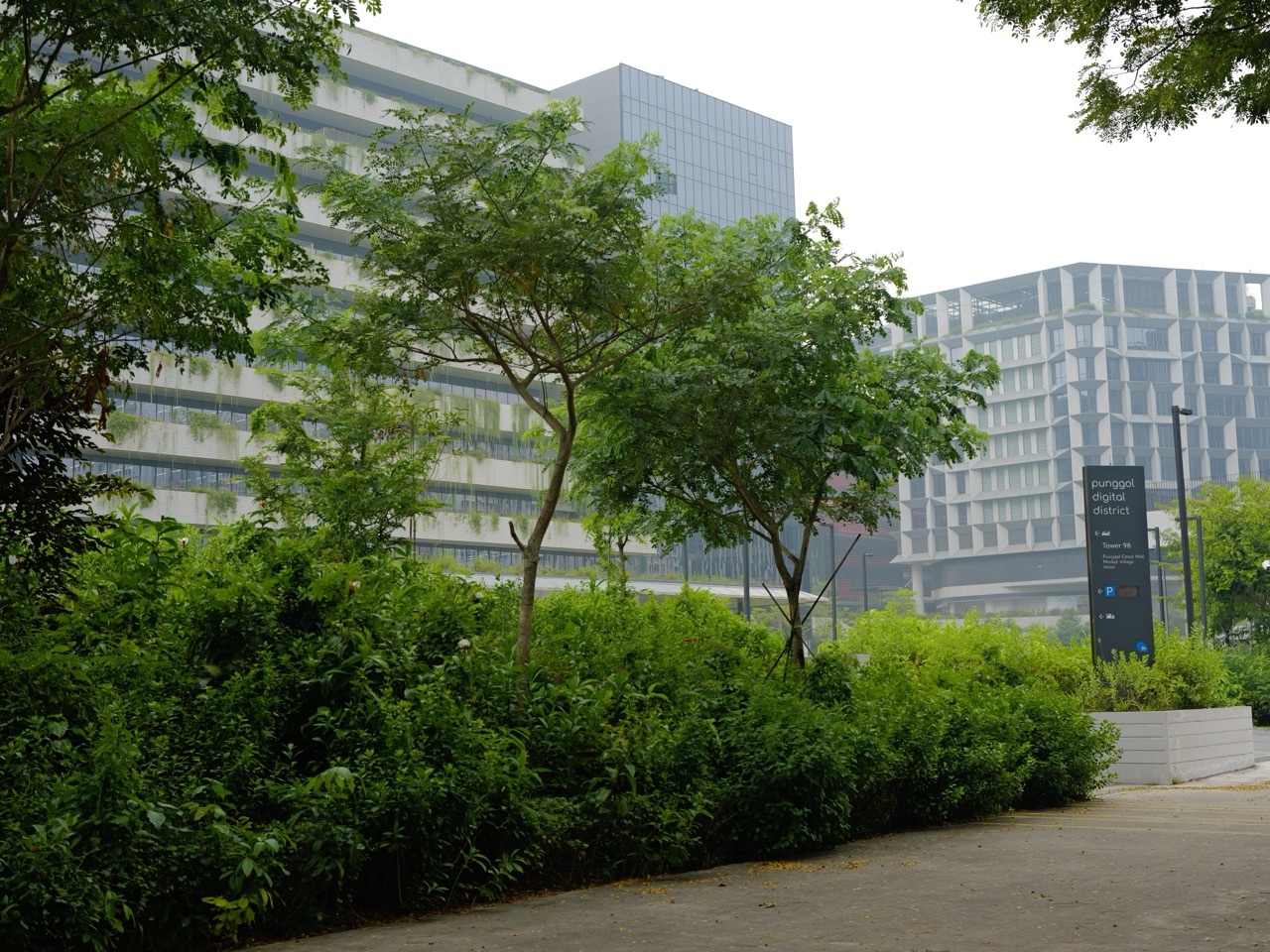
Quick answer, 23 October 2026: OCBC’s planned Punggol innovation hub is one of the clearest next steps in the transformation of Punggol Digital District. JTC and OCBC announced an investment of about S$500 million, including a roughly 430,000-square-foot facility at 98 Punggol Way intended to accommodate up to 4,000 employees, predominantly from the bank’s technology workforce. The 2024 announcement gave the first quarter of 2027 as the completion target. That is a project target, not an assertion that four thousand new vacancies will appear in January or that the building is already open for public visits.
Why should a Punggol parent, student, jobseeker or small business care about one corporate office? Because a workplace of this scale changes the daily rhythm of a district. Commuters arrive, food businesses see different lunch and evening patterns, university students meet industry mentors, and more residents may have professional opportunities nearer home. But each of those is a possible effect, not an automatic entitlement. We will examine the machinery behind the announcement, the decisions families can make now, and which numbers should never be confused.
The facts at a glance
| Question | Confirmed position or careful interpretation |
| Where? | OCBC Punggol, 98 Punggol Way, within Punggol Digital District |
| How much? | About S$500 million in total announced investment, including the innovation hub and SIT partnership; not a 2027 recruitment budget |
| Scale? | Approximately 430,000 sq ft across eight floors of a 12-storey mixed-use building |
| Employees? | Designed to house up to 4,000 staff, largely in technology roles; this is capacity, not a promise of 4,000 net new jobs |
| Target? | First quarter of 2027 in JTC/OCBC’s 18 September 2024 announcement; recheck for revised occupancy |
| Academic link? | A strategic partnership with Singapore Institute of Technology, including a lab, talent-development activities and scholarships |
| For residents? | Potential shorter journeys, commercial activity and learning opportunities, subject to actual job locations, access rules and recruitment criteria |
| What is still unknown? | A precise public move-in date, general-public entry rights, the number of new external vacancies and final tenant mix |
The basic project specification comes directly from the JTC and OCBC announcement of 18 September 2024. The distinction between a workplace’s stated capacity and the labour market it creates will recur throughout this article, because it makes the difference between a useful career guide and an exaggerated headline.
What is different about an innovation hub?
A conventional bank branch deals with customers in person: opening an account, addressing a service query or providing certain counter services. An innovation hub is not that kind of facility. A bank’s technology organisation builds, secures, tests and operates the systems that make modern financial services work. At Punggol, the announced emphasis includes emerging technology areas such as quantum computing and mixed reality, alongside the broader engineering and digital transformation functions that support banking.
The physical design expresses that work. The hub is connected to SIT’s Chua Thian Poh Discovery Hub by a striking red link bridge. An 800-metre canopy along Campus Boulevard provides another district connection. Those features matter less as architectural spectacle than as everyday infrastructure: students, researchers and staff can move between organisations, while people walking through the precinct gain routes that are not dependent on driving from building to building.
It is tempting to imagine that every employee in a modern office works as an artificial-intelligence scientist. Real technology organisations need a much wider range of roles. Banking services depend on people designing reliable systems, writing secure code, testing changes, maintaining networks, assessing risks, improving accessibility, safeguarding customer data and keeping services available when demand surges. A future career guide should therefore map functions and skills rather than equating ‘tech jobs’ with one fashionable job title.

Understanding the 2027 milestone
A planned completion date belongs to the delivery of a building or fit-out programme. An operational workplace can follow a more complicated schedule. Systems have to be tested, teams assigned spaces, security arrangements approved, equipment installed, and staff transferred in ways that do not interrupt a bank’s essential services. For this reason, “targeted to complete in Q1 2027” does not necessarily mean every part of the campus will be occupied on one publicly advertised day.
Families often hear the words “opening”, “completion”, “operational” and “inauguration” as if they were synonyms. They are not. Completion may refer to construction or project milestones; occupancy refers to people using the space; an official opening may occur before or after some operating activities; and recruitment is a separate employer process. One corporate project can legitimately have different dates attached to different stages.
For 2026 planning, the safest language is that OCBC has committed to the hub and previously announced a first-quarter-2027 completion target. For a prospective employee, the action is to watch the bank’s official careers site for specific openings. For an existing employee, the action is to rely on internal HR communications, not speculation that every technology worker will be reassigned. For a restaurant owner, the action is to observe actual office occupancy before committing expenditure based on a forecast footfall spike.
Why Punggol was selected
Punggol Digital District is not simply a business park at the end of a train line. JTC’s 50-hectare development is deliberately integrated with SIT’s Punggol campus. The district has public transport, pedestrian links, retail, shared spaces and a common digital infrastructure concept. The point is that companies and university teams are close enough for joint experiments and applied learning to be practical. Geography will not guarantee innovation, but it can make collaboration considerably easier to organise.
A company that needs software engineers, data specialists or industrial researchers ordinarily has to assemble partners scattered around the city. A student seeking a real-world problem may have to work through multiple institutions before meeting an industry sponsor. When a large technology team shares the same district with a university, both sides can potentially reduce travel, hold shorter workshops and make technical demonstrations easier. Whether that proximity becomes a high-quality internship depends on supervision, project scope and access agreements, not merely on metres between buildings.
The hub also sits within a broader move to decentralise employment. Punggol is a substantial residential area, not just an employment destination. An employer with a major northeast address can create an alternative to the assumption that every digital career requires a daily journey to the CBD. This is part of the attraction for families who manage school drop-offs, eldercare and work. Still, one parent’s shorter commute may become another worker’s longer commute; proximity advantages depend on where individuals live and which job location is actually assigned.
The partnership with SIT: what it can and cannot offer
The announcement pairs the building with a strategic partnership involving Singapore Institute of Technology. It describes a learning lab and scholarship support intended to develop fintech skills and a technology talent pipeline. These elements are educational arrangements, not a blanket guarantee that SIT students will receive OCBC internships, employment or financial support. Each scholarship and programme will have its own conditions, eligible courses and selection process.
SIT’s applied-learning structure creates a natural fit for industry projects. Students may encounter authentic challenges such as reducing false positives in financial crime detection, improving interfaces for people with accessibility needs, managing operational data or protecting software supply chains. Those are examples of the kinds of problems relevant to technology-led financial services, not a claim that OCBC has committed to particular student projects or data access. Banks handle sensitive information, so practical student projects usually require carefully defined boundaries.
One valuable skill for university applicants is to ask a more precise question than “Does OCBC work with SIT?” A better question is “Which faculty manages the programme, what are the prerequisites, which academic year can participate, who supervises the work, and what can be published in my portfolio?” That converts the idea of partnership into a personal decision. The answer could differ between a computing degree, an engineering pathway, and a mature student entering via continuing education.
For general orientation, read our focused OCBC–SIT scholarship guide and OCBC Analytics and Innovation Lab guide. Those pages deal with specific educational offerings. This article instead follows how the larger 2027 workplace could reshape labour demand and daily life.
Which technology careers may fit the district?
A realistic career map begins with what problems a bank must solve. A financial organisation accepts and makes payments, manages customer identity, maintains records, supports lending, protects access to accounts, fulfils regulatory obligations and delivers services through digital products. Technology colleagues translate those needs into stable systems. A local graduate might work on user-interface design; a polytechnic diploma holder might begin in IT operations; a mid-career engineer might retrain in quality assurance or infrastructure. The title printed on a badge matters less than the task, controls and responsibility behind it.
Software engineering and dependable services
Software engineering is much more than writing one application. Banking systems need reliable code review, version control, test coverage, monitoring, deployment discipline and recovery procedures. An applicant who can show a small well-documented application—with tests, error handling, permissions and user guidance—often demonstrates clearer professional habits than someone who lists several programming languages without evidence of how they were used. A Punggol technology workplace may need such skills, but vacancies and exact teams must be checked rather than assumed.
Cybersecurity and digital trust
Banks handle financial assets and highly sensitive customer information. Security work can involve identity and access management, secure configuration, incident response, vulnerability analysis, threat intelligence and audit-ready documentation. Students should practise threat modelling and secure development in authorised educational environments. They should never test a real bank service, attempt to probe another user’s account or bypass security controls without written permission. Responsible judgement is part of employability.
Data engineering, analytics and responsible AI
Banking analytics depends on high-quality records and clear definitions. A dashboard is only as useful as its underlying data. People working in this field need SQL, data-quality checks, reproducible analysis and the ability to explain limitations. AI adds concerns such as model reliability, bias, privacy, evaluation and human oversight. For a graduate, an excellent portfolio project might analyse a public, non-sensitive data set and carefully explain errors and trade-offs rather than pretending to have access to customer account records.
Design, accessibility and user research
Financial products are used by teenagers, busy working adults, caregivers and seniors. An efficient system for a technically confident person can still fail someone with low vision, a language barrier or anxiety about fraud. User experience research and accessibility testing can therefore be strategically important. A Punggol student interested in design can document how an interface works under different needs and conditions, conduct ethically consented tests and show what changed after feedback.
Infrastructure, cloud and service operations
Behind a mobile banking interface sit networks, databases, cloud services, monitoring tools and incident-management routines. During an outage, operational teams need calm prioritisation and honest communication. Trainees can develop this judgement in simulations: deliberately break a toy application, observe the resulting failures, restore service and write a plain-language incident report. Such practice illustrates systems thinking without implying any direct access to a bank’s production environments.
Business analysis and project coordination
Not every technology worker is expected to code every day. Business analysts translate requirements, product managers set priorities, change specialists coordinate risk controls, and project staff track dependencies. These are substantive professions because poorly framed requirements can turn even excellent code into an unsafe product. A student who can interview users, create a process map, identify conflicting needs and write precise acceptance criteria has skills that may transfer across fintech, logistics, healthcare and the public sector.
The skills ladder: from secondary school to a professional role
| Stage | Realistic preparation | What not to assume |
| Secondary school | English communication, algebra, statistics, digital literacy, responsible computing projects | That taking one computing subject promises a bank job |
| ITE / Polytechnic | Diploma or technical competence, projects, internship readiness, foundational security | That all roles require the same certificate |
| University | Deep discipline knowledge, supervised industry projects, teamwork and evidence of work | That proximity to SIT guarantees an OCBC placement |
| Mid-career | Role-specific retraining, demonstrable portfolio, work-history translation and realistic job applications | That a short course guarantees an experienced engineer’s salary |
| Early professional | Operational reliability, documentation, mentoring, measurable outcomes and ethical practice | That every technology role involves AI or quantum computing |
The simplest bridge between schoolwork and professional technology is disciplined problem solving. In Mathematics, students learn to define a variable and check assumptions. In English, they learn to explain an argument, communicate with precision and revise when feedback reveals ambiguity. In Science, they learn to control variables and distinguish evidence from guesswork. These habits remain useful long after a coding framework has changed. They are also qualities that a project portfolio can demonstrate explicitly.
For families considering tuition or enrichment, there is no need to purchase every trending technology course in the hope of reaching a Punggol job. Begin with what the student enjoys and can practise consistently. A fifteen-year-old who builds one accessible scheduling app and writes clear tests may learn more than another who completes ten superficial tutorials. The strongest preparation combines foundations, curiosity and enough time to reflect on mistakes.
Worked example: a Secondary 3 student interested in fintech
Imagine a student living near Punggol Central who enjoys Additional Mathematics, Computer Studies and making small mobile apps. The news about OCBC Punggol sounds like proof of a future career, but it is not a job offer. A sensible six-month project begins with identifying one everyday problem, such as a shared family budget that becomes confusing when different people record expenses in different ways. The student defines data fields, builds a simple spreadsheet or app, uses fictitious sample transactions and asks family members what is unclear.
In the second month, the student improves data validation. Every expense should have a date, category and amount; missing or impossible values should trigger a friendly message. In the third month, the project gains readable charts and accessible contrast. In the fourth, the student creates tests and records what broke. In the fifth, the student writes a short explanation of privacy choices. In the sixth, the work can be presented honestly in a school portfolio as a learning exercise, not a real financial application.
This exercise helps the student discover whether they enjoy designing interfaces, analysing numbers, writing code or documenting systems. It also makes a secondary-school Mathematics lesson more tangible: percentages matter when a budget has limits, algebra matters when quantities interact, and error checking matters whenever users enter imperfect data. The benefit is educational even if the student ultimately chooses healthcare, engineering or teaching rather than banking.
Worked example: a polytechnic student seeking an internship
A diploma student might see ‘up to 4,000 technology staff’ and imagine a large internship queue. A more careful strategy starts with reading current internship listings, checking education prerequisites and identifying which tasks align with the student’s modules. The student should document programming projects, tests, collaboration, change requests and any production-like constraints in their own training environment. The portfolio should emphasise what they personally contributed rather than taking credit for an entire team project.
Suppose the student has built a sensor dashboard. That can be relevant even if it has nothing to do with finance. They can explain how readings were validated, how missing values were handled, how a misleading graph was corrected and how a small audience used the finished display. These are transferable habits. The bank may or may not recruit for that precise role in Punggol, but the student becomes a stronger candidate for a broad range of technology employers.
Worked example: a mid-career parent returning to work
A parent who previously worked in customer service may feel that emerging-technology positions are out of reach. Some will be; advanced specialist roles require deep training and experience. But technology organisations also need professionals who understand customer journeys, process documentation, product testing, training and operational coordination. A meaningful reskilling plan begins by listing the individual’s existing evidence: resolving difficult cases, managing records accurately, training colleagues or improving turnaround times.
Next, the parent compares realistic job descriptions with those strengths. If the gap is data analysis, they can learn spreadsheet modelling and introductory SQL, then build a project using a public data set. If the gap is process improvement, they can document a workflow and measurable changes. They should check course subsidies and eligibility on official platforms and avoid spending heavily on courses that promise employment or a particular employer. Work location is only one factor; role suitability and family logistics still matter.
How the daily Punggol workday could change
The district has a very different shape from an office canyon in the central business district. Punggol Coast MRT, the campus, offices, food venues and outdoor paths are intended to function as an integrated system. That can make walking between lunch, learning and work realistic, particularly where covered links have been built. However, actual wayfinding, lift access, public-entry rules and works boundaries need to be checked on the day. A bridge between two buildings may exist for authorised occupants without being a public shortcut.
For lunch operators, a growing technology workforce may alter both the number of customers and their timetable. There can be a concentrated noon rush, uneven hybrid-working days and a higher need for takeaway services. None of those patterns is guaranteed, especially during phased occupancy. A small merchant should collect observed data—queue lengths, sales by half-hour, staff costs, food wastage—before assuming that a projected headcount will turn directly into daily lunch receipts.
Parents working near SIT may gain a shorter trip between home, school and office. But proximity does not cancel childcare centre operating hours, eldercare appointments or the unpredictability of emergencies. Good household planning still needs a backup for late meetings and school closures. The new office should be thought of as a potential improvement to work geography, not a replacement for carefully designed family routines.
Visitors may find more to do in the wider district as amenities mature. Punggol Coast Mall, local food options, the campus and the heritage and waterfront networks can support an entire afternoon. Yet companies are not tourist attractions by default. Do not walk into office reception expecting a public exhibition, workplace tour or demonstration. For leisure planning, rely on specifically designated public spaces and opening information instead.
The meaning of ‘up to 4,000 employees’
This phrase deserves its own section because it is routinely misunderstood. Capacity refers to how many people the premises can house under the announced arrangement. A workforce transfer can relocate an existing job without creating a new role. Some roles might remain elsewhere; some employees might work hybrid schedules; staff numbers can change. Public sources do not establish how many net jobs will be created solely by the new building, or how many of those vacancies will be open to external applicants in Punggol.
The same caution applies to district-wide figures. JTC states that Punggol Digital District is expected to bring approximately 28,000 jobs closer to the northeast. That is a longer-range district ambition involving multiple organisations. It is not the number of OCBC vacancies, nor a count of positions currently on job boards. Readers can use the number to understand the scale of the policy vision, but should never multiply it by a salary assumption to estimate automatic local income gains.
An applicant’s best signal of genuine opportunity is a specific vacancy listing with duties, required experience, employment terms and an official application route. An older press release is strong evidence of organisational intent, but weak evidence of a hiring event on a given date. For live opportunities, start with OCBC Careers and the official MyCareersFuture portal.
How does OCBC differ from other PDD tenants?
Punggol Digital District includes different kinds of organisations. A financial institution operates under banking regulation; a public-sector digital agency has public-service responsibilities; a university must protect its academic integrity; and a startup may focus on one narrow product. The district creates chances for contact, but their missions do not dissolve into one common employer. An internship with SIT is not automatically an internship with OCBC, and a demonstration at a JTC showcase is not proof that the technology is in commercial deployment.
This matters especially for careers that cross organisational boundaries. An engineer building autonomous delivery software may work for a startup, while a bank’s engineer may specialise in systems integration or risk controls. A cybersecurity student could find similar fundamentals valuable in both places without having identical access permissions, constraints or reporting lines. When comparing opportunities, study the actual employer and project—not just the shared address of Punggol Digital District.
A practical six-part check before applying for a role
- Identify the exact employer. Look at the legal hiring organisation, not just the building name or district logo.
- Read the work-location wording. A Singapore-based vacancy is not necessarily a Punggol-based vacancy.
- Compare essential skills with evidence. Match duties to demonstrated projects or prior responsibilities, and distinguish requirements from preferences.
- Check training and salary claims. Treat promised salary figures in social posts cautiously; rely on the employer’s actual offer and legitimate salary research.
- Verify application authenticity. Use official career sites and be wary of anyone demanding advance recruitment payments or login credentials.
- Model the whole journey. Consider transport costs, school schedules, hybrid arrangements and total commuting time alongside nominal salary.
A helpful exercise is to score each potential role on four independent dimensions: relevance to your skills, opportunity for growth, financial fit and household logistics. A job that scores highly on location but poorly on learning or contract stability may not be the best choice. Conversely, a further-away opportunity with excellent training could prepare someone to return to Punggol later. A new district increases the menu of choices; it does not determine the correct meal for every worker.
What small businesses should watch from 2026 onward
An increase in office activity can support food services, maintenance businesses, professional services and local transport. But corporate occupancy is not synonymous with open procurement. Contracts may be consolidated, competitively tendered or subject to vendor qualification. A local supplier should not assume that sharing a postal district creates entitlement. The sound approach is to check official procurement opportunities, identify services they can reliably deliver and maintain business records and safety standards.
For a neighbourhood café, the first useful question is not how many seats an OCBC office contains. It is how many people enter the catchment at the times the café can serve them. A two-week observation notebook may reveal that mornings, rather than lunch, offer an opening for quick coffee. Another vendor may find that weekends remain family-driven while weekday orders change. These observations can shape staffing without overreacting to a headline.
An enrichment provider might hope that more technology professionals means more interest in coding for children. That may prove true in some households, but families have diverse preferences and budgets. Useful programmes need safe learning design, appropriate age levels and measurable educational value, not merely an AI label. Providers should not imply endorsement by OCBC, SIT or JTC without explicit permission.
What a resident can measure in the first three months after occupancy
| Observation | Simple way to check | What a change would mean |
| Morning walkway use | Repeat a count at the same location and hour over several weekdays | Footfall may be shifting; it does not identify who works where |
| Hawker queues | Compare similarly timed weekday observations | Demand patterns can guide visit times, not guaranteed revenue |
| MRT and LRT crowding | Observe train headways, queues and transfer friction during real trips | Plan travel buffers rather than projecting network-wide ridership |
| Job listings | Track official vacancies with a Punggol work address | Confirmed live hiring, distinct from building capacity |
| Public events | Check JTC/SIT calendars and entry rules | An actual public opportunity rather than assumed open-door access |
| Covered-route access | Follow signage at public entrances in dry and rainy weather | Practical accessibility can differ from a master-plan drawing |
Write the observation date beside each figure and compare like with like. A rainy Tuesday and a sunny Saturday are poor bases for a causal claim about office occupancy. School holidays, public holidays and construction works can shift behaviour independently. Residents do not need specialist software to avoid this mistake: a notebook that records the time, weather and what was actually counted is enough to make observations more honest.
The 2027 plan for students: four low-cost steps
First, strengthen written explanation. A student who can state the problem, show a method and admit uncertainty already has an advantage in collaborative technical work. Second, build one project with a clear user and a narrow purpose. Third, introduce simple testing—what should happen when input is missing, invalid or contradictory? Fourth, document the outcome in a portfolio with screenshots, a brief technical note and a reflection on what still needs work.
For a student interested in data, a public transit or environmental data set can serve as a safer learning resource than simulated bank account records. For a student interested in cybersecurity, approved educational capture-the-flag exercises provide a lawful arena to practise. For a student interested in design, redesigning a family timetable or school event sign-up form can expose accessibility problems. Each exercise gives the learner a truthful answer to “What have you actually made?”
A related resource is our broader guide to Punggol Digital District, SIT and work-based learning. Keep that overview for district fundamentals and use this page for the narrower workforce change associated with the OCBC development.
The 2027 plan for mid-career adults
Begin with a skills inventory, not a course catalogue. Separate tasks you can already perform reliably from tasks you have only observed or attempted once. If you have managed spreadsheets in an operations role, you may have transferable data-cleaning instincts. If you have handled confidential records, you understand why permissions matter. If you have trained colleagues, you can demonstrate communication and change-management experience. These strengths can influence the kind of technology-adjacent job for which a transition is realistic.
Next, select one role family and read several live vacancy descriptions. If most require years of cloud operations, a short certificate is unlikely to substitute for that experience. You might instead seek a junior support role, an internal transfer or a training programme with supervised practice. Check training subsidies and eligibility through MySkillsFuture and appropriate government sources. Avoid guaranteed-placement marketing and ensure a provider is authorised before submitting payment.
Finally, fit training into actual family life. The ideal plan is one you can follow for three months without exhausting your household. A one-hour routine three times each week, with focused hands-on exercises and regular review, may be more sustainable than booking an expensive course during a period of unpredictable childcare. The hub is one possible destination; transferable competence is the durable result.
Three future scenarios, clearly labelled
Scenario A: phased office occupancy
Suppose different OCBC teams relocate across several months. Local lunch traffic rises gradually, while school and work routes continue to operate normally. In this scenario, a restaurant owner responds with small staffing adjustments rather than an immediate large expansion. A jobseeker applies to specific openings, not one imagined annual intake. This is a planning example; it is not a public OCBC move-in schedule.
Scenario B: fewer external vacancies than expected
Suppose much of the workforce consists of existing employees moving from elsewhere. The district may still gain daily activity and greater proximity to SIT, but net new hiring is smaller than the headline building capacity suggests. A parent should not treat that as failure of the project; it is a reminder that workplace relocation and job creation are different economic events. Applicants should maintain a broad employer shortlist.
Scenario C: a strong university-industry talent pipeline
Suppose SIT and OCBC expand mutually useful supervised projects over time. Students may gain practical problems to study, employees may mentor learners, and some graduates may compete for openings more effectively. The effect depends on course eligibility, mentor capacity and the quality of placements. It does not imply that student data, proprietary code or sensitive customer records become publicly accessible.
Common misunderstandings to avoid
- “S$500 million means S$500 million in salaries.” No. The announced sum covers investment in the hub and partnership.
- “Four thousand employees means four thousand new job ads.” No. That figure describes intended workplace capacity.
- “The project will open exactly on 1 January 2027.” No. The announced timeline is first quarter 2027, and the current official milestone must be rechecked.
- “Every SIT student can use the office or get a scholarship.” No. Campus and programme access have distinct rules.
- “The red link bridge is a public shortcut.” Not necessarily; only use access routes designated for the public.
- “I need to learn quantum computing to work at PDD.” Not necessarily; the broader workforce includes many technology and business functions.
- “Punggol residents will be hired first.” No general local hiring preference is established by the source announcement.
Frequently asked questions
When is the OCBC Punggol innovation hub expected to be completed?
JTC’s official September 2024 release gave the first quarter of 2027 as the completion target. Construction milestones, fit-out and staff occupancy are not necessarily the same event. Check newer OCBC and JTC notices before making a time-sensitive plan.
Where will the hub be?
The official address in JTC’s release is 98 Punggol Way, within Punggol Digital District. It is linked to the SIT environment via collaboration and pedestrian routes. Actual entrance and reception instructions should be obtained from the organisation hosting the visit.
How many new jobs will OCBC create?
The announcement says the Punggol premises will accommodate up to 4,000 employees, mainly in technology. It does not state that all are net new jobs. Existing staff transfers and later hiring should not be counted twice.
Can a secondary-school student apply for a programme there?
A school-aged student should begin with age-appropriate education and publicly offered activities. The site announcement is not an invitation to apply for work or attend private company premises. Look for officially advertised outreach events or school-sanctioned learning opportunities.
Is it a retail bank branch?
The announced function is a major technology and innovation workplace, not a substitute for checking OCBC’s branch and ATM directory. Customers should use the bank’s official service-location tools for ordinary banking errands.
Is the new office the only reason Punggol Digital District is growing?
No. The integrated SIT campus, other public and private tenants, district infrastructure, transport links and community amenities are all part of the PDD programme. OCBC is one significant contributor, not the entire project.
Can the public walk across the link bridge to SIT?
Do not assume so. Some routes between corporate and academic buildings may be controlled. Follow local signs and authorised visitor instructions; use clearly public Campus Boulevard and other designated paths for leisure outings.
What should a graduate put in an application?
A truthful portfolio that shows relevant competence: a defined problem, personal contribution, method, tests, ethical constraints, decisions and results. Match it to the advertised role rather than repeating marketing language about PDD.
What does the bank–SIT partnership mean for scholarships?
It signals an educational commitment, but scholarship eligibility and award conditions remain programme-specific. Consult the current university or bank announcement before applying, and distinguish general partnership statements from scholarship terms.
Does the hub guarantee less crowded journeys for Punggol residents?
No. Closer jobs may benefit some residents, but additional commuters can change peak flows. Actual travel effects depend on transport service, office occupancy, individual origin and the walking route to the building.
A practical family decision matrix for the first half of 2027
Families often ask whether they should change their school, training, work or transport plans now that a major technology campus is coming. A useful answer begins with a decision that actually has a deadline. A student choosing a 2027 course needs to apply according to the institution’s published admissions criteria, not according to a building’s occupation date. A parent reviewing a job offer must compare the contract and confirmed work address with household travel obligations. A food operator considering a new stall should test observed demand and lease costs. These decisions have different evidence requirements, even though the same Punggol development provides their context.
One practical household meeting can separate the decisions into three columns. Under confirmed now, record the present transport network, current school or job criteria and amounts the family can afford. Under officially planned, record the OCBC investment, 2027 completion target and intended office capacity, with the dates of the source announcements. Under still to verify, record recruitment openings, precise occupancy schedules, public access and commute effects. A statement should move from the last column only when a reliable later source supplies the missing fact.
This method prevents an interesting future development from crowding out the ordinary decisions that determine a family’s well-being. A nearer office could be wonderful for a working parent, but a role with unsuitable hours may still be the wrong choice. A scholarship announcement may inspire a teenager, but the first task is to see whether the student is eligible and genuinely interested in the course. A new café opportunity could eventually be attractive, but the operator must still make the numbers work before signing a lease. Planning well means keeping optimism and verification in the same notebook.
Official sources and related Punggol guides
- JTC / OCBC: S$500 million investment announcement, 18 September 2024 — building area, floor allocation, address, staff capacity, design and SIT partnership.
- JTC: Punggol Digital District — district scale, ecosystem, other tenants and business-park context.
- URA: Punggol Digital District urban design guidelines — pedestrian-friendly planning and integration of business, campus and public realm.
- OCBC Careers — source for current vacancies and entry criteria, not the older investment headline.
- Singapore Institute of Technology — current programme and campus information.
- eduKatePunggol: OCBC Punggol address and 2027 target — short factual project guide.
- eduKatePunggol: how to find verified jobs at PDD — practical vacancy-search route.
Update boundary, 23 October 2026: Specific job openings, final occupancy, building access, programme eligibility and commuting patterns can change. Planning scenarios above are clearly marked illustrations and should not be presented as OCBC forecasts. This article is an independent local explainer, not a corporate recruitment notice.
