
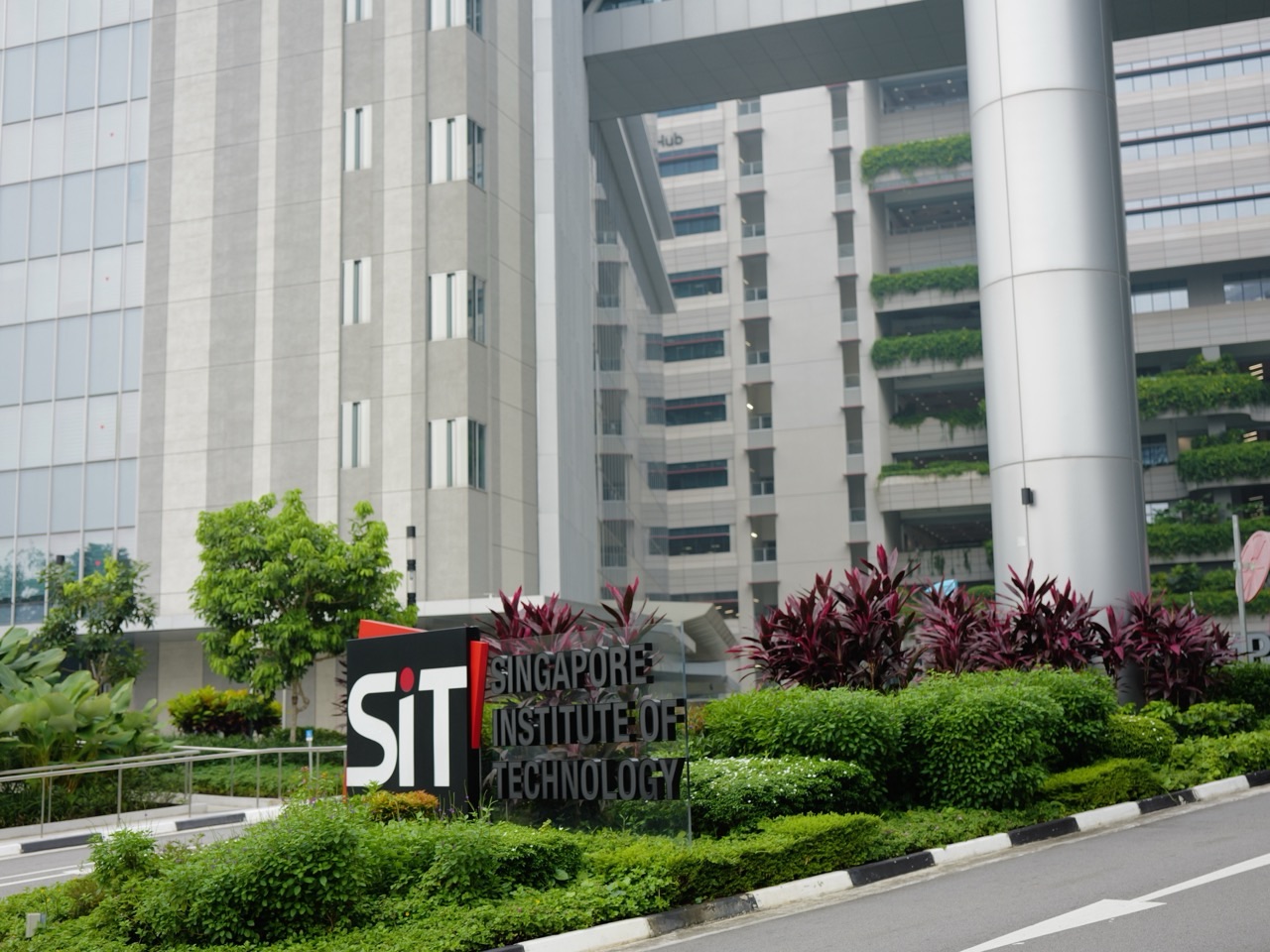
From Academic Year 2026, Singapore Institute of Technology (SIT) is restructuring its Master of Health Sciences into a 60-credit, competency-based, stackable postgraduate pathway. Qualified healthcare professionals can undertake focused micro-credentials, earn Graduate Certificates and, when the relevant university requirements are met, progress toward the full Master’s award. Parts of the revised programme have phased implementation plans extending into AY2027.

This is a significant future-education story for Punggol because SIT’s campus is within Punggol Digital District, and advanced healthcare education is now part of the town’s growing university role. Yet the programme is not for ordinary school-leavers, and it is not a short public health course. It serves suitably qualified allied health and nursing professionals with relevant academic or clinical experience.
The most important distinction is between a published programme plan, a specific course with an open intake, and an individual applicant who meets its requirements. These are not automatically the same. SIT’s statements about 2026–2027 module rollouts do not guarantee admission to every specialisation in every trimester. The university’s current Master of Health Sciences programme page takes precedence over a general article.
What is changing at SIT in 2026–2027?
SIT’s 2026 programme announcement describes a change toward competency-based learning. Instead of treating the full postgraduate degree as the only meaningful outcome, the revised model allows eligible practitioners to complete focused components and receive Graduate Certificates. These may contribute credits toward the recognised Master’s qualification under SIT’s rules.
SIT states that this restructuring removes some previous core and independent-project requirements and places increased emphasis on speciality-related, applied competencies relevant to clinical practice. The degree itself remains a substantial postgraduate qualification. An eight-month part-time learning unit is not interchangeable with the entire 60-credit degree.
The new structure is meant to fit the circumstances of employed professionals. Some learners may need advanced expertise for a particular clinical role while others plan to build a full qualification over several years. This flexibility is valuable only when eligibility, academic quality, clinical supervision and assessment remain clear.
The university’s official 2026 announcement also refers to both a competency-based stackable pathway with eligible training support and a degree route subject to its separate funding model. Candidates should check the specific admission and financing arrangement intended for them.
The five specialisations named by SIT
The Master of Health Sciences structure names Adult and Geriatric Rehabilitation, Musculoskeletal Physiotherapy, Medical Sonography, Rehabilitation Nursing and Organ Transplant Nursing. These are not interchangeable labels. The appropriate route depends on the applicant’s professional qualification, work experience, desired skills and ability to satisfy specialty-specific requirements.
Adult and Geriatric Rehabilitation addresses challenges relevant to rehabilitation and function, particularly among older adults or people with complex conditions. SIT identifies registered occupational therapists and physiotherapists as a key eligible group and says other healthcare professionals may be considered individually.
Musculoskeletal Physiotherapy is a clinical specialisation for practitioners wishing to deepen the quality of assessment and management reasoning in musculoskeletal care. SIT highly recommends at least two years of relevant professional experience.
Medical Sonography involves the technical and clinical practice of medical ultrasound. SIT identifies practising radiographers involved in ultrasound, and certain other healthcare professionals, as relevant applicants. Crucially, the programme includes requirements for appropriate access to supervised ultrasound practice, clinical logs and assessment of practical skills.
Rehabilitation Nursing relates to advanced nursing expertise in rehabilitation contexts, where clinical reasoning, coordination, patient-centred care and specialty experience matter. Organ Transplant Nursing concerns complex care across organ transplantation pathways. SIT’s general criteria for these specialisations include healthcare experience and relevant specialty experience.
SIT’s micro-credential information states that learners are awarded one specialisation within the Master’s. Interest in more than one area is not the same as automatic eligibility for more than one named award.
Which postgraduate healthcare pathways are open now?
The answer must be checked by specific course and academic year. SIT has published a rollout of micro-credentials in 2026 and 2027, but earlier programme information also indicated review of some nursing specialisations for new AY2026 admissions. Additional nursing Graduate Diploma pathways are described as forthcoming rather than automatically available for immediate enrolment.
For this reason, a general statement such as “SIT will teach a Rehabilitation Nursing module in AY2027” should not be rewritten as “new students can register for Rehabilitation Nursing immediately”. Teaching plans, application windows, the identity of eligible intakes and the administrative status of a programme can differ.
Medical Sonography, Adult and Geriatric Rehabilitation and Musculoskeletal Physiotherapy also have intake-specific requirements. An applicant who satisfies the professional profile might still miss the relevant application cycle or need to arrange clinical practice before entering.
A reliable education guide makes those uncertainties visible. Families should use the live SIT postgraduate admissions hub, course-specific notices and direct university enquiries before making financial or professional commitments.
What is a stackable Graduate Certificate?
In the revised pathway, an eligible learner can complete an assessed micro-credential and receive a Graduate Certificate. SIT’s health-sciences micro-credential page describes focused part-time courses taking around eight months, which may be stacked towards the 60-credit Master’s if all the programme’s conditions are met.
This is very different from collecting unrelated course-attendance badges. An academic Graduate Certificate carries defined assessed learning, but its relationship to a degree depends on whether it is approved for the named specialisation and satisfies the university’s credit requirements.
Imagine a healthcare professional who wants more advanced understanding of elderly rehabilitation but is not ready to undertake the whole Master’s. A suitable Graduate Certificate could offer a meaningful qualification in its own right. The learner may later decide to proceed to further components after assessing their work schedule and professional goals.
Another person might know from the beginning that a Master’s degree is required for a particular career objective. That applicant should request a full course map before starting, noting compulsory components, speciality rules, application cycles, credit validity and any prerequisites between modules.
SIT’s 2026 announcement describes a five-year validity framework for progressively stacking modules toward the Master’s. Treat that as a point for official confirmation in the individual’s programme plan rather than assuming that credits can be left unused indefinitely.
Phased module rollout: the 2026–2027 plan
SIT’s published roadmap identifies several components for AY2026 Trimester 1, including Health Research and Implementation, Advanced Musculoskeletal Physiotherapy Practice and Medical Sonography Principles and Practice. The teaching timeline is a framework, not confirmation of an open personal application.
The announced AY2026 Trimester 2 components include Clinical Applications for Medical Sonography and Elder Rehabilitation with Conditions. For AY2026 Trimester 3, SIT names areas such as Integrated Care and Healthy Ageing, Complexity and Pain Management for Musculoskeletal Health, and Integrated Transplant Care Across Continuum.
Looking into AY2027, the statement lists planned components including Extended Musculoskeletal Physiotherapy Practice, Integrated Rehabilitation Nursing Practice, Public Health Perspectives for Rehabilitation Nursing and Transplant Nursing Across Specialty.
These modules suggest a progression from foundations toward increasingly specific professional competence. For example, someone specialising in rehabilitation needs to connect clinical knowledge, assessment, patient priorities and multidisciplinary care, not simply memorise a catalogue of interventions.
But dates and labels must not become fictitious enrolment instructions. A prospective nursing learner should ask whether that particular specialisation is admitting new students, not rely solely on the programme-announcement table. Later notices may revise availability.
Why competency-based assessment matters in healthcare
A healthcare professional regularly encounters uncertain, evolving situations. It is not enough to know a definition from a textbook. Clinical decisions require integrating observations, the person’s history, relevant evidence, professional standards and individual preferences.
Suppose a therapist is helping an older person regain daily function. A weak educational assessment might reward only the correct description of a technique. A stronger applied assessment asks why a particular approach was considered, what outcome matters to the person, which risks were identified, how uncertainty was handled and when other professionals should be consulted.
Competence also involves communication. A technically accurate recommendation can fail when a patient cannot understand the purpose of a plan or the healthcare team receives a misleading account of its limitations.
The value of postgraduate learning is therefore more than accumulating specialised vocabulary. It should help professionals explain what they know, where evidence remains incomplete, and how to act safely within their roles.
Clinical qualifications do not replace professional registration
A Master of Health Sciences degree, or an individual Graduate Certificate, is not a universal licence to perform any procedure. Clinical practice remains subject to professional registration, scope of practice, supervision, employer governance and applicable rules.
For example, a radiographer studying medical ultrasound cannot use the existence of a qualification to bypass clinical competency requirements. A nurse studying transplant-related care remains bound by workplace responsibilities and professional standards. A therapist with advanced education must recognise situations that require further medical or specialist assessment.
The educational benefit includes knowing these limits. Expertise is not proved by performing beyond one’s authorised role. It is demonstrated through reliable practice, appropriate escalation and professional judgement.
This article is about education pathways, not a claim that SIT’s course pages provide clinical authorisation or personalised medical advice.
Why Medical Sonography requires special preparation
SIT explicitly describes practical clinical requirements for the Medical Sonography specialisation. Candidates need suitable access to medical ultrasound practice and the ability to complete required supervised experience, a clinical portfolio and clinical skills assessment.
That requirement can be more decisive than travel to Punggol. Consider two hypothetical applicants with a similar degree and motivation. One works in a department with appropriate supervised ultrasound practice available. The other has no workplace access to such clinical experience. Their ability to satisfy the course requirements may be very different.
The second applicant should not assume that registering for the university automatically provides access to a supervised clinical facility. They must check SIT’s responsibility and eligibility statements and resolve required practice arrangements before committing.
This is a good example of why adult-learning flexibility has limits. Some knowledge can be studied online; clinical competence also depends on appropriate real-world practice, feedback and professional oversight.
Rehabilitation learning: the person is more than a test result
In adult and geriatric rehabilitation, progress is not always captured by a single number. Functional ability, endurance, independence, environmental supports and personal goals may all be relevant to planning and evaluating care.
An educational case might compare a person’s measured improvement with whether they can resume a meaningful daily activity. It might ask why a plausible intervention is not appropriate for a particular person, or what additional evidence would reduce uncertainty.
These thought exercises illustrate the reasoning that advanced education seeks to develop. They are not treatment instructions for the public. Real care decisions belong to the appropriate healthcare professionals working with the patient.
For an experienced clinician, a focused Graduate Certificate could help structure learning around existing responsibilities. The clinician should still evaluate whether the course covers the particular competency gaps identified in workplace practice.
Musculoskeletal Physiotherapy: experience changes how a course is used
SIT highly recommends relevant professional experience for the Musculoskeletal Physiotherapy track. This matters because postgraduate learning can assume familiarity with real clinical situations, documentation and professional judgement.
A candidate who has practised for several years may understand how a patient’s presentation can differ from a textbook pattern. They can bring examples of uncertainty, competing explanations and communication difficulties into academic discussions.
An applicant without relevant experience may find the language familiar but lack the context necessary to apply it responsibly. Eligibility should therefore be assessed on the actual university criteria, and applicants should not infer admission solely from a general degree title.
The objective is not to accumulate the maximum number of named techniques. It is to improve how evidence and patient circumstances inform safe clinical decisions.
Nursing tracks and the planned Graduate Diploma routes
SIT has identified future Graduate Diploma pathways for Rehabilitation Nursing and Organ Transplant Nursing, alongside the revised Master’s structure. Its current information indicates that more details will become available as those offerings are launched.
That creates two decisions for a practising nurse. First, whether the professional goal requires a specific graduate-level competency or a full Master’s. Second, which qualification route is actually accepting applicants in the relevant academic year.
A nurse with two years of healthcare experience should not assume the experience rule is the only condition. The university may require specific professional registration, a relevant degree, specialty experience and other programme requirements.
For someone seeking to enter nursing for the first time, these are not substitutes for the initial recognised educational and professional-registration route. Postgraduate specialist education follows professional foundations.
A Punggol household’s realistic study schedule
A local university campus may be convenient, but an employed healthcare professional still has shift patterns, travel to hospitals, family responsibilities and practical assessments. Study becomes sustainable when those constraints are made explicit.
Imagine a physiotherapist living in Punggol who works across town and has two primary-school children. Before applying for an eight-month micro-credential, the applicant should map a normal month: clinical duties, weekends, family care, compulsory university sessions, reading, writing and assessment deadlines.
There may be a need to arrange shift swaps or employer study support. If the module includes clinical practice, those requirements must also be coordinated. Simply promising to study late every night is not a durable plan.
A useful timetable reserves protected reading and assignment blocks while allowing contingency for difficult work weeks. Clinical postgraduate education involves more than watching lectures; it can require sustained interpretation of research, reflection and case-related analysis.
This logistical check can prevent an enthusiastic but impossible commitment. It also helps the applicant decide whether a single Graduate Certificate is a reasonable initial goal.
What to ask about academic fit before spending money
Start with the exact specialty. What professional tasks does the module address? Is it intended for someone at the applicant’s current stage? Which foundations are presumed? Which kinds of assessment will be used?
Then ask whether each unit can stand alone and whether the credit counts toward the full Master’s in the chosen specialisation. Request confirmation of the order in which modules may be taken and any limits on how long credits remain valid.
Ask about clinical practice. Does the learner require employer-supervised cases, a portfolio, professional sign-off or access to particular facilities? Who arranges those opportunities? Are they available to the applicant before the course begins?
Finally, ask how learning is delivered. Which components are online, which are face-to-face, which need campus presence and which depend on the workplace? A flexible timetable is useful only if it matches the individual’s roster and responsibilities.
A worked programme-choice example
A hypothetical occupational therapist works primarily with older adults and wants deeper capability in complex rehabilitation. They read SIT’s Adult and Geriatric Rehabilitation description and compare it with their everyday needs.
Rather than beginning with the question “Will a Master’s raise my salary?”, they begin with “Which clinical decisions am I less confident about, and does this curriculum assess those competencies?” They seek advice from their supervisor and ask the university whether their current professional role and experience meet the requirements.
They also consider the duration. If a full degree would be difficult to complete immediately, an appropriate Graduate Certificate might represent a useful first stage, assuming the programme is open and the credit rules permit future stacking.
The right answer may be to proceed, to defer until a suitable intake, or to seek a different course. An informed postponement is not educational failure.
A second worked example: qualifications versus actual workplace needs
A practising nurse is interested in Organ Transplant Nursing because it sounds highly specialised. Before applying, they should verify whether the relevant programme is currently admitting, whether their experience meets the specified specialty threshold and whether the learning relates to actual responsibilities or a credible professional progression.
They may discover that a different training route better addresses their current gaps. Alternatively, they may identify a genuine need for the planned postgraduate content and decide to follow SIT’s announcements.
The decisive question is not whether a programme is prestigious. It is whether the candidate can satisfy admission and supervised practice requirements and responsibly use the learning in the role they hold or are preparing for.
For a Punggol parent who is not a healthcare professional, this example also illustrates a broad education lesson: later qualifications are most meaningful when selected for a well-defined purpose.
Funding, sponsorship and total cost
SIT advertises possible subsidies for eligible health-sciences micro-credential learners, sometimes described as up to 90% under the applicable arrangements. That is not an individual guarantee. The course, funding approval, applicant’s status and other conditions determine the actual amount payable.
Before committing, obtain the specific fee table and any applicable funding conditions. Ask whether the employer sponsors part of the course or provides study leave. Check withdrawal and attendance requirements and whether further modules could be funded differently.
The true cost is not solely the invoice. A person may need transport, time away from work, rearranged childcare or clinical supervision. An affordable course fee does not automatically make the programme feasible.
Equally, do not treat the absence of a subsidy as proof that a course is unhelpful. Compare educational outcomes, the applicant’s professional needs, total personal cost and the opportunity cost of time. It may be better to undertake one targeted unit than to pursue a degree that does not align with work.
How the 2027 changes differ from other SIT pathways
This health-sciences Master’s is different from SIT’s undergraduate degrees, the work-study programmes for students entering industry, and the engineering specialist certificates in our engineering micro-credential guide.
Engineering courses may offer around three-month specialist units carrying eighteen credits towards specified bachelor’s degree structures. SIT’s health-sciences page describes roughly eight-month part-time Graduate Certificates and a 60-credit postgraduate Master’s, with additional clinical requirements. The educational level and purpose are different.
The site’s general postgraduate admissions guide compares Master’s, research and PhD pathways. This page instead owns the specific AY2026–2027 SIT Health Sciences redesign and the practical professional choices it creates.
For the broader relationship among university study, work and industry, see our Punggol SIT living labs and work-study article.
What this means to primary and secondary students in Punggol
A teenager may be curious about physiotherapy, sonography or nursing because the professions are visible in the community. However, a postgraduate Master’s is many educational stages away. It should not be promoted as a direct route after Secondary 4.
The immediate work for a school student is to develop strong foundations in English, Mathematics and Science, to learn careful reasoning, and to explore professional careers through appropriate official resources and school guidance. Reading clinical research requires language comprehension and statistical judgement, while professional life requires ethics and empathy.
The student can learn that higher education is not necessarily completed at age twenty-three. Someone may return to specialised study many years into a career because their profession evolves and new evidence becomes available.
That is a useful, non-pressuring message for parents. Children do not need to choose a specific postgraduate specialty now. They do benefit from learning habits that leave future opportunities open.
Common mistakes
Mistake: “A Graduate Certificate makes me a licensed specialist.” Correction: academic awards and regulated professional authority are separate.
Mistake: “Every AY2027 module means an open AY2027 intake.” Correction: a published academic rollout is not an admissions confirmation.
Mistake: “I can learn all of sonography from home.” Correction: SIT requires suitable supervised clinical practice, records and assessment.
Mistake: “All healthcare graduates are eligible for every track.” Correction: professional experience, registration and qualifications vary by specialisation.
Mistake: “The Punggol campus makes a postgraduate course easy to fit into family life.” Correction: time demands can remain substantial, especially with shifts and clinical practice.
Mistake: “One funding figure covers the entire Master’s.” Correction: individual funding status, module fees and future financial commitments must be checked separately.
Frequently asked questions
What is changing in the SIT Master of Health Sciences?
From AY2026, SIT is using a competency-based stackable framework in which approved Graduate Certificates can contribute to a full 60-credit Master’s subject to all requirements.
Which five fields does the programme identify?
Adult and Geriatric Rehabilitation, Musculoskeletal Physiotherapy, Medical Sonography, Rehabilitation Nursing and Organ Transplant Nursing.
Is this available to school-leavers?
No. It is postgraduate education intended for suitably qualified healthcare professionals.
How long does a health-sciences micro-credential take?
SIT’s official pathway describes an approximately eight-month part-time course for an individual Graduate Certificate. Confirm the live timetable for each offering.
Does every learner need to complete the full Master’s?
No. A focused Graduate Certificate may serve as a standalone learning outcome, subject to the programme’s rules.
Can certificates later contribute to the Master’s?
Approved modules may be stacked toward the degree within the applicable credit and validity framework. SIT’s announcement describes a five-year stacking framework; confirm your exact conditions.
Is Medical Sonography taught entirely on campus?
No. SIT identifies supervised clinical practice and portfolio requirements outside the academic classroom as important parts of the pathway.
Are the nursing tracks guaranteed for new students in 2027?
Do not assume this. SIT has described phased plans and separate review notices; check the latest actual intake status.
Does the qualification guarantee a job promotion?
No. Qualifications, professional registration, employer decisions and individual performance are separate factors.
What is the best official starting point?
Use SIT’s current MHSc programme page, the health-sciences micro-credential pathway and postgraduate admissions requirements.
Reliable sources and update limits
The primary sources are SIT’s 2026 future-ready programmes announcement, Master of Health Sciences programme, CSM Health Sciences pathway and professional and academic requirements. Apply using the current university instructions, not a projected course schedule quoted without context.
Reviewed on 23 October 2026. Individual clinical eligibility, admissions cycles, future nursing programme availability, funding and the exact course schedule remain subject to SIT’s official confirmation.
The educational future this points toward
Punggol’s future education landscape is not just a pipeline from primary school to university graduation. With a university embedded in the town, advanced learning can return throughout professional life. A nurse, therapist or other qualified healthcare professional may need new competencies as clinical knowledge and services change.
The promise of stackable postgraduate education is meaningful when flexibility is matched by assessment and clinical responsibility. A Graduate Certificate should tell the learner what they can now do better; a full Master’s should represent a coherent, demanding set of professional competencies. The result is valuable not because the certificate is new, but because the expertise gained can be applied carefully in real work with real people.


