
Punggol East Community Children’s Library was reported to have soft-opened on 11 November 2000 at Block 124 Rivervale Road, #01-181. On 2 May 2001, a contemporary announcement said that its formal opening was scheduled for Saturday, 5 May. It also recorded 1,293 members at the time.
These facts make the branch a distinctive part of Punggol East’s reading history, but they also require geographical care. Rivervale Road is in today’s Sengkang area, while the library’s historical name reflects the community geography of its era.
Did you know? This was not the same dated milestone as the separately named Punggol Community Children’s Library recorded by NLB as opening on 4 February 1997, nor was it the Punggol Regional Library at One Punggol.
Read the Punggol East library timeline
- Two dates that must not be merged
- The address was at Block 124 Rivervale Road
- Why the library was called Punggol East
- A soft opening had already attracted members
- The service was intended for young children
- Who was named for the planned ceremony
- The contemporaneous announcement covered two libraries
- The national network was growing
- Why small void-deck libraries existed
- How local library access fitted a developing district
- The programme’s roots go back before this branch
- Do not confuse Punggol and Punggol East libraries
- The Punggol East name preserves a larger local history
- Library membership did not equal children’s literacy attainment
- What story time might have looked like—and what we cannot prove
- How a parent in 2001 would have encountered the library
- How the Community Children’s Libraries programme later changed
- Why today’s regional library is another chapter
- An evidence table for history students
- How to interview someone who used the branch
- Frequently asked questions
- Sources, caveats and further reading
Two dates that must not be merged
A contemporary report dated 2 May 2001 states that Punggol East Community Children’s Library had a soft launch on 11 November 2000 and was scheduled for its official opening on Saturday, 5 May 2001. Both dates matter, but they describe different milestones.
A soft launch means the library could already serve families before its formal ceremony. The source was a prospective announcement written before the May event, so the most careful wording is that the ceremony was scheduled for 5 May. Without a later report, we should not invent a detailed account of what happened on the day.
The address was at Block 124 Rivervale Road
The same contemporary notice identified the premises as Block 124 Rivervale Road, #01-181. This period address is unusually helpful because it stops the reader from accidentally placing the historic children’s library inside today’s One Punggol complex.
Rivervale Road is associated with modern Sengkang. That does not disprove the library’s historical name, Punggol East. Electoral and community divisions in the early 2000s did not necessarily follow the names and boundaries that a present-day resident expects.
Why the library was called Punggol East
The library belonged to a neighbourhood service history whose division name was Punggol East. In 2000, an archived government speech at a Punggol East Division National Day dinner also referred to a larger historical electoral context.
It is more accurate to say the old branch bore the Punggol East name and was listed at Rivervale Road than to rewrite its address as present-day Punggol or declare that the historic source was mistaken. Names must be interpreted in their own date and administrative setting.
A soft opening had already attracted members
As of the 2 May 2001 announcement, membership for the Punggol East branch was reported as 1,293. That was a dated snapshot after the November 2000 soft launch, not a count of people who attended an official opening ceremony.
A membership figure is not a visitor count, book-loan count or proof of unique daily users. Readers should keep the original measure attached to it: the announcement described the number of registered members at that point in time.
The service was intended for young children
The notice explained that families could register children aged ten years and below for membership. This matched the community children’s library model promoted by the National Library Board and its neighbourhood partners.
The branch’s age focus made it different from a comprehensive regional library. Parents, grandparents and caregivers could play a role in bringing younger children to a nearby reading space, but the source does not provide a record of every family activity.
Who was named for the planned ceremony
The 2 May report identified Zainul Abidin Rasheed, then Senior Parliamentary Secretary for Foreign Affairs and an MP for Cheng San GRC, as the scheduled guest of honour for the 5 May official opening.
A published advance notice is reliable evidence of the programme being planned. It is not a complete eyewitness report of the ceremony. The article therefore preserves the speaker’s roles and the planned opening rather than inventing remarks he may or may not have delivered.
The contemporaneous announcement covered two libraries
The same report concerned Kampong Ubi Community Children’s Library, which had a soft opening on 1 February 2001 and an official opening planned for Sunday, 6 May. Punggol East had its own earlier soft launch and separate Saturday programme.
Grouping two openings into one announcement made sense for a national library network, but it does not mean the libraries shared an address, a date or their member totals. The 361 members reported for Kampong Ubi must not be confused with Punggol East’s 1,293.
The national network was growing
According to the 2 May announcement, adding the two branches brought Singapore’s community children’s library network to 44 branches. The figure was stated at the time of the planned openings.
A later NLB historical overview describes a network of 46 CCLs, reflecting a later period in the programme. The numbers can both be valid when they refer to different dates; they should not be presented as simultaneous counts.
Why small void-deck libraries existed
NLB’s history of public libraries explains that community children’s libraries operated at HDB void decks and were developed with the PAP Community Foundation. Their purpose was to offer reading opportunities near households.
Convenience is a meaningful form of access. A small library that children can visit repeatedly with a caregiver may serve a role that a large but distant institution cannot. The national programme’s location model does not by itself certify the architecture or floor plan of the Rivervale premises.
How local library access fitted a developing district
Around 2000–2001, the northeastern housing estates were growing and residents’ journeys, schools and household routines were changing. A local children’s-library service added an everyday learning point near homes.
The announcement does not claim that the library solved every access problem or raised examination results. Its historical significance lies in the dated provision of a child-focused public service amid wider neighbourhood development.
The programme’s roots go back before this branch
NLB’s inaugural 1996–1997 report described an earlier phase of the Community Children’s Libraries programme, and its timeline recorded a Punggol Community Children’s Library opening on 4 February 1997.
That 1997 entry and the Punggol East branch described in the 2001 report should be kept separate unless independent material proves an organisational relationship. Their names, years and documented addresses must not be collapsed into one uninterrupted premises history.
Do not confuse Punggol and Punggol East libraries
An easy error is to call the 2001 Rivervale Road branch ‘the first Punggol Community Children’s Library’. The published NLB record establishes a 1997 Punggol-named branch, while the 2001 notice identifies a Punggol East branch.
Different names may represent different local service points. Our 1997 library history studies the first record on its own terms, leaving the later Punggol East story free to describe its actual timeline and published membership count.
The Punggol East name preserves a larger local history
Today Punggol and Sengkang are often described as distinct towns. In the 1990s and early 2000s, community and electoral divisions used overlapping names. Punggol Park also lay within the wider historical context of Punggol East.
The lesson is not merely about library nomenclature. Archival search terms reflect older boundaries. An investigator who searches only for present-day Punggol postal codes might miss relevant records in Rivervale and Hougang.
Library membership did not equal children’s literacy attainment
The reported 1,293 memberships show that families had registered for a service. They do not tell us how many books a child read, how regularly the child visited, or whether an individual learner’s grades improved.
A good social-history article can celebrate expanded access without claiming academic impact that was never tested. For learning-outcome questions, researchers would need reading studies, circulation records, surveys or other sources.
What story time might have looked like—and what we cannot prove
The wider CCL scheme was designed to introduce young readers to books and activities in welcoming neighbourhood settings. The format suited small-group engagement and family routines.
However, the published opening notice does not include a Punggol East programme schedule, a list of story-telling titles, staff names or photographs. An attractive imagined reconstruction should not be mistaken for an archival account.
How a parent in 2001 would have encountered the library
The most useful verified details were straightforward: an address in Block 124 Rivervale Road, an age group of ten and below, and a functioning service from the soft launch. Such information could guide a family seeking a nearby place for children’s books.
Historical readers can also ask what transport and daily errands were available around the block then. A present-day journey planner will not answer that question accurately without showing the transport network as it existed in 2000–2001.
How the Community Children’s Libraries programme later changed
NLB’s historical overview records that, with expansion of the public library network and dedicated children’s sections in larger libraries, the Community Children’s Libraries were phased out by 2011.
That is a national programme statement. It does not specify the exact closing date of the Punggol East branch, and this article does not make one up. A branch-level closure date would need a local announcement or archive entry.
Why today’s regional library is another chapter
Punggol Regional Library at One Punggol opened much later and has a far wider service model, including facilities for different ages and accessibility needs. Its building and collections should not be retrospectively treated as the 2001 branch.
Read the modern Punggol Regional Library guide for current services. History is clearer when small libraries, former local branches and contemporary regional facilities receive distinct dates and descriptions.
An evidence table for history students
Make three columns headed ‘recorded event’, ‘source date’ and ‘what it proves’. For Punggol East, place 11 November 2000 under soft launch, 2 May 2001 under the publication date and 5 May 2001 under the planned formal ceremony.
In the next row, enter 1,293 as a reported membership count as of 2 May 2001—not as a first-day attendance figure. This simple table prevents some of the most frequent mistakes in a timeline assembled from press notices.
How to interview someone who used the branch
Ask former residents whether they have old photographs, library cards, school newsletters or family memories from the Rivervale period. Record dates as remembered rather than converting uncertainty into false precision.
Then check the details against the 2001 announcement and dated directories. Personal testimony can add texture to formal records, but should not override a clearly documented opening date merely because a memory feels vivid.
Frequently asked questions
Was Punggol East Community Children’s Library operating before May 2001? The report says it soft-opened on 11 November 2000. Where was it? Block 124 Rivervale Road, #01-181. What was scheduled for 5 May 2001? Its official opening ceremony.
Was the reported 1,293 a visitor count? No, it was membership. Did the library serve secondary-school students as its main audience? No; it was aimed at children aged ten and below. Is it the same institution as today’s Punggol Regional Library? They belong to different premises and phases, and should not be casually merged.
Sources, caveats and further reading
The key dated source is the 2 May 2001 announcement of the Punggol East and Kampong Ubi children’s library openings. NLB’s history of public libraries provides programme context and later phase-out information. The 1996–1997 NLB annual report records the separately named 1997 Punggol branch.
The 12 August 2000 Punggol East Division speech supports the wider historical naming context; our earlier Punggol library chapter and the Punggol history directory complete the reading route. The core finding is that this Rivervale Road children’s library was already operating by November 2000 and was publicly preparing for a formal May 2001 opening.
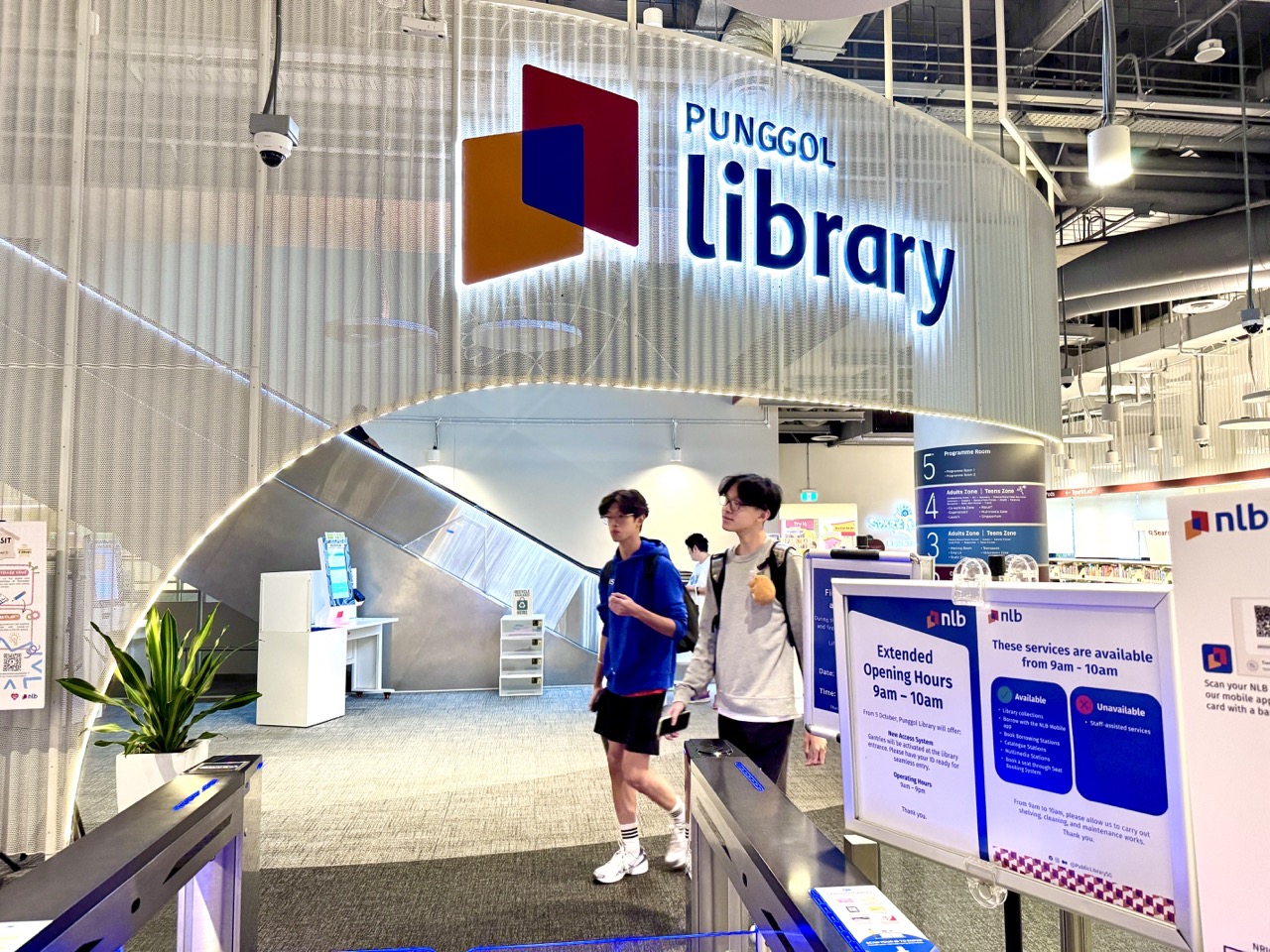
Featured photograph: present-day Punggol Regional Library at One Punggol, included for comparison. It does not depict the original Rivervale Road children’s-library branch or its 2001 programme.


