
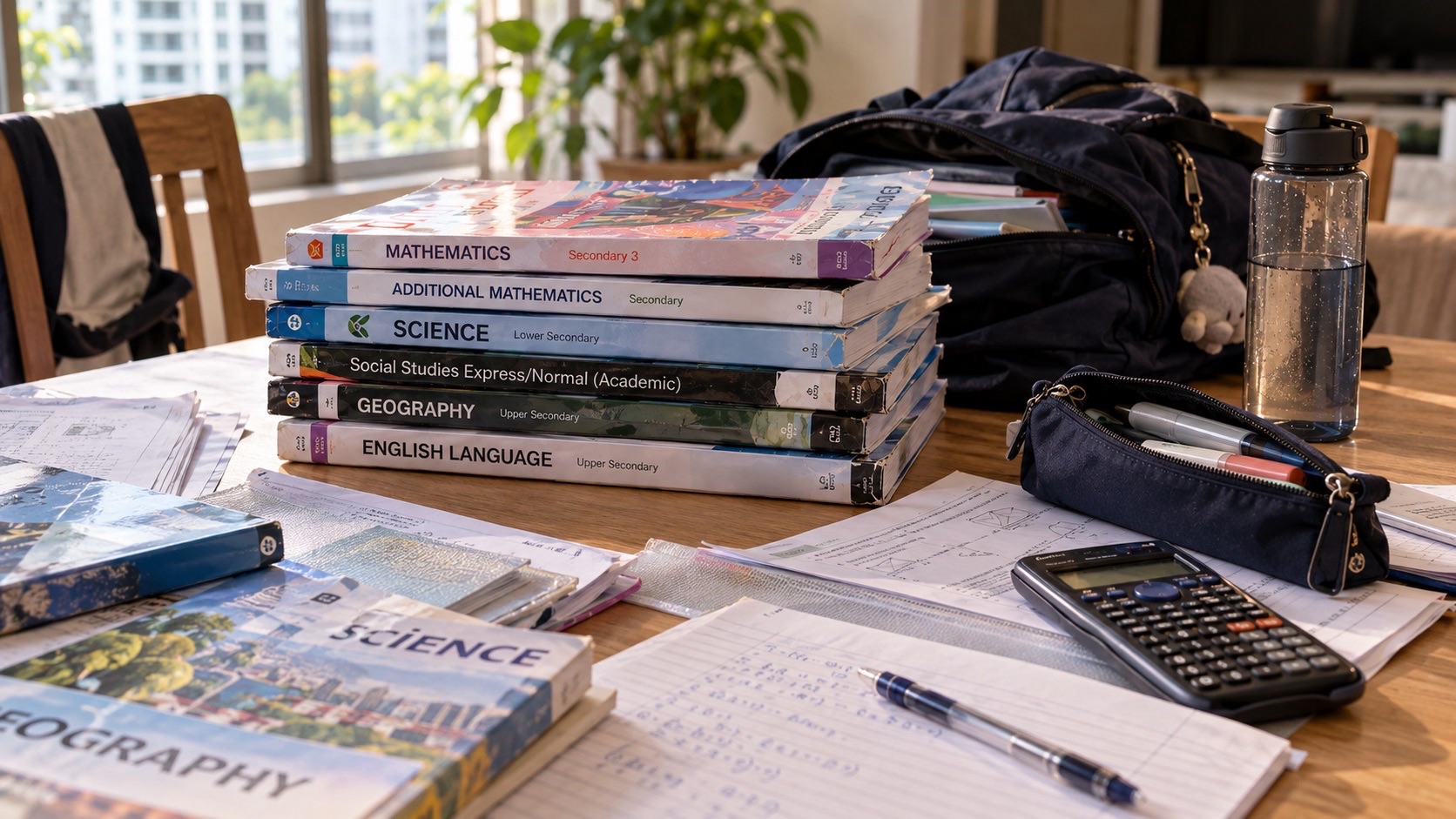
Quick answer. Parents preparing a child for a Punggol primary or secondary school should buy only the books, workbooks, PE attire, uniform and supplies on the child’s actual school and level list. Singapore’s MOE publishes an Approved Textbook List (ATL), but each school selects the books and editions it will use and can issue a distinct booklist for a different Secondary 1 subject level or stream of study. The ATL is not a universal shopping basket and does not guarantee that a nearby retailer stocks every title.
For 2026, official school notices show different ordering methods: online ordering with school collection, home delivery for a specified fee, or school-based vendor appointments. Dates and vendors differ by school. Children approved for MOE Financial Assistance Scheme (MOE FAS) should check the school’s distribution procedure before purchasing items themselves. For eligible Singapore Citizen students in government and government-aided schools, the 2026 scheme has an income test of gross household income not exceeding $4,000 or per-capita income not exceeding $1,000 and can provide free textbooks and specified school attire.
For Punggol families, the practical problem is not choosing the most expensive stationery set. It is matching the correct level, syllabus, title, edition, delivery or collection slot and available financial assistance—then making sure the student can actually use the materials. This guide covers the full 2026-to-2027 school-opening process, worked budget and booklist examples, what to do when a title is out of stock and the difference between school resources and optional tuition material. Last reviewed 22 October 2026; check the actual school’s latest circular before ordering.
First, separate three different lists
| List or notice | Who controls it? | Why it matters |
|---|---|---|
| MOE Approved Textbook List | MOE | Approved materials, not each school’s basket |
| Actual school booklist | Child’s school | Compulsory titles, level and editions |
| Vendor order notice | School/authorised vendor | Dates, payment and delivery/collection |
| FAS collection instructions | MOE and school | Eligible items and voucher arrangements |
Jump to the parent’s task
- Find the right booklist
- MOE FAS and avoiding double payment
- Uniform and subject-level differences
- Punggol family worked examples
- Frequently asked questions
1. The school’s booklist is the buying instruction
MOE’s Approved Textbook List covers materials approved for school use, but a school selects the books it will adopt for its teaching. A Punggol pupil should therefore use the institution’s issued booklist and level rather than a general online article claiming to identify every compulsory textbook in Singapore.
Different secondary students may take G1, G2 or G3 subjects under Full Subject-Based Banding. The exact Maths or English materials, workbooks and literature texts may therefore differ even among classmates in one school building.
Before buying, check the child’s school name, year, class or subject level where known, title and edition. The goal is an accurate set, not a large collection of books that might never be used.
2. What the Approved Textbook List actually means
MOE’s public ATL FAQ explains that the ATL is an electronic list of textbooks, workbooks and activity books approved for the relevant primary and secondary school year. It is updated around mid-August. Approval means that the material is an acceptable option within the framework; it does not require all schools to choose every entry.
The FAQ also explains why schools sometimes use different books: they have discretion to select materials that suit their pupils. Lower-secondary Literature texts are a particular example in which schools use recommended text-selection principles rather than one identical compulsory title.
If a parent finds an approved book online that is not on the child’s school list, ask why it is needed before paying. The correct instructional sequence matters more than a prestigious publisher name.
3. School notices are cohort-specific
A Secondary 1 pupil entering in January may have a later ordering window than students continuing to Secondary 2 or 3. Tanjong Katong Secondary’s 2026 notice, for example, published separate 2025 online-order opening dates for 2026 Secondary 1 and older levels. This illustrates that even one school can use more than one schedule.
Those dates are historical, not a promise about the 2027 intake. Punggol parents should not copy a December 2025 sales deadline and present it as the current December 2026 closing date.
Save the school notice with its issue date and consult the current school office or approved vendor for corrections. A screenshot without the year is weak purchasing evidence.
4. Do not confuse approved, recommended and compulsory
An approved textbook may be permitted for school use; a recommended reading book may be suggested for extension; a compulsory workbook on the class list may be required for a particular course. These are three different directions.
A family can spend unnecessarily by buying every title recommended on a school website. Conversely, skipping a compulsory printed workbook because an online resource appears similar may leave the pupil without required class materials.
Check whether an item is for the whole cohort, one subject level, a selected programme or voluntary reading. Clarifying the category protects family finances without reducing meaningful learning opportunities.
5. The role of the school bookshop
A school bookshop or approved vendor may handle sales and collection on designated days. Some schools outsource ordering through online platforms, offer delivery or use appointments to reduce queues. There is no reliable reason to assume every Punggol school uses the same supplier.
The actual notice should identify the vendor, payment methods, collection point and whether the child must be present. A parent can compare the options for convenience but should not buy from an unofficial account that claims to be the school bookshop.
School purchases are practical arrangements within the national system, not the source of curriculum authority. Ask the school if the supplier’s product description appears to conflict with the official booklist.
6. Online ordering and school collection are different choices
One 2026 MOE secondary-school guide described buying books online and choosing either home delivery or self-collection at school. In that example the delivery had an explicit fee and the collection took place only on named days. These details are real for that institution, not national delivery prices.
A family in Punggol should compare whether a school collection is feasible with work or caregiver responsibilities. Home delivery may save travel but creates a risk of a missed delivery window.
Keep a copy of the invoice and delivery or collection instructions. A payment confirmation by itself may not tell the family which day the books can be collected.
7. The uniform supplier may be different from the book vendor
Some schools use one authorised provider for textbooks and a different provider for uniforms and PE attire. Other institutions organise temporary sales at the campus or permit purchases at the supplier’s retail outlet. The actual school notice controls the options.
Check sizes, name tags, socks, shoes, ties and PE-kit requirements rather than relying on a generic secondary-school uniform photograph. Buying a uniform from the wrong school with a similar colour is not a substitute for the named item.
If the student is between sizes, ask about the supplier’s exchange conditions before cutting labels or washing a new uniform. A small fit problem is easier to resolve before the first lesson.
8. What a 2026 MOE FAS approval can cover
Official 2026 MOE-school FAS pages list a full waiver of qualifying school and standard miscellaneous fees, free textbooks and specified school attire for eligible students in government and government-aided schools. Attire provision is commonly described as two uniform sets, two PE sets, one pair of shoes and two pairs of socks.
Support may also include school-meal and transport assistance under separately defined rules. Those benefits should not be converted into unrestricted spending or assumed to apply to every independently purchased accessory.
For details use the current MOE Financial Assistance information and the student’s school notice. The school processes actual entitlement and collection.
9. FAS income thresholds must be dated
The 2026 MOE FAS criteria shown by official secondary schools use monthly gross household income of no more than $4,000 or per-capita income of no more than $1,000. The alternative test matters for larger households that have several dependants.
A family should not treat this as the income criterion for every independent-school bursary, student care subsidy or 2027 scheme. Those are different awards with different rules and possible revisions.
Use the government’s assessment and declare household information accurately. A home calculation may be useful for preparation but is not an official eligibility decision.
10. Why eligible parents should pause purchases
Several official 2026 school notices tell families with MOE FAS approval or pending applications not to buy textbooks and uniforms through the ordinary online order until the appropriate school collection procedure is clarified. That is because the eligible items may be supplied using school-issued vouchers or other approved arrangements.
If a parent buys everything in advance, they should not assume the school or supplier must reimburse the amount afterwards. The refund treatment depends on the real policy and vendor terms.
Check the FAS outcome and follow the school’s specified distribution instructions. Preserving access to help can be as simple as not placing an unnecessary early order.
11. FAS can continue into Secondary 1 through a new school’s process
A qualifying Primary 6 pupil entering secondary school may already have MOE FAS approval. A new school can require the approval letter or email to be presented to its General Office before issuing book or attire collection vouchers.
The 2026 Woodlands Secondary registration guidance gave exactly this kind of instruction and warned approved families against ordinary online purchase. Another school may have a different collection system, but the principle of checking first remains valid.
Parents should retain approved documentation securely and ask the receiving school what needs to be resubmitted. The child’s school change does not mean all practical arrangements are automatic.
12. School-based assistance can fill other gaps
Some schools operate their own School-Based Financial Assistance Scheme in addition to MOE FAS, with separate criteria and benefits. A student just outside the national threshold may still qualify for school help, depending on the institution.
The family should ask whether books, attire or meal support are available through a school-based route and what proof is required. Do not assume the same income criteria or benefits at every campus.
A school finance officer can explain the actual decision. This matters when the household’s costs rise unexpectedly during a P1 or S1 transition.
13. Work out what is actually compulsory
A list may contain textbooks, workbooks, dictionaries, files, stationery and optional supplementary items. Mark the required pieces first, then inspect what the family already owns and what can be reused legitimately.
Do not discard an approved older calculator or dictionary simply because the packaging changed. But do verify the actual model and examination conditions, especially for an upper-secondary subject with calculator restrictions.
A disciplined shopping method protects money and reduces waste. The goal is a child who has the tools needed for learning, not a desk full of unused supplies.
14. The G1, G2 and G3 distinction at Secondary 1
Full Subject-Based Banding allows secondary students to study subjects at different levels suited to their readiness and eligibility. The same school may have different textbooks or instructional resources for one subject at G1, G2 or G3.
A parent should not buy a G3 Additional Mathematics text because the child is in a Posting Group associated with stronger academic study. The actual subject enrolment and level determine materials.
Wait for the receiving school to issue the accurate booklist or confirm an uncertain item. Buying ahead using predictions from an internet forum can create avoidable replacements.
15. Primary level and secondary level use different materials
A Primary 6 child’s familiar mathematics models and workbooks may not match the algebraic notation introduced at Secondary 1. Some earlier books can remain useful for prerequisite repair, but they are not substitutes for the current secondary course material.
Parents can retain one or two representative old workbooks to identify foundation gaps if needed. That does not mean copying every P6 revision worksheet is the best way to prepare for Secondary 1.
Use the new school’s curriculum and selected booklist as the starting point. The student then learns the structure of the next stage rather than merely collects a higher stack of books.
16. Distinguish physical books from digital access
Some schools provide material through Student Learning Space or other authorised digital platforms. This may supplement printed textbooks, but a digital link does not automatically remove the requirement for a physical workbook or literature text.
Ask which lessons require print, what device or login is supplied and whether school-specific notes will be distributed later. Parents should avoid purchasing a commercial e-book subscription merely because the publisher logo looks familiar.
If a pupil cannot log in, seek the school’s authorised technical support. A copied login from a sibling is not a sound substitute for a legitimate student account.
17. New editions should be checked against the school list
An online retailer may list two editions with nearly identical covers. A publisher can change examples, page numbers or exercise order, leaving a child unable to follow the teacher’s references.
Match ISBN or edition number where listed, in addition to title and level. If the exact item is unavailable, ask the school or authorised supplier whether a substitute is acceptable before ordering an apparently close alternative.
Price alone is not proof that an edition is suitable. The educational cost of buying the wrong item includes replacement expense and confusion during class.
18. Literature texts can differ from a national textbook list
MOE’s Approved Textbook List FAQ notes that schools have discretion in selecting lower-secondary Literature works under appropriate guidance. This means two schools may teach different stories or poems even when both are teaching the national curriculum.
Buying a famous novel because it appears on another school’s recommended list does not mean it is the prescribed text for the child’s current class. Wait for the actual school reading list when it matters for graded work.
Families can still read other age-appropriate literature for pleasure. Voluntary reading and required set texts serve different purposes.
19. A book missing from the retailer’s catalogue
MOE’s ATL FAQ says families encountering an approved title that is unavailable for sale can contact MOE or the publisher for assistance. In practice the child’s school vendor or subject teacher is also an appropriate place to ask about school-specific supply.
Do not silently replace a compulsory title with an unrelated workbook or photocopy protected material illegally. A teacher may have a temporary class solution while the approved edition is obtained.
A short written enquiry specifying title, edition, ISBN and the child’s year level helps the supplier respond accurately.
20. A hypothetical P1 shopping calculation
Imagine a fictional Punggol family with a school-specific booklist totalling $68, uniform and PE attire costing $54, and additional stationery of $18. Their illustrated starting cost is $140 before transport or other separate charges.
Now suppose the child receives approved FAS coverage for all eligible textbooks and the specified attire, while $18 in optional stationery remains outside that assumed coverage. The remaining private outlay would be $18 under these hypothetical conditions, not an official FAS award calculation.
The figures are invented. Only the school’s real vendor and FAS distribution instructions determine the actual costs and covered items.
21. A worked duplicate-item check
A fictitious secondary booklist contains two workbooks at $16 each and a textbook at $28. If a parent accidentally buys a second copy of the $28 textbook, the purchase would total $88 instead of the required $60.
The arithmetic is simple, but it illustrates why a checklist with quantities matters. A general online basket can contain duplicate titles when parents switch between a book vendor and a marketplace.
Confirm quantities and the applicable subject level before payment. Saving $28 by preventing a duplicate purchase is often more useful than chasing a tiny discount on every individual pencil.
22. PE attire and uniform are not interchangeable
Some schools require prescribed PE clothing for specified activities and full uniform for others. A family should not assume a pupil may wear PE attire for every school day merely because it is comfortable or has the school’s logo.
Ask the school how the dress code works for ordinary classes, CCA, sports and events. Check footwear, hair and name-tag rules directly rather than relying on observations of pupils on one particular day.
The goal is practical readiness and respect for school procedures, not buying more sets than the family actually needs.
23. Sizing children growing rapidly
A younger child may grow during the school year. Some parents buy larger items in advance, but an oversized uniform or poorly fitting shoe can interfere with comfort and safe movement. A supplier’s measurements and exchange policy are more useful than guessing.
Consider the child’s ability to manage buttons and shoes independently, especially during the Primary 1 transition. A uniform that is simple to wear can support confidence in school routines.
Ask what quantities are needed initially and whether later purchases are easy. It is not necessary to buy several years of sizes before the child starts.
24. Label property without exposing unnecessary private information
Name tags and book labels help children keep track of belongings. Use the school’s recommended identification format, normally enough for staff to return an item. There is seldom a reason to print the household’s full address and family phone numbers on the outside of every pencil case.
A parent can keep a separate private record of book purchases and uniform sizes. Protecting personal information is part of a sensible school-shopping routine.
Lost-property processes vary by school; confirm where pupils report a missing book or bag and whom parents should contact if a valuable item disappears.
25. Buying second-hand items carefully
An older sibling’s bag or a second-hand uniform may be reusable when the school permits it and the item is in suitable condition. Textbooks require additional checking because editions, activity pages and course requirements can change.
A family should not assume one child’s Secondary 1 Mathematics book remains identical for another child several years later. Compare the current booklist and subject level before making the decision.
Reuse can reduce costs and waste while preserving learning, provided the item actually serves the present curriculum and is safe and appropriate for use.
26. Schoolbag weight and storage planning
A pupil carrying every textbook daily can become unnecessarily uncomfortable. Schools may provide timetables, lockers or instructions that allow pupils to bring only required materials. Check the local arrangement before buying an unusually large bag.
Arrange items by subject and the next school day’s schedule. Teach the child to review a short checklist independently instead of relying on adults to repack everything at night.
This is not only a purchasing question. It develops organisation, a habit that becomes more important when secondary pupils move between different subjects and classrooms.
27. A booklist is not a complete learning programme
Owning the correct workbook does not prove a pupil understands its contents. A learner may complete an exercise mechanically while retaining a misconception about fractions or negative numbers.
Good teaching identifies the idea, explains why a method is valid and checks whether the child can solve a changed question independently. A workbook is useful when it supports that process, not simply because many pages are filled.
Parents should resist equating academic preparation with purchase volume. One appropriate text used well can outperform a stack of unrelated resources.
28. Original diagnostic: a textbook algebra example
A Secondary 1 student is asked to solve 3(x − 2) = 15 and answers x = 5 after dividing by three. The pupil has stopped at x − 2 = 5 and forgotten that the unknown remains two less than five at that step.
Explain that x − 2 = 5 implies x = 7, then verify 3(7 − 2) = 15. The error is about completing a balanced equation, not the number of textbooks available.
For transfer, change the question to 4(y + 1) = 24, giving y = 5. A correct independent explanation shows that the earlier missing step has been repaired.
29. What to do when delivery arrives incomplete
Check the delivered items against the invoice and school list soon after receipt. Photograph a genuinely missing or damaged item if needed, while avoiding images showing other families’ private data. Contact the authorised vendor within its reported process.
Do not assume that a missing workbook means the child should skip the topic until January. Ask the school whether temporary material is available.
Keep the supplier’s response and the order reference. A calm factual enquiry is often more effective than a public accusation before the cause of the discrepancy has been established.
30. January is a transition, not a shopping competition
The beginning of school also involves teacher introductions, classmates, classroom routines, transport and potentially student care. A family that spends all its energy on buying accessories may overlook the child’s actual adjustment needs.
Before the first day, check reporting time, school location, authorised pickup, essential books, water bottle and lunch or meal arrangements. Practice opening the bag and finding a subject book without stress.
School purchases should support the child’s independence. A well-prepared student is not necessarily the one carrying the most expensive stationery set.
31. A fictional Punggol family moving from P6 to S1
Imagine a child entering a secondary school after PSLE. The family has old Mathematics and Science books and sees several new secondary texts advertised. It is tempting to buy everything immediately before subject levels are confirmed.
Instead they wait for the Secondary 1 information pack, verify G1/G2/G3 subject materials, ask how MOE FAS will transfer if approved and choose the school’s actual collection arrangement. They retain a few old prerequisite resources and avoid unnecessary replacements.
This example illustrates process, not a particular Punggol school’s private ordering dates. Every practical instruction should come from the receiving school.
32. A four-week pre-opening purchase plan
Week 1: obtain the actual year-level school booklist, identify compulsory books and confirm the uniform vendor. Check whether any 2027 information is still provisional.
Week 2: apply for or confirm financial assistance if eligible, and do not make ordinary online purchases that conflict with the school’s FAS distribution guidance.
Week 3: purchase or collect approved items using the authorised method. Inspect quantities, size and edition. Keep receipts and clarify missing stock promptly.
Week 4: label materials minimally, organise the schoolbag according to timetable and rehearse the student’s first-day routine. Leave space for changes communicated by teachers.
33. How the family can use a simple purchase table
Create four columns: item, required edition/size, source and status. Mark an item as “required”, “optional” or “confirm”. Include a separate note if the school will issue it through FAS rather than requiring parental payment.
Do not copy price estimates from unrelated schools into the total. Use the supplier’s current figures and write “not yet confirmed” where appropriate.
This small method prevents duplicate orders, premature purchases and confusion about who is responsible for collection. It is a practical information-retrieval tool, not an examination revision strategy.
34. Differences for schools with distinctive programmes
An independent or specialised secondary school may require particular materials or instruments beyond ordinary government-school books. A student’s sports, arts or technology programme could have its own approved list and financial assistance arrangements.
These should not be inferred from the generic ATL or a mainstream school parent’s purchase history. The actual institution sets its required equipment and eligibility for support.
Ask for a complete written fee and materials schedule before committing to large purchases. The program’s learning content and affordability should be evaluated together.
35. Avoiding purchasing scams
An unverified message might claim that a Punggol school has moved all payments to a personal bank account or that a special textbook is required immediately. Parents should check the official school site, known vendor or General Office before transferring funds.
Use authenticated channels, keep receipts and avoid sharing banking passwords or identity documents through public groups. A legitimate school can clarify which payment steps are required.
Urgent language does not make a message authoritative. A brief independent check can protect both money and personal information.
36. What an official FAQ can and cannot settle
MOE’s ATL FAQ can explain why book choices differ and when the approved list is updated, but it cannot tell the parent the exact collection slot at a particular Punggol school. A school’s purchase notice can answer that local operational question.
Likewise, an official national FAS description outlines eligibility and benefits while the school can clarify how eligible items are distributed. Each source controls a different part of the decision.
Use the right source for the right question rather than treating a general article as the final authority on every local school instruction.
37. Common mistakes families can avoid
The most frequent errors are buying the wrong edition, ordering G3 material before a subject level is confirmed, missing the uniform sizing policy and duplicating a book already supplied. Another is purchasing everything independently while an MOE FAS application is pending.
Parents sometimes confuse the Approved Textbook List with a school-specific compulsory booklist or assume every school uses the same vendor and December ordering dates. Neither is safe.
Correct these by checking the exact school notice, year and status. Simple verification is more valuable than a large stack of speculative materials.
38. The standard for being ready on the first school day
The child should have the compulsory items already available or an agreed school plan for anything delayed, clothing that fits the current instructions, and an understandable timetable and transport routine.
Academic readiness includes being able to locate materials, follow directions and ask a teacher about a missing item. It does not require completing the entire textbook before school starts.
The right purchase supports learning instead of becoming a source of financial or organisational pressure.
Frequently asked questions
Does MOE publish one compulsory booklist for every Punggol school?
No. MOE publishes an Approved Textbook List while individual schools select appropriate titles and issue their own required lists.
When is the MOE Approved Textbook List updated?
MOE’s public FAQ says it is normally updated around mid-August each year.
Can two Singapore secondary schools use different books?
Yes. Schools select material suitable for their curriculum and student needs under applicable guidance.
Can G1 and G3 pupils need different books?
Yes. Subject-level content and the school’s selected materials can differ.
Should parents buy a school’s old Secondary 1 list in October?
Only if the school confirms it applies to the relevant new cohort. Later official circulars may change editions or ordering details.
Must all book sales take place at a school bookshop?
No. Some schools use approved online vendors with delivery or timed self-collection.
Do all schools use the same vendor?
No. Vendor, uniform supplier and collection arrangements differ.
What is MOE FAS 2026’s income test?
Official school notices describe GHI up to $4,000 or PCI up to $1,000 for eligible Singapore Citizen students, subject to full criteria.
Does MOE FAS cover textbooks?
It can provide free textbooks for eligible pupils in the applicable school scheme.
What school attire may MOE FAS provide?
Official 2026 notices commonly list two uniform sets, two PE sets, one pair of shoes and two pairs of socks.
Should an FAS applicant buy books before approval?
Check the actual school’s instruction first; multiple official schools advise approved or pending families not to use ordinary paid orders.
Can families claim reimbursement for items bought early?
Do not assume it. The school’s assistance and vendor policies govern what is supplied or refundable.
Does an approved primary FAS letter automatically work at the new secondary bookshop?
The new school may require the approval documentation at its General Office before vouchers or eligible items are issued.
Can school-based FAS differ from MOE FAS?
Yes. Schools may have additional criteria and benefits under their own assistance arrangements.
What if an ATL-approved book is unavailable?
MOE’s FAQ suggests contacting MOE or the publisher. Also ask the child’s school about the adopted title and temporary options.
Can a child reuse an older sibling’s textbook?
When the exact edition and school requirement match and the item is suitable, reuse may be practical.
Does a digital lesson replace the workbook?
Not automatically. The school determines what printed and online materials are required.
Why should parents verify book editions?
Page numbers, exercises and taught examples may change between editions.
Do all school uniforms have the same permitted shoes?
No. Check the actual dress code and attire notice.
Is more stationery a substitute for learning?
No. Accurate explanation, guided correction and independent transfer are what develop understanding.
What if a delivery omits one workbook?
Compare the invoice and list, contact the authorised vendor and ask the school about temporary teaching material.
What should be on the first-day bag checklist?
Only the actual school’s essential materials, appropriate attire, water and other items named in its orientation instructions.
Are independent-school materials always paid under MOE FAS?
Independent schools have different bursary arrangements; ask their official finance office.
Should parents use a seller from a WhatsApp forwarding chain?
Only after independently confirming the legal vendor and payment method with the school.
Can the school tell me if a title is optional?
Yes. The school’s issued list and subject teacher should clarify the intended use.
What is the single best purchase check?
Confirm exact school, cohort, subject level, title/edition and financial-assistance status before paying.
Official sources and related Punggol guides
- MOE Approved Textbook List public FAQ
- MOE financial assistance
- Peicai Secondary 2026 textbook and uniform ordering
- Tanjong Katong Secondary 2026 booklists and uniform sales
- Riverside Secondary 2026 school materials purchase guidance
- Peicai Secondary 2026 MOE FAS and benefits
- Manjusri Secondary 2026 FAS example
- MOE Student Finance System
- Punggol correct school booklist short guide
- Punggol curriculum and textbook approval ownership
- Punggol MOE Financial Assistance guide
- Punggol school types, fees and aid
- Immutable Clementi first-principles tuition reference
Editorial review, 22 October 2026. MOE, current school notices and approved-vendor material govern the factual distinctions. Price examples and pupils are fictional. The institution decides specific booklists, FAS eligibility and collection arrangements. This is independent guidance, not a shopping or assistance guarantee.


