
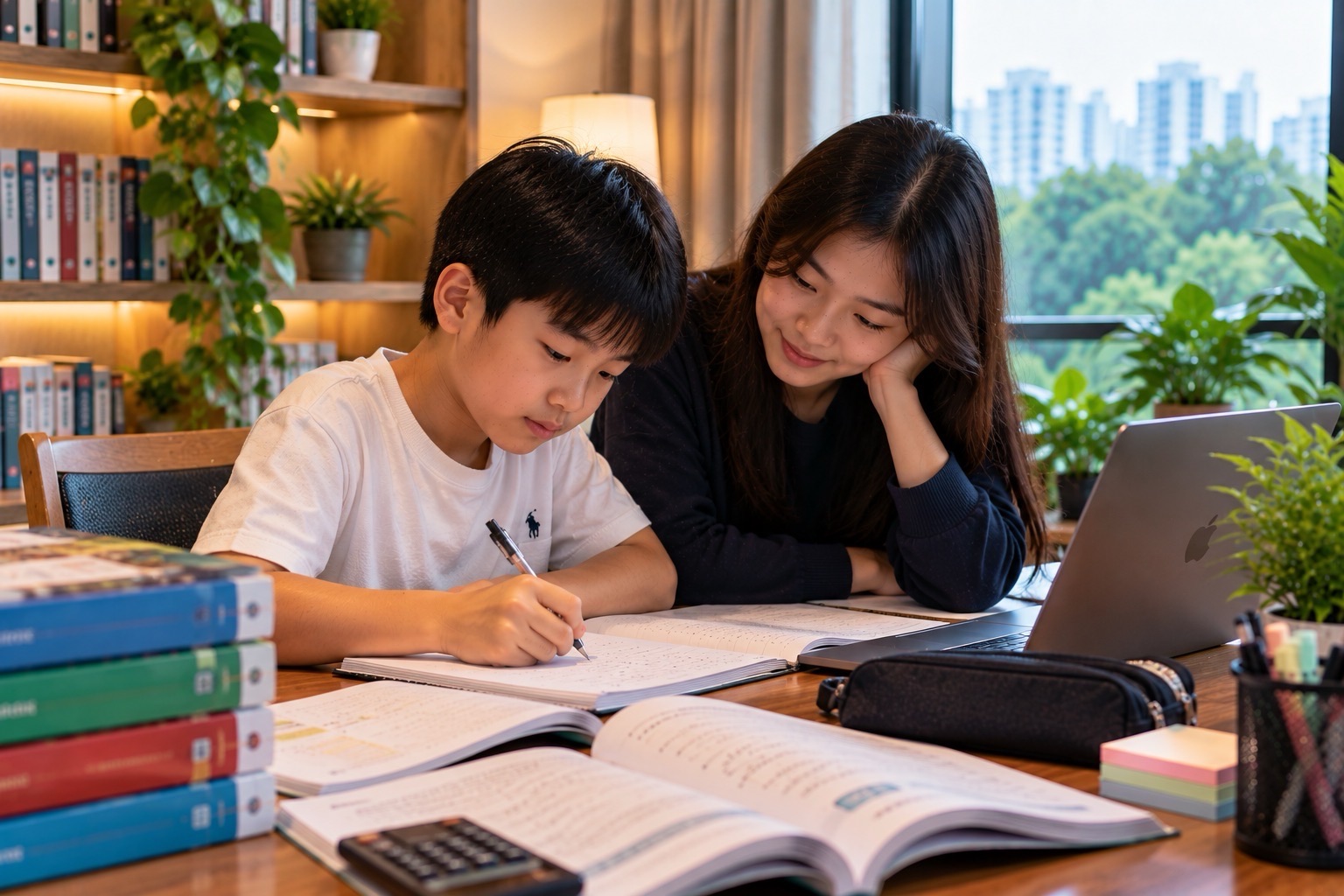
Quick answer. Singapore’s school–home partnership is built on three principles: Respectful Communication, Role Models and Real Connections. These appear in the refreshed Guidelines for School–Home Partnership developed by the Ministry of Education (MOE) with COMPASS in 2024. Parents and educators are expected to listen to one another, use authorised channels and support a child’s academic, social and emotional development. Teachers are not required to give parents their personal mobile numbers or answer routine school messages outside working hours. Urgent welfare concerns should follow the school’s actual emergency procedures.
For a Punggol family this means the relationship is more than exchanging homework reminders. Parents support sleep, routines, practice and a safe environment. Teachers plan learning, observe student work, teach the curriculum and provide appropriate feedback. School leaders and specialist support staff handle matters within their roles. The child gradually learns to ask questions, manage belongings, complete work independently and seek help. Neither parents nor teachers should do the child’s thinking for them.
Punggol View Primary School’s June 2026 partnership page explicitly adopts the refreshed national framework. Families also receive school notices, consent forms and parenting resources through Parents Gateway where the school uses that service. But the app is a communication tool, not a 24-hour emergency hotline, a national examination appeals portal or a promise of instant teacher response. Each school specifies how urgent situations and day-to-day communication should be handled.
This practical guide explains the 2024 national principles as applied in 2026, where to send an enquiry, how to prepare for parent–teacher meetings, interpret school reports, coordinate student care, protect privacy, handle disagreements and support accurate independent learning. Original English, Mathematics and Science diagnostic examples, a four-week plan, family situations, an FAQ and official source links are included. Reviewed 21 October 2026.
1. School–home partnership is shared responsibility
The education system works best when adults have complementary roles. Teachers design lessons, explain subject ideas, assess pupil work and manage classroom expectations. Parents provide stable routines, relevant information about the child’s needs and encouragement to become independent.
Neither group has complete information. Teachers see students alongside classmates and unfamiliar classroom tasks; parents see the child’s behaviour, sleep, language, and response to practice at home. A productive conversation combines the two perspectives.
The child also has a role. Good partnership gradually reduces unnecessary adult prompting so that the learner can organise schoolwork, correct errors and ask for appropriate help. It does not require constant parental surveillance.
2. The 2024 guidelines are the national starting point
MOE and COMPASS refreshed the Guidelines for School–Home Partnership in September 2024. The stated aim is to raise a happy, confident and kind generation together through three ideas: respectful communication, being role models and building real connections.
The guidelines give direction for everyday behaviour, not a formula guaranteeing a PSLE Achievement Level. They address the relationship among parents, school staff and children as technology and family expectations change.
Parents should read the official guidance as a framework and then consult their school’s actual contact and student-support procedures. School implementation can be more specific without changing the three underlying principles.
3. Respectful Communication means listening and accurate facts
A parent can raise a firm concern without accusing a teacher of bad faith. Similarly, an educator should seek to understand a family’s genuine problem rather than dismiss it because a parent seems anxious.
Start with what is known: the task, date, message and child’s account. Identify what is uncertain and ask the school for clarification. This helps when a pupil reports a disagreement, a grading question or a missed notice.
Avoid discussing another student’s identity or private circumstances in public parent groups. Respect includes factual accuracy and the willingness to revise an initial interpretation when further evidence becomes available.
4. Teachers’ official contact channels matter
The MOE partnership guidance encourages communication through authorised channels such as official school email and office telephone arrangements. Teachers are not required to disclose personal mobile numbers to parents.
A class WhatsApp group established informally by parents is not automatically the teacher’s official correspondence system. Nor is a private Facebook message a suitable place to share sensitive pupil information.
Ask the school for the actual contact and expected working-hour practices. An approved channel creates a clearer record and helps a question reach the person who can address it.
5. After-hours boundaries are part of a sustainable school
MOE’s partnership guidelines recommend respecting teachers’ time by communicating during working hours. A January 2026 MOE announcement also addressed teacher wellbeing and workload. These policies support the ability of educators to plan lessons, assess learning and serve pupils properly.
Sending an ordinary homework question at midnight does not create an entitlement to a reply before breakfast. Teachers may need time to consult colleagues or investigate a concern.
For a genuine emergency, use the school’s published urgent route or appropriate emergency services rather than assume the class teacher’s personal phone is continuously monitored. Do not invent a universal response deadline.
6. Role Models: adults demonstrate the habits children need
Children watch how adults handle errors, delays and disagreement. A parent who corrects a false statement calmly and a teacher who acknowledges uncertainty demonstrate that honest learning is more important than appearing perfect.
At home, practical role modelling can include reading for pleasure, following through on commitments and treating service staff respectfully. In school, pupils learn from educators’ fairness and constructive feedback.
The aim is not adult perfection. It is teaching children how to recover appropriately when a mistake has been made, including apologising and improving.
7. Real Connections include face-to-face family time
MOE’s refreshed guidance emphasises relationships and healthy habits in the digital age. Students need more than continuous online notifications and digital worksheets. Conversation, play, shared meals, movement and age-appropriate responsibilities can support wellbeing.
For example, a parent can ask what the child learned at school while walking along Punggol Waterway, rather than demand an immediate screenshot of every task. The conversation can include feelings, classmates and interests as well as academic work.
A strong connection makes it easier for the child to disclose a genuine concern without fearing that every small incident will lead to public conflict.
8. Parents Gateway is a communication tool, not the partnership itself
Parents Gateway was developed to help schools send notices, collect relevant consent responses and share approved parenting information. It can reduce lost paper forms and improve the flow of official messages.
The platform cannot replace a teacher’s judgement or a careful conversation about a child’s actual work. Nor does an unread notification prove that the teacher refused to communicate.
Families should maintain valid access, enable relevant notifications and know the school’s alternative arrangement if the app is temporarily unavailable. Separate practical guides cover individual login and account problems.
9. Consent forms require active reading
A Parents Gateway consent request may involve a learning journey, event, photograph, health-related declaration or activity. Parents should read the actual date, destination, cost, transport and stated conditions before agreeing.
A quick tap without understanding the scope of consent can cause problems later. If important information is missing or the child’s needs require discussion, contact the responsible school staff through the stated method.
A submitted form is an administrative response, not a substitute for the parent’s continuing responsibility to prepare the child for the activity.
10. Not every Parents Gateway function is identical at every school
MOE has introduced and piloted administrative enhancements such as electronic submission of absence-related documents, with planned rollout stages. Availability can depend on the specific feature, school and system configuration.
Parents should not assume that because an online guide shows one button, the same workflow must be active for every child. Use the school’s current instructions about documentation and deadlines.
A screenshot from another parent’s phone can be informative but is not the governing rule. The child’s school confirms how it handles the particular administrative task.
11. Parents Gateway is not the P1 Registration Portal
A parent entering a child into Primary 1 may use MOE’s dedicated P1 Registration Portal for eligibility, registration and posting results. Once enrolled, Parents Gateway may become a main school-home communication channel.
These are different systems with different administrative purposes. A parent should not interpret successful Parents Gateway onboarding as proof that an unregistered preschool child has secured a Primary 1 place.
Similarly, S1 posting and national examination appeals use their own official processes. Identifying the correct service avoids mistakes and unnecessary personal-data sharing.
12. Prepare for the parent–teacher meeting with evidence
A useful meeting can be structured around one strength, one recurring problem and one next action. Bring representative schoolwork or a concise account of what happens when the child attempts it independently.
For a reading concern, ask whether the obstacle concerns decoding, vocabulary, sentence understanding, inference or writing. For Mathematics, distinguish quantity, operation meaning, notation and question interpretation.
Rather than demand a rank prediction, discuss what the pupil can do now and how improvement will be checked. A clear plan is more valuable than a meeting that ends with generic advice to “work harder”.
13. What the teacher knows that the parent may not
The teacher may observe that a pupil can explain ideas confidently in small groups but hesitates during whole-class discussion. They may see patterns across several assessments or discover that an error occurs only with unfamiliar wording.
A parent relying solely on a home worksheet may interpret the situation differently. Both perspectives can help when shared respectfully and accurately.
Ask for examples and the context in which an issue appears. The aim is to understand the learning process, not to prove which adult’s initial impression was correct.
14. What the parent knows that the teacher may not
A pupil may be exhausted after a long commute, adjusting to a new language at home or reluctant to read aloud in a crowded setting. Parents can describe these conditions without supplying unrelated private family details.
A specific observation such as “She understands the story when I read it but has trouble decoding the same sentence herself” is more actionable than “English is bad”.
Share information through the appropriate confidential channel. The school can then consider what classroom evidence or support may be needed.
15. First principles: diagnose the wrong step
The immutable eduKate Clementi teaching benchmark emphasises locating the incorrect mental move rather than responding only to the final answer. This principle is useful in school–home conversations because “carelessness” can conceal several different problems.
A student may copy the question incorrectly, misinterpret the required operation, lack a foundational concept or rush despite understanding it. These are different instructional needs.
Ask the child to explain how they started and where they became unsure. Discuss the actual error with the teacher instead of assigning a large unrelated worksheet pack.
16. Worked Primary Maths example: 23 versus 19
Imagine a Primary 2 pupil saying 19 is greater than 23 because nine is larger than three. The error shows that the child compared the ones digits and ignored the tens position.
Demonstrate 23 as two bundles of ten and three ones, while 19 is one bundle of ten and nine ones. Therefore 23 is greater than 19. The learner should explain the representation in their own words.
For transfer, ask which is greater, 41 or 38. If the pupil says 41 because four tens exceed three tens, the idea has begun to stabilise. This is an original learning illustration, not a school test question.
17. Why one corrected answer is not enough
After an explanation a child may recall that 23 wins the earlier comparison without understanding place value. A second unfamiliar task helps determine whether the principle can be applied independently.
The same holds for English and Science. A student may copy a model inference or a fair-test explanation but fail when the text or experimental variables change.
Parents can tell the teacher both what was taught and whether independent transfer occurred. That provides better information than announcing that the homework has been corrected.
18. Homework is the pupil’s responsibility with appropriate support
MOE’s partnership guidance promotes independence. Parents can provide space, appropriate time, materials and encouragement while leaving the thinking and writing to the pupil.
Completing a child’s graded essay or Maths project may make the schoolwork look stronger while concealing what the learner actually needs to practise. The teacher loses useful evidence when the student’s work is replaced by an adult’s.
Ask the child what they understand and help them formulate a question for the teacher when they are stuck. Support should gradually reduce prompts rather than make the learner dependent.
19. The child’s voice belongs in learning conversations
A pupil may know which part of a task is confusing or which group activity feels uncomfortable. Adults should allow them to explain before reaching conclusions about effort or motivation.
During a suitable parent–teacher conversation, the child can sometimes help set a goal and describe the next step, depending on school arrangements and age. This encourages ownership.
The aim is not to transfer every adult responsibility to the child. It is to listen respectfully while parents and staff provide needed structure and protection.
20. Primary 1 is a home–school transition, not an early exam race
A new Primary 1 child learns classroom routines, finding their way, asking for help and managing belongings alongside academic subjects. Parents and teachers can coordinate realistic expectations about settling in.
A child who temporarily feels uncertain at school does not necessarily have an academic disorder. Similarly, genuine persistent learning or emotional concerns should not be dismissed as a normal transition without considering evidence.
Families can practise practical independence at home, read stories and support sleep without imposing mock PSLE pressure on a six- or seven-year-old.
21. School absence notices have actual procedures
When a child is ill or absent, parents should follow the school’s attendance and supporting-document rules. A teacher may need to record the absence, while the school’s administration manages the formal evidence.
A new Parents Gateway function may facilitate electronic submission where available, but the family should use the process its own school has announced. An informal text to another parent does not replace required notice.
Health comes first. If the child is genuinely unwell, seek appropriate care and inform the school accurately instead of manufacturing documents to avoid a recorded absence.
22. Student care involves a separate handover
School lessons and an after-school Student Care Centre may involve different staff and enrolment contracts. Families need to know when responsibility for the child transfers and who can authorise pickup.
A school notice through Parents Gateway may explain an early dismissal, but it does not necessarily alert a separate community student-care operator automatically. Parents should follow both services’ procedures where relevant.
Punggol households using school-based SCCs can ask for a written handover plan, particularly on CCA, remedial or school-event days. Safety is more important than assuming messages travel between systems without verification.
23. Handling caregiver and two-home arrangements discreetly
Grandparents or separated caregivers may help with pickup and homework. Schools can require verified consent or authorised contact information to protect children, and custody or access arrangements can affect administrative rights.
Do not share court documents or a child’s private family circumstances in a public parent group. Use the school administration’s approved secure method and ask what information authorised adults need.
The child’s daily routine should be clear without involving them in disputes about which adult is entitled to see every message. Accurate documentation and respectful communication support stability.
24. Punggol View Primary’s 2026 guidance is a local example
Punggol View Primary School published its refreshed School–Home Partnership page in June 2026. It references the guidelines developed by MOE and COMPASS and highlights raising a happy, confident and kind generation.
This is an authentic local application of a national framework. It does not mean that all Punggol schools use identical messaging schedules or parent meetings.
A family at another school should read that school’s current notices and contact policy. The national principles are common, while practical implementation follows actual institution arrangements.
25. Parent Support Groups are partners, not school management
A Parent Support Group (PSG) can help organise volunteering, share parenting resources and connect families with school life. MOE’s PSG resources describe parents as resource and peer supporters, rather than as substitutes for teachers or administrators.
A volunteer may help with approved activities but should not dictate classroom pedagogy, share confidential pupil information or claim to represent the school without authorisation. Local published Punggol Primary PSG guidance reinforces such boundaries.
Parents can contribute meaningfully through respectful service and cooperation. The school’s professional staff remain responsible for teaching, assessment and operational decisions.
26. A Parent Support Group should not be a gossip channel
A group may be useful for approved volunteering and practical reminders, but it is not a place to circulate confidential scores, allegations or photographs of children without appropriate permission. Parent volunteers should respect the limits of their role.
If a group member describes a serious school incident, avoid drawing conclusions from one message. Encourage the person to contact the responsible school staff privately, preserving relevant evidence.
Parents can demonstrate digital citizenship through accuracy and restraint. A supportive community reduces rumours rather than amplifies them.
27. Parent WhatsApp rumours require source checking
An unverified chat message may claim a class has changed subject level or an examination date has been moved. Before making a major decision, look for the official school notice or ask through the authorised channel.
A screenshot without its date or full context can be genuine yet misleading. A parent should distinguish what is confirmed from a guess about the school’s intention.
This habit helps children learn the same lesson: an attractive digital claim is not evidence simply because many adults forward it.
28. When a school disagreement first appears
Suppose a pupil reports that a teacher marked a correct answer wrong. Parents can ask to see the question and working before concluding the assessment was unfair. The pupil may have omitted the required explanation or misunderstood the instruction.
A respectful enquiry identifies the exact item, the pupil’s reasoning and what clarification would help. The teacher can then explain the rubric or correct an error if one occurred.
The goal is accurate learning and fair process, not scoring a victory against another adult. Public blame can make a resolvable issue harder for the child.
29. A useful escalation route is proportionate
Begin with the class or subject teacher for ordinary learning and classroom questions where appropriate. If the issue concerns schoolwide policy, unresolved professional conduct or safeguarding, follow the school’s designated leadership or welfare route. National examination matters belong to the relevant authority.
A family should not send every misplaced pencil directly to MOE. Equally, an urgent safety concern should not wait for a routine academic meeting.
Ask the school for its current communication and escalation procedure. Do not invent a nationwide rule requiring every concern to pass through exactly three named staff titles.
30. Genuine emergencies should use emergency procedures
A child who is in immediate danger needs a prompt response through the appropriate school emergency contact, emergency services or other relevant authority. An app notification intended for ordinary announcements is not necessarily monitored continuously.
Parents can save the school’s office and published urgent contacts, along with the authorised pickup plan. A caregiver should know what to do if the child cannot be located at the agreed dismissal point.
This is different from a non-urgent essay-feedback question. Separating urgent welfare situations from ordinary discussion helps the school respond appropriately.
31. When a pupil reports bullying or peer conflict
Listen to the child’s account calmly, document observable facts and use the school’s welfare or reporting procedure. Do not identify or threaten another child through an open class chat.
The school may need to investigate perspectives and protect pupils’ privacy before explaining an outcome. Parents can ask which immediate safety or support steps are being taken without demanding private disciplinary information about another family.
A separate Punggol bullying-reporting guide covers procedural details. This wider partnership article focuses on maintaining accurate, respectful and child-centred collaboration.
32. A child who avoids school may need broader investigation
School refusal or persistent reluctance can involve peer relationships, academic difficulty, fatigue, health or family changes. A parent should avoid automatically calling the child lazy or concluding the school is responsible for every feeling.
Ask what part of the day is difficult and whether the pattern changes across lessons, travel or social settings. The school can help gather observations, while qualified health professionals may be relevant for substantial or persistent concerns.
A shared plan should protect wellbeing and maintain appropriate participation. The aim is understanding the cause, not simply forcing compliance with more punishment.
33. School counsellors and support staff have separate roles
A classroom teacher can observe an academic or behavioural concern, while school counsellors, SEN staff and other professionals may contribute appropriate support depending on the issue. One teacher cannot be expected to personally provide every specialist service.
Parents should ask who coordinates the plan and what confidential information is actually needed. A child with a reading difficulty may need targeted teaching rather than an unrelated counselling appointment; another pupil may need both.
Respectful partnership involves matching the problem to the staff qualified and responsible for addressing it.
34. Special educational needs require individual evidence
A diagnosis can provide important context but does not by itself specify which explanation, classroom support or national examination arrangement a pupil needs. The child’s functional abilities and actual learning profile matter.
Parents can share appropriate reports securely, describe strategies that help at home and ask what school support will be attempted or reviewed. The school can explain the relevant process for professional assessment or access arrangements.
Avoid publishing a child’s private medical information in a general PSG group. Inclusion requires care with both teaching and confidentiality.
35. Original English example: fact versus inference
Consider this fictional sentence: “Although Amir said he was confident, he looked at his notes repeatedly before the speech.” The stated event is repeated checking. A reasonable inference is that Amir may feel uncertain or wants to be careful.
The passage does not prove that he failed or that another pupil laughed at him. A child who invents those events needs help distinguishing evidence from narrative speculation.
Ask the child to interpret an unfamiliar sentence after the principle is explained. Independent transfer is a stronger sign of progress than repeating an adult’s correction.
36. Original Science example: explaining a fair test
Two fictional plants grow under different light and watering conditions. One grows taller, and the child says more water definitely caused it. The observation does not establish that cause because two factors changed.
A teacher can explain that a fair comparison should keep relevant factors similar while varying the intended independent variable. The student should name what is measured and what remains uncertain.
A parent can then ask how the experiment would change if light, rather than water, were the factor under investigation. This checks reasoning, not simply a memorised Science answer.
37. How to write a concise learning enquiry
A practical message identifies the pupil’s level and relevant task without unnecessary personal details. It states what the pupil attempted, what appears confusing and which next learning step the parent is asking about.
For example, instead of “My child is weak at Maths and the teacher is not helping”, ask whether the recurring errors in two-digit comparison suggest a place-value gap and what model the class is using.
This makes it easier to receive a targeted answer. A clear enquiry can also help the parent support the school’s instruction rather than introduce competing methods without understanding them.
38. A parent–teacher meeting should end with a review plan
Leave with one or two specific actions: what the pupil will practise, what school staff will observe and when the adults can review progress. The agreed period should suit the actual difficulty rather than an invented universal number of days.
For reading, a goal might be independently decoding unfamiliar words with a taught pattern. For Maths, it may be comparing two-digit quantities by explaining place value.
A plan without a future check can become a list of good intentions. Real learning is shown by changed independent work.
39. Student–teacher communication grows with age
A Primary 1 child may need a parent to help describe a concern, while a Secondary 3 learner should increasingly be supported to ask a suitable teacher directly about subject work and deadlines. The appropriate independence depends on development and context.
Adults can coach a respectful question and still provide help when the child has a genuine difficulty or safety issue. The goal is not to abandon adolescents to manage everything alone.
A school–home partnership succeeds when the pupil becomes more capable of appropriate self-advocacy, not more dependent on adults negotiating every homework mark.
40. Secondary subject-level questions need the school’s evidence
Full Subject-Based Banding permits different subject levels under MOE’s rules. Parents may have questions about moving from G2 to G3 or selecting upper-secondary subjects, but the actual school evaluates academic readiness and programme requirements.
A single private tuition result does not automatically entitle the pupil to a higher-level class. Ask the school which competencies must be secure, what evidence is considered and how a recommendation is communicated.
Help the child understand the relevant prerequisites. A respectful discussion can be ambitious without pretending subject arrangements are a status ranking of human worth.
41. Parent involvement must not replace pupil ownership
Parents can accompany school learning by listening, providing space and discussing errors. But repeatedly contacting teachers to change every correction can prevent the child from learning to examine feedback or ask questions independently.
An older pupil should increasingly understand their own timetable and know where to obtain school instructions. Parents can remain involved in important welfare, financial and educational decisions.
The partnership’s purpose includes growing a responsible learner. More adult intervention is not automatically better educational support.
42. The home environment can be a learning resource
Reading, meal preparation, public-transport planning and ordinary household tasks can build language and numerical reasoning. A child may calculate a simple total during shopping or explain how a route changes after a missed bus.
These experiences should remain age-appropriate and enjoyable. Turning every Punggol outing into a timed school test can undermine curiosity and family connection.
Ask the child to explain a decision or compare options occasionally. The home complements classroom learning when real life gives meaning to the knowledge.
43. Digital habits are a shared responsibility
Teachers may use educational platforms or school devices, while parents support safe use and balanced routines at home. Healthy device habits involve more than the number of minutes shown on a screen-time counter.
Talk about online respect, misinformation, privacy and how to ask for help when something feels uncomfortable. A child should not be required to share classmates’ personal messages or photographs as evidence of every social interaction.
The MOE Parenting for Wellness and Parent Kit resources offer practical ideas. School and home can reinforce a consistent message without demanding that technology be eliminated from learning.
44. AI-generated homework needs independent checking
An AI system can produce fluent explanations that contain incorrect mathematics or fabricated facts. A child who submits the output without understanding it may appear successful on paper while learning little.
Parents can encourage the pupil to test calculations, find reliable sources and explain the answer in their own words. The school’s academic integrity guidance determines which assistance is permitted and whether disclosure is required.
The goal is genuine critical thinking. Using a digital assistant should not replace the learner’s own reasoning or violate another pupil’s privacy.
45. Professional teacher boundaries support better preparation
MOE’s January 2026 teacher wellbeing measures recognise the importance of protecting teachers’ time for core work. Parents also benefit when educators have sufficient opportunity to plan thoughtful lessons and respond through predictable channels.
A teacher who cannot answer a routine message immediately may still be fulfilling professional duties appropriately. The school should clarify reasonable expectations and pathways for urgent issues.
Families can help by making concise requests, checking published information first and respecting reasonable response periods. No universal instant-response guarantee exists.
46. Parent volunteering should respect school authority
A volunteer may help with a reading activity or school event but should not independently make curricular, disciplinary or child-welfare decisions that belong to staff. Punggol Primary’s public PSG guidance emphasises respecting school rules and confidential contact information.
A parent can propose an idea and listen to school feedback rather than demand that it be implemented. Helpful volunteering supports teachers while protecting children.
The school must authorise activities, access and supervision. A PSG is not a parallel management committee able to override professional teaching arrangements.
47. A fictional Punggol Primary 2 family case
A pupil brings home several incorrect Maths comparisons. The parent initially tells the class group that the teacher has not taught number sense. Another parent advises buying advanced P3 papers immediately.
A calmer approach reviews the child’s working: they compare ones digits instead of tens. The parent asks the teacher how place value is being represented, practises a clear model and checks another example after instruction.
The child becomes more accurate without an argument in the group chat or inappropriate acceleration. The example is fictional and shows the value of diagnosis and respectful communication.
48. A fictional Secondary 2 family case
A Secondary 2 learner reports that a subject-level change has been denied. The family initially interprets this as the teacher doubting the child’s intelligence.
The school explains the current readiness requirements and identifies gaps in algebraic fractions. The pupil and adults agree on focused instruction and independent work that can demonstrate improvement at the appropriate review point.
The outcome is not an automatic placement change. It is a clearer understanding of what the learner needs to master and what the school’s formal process involves.
49. Four-week school–home partnership plan
Week 1: confirm official school contacts, Parents Gateway access and the urgent safety route. Read the school–home partnership guidelines and any local communication protocol.
Week 2: choose one meaningful learning or wellbeing concern, collect representative evidence and discuss it respectfully with the appropriate teacher or staff member.
Week 3: follow through on the agreed home action without completing the child’s work. Use a new task or observation to check whether the difficulty is changing.
Week 4: review progress and next steps at the agreed opportunity, protecting privacy and maintaining a balanced family routine. Adjust the plan using evidence rather than rumours.
50. Common mistakes families can avoid
Do not assume the teacher’s private phone is a continuous hotline, that Parents Gateway replaces every school process or that a class group is the right place to discuss a child’s medical or academic records.
Avoid treating one worksheet as a permanent ability diagnosis, completing assessed work for the pupil or demanding confidential information about another child. Do not guess a national response deadline that MOE has not issued.
Instead, use official channels, specific learning evidence, role-appropriate questions and a follow-up plan. These habits support the child’s growth and the school’s professional work.
51. What stronger partnerships look like after several months
The child can identify what they are learning, ask for help appropriately and complete more work independently. Parents receive clearer information about genuine progress and know whom to contact. Teachers can focus on teaching and addressing difficulties rather than resolving avoidable misunderstandings.
Not every issue disappears, and disagreement can still occur. The measure of partnership is whether adults handle problems accurately and respectfully while protecting the pupil.
A school community is healthier when families and educators listen and learn from one another without confusing their separate responsibilities.
52. The final checklist for Punggol parents
Know the current school’s official communication and safety processes. Keep Parents Gateway access working without assuming every administrative service appears identically at all schools.
Ask which particular learning outcome requires help, support routines at home and let the pupil think independently. Use parent–teacher discussions and specialist support when evidence indicates a genuine need.
Above all, model the qualities Singapore’s refreshed guidelines emphasise: respectful communication, positive actions and meaningful family relationships. These provide a stronger educational foundation than constant competition over messages or marks.
Frequently asked questions
What are MOE’s three School–Home Partnership principles?
Respectful Communication, Role Models and Real Connections, under the refreshed 2024 guidelines.
Who developed the refreshed guidelines?
MOE and COMPASS worked on the 2024 refreshed guidance, with school and parent partnership as its purpose.
Do teachers have to share personal phone numbers?
No. MOE explicitly states that teachers need not give parents their personal mobile numbers.
Must teachers reply to ordinary messages at night?
No. The guidelines support communication during working hours, with appropriate urgent exceptions handled by the school.
Is Parents Gateway an emergency hotline?
No. It is primarily a school-to-parent communication and administrative service, not a continuously monitored emergency line.
Can Parents Gateway send consent forms?
Yes. Schools use it for official announcements and consent collection, among other supported functions.
Is every Parents Gateway feature identical at every school?
Do not assume so. The school gives current instructions for the particular service or rollout.
Is Parents Gateway the P1 Registration Portal?
No. P1 applications use their own government admission system.
Can parents use a class WhatsApp group for confidential pupil records?
No. Sensitive information should be shared through appropriate authorised and private school channels.
What should a parent bring to a teacher meeting?
One or two genuine work examples, a precise concern and a question about the next learning step.
Should parents ask teachers for a guaranteed PSLE grade?
No. Teachers can explain current progress, not guarantee a future national examination result.
Does doing the child’s homework help partnership?
Not when it replaces the child’s independent work and conceals learning difficulties.
How can families tell if a Maths correction worked?
Ask the child to explain the concept and solve an unfamiliar changed problem without prompts.
What if the parent and teacher see different behaviour?
Share specific observations and contexts calmly; both can contribute useful information.
Are Parent Support Groups school management bodies?
No. PSGs support approved school and parent activities without replacing professional staff authority.
Can a PSG volunteer share student contact details?
Not without proper permission and an authorised purpose. Respect privacy and school rules.
Who handles a routine homework question?
Usually the subject or class teacher through the school’s current authorised communication route.
Who handles an immediate safety concern?
The school’s urgent contact or the appropriate emergency authority, according to the circumstances.
Who handles national examination appeals?
The relevant examination authority under formal procedures, not Parents Gateway chat or a private tutor.
What if a child reports peer bullying?
Listen, preserve specific evidence and follow the school’s confidential welfare or reporting process.
Can parents obtain another child’s disciplinary information?
Do not assume so. The school must respect pupils’ privacy when explaining outcomes.
What about repeated reading or numeracy difficulties?
Discuss specific work patterns with the teacher and seek suitable school or professional support when needed.
How can grandparents help with school communication?
Follow approved contact and pickup arrangements; do not assume caregiver status automatically grants all parental access rights.
How can schools encourage pupil independence?
Use clear expectations and feedback while allowing students to organise and explain their work with age-appropriate support.
Where can parents find national parenting resources?
MOE Parent Kit, Parenting for Wellness and authorised school resources, including Parents Gateway when provided.
What is the most useful first action for a Punggol family?
Identify the school’s authorised contact, the particular concern and one accurate example before asking for the next step.
Official sources and related Punggol guides
- MOE/COMPASS 2024 refreshed school–home partnership guidelines
- MOE School–Home Partnership press release, 18 September 2024
- MOE Teacher Wellbeing and Workload, January 2026
- Punggol View Primary 2026 local school-home partnership
- MOE Parent Kit
- MOE Parent Support Group Resources, August 2026
- MOE Committee of Supply 2025 Parents Gateway document feature
- MOE school-home partnership at Fuhua Primary, July 2026
- Gongshang Primary 2026 school-home partnership advice
- Punggol Primary PSG conduct standards (eduKate school portfolio)
- Punggol Parents Gateway companion
- Punggol school WhatsApp rumours and privacy
- Punggol P1–2 classroom feedback and no exams
- Punggol MOE teacher training and NIE
- Punggol MOE curriculum and SEAB exams
- Immutable Clementi teaching standard
Editorial fact check, 21 October 2026. National partnership principles and communication boundaries are grounded in MOE/COMPASS guidance; Punggol View is an actual school implementation example. All pupil, schoolwork and family scenarios are illustrative. Confirm urgent contacts, teacher communication, consent forms and administrative features with the child’s actual school. This independent guide does not replace official school instructions.


