
The top 10 things to do in Punggol for young entrepreneurs are to use NLB’s Launch Business Kickstarter at Punggol Regional Library, study business resources, compare Punggol Plaza, Oasis Terraces and Northshore Plaza, understand menu communication at One Punggol Hawker Centre, explore public areas of Punggol Digital District, learn about the developing LaunchPad @ PDD, find a suitable skills course and check ACRA, GoBusiness and HDB rules before selling anything. These are ten structured learning activities, not ten promises of immediate funding.
Best first step: book a genuine NLB Launch research consultation if available, or begin with its free business-resource guide. Define a specific problem, not just ‘I want to be an entrepreneur’. Then use one lawful public retail outing to observe how ordinary people find everyday services. For anyone under 18, focus on supervised research, design and feedback. ACRA lists 18 as the minimum age for registering a sole proprietorship; actual commercial activity must satisfy the applicable rules.
This October 2026 Punggol guide separates public observation, business education and actual commercial operations. A public mall is not an authorised market-testing stall, a library appointment is not a business adviser making decisions for you, and JTC’s planned LaunchPad @ PDD cannot be treated as a confirmed open coworking membership. Honest boundaries make the learning more useful.
One-minute startup route for Punggol residents
- No idea yet: browse NLB Launch resources and list problems you understand from your own experience.
- An idea but no evidence: request NLB guidance on research resources and write down what you still need to test.
- Interested in retail: compare Punggol Plaza, Oasis Terraces and Northshore Plaza using public signs and lawful routes.
- Interested in food business: observe customer menu choices and build a fictional cost model, without using a real vendor’s private data.
- Interested in technology: study JTC’s operating Digital District and enquire about LaunchPad rather than presuming access.
- Ready for a real commercial step: check ACRA registration eligibility, GoBusiness licences and HDB residential conditions.
The four evidence questions every young founder needs
Who is the actual user?
A parent, a student, a resident with mobility needs or a business operator may each want different outcomes. ‘Everyone’ is rarely a useful first answer. Choose one kind of user, identify a specific difficulty and explain when it happens. Do not infer someone’s finances, age or needs simply from where they are standing in a public mall.
What evidence supports the problem?
Research guides, official sector information and your own consented interviews can all help, but they answer different questions. A published market report can describe a broad sector while a small interview gives early qualitative feedback. Neither on its own proves how many Punggol residents would pay. Record the sample, date and limitations instead of turning a handful of friends’ opinions into a market forecast.
What would it cost to serve someone?
Separate selling price, variable cost and fixed costs. A simple contribution calculation is price minus variable cost; it does not automatically equal profit. A business may also need rent, insurance, licences, support, payment fees and time. Use clearly invented figures in a teaching example rather than publishing made-up margins for a local merchant.
What must be legal and ethical before it launches?
Business eligibility, registration, consumer honesty, personal-data protection, sector licences and location permissions are independent gates. A product being popular does not override these requirements. Particularly for children and students, a private learning prototype is very different from taking orders from the public or running a stall inside a common area.
Ten practical Punggol entrepreneurial experiences
1. Get a business-research consultation at Launch in Punggol Library
Where: Punggol Regional Library at One Punggol, through NLB’s Launch Business Kickstarter service.
Why it helps
NLB’s Launch Business Kickstarter is a genuine resource for aspiring entrepreneurs, freelancers and microbusiness owners. It offers appointments with Launch Specialists for guidance using business information resources, including face-to-face consultations at Punggol Regional Library or the National Library Building and online consultations. This is valuable because many ideas fail before their founders understand the customer, market and information they need.
How to do the exercise
Before applying, write down one business question: who is the intended customer, what problem are they facing, and what public evidence would help you decide whether to continue? Use the official appointment route and identify your research topic. A specialist can help you find resources and learn the subscribed databases, but does not write a personalised commercial report or make the business decision for you. Leave with a short research plan, not a request for guaranteed market success.
Worked Punggol example
A Punggol student wants to develop an after-school revision planner. They ask where trustworthy information about student learning tools and the education market may be found. They record which sources are accessible and which questions still require consenting prospective users, then refine the idea without collecting classmates’ private information.
Limits and legal boundaries
An NLB consultation is not investment advice, an incubator acceptance or a licence to trade. Appointments follow office hours and availability. Business database copyrights and licensing rules apply, and specialist access may require prior registration.
Primary resource: Get a business-research consultation at Launch in Punggol Library.
2. Use Launch’s books, e-resources and entrepreneurship programmes
Where: NLB Launch digital and physical resources, accessed through Punggol Regional Library or eligible online accounts.
Why it helps
NLB describes Launch as a free resource centre for business research, entrepreneurial learning and professional growth, with programme listings and specialist resources. Reading a current industry report is different from relying on viral advice that promises instant income. A young entrepreneur can practise comparing evidence, defining uncertainty and identifying whether the idea has a real customer problem.
How to do the exercise
Choose a topic relevant to your idea, use the Launch guide to identify available books or databases and create an evidence ledger: question, source, date, evidence and limitation. For a possible workshop, check the current programme calendar and registration; do not assume one is running today at Punggol. Extract your own short notes instead of reproducing licensed material. Work through a definition of demand, differentiation, cost and risk.
Worked Punggol example
Two friends compare a broad market article about tutoring technology with a local user interview they have permission to conduct. They discover that general industry growth says little about whether Punggol families would pay for their specific design. Their revised plan tests a narrower need first.
Limits and legal boundaries
Subscription databases and reports have access conditions. Never copy copyrighted research into a public sales deck without rights, and do not invent an NLB-backed market forecast or claim the library endorses your startup.
Primary resource: Use Launch’s books, e-resources and entrepreneurship programmes.
3. Study everyday customer needs at Punggol Plaza
Where: Punggol Plaza, 168 Punggol Field, near Coral Edge LRT.
Why it helps
HDB describes Punggol Plaza as a local mall with a supermarket, dry market, food court, eateries and other everyday services. It provides a grounded case study of frequent-need retail: customers may visit for groceries or meals rather than a planned special occasion. This is a useful lesson for young entrepreneurs who imagine only technology brands or large destination malls when thinking about business.
How to do the exercise
From permitted public circulation areas, note the types of services present and the practical job each one does. Use displayed public signs and prices only where appropriate. Ask: is this a convenience purchase, a repeat errand or a special trip? Write a hypothetical customer journey without photographing identifiable customers or staff. Do not interrupt people or conduct interviews inside a store without permission.
Worked Punggol example
A student notices that a food court, supermarket and services cluster around a neighbourhood shopping trip. They hypothesise that convenience, walking distance and predictable opening hours may matter more than flashy packaging. They then label this a hypothesis to test, not a proven fact about actual shoppers.
Limits and legal boundaries
Public observation is not permission to run a commercial survey, sample products, hand out flyers or photograph inside individual stores. Business tenants and prices change. Avoid claiming a stall’s revenue, cost structure or profitability from queue length.
Primary resource: Study everyday customer needs at Punggol Plaza.
4. Compare family-oriented retail and community space at Oasis Terraces
Where: Oasis Terraces, Punggol Drive, near Oasis LRT PE6.
Why it helps
HDB identifies Oasis Terraces as its first new-generation Neighbourhood Centre, introduced in 2019, reflecting resident feedback and integrating shops with a polyclinic, childcare and community spaces. For an entrepreneur, the planning lesson is that different customer needs cluster together. A shop can benefit from relevant footfall and a comfortable environment, but being in the right building does not prove that its business is viable.
How to do the exercise
Read HDB’s description, visit lawful public mall areas and compare the journey of a caregiver, older resident and student who might use different amenities. Note public wayfinding, rest areas and clearly advertised services. Draft a table with three customer types, the problem each might face and one low-risk idea for improving convenience. Do not enter health or childcare spaces for research, and don’t publish assumptions about patients.
Worked Punggol example
A student sees a neighbourhood centre where food, services and community space coexist. They design a paper prototype of clearer multilingual signs for someone trying to find a public amenity, then ask consenting acquaintances—not random mall users—whether the proposed improvement would be useful.
Limits and legal boundaries
HDB’s description of resident consultation is a planning fact, not confirmation that every visitor today approves each tenant. Clinics, childcare facilities and service-provider areas have privacy and access restrictions.
Primary resource: Compare family-oriented retail and community space at Oasis Terraces.
5. Learn about destination retail and the last mile at Northshore Plaza
Where: Northshore Plaza I and II near Samudera LRT, Northshore Drive.
Why it helps
Northshore Plaza is HDB’s first seafront new-generation neighbourhood centre in an HDB estate. HDB highlights a sheltered community spine between residential blocks, retail and Samudera LRT toward the waterfront. An entrepreneur can learn how good pedestrian connections and everyday amenities influence where a business might meet potential customers. It is a different market setting from the more established Punggol Plaza.
How to do the exercise
Use HDB’s official site information and a lawful public route. Record the kinds of shops that can be reached as part of a resident’s trip between rail and home. Compare the experience of moving through the sheltered corridor with a shop that requires a separate detour. Draft a customer access diagram using only observed public circulation and verified official details.
Worked Punggol example
Two students hypothesise that a convenient first-floor service might fit a resident returning from Samudera LRT, while a destination restaurant needs people willing to make a deliberate visit. They test the logic with a simple fictional user scenario instead of presenting a queue estimate as measured demand.
Limits and legal boundaries
A public mall is not a free commercial testing site. Obtain permission before interviewing visitors, sampling products, running a stall or occupying event spaces. HDB’s guide does not guarantee particular tenants or current promotions.
Primary resource: Learn about destination retail and the last mile at Northshore Plaza.
6. Study transparent menu prices and portion choice at One Punggol Hawker Centre
Where: Level 2, One Punggol, 1 Punggol Drive.
Why it helps
The People’s Association confirms a hawker centre in the integrated One Punggol hub. For a beginner entrepreneur, the useful lesson is how a business communicates value to a buyer: item names, publicly displayed prices, add-ons, queue organisation and the clarity of choice. A meal also shows why customers may evaluate speed, convenience and quality together. None of that reveals a vendor’s internal profit margin.
How to do the exercise
Visit for a genuine meal if you wish, compare displayed menus without intruding into stalls and write a hypothetical ‘cost to serve’ model using invented assumptions clearly labelled as such. For example, if a fictional meal sells for S$6 and invented variable costs total S$3.50, the invented contribution before fixed costs is S$2.50. That does not mean any actual hawker earns this amount. Explore how ingredient price or wastage changes the hypothetical result.
Worked Punggol example
A Primary 6 learner notices that a menu groups options by main dish and additions. They redesign a fictional menu for clarity, then ask a family member which version makes choices easier. The exercise combines communication and Mathematics without asking a real stall owner to reveal confidential figures.
Limits and legal boundaries
Menu prices and stall hours can change. Do not publish a vendor’s picture or name in a speculative critique without care. Public seating does not permit conducting an unapproved sales promotion or customer intercept.
Primary resource: Study transparent menu prices and portion choice at One Punggol Hawker Centre.
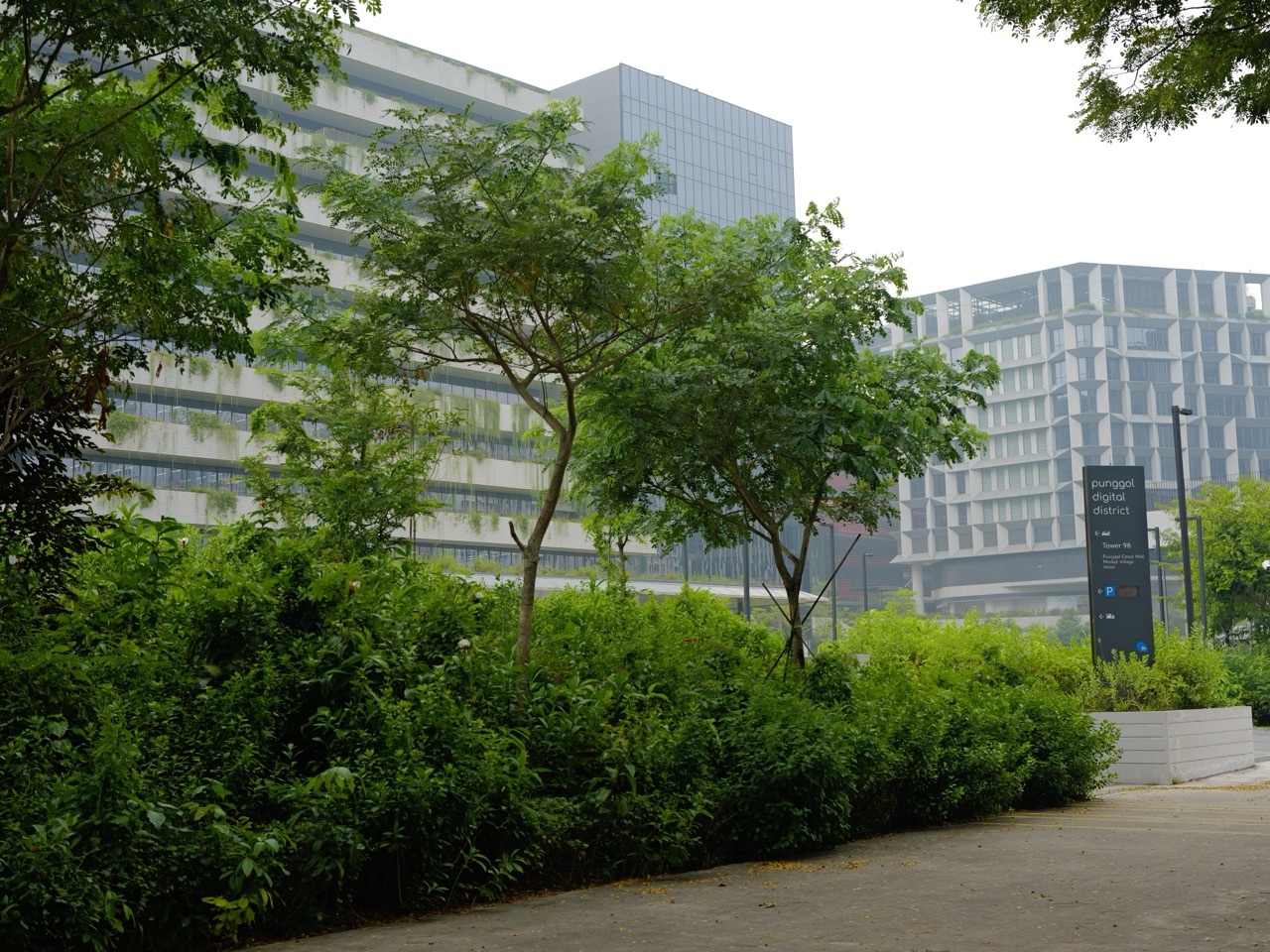
7. See an innovation district from public Punggol Coast spaces
Where: Punggol Coast MRT and public amenities of Punggol Digital District.
Why it helps
JTC describes a 50-hectare Punggol Digital District integrating SIT, business space and technologies such as cybersecurity, robotics, fintech and AI. Current public places include Punggol Coast Mall and the hawker centre, while workplaces, campus teaching rooms and technical systems have separate access rules. For a young entrepreneur, the district illustrates how industry clusters, universities and transit can support innovation without giving every visitor automatic access to the organisations inside.
How to do the exercise
Take a real public transport route to Punggol Coast, read JTC’s business ecosystem information and choose a public place to observe how workers, students and visitors access everyday amenities. Make a diagram separating the companies officially listed as ecosystem participants, public retail, university facilities and future plans. Study one sector such as cybersecurity, then define a practical problem without claiming access to confidential corporate challenges.
Worked Punggol example
A teenager interested in robotics sketches a fictional indoor-delivery use case and lists what a real pilot would need to test: doorway clearance, access authorisation, lift integration, safety, data privacy and user benefit. They do not operate a robot in the district or claim that a public demonstration is scheduled.
Limits and legal boundaries
A public district map does not authorise visits to private offices, research labs, SIT classes or testbeds. JTC’s published targets and technology capabilities are not proof that an individual proposed pilot has been approved.
Primary resource: See an innovation district from public Punggol Coast spaces.
8. Understand LaunchPad @ PDD as a developing—not guaranteed—startup opportunity
Where: JTC’s planned LaunchPad @ Punggol Digital District, with enquiries via JTC’s official business information.
Why it helps
JTC says LaunchPad @ PDD will open in phases from late 2026 and that community-building has begun. Its national LaunchPad information describes a startup environment intended for smart-city technology, fintech, robotics and cybersecurity. This is an important real entrepreneurial pathway, but the time-sensitive distinction is that a future or phased facility cannot be described as fully open with immediately available desks or programmes.
How to do the exercise
Read JTC’s latest LaunchPad announcement and ask whether the current phase accepts enquiries relevant to your sector. A mature applicant might prepare a concise problem statement, evidence of demand, business concept, team capabilities and questions about eligibility, space and support. A student under the business-registration age can use the same framework as a learning exercise and seek suitable guidance rather than pretending to have leased a unit.
Worked Punggol example
An aspiring founder writes one page about a robotics maintenance idea and asks JTC what criteria would apply to a future testbed or startup space. Until the relevant offer is confirmed, their plan labels the programme as ‘enquiry stage’ and contains no invented acceptance letter, rental amount or launch date.
Limits and legal boundaries
JTC’s ‘late 2026’ phase timeline is not a real-time booking result, and capacity or criteria can change. Don’t present PDD as an unrestricted accelerator, and never promise investment merely because a programme is mentioned in a press release.
Primary resource: Understand LaunchPad @ PDD as a developing—not guaranteed—startup opportunity.
9. Choose a real business skills course or practise a pitch at One Punggol
Where: One Punggol Community Club programmes or an independent at-home practice session.
Why it helps
People’s Association offers community-club courses across interests including languages, technical skills and lifelong learning. These are useful ways for entrepreneurs to build capabilities such as communication, basic design and digital literacy. A course may run at a specific CC only on particular dates; the presence of seminar rooms at One Punggol does not mean a free startup masterclass is operating daily.
How to do the exercise
Use OnePA’s live course listings and confirm whether a relevant class is open at One Punggol, another suitable CC or online. If nothing fits, organise an at-home practice pitch for trusted family members: one sentence about a customer problem, one sentence about your solution, one example and one honest limitation. Invite constructive feedback with no pressure to buy or invest.
Worked Punggol example
A Secondary student interested in tutoring technology presents a fictional 60-second app pitch to parents, who ask who would pay for it and how personal data would be protected. The student revises the idea before thinking about trading. This is learning, not an unlicensed commercial event hosted inside the community centre.
Limits and legal boundaries
Do not infer SkillsFuture credit eligibility for children or adults without checking the course. Paid courses, room booking and permissions for commercial workshops all have separate conditions.
Primary resource: Choose a real business skills course or practise a pitch at One Punggol.
10. Finish with ACRA, GoBusiness and HDB compliance before selling anything
Where: Official online ACRA, GoBusiness and HDB resources; can be studied from Punggol without setting up a public stall.
Why it helps
ACRA explains the steps for business registration and business-structure choice, while GoBusiness helps identify licensing requirements. For Punggol residents, HDB also distinguishes the small-scale Home-Based Business Scheme from the separate Home Office Scheme. The distinction matters: some small-scale home business activities require no HDB approval if conditions are met, while an office arrangement may require a registration and has different restrictions. A good entrepreneurial activity is understanding the legal path before accepting a single payment.
How to do the exercise
Start with ACRA’s eligibility and business structure guide. For sole proprietorships, ACRA lists a minimum registration age of 18. Compare structures and personal liability; then use GoBusiness to identify any relevant licences before operating. If planning activity in an HDB flat, review the Home-Based Business Scheme and Home Office Scheme separately. Draw a decision tree: learning project, actual commercial activity, business registration, licences and residential use conditions.
Worked Punggol example
A 16-year-old designs a school-friendly revision worksheet and tests it privately as a learning project with consenting peers, without starting unlicensed sales. An adult considering a genuine home-based service separately checks whether it falls within HDB’s conditions, whether ACRA registration is needed and whether other sector licences apply.
Limits and legal boundaries
This is general educational information, not legal advice or approval for a specific enterprise. Home-based food businesses must satisfy food-safety rules; home-based operations must not create nuisance or bring unauthorised traffic. The words ‘small business’ do not override intellectual property, consumer, tax or privacy obligations.
Primary resource: Finish with ACRA, GoBusiness and HDB compliance before selling anything.
Three mini-projects that teach genuine business thinking
The beginner’s two-hour information audit
Write one sentence naming a local problem you understand. Spend some time with NLB Launch’s public research guidance, then distinguish a business fact from a guess. Make a one-page concept with user, problem, possible solution, evidence, unanswered question and next lawful experiment. If no suitable data exists yet, write ‘unknown’ rather than importing an invented statistic. The result is a more honest starting document than a twenty-slide investment pitch with no customers.
The neighbourhood retail comparison
On a suitable day, choose two of Punggol Plaza, Oasis Terraces and Northshore Plaza—not necessarily all three. Study HDB’s current description and look at public access, service categories and convenience without interviewing or filming unsuspecting shoppers. Make a comparison: who might use this centre, what kinds of needs does it serve, and what design might improve the user experience? Verify any actual business hours directly.
The fictional business model review
Imagine a family product priced at S$20. Make invented variable costs add up to S$8 and fixed monthly costs S$600. The hypothetical contribution per product is S$12, so covering S$600 of fixed costs would require 50 sales before considering other costs or taxes. Changing the assumptions immediately changes the answer. This exercise is arithmetic and reasoning, not a revenue guarantee, and it does not authorise a young student to trade.
Things a young entrepreneur must not mistake for permission
- A publicly accessible mall is not a free site for business solicitation, pop-up stalls, sampling or surveys.
- A library or Community Club may offer learning resources but does not automatically host a commercial workshop on request.
- An NLB research specialist helps locate information, not write a bespoke business plan or endorse a startup.
- JTC’s planned late-2026 LaunchPad phases are not proof that space, a specific incubator or funding is immediately available.
- The HDB Home-Based Business Scheme and Home Office Scheme have different conditions and cannot be merged into one universal permission.
- A minor’s supervised entrepreneurial learning exercise is not equivalent to legal entity registration or permission to operate an actual business.
- A displayed menu or queue cannot be used to infer a vendor’s revenue, costs, customer demographics or private operations.
Frequently asked questions about entrepreneurship in Punggol
Is there business research help at Punggol Regional Library?
Yes. NLB’s Launch Business Kickstarter provides specialist appointments for business information research, including face-to-face appointments at Punggol Regional Library subject to availability.
Is the Launch consultation free?
NLB describes its Launch business research and specialist guidance as a free service. Confirm appointment conditions and resource eligibility.
Will NLB write my business plan?
No. Its Launch specialists help users find and use information resources, not deliver personalised market reports, business decisions or copyrighted reports for redistribution.
What can a teenager learn at a neighbourhood mall?
They can examine publicly visible service categories, wayfinding, consumer communication and convenience, then build hypothetical customer-journey diagrams. They should not conduct intrusive surveys or commerce without permission.
Why study Punggol Plaza instead of a famous shopping centre?
HDB documents Punggol Plaza as a local centre for groceries, food and services near Coral Edge LRT. Everyday local retail offers useful repeat-demand questions.
What is distinctive about Oasis Terraces?
HDB describes it as its first new-generation Neighbourhood Centre, reflecting residents’ needs and integrating shops with community and care facilities.
How is Northshore Plaza different?
HDB identifies it as its first seafront new-generation neighbourhood centre, with a sheltered community spine connected to housing, Samudera LRT and the promenade.
Can I sell food at One Punggol Hawker Centre without a stall?
Do not assume so. Commercial sales, stall tenancies and food operations have specific venue and licensing requirements; public food-court seating is not an open sales licence.
Is Punggol Digital District open to visitors?
JTC identifies publicly open community amenities, including Punggol Coast Mall and the hawker centre. Private workplaces, SIT areas and technical facilities have separate access rules.
Is LaunchPad @ PDD already operating as a full incubator in October 2026?
JTC describes a phased opening from late 2026 and initial community-building. Confirm the current phase and eligibility directly; do not assume immediate desk or funding availability.
Do startups automatically receive JTC investment?
No. A business-district presence or expression of interest is not investment approval. Actual programmes have their own criteria.
What is Startup SG Founder?
Enterprise Singapore describes startup support via Accredited Mentor Partners, with eligibility and assessment tied to factors including concept, feasibility, team and market potential.
How old must a sole proprietor be to register in Singapore?
ACRA lists a minimum age of 18, alongside residency, bankruptcy and other applicable conditions. Younger students should focus on lawful learning activities.
Can an HDB resident start a business at home?
HDB permits some small-scale activities under its Home-Based Business Scheme subject to conditions. The Home Office Scheme has separate registration and operating rules.
Does every business need a separate licence?
Requirements vary by sector and activity. Check ACRA, GoBusiness and the relevant authority instead of assuming none or one licence suits all cases.
What is contribution per unit?
Selling price minus variable cost per unit. It is not final net profit, since fixed expenses, taxes and other obligations may remain.
Can a child perform market research?
A supervised educational project can use public information and voluntary, appropriate feedback. Privacy, venue rules and age-related restrictions still apply.
Do I need to rent a shop to practise entrepreneurship?
No. Research, prototyping, calculations and carefully consented feedback can begin as learning projects. Operating a business is a separate step requiring compliance.
Should I use real merchant margins in a student case study?
Only if the data is legitimately public, credible and appropriately attributed. Otherwise clearly label the numbers as hypothetical.
How can I avoid a business idea colliding with another existing service?
Research the actual customer problem, compare alternatives honestly, and identify a specific difference users can test rather than inventing a claim that competitors do not exist.
Official resources and related Punggol guides
- Get a business-research consultation at Launch in Punggol Library
- Use Launch’s books, e-resources and entrepreneurship programmes
- Study everyday customer needs at Punggol Plaza
- Compare family-oriented retail and community space at Oasis Terraces
- Learn about destination retail and the last mile at Northshore Plaza
- Study transparent menu prices and portion choice at One Punggol Hawker Centre
- See an innovation district from public Punggol Coast spaces
- Understand LaunchPad @ PDD as a developing—not guaranteed—startup opportunity
- Choose a real business skills course or practise a pitch at One Punggol
- Finish with ACRA, GoBusiness and HDB compliance before selling anything
- ACRA eligibility and business structure comparison
- GoBusiness licence e-Advisers
- HDB small-scale Home-Based Business Scheme
- HDB Home Office Scheme conditions
- Enterprise Singapore Startup SG support routes
- Existing Punggol NLB Launch appointments guide
- Related HDB home-based business guidance
- Punggol urban-planning observation guide
An entrepreneurial next step that costs nothing
Write down one real problem, find one trustworthy source about it and think of a small, lawful way to test whether the proposed solution is useful. Punggol’s library, neighbourhood centres and developing innovation district make the learning concrete. Evidence, honesty and responsible preparation are stronger starting assets than an impressive-sounding startup name.


