
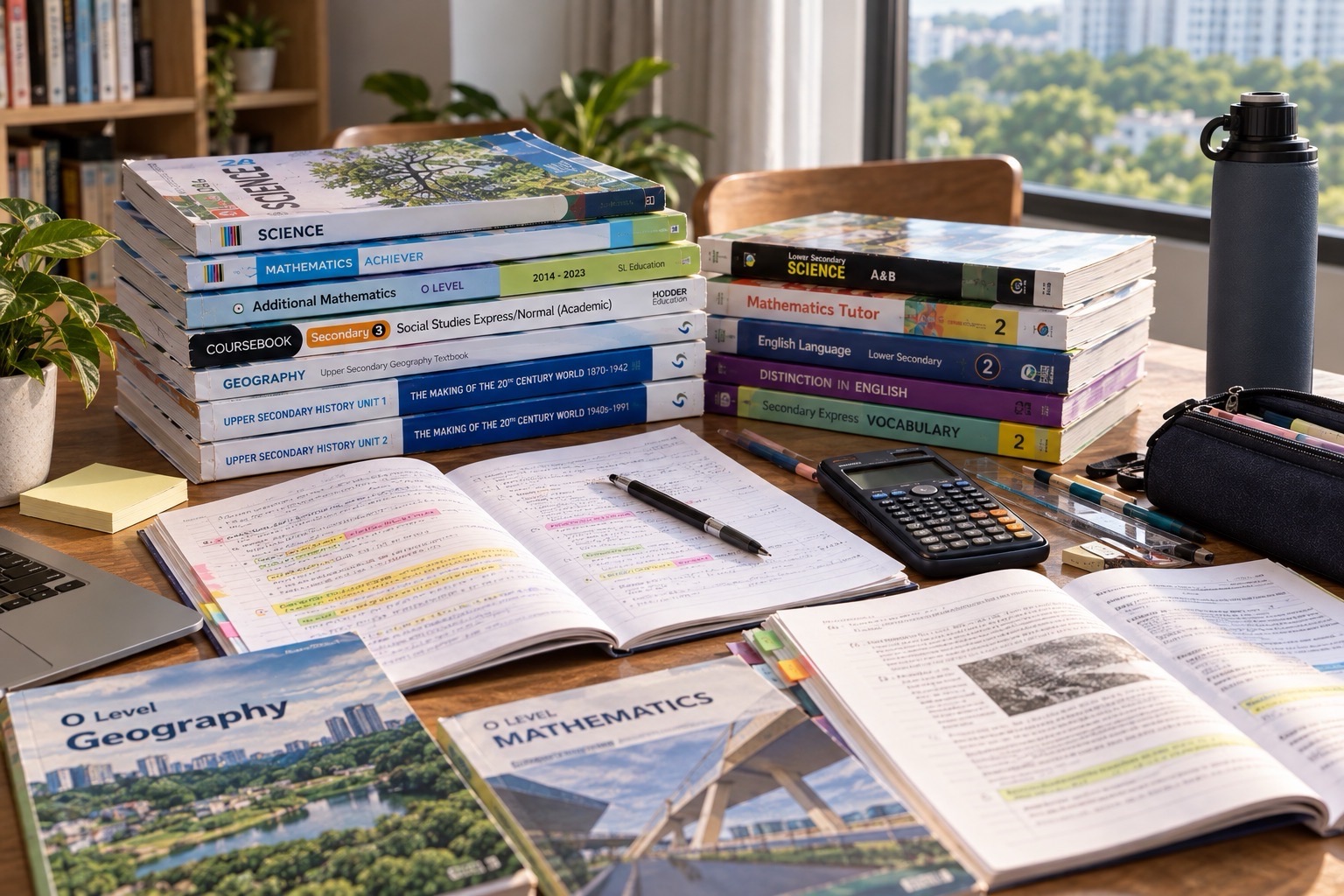
Additional Mathematics helps students express changing quantities, functions, rates and geometric relationships. Those mathematical habits connect naturally to Physics, Chemistry, Computing and later quantitative study, but **taking Additional Mathematics is not automatically a prerequisite for every science subject, diploma or university programme**. Punggol families should distinguish what students actually study in the 2027 SEC from optional advanced explanations and future institutional entry requirements.
For the 2027 Singapore–Cambridge Secondary Education Certificate, SEAB lists G2 Additional Mathematics as K232 and G3 as K341. It also lists separate G3 Physics K323, Chemistry K324 and Computing K349 syllabuses. Physics explicitly examines kinematics graphs and the area under a velocity–time graph for specified motion; Chemistry examines interpretation of reaction-rate experiment data; Computing includes programming and spreadsheets. These are real national curriculum connections, not a claim that the same calculus technique is compulsory in all four subjects.
Singapore Institute of Technology officially opened its Punggol campus in September 2025 within Punggol Digital District, giving the town a visible applied-learning destination. This guide explains mathematics-to-STEM bridges from Primary foundations to post-secondary options using clearly hypothetical measurements, fifty original worked checks, parent FAQ and a first-principles teaching plan. SIT admissions and specific programme prerequisites must still be checked separately.
FAST FACTS | K232 G2 / K341 G3: national 2027 A-Math codes | G3 Physics K323: motion graphs, speed and acceleration | G3 Chemistry K324: experimental reaction-rate data | G3 Computing K349: algorithms, Python and spreadsheets | SIT Punggol officially opened 2025 | All numerical science cases below are hypothetical and do not predict actual local measurements.
Related guides: the Additional Mathematics education system
Use the current 2027 G2 K232 or G3 K341 syllabus as the authority, then choose the specialist question here. These four guides cover separate decisions: the supplied formulae, calculator use, mathematical notation and connections to other subjects.
Find the bridge from Maths to a science or computing question
- The quick answer: the same graph can ask different questions
- What the official 2027 subject documents establish
- Primary numeracy is the first STEM bridge
- Secondary 1–2 algebra connects quantities to relationships
- Physics: average speed and velocity are not synonyms
- Physics: a velocity–time graph represents displacement by area
- Average acceleration comes from a change divided by time
- A position polynomial is a mathematical extension of motion graphs
- Motion graphs can be analysed without inventing real measurements
- Physics electrical relationships are another algebra bridge
- Physics and trigonometry use different views of periodic patterns
- Chemistry: data from a reaction is not automatically an exponential
- Chemical reaction rate: gradient and experimental explanation
- Chemistry: ratios and units are often more urgent than calculus
- Chemistry: exactness and measurement precision differ
- Computing: an algorithm is a mathematical decision sequence
- Computing: a spreadsheet formula can be mathematically wrong
- Computing: repeated powers need careful input validation
- Computing: numerical approximations are not exact identities
- G3 exponential models can bridge toward later scientific study
- SIT Punggol is a visible higher-education destination, not an automatic progression
- Post-secondary Mathematics requirements differ by route
- One transferable method: state what is known, model and check
- A six-week cross-curricular diagnostic sequence
- 60 original worked STEM checks
- Six classroom and parent case studies
- Parent FAQ
- Official curriculum and SIT sources
The quick answer: the same graph can ask different questions
A displacement–time graph, a velocity–time graph, a chemical reaction progress graph and a data-processing plot may all have horizontal and vertical axes. Their meanings depend on the labelled quantities. The gradient of a position graph represents a rate of displacement change; the gradient of an experiment’s volume curve can represent gas production per unit time.
In Additional Mathematics, differentiating a given smooth function can calculate an instantaneous rate. In a Physics or Chemistry syllabus, a graph may instead be read using a tangent, average gradient or supplied data without requiring the student to perform that particular symbolic calculus technique. The mathematical connection does not erase subject-specific assessment boundaries.
A useful parent question is, ‘Which quantity does the vertical axis show, and what does a one-unit horizontal change represent?’ The student must understand the diagram before choosing a rule.
What the official 2027 subject documents establish
SEAB K232 and K341 Additional Mathematics include algebra, geometry/trigonometry and calculus, with G3 named additions such as exponential-logarithmic functions and specified derivatives. Their aims explicitly connect mathematical ideas to other subjects, particularly sciences, and emphasise reasoning, communication and models.
The 2027 G3 Physics K323 syllabus includes speed, velocity, acceleration and graphical analysis of motion, including displacement–time and velocity–time graphs. The G3 Chemistry K324 syllabus includes experimental reaction-rate data interpretation. The G3 Computing K349 syllabus includes Python programming, algorithms and spreadsheets.
These separate documents are the source of the cross-curricular map. A school-specific combination may or may not include all those subjects for one learner, and an Additional Mathematics class does not automatically assess every example in the other syllabuses.
Primary numeracy is the first STEM bridge
Primary Mathematics develops place value, number operations, fractions, ratios, graphs and units. These support later scientific reasoning more directly than premature memorisation of calculus. A learner who cannot compare 0.50 and 0.47 may struggle with data tables long before advanced differentiation is relevant.
Take a fictional observation of a plant height increasing from eight to twelve centimetres in four days. Its average change is (12−8)/4=1 centimetre per day. The arithmetic uses subtraction, a ratio and compound units; later Mathematics can describe a changing rate using a function.
The purpose is to build the habit of naming variables, reading units and asking whether the situation actually follows a constant-rate model. A single mean rate does not establish that growth was uniform on every day.
Secondary 1–2 algebra connects quantities to relationships
A student moving into symbolic Mathematics learns that an equation preserves information about quantities. The expression y=3+2t represents a fixed component three plus a component varying with t. If t is a hypothetical number of hours and y a total amount, the coefficient two has units of amount per hour.
Expanding −2(x−4) correctly to −2x+8 is a basic symbolic skill but also protects calculations in acceleration, temperature change and graph fitting. A mistake in signs can travel across subjects even when the science idea is understood.
Before taking advanced Physics or Chemistry graphs as proof a child needs more tuition, inspect whether the first error comes from a graph concept, unit translation, algebra manipulation or reading the question. The correction should target the real bottleneck.
Physics: average speed and velocity are not synonyms
Average speed is total distance travelled divided by total time. Velocity also includes direction, so a one-dimensional signed-velocity model can distinguish movement forward from movement backward. The 2027 K323 syllabus names speed, velocity and acceleration and their graph interpretation as explicit topics.
If a fictional object travels sixty metres in twelve seconds with no changing route, its average speed is five metres per second. If it moves thirty metres east and thirty metres west, the distance is sixty metres but net displacement is zero; average velocity over twelve seconds is zero.
Students should ask which numerator the problem requires: distance or displacement. A-Math can extend these ideas through functions and differentiation, but the original Physics meaning comes first.
Physics: a velocity–time graph represents displacement by area
The G3 Physics K323 learning outcomes explicitly include using area under a velocity–time graph to determine displacement for uniform velocity or uniform acceleration. A rectangular region of constant positive velocity five metres per second for four seconds represents twenty metres of displacement.
On a graph with increasing velocity, a trapezoidal region can capture uniform-acceleration displacement. Suppose velocity rises linearly from two to eight metres per second over three seconds. The area is (2+8)/2×3=15 metres.
The A-Math connection is definite integration as signed accumulation. But a Physics pupil can solve the stated straight-line, constant-acceleration graph using geometric areas without needing a general symbolic integral. Keep the curricular levels distinct.
Average acceleration comes from a change divided by time
Suppose a fictional object’s velocity changes from eight to twenty metres per second over four seconds. Its average acceleration is (20−8)/4=3 metres per second squared. The unit comes from changing velocity (m/s) over time (s).
Uniform acceleration means the velocity changes by the same amount per equal unit of time. A graph showing that behavior has constant slope; a curved velocity–time graph suggests changing acceleration instead.
Parents can ask a student to explain the meaning of the slope before using the formula. A child who calculates twelve divided by four but labels the answer m/s has missed the physical quantity even though the number is right.
A position polynomial is a mathematical extension of motion graphs
Take a fictional differentiable position function s(t)=t²+2t metres for t≥0 measured in seconds, with coefficients carrying the appropriate physical dimensions. Additional Mathematics differentiation gives v(t)=2t+2 metres per second and a(t)=2 metres per second squared in this model.
At t=2, position s=8 metres and instantaneous velocity v=6 metres per second. The average velocity over t=2 to t=3 is [15−8]/1=7 metres per second. The two rates differ because the position model is curved.
This demonstrates a conceptual bridge into calculus. It should not be described as a compulsory symbolic-derivative technique in every G3 Physics question merely because K323 includes motion graphs.
Motion graphs can be analysed without inventing real measurements
A classroom table of times and distances can be illustrative, observed or measured. A formula such as s(t)=t²+2t gives exact outputs by definition; it does not prove that any real child cycling along Punggol Waterway follows such a curve.
If a learner constructs a velocity–time diagram from invented values, they should label the model hypothetical. If the values come from an actual school practical, measurement error and experimental conditions become relevant. These cases demand different interpretations.
The first-principles question is what each data point represents and where it came from. Mathematics is most useful when it clarifies the evidence rather than concealing assumptions under precise decimals.
Physics electrical relationships are another algebra bridge
An illustrative Ohm’s-law relationship V=IR connects potential difference V, current I and resistance R for an appropriate ohmic component under its valid conditions. Given V=9 volts and R=3 ohms, the mathematical current is I=3 amperes.
The calculation is linear algebra: divide both sides by nonzero R and track units. That same algebraic transformation is learned well before Additional Mathematics, yet advanced work benefits from consistently interpreting variables and restrictions.
This is a symbolic electrical example, not an instruction to construct circuits or an assertion about any real Punggol electrical installation. A teacher should first check whether the science assumptions are stated.
Physics and trigonometry use different views of periodic patterns
A simple mathematical sine model y=2+0.5sin(πt/6) has midline two, amplitude one-half and period twelve time units. Such curves can help students reason about periodic quantities and relate them to waveform ideas, without claiming that real sound, light or water conditions follow the chosen formula.
The period comes from requiring the sine argument to advance by 2π. Solving (π/6)T=2π gives T=12. The amplitude determines the range from 1.5 to 2.5. These are direct results of a function, not measured Physics data.
Ask the learner which parameter changes amplitude and which changes period. Comparing two models with different coefficients tests whether the student understands trigonometric structure instead of simply tracing a familiar wave.
Chemistry: data from a reaction is not automatically an exponential
The 2027 K324 Chemistry syllabus includes interpreting data from reaction-rate experiments and explaining changes in rate using chemical ideas. A curve of gas volume against time can show production slowing as a reaction progresses, but no general exponential formula follows merely because a curve bends.
Imagine made-up gas-volume observations of 10 mL at two seconds and 26 mL at six seconds. The average change is (26−10)/(6−2)=4 mL/s across that interval. That average does not prove the instantaneous production rate remained four at every moment.
A student should recognise the difference between an experimental observation and an A-Math function invented to illustrate a possible pattern. Real laboratory conclusions require appropriate methods and evidence.
Chemical reaction rate: gradient and experimental explanation
If a gas-production graph rises quickly at first and then levels off, the tangent’s gradient may decrease over time. A secondary Chemistry question may ask for interpretation of data and relevant scientific causes, such as changes in reactant availability or conditions; the graph alone does not establish a unique mechanism.
Additional Mathematics calculus formalises an instantaneous derivative when an explicit differentiable function is supplied. This is a useful conceptual connection, not a reason to replace the Chemistry syllabus’s experimental explanation with a purely algebraic answer.
Ask the learner to present two sentences separately: what the graph shows and what chemical explanation is supported under the stated conditions. This prevents a numerical gradient being mistaken for a complete science response.
Chemistry: ratios and units are often more urgent than calculus
Chemistry uses ratios, proportions and unit conversions extensively. A hypothetical dilution calculation C₁V₁=C₂V₂ may describe a nonreacting solute conserved when a solution is diluted, under appropriate assumptions. If 2 units of concentration multiply ten mL, achieving half the concentration requires twenty mL final volume.
This is an algebraic proportionality example, not an instruction to prepare or mix any specific chemical. A student should identify what is conserved, keep volume units consistent and confirm the final concentration is lower.
Parents can see how Primary fraction reasoning and Secondary algebra underlie scientific calculations. An extra calculus lesson cannot repair a persistent misreading of ratio or unit conversion.
Chemistry: exactness and measurement precision differ
A theoretical stoichiometric relationship can produce an exact ratio under a model. A laboratory measurement, however, may be limited by instrument resolution and experimental error. Reporting many decimals from a calculator does not create more reliable measured data.
Imagine a school record of 12.5 mL measured to a specified scale. Using that number in a longer equation may produce a decimal with several further digits, but the final result should respect the problem’s stated accuracy and measured uncertainty where relevant.
This connects Additional Mathematics’ symbolic exact forms with scientific honesty: say which relationships are exact mathematics and which input values are empirical approximations.
Computing: an algorithm is a mathematical decision sequence
The official 2027 G3 Computing K349 syllabus includes programming, data representation and spreadsheets. A program can calculate a mathematical formula repeatedly, but it needs correct inputs, constraints and tests. A wrong algebraic expression will not become correct because it runs without crashing.
For example, a toy algorithm calculates f(x)=x²−3 for x values zero, one and two, giving −3, −2 and 1. A learner should predict the expected outputs on paper before trusting software. This is a simple way to connect function tables to program testing.
Additional Mathematics supports modelling and symbolic reasoning, while Computing adds program design and debugging. The two subjects have separate assessed objectives and should not be merged into a single unspecified ‘STEM’ curriculum.
Computing: a spreadsheet formula can be mathematically wrong
Suppose a spreadsheet aims to compute the area A=πr² from radii in a column. Accidentally entering π×2r produces values that may look plausible for one row yet represent circumference-related arithmetic rather than area. A student should test one known radius, such as r=1 or r=2, against a manually checked result.
The issue is not a spreadsheet skill alone. The mathematical equation and its units must be correct before being translated into a cell reference or Python expression.
Teach three independent checks: identify the intended mathematical model, calculate a small known case by hand, then compare the program or spreadsheet output. This routine links good mathematics to good debugging.
Computing: repeated powers need careful input validation
An algorithm implementing 2ⁿ requires knowing which n values are allowed and which numeric representation is used. For example, 2⁰=1, 2¹=2 and 2³=8. A student who codes multiplication 2n instead of exponentiation 2^n has changed the mathematical model.
Checking the output for n=0,1,2 and 3 catches the error quickly. The program’s syntax for exponentiation depends on the programming language; correct mathematical meaning should be established first.
Not every A-Math exponential method is a required K349 programming problem, and the K349 syllabus should be consulted separately for its software and algorithm objectives.
Computing: numerical approximations are not exact identities
A simple Python or spreadsheet calculation may output 0.333333… for one-third. That is a finite floating-point approximation, not a proof that one-third is exactly a particular terminating decimal. Likewise, a computed value close to zero may be a rounding residual rather than a genuine nonzero theoretical result.
Students should distinguish exact symbolic expressions from numerical approximations and test code with a tolerance only when the task and computational method justify it. This is an extension of the SEC A-Math distinction between = and ≈.
A parent does not need to teach floating-point engineering. Asking whether the child can explain what their output represents is already a useful first step.
G3 exponential models can bridge toward later scientific study
The 2027 K341 G3 Additional Mathematics syllabus includes exponential and logarithmic algebra. Consider an explicitly hypothetical quantity N(t)=100×2^(t/3). It doubles every three time units, so N(6)=400. Solving N(t)=500 gives t=3log₂5.
An exponential model may be relevant in future sciences, computing or finance, but an actual phenomenon needs evidence of the model’s validity. The formula above is invented and not a prediction of Punggol population, laboratory results, infection rates or utility demand.
K232 G2 does not list this as matching compulsory A6 material. A G2 learner can explore ahead when appropriate, but the school-level content and child’s current foundations should govern priority.
SIT Punggol is a visible higher-education destination, not an automatic progression
SIT officially opened its Punggol Campus on 16 September 2025 within JTC’s Punggol Digital District. SIT’s published account emphasises applied learning, research and collaboration with industry. This is a verified local education fact, useful for making the Primary-to-University journey more visible.
However, living in Punggol, taking G3 Additional Mathematics or enjoying a STEM demonstration does not guarantee an SIT programme place. Degree admission depends on the specific programme’s current recognised qualifications, prerequisites and selection process.
A family can use the campus as inspiration to investigate future pathways while keeping today’s decision grounded in the child’s actual school and available subjects. Avoid constructing a false one-way route from Secondary 4 A-Math straight into university.
Post-secondary Mathematics requirements differ by route
Junior colleges, Millennia Institute, polytechnics, ITE and universities offer different programmes with changing entry rules. Additional Mathematics develops useful foundations in algebra, trigonometry and rates, but no general statement can replace the specific programme’s published admission criteria for the intake year.
A student considering quantitative education might want a stronger grasp of functions and calculus; another programme may value statistics, practical modelling or foundational numeracy differently. Core Mathematics and communication remain important across many routes.
Parents should compare the actual course name, entry year, subject-level requirements and any bridging arrangements. A tutor’s promise of a particular institution is not an admissions policy.
One transferable method: state what is known, model and check
In a physics question, define speed and unit before dividing distance by time. In a chemistry graph question, identify axis quantities before calculating slope. In a spreadsheet, write the formula before translating to a cell expression. In an A-Math problem, state the permitted domain before transforming an equation.
All four situations reward method selection and verification. Their subject-specific scientific or computational explanations still differ; the same mathematics does not make them identical examination questions.
A small-group lesson can compare one correctly reasoned example from each context, then ask pupils to classify which parts are mathematics, which are subject knowledge and which are assumptions.
A six-week cross-curricular diagnostic sequence
Week one checks fractions, ratios and units. Week two reads motion graphs and calculates basic gradients. Week three compares a Chemistry experiment data table with a defined mathematical function. Week four solves simple algebraic science relationships and tests domains. Week five explores function tables and computational checks. Week six connects A-Math rates to clearly labelled optional extensions and presents one independent new case.
The teaching plan should not pretend that Primary students must study differentiation or that every SEC Physics or Chemistry task requires calculus. Sequence examples at the learner’s actual level. Use the K232/K341 documents to verify what is compulsory in Additional Mathematics.
A parent should ask for the child’s original error, the mathematical or scientific reason it occurred, a fresh independent problem and a later explanation. This evidence is more reliable than a tutor advertising many STEM topics without demonstrating comprehension.
60 original Mathematics-to-STEM worked checks
Each teaching question below is hypothetical unless a national syllabus fact is stated. None describes a live Punggol vehicle, laboratory, sensor, school or business. The examples separate K232/K341 mathematical preparation from K323 Physics, K324 Chemistry and K349 Computing content, and identify G3 A-Math extensions where relevant.
1. Average speed
Problem or fact check: Fictional travel 60 m in 12 s.
Worked answer: 5 m/s.
What the result depends on: Distance divided by time.
Independent check: Does not describe change during interval. Identify whether the question describes a mathematical model, a science requirement or a computational test.
2. Average velocity
Problem or fact check: 30 m east then 30 m west in 12 s.
Worked answer: 0 m/s average signed velocity.
What the result depends on: Net displacement zero.
Independent check: Speed remains positive over motion. Identify whether the question describes a mathematical model, a science requirement or a computational test.
3. Distance versus displacement
Problem or fact check: Same east/west trip.
Worked answer: Distance 60 m; displacement 0.
What the result depends on: Different numerators.
Independent check: Explain direction. Identify whether the question describes a mathematical model, a science requirement or a computational test.
4. Acceleration
Problem or fact check: Velocity 8 to20 m/s in four seconds.
Worked answer: 3 m/s².
What the result depends on: Change 12 divided by four.
Independent check: Name unit. Identify whether the question describes a mathematical model, a science requirement or a computational test.
5. Constant-speed area
Problem or fact check: 5 m/s for four seconds.
Worked answer: Displacement 20 m.
What the result depends on: Rectangle under v–t graph.
Independent check: Physics K323 graphical connection. Identify whether the question describes a mathematical model, a science requirement or a computational test.
6. Uniform acceleration area
Problem or fact check: Velocity increases 2 to8 m/s over 3 s.
Worked answer: Displacement 15 m.
What the result depends on: Trapezoid (2+8)/2×3.
Independent check: Requires linear v–t segment. Identify whether the question describes a mathematical model, a science requirement or a computational test.
7. Graph gradient
Problem or fact check: Positions (t,s)=(1,3),(4,9).
Worked answer: Average gradient 2 m/s.
What the result depends on: (9−3)/(4−1).
Independent check: Read labelled axes. Identify whether the question describes a mathematical model, a science requirement or a computational test.
8. Position polynomial
Problem or fact check: s=t²+2t, at t=2.
Worked answer: Position 8 m.
What the result depends on: Direct substitution.
Independent check: Toy model. Identify whether the question describes a mathematical model, a science requirement or a computational test.
9. Instantaneous velocity
Problem or fact check: Same s(t).
Worked answer: v=2t+2; v(2)=6 m/s.
What the result depends on: Differentiate with respect to t.
Independent check: Calculus link. Identify whether the question describes a mathematical model, a science requirement or a computational test.
10. Average velocity curved model
Problem or fact check: Same s(t), t=2 to3.
Worked answer: 7 m/s.
What the result depends on: [s(3)−s(2)]/1.
Independent check: Not instantaneous at two. Identify whether the question describes a mathematical model, a science requirement or a computational test.
11. Acceleration derivative
Problem or fact check: v=2t+2.
Worked answer: a=2 m/s².
What the result depends on: Derivative of velocity.
Independent check: Interpret second derivative. Identify whether the question describes a mathematical model, a science requirement or a computational test.
12. Uniform velocity formula
Problem or fact check: Start s0=3m, v=4m/s; s at t=2?
Worked answer: 11 m.
What the result depends on: s=s0+vt.
Independent check: Define origin. Identify whether the question describes a mathematical model, a science requirement or a computational test.
13. Uniform acceleration toy
Problem or fact check: v0=2 m/s,a=3 m/s²,t=4s; displacement.
Worked answer: 32 m.
What the result depends on: v0t+(1/2)at²=8+24.
Independent check: Model assumes constant a. Identify whether the question describes a mathematical model, a science requirement or a computational test.
14. Displacement graph
Problem or fact check: v positive 4 m/s from t=0 to5.
Worked answer: 20 m forward.
What the result depends on: Positive signed area.
Independent check: Not negative. Identify whether the question describes a mathematical model, a science requirement or a computational test.
15. Negative velocity graph
Problem or fact check: v negative −4 m/s for 5s.
Worked answer: Displacement −20 m.
What the result depends on: Signed area below axis.
Independent check: Distance 20m. Identify whether the question describes a mathematical model, a science requirement or a computational test.
16. Velocity triangle
Problem or fact check: Velocity rises 0 to6 m/s over 4s.
Worked answer: 12 m displacement.
What the result depends on: Triangle area half×4×6.
Independent check: Uniform acceleration. Identify whether the question describes a mathematical model, a science requirement or a computational test.
17. Ohm’s law example
Problem or fact check: V=9 V,R=3 Ω; calculate I.
Worked answer: 3 A.
What the result depends on: I=V/R.
Independent check: Assumes appropriate ohmic model. Identify whether the question describes a mathematical model, a science requirement or a computational test.
18. Solve for resistance
Problem or fact check: V=12 V,I=2 A.
Worked answer: R=6 Ω.
What the result depends on: Rearrange V=IR.
Independent check: No real circuit built. Identify whether the question describes a mathematical model, a science requirement or a computational test.
19. Function units
Problem or fact check: E(t)=t²+3t joules in toy model.
Worked answer: dE/dt=2t+3 J/s.
What the result depends on: Derivative yields power units.
Independent check: Coefficients carry implied units. Identify whether the question describes a mathematical model, a science requirement or a computational test.
20. Power at time two
Problem or fact check: Same E(t), t=2.
Worked answer: 7 W.
What the result depends on: J/s is watt.
Independent check: Fictional energy model. Identify whether the question describes a mathematical model, a science requirement or a computational test.
21. Sine model amplitude
Problem or fact check: y=2+0.5sin(πt/6).
Worked answer: Amplitude 0.5.
What the result depends on: Coefficient outside sine.
Independent check: Toy model. Identify whether the question describes a mathematical model, a science requirement or a computational test.
22. Sine model midline
Problem or fact check: Same y.
Worked answer: Midline two.
What the result depends on: Vertical shift.
Independent check: State units only if defined. Identify whether the question describes a mathematical model, a science requirement or a computational test.
23. Sine model period
Problem or fact check: Same y.
Worked answer: Period 12 t-units.
What the result depends on: Argument change 2π.
Independent check: Not real sensor data. Identify whether the question describes a mathematical model, a science requirement or a computational test.
24. Sine model peak
Problem or fact check: Same y at t=3.
Worked answer: 2.5.
What the result depends on: sinπ/2=1.
Independent check: Not actual water level. Identify whether the question describes a mathematical model, a science requirement or a computational test.
25. One average gas rate
Problem or fact check: Invented volumes 10mL at 2s and 26mL at6s.
Worked answer: 4 mL/s.
What the result depends on: (26−10)/(6−2).
Independent check: Average, not guaranteed instantaneous. Identify whether the question describes a mathematical model, a science requirement or a computational test.
26. Chem graph flatter
Problem or fact check: Fictional gas-volume curve flattens.
Worked answer: Smaller positive gradient.
What the result depends on: Rate appears to decrease.
Independent check: Scientific cause needs context. Identify whether the question describes a mathematical model, a science requirement or a computational test.
27. Chem measurement units
Problem or fact check: Convert 25 mL to cm³.
Worked answer: 25 cm³.
What the result depends on: One millilitre equals one cubic centimetre.
Independent check: Useful in lab tables. Identify whether the question describes a mathematical model, a science requirement or a computational test.
28. Chem ratio model
Problem or fact check: C1=2 units,V1=10mL,C2=1 unit; find V2.
Worked answer: 20mL.
What the result depends on: C1V1=C2V2 under dilution assumptions.
Independent check: Not a lab procedure. Identify whether the question describes a mathematical model, a science requirement or a computational test.
29. Chem ratio doubling
Problem or fact check: If volume doubles while amount fixed, concentration?
Worked answer: Half.
What the result depends on: Inverse proportion.
Independent check: Specify conservation. Identify whether the question describes a mathematical model, a science requirement or a computational test.
30. Reaction-rates data
Problem or fact check: At t=0 gas volume0, t=5 volume20mL.
Worked answer: Average 4mL/s.
What the result depends on: Linear average only.
Independent check: Do not assert rate constant. Identify whether the question describes a mathematical model, a science requirement or a computational test.
31. Chemical energy sign
Problem or fact check: If ΔH is negative, is an exothermic process indicated?
Worked answer: Yes under chemistry sign convention.
What the result depends on: K324 treats negative enthalpy as exothermic.
Independent check: Do not confuse with speed. Identify whether the question describes a mathematical model, a science requirement or a computational test.
32. Chem exact versus measure
Problem or fact check: Measured volume 12.5mL; calculator gives 12.5000000.
Worked answer: Precision not improved.
What the result depends on: Displayed zeros are not new measurement data.
Independent check: Respect instrument resolution. Identify whether the question describes a mathematical model, a science requirement or a computational test.
33. A-Math quadratic model
Problem or fact check: f(x)=x²−6x+13.
Worked answer: Minimum four at x=3.
What the result depends on: Complete square.
Independent check: Not real lab result. Identify whether the question describes a mathematical model, a science requirement or a computational test.
34. Graph intercepts
Problem or fact check: y=x²−4.
Worked answer: x-intercepts −2 and2.
What the result depends on: Solve y=0.
Independent check: Interpret only if units known. Identify whether the question describes a mathematical model, a science requirement or a computational test.
35. Spreadsheet model
Problem or fact check: Area A=πr² with r=2.
Worked answer: 4π units².
What the result depends on: Check formula before entering spreadsheet.
Independent check: Distinguish 2πr. Identify whether the question describes a mathematical model, a science requirement or a computational test.
36. Spreadsheet wrong formula
Problem or fact check: If code computes 2πr when expecting area.
Worked answer: Wrong mathematical model.
What the result depends on: It’s circumference.
Independent check: Use known case. Identify whether the question describes a mathematical model, a science requirement or a computational test.
37. Algorithm function test
Problem or fact check: f(x)=x²−3, x=0,1,2.
Worked answer: −3,−2,1.
What the result depends on: Test expected outputs by hand.
Independent check: Code must match formula. Identify whether the question describes a mathematical model, a science requirement or a computational test.
38. Algorithm exponent
Problem or fact check: Calculate 2³.
Worked answer: 8.
What the result depends on: Power is not 2×3.
Independent check: Choose correct syntax. Identify whether the question describes a mathematical model, a science requirement or a computational test.
39. Algorithm base case
Problem or fact check: Calculate 2⁰.
Worked answer: 1.
What the result depends on: Zero exponent rule.
Independent check: Useful test input. Identify whether the question describes a mathematical model, a science requirement or a computational test.
40. Decimal float approximation
Problem or fact check: Is 0.333 exact 1/3?
Worked answer: No.
What the result depends on: Finite decimal approximate.
Independent check: Distinguish equality symbols. Identify whether the question describes a mathematical model, a science requirement or a computational test.
41. Scientific notation
Problem or fact check: Write 0.0004567 as power of ten.
Worked answer: 4.567×10⁻⁴.
What the result depends on: Scale shift.
Independent check: Check sign positive. Identify whether the question describes a mathematical model, a science requirement or a computational test.
42. Binary conversion
Problem or fact check: Represent decimal five in binary.
Worked answer: 101.
What the result depends on: 4+1.
Independent check: Computing numerical literacy. Identify whether the question describes a mathematical model, a science requirement or a computational test.
43. Boolean truth
Problem or fact check: If A true, B false, A AND B?
Worked answer: False.
What the result depends on: AND requires both true.
Independent check: Logic separate from A-Math calculus. Identify whether the question describes a mathematical model, a science requirement or a computational test.
44. Power versus exponential
Problem or fact check: Compare y=x² and y=2ˣ at x=3.
Worked answer: 9 versus 8.
What the result depends on: Variable position differs.
Independent check: Functions not interchangeable. Identify whether the question describes a mathematical model, a science requirement or a computational test.
45. G3 exponential model
Problem or fact check: N(t)=100×2^(t/3), N(6)?
Worked answer: 400.
What the result depends on: Two hypothetical doubling intervals.
Independent check: No real population prediction. Identify whether the question describes a mathematical model, a science requirement or a computational test.
46. G3 inverse log
Problem or fact check: Same N(t)=500 solve time.
Worked answer: t=3log₂5.
What the result depends on: Inverse exponent.
Independent check: Check by substitution. Identify whether the question describes a mathematical model, a science requirement or a computational test.
47. Linearisation extension
Problem or fact check: For positive x,y with y=3x².
Worked answer: ln y=ln3+2ln x.
What the result depends on: K341 named transformation.
Independent check: Not required as all G2 content. Identify whether the question describes a mathematical model, a science requirement or a computational test.
48. Data fit interpretation
Problem or fact check: Three real readings nearly on a line.
Worked answer: Model parameters are estimates.
What the result depends on: Scatter and error remain.
Independent check: Do not claim exact relation. Identify whether the question describes a mathematical model, a science requirement or a computational test.
49. Area under v–t vs position
Problem or fact check: Constant 5m/s for4s.
Worked answer: 20m displacement.
What the result depends on: Area gives change in position.
Independent check: Different from final position without s0. Identify whether the question describes a mathematical model, a science requirement or a computational test.
50. Motion sign crossing
Problem or fact check: v(t)=t−1 on 0≤t≤2.
Worked answer: Signed displacement zero.
What the result depends on: Integral positive and negative cancel.
Independent check: Distance positive. Identify whether the question describes a mathematical model, a science requirement or a computational test.
51. Same motion distance
Problem or fact check: v=t−1 on 0≤t≤2.
Worked answer: Total distance one metre.
What the result depends on: Two triangles area 1/2 each.
Independent check: G3 A-Math motion illustration. Identify whether the question describes a mathematical model, a science requirement or a computational test.
52. Units of graph slope
Problem or fact check: Vertical mL, horizontal seconds.
Worked answer: mL/s.
What the result depends on: Rate of gas volume change.
Independent check: Does not automatically imply mol/s. Identify whether the question describes a mathematical model, a science requirement or a computational test.
53. Chemistry versus maths error
Problem or fact check: A pupil computes correct graph slope but claims all rates identical at every time.
Worked answer: Unsupported extrapolation.
What the result depends on: Average slope not instantaneous.
Independent check: Need scientific evidence. Identify whether the question describes a mathematical model, a science requirement or a computational test.
54. Mathematical model assumptions
Problem or fact check: C(t)=3+2t, t≥0.
Worked answer: Initial three, slope two.
What the result depends on: Defined fictional relationship.
Independent check: No real tuition pricing claim. Identify whether the question describes a mathematical model, a science requirement or a computational test.
55. Physics free-fall
Problem or fact check: Use simplified g≈10m/s², t=2s from rest.
Worked answer: Change in speed ≈20m/s.
What the result depends on: Assumes negligible air resistance and near-Earth model.
Independent check: Check K323 context. Identify whether the question describes a mathematical model, a science requirement or a computational test.
56. Future university qualification
Problem or fact check: Does A-Math guarantee entry to SIT?
Worked answer: No.
What the result depends on: Course admission criteria distinct.
Independent check: Look up current programme. Identify whether the question describes a mathematical model, a science requirement or a computational test.
57. Input domain
Problem or fact check: For f(t)=100×2^(t/3), t≥0 toy elapsed time.
Worked answer: No negative elapsed time in stated context.
What the result depends on: Mathematical formula defined wider.
Independent check: Model constraints matter. Identify whether the question describes a mathematical model, a science requirement or a computational test.
58. Unit dimensional check
Problem or fact check: May one add 5m/s to 2m²?
Worked answer: No.
What the result depends on: Dimensions differ.
Independent check: Repair formula. Identify whether the question describes a mathematical model, a science requirement or a computational test.
59. Interpret velocity sign
Problem or fact check: If v=−3m/s in 1D, direction?
Worked answer: Negative relative to chosen positive axis.
What the result depends on: Speed is 3m/s.
Independent check: Define coordinate direction. Identify whether the question describes a mathematical model, a science requirement or a computational test.
60. Parent teaching check
Problem or fact check: Student can recite derivative but cannot interpret graph.
Worked answer: Revisit quantity/rate meaning.
What the result depends on: Use units and visual.
Independent check: Require independent transfer. Identify whether the question describes a mathematical model, a science requirement or a computational test.
Six case studies: where a cross-subject transfer can fail
Physics average speed is mistaken for instantaneous velocity
A student sees a curved position graph and divides total distance by total time to report ‘velocity at exactly two seconds’. That quotient is an interval average, not a local instantaneous gradient. The A-Math extension takes a derivative of a stated differentiable position model to obtain the instant rate. Both can be useful, but they answer different questions.
The tutor should draw a secant through two times and a tangent at one time, label the units and ask the student to explain the distinction without being told which formula belongs. This also protects the separate K323 Physics curriculum from unnecessary overstatement.
Chemistry graph slope is right, scientific conclusion is unsupported
A learner calculates four mL/s from two gas-volume observations and states that a reaction proceeded at exactly four mL/s at every moment. The calculation only describes the average across the interval. A single average cannot establish the shape of the entire volume-time curve or the reaction mechanism.
Ask the child to separate data description from explanation. A fresh graph with several points should be interpreted qualitatively before any derivative method is proposed as extension.
A computer program runs but its equation is wrong
A pupil writes software to calculate the area of a circle but uses 2πr, which represents circumference. The program returns numbers smoothly, so the learner assumes the code is correct. Testing a known case against the mathematical formula A=πr² reveals the problem before any deeper debugging.
A tutor should ask for a mathematical specification, manual test value, actual output and explanation of discrepancies. This connects mathematical modelling with K349-style program testing without claiming every calculus problem is required in Computing.
A negative velocity is confused with negative speed
On a one-dimensional signed-velocity graph, a learner says moving at −3m/s means negative distance travelled. The minus sign indicates direction relative to the chosen positive axis. The speed’s magnitude is three metres per second, while displacement over an interval can be negative.
Have the student draw an axis and distinguish speed, signed velocity, distance and displacement. A later graph with changing direction can test whether the difference persists independently.
A G2 learner is assigned G3 logarithmic modelling as compulsory Chemistry
A private worksheet combines exponential logarithms with a chemical-reaction example and labels it mandatory for every Additional Mathematics pupil. K341 G3 contains the named exponential-logarithm algebra outcomes, while K232 G2 does not list the matching compulsory topic. Chemistry K324 has its own requirements and should not be conflated with either mathematics level.
A parent should ask which SEAB code the child takes, whether the task is enrichment, and what foundational skill it addresses. More advanced-looking material is not automatically better preparation.
An SIT Punggol reference becomes a false admissions promise
A pupil learns that SIT has a Punggol campus and assumes excellent Additional Mathematics alone secures an engineering or computing degree there. SIT’s location and applied-learning mission are genuine facts; actual programme applications have eligibility and selection requirements that differ by programme and year.
The educational next step is to review current official course-specific requirements when the child reaches that stage. Meanwhile build strong mathematical understanding, science communication and independent learning without promising a particular university place.
Frequently asked Punggol parent questions
Does Additional Mathematics replace core Mathematics in Physics or Chemistry?
No. Foundational number, ratio, units, data and graphs remain important; A-Math adds deeper functions and calculus.
Are calculus derivatives compulsory in every 2027 Physics K323 motion task?
Do not assume that. K323 explicitly requires motion graphs and stated speed/acceleration skills; symbolic calculus is a useful separate A-Math connection.
Does Chemistry K324 teach logarithmic calculus?
Its stated reaction-rate outcomes include experiments and data interpretation. G3 A-Math K341 has its own logarithm and calculus topics.
Is Python part of G3 Computing K349?
The official 2027 K349 syllabus includes Python programming and a lab-based examination, subject to its actual specifications.
Is a function table useful for testing software?
Yes, it provides expected outputs that can be checked independently of the code.
Why do units matter in cross-curricular problems?
They identify the physical quantity, help validate formulas and distinguish rates from totals.
Is an exponential graph proof of real growth?
No. Real data and assumptions must justify any model; a classroom equation is only illustrative.
Does SIT really have a Punggol Campus?
Yes. SIT officially opened its Punggol Campus on 16 September 2025.
Does taking K341 guarantee an SIT degree place?
No. Admission depends on the relevant programme and intake requirements.
Can a K232 student learn G3 extensions?
Yes, when appropriate, but the child’s own examined K232 outcomes should remain clear.
How should a parent judge science-related tutoring?
Ask whether the learner can explain both the mathematical operation and the scientific meaning, then transfer them to a fresh problem.
What is the first useful home exercise?
Take a short graph, label both axes and units, calculate one average change, and ask what the result does and does not prove.
Primary syllabus evidence, SIT Punggol and onward routes
Fact-check date: 19 October 2026. The 2027 K232/K341, K323, K324 and K349 scopes are checked against official SEAB school-candidate documents. SIT Punggol campus information is sourced from SIT itself. All quantitative example values are original classroom illustrations, and no course-specific admissions promise or local measurement is invented.
- SEAB official 2027 G2 Additional Mathematics K232 PDF
- SEAB official 2027 G3 Additional Mathematics K341 PDF
- SEAB official 2027 G3 Physics K323 PDF
- SEAB official 2027 G3 Chemistry K324 PDF
- SEAB official 2027 G3 Computing K349 PDF
- SEAB G3 school-candidate subject directory 2027
- SIT official Punggol Campus 2025 opening release
- SIT official Punggol Campus guide
- Immutable Clementi first-principles, 3-pax and 90-minute benchmark
- Punggol A-Math and Waterway modelling learning examples
- Punggol A-Math Primary-to-University education hub
- Punggol post-SEC JC, polytechnic, ITE and SIT pathways
Series: Understanding the Additional Mathematics Education System of Punggol. This cross-curricular companion concentrates on the transition from mathematical reasoning to Physics, Chemistry, Computing and future applied learning; the Primary–University roadmap covers the broader education system.


