
Quick answer: To find an unknown angle in a Primary 6 composite figure, first identify the shape and mark its known properties. A rectangle or square has four right angles, a parallelogram and rhombus have equal opposite angles, adjacent interior angles of a parallelogram add to 180°, and the interior angles of any quadrilateral add to 360°. Use only properties supported by the diagram.
Many Punggol Primary 6 pupils can remember ‘opposite angles equal’ but forget to check whether the two angles belong to a parallelogram, rhombus or unrelated trapezium. Others rush to subtract from 180° even when the angles are not on a straight line. The solution is not a longer list of rules; it is to connect each rule to a specific visible relationship.
This original 2026 PSLE Mathematics guide gives eighteen worked examples, a picture-reading method, frequent mistake corrections, a practice plan and ways parents can test understanding without turning home into another examination hall. The figures are hypothetical geometric diagrams, not measurements of Punggol buildings or official examination questions.
Official 2026 Primary 6 geometry scope
Singapore’s MOE Primary Mathematics syllabus updated October 2025 specifies solving for unknown angles without additional construction of lines in composite figures involving squares, rectangles, triangles, parallelograms, rhombuses and trapeziums. This is a particular strand of Primary 6 geometric reasoning, not a requirement to learn formal upper-secondary proof methods.
The revised SEAB Standard Mathematics 0008 format from 2026 includes Paper 1 (50 marks, 1 hour 10 minutes, no calculator) and Paper 2 (50 marks, 1 hour 20 minutes, calculator permitted). There are 45 questions across both papers. This guide offers original reasoning exercises, not claims about which figures will appear.
The words ‘without additional construction lines’ guide the worked problems below. Drawings can be annotated with angle labels, but a pupil should not assume that new lines must be invented to solve every question. Often the needed fact is already present in a quadrilateral or triangle.
What the shapes guarantee — and what they do not
| Shape or relationship | Angle fact usable with evidence | Common wrong assumption |
| Square | Four angles of 90° | Every quadrilateral has four right angles. |
| Rectangle | Four angles of 90° | A sloping quadrilateral is automatically a rectangle. |
| Parallelogram | Opposite angles equal; adjacent angles total 180° | Every quadrilateral with two equal-looking sides is one. |
| Rhombus | Opposite angles equal; adjacent angles total 180° | Every rhombus has four 90° angles. |
| Trapezium | A marked pair of opposite sides is parallel; co-interior angles on a transversal total 180° | Its two base angles are automatically equal. |
| Triangle | Its interior angles total 180° | Every triangle is isosceles because the drawing looks balanced. |
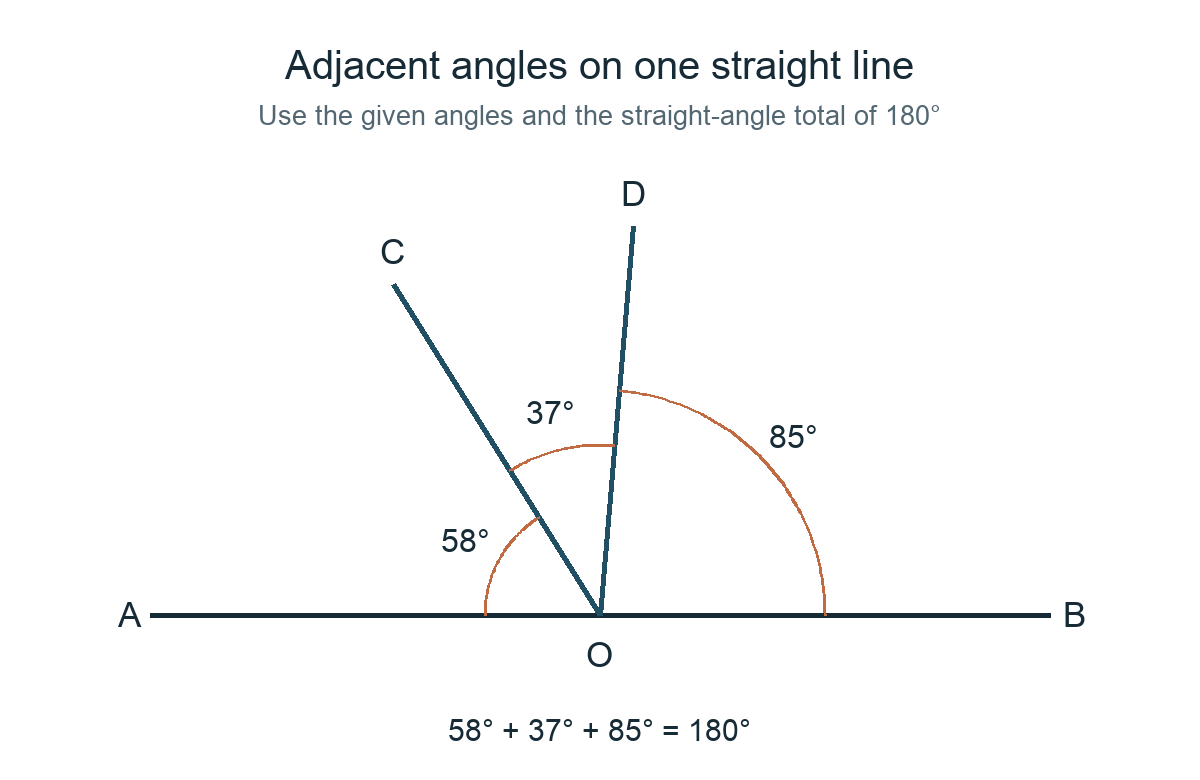
| Straight line | Adjacent angles on one side total 180° | Any two touching angles total 180°. |
| Around a point | A complete turn totals 360° | Only two angles may be present. |
The distinction between a trapezium and an isosceles trapezium is especially important. A general trapezium with one pair of parallel sides need not have equal angles at its base. When a question explicitly states that the non-parallel sides are equal, the isosceles properties become available. Never add information because a printed image happens to look symmetric.
A visual method: read, mark, reason, check
Read the givens first. Draw a small parallel-line arrow on each side that is stated to be parallel, and a right-angle square where a right angle is given. Mark equal angles only where shape properties justify them. Then identify the smallest triangle, straight line or quadrilateral that contains the missing angle.
Choose the relevant relationship, write it with numbers, and calculate. Afterward, check whether the answer fits the broad shape: an obtuse angle should exceed 90°, a right angle must equal 90°, and an angle described as supplementary to 68° must exceed 90°. The check is a mathematical prediction, not an attempt to measure the printed picture with a ruler.
In composite diagrams, the same angle may belong to more than one geometric structure. A diagonal can split one corner of a rectangle; the pieces total 90°. A triangle may lie beside a straight edge; the interior and adjacent exterior angles total 180°. Recognising which total is relevant prevents choosing an unrelated familiar formula.
Eighteen original worked angle problems
Original worked question 1: square corner split
Question. A ray splits one 90° corner of a square into 37° and x. Find x.
Working. x = 90° − 37° = 53°.
Why this rule applies. The entire square corner is one right angle, and the two smaller angles fill it.
Check. 37° + 53° = 90°.
Original worked question 2: rectangle diagonal
Question. A diagonal at a rectangle corner makes 35° with the horizontal side. Find the angle it makes with the vertical side.
Working. x = 90° − 35° = 55°.
Why this rule applies. A diagonal divides the 90° corner into two parts.
Check. 35° + 55° = 90°.
Original worked question 3: parallelogram adjacent angle
Question. One interior angle of parallelogram ABCD is 68°. Find its adjacent angle.
Working. Adjacent angle = 180° − 68° = 112°.
Why this rule applies. Adjacent parallelogram interior angles are supplementary because opposite sides are parallel.
Check. 68° + 112° = 180°.
Original worked question 4: parallelogram opposite angle
Question. In the same parallelogram, find the angle opposite 68°.
Working. The opposite angle is 68°.
Why this rule applies. Opposite angles of a parallelogram are equal.
Check. The four angles are 68°, 112°, 68°, 112° and sum to 360°.
Original worked question 5: rhombus adjacent angles
Question. A rhombus has one obtuse interior angle of 118°. Find its adjacent acute angle.
Working. x = 180° − 118° = 62°.
Why this rule applies. A rhombus is a parallelogram with all four sides equal, so adjacent angles add to 180°.
Check. 118° + 62° = 180°.
Original worked question 6: rhombus opposite angles
Question. A rhombus has two 62° angles and two obtuse angles. Find either obtuse angle.
Working. x = (360° − 2 × 62°) ÷ 2 = 118°.
Why this rule applies. Opposite angles come in equal pairs in a rhombus.
Check. 62° + 118° + 62° + 118° = 360°.
Original worked question 7: triangle angle sum
Question. A triangle contains two angles of 48° and 62°. Find the third.
Working. x = 180° − 48° − 62° = 70°.
Why this rule applies. The interior angles of a triangle total 180°.
Check. 48° + 62° + 70° = 180°.
Original worked question 8: quadrilateral angle sum
Question. A quadrilateral has three interior angles of 85°, 110° and 95°. Find the last.
Working. x = 360° − (85° + 110° + 95°) = 360° − 290° = 70°.
Why this rule applies. Every quadrilateral’s interior angles total 360°, whether or not opposite sides are parallel.
Check. 85° + 110° + 95° + 70° = 360°.
Original worked question 9: three right angles in a quadrilateral
Question. Three corners of a quadrilateral are right angles. What is the fourth?
Working. x = 360° − (90° + 90° + 90°) = 90°.
Why this rule applies. This follows from the sum of all four interior angles, not just appearance.
Check. Four angles of 90° total 360°.
Original worked question 10: straight-line pair
Question. A ray divides a straight angle into 65° and x. Find x.
Working. x = 180° − 65° = 115°.
Why this rule applies. The two adjacent angles occupy one side of the same straight line.
Check. 65° + 115° = 180°.
Original worked question 11: angles around a point
Question. Four angles meeting at a point are 90°, 110°, 70° and x. Find x.
Working. x = 360° − (90° + 110° + 70°) = 90°.
Why this rule applies. A complete turn around a point is 360°.
Check. 90° + 110° + 70° + 90° = 360°.
Original worked question 12: trapezium along parallel sides
Question. A trapezium has top and bottom sides marked parallel. The interior bottom-left angle is 70°. Find the top-left angle on the same non-parallel leg.
Working. x = 180° − 70° = 110°.
Why this rule applies. These are co-interior angles formed when the left leg intersects parallel sides.
Check. 70° + 110° = 180°.
Original worked question 13: isosceles trapezium
Question. An explicitly labelled isosceles trapezium has both bottom-base angles equal; one is 75°. Find both top-base angles when the bases are parallel.
Working. The other bottom angle is 75°. Each top angle is 180° − 75° = 105°.
Why this rule applies. The equal bottom angles follow from the stated isosceles property; the supplementary pairs follow from parallel sides.
Check. 75° + 75° + 105° + 105° = 360°.
Original worked question 14: parallelogram angle divided by diagonal
Question. A parallelogram has an interior angle of 110°. A diagonal divides that angle into 45° and x. Find x.
Working. x = 110° − 45° = 65°.
Why this rule applies. The diagonal splits one known interior angle into two parts; no extra lines are required.
Check. 45° + 65° = 110°.
Original worked question 15: triangle exterior angle
Question. A triangle has interior angles of 50°, 60° and x. Find x and the exterior angle adjacent to x on a straight line.
Working. x = 180° − 50° − 60° = 70°. Exterior = 180° − 70° = 110°.
Why this rule applies. The triangle sum finds the inside angle; straight-line sum finds the outside angle.
Check. 70° + 110° = 180°.
Original worked question 16: quadrilateral with one obtuse unknown
Question. An irregular quadrilateral has three known interior angles 65°, 75° and 115°. Find its fourth.
Working. x = 360° − 65° − 75° − 115° = 105°.
Why this rule applies. No special parallelogram or rhombus assumption is necessary.
Check. 65° + 75° + 115° + 105° = 360°.
Original worked question 17: an algebraic angle relation
Question. In a parallelogram, two adjacent angles are 2x and x + 30 degrees. Find x and the two angles.
Working. 2x + x + 30 = 180; 3x = 150; x = 50. The angles are 100° and 80°.
Why this rule applies. Use the parallelogram supplementary relation before solving the simple equation.
Check. 100° + 80° = 180°; opposites repeat.
Original worked question 18: composite rectangle and triangle
Question. A triangular region sits against a rectangle. One triangle angle is 40°, another is 65°. Find the triangle’s third angle, then its neighbouring exterior angle on a straight line.
Working. Third interior = 180° − 40° − 65° = 75°. Adjacent exterior = 180° − 75° = 105°.
Why this rule applies. Apply one figure’s interior total first and the straight-line rule second; they answer different parts.
Check. 75° + 105° = 180° and 40° + 65° + 75° = 180°.
Why a 180-degree subtraction is sometimes wrong
A child may see an unknown angle labelled near 70° and immediately do 180 − 70. That only works when the relevant two angles really form a supplementary pair, such as adjacent parts of a straight angle or qualifying co-interior angles on parallel lines. Two ordinary angles inside an irregular quadrilateral do not necessarily add to 180°.
The repair is to require one spoken reason for each subtraction: ‘because this is a right-angle corner’, ‘because these are angles on a straight line’, or ‘because these are adjacent parallelogram angles’. A memorised number without a geometric condition is not a complete method.
If the diagram has parallel sides, mark them before invoking co-interior angle rules. If a shape is said to be a square, use 90° without relying on how precisely the page was drawn. If the shape is an ordinary trapezium, do not give it rhombus properties simply because two edges seem to match.
What a ‘not drawn to scale’ warning changes
A drawing can be stretched for readability. The correct angle value comes from the labels, the type of shape and its stated properties, not from trying to estimate whether a corner looks close to 90°. A rough sketch can still help establish which side belongs to which angle, but measurement from the page is not a substitute for proof.
This distinction is increasingly important when a question combines two shapes. A triangle placed next to a rectangle may look nearly symmetrical without being declared isosceles. The child should mark only relationships that the written description or the relevant established properties support.
Common diagnostic categories
| Pupil mistake | First likely weak link | Focused next action |
| Treats all four-sided shapes as rectangles | Shape classification | Compare a square, rectangle, rhombus and irregular quadrilateral. |
| Uses equal base angles in a general trapezium | Assumes isosceles without evidence | Point out that only an explicitly isosceles trapezium grants equal base angles. |
| Subtracts from 180° with no straight-line or parallel rule | Chooses formula before geometry | Make the pupil name the two angles and why they are supplementary. |
| Treats a rhombus as four right angles | Confuses equal sides with square corners | Draw a slanted rhombus and test adjacent angles. |
| Forgets quadrilateral angles total 360° | Recall or structure gap | Divide a quadrilateral mentally into two triangles. |
| Omits degree symbols and labels | Working communication | Write the rule, calculation and named unknown together. |
| Starts with the wrong small shape | Diagram interpretation | Trace the triangle or quadrilateral containing the unknown. |
A 12-minute home check
Ask the pupil to name two facts about a rectangle and two about a rhombus. Next show a parallelogram with one angle 68° and ask for the remaining angles. Finally draw a trapezium marked with only one parallel pair, state a bottom angle and ask for the top angle on the same leg. The child should explain every use of 180° or 360°.
Record whether the error comes from not recognising the figure, misreading what is parallel, confusing equal and supplementary angles, or incorrect subtraction. The solution may require shape classification, a clearer diagram or arithmetic practice rather than yet another full worksheet.
A four-week small-step repair plan
| Week | Main task | Independent evidence |
| 1 | Square, rectangle, triangle and basic angle totals | Correct use of 90°, 180° and 360° with named reasons. |
| 2 | Parallelogram and rhombus properties | Find opposite and adjacent angles without assuming right angles. |
| 3 | Trapeziums, parallel sides and composite figures | Use only indicated parallel relationships and no invented symmetry. |
| 4 | Mixed figures and explain-your-rule questions | Find an unseen angle, annotate the relationship and verify logically. |
The weeks are an illustrative teaching sequence, not a promise of examination results. A child with insecure arithmetic may need extra time to subtract accurately; a child confident with angle properties may be ready to practise interpreting longer diagrams with less prompting.
Small-group tutoring should reveal each different error
In a lesson limited to three pupils, one student might wrongly identify a rhombus as a square, another might understand the shape but fail to recognise a straight-line pair, and a third might choose the correct relationship but subtract incorrectly. These are different problems disguised by the same wrong final answer.
A careful tutor should diagnose the earliest incorrect assumption, teach one clear example, let the pupil try an altered diagram and then reintroduce the idea after a short delay. The goal of a 1.5-hour lesson is not to maximise the number of completed angle diagrams; it is to create understanding that survives when the numbers and orientation change.
Parents evaluating tuition in Punggol should request a consultation with school questions showing working, not just a test percentage. A confident child may need no additional tuition on this topic. If support is needed, the evidence should guide whether the lesson begins with geometric properties, mathematical reading or arithmetic.
Paper 1 versus Paper 2 and written explanation
The no-calculator Paper 1 rewards fluency with 90°, 180° and 360° facts and small numerical operations. In Paper 2, a longer diagram can require a clear sequence of reasons. A calculator cannot supply the missing evidence that two lines are parallel or that a shape has the properties of a parallelogram.
The SEAB assessment objectives cover recall, interpretation, application and mathematical reasoning. An angle question can combine them all: recall a property, identify the appropriate figure in a composite drawing, carry out subtraction and test the result.
Extended geometry workbook: composite angles and properties that must be justified
The preceding eighteen problems establish angle sums, properties of special quadrilaterals and simple diagram reading. The next eighteen original questions deliberately change the starting information so that a learner has to select a fact rather than recognise a familiar numerical pattern. They use squares, rectangles, triangles, parallelograms, rhombuses and trapeziums within the Primary 6 geometry progression. Unless stated, do not assume that a drawn line bisects an angle or that a trapezium is isosceles.
A reliable solution has three pieces: the known angle fact, the arithmetic it permits, and a check against the figure. ‘Because it looks equal’ is not a geometric reason. If a pupil writes a missing angle of 60°, ask whether that follows from a straight line, an isosceles triangle, a parallelogram property or an explicit statement about the diagram. Labelling the reason prevents correct-looking guesses from becoming an unreliable habit.
These diagram descriptions are idealised mathematical situations, not a request to measure angles from a printed illustration. The angle measures given in words determine the solution even if a hand-drawn sketch is imperfect. Where an additional property would be needed, the question supplies it openly instead of silently importing a Secondary-school theorem.
Additional original worked question 19 — square corner divided into two
Problem. One 90° corner of a square is split by a ray into angles of 32° and x. Find x.
Working. x = 90° − 32° = 58°.
Why the angle rule applies. Every interior corner of a square is a right angle. Two adjacent parts must total 90°.
Verification. 32° + 58° = 90°. The unknown is not an opposite angle elsewhere in the square.
Additional original worked question 20 — a parallelogram from one known angle
Problem. One interior angle of a parallelogram is 68°. Find each adjacent angle.
Working. Adjacent angles are supplementary, so each equals 180° − 68° = 112°.
Why the angle rule applies. Parallel opposite sides make each adjacent pair on a transversal sum to 180°.
Verification. The four angles are 68°, 112°, 68°, 112° and total 360°.
Additional original worked question 21 — a rhombus with an obtuse corner
Problem. A rhombus has an interior angle of 110°. Find a neighbouring angle.
Working. Neighbouring interior angles are supplementary: 180° − 110° = 70°.
Why the angle rule applies. A rhombus is a special parallelogram, so the supplementary adjacent-angle rule still holds.
Verification. The opposite corners match; 110 + 70 + 110 + 70 = 360°.
Additional original worked question 22 — a triangle inside a composite figure
Problem. A triangle’s first two angles are 47° and 58°. Find its third.
Working. Third angle = 180° − 47° − 58° = 75°.
Why the angle rule applies. The triangle angle sum is a property; no line needs to be drawn beyond the given triangle.
Verification. 47 + 58 + 75 = 180. Name this triangle before using surrounding shapes.
Additional original worked question 23 — angles at one side of a trapezium
Problem. A trapezium has a pair of parallel bases. Two interior angles lying at opposite ends of one nonparallel side are 113° and x. Find x.
Working. x = 180° − 113° = 67°.
Why the angle rule applies. The nonparallel side crosses two parallel lines, making co-interior angles supplementary.
Verification. 113 + 67 = 180. Other corners cannot be inferred without further information.
Additional original worked question 24 — a rectangle and a stated sloping line
Problem. Inside a rectangle, a line from one corner makes 25° with one horizontal side. Find its angle with the vertical side at the same corner.
Working. The horizontal and vertical sides meet at 90°, so x = 90° − 25° = 65°.
Why the angle rule applies. The two adjacent angles partition one right angle; the line’s position is stated.
Verification. 25 + 65 = 90. Do not treat the line as an angle bisector.
Additional original worked question 25 — an isosceles triangle’s apex
Problem. An isosceles triangle has equal base angles of 52° each. Find its apex angle.
Working. Apex = 180° − 52° − 52° = 76°.
Why the angle rule applies. Equal sides opposite the base angles justify the equality; the triangle sum completes the solution.
Verification. 52 + 52 + 76 = 180°.
Additional original worked question 26 — equilateral rather than merely isosceles
Problem. An equilateral triangle is shown as part of a composite figure. What is one interior angle?
Working. All three angles are equal and total 180°, so each is 60°.
Why the angle rule applies. Equilateral means three equal sides and hence equal angles; the result is not guessed from the sketch.
Verification. 3 × 60° = 180°. Do not use this property for an arbitrary triangle.
Additional original worked question 27 — opposite and adjacent corners of a parallelogram
Problem. A parallelogram has an interior angle of 84°. Find the opposite and an adjacent angle.
Working. Opposite = 84°; adjacent = 180° − 84° = 96°.
Why the angle rule applies. Opposite interior angles are equal; adjacent interior angles are supplementary.
Verification. 84 + 96 + 84 + 96 = 360°.
Additional original worked question 28 — a square diagonal
Problem. A diagonal of a square joins opposite corners. Find its angle with either side at a corner.
Working. The diagonal of a square bisects its 90° corner, giving 45°.
Why the angle rule applies. This special property follows from the two equal right triangles formed by the diagonal in a square.
Verification. 45 + 45 = 90. Do not assume a random line through the corner has this property.
Additional original worked question 29 — four angles of a general quadrilateral
Problem. A quadrilateral has interior angles 90°, 120°, 80° and x. Find x.
Working. The angle sum is 360°, so x = 360° − 90° − 120° − 80° = 70°.
Why the angle rule applies. Splitting a quadrilateral into two triangles establishes 2 × 180° = 360°.
Verification. 90 + 120 + 80 + 70 = 360°. No special shape is required.
Additional original worked question 30 — four angles around a point
Problem. Four adjacent angles around a point are 115°, 90°, 65° and x. Find x.
Working. x = 360° − (115° + 90° + 65°) = 90°.
Why the angle rule applies. One full turn around the point totals 360°, irrespective of the shape of surrounding sectors.
Verification. 115 + 90 + 65 + 90 = 360°.
Additional original worked question 31 — three adjoining angles on a straight line
Problem. Three adjacent angles on a straight line measure 65°, x and 35°. Find x.
Working. x = 180° − 65° − 35° = 80°.
Why the angle rule applies. A straight angle measures 180°; all three given parts lie along that same straight angle.
Verification. 65 + 80 + 35 = 180°. Do not use the 360° rule for a half turn.
Additional original worked question 32 — the acute corner of an obtuse parallelogram
Problem. A parallelogram has one interior angle of 126°. Find its acute interior angles.
Working. Each neighbouring angle = 180° − 126° = 54°.
Why the angle rule applies. Only two different angle sizes occur in a parallelogram, alternating around its boundary.
Verification. 126 + 54 + 126 + 54 = 360°.
Additional original worked question 33 — a second trapezium supplementary pair
Problem. The parallel bases of a trapezium are crossed by one leg. The lower interior angle there is 74°. Find the upper interior angle on the same leg.
Working. Upper = 180° − 74° = 106°.
Why the angle rule applies. Co-interior angles formed by parallel lines and a transversal are supplementary.
Verification. 74 + 106 = 180°. The opposite leg may have different angle sizes.
Additional original worked question 34 — an exterior angle next to a triangle interior
Problem. A triangle has an exterior angle of 130° adjacent to an interior angle at one vertex. The other two interior angles are equal. Find each.
Working. The adjacent interior angle is 180° − 130° = 50°. Remaining two sum 130°, so each is 65°.
Why the angle rule applies. The equal-angle condition is stated, and a straight-line pair gives the third vertex angle.
Verification. 50 + 65 + 65 = 180°; the external 130° also equals the two remote interior angles added.
Additional original worked question 35 — distinguish a square and a general rhombus
Problem. A rhombus has one interior angle of 80°. Must the other angles all be 90°? Find the adjacent angles.
Working. No. Each adjacent angle is 180° − 80° = 100°, and the opposite angle is 80°.
Why the angle rule applies. Equal sides in a rhombus do not require every interior angle to be a right angle. A square is a more restrictive case.
Verification. 80 + 100 + 80 + 100 = 360°.
Additional original worked question 36 — a composite figure with a rectangle corner
Problem. One 90° rectangle corner is divided into a 28° angle and x. At a different right-angle corner, a line makes 42° with one side. Find both missing adjacent parts.
Working. First x = 90° − 28° = 62°; the second missing angle is 90° − 42° = 48°.
Why the angle rule applies. Each right-angle corner can be solved independently before the diagram’s other shape is considered.
Verification. 28 + 62 = 90 and 42 + 48 = 90. Distinguish the two corners carefully.
Square, rectangle, parallelogram, rhombus and trapezium: a property map
A square has four equal sides and four right angles. A rectangle has four right angles but adjacent sides need not be equal. A rhombus has four equal sides, yet its angles need not be 90°. A parallelogram has opposite sides parallel, opposite angles equal and adjacent angles supplementary. A trapezium has a pair of parallel opposite sides; its base-adjacent angles are constrained by those parallel lines, but other equalities require extra conditions.
This classification prevents one of the most common mistakes: transferring a special property to a more general shape. A student may have seen an isosceles trapezium with equal base angles in an earlier exercise and then assume every trapezium behaves the same way. Similarly, not every rhombus is a square. Ask a pupil to draw counterexamples with plausible angles and explain precisely which constraints remain true.
How to distinguish evidence from a guess in a diagram
When a diagram labels two sides with identical tick marks, the teacher can ask which side-length equality they express and what angle property, if any, follows. When two lines carry parallel arrow marks, identify the transversal and the specific corresponding, alternate or co-interior angle relationship being used. When the figure provides only an approximate appearance, no such property may be justified.
Pupils sometimes mistake a 70° corner for a 75° angle after measuring it on a screenshot. The printed angle itself is not a reliable measurement scale unless the question expressly instructs measurement. Explain that geometric deduction uses given equalities, parallel lines, angle sums and stated facts. This method is particularly helpful when the diagram is explicitly labelled not drawn to scale.
A five-minute justification routine for independent work
Present a parallelogram with one angle of 125° and ask the pupil to find an adjacent one. Do not accept a bare ‘55°’. Ask for the reason: adjacent angles of a parallelogram total 180°. Then show a rhombus with one angle of 125° and confirm that the same rule applies. Finally show an arbitrary quadrilateral with an angle of 125° but no other data. A mature pupil should now say that the adjacent angle cannot be uniquely found.
This progression teaches the boundary of a mathematical statement. A child is not truly using a property if they apply it even when the required condition is missing. In a small group, each pupil can be asked to defend a different angle relationship while the others test whether the stated conditions support it. The aim is clear reasoning, not elaborate language.
A 2026 Paper 1 and Paper 2 angle strategy
In Paper 1, the student should identify right angles, straight-line pairs and triangle or quadrilateral sums quickly and without a calculator. A 90° or 180° fact should be used accurately before more complicated subtraction. In a structured Paper 2 question, the same facts may be embedded inside a composite figure and require two or three distinct steps. The exact method should be made visible so that the logic can be followed.
Encourage students to write a short label beside each new angle: ‘straight line’, ‘opposite angles’, ‘adjacent angles of parallelogram’ or ‘triangle sum’. That label is not decoration; it tells the student which fact supported the calculation. A clean chain of two justified steps is stronger than a page filled with speculative markings.
A final concept-transfer check for parents
Choose one square, one non-square rectangle, one non-square rhombus and one ordinary trapezium. Ask your child what angle facts must hold in each and what cannot be assumed. The correct answers should vary: all corners of squares and rectangles are right angles, rhombuses and parallelograms have opposite equal angles, and trapezium parallelism gives supplementary pairs along a common leg. An honest answer of ‘not enough information’ is evidence of strength when a property is absent.
Finish with an unseen mixed sketch and request a short explanation before arithmetic. If a child still makes mistakes, locate the first unstable property and repair that one. Repeating many familiar 180° subtractions will not help if the actual difficulty is recognising which lines are parallel or which shape is guaranteed to have equal angles. This approach meets the Clementi-style principle of correcting the reasoning rather than merely drilling a final answer.
Frequently asked questions
Are opposite angles of every quadrilateral equal?
No. They are equal in a parallelogram and rhombus, but not necessarily in an irregular quadrilateral or general trapezium.
Does a rhombus always have right angles?
No. Its sides are all equal, but its corners need not be 90°. A square is a special type of rhombus with right angles.
What is the angle sum of a quadrilateral?
The four interior angles total 360°, regardless of whether the quadrilateral is regular or irregular.
Are all trapeziums isosceles?
No. A trapezium with one pair of parallel sides need not have equal non-parallel legs or equal base angles.
What can I do if the drawing looks out of proportion?
Use the stated measurements and proven shape properties rather than estimating angles from appearance. Respect a ‘not drawn to scale’ instruction.
What does ‘no additional construction lines’ mean here?
It means the Primary 6 tasks described in the updated syllabus are solved using the given figure and its established relationships, without needing to add an extra line to make a theorem work.
How should my child explain 180° in the working?
Write the relevant reason, such as ‘adjacent angles in a parallelogram’ or ‘angles on a straight line’, before calculating.
Should a pupil practise only difficult composite figures?
No. Accurate recall of basic shape properties is the foundation for the unfamiliar drawings. Use a mix of direct and combined cases.
When does tuition become worth considering?
Repeated shape or relationship errors that do not improve after targeted explanation may justify a consultation using marked work. Reliable independent performance may mean extra tuition is unnecessary.
Does this prepare students for Secondary 1 geometry?
Yes, it builds precise use of mathematical statements and reasons, although Secondary 1 will also introduce its own more formal notation and extended topics.
Related Punggol Mathematics learning
- PSLE circles and composite figures — distinguishing boundaries, areas and internal joins.
- Cuboid volume and hidden dimensions — reversing measurement relationships.
- Simple linear equations — understanding balance and unknowns.
- 2026 PSLE Mathematics synthesis — broader original worked practice.
Official references
- MOE Primary Mathematics syllabus, October 2025 update — special quadrilaterals and composite unknown-angle objectives.
- SEAB Standard PSLE Mathematics 0008 from 2026 — official format and assessment objectives.
- SEAB 2026 PSLE subject format index — distinctions between Standard and Foundation.
- eduKate Mathematics teaching reference — diagnosed errors, concrete explanation and independent learning.
Mastery means more than finding x: It means identifying the correct shape, stating the angle rule that is truly supported by the diagram, calculating accurately and checking that the result makes geometric sense. That habit prepares a pupil for both PSLE and the next stage of mathematical reasoning.


