
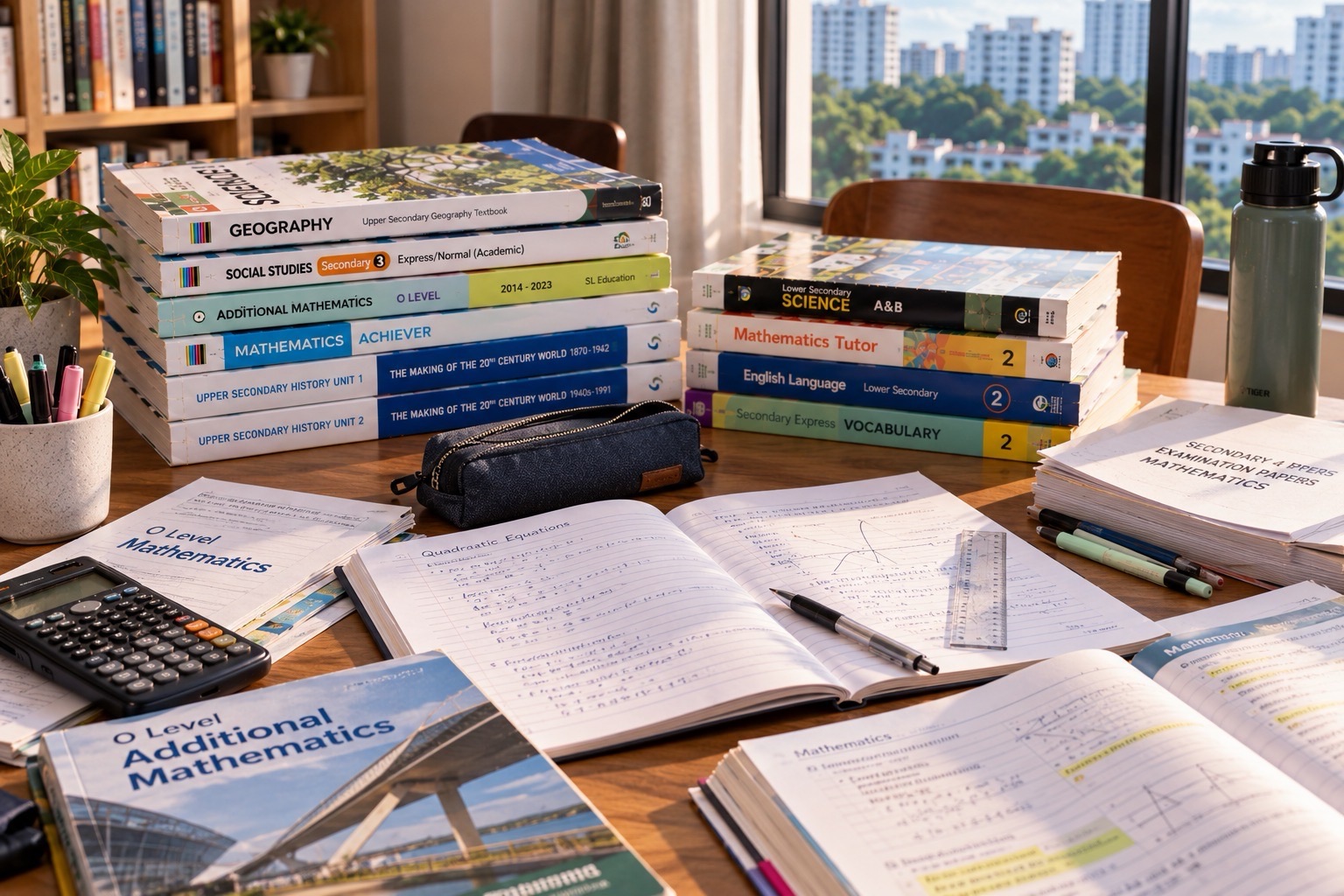
Mathematics and Additional Mathematics are different subjects in Singapore’s secondary education system. A student taking Additional Mathematics does not thereby stop learning core Mathematics. Core Mathematics provides number, algebra, geometry, measurement, statistics and probability; Additional Mathematics develops deeper algebra, trigonometry, coordinate geometry and calculus for students who are ready for it. This distinction is the first fact Punggol parents need when reading subject-combination choices.
For the 2027 Singapore–Cambridge Secondary Education Certificate (SEC), the official subject codes are G2 Mathematics K210, G3 Mathematics K310, G2 Additional Mathematics K232 and G3 Additional Mathematics K341. These are four separate syllabus documents. The availability of a particular combination, and the student’s eligibility to take it, depend on the school’s current arrangements; no neighbourhood automatically guarantees a particular choice.
Use this guide to see which skills belong to which subject, understand why a student can struggle with one while coping in the other, identify what to repair first and hold a useful conversation about the next academic pathway. The approach is diagnosis, first-principles explanation, independent transfer and honest assessment of workload—not treating every mathematics difficulty as a reason to buy more lessons.
QUICK FACTS | Core Mathematics 2027: K210 (G2) and K310 (G3) | Additional Mathematics 2027: K232 (G2) and K341 (G3) | Punggol follows Singapore’s national syllabuses | School subjects and eligibility: confirm directly | Most useful diagnostic: first wrong line, independent retry.
Mathematics and Additional Mathematics compared
| Question | Mathematics | Additional Mathematics |
|---|---|---|
| Purpose | Broad foundations, applications and data literacy | Deeper symbolic, analytic and calculus skills |
| G2 code 2027 | K210 | K232 |
| G3 code 2027 | K310 | K341 |
| Main strands | Number/Algebra; Geometry/Measurement; Statistics/Probability | Algebra; Geometry/Trigonometry; Calculus |
| When | Secondary mathematics pathway | Typically relevant to upper-secondary subject choices |
| Parent question | Is everyday numeracy and interpretation secure? | Is prerequisite algebra stable and subject fit appropriate? |
Find the answer by decision
- The two-subject answer parents can use immediately
- How 2027 SEC codes remove confusion
- Primary school: a foundation, not a separate A-Math track
- Lower secondary: where the subjects begin to diverge
- Core Mathematics: breadth and usable numeracy
- Additional Mathematics: depth, conditions and symbolic control
- A simple comparison: percentages versus a quadratic parameter
- A second comparison: statistical evidence versus functions
- A third comparison: geometry and calculus
- The separate role of exactness and approximation
- Why a weak test score is not a complete subject-level diagnosis
- How Full Subject-Based Banding changes parent language
- A sustainable 90-minute small-group learning model
- Family timetables are a real mathematics decision
- Post-secondary choices: keep preparation separate from admission
- Five questions that make a subject-combination meeting useful
- An eight-week two-subject support plan
- How to maintain one reliable family mathematics record
- 20 original worked checks
- Parent FAQ
- Official references
The two-subject answer parents can use immediately
Mathematics, sometimes called E-Math informally in older O-Level conversations, is the broad foundational subject. Its content spans number and algebra, geometry and measurement, and statistics and probability. Additional Mathematics is an additional upper-secondary course with more abstract functions, algebra, trigonometry, coordinate geometry and calculus. In official 2027 SEC documentation, use the subject title and code rather than relying on old labels alone.
The subjects connect but have different assessment blueprints. Being strong at percentages and statistics is valuable in Mathematics but does not automatically establish fluency in polynomial division. Conversely, being able to differentiate a polynomial does not show that a student can interpret a statistical graph, manage a household-finance context or estimate a measurement correctly. Each syllabus has its own intended knowledge.
The practical decision is to ask the school for the current combination booklet and the exact code attached to the proposed subject level. Then examine the child’s independent schoolwork. A responsible teacher will distinguish a prerequisite gap in Mathematics from an Additional Mathematics topic that requires new teaching instead of calling the child simply weak at maths.
How 2027 SEC codes remove confusion
SEAB identifies G2 Mathematics as K210 and G3 Mathematics as K310. The corresponding 2027 Additional Mathematics syllabuses are K232 at G2 and K341 at G3. G2 and G3 indicate examination subject levels, not that the letters ‘A-Math’ and ‘E-Math’ can be swapped. Each level and subject has its own official PDF with assessment objectives and outcomes.
The G2 Additional Mathematics K232 introduction states that the syllabus is intended to prepare students adequately for G3 Additional Mathematics. That intention does not mean a student changes levels automatically, and it does not guarantee a timetable slot, admission into a higher-level course or a future post-secondary place. Families should ask their school for current policies and not infer an individual entitlement from national curriculum wording.
The easiest parental audit is to write four lines: current core Mathematics level; current Additional Mathematics level if any; expected examination year; and which official PDF was consulted. A revision book marketed as ‘O-Level A-Math’ should be checked against those details. The book can still contain useful practice, but it should not silently define the child’s examined syllabus.
Primary school: a foundation, not a separate A-Math track
Children in Punggol primary schools learn Mathematics under the national primary curriculum. Primary-school topics such as whole-number operations, fractions, proportional thinking and model drawing help form the foundation for algebra and later functions. There is no national Primary 4 or Primary 6 SEC Additional Mathematics examination. Advertising that suggests otherwise confuses optional enrichment with the official school system.
A child who cannot reliably compare 0.6 with 0.58 is not helped by learning a binomial theorem identity in advance. The important repair is place value: 0.60 is greater than 0.58 because sixty hundredths is greater than fifty-eight hundredths. A child who understands this can later make sense of decimal coordinates and scientific measurements.
For families with a Primary 5 or 6 learner, the better bridge is explanation. Ask for the reason a calculation works, a quick estimate and an independent check. The transition to symbolic algebra requires knowing what quantities mean. A student who can defend a bar-model solution has begun the reasoning that Additional Mathematics later makes more formal.
Lower secondary: where the subjects begin to diverge
At Secondary 1 and Secondary 2, students learn expressions, equations, graphs, negative values and increasingly complex relationships. These are common preparation skills for future mathematical study. Upper-secondary Additional Mathematics is not simply ‘Secondary 2 Mathematics continued faster’; it adds topics whose explanations assume that earlier structures are stable.
Consider the student who can expand 2(x + 3) but cannot correctly expand −2(x + 3). The first result is 2x + 6 and the second is −2x − 6. If sign control has not been secured, both core Mathematics and Additional Mathematics will be affected. The repair target is the distributive property under a negative coefficient, not a chapter labelled calculus.
Ask the child to explain an equation as balanced information. In 4x − 3 = 17, adding three to both sides and then dividing by four yields x = 5. The operations preserve equality. If the child relies entirely on a ‘move across, change sign’ slogan, check whether the method survives fractions and brackets before adding a harder course.
Core Mathematics: breadth and usable numeracy
The K210 and K310 Mathematics syllabuses organise content into number and algebra, geometry and measurement, and statistics and probability. Learners practise arithmetic, percentages, ratio, graphs, shape, measurement, chance and data. These topics are not minor preliminaries. They support practical interpretation and sound decisions in a wide range of future occupations and studies.
Core Mathematics also teaches mixed problems whose chapter is not announced at the top. A family comparing transport costs may need percentages, rates, time intervals and a graph in the same question. The 2027 G2 Mathematics syllabus explicitly incorporates real-world scenarios in its Paper 2 arrangement. Solving such questions requires reading and reasoning, not simply knowing one formula.
A learner strong in A-Math differentiation may still mishandle compound units or ignore a histogram’s class width. Diagnose those as core skill gaps. It is a mistake to assume advanced symbolic competence replaces everyday data literacy. The whole Mathematics education system is healthier when both subjects are valued for what they contribute.
Additional Mathematics: depth, conditions and symbolic control
At G2 K232, Additional Mathematics has algebra, geometry and trigonometry, and calculus strands. The content includes the nature of quadratic roots, surds, polynomials, partial fractions, trigonometric functions and identities, coordinate geometry, differentiation and integration. G3 K341 expands the learning in named areas such as the binomial theorem, exponential and logarithmic functions, and specified further calculus applications.
Additional Mathematics questions frequently hinge on choosing the correct representation. A polynomial may need factorisation, a tangent condition may need the discriminant and a changing rate may need a derivative. This is deeper than memorising many steps. Students must decide why a particular method answers the question and what assumptions make it valid.
The distinction also matters for tutoring: the same 90-minute revision class should not pretend that every learner at a different SEC subject level has identical objectives. A skilled tutor begins from the child’s relevant syllabus and checks prior knowledge. Mixed discussions are possible, but individual practice and feedback must match the student’s actual learning needs.
A simple comparison: percentages versus a quadratic parameter
In core Mathematics, a sale price reduced by twenty percent is calculated as original price multiplied by 0.8. If an item costs S$50 before the reduction, the simplified discounted amount is S$40, assuming no other charges. A good student can explain why multiplying by 0.2 would give only the discount, not the resulting price.
In Additional Mathematics, the question may instead ask for which k the equation x² − 6x + k = 0 has two distinct real roots. With discriminant 36 − 4k, the condition is k < 9. The technique is quite different from the percentage computation, but both require deciding what quantity the answer represents.
The connection is problem interpretation. The student must read the words carefully and distinguish discount from final cost, or two distinct roots from a repeated root. A tutor who checks only arithmetic misses the deeper reading skill that ties the subjects together.
A second comparison: statistical evidence versus functions
Core Mathematics teaches learners to read and represent data and to distinguish a sensible statistical statement from an unsupported conclusion. A line of best fit expresses a trend and should not automatically be interpreted as a chain of exact values. The scales and labels determine what a graph means.
Additional Mathematics develops abstract function relationships and transformations. A quadratic y = (x − 2)² + 1 has a minimum of one at x = 2. This mathematical statement is exact for every real input under that formula, but it is not evidence that real exam marks or growth follow that curve. The distinction between an exact formula and an empirical approximation is important.
To teach both subjects responsibly, set two diagrams side by side: measured data with scatter and a defined algebraic function. Ask which conclusions come from observation and which follow logically from the formula. This makes mathematics a tool for clearer thinking, not just examination rehearsal.
A third comparison: geometry and calculus
Core Mathematics asks a student to calculate an area or length under geometric conditions. The familiar triangle area formula one half times base times perpendicular height requires identifying which line is perpendicular. Choosing a slanted side as ‘the height’ may be the first conceptual failure even if the multiplication is correct.
Additional Mathematics can analyse an instantaneous gradient. For y = x² + 1, the derivative is 2x. At x = 3, the tangent’s gradient is six. The concept is not merely ‘change the power and multiply’; it relates a curved graph to the gradient of a line at one point.
A family can see continuity: core geometry makes measurement precise, graphs make relationships visible, and calculus formalises change. Do not rush to a derivative before the student knows what a gradient means. The stronger the bridge, the less later learning depends on fragile remembered slogans.
The separate role of exactness and approximation
Core Mathematics teaches rounding, estimation, units and calculator judgment. Additional Mathematics often retains exact symbolic answers such as 2√3, fractions or multiples of π until a question specifies rounding. Neither habit is superior in every context. The task determines the required representation.
For instance, √12 is exactly 2√3. Reporting 3.46 may be an appropriate approximation when requested, but substituting it into further calculations can propagate unnecessary rounding error. Conversely, reporting a measurement as 2√3 centimetres when the question needs an instrument reading may be less useful than a justified decimal.
Teach the student to ask ‘What does the question require?’ before pressing equals on a calculator. A clear written chain of reasoning, correctly labelled units and a final check matter in both subjects. Accuracy is a form of understanding, not only tidy presentation.
Why a weak test score is not a complete subject-level diagnosis
Two students can receive the same mathematics test percentage for very different reasons. One may understand concepts but lose marks from rushing, missing units and copying signs. Another may complete routine examples correctly but fail to choose a method when the presentation changes. The remedies are not interchangeable.
Categorise wrong questions as reading, conceptual, retrieval, procedure, arithmetic, communication or time-management errors. Ask where the first unjustified line appears. A learner who selects the wrong theorem needs a different intervention from one who selects it properly but makes a multiplication slip. Use two or three representative questions to establish a pattern.
A school subject-combination conversation should therefore include classroom evidence, independent work and the demands of the student’s full timetable. A single tutoring diagnostic or parent’s estimate cannot substitute for current school eligibility rules. Decisions should match both learning readiness and actual subject availability.
How Full Subject-Based Banding changes parent language
Under Full Subject-Based Banding, students can study subjects at different levels subject to school rules and their eligibility. It is misleading to reduce an individual student’s entire identity to an old stream label or to assume the same subject level applies to everything. The 2027 SEC is designed around subject-level codes, which makes precision in conversation especially useful.
A parent should write ‘G2 Additional Mathematics K232’ or ‘G3 Additional Mathematics K341’, not only ‘A-Math’. The same care applies to core Mathematics K210 or K310. Correct naming makes it easier to locate the right SEAB PDF and avoid mistakenly drilling a G3-only objective as if it were tested in G2.
School placement, timetable and combination decisions can have conditions that are not printed in a syllabus. Contact the school directly when eligibility or subject-level movement matters. One student’s experience in a previous year is useful context, but not a substitute for the policy governing the child’s cohort.
A sustainable 90-minute small-group learning model
An educationally sound ninety-minute support session can begin with ten minutes of retrieval from earlier mathematics, twenty minutes of diagnosis and explicit explanation, twenty minutes of guided practice, twenty minutes of independent transfer and twenty minutes of review, feedback and planning. This is an illustrative teaching design, not a claim that every Punggol school follows the same lesson structure.
In a three-student tutorial, compare two genuinely different solution strategies, ask each learner to identify an incorrect step and then require independent completion without hints. The teacher should inspect individual working rather than relying on the fastest child’s answer. Close attention to method matters more than merely keeping a group small.
Parents should ask for an independently solved follow-up problem and the tutor’s diagnosis in plain language. If the child only improves while prompted, teaching has not yet established autonomy. Progress can be gradual, and a credible programme will not promise an identical grade outcome for every learner.
Family timetables are a real mathematics decision
Punggol has schools, transport links, homework obligations, CCAs and family routines. Choosing two demanding mathematics subjects may create more practice requirements than a child can handle with endless additional classes. The educational calculation includes time, sleep, travel and opportunities for revision over several days.
A plan that spends every evening copying full solutions can hide weak retention. Brief spaced practice—attempt, wait, retry and explain—is often more informative. Pair a core Mathematics interpretation problem with an A-Math algebra problem occasionally so the learner must choose the method rather than respond to the worksheet heading.
Parents should decide which lesson is solving a demonstrated problem. If schoolwork already shows independent mastery, more tutoring may not be necessary. If a clear recurring conceptual error persists, targeted instruction can be worthwhile. A sustainable rhythm protects motivation and the time needed to practise responsibly.
Post-secondary choices: keep preparation separate from admission
Both Mathematics and Additional Mathematics can support quantitative study after Secondary school, but future admissions are not determined by a slogan like ‘A-Math equals engineering’. Junior colleges, Millennia Institute, polytechnics and ITE have specific pathways and published eligibility conditions. The student’s subject levels and grades must be interpreted under the current admissions arrangements.
The choice of H2 Mathematics at a junior college, for instance, should be checked against that JC’s actual prerequisites and support arrangements for the intake year. Polytechnic course requirements also differ by diploma. A student heading to Singapore Institute of Technology in Punggol will later apply with an accepted qualification to a particular degree programme, not directly because of living nearby.
For a family anticipating the 2027 SEC and 2028 post-secondary admissions, retain the official subject codes and compare current guidance near the application year. Today’s preparation can build real mathematical capability without pretending to fix the entire future course map years in advance.
Five questions that make a subject-combination meeting useful
First, which core Mathematics and Additional Mathematics subject levels are available in the student’s intended upper-secondary combination? Second, what are the school’s published or communicated selection criteria for this cohort? Third, what evidence of readiness matters beyond a single test? Fourth, are there options to review subject-level placement later? Fifth, what would a sensible improvement plan look like if the pupil is close but not yet ready?
Bring three independent pieces of work: a sound problem solution, a common recurring mistake and an unfamiliar question attempted without assistance. Ask which skill should be stabilised first. This is more useful than taking a tutor’s general marketing claim into a school meeting.
Record who gave the advice and when, then revisit it before making the final choice. The answer should reflect current school arrangements, the student’s interests, obligations and progress. The objective is a sustainable set of learning options, not an impressive-sounding timetable.
An eight-week two-subject support plan
Weeks one and two: separate diagnostics for Mathematics breadth and Additional Mathematics depth. Collect an ordinary percentage or graph interpretation task, a basic algebra task, a quadratic or trigonometry task and an independent written explanation. Record the first error type in each; do not merge them into one ‘maths weakness’ label.
Weeks three and four: repair the shared prerequisite that has the greatest knock-on effect. If signs and fractions are unstable, address those first. Weeks five and six: restore separate practice streams matched to the current official subject syllabuses. Use retrieval after a delay to test retention, then introduce fresh wordings that require method choice.
Weeks seven and eight: combine a small selection of two-subject problems, then hold a parent–student review. Ask whether homework completion, independent explanations and test confidence are improving without unsustainable hours. The final result should be a documented next step, not a guarantee of a particular examination grade.
How to maintain one reliable family mathematics record
Keep a one-page table showing the child’s examination year, each Mathematics subject code, the latest school topic, the specific difficulty found and the date it was retested independently. Add links to official SEAB syllabus PDFs. A revision book may be useful, but the official PDF governs the published examinable content.
Separate the evidence into concept, procedure, transfer and communication. A student who gets the correct answer with heavy hints should not yet be counted as independent. Ask the learner to explain a wrong solution without being supplied the heading. This tests whether the correct concept can be retrieved.
The family can then evaluate tuition as a service: did it identify the cause, repair the mental move and produce a demonstrably stronger student? This is the underlying value of the immutable Clementi benchmark—a learner who can think clearly and continue after the lesson ends.
20 original worked checks: classify the skill before teaching it
The questions below are illustrative learning diagnostics, not copied examination questions. Each shows how core Mathematics and Additional Mathematics differ while sharing sound mathematical habits. Choose the tasks relevant to the student’s present level.
1. Read the SEC code
Question or situation: A parent says every upper-secondary mathematics exam is ‘4049’.
Correct worked route: 4049 is the pre-2027 reference code shown for G3 Additional Mathematics, not a generic code for Mathematics. In 2027 use K341 for G3 A-Math and K310 for G3 Mathematics.
First wrong move to watch: Compare two official PDFs; write the code and title at the top of each revision folder.
Independent transfer: The learner or parent should be able to find the right exam syllabus without prompting.
2. Place value
Question or situation: A Primary student claims 0.6 is smaller than 0.58.
Correct worked route: Write 0.60 and 0.58. Sixty hundredths is greater than fifty-eight hundredths. Place the two values on a zero-to-one number line.
First wrong move to watch: Basing order on digit count is a foundational mistake, not an A-Math topic.
Independent transfer: Ask for a decimal between 0.58 and 0.60 and an explanation.
3. A percentage discount
Question or situation: A simplified purchase costs S$50 with a 20% reduction. What is the resulting price?
Correct worked route: Multiply the original amount by 0.80: S$50 × 0.8 = S$40, assuming there are no other fees or conditions.
First wrong move to watch: A learner who returns S$10 has calculated the discount, not the resulting price.
Independent transfer: Ask how a 20% increase instead would be calculated.
4. A ratio simplification
Question or situation: A project uses six red counters and nine blue counters.
Correct worked route: The ratio red:blue is 6:9 = 2:3 after dividing both by three. It is not 2/3 of the total counters; the red proportion of the total is 6/15 = 2/5.
First wrong move to watch: The ratio and part-to-whole fraction answer different questions.
Independent transfer: Ask how many blue counters are needed if there are ten red counters at the same ratio.
5. An equation balanced
Question or situation: Solve 4x − 3 = 17.
Correct worked route: Add three to both sides, obtaining 4x = 20; divide by four to obtain x = 5. Substitute to check 4(5) − 3 = 17.
First wrong move to watch: A slogan about moving signs may hide whether the learner understands the operation.
Independent transfer: Ask for a second equation needing a division first.
6. Negative distribution
Question or situation: Expand −2(x + 3).
Correct worked route: Multiply both terms by negative two: −2x − 6. At x = 1, the original and expansion both give −8.
First wrong move to watch: Writing −2x + 3 forgets that the constant also needs multiplication.
Independent transfer: Ask the student to expand −3(2x − 5).
7. Simple straight-line gradient
Question or situation: A line goes through (1,2) and (4,8). Find its gradient.
Correct worked route: Compute (8 − 2)/(4 − 1) = 2. It rises two vertical units for every one horizontal unit.
First wrong move to watch: Using denominator four minus one and numerator two minus eight reverses only one subtraction.
Independent transfer: Verify using both ordered directions consistently.
8. Factorisation
Question or situation: Solve x² − 5x + 6 = 0.
Correct worked route: Factor as (x − 2)(x − 3) = 0, giving x = 2 or x = 3. Both are verified by substitution.
First wrong move to watch: Cancelling a factor during solving could eliminate a genuine root.
Independent transfer: Ask why an equation with product zero can have more than one solution.
9. Discriminant
Question or situation: For x² − 6x + k = 0, find when two distinct real roots exist.
Correct worked route: Use D = 36 − 4k > 0, giving k < 9. For k = 9 the roots coincide.
First wrong move to watch: A learner who applies D ≥ 0 answers a different question.
Independent transfer: Draw one sketch from each discriminant case.
10. An exact surd
Question or situation: Simplify √12 exactly.
Correct worked route: Recognise √12 = √(4×3) = 2√3. It is not equal to 6 or an exact decimal 3.46.
First wrong move to watch: A calculator approximation can support a sense check but must not replace required exact form.
Independent transfer: Square 2√3 and recover twelve.
11. Algebraic domain
Question or situation: Simplify (x² − 9)/(x − 3).
Correct worked route: Factor numerator (x − 3)(x + 3); simplify to x + 3 while retaining x ≠ 3.
First wrong move to watch: Cancelling a factor does not permit the originally forbidden input.
Independent transfer: Evaluate the original expression at x = 3 to explain why it is undefined.
12. Polynomial remainder
Question or situation: What is the remainder when P(x) = x³ − 2x + 7 is divided by x − 2?
Correct worked route: The remainder theorem gives P(2) = 8 − 4 + 7 = 11.
First wrong move to watch: Putting −2 into the polynomial confuses x − a with x + a.
Independent transfer: Check using dividend = divisor × quotient + remainder.
13. A quadratic minimum
Question or situation: Find the minimum of y = x² − 6x + 11.
Correct worked route: Complete the square: y = (x − 3)² + 2, minimum two at x = 3.
First wrong move to watch: The minimum is not the y-intercept eleven.
Independent transfer: Sketch the vertex and test neighbouring inputs.
14. A trig value
Question or situation: Evaluate sin 30° exactly.
Correct worked route: In a suitable right triangle or unit circle, sin 30° = 1/2. The same angle is π/6 radians.
First wrong move to watch: A wrong calculator angle mode can produce a misleading decimal.
Independent transfer: State the equivalent radian angle before evaluating.
15. A tangent gradient
Question or situation: For y = x² + 1, find the gradient at x = 3.
Correct worked route: Differentiate to obtain dy/dx = 2x, so the instantaneous gradient is six.
First wrong move to watch: A student returning y = 10 has found the function value, not the slope.
Independent transfer: Use point (3,10) to find tangent equation y − 10 = 6(x − 3).
16. An indefinite integral
Question or situation: Integrate 6x² with respect to x.
Correct worked route: Reverse the power rule: the result is 2x³ + C because differentiation gives 6x².
First wrong move to watch: Leaving off C in an indefinite integral loses the family of antiderivatives.
Independent transfer: Differentiate the answer to verify.
17. A signed integral
Question or situation: Calculate the integral of x from −1 to 1.
Correct worked route: Its antiderivative is x²/2. Endpoint substitution gives 1/2 − 1/2 = 0, due to cancellation of negative and positive signed areas.
First wrong move to watch: Zero signed integral does not mean the graph encloses no geometric area.
Independent transfer: Sketch and calculate each triangular region separately.
18. A statistics misunderstanding
Question or situation: Two datasets share the same mean. Must they have the same spread?
Correct worked route: No. For 2,4,6 mean is four and values vary; for 4,4,4 mean is four with zero spread. The shared average does not determine variation.
First wrong move to watch: This is a core-Mathematics concept, not an Additional Mathematics calculus problem.
Independent transfer: Ask which dataset gives a more consistent reading and why.
19. A model and its domain
Question or situation: A toy model uses C(t) = 3 + 2t dollars for t hours.
Correct worked route: The fixed part is S$3, and the variable part increases by S$2 per hour. For t = 5, C = 13. Interpretation depends on an assumed valid nonnegative duration and pricing rule.
First wrong move to watch: The formula does not automatically describe a real business or actual billing practice.
Independent transfer: Ask what restrictions the model needs before being used in a real-world decision.
20. A learning decision
Question or situation: A teenager has sound A-Math derivatives but keeps misreading histogram class widths.
Correct worked route: The next revision should diagnose the histogram area/frequency relationship in core Mathematics, rather than assigning twenty more derivatives.
First wrong move to watch: One strong topic cannot stand in for the whole Mathematics syllabus.
Independent transfer: Ask for a fresh histogram question solved unaided after the repair.
Parent FAQ
Are Mathematics and Additional Mathematics the same exam?
No. The 2027 SEC lists separate subjects and separate codes at G2 and G3. Read the four relevant SEAB syllabuses.
Does A-Math replace E-Math?
No. Additional Mathematics supplements foundational Mathematics; enrolment and combination arrangements must be checked with the school.
Is G2 Additional Mathematics an official subject?
Yes. SEAB lists K232 for 2027, with 4051 as the earlier reference code. Its national syllabus does not guarantee every school offers it.
Are G2 and G3 simply grades of the same paper?
No. They represent different subject levels, have distinct syllabus documents and different exam arrangements.
Is Primary 6 Mathematics already A-Math?
No. Primary Mathematics is foundational and prepares reasoning skills; A-Math refers to a separate upper-secondary subject.
My child is good at algebra but weak in statistics. Which subject needs help?
Review the exact school question. Statistics is part of core Mathematics. Support should repair that skill rather than automatically adding A-Math drills.
Can an A-Math student neglect core Mathematics?
That is unwise: core Mathematics has its own curriculum, assessments and implications for later academic requirements.
Does A-Math guarantee JC H2 Mathematics?
No. Ask the relevant JC about current entry and subject prerequisites for the actual intake year.
How long should a diagnostic take?
A few carefully selected independent tasks may reveal the first unstable skill. The precision of the observation matters more than the number of pages.
Which tuition setting is best?
Fit depends on the learner. A small group supports method comparison if each student’s work is checked; one-to-one can target highly individual gaps. Neither format guarantees a grade.
What if the student cannot get Additional Mathematics in the chosen school?
Check the current school subject allocation process and broader post-secondary pathways. Do not assume that one unavailable subject closes every future option.
Where should the family verify 2027 subject content?
Use SEAB’s K210, K310, K232 and K341 PDFs, and confirm school-specific arrangements directly with the school.
Verified official sources and Punggol companion guides
Editorial fact-check: 18 October 2026. National content, exam codes and subject-level distinctions are based on official 2027 SEAB source documents. Punggol examples are general family teaching illustrations; no unverified school-specific A-Math offer is asserted.
- SEAB 2027 G2 Mathematics K210
- SEAB 2027 G3 Mathematics K310
- SEAB 2027 G2 Additional Mathematics K232
- SEAB 2027 G3 Additional Mathematics K341
- SEAB school-candidate G2 list
- SEAB school-candidate G3 list
- Punggol A-Math Primary–University guide
- Punggol G2/G3 subject-choice guide
- Punggol A-Math algebra foundations
- Immutable Clementi teaching standard
Series: Understanding the Additional Mathematics Education System of Punggol — a reference library for Primary-to-University learning decisions. Read the subject-level and school guidance for the relevant cohort before committing to any specific pathway.


