
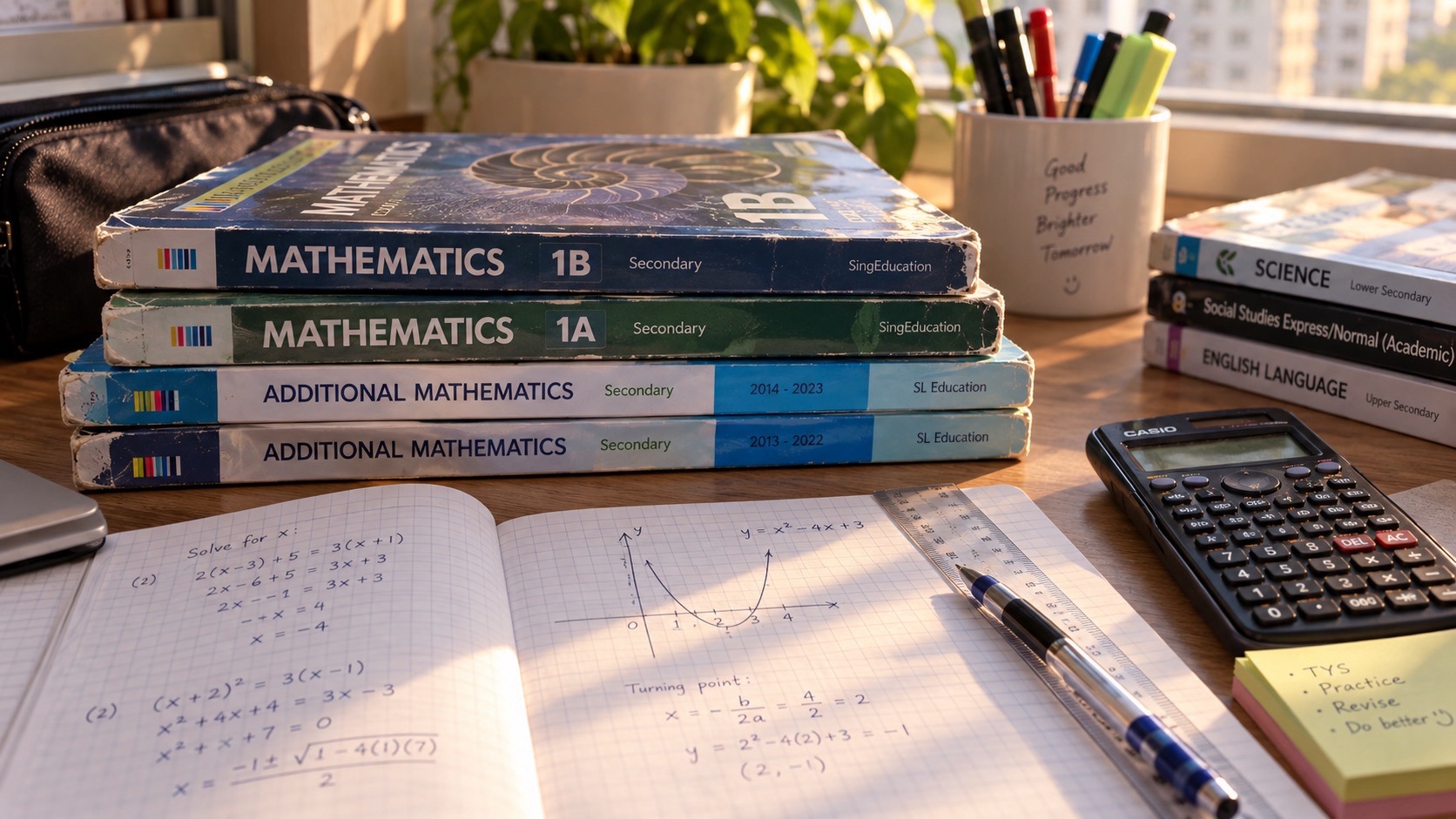
Answer first. G2 Additional Mathematics in Punggol is Singapore’s national 2027 SEC subject K232, a separate examination from G2 Mathematics K210. It includes Algebra, Geometry and Trigonometry, and Calculus, with two compulsory 1-hour-45-minute papers of 70 marks each. The subject is designed to develop students with an interest in mathematics and provide a bridge towards G3 Additional Mathematics. The actual school offer and lesson sequence, not a tuition centre, determine whether a particular pupil takes it.
Here is the practical route. A parent first checks the exact school subject, identifies the prior Mathematics skills the syllabus assumes, then uses the topic finder below to investigate a specific misconception. Every chapter begins with the mathematical point, solves an original example, explains a tempting error and shows how to check an independent attempt. The aim is to make the learner more capable of explaining unfamiliar questions, not merely faster at copying familiar working.
Source checkpoint — 18 October 2026: The 2027 K232 syllabus is published by SEAB and identifies the older 4051 subject for reference. K232’s published Algebra section does not contain the additional Binomial Expansions and Exponential/Logarithmic Functions headings that appear in K341; its Calculus section includes rational powers, product and quotient rules, chain rule, optimisation, integration and area in its specified scope. This guide does not invent extra required topics.
At a glance: the official 2027 K232 framework
- Qualification: 2027 G2 Additional Mathematics K232; reference code 4051 for 2026 and earlier.
- Strands: Algebra; Geometry and Trigonometry; Calculus.
- Paper 1: 1 hour 45 minutes, 70 marks, around 13–15 compulsory questions; 50% overall.
- Paper 2: 1 hour 45 minutes, 70 marks, around 8–10 compulsory questions; 50% overall.
- Approximate assessment objectives: AO1 50%, AO2 40%, AO3 10%.
- Calculator: an approved model may be used; SEAB still requires essential mathematical working.
- Relevant accuracy: generally three significant figures for non-exact numbers and one decimal place for angles in degrees unless specified otherwise.
- Prerequisite: G2 Mathematics foundations, with additional assumed skills from the official specification.
Choose the exact issue from this topic index
- 1. What the K232 qualification is
- 2. The 2027 paper structure and assessment objectives
- 3. The G2 Mathematics prerequisites are real
- 4. Completing the square explains quadratic maxima and minima
- 5. The discriminant predicts how many real roots exist
- 6. Quadratic inequalities describe intervals
- 7. A linear–quadratic system can have two solutions
- 8. Surds and rationalisation preserve exact values
- 9. Polynomial division and the remainder theorem
- 10. A cubic may have several real roots
- 11. Partial fractions with distinct linear factors
- 12. Repeated factors need a complete partial-fraction form
- 13. Exact trigonometric angles are not decimal guesses
- 14. Angle-addition identities produce new exact values
- 15. Trigonometric graphs have amplitude and period
- 16. R sin form reveals a maximum instantly
- 17. Coordinate geometry: perpendicular lines and circles
- 18. A derivative represents a local rate of change
- 19. Product, quotient and chain rules are different relationships
- 20. Stationary points need classification
- 21. Integration reverses differentiation
- 22. Definite integrals and signed area
- 23. Connected rates and the meaning of units
- 24. Four-week revision from first error to independent control
Why Additional Mathematics changes the learning system
Additional Mathematics is not simply a second arithmetic workbook. At this level a single error in algebraic structure may spread into trigonometry, calculus, graphs and optimisation. If a student mishandles the factor (x−1), the consequence can surface in a rational denominator or a polynomial division question. If they cannot tell a derivative from a function value, a line tangent to a curve can be drawn through the wrong point. A good educational response finds the first wrong mental step and corrects that relationship before assigning large quantities of similar exercises.
The national syllabus establishes what can be assessed. The school establishes which topics are being taught this term, what feedback is available and whether a pupil is offered the subject. Parents can help by bringing recent school questions and the child’s full original workings to a discussion; a tutor should use them to diagnose misconceptions, practise changing the surface details and protect independent effort. A faster algorithm without an explanation is not necessarily better preparation.
1. What the K232 qualification is
Mathematics principle. The 2027 Singapore-Cambridge SEC lists G2 Additional Mathematics as subject K232, with 4051 shown for reference to the earlier examination. It is a separate mathematics subject from G2 Mathematics K210. The published syllabus states an intention to prepare suitable learners for G3 Additional Mathematics, and it is organised around Algebra, Geometry and Trigonometry, and Calculus. Those three strands are not optional enrichment invented by a tuition provider.
Original worked example. A student takes G2 Mathematics in one timetable entry and G2 Additional Mathematics in another. The first uses K210 curriculum outcomes and the second adds K232 outcomes such as partial fractions and calculus. A parent should use the correct subject name and code when selecting material, even though the two courses share algebraic foundations. The answer is not complete until the student can explain what the intermediate values represent, and identify any excluded inputs, units or precision required.
Typical failed step. A common misunderstanding is that Additional Mathematics is merely a harder version of the same examination or that G2 A-Math has no calculus. That overlooks both its separate certificate code and the explicit Calculus strand. One incorrect answer starts an investigation; it is not a reliable label for the student’s overall mathematical potential.
Teaching and independent check. Ask the school whether the subject is offered to this learner, what prerequisites the department expects and how the subject is assessed each year. Do not assume every Punggol school offers the same combination or that a tuition class can make an official entry happen. Ask for a numerically or visually altered problem after the worked example is hidden. Record whether the student selected the strategy unaided.
Next mathematical connection. The first decision is curricular fit rather than speed. Good progress makes the student increasingly independent when linking prior Mathematics concepts to new symbolic demands.
2. The 2027 paper structure and assessment objectives
Mathematics principle. The K232 document specifies two written papers, each one hour forty-five minutes and 70 marks, contributing half of the result. Paper 1 contains approximately 13–15 questions, while Paper 2 has 8–10; all questions are compulsory. Approximate objective weightings are AO1 50%, AO2 40% and AO3 10%. An approved calculator may be used in both papers, while essential working still matters.
Original worked example. A student’s revision plan therefore cannot concentrate solely on short repetitive expansion questions. The second paper may include fewer, longer tasks requiring connections across chapters, and reasoning or interpretation can contribute marks beyond a numeric outcome. Practise both a concise algebra item and an extended contextual application of calculus. The answer is not complete until the student can explain what the intermediate values represent, and identify any excluded inputs, units or precision required.
Typical failed step. One error is assuming Paper 2 is an optional section or that a fast calculator answer substitutes for the essential steps. Another is treating these national paper lengths as the mandatory duration of a Secondary 3 school test. One incorrect answer starts an investigation; it is not a reliable label for the student’s overall mathematical potential.
Teaching and independent check. Use the current SEAB PDF for exact timings, rounding rules and instructions. School assessments should still follow the school’s own schedule. Gradually introduce timed work only after untimed understanding is sufficiently accurate. Ask for a numerically or visually altered problem after the worked example is hidden. Record whether the student selected the strategy unaided.
Next mathematical connection. Exam fluency should mean selecting an appropriate mathematical relationship, recording reconstructable working and verifying a result, not simply being able to race the clock.
3. The G2 Mathematics prerequisites are real
Mathematics principle. The K232 syllabus assumes knowledge from G2 Mathematics, plus specified foundation topics such as linear inequalities and quadratic graph sketches. It does not directly repeat every prerequisite in its listed A-Math topics, but that older knowledge can be required indirectly in a solution. A weak fraction, sign or quadratic factorisation skill can undermine several unrelated A-Math chapters.
Original worked example. Before completing the square in x²−6x+8, the student should be able to expand (x−3)² as x²−6x+9 and to identify the change from nine to eight. If expansion is unreliable, the completed-square explanation appears mysterious and must be memorised. The answer is not complete until the student can explain what the intermediate values represent, and identify any excluded inputs, units or precision required.
Typical failed step. A pupil may score well on a copied K232 model while still confusing the coefficient −6 with a constant, or may solve a quadratic only when the factors are printed in the previous line. One incorrect answer starts an investigation; it is not a reliable label for the student’s overall mathematical potential.
Teaching and independent check. Give a short baseline of signed arithmetic, expansion, factorisation, simple quadratic graphs and fraction operations. Use one changed question after correction to check independent transfer before a full new chapter. Ask for a numerically or visually altered problem after the worked example is hidden. Record whether the student selected the strategy unaided.
Next mathematical connection. Prerequisite repair is more efficient than repeatedly reteaching calculus or trigonometry on top of shaky algebra.
4. Completing the square explains quadratic maxima and minima
Mathematics principle. A quadratic written as ax²+bx+c can be reorganised to reveal its turning point. Completing the square is not a cosmetic manipulation; it makes a minimum or maximum value visible through the fact that a square is never negative. The sign of the leading coefficient controls the opening direction.
Original worked example. Rewrite x²−6x+8 as (x−3)²−1. The squared term is at least zero, so the minimum is −1 when x=3. As a check, substitute x=3 into the original: nine minus eighteen plus eight equals −1. The equivalent graph opens upward with vertex (3,−1). The answer is not complete until the student can explain what the intermediate values represent, and identify any excluded inputs, units or precision required.
Typical failed step. Students often write (x−3)²+8, forgetting that expanding the square adds nine, or report x=−3 as the vertex because the bracket shows a minus sign. One incorrect answer starts an investigation; it is not a reliable label for the student’s overall mathematical potential.
Teaching and independent check. Expand the proposed result and compare every coefficient. Plot three points on either side of x=3 and explain graph symmetry. Retest with a negative leading coefficient where the stationary value is a maximum. Ask for a numerically or visually altered problem after the worked example is hidden. Record whether the student selected the strategy unaided.
Next mathematical connection. This supports curve modelling, inequalities, discriminant analysis and later optimisation through derivatives.
5. The discriminant predicts how many real roots exist
Mathematics principle. For ax²+bx+c=0 with nonzero a, the discriminant b²−4ac indicates whether a quadratic has two distinct real roots, one repeated real root or no real roots. In K232 this is also linked to a line intersecting or touching a parabola. A discriminant is a structural statement, not a guess from a plot.
Original worked example. Consider x²−4x+4=0. Its discriminant is 16−16=0, giving one repeated real root x=2. The expression is (x−2)², so its graph touches the x-axis at (2,0) rather than crossing at two distinct points. The answer is not complete until the student can explain what the intermediate values represent, and identify any excluded inputs, units or precision required.
Typical failed step. One pupil counts the repeated root as two different x-intercepts, while another uses b rather than b² and misclassifies the number of real solutions. One incorrect answer starts an investigation; it is not a reliable label for the student’s overall mathematical potential.
Teaching and independent check. Write a, b and c in a small table before calculating. Compare the factorised form and the graph, then alter the constant term from four to three and explain how the crossing pattern changes. Ask for a numerically or visually altered problem after the worked example is hidden. Record whether the student selected the strategy unaided.
Next mathematical connection. A reliable discriminant argument later supports tangency conditions, modelling constraints and decision-making about possible solutions.
6. Quadratic inequalities describe intervals
Mathematics principle. A quadratic inequality asks where an expression is positive or negative, not merely where it equals zero. The zeroes divide the number line into intervals, and the direction of the parabola helps establish the sign in each region. Endpoint inclusion depends on whether the inequality is strict.
Original worked example. Solve x²−5x+6>0. Factor to (x−2)(x−3)>0. The expression is positive to the left of two and to the right of three; the solution is x<2 or x>3. Check x=0 gives six, while x=2.5 gives a negative value. The answer is not complete until the student can explain what the intermediate values represent, and identify any excluded inputs, units or precision required.
Typical failed step. A student reports 2<x<3 because those numbers sit between the roots, or includes 2 and 3 even though the original inequality is strict. One incorrect answer starts an investigation; it is not a reliable label for the student’s overall mathematical potential.
Teaching and independent check. Draw a simple sign chart or upward-opening graph. Test one value in each interval and mark the endpoints as open or filled according to the sign of inequality. Repeat with a negative leading coefficient. Ask for a numerically or visually altered problem after the worked example is hidden. Record whether the student selected the strategy unaided.
Next mathematical connection. The habit prevents confusion when studying algebraic domains and applying constraints in calculus problems.
7. A linear–quadratic system can have two solutions
Mathematics principle. Simultaneous equations involving a line and a parabola require satisfying both equations together. Substituting the linear relation into the quadratic often leads to two possible x-values, corresponding geometrically to intersections. Each resulting pair must be checked in both original equations.
Original worked example. Solve y=x+1 together with y=x²−1. Set x+1=x²−1 to obtain x²−x−2=0, so (x−2)(x+1)=0. The intersections are (2,3) and (−1,0). Both satisfy y=x+1 and y=x²−1. The answer is not complete until the student can explain what the intermediate values represent, and identify any excluded inputs, units or precision required.
Typical failed step. A learner may find x=2 and stop, or pair x=−1 with the y-value from the other root, creating a point that satisfies neither system. One incorrect answer starts an investigation; it is not a reliable label for the student’s overall mathematical potential.
Teaching and independent check. Sketch rough graphs to predict the possibility of two intersections. Substitute each x into the simpler linear equation, then verify both coordinates in the quadratic relation. Ask for a numerically or visually altered problem after the worked example is hidden. Record whether the student selected the strategy unaided.
Next mathematical connection. This is a bridge between symbolic solutions, geometric intersections and later functional models.
8. Surds and rationalisation preserve exact values
Mathematics principle. A surd is an exact expression involving roots that cannot be simplified to a rational value. K232 includes operations on surds, rationalising a denominator and equations involving surds. Exact form is important when a rounded decimal would conceal an identity or accumulate error.
Original worked example. Simplify 2/(√3−1) by multiplying numerator and denominator by √3+1. The denominator becomes 3−1=2 and the expression simplifies to √3+1. Numerically √3+1 is about 2.732; multiplying it by √3−1 gives two. The answer is not complete until the student can explain what the intermediate values represent, and identify any excluded inputs, units or precision required.
Typical failed step. A student rationalises only the denominator and forgets to multiply the numerator by the same factor, changing the fraction’s value. Another treats √3+1 as √4, which is not an algebraic identity. One incorrect answer starts an investigation; it is not a reliable label for the student’s overall mathematical potential.
Teaching and independent check. Explain the conjugate as a way to create a difference of squares. Expand both numerator and denominator visibly, then check with a decimal estimate. Try 1/(2+√3) as independent transfer. Ask for a numerically or visually altered problem after the worked example is hidden. Record whether the student selected the strategy unaided.
Next mathematical connection. Exact manipulation is foundational for more complex trigonometric values and symbolic calculus.
9. Polynomial division and the remainder theorem
Mathematics principle. A polynomial can be divided by another polynomial with a quotient and remainder. The remainder theorem gives the remainder on division by x−a as f(a). The factor theorem says x−a is a factor if f(a)=0. Both ideas connect numeric substitution to algebraic factorisation.
Original worked example. Take f(x)=x³−4x+3. Evaluate f(1)=1−4+3=0, so x−1 is a factor. Division gives quotient x²+x−3 and zero remainder. Check (x−1)(x²+x−3)=x³−4x+3. The answer is not complete until the student can explain what the intermediate values represent, and identify any excluded inputs, units or precision required.
Typical failed step. Students may substitute the opposite sign, calculating f(−1) when the divisor is x−1, or omit the missing x² coefficient in synthetic division. One incorrect answer starts an investigation; it is not a reliable label for the student’s overall mathematical potential.
Teaching and independent check. Write the divisor’s root first and insert zero coefficients for missing powers. Multiply quotient and divisor again to verify the full original polynomial. Ask for a numerically or visually altered problem after the worked example is hidden. Record whether the student selected the strategy unaided.
Next mathematical connection. This is the prerequisite for solving cubic equations and decomposing algebraic fractions.
10. A cubic may have several real roots
Mathematics principle. Solving a cubic through factorisation requires finding an initial linear factor and reducing the remaining polynomial to a quadratic. Guessing one root without checking the others gives an incomplete solution set.
Original worked example. Solve x³−6x²+11x−6=0. Substitution shows x=1 is a root. Dividing by x−1 gives x²−5x+6=(x−2)(x−3), so all three roots are x=1,2,3. Substituting each into the original confirms zero. The answer is not complete until the student can explain what the intermediate values represent, and identify any excluded inputs, units or precision required.
Typical failed step. A student may believe the task is complete after finding x=1, or make a sign error dividing the polynomial and obtain a quadratic with incorrect factors. One incorrect answer starts an investigation; it is not a reliable label for the student’s overall mathematical potential.
Teaching and independent check. Use factor theorem systematically, perform polynomial division, then solve the residual quadratic. Write the factorised product and recover the original coefficients as a check. Ask for a numerically or visually altered problem after the worked example is hidden. Record whether the student selected the strategy unaided.
Next mathematical connection. The method extends structural reasoning to complex algebraic systems and later polynomial modelling.
11. Partial fractions with distinct linear factors
Mathematics principle. Partial fraction decomposition rewrites a rational function as simpler fractions whose denominators are factors of the original denominator. It is preparation for algebraic manipulation and, later, some integration tasks. The form of the numerator must correspond to the denominator’s factor structure.
Original worked example. Write 5/[(x+1)(x+2)] as A/(x+1)+B/(x+2). Multiplying through gives 5=A(x+2)+B(x+1). At x=−1, A=5; at x=−2, B=−5. Thus the expression is 5/(x+1)−5/(x+2), with x≠−1,−2. The answer is not complete until the student can explain what the intermediate values represent, and identify any excluded inputs, units or precision required.
Typical failed step. Students may try A+B over the original denominator and forget the factors multiplying each numerator, or ignore excluded x-values, leaving a correct-looking expression without its original domain. One incorrect answer starts an investigation; it is not a reliable label for the student’s overall mathematical potential.
Teaching and independent check. Clear denominators, choose substitution points and then recombine the results over the common denominator. Confirm the reconstructed numerator equals five. Ask for a numerically or visually altered problem after the worked example is hidden. Record whether the student selected the strategy unaided.
Next mathematical connection. This develops precise factor awareness and helps students see rational expressions as connected structures.
12. Repeated factors need a complete partial-fraction form
Mathematics principle. Where the denominator contains a repeated factor, the correct decomposition includes a term for each required power of that factor. Leaving a power out can make the resulting coefficients impossible to solve consistently.
Original worked example. For 1/[x(x+1)²], set A/x+B/(x+1)+C/(x+1)². Multiplying through gives 1=A(x+1)²+Bx(x+1)+Cx. Substituting x=0 gives A=1; x=−1 gives C=−1; comparing x² coefficients gives B=−1. Therefore 1/x−1/(x+1)−1/(x+1)². The answer is not complete until the student can explain what the intermediate values represent, and identify any excluded inputs, units or precision required.
Typical failed step. A pupil may use only A/x+B/(x+1) even though (x+1) repeats, producing a contradiction when comparing coefficients. One incorrect answer starts an investigation; it is not a reliable label for the student’s overall mathematical potential.
Teaching and independent check. List all factors and powers before writing the decomposition. Recombine and simplify to confirm the numerator equals one. Record the excluded values x=0 and x=−1. Ask for a numerically or visually altered problem after the worked example is hidden. Record whether the student selected the strategy unaided.
Next mathematical connection. Careful structural setup is more transferable than memorising coefficients from a demonstration.
13. Exact trigonometric angles are not decimal guesses
Mathematics principle. The G2 Additional Mathematics trigonometry strand covers the six functions for angles of general magnitude and exact special-angle values. The functions express side and circle relationships; changing from degrees to radians changes the numerical unit of the angle, not the geometric turn.
Original worked example. At 30°, sin30°=1/2 and cos30°=√3/2. The same angle is π/6 radians, so sin(π/6)=1/2. By contrast sin(30 radians) does not have that value; the units differ radically. The answer is not complete until the student can explain what the intermediate values represent, and identify any excluded inputs, units or precision required.
Typical failed step. A student leaves a calculator in radians when entering degree values, or writes sin60°=1/2 by mixing the two complementary special angles. One incorrect answer starts an investigation; it is not a reliable label for the student’s overall mathematical potential.
Teaching and independent check. Use a 30°–60°–90° triangle and a unit circle to derive values. Write each angle both in degrees and radians, state the calculator mode and verify with approximate decimals. Ask for a numerically or visually altered problem after the worked example is hidden. Record whether the student selected the strategy unaided.
Next mathematical connection. Exact trigonometric values make identity proofs and equations much more intelligible.
14. Angle-addition identities produce new exact values
Mathematics principle. K232 explicitly includes sine, cosine and tangent sum/difference expansions. These identities connect known special angles to new ones and show why trigonometric functions do not simply distribute over addition.
Original worked example. sin75°=sin(45°+30°)=sin45°cos30°+cos45°sin30°=(√2/2)(√3/2)+(√2/2)(1/2)=(√6+√2)/4, approximately 0.966. The answer is not complete until the student can explain what the intermediate values represent, and identify any excluded inputs, units or precision required.
Typical failed step. A pupil writes sin(45°+30°)=sin45°+sin30°, which can even produce an impossible result greater than one. The identity, not ordinary addition, governs the function. One incorrect answer starts an investigation; it is not a reliable label for the student’s overall mathematical potential.
Teaching and independent check. Label the two angles and write the appropriate expansion before inserting exact values. Check the result lies between −1 and 1 and is plausible for an acute angle near 90°. Ask for a numerically or visually altered problem after the worked example is hidden. Record whether the student selected the strategy unaided.
Next mathematical connection. A correct proof becomes a reusable tool for double-angle expressions and trigonometric modelling.
15. Trigonometric graphs have amplitude and period
Mathematics principle. Sine and cosine models have amplitude, period, symmetry and vertical translation. Altering the coefficient inside a function changes horizontal frequency, while a multiplier outside changes vertical scale. Interpreting the two accurately matters for cyclical phenomena.
Original worked example. For y=2sin(3x) with x in radians, amplitude is two and period is 2π/3. The function passes through zero when x=0 and reaches its first maximum at x=π/6. The factor three makes the cycle three times as frequent as ordinary sin x. The answer is not complete until the student can explain what the intermediate values represent, and identify any excluded inputs, units or precision required.
Typical failed step. A student claims amplitude three or period six π because the coefficients were read as unrelated memorised numbers. Another draws the function as a straight line through the origin. One incorrect answer starts an investigation; it is not a reliable label for the student’s overall mathematical potential.
Teaching and independent check. Start from the unit sine curve and mark a full period. Compress x-coordinates by three, stretch y-values by two and check key points from a table. Ask for a numerically or visually altered problem after the worked example is hidden. Record whether the student selected the strategy unaided.
Next mathematical connection. This is the foundation for describing periodic signals, waves and other applied phenomena.
16. R sin form reveals a maximum instantly
Mathematics principle. A linear combination a sinθ+b cosθ can be expressed as a single shifted sine or cosine wave with amplitude R=√(a²+b²). The transformation is an identity, not an approximation. It simplifies both optimisation and some trigonometric equations.
Original worked example. Rewrite 3sinθ+4cosθ as 5sin(θ+α), where 5cosα=3 and 5sinα=4. Hence cosα=3/5, sinα=4/5, with α in the first quadrant. The maximum value of the original expression is five. The answer is not complete until the student can explain what the intermediate values represent, and identify any excluded inputs, units or precision required.
Typical failed step. A learner sets R=a+b=7 or swaps the sine and cosine coefficient conditions. Another quotes a maximum of five without checking the required domain interval if a question restricts θ. One incorrect answer starts an investigation; it is not a reliable label for the student’s overall mathematical potential.
Teaching and independent check. Expand 5sin(θ+α) back into separate terms. Mark the permissible θ interval and check whether the maximum is attainable within it before giving a contextual answer. Ask for a numerically or visually altered problem after the worked example is hidden. Record whether the student selected the strategy unaided.
Next mathematical connection. This is a direct link between identities, wave models and reasoning about maxima.
17. Coordinate geometry: perpendicular lines and circles
Mathematics principle. K232 includes conditions for parallel and perpendicular lines, the midpoint, rectilinear area and equations of circles. A coordinate equation should be interpreted as a geometric locus. Translation between an equation and a diagram is the key skill.
Original worked example. The circle (x−2)²+(y+1)²=9 has centre (2,−1) and radius three. The point (5,−1) lies on it, since (5−2)²+0²=9. A horizontal tangent at the top point (2,2) is y=2. The answer is not complete until the student can explain what the intermediate values represent, and identify any excluded inputs, units or precision required.
Typical failed step. A student reads the centre as (−2,1) by copying signs directly, or confuses the circle radius of three with the right-side value nine. One incorrect answer starts an investigation; it is not a reliable label for the student’s overall mathematical potential.
Teaching and independent check. Use a centre-and-radius sketch to predict one or two points on the circle, then substitute to verify. Complete the square on a general circle equation as an independent variation. Ask for a numerically or visually altered problem after the worked example is hidden. Record whether the student selected the strategy unaided.
Next mathematical connection. The technique supports analytic geometric reasoning and modelling boundaries in two-dimensional space.
18. A derivative represents a local rate of change
Mathematics principle. Differentiation is one of the defining new strands in Additional Mathematics. The derivative f′(x) describes the tangent gradient of y=f(x) at a chosen point and may represent an instantaneous rate in a physical model. It changes with x for a nonlinear function.
Original worked example. For f(x)=x³−3x, f′(x)=3x²−3. At x=2, gradient is 9. The point on the curve is (2,2), so the tangent has equation y−2=9(x−2). Check the point and slope by substituting x=2. The answer is not complete until the student can explain what the intermediate values represent, and identify any excluded inputs, units or precision required.
Typical failed step. A pupil calculates f′(2)=9 correctly but constructs a tangent through (2,9), mistaking the gradient for the y-coordinate. One incorrect answer starts an investigation; it is not a reliable label for the student’s overall mathematical potential.
Teaching and independent check. Separate the derivative value from the function value in a two-row table. Plot the actual point, draw a tangent and verify that its gradient matches the derivative. Ask for a numerically or visually altered problem after the worked example is hidden. Record whether the student selected the strategy unaided.
Next mathematical connection. This establishes the interpretation of velocity, marginal change and local optimisation.
19. Product, quotient and chain rules are different relationships
Mathematics principle. The derivative of a product is not usually the product of derivatives, and the derivative of a composite function requires a chain rule. The K232 syllabus includes the product, quotient and chain rules, so pupils must first identify the structure of the expression before choosing a technique.
Original worked example. Let y=(x²+1)(x−2). The product rule gives y′=2x(x−2)+(x²+1). For y=(3x+1)², the chain rule gives y′=2(3x+1)×3=6(3x+1). Each answer can be checked by expanding before differentiating. The answer is not complete until the student can explain what the intermediate values represent, and identify any excluded inputs, units or precision required.
Typical failed step. A student writes derivative of a product as 2x×1, or applies the power rule to (3x+1)² and forgets the inner derivative three. One incorrect answer starts an investigation; it is not a reliable label for the student’s overall mathematical potential.
Teaching and independent check. Underline the two factors of a product and the inner function of a composition. Differentiate by two methods when feasible, then compare equivalent results for a new function. Ask for a numerically or visually altered problem after the worked example is hidden. Record whether the student selected the strategy unaided.
Next mathematical connection. This enables reliable modelling of rates, changing areas and optimisation.
20. Stationary points need classification
Mathematics principle. A stationary point satisfies f′(x)=0, but it may be a local maximum, minimum or stationary inflection. The second derivative can help classify simple turning points, and the sign of the first derivative gives another interpretation.
Original worked example. For f(x)=x³−3x, f′(x)=3x²−3=0 at x=−1 and x=1. The second derivative is 6x. At x=−1 it is negative, giving local maximum f(−1)=2; at x=1 it is positive, giving local minimum f(1)=−2. The answer is not complete until the student can explain what the intermediate values represent, and identify any excluded inputs, units or precision required.
Typical failed step. A pupil assumes every stationary point is a minimum or labels the x-coordinate as the function’s maximum value without calculating f(x). One incorrect answer starts an investigation; it is not a reliable label for the student’s overall mathematical potential.
Teaching and independent check. Find stationary x-values, evaluate their actual y-values, then inspect second derivative or a sign chart. State whether each extremum is local and whether a domain restriction changes the relevant answer. Ask for a numerically or visually altered problem after the worked example is hidden. Record whether the student selected the strategy unaided.
Next mathematical connection. These checks connect algebraic roots, curve sketching and optimisation decisions.
21. Integration reverses differentiation
Mathematics principle. An indefinite integral represents a family of functions with the stated derivative, so a constant of integration is required. Integration of powers uses an antiderivative rule with exclusions that matter: the ordinary power rule for integration does not apply at exponent −1.
Original worked example. Integrate 3x²−4x with respect to x: x³−2x²+C. Differentiate the result to get 3x²−4x. The arbitrary C disappears on differentiation, which explains why the original derivative did not determine a unique constant. The answer is not complete until the student can explain what the intermediate values represent, and identify any excluded inputs, units or precision required.
Typical failed step. A learner writes x³−2x² without +C in an indefinite integral or applies the power rule to x⁻¹ as if division by zero were valid. One incorrect answer starts an investigation; it is not a reliable label for the student’s overall mathematical potential.
Teaching and independent check. Require a derivative check after each indefinite integral. Ask how initial conditions could determine C in an applied setting. Compare a definite integral, which gives a number, with the family of antiderivatives. Ask for a numerically or visually altered problem after the worked example is hidden. Record whether the student selected the strategy unaided.
Next mathematical connection. This conceptual distinction becomes important in area calculations and later mathematical modelling.
22. Definite integrals and signed area
Mathematics principle. A definite integral evaluates net signed accumulation over an interval. If the curve remains nonnegative over the interval, the integral corresponds to ordinary area. Otherwise regions below the horizontal axis contribute negatively, so area and net integral must be distinguished.
Original worked example. The area under y=x² from x=0 to x=2 is ∫₀²x²dx=[x³/3]₀²=8/3 square units. This is a positive curve on the interval, so the definite integral equals the geometric area. The answer is not complete until the student can explain what the intermediate values represent, and identify any excluded inputs, units or precision required.
Typical failed step. A student substitutes the upper limit but forgets the lower one, or writes the antiderivative without evaluating the limits. Another assumes any integral equals total positive geometric area regardless of sign. One incorrect answer starts an investigation; it is not a reliable label for the student’s overall mathematical potential.
Teaching and independent check. Sketch the function and shade the specified region. Evaluate the antiderivative at both limits and subtract, then check whether the sign fits the picture. Ask for a numerically or visually altered problem after the worked example is hidden. Record whether the student selected the strategy unaided.
Next mathematical connection. K232’s stated area scope excludes the region between two curves; do not turn that more general case into an asserted required topic.
23. Connected rates and the meaning of units
Mathematics principle. Related-rate problems use the chain rule to relate quantities changing in time. The derivative must preserve units and the question should specify which quantities are changing and which remain constant. Applying a memorised formula without reading the physical relationship is risky.
Original worked example. A circular region has area A=πr². If its radius increases at 0.2 m/s when r=5 m, then dA/dt=2πr(dr/dt)=2π×5×0.2=2π m²/s. The answer is an area growth rate, not a radius change. The answer is not complete until the student can explain what the intermediate values represent, and identify any excluded inputs, units or precision required.
Typical failed step. A learner writes dA/dt=2πr and omits dr/dt, or reports metres per second instead of square metres per second. That suggests the formula was differentiated without respect to time. One incorrect answer starts an investigation; it is not a reliable label for the student’s overall mathematical potential.
Teaching and independent check. Write A as a function of r and r as a function of time. Differentiate carefully, substitute known values and check dimensional units. Try a new radius and growth rate after a gap. Ask for a numerically or visually altered problem after the worked example is hidden. Record whether the student selected the strategy unaided.
Next mathematical connection. The reasoning supports science applications such as changing surface areas, motion and optimisation.
24. Four-week revision from first error to independent control
Mathematics principle. Preparation for K232 should begin with a short diagnostic across Algebra, Geometry/Trigonometry and Calculus, not an indiscriminate paper stack. A strong student can explain how a new question fits a known principle even when the wording or diagram changes.
Original worked example. Week one samples a quadratic, a surd, an identity and a derivative. Week two repairs two recurring prerequisite failures. Week three gives new numbers, a changed unknown and a different picture. Week four checks an integrated question with a modest time limit and a complete written explanation. The answer is not complete until the student can explain what the intermediate values represent, and identify any excluded inputs, units or precision required.
Typical failed step. A child who reproduces a tutor’s differentiation pattern perfectly but cannot choose between the chain and product rules on an unfamiliar expression has not yet gained independent control. One incorrect answer starts an investigation; it is not a reliable label for the student’s overall mathematical potential.
Teaching and independent check. Track first incorrect steps and amount of adult prompting. For every correction, ask for one delayed attempt without the model in sight and a short explanation of why the method applies. Ask for a numerically or visually altered problem after the worked example is hidden. Record whether the student selected the strategy unaided.
Next mathematical connection. The purpose of tuition, school feedback and practice is to create a learner who needs less prompting, not to celebrate a pile of identical completed sums.
Three cross-topic diagnosis cases
The disguised quadratic behind a tangent question
Consider the line y=2 and the parabola y=x²−4x+6. Setting the expressions equal gives x²−4x+4=0, or (x−2)²=0. The repeated root x=2 corresponds to tangency at (2,2). This one example connects a simultaneous system, factorisation, the discriminant of zero and a geometrical claim about one shared point. Ask a pupil to explain each connection. A child who says the root is x=−2 has lost a sign; a child who says two distinct intersections has not understood repeated roots. Change the line to y=3, which gives x²−4x+3=0 and two points, and require a second independent explanation.
A trigonometric identity that must be checked within a domain
Solve sinθ=1/2 for 0°≤θ<360°. The two solutions are 30° and 150°, because sine is positive in the first and second quadrants. Writing only 30° shows a failure to consider symmetry over the entire prescribed interval. Now change the domain to −180°≤θ<180°; −210° lies outside this interval, while 30° and 150° remain inside. The interval is part of the problem, not a decorative statement. For a further check, sketch one sine cycle and mark intersections with the horizontal line one half.
A differentiation calculation that answers the wrong question
A function y=x²−4x+7 has derivative y′=2x−4. At x=3 the gradient is two, while the point’s y-coordinate is 9−12+7=4. The tangent is y−4=2(x−3), or y=2x−2. A student who writes y−2=2(x−3) has confused the gradient with the point’s vertical coordinate; the algebra may be internally perfect but the tangent misses the curve at x=3. Ask the learner to substitute x=3 into both the proposed line and curve and compare. This is an efficient independent check on the modelling step.
A practical six-week K232 learning loop
Week 1 — identify the weakest prerequisite
Collect one question on quadratic manipulation, a polynomial or surd, trigonometry and calculus. Ask for full working before showing hints. Classify the earliest wrong step: notation, structure, model choice, computation, answer accuracy or explanation. Select no more than two recurring causes.
Week 2 — rebuild in more than one representation
Teach each selected issue through a diagram or numerical example, then a symbolic procedure. For a completed square, connect expansion to the vertex; for derivatives, use tangent slopes; for partial fractions, recombine denominators. End with one unprompted attempt.
Week 3 — delay and vary the practice
Return to those ideas several days later. Change coefficients, a domain interval or the position of an unknown. Hide the previous model. Ask the learner to say why the method applies rather than announce which formula they remember.
Week 4 — integrate two strands
Combine algebra and graphs, or calculus and geometric measurement, in a single self-contained question. Require students to choose the mathematical representation and finish with a contextual interpretation. This is preparation for AO2 and AO3, not merely AO1.
Week 5 — include precision and written argument
Review calculator settings, exact values and the syllabus rounding convention. Make students show the point of substitution, domain exclusions, justification of a stationary point and any relevant units. Compare their solution with a valid alternative where possible.
Week 6 — measure independent readiness
Use modest timed work from both paper styles, then conduct a deliberate error review. A final correct score matters, but so does the number of prompts needed, the recurrence of old sign mistakes and the ability to solve a changed unseen example after a delay.
Frequently asked G2 Additional Mathematics questions
Does G2 Additional Mathematics include calculus?
Yes. K232 lists differentiation, product/quotient and chain rules, related rates, integration and definite integrals. It is inaccurate to describe the course as algebra without calculus. For an individual child, school admission to the subject and the current term’s assessed topics must be checked directly with that school.
What is the difference between K210 and K232?
K210 is G2 Mathematics. K232 is a separate G2 Additional Mathematics subject that assumes much of the K210 foundation and extends it through three additional strands. For an individual child, school admission to the subject and the current term’s assessed topics must be checked directly with that school.
Is the 2027 K232 exam one paper?
No. It has two compulsory papers, each 1 hour 45 minutes, 70 marks and 50% weighting. For an individual child, school admission to the subject and the current term’s assessed topics must be checked directly with that school.
Is there a choice of questions in Paper 2?
The published K232 scheme says all questions must be answered. Do not confuse it with the different Paper 2 choice arrangement of G2 Mathematics K210. For an individual child, school admission to the subject and the current term’s assessed topics must be checked directly with that school.
Does K232 include logarithms and binomial expansion as stated topics?
The 2027 K232 subject-content list does not include the G3 K341 headings for exponential/logarithmic functions or binomial expansions. Read the exact syllabus rather than equating the two levels. For an individual child, school admission to the subject and the current term’s assessed topics must be checked directly with that school.
Which angle units are used?
The syllabus covers trigonometric functions in degrees or radians. Students must check the question and calculator mode before evaluating angles. For an individual child, school admission to the subject and the current term’s assessed topics must be checked directly with that school.
Why is a calculator not enough?
The 2027 K232 scheme permits an approved calculator, but essential working remains assessable. A numeric result without a valid model can also be the answer to the wrong question. For an individual child, school admission to the subject and the current term’s assessed topics must be checked directly with that school.
Can G2 A-Math prepare a pupil for G3 A-Math?
The official K232 introduction says the syllabus intends to prepare students adequately for G3 Additional Mathematics. Individual subject-level offers, timing and eligibility are decided through school procedures. For an individual child, school admission to the subject and the current term’s assessed topics must be checked directly with that school.
Should pupils use G3 papers immediately?
Not as a general rule. Secure current K232 prerequisites, examine the actual G3 syllabus differences and ask the teacher for the appropriate progression plan. For an individual child, school admission to the subject and the current term’s assessed topics must be checked directly with that school.
What is the first sign of a weak algebra prerequisite?
The learner cannot explain factorisation, signed arithmetic or denominator restrictions in a novel question. These issues often reappear in partial fractions, quadratic inequalities and calculus. For an individual child, school admission to the subject and the current term’s assessed topics must be checked directly with that school.
Which worked problems should a parent request?
Ask for one quadratic, one rational expression, one trigonometric model and one derivative or integral. The pupil should identify the method and verify it independently. For an individual child, school admission to the subject and the current term’s assessed topics must be checked directly with that school.
Can a tutor guarantee a distinction or subject-level change?
No. A teaching provider can improve competence and offer diagnostic feedback, but school decisions and national examination results cannot responsibly be guaranteed. For an individual child, school admission to the subject and the current term’s assessed topics must be checked directly with that school.
Official references and further reading
These sources distinguish current SEAB syllabus facts from the original teaching examples. The national documents take precedence if a later edition changes subject content or examination requirements.
- 2027 G2 Additional Mathematics K232 official SEAB PDF
- 2027 SEC G2 school-candidate syllabus index
- 2027 SEC G3 school-candidate syllabus index for comparisons
- MOE Full Subject-Based Banding
- Immutable Clementi Mathematics baseline
The Mathematics Education System of Punggol: related routes
- 2027 G3 Additional Mathematics K341 detailed reference
- 2027 G2 Mathematics K210 learning system
- Secondary 3–4 Mathematics and Additional Mathematics choices
- Full SBB Mathematics subject-level movement
- JC H1, H2 and Further Mathematics guide
The best learning outcome in Additional Mathematics is an independent problem solver: a student who can recognise the structure of an equation or graph, justify a symbolic transformation, check a result and revise a faulty first attempt. That is a more dependable foundation than speed in a chapter the student can solve only when it looks like the tutor’s example.


