
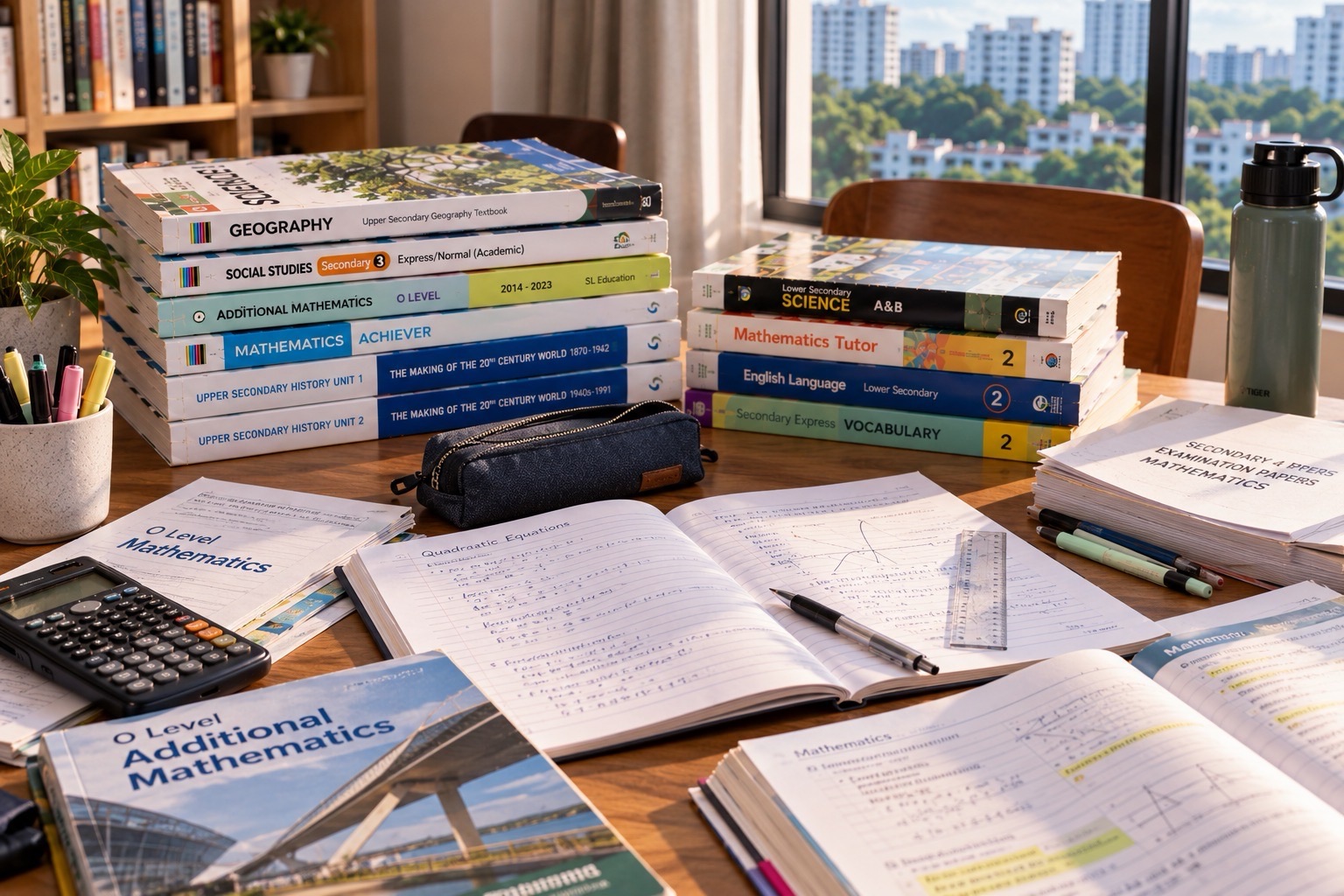
Coordinate geometry makes algebra and geometry answer the same question. A line is a geometric object and an equation at once; a circle can be described by a distance condition and by squared coordinates; a polygon’s area can be computed from coordinates once its shape is understood. These are central upper-secondary Additional Mathematics skills, not a collection of unrelated formulas.
In Singapore’s 2027 Secondary Education Certificate, both G2 Additional Mathematics K232 and G3 Additional Mathematics K341 include coordinate geometry in two dimensions. The common syllabus specifies parallel and perpendicular lines, midpoints, areas of rectilinear figures, and circles in centre-radius and general equation forms. Both explicitly exclude problems involving two circles. K341 additionally names transforming power and exponential relationships into linear form, and lists a separate section on proofs in plane geometry.
For Punggol families choosing textbooks or support, those distinctions matter. A student who is revising a real G2 syllabus should not be told that every G3 extension is mandatory, and a student preparing for G3 should not omit linearisation or proofs because a generic coordinate-geometry worksheet lacks them. This guide starts with an immediate answer, maps prerequisite skills, then supplies 29 original diagnostics with full explanations.
FACTS FIRST | 2027 G2 Additional Mathematics K232: shared line, midpoint, area and circle content | 2027 G3 Additional Mathematics K341: same plus transformation to linear form and a separate geometry-proofs strand | Both exclude two-circle problems in this stated section.
Contents and quick answer routes
- The official answer: what G2 and G3 share and what differs
- Early geometry: from Primary shapes to coordinate arguments
- Gradient is change per unit, not merely an angle on paper
- Parallel, perpendicular, vertical and horizontal lines
- The equation of a straight line contains a point and direction
- Midpoints are averages of corresponding coordinates
- Area of a rectilinear figure from coordinates
- The distance relation behind a circle’s equation
- Complete the square to recover a centre and radius
- A point on, inside or outside a circle
- Lines and one circle: translate into an equation carefully
- Keep the two-circle exclusion visible
- The G3 linearisation extension: turning curves into straight-line data
- G3 proofs in plane geometry: linked ideas, distinct syllabus section
- Accuracy and calculator practice belong inside the lesson
- A five-week Punggol family support plan
- What a tutor must demonstrate and what parents should ask
- How coordinate geometry prepares for later study
- 29 worked coordinate-geometry problems
- Parent FAQ
- Official syllabuses and related articles
The official answer: what G2 and G3 share and what differs
The Geometry and Trigonometry strand of the K232 syllabus includes two-dimensional coordinate geometry: parallel and perpendicular conditions, midpoint of a segment, area of rectilinear figures and equations of circles. The same basic coordinate outcomes appear in K341. These outcomes build on knowledge assumed from the student’s existing G2 or G3 Mathematics subject.
One explicit difference is that K341 additionally covers transforming given power and exponential relationships to straight-line form to determine unknown constants. This needs the logarithmic knowledge listed in its algebra strand. K341 also has a separate G3 proofs-in-plane-geometry outcome involving stated theorems; it should not be silently added to a supposed K232 topic checklist.
The official description excludes questions involving two circles from the named circle coordinate-geometry outcome. It does not mean students can ignore one-circle problems with lines, nor that they can solve any circle problem by rote. Parents should use the school’s current subject code and the official PDF when evaluating tutor worksheets.
Early geometry: from Primary shapes to coordinate arguments
Primary-school pupils learn rectangles, triangles, symmetry, perimeter and area from drawings and measurements. Lower secondary introduces greater fluency with graph axes, directed numbers, linear relations and the notation of points. Upper-secondary coordinate geometry combines these foundations so that geometric claims can be proved through numerical and algebraic reasoning.
A learner might know from a diagram that two edges appear parallel. In coordinate geometry, they test gradients. A learner might visually estimate the centre of a circle. In algebra, they read the centre from a completed-square equation. The diagram still matters because it detects implausible signs or misread scales.
A Punggol parent can support this transition by asking the child to draw a set of points from a small table, label axes clearly and explain what a coordinate means. The key is not drawing a picture quickly but expressing the same relationship in words, numbers, symbols and a sketch.
Gradient is change per unit, not merely an angle on paper
For distinct points (x₁, y₁) and (x₂, y₂) with x₂ ≠ x₁, the gradient is (y₂ − y₁)/(x₂ − x₁). It measures vertical change relative to horizontal change. If y and x represent different physical quantities, the gradient carries their units as well.
Consider A(1,2) and B(5,10). The change in y is eight and the change in x is four, so gradient is two. This remains two if both numerator and denominator reverse their signs when the point order is swapped. The choice of order is arbitrary, but the order must be consistent.
When a learner gets different gradients from the same two points, ask them to write two vertical subtraction columns and draw an arrow showing the direction. Fixing subtraction order and directed numbers repairs the source error; giving another formula card does not.
Parallel, perpendicular, vertical and horizontal lines
Nonvertical parallel lines have equal gradients. Two nonvertical, nonhorizontal perpendicular lines have gradients whose product is −1. The negative-reciprocal rule follows from the geometry of a right angle and should be used with care when a gradient is zero or undefined.
A horizontal line such as y = 3 has gradient zero. A vertical line such as x = 4 has undefined gradient. They are perpendicular even though their gradients cannot be multiplied to obtain −1. This is a valuable exception to simplistic classroom slogans.
For a line with gradient two, a perpendicular nonvertical line has gradient −1/2. A student who writes −2 has changed the sign but not taken the reciprocal. Ask for a visual sketch as a reasonableness check before calculating an equation.
The equation of a straight line contains a point and direction
The form y = mx + c identifies the gradient m and y-intercept c for a nonvertical line. The point-gradient form y − y₁ = m(x − x₁) is useful when one point and gradient are given. Each is a representation of the same underlying set of points.
Suppose a line passes through (2,3) with gradient −2. Use y − 3 = −2(x − 2), so y = −2x + 7. Substitute the original point to confirm 3 = −4 + 7. The check requires only arithmetic and catches a missed bracket.
Teach students to choose a form based on the given information rather than always insisting on slope-intercept form first. When a line is vertical, y = mx + c is unsuitable; its equation is x = constant. A useful teacher explains why the familiar form does not apply.
Midpoints are averages of corresponding coordinates
For A(x₁,y₁) and B(x₂,y₂), the midpoint M is ((x₁+x₂)/2, (y₁+y₂)/2). This expresses the halfway position independently on each axis. It is not the point obtained by subtracting coordinate values or averaging the total distance from the origin.
If A = (−2,4) and B = (6,−2), then M = (2,1). Reversing the endpoints produces the same answer, which is an immediate consistency check. For a missing endpoint, solve the midpoint equations backwards instead of guessing from a graph.
A learner who can find a midpoint numerically should also explain why a midpoint has equal coordinate displacements from both ends. That explanation transfers to geometry proof, symmetry and later modelling.
Area of a rectilinear figure from coordinates
Coordinate-area questions may involve triangles, parallelograms and other straight-edged polygons. A diagram helps identify a base, perpendicular height, dissection or bounding rectangle. Do not automatically count graph-paper squares unless the axes use the same physical scales and the scale conversion is understood.
For triangle A(0,0), B(4,0), C(1,3), take AB as a horizontal base of four units and vertical height three units. Its area is 1/2 × 4 × 3 = 6 square units. The fact that C is not above the midpoint of AB does not change that area.
An alternative for more complicated polygons is to partition them into simpler shapes. The school syllabus names area of rectilinear figures, not a single compulsory algorithm. The student should choose a route that can be explained and verified, including correct units.
The distance relation behind a circle’s equation
A circle is the set of points at a fixed distance r from a centre (a,b), with r positive. The distance formula leads to (x − a)² + (y − b)² = r². The squared radius appears on the right, so r is its positive square root.
A circle centred at (2,−3) with radius 4 has equation (x − 2)² + (y + 3)² = 16. The positive sign in the y-bracket reflects the negative y-coordinate of its centre; it is not an arbitrary sign flip.
Students commonly read the centre as (−2,3) by copying bracket signs. Ask them to test the actual centre: if x = 2 and y = −3, both squares become zero. The correct centre is the point where the squared deviations vanish.
Complete the square to recover a centre and radius
Another official circle form is x² + y² + 2gx + 2fy + c = 0. Completing the square in x and y gives (x+g)² + (y+f)² = g² + f² − c. The centre is (−g,−f) and the squared radius must be positive for a genuine circle of positive radius.
For x² + y² − 6x + 4y − 12 = 0, group x² − 6x and y² + 4y. Completing the squares gives (x − 3)² + (y + 2)² = 25, so centre (3,−2) and radius 5.
Teach students to expand their completed squares to check coefficients. The routine catches most lost constants. When a purported squared radius is negative, the equation has no real-circle locus. That is a meaningful geometric conclusion, not a reason to force an imaginary radius into an ordinary diagram.
A point on, inside or outside a circle
Given a centre-radius equation, evaluate the left side at a test point and compare it with r². Equality means the point is on the circle. A smaller squared distance means inside; a larger value means outside. This simple comparison is often more efficient than solving for x or y.
For (x − 1)² + (y + 2)² = 25, point (4,2) gives 3² + 4² = 25, so it lies on the circle. Point (1,−2) gives zero, which places it at the centre. Point (7,−2) gives 36, so it lies outside.
Ask the learner to classify three points without drawing an exact scale diagram first, then check by sketching. This builds a bridge between algebraic conditions and intuitive geometric location.
Lines and one circle: translate into an equation carefully
A line may intersect a circle at two points, touch it once or miss it. The general route is to substitute the line equation into the circle equation and inspect the resulting quadratic. A sketch predicts the count; algebra verifies the exact coordinates.
For x² + y² = 8 and y = x, substitution gives 2x² = 8 and x = ±2. Thus the intersection points are (2,2) and (−2,−2). Reporting only x = ±2 loses the coordinate interpretation and could lead to mixing signs.
A horizontal line y = 3 touches x² + y² = 9 at (0,3). Here x² + 9 = 9 gives x = 0 only. The line’s single contact also agrees with the circle’s uppermost point. Such consistency checks strengthen reasoning beyond algebraic speed.
Keep the two-circle exclusion visible
The K232 and K341 content list explicitly excludes problems involving two circles from the named coordinate-circle outcome. A student may still encounter richer geometry in enrichment, but teaching a sophisticated two-circle intersection technique is not evidence that an underprepared child has mastered the actual syllabus.
A useful parent question is whether each difficult worksheet question can be mapped to an official subject outcome. If it is enrichment, the tutor can say so. If the task belongs to a later level, the family can decide whether the child has the prerequisite foundations and the available time.
Careful boundary setting is not lowering ambition. It protects the curriculum from becoming an endless race through impressive-looking symbols. Master the core and then extend deliberately, with transparent labels and clear evidence of independent understanding.
The G3 linearisation extension: turning curves into straight-line data
The 2027 K341 syllabus specifies transformations of relationships, including y = axⁿ and y = kbˣ, into linear form to determine unknown constants from straight-line graphs. This extension is not listed in the same K232 coordinate-geometry section. It also requires a secure understanding of logarithms and their domains.
If y = 4x² for positive x and y, taking natural logarithms gives ln y = ln 4 + 2ln x. A graph of ln y against ln x is a straight line of gradient two and vertical intercept ln 4. A student should be able to recover exponent n from the gradient and coefficient a from the intercept.
For y = 3·2ˣ, ln y = ln 3 + x ln 2. A plot of ln y against x has gradient ln 2 and intercept ln 3. The student must name which transformed quantity goes on each axis: changing from ln y versus ln x to ln y versus x changes what the gradient means.
G3 proofs in plane geometry: linked ideas, distinct syllabus section
K341 also has a geometry-proofs outcome involving properties of parallel lines, congruence and similarity, the midpoint theorem and the tangent-chord theorem. Some prerequisite properties are already learned in G3 Mathematics. The proof strand should not be confused with an additional ‘coordinate circle’ formula or assumed to be in the same form in K232.
Consider a triangle ABC with D and E the midpoints of AB and AC. The midpoint theorem states DE is parallel to BC and DE = 1/2 BC. A good proof explanation connects the midpoint condition to the resulting parallelism and proportional lengths, rather than merely writing ‘midpoint theorem’ beside a drawing.
Students may solve a geometry question through a theorem, coordinates or a mixture of representations, as appropriate to the actual instructions. In every route, label points consistently and justify the step that makes the conclusion follow. An unlabeled sketch is not a proof.
Accuracy and calculator practice belong inside the lesson
Both 2027 syllabus levels permit approved calculators in their papers and expect essential working. Non-exact numerical answers are generally required to three significant figures, or one decimal place for degree angles, unless a question specifies otherwise. Coordinate answers involving exact fractions or radicals should be kept exact when appropriate.
A calculator can check whether a substituted coordinate pair satisfies an equation, but the full reasoning still matters. For example, if a student obtains centre (−3,2) for x² + y² − 6x + 4y − 12 = 0, entering the point will quickly contradict the supposed centre, but completing the square shows why the correct centre is (3,−2).
Require students to write clear ordered pairs, equations of lines rather than lone gradients, and square units for area. Exam performance often improves through these presentation habits because the marking can follow valid mathematics instead of guessing at a scattered sketch.
A five-week Punggol family support plan
Week one: revisit coordinates, negative numbers, graph scales and the gradient formula. Give one horizontal, one vertical and one ordinary sloping line. The learner should explain why a vertical line has undefined gradient before moving to negative reciprocals.
Week two: form equations from points and gradients, calculate midpoints and areas, and verify one result by another route. Week three: learn centre-radius equations, complete the square and classify points. Week four: substitute a line into a single circle and communicate intersection coordinates. For G3 only, schedule the officially required linearisation and proofs work as appropriate.
Week five: mix topics and revisit a deliberately selected original error without prompts. A family should compare before-and-after workings, not the number of pages filled. Adjust study load around school lessons and CCAs; sufficient time to explain one correct method is often more valuable than a late-night set of fifty rushed exercises.
What a tutor must demonstrate and what parents should ask
A strong tutor diagnoses the first mathematical slip. The child may have reversed a midpoint sign, taken a negative reciprocal incorrectly, confused radius with squared radius, or chosen the wrong transformed axis for logarithmic data. Each mistake reflects a distinct conceptual issue and should have a distinct corrective explanation.
In a small group, one student may solve a line-circle intersection algebraically while another explains it on a sketch. This is valuable only if every learner can independently reconstruct an answer afterwards. A one-to-one lesson can offer concentrated repair, but it should also leave the student able to work without continual prompts.
Local decisions in Punggol include school timetable, travel, homework space and fatigue. None changes the national syllabus. Ask what the child’s school is currently teaching, what its subject-level expectations are, what evidence of transfer will be collected, and when the tutor will retest corrected errors. That is a defensible basis for support.
How coordinate geometry prepares for later study
The connection between geometric figures and equations becomes more important in calculus, mechanics, engineering, design and data analysis. A gradient can represent a physical rate; a curve can be constrained by an equation; transformation into a straight line can help identify model parameters from observations.
This relevance is preparation, not an admissions guarantee. A future JC H2 Mathematics choice, polytechnic diploma or SIT degree involves its own conditions and application. Strong coordinate reasoning can make subsequent mathematics more coherent, but parents should not make course promises based on a single subject topic.
End each learning cycle by asking a sentence-level question: ‘What does the answer mean geometrically, and how did we check it?’ The ability to explain that relationship is the real bridge from school exercises to analytical work beyond Secondary 4.
29 worked coordinate-geometry problems with error checks
These original worked examples are educational diagnostics, not copied SEC papers. G3-only syllabus extensions are identified in their labels. A learner should first try each question independently and then use the explanation to identify the precise reasoning gap.
1. Gradient from two points
Problem: Find the gradient through (1,2) and (5,10).
Worked answer: (10−2)/(5−1) = 8/4 = 2.
Error diagnosis: Reverse both subtractions together or neither; reversing only one changes the sign.
Independent transfer: Check that y rises by eight while x rises by four.
2. Parallel gradient
Problem: A line is parallel to y = −3x + 7. What is its gradient?
Worked answer: It must have gradient −3, unless the question changes the coordinate system.
Error diagnosis: Parallel nonvertical lines share slope, not necessarily intercept.
Independent transfer: Construct a different parallel line through (0,2).
3. Perpendicular gradient
Problem: Find the gradient perpendicular to y = 2x + 1.
Worked answer: The nonvertical perpendicular gradient is −1/2.
Error diagnosis: Changing only the sign gives −2, which is not the negative reciprocal.
Independent transfer: Multiply the two gradients and obtain −1.
4. Vertical line
Problem: Write the equation of the line through (4,−3) parallel to the y-axis.
Worked answer: Every point has x = 4, so the equation is x = 4.
Error diagnosis: Do not write y = 4; that would be horizontal.
Independent transfer: Explain why the gradient is undefined.
5. Horizontal line
Problem: Write the horizontal line through (5,−2).
Worked answer: The equation is y = −2; gradient zero.
Error diagnosis: A horizontal line does not require a y = mx + c calculation.
Independent transfer: Name two other points on this line.
6. Midpoint with negative values
Problem: Find the midpoint of (2,6) and (8,−2).
Worked answer: ((2+8)/2,(6−2)/2) = (5,2).
Error diagnosis: Average each coordinate pair separately, not the coordinate sums together.
Independent transfer: Check the coordinate displacement from each endpoint.
7. Recovering an endpoint
Problem: A=(1,2), M=(3,4) is the midpoint of AB. Find B.
Worked answer: 2M − A = (6−1,8−2) = (5,6).
Error diagnosis: Do not add M and A to find B.
Independent transfer: Verify the midpoint of (1,2) and (5,6).
8. Point and gradient
Problem: Find the line through (2,3) with gradient −2.
Worked answer: y−3 = −2(x−2), so y = −2x + 7.
Error diagnosis: The bracket must multiply the entire difference x−2.
Independent transfer: Test the given point.
9. Line through two points
Problem: Find the line through (1,4) and (3,0).
Worked answer: Gradient (0−4)/(3−1) = −2; y−4 = −2(x−1), so y = −2x + 6.
Error diagnosis: Do not confuse x- and y-coordinate subtraction.
Independent transfer: Check both original points.
10. Parallel through a point
Problem: Find line parallel to y=3x+2 through (2,−1).
Worked answer: Use y = 3x + c; −1 = 6+c, so c = −7; y = 3x−7.
Error diagnosis: Equal slope does not mean equal intercept.
Independent transfer: Substitute (2,−1).
11. Perpendicular through a point
Problem: Find line perpendicular to y=−2x+5 through (4,1).
Worked answer: New gradient 1/2; y−1 = (x−4)/2, so y = x/2−1.
Error diagnosis: Care is required when finding the intercept.
Independent transfer: Check x=4 gives y=1.
12. Intersection of lines
Problem: Solve y = x+1 and y = −x+5.
Worked answer: Equate: x+1 = −x+5, so x=2 and y=3.
Error diagnosis: A point of intersection needs both coordinates.
Independent transfer: Check (2,3) satisfies both.
13. Triangle area
Problem: Find area of A(0,0), B(4,0), C(1,3).
Worked answer: Base AB length 4; perpendicular height 3; area 6 square units.
Error diagnosis: Horizontal offset of C from midpoint is irrelevant.
Independent transfer: Draw the altitude from C to the x-axis.
14. Parallelogram area
Problem: Area of vertices (0,0),(3,0),(4,2),(1,2).
Worked answer: Base three and height two yield area 6 square units.
Error diagnosis: A slanted side is not the perpendicular height.
Independent transfer: Explain the same area by cutting and shifting a triangle.
15. Centre-radius equation
Problem: Write circle centre (2,−3), radius four.
Worked answer: (x−2)²+(y+3)²=16.
Error diagnosis: The radius is 4, not 16.
Independent transfer: Substitute centre coordinates to get left side zero.
16. Recover centre from general form
Problem: Find centre and radius of x²+y²−6x+4y−12=0.
Worked answer: (x−3)²+(y+2)²=25; centre (3,−2), radius 5.
Error diagnosis: Remember to compensate for added square constants.
Independent transfer: Expand the final equation to confirm.
17. Not a real circle
Problem: Interpret x²+y²+2x−8y+20=0.
Worked answer: (x+1)²+(y−4)²=−3; there are no real points satisfying this.
Error diagnosis: A squared distance cannot be negative.
Independent transfer: Explain why it is not a real circle of radius √3.
18. Intercepts on a circle
Problem: Find axes intersections of x²+y²=25.
Worked answer: x-axis: (5,0),(−5,0). y-axis: (0,5),(0,−5).
Error diagnosis: Set the other coordinate to zero for each axis.
Independent transfer: Plot four points and infer centre and radius.
19. Test a point on a circle
Problem: Does (4,2) lie on (x−1)²+(y+2)²=25?
Worked answer: 9+16=25, so yes.
Error diagnosis: Checking one coordinate alone proves nothing.
Independent transfer: Compare with (1,−2), the centre.
20. Line tangent to circle
Problem: Find point where y=3 touches x²+y²=9.
Worked answer: Substitute y=3: x²+9=9 gives x=0; point (0,3).
Error diagnosis: Do not return only the x-value when a point is requested.
Independent transfer: Sketch horizontal tangent at the top of the circle.
21. Two intersections, one circle
Problem: Solve y=x with x²+y²=8.
Worked answer: 2x²=8, x=±2. Points (2,2) and (−2,−2).
Error diagnosis: Retain the matching sign for y.
Independent transfer: Substitute both ordered pairs into the circle.
22. No real line-circle intersection
Problem: Does y=4 intersect x²+y²=9?
Worked answer: x²+16=9 gives x²=−7, impossible for real x.
Error diagnosis: Do not write x = −√7 as a real solution.
Independent transfer: Use a sketch: the line is above the circle.
23. Parabola vertex coordinates
Problem: For y=(x−2)²−1, find vertex and zeros.
Worked answer: Vertex (2,−1). Zeros when (x−2)²=1, so x=1 or 3.
Error diagnosis: The vertex and x-intercepts are not the same points.
Independent transfer: Explain the symmetry about x=2.
24. G3 linearisation: power law
Problem: If y=4x² for x>0, write a straight-line relationship.
Worked answer: ln y = ln 4+2 ln x. Plot ln y versus ln x for gradient 2.
Error diagnosis: Plotting ln y versus x does not give this gradient.
Independent transfer: Recover 4 from the intercept ln4.
25. G3 linearisation: exponential
Problem: If y=3·2ˣ, obtain linear form.
Worked answer: ln y = ln3 + x ln2; plotting ln y versus x gives gradient ln2.
Error diagnosis: Do not put ln x on the horizontal axis for this model.
Independent transfer: Recover the base by exponentiating the gradient.
26. G3 log-log gradient
Problem: If ln y = ln4 + 2.5ln x, identify the original relation.
Worked answer: Exponentiate: y = 4x^2.5 for x>0.
Error diagnosis: The slope is the exponent, not the coefficient 4.
Independent transfer: Check x=1 gives y=4.
27. G3 semi-log gradient
Problem: If ln y = ln2 + x ln3, recover the relationship.
Worked answer: y = 2·3ˣ for the domain described by the model.
Error diagnosis: A log y versus log x graph would represent a different relation.
Independent transfer: Check x=0 gives y=2.
28. Midpoint theorem
Problem: In triangle ABC, D and E are midpoints of AB and AC. State a conclusion.
Worked answer: The midpoint theorem gives DE ∥ BC and DE = BC/2.
Error diagnosis: G3 plane-geometry proof content is distinct from the shared circle formulas.
Independent transfer: State clearly which segments are bisected.
29. Parallel/perpendicular exception
Problem: Why can’t we apply m₁m₂ = −1 to y=2 and x=4?
Worked answer: The horizontal line has gradient zero and the vertical line has undefined gradient. They are perpendicular geometrically.
Error diagnosis: The product rule assumes both gradients exist and are nonzero.
Independent transfer: Explain the angle of intersection without computing slopes.
Parent FAQ
Is coordinate geometry officially in both levels?
Yes. K232 and K341 both list parallel/perpendicular line conditions, midpoints, rectilinear area and circles in two equations forms.
Do both official levels exclude two-circle problems?
Yes, the named circle topic in both PDFs expressly excludes problems involving two circles. Different enrichment may go further but should be labelled.
Does G2 need G3-style linearisation?
The explicit relationship-to-linear-form outcome appears in K341’s coordinate-geometry section. Parents should follow the subject-level PDF rather than assuming a G3 extension is compulsory at G2.
What is the difference between gradient and angle?
Gradient measures vertical change per horizontal change. It can be related to an angle, but is not itself the same numerical quantity as an angle measurement.
Why is a vertical line’s gradient undefined?
Its horizontal change is zero; the ratio rise/run would require division by zero. Its equation is x = constant.
How do you read a circle centre from brackets?
In (x−a)²+(y−b)²=r², centre is (a,b). Read signs through the zero-deviation condition, not by copying written signs.
Do line-circle questions require both coordinates?
When intersection points are requested, yes. Recover x and y as matching ordered pairs and check both in the original equations.
Does a negative squared radius make a valid ordinary circle?
No. An equation equating a sum of two real squares to a negative number has no real points.
Are geometry proofs part of G3 A-Math?
K341 includes an explicit G3 proofs-in-plane-geometry section, beyond its common coordinate geometry. Check the stated theorem list.
How can a parent track improvement?
Save a diagnostic error, the repaired explanation, and an independent new question completed later. Those reveal whether the child understands instead of copies.
Syllabus documents and connected learning routes
Fact check: 18 October 2026. The two official 2027 SEC syllabus PDFs are the basis for subject-level distinctions. School-specific choices and future admissions require separate current verification.
- Official SEAB 2027 G2 Additional Mathematics syllabus K232
- Official SEAB 2027 G3 Additional Mathematics syllabus K341
- SEAB 2027 G2 school-candidate syllabus list
- SEAB 2027 G3 school-candidate syllabus list
- Clementi tutor lesson-depth reference
- Punggol Primary-to-University A-Math learning roadmap
- Punggol algebra prerequisites and error repair
- Punggol quadratics and discriminants guide
- Punggol trigonometry and interval equations guide
This article belongs to Understanding the Additional Mathematics Education System of Punggol, a 100-article educational series connecting Primary mathematical foundations, Secondary A-Math study, examination decisions and post-secondary options.


