
G3 Biology tuition can untangle the terms by tracking both place and purpose. Absorption is the movement of small, soluble products of digestion through the intestinal wall into the blood or lymph. Assimilation happens after transport, when those absorbed substances are taken up and used or converted by cells and tissues.
The immediate next step is to draw one glucose molecule’s journey and label three moments: crossing a villus, travelling in blood, and being used by a cell or converted by the liver. If “absorption” is written at all three points, the student has found the misconception.
Did you know? Many weak answers are not short of facts; they put a correct fact in the wrong location. A good tutor therefore asks “where is the substance now?” before asking for another definition.
Trace food into usable material
Start with the whole sequence
Ask your child to arrange these processes: ingestion, digestion, absorption, transport, assimilation and egestion. Then ask what changes at each arrow. If digestion and absorption are merged, the child may not distinguish breaking large molecules down from moving small molecules across a surface. If absorption and assimilation are merged, the child may understand the villus but not what tissues do with nutrients afterwards.
This quick sequence is more diagnostic than asking for two isolated definitions, because it reveals which boundary in the story is missing.
Use three columns: location, movement, fate
| Question | Absorption | Assimilation |
|---|---|---|
| Where? | Across the wall of the small intestine, especially villi | In body cells and organs after transport |
| What happens? | Nutrients enter blood capillaries or lacteals | Nutrients are used, stored or converted |
| What evidence belongs? | Thin surface, large surface area, capillaries, lacteal | Respiration, growth, repair or conversion to storage material |
A tutor can remove one column and have the student reconstruct it, then switch to amino acids or fatty acids so the understanding is not tied to a single memorised diagram.
Example: what happens to glucose?
After carbohydrate digestion produces glucose, glucose crosses the villus epithelium and enters blood capillaries: that is absorption. Blood rich in absorbed nutrients travels from the small intestine to the liver through the hepatic portal vein. Glucose may then be used by cells in respiration or converted to glycogen for storage: those uses and conversions illustrate assimilation.
The learner should narrate this without jumping from “small intestine” straight to “energy”. The transport step is the bridge that keeps the locations honest.
How this fits the 2027 G3 Biology syllabus
The official 2027 G3 Biology syllabus (K325) lists absorption and assimilation within Nutrition in Humans. It requires functions of digestive-system parts in relation to these processes, the villus’s suitability for absorption, transport of nutrient-rich blood to the liver through the hepatic portal vein, and liver roles including conversion between glucose and glycogen.
The assessment comprises Paper 1 multiple choice (30%), Paper 2 structured and free-response questions (50%), and Paper 3 practical (20%). Tuition should therefore connect accurate terminology to diagrams, unfamiliar contexts and reasoned explanations—not train definitions in isolation.
Independent progress checks
- Your child places each process at the correct location.
- They distinguish crossing a surface from later cellular use.
- They connect villus structures to absorption without calling those features assimilation.
- They can transfer the explanation from glucose to another nutrient.
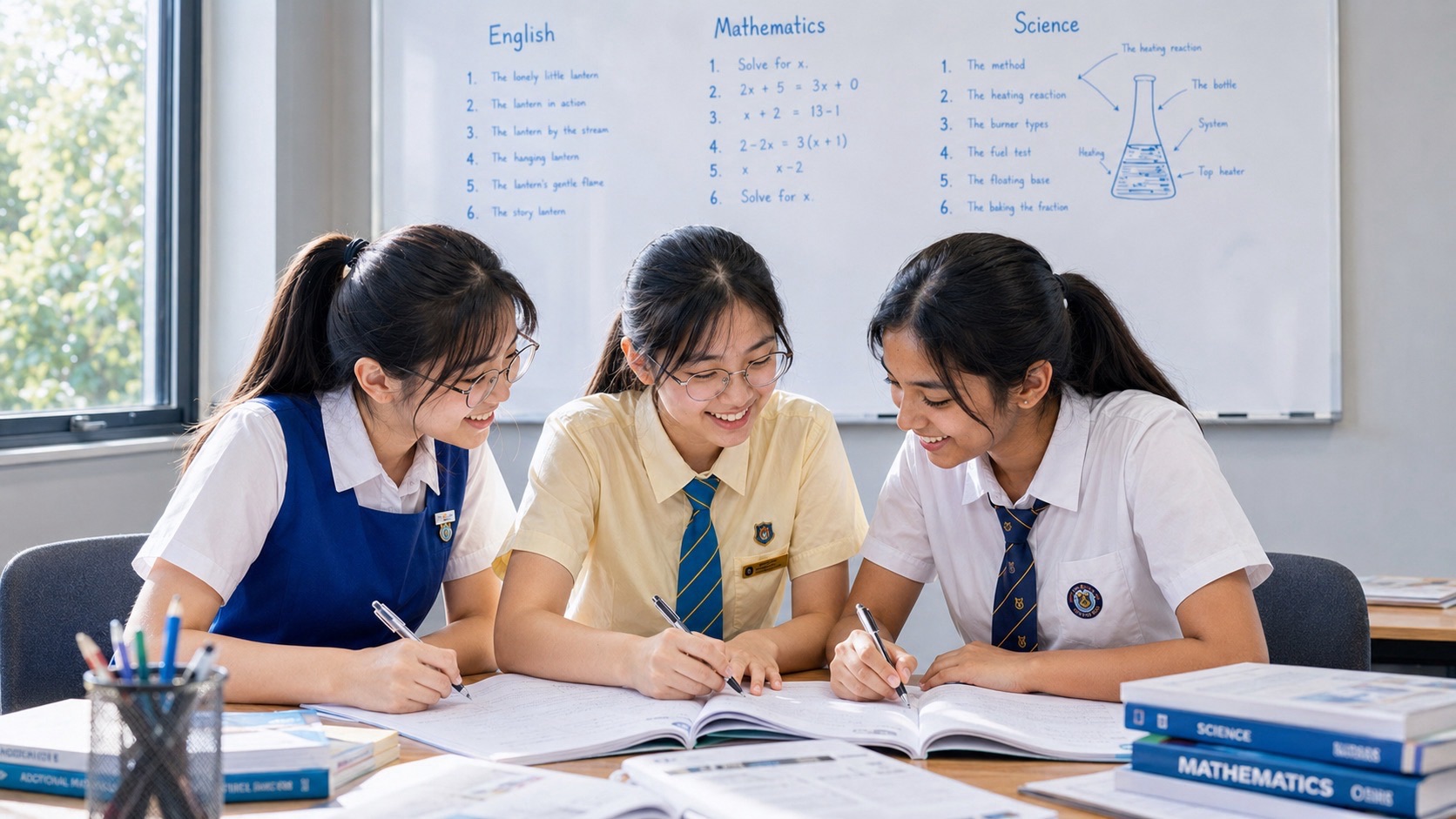
In a three-student lesson, if available, each learner can trace a different nutrient and challenge one another’s location words; each should then complete a fresh explanation alone. Continue with the related guide on enzymes, human nutrition and structured questions, or use the series directory.


