
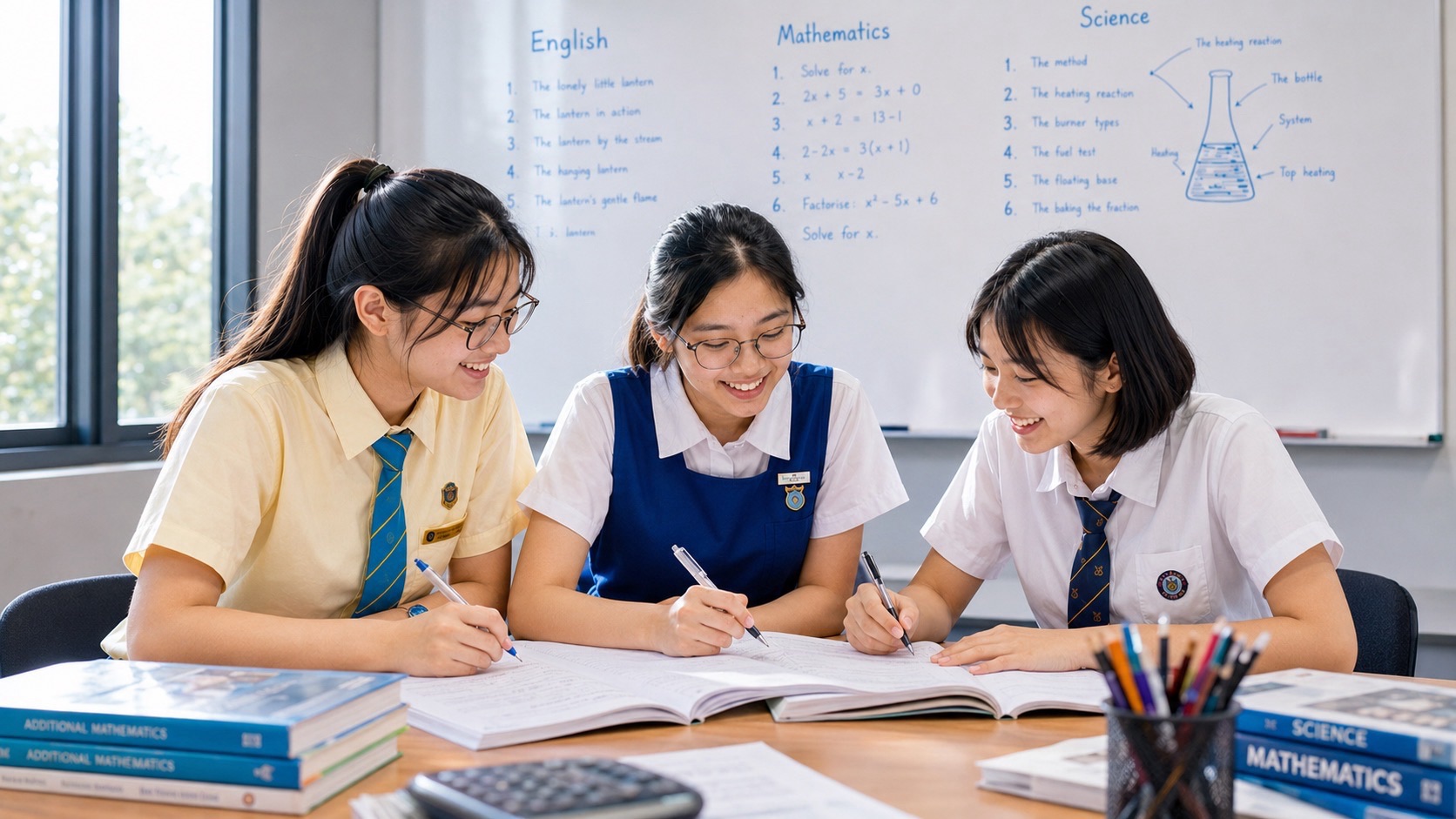
G3 Literature tuition can help your child choose between two unseen-poetry questions by replacing the search for the “easier poem” with a short evidence test. The better choice is usually the question for which the student can form a defensible view, trace a meaningful change and locate several precise pieces of language or structure.
Try this first: place two short unfamiliar poems beside their questions and allow three minutes. For each option, ask your child to write a one-sentence answer and mark three details that could support it. Choose only after both mini-plans exist.
G3 is a subject level, not Posting Group 3. This guide follows full Literature in English K331 for 2027 school candidates. A student taking Literature as an elective within G3 Humanities sits a different syllabus and paper code, so confirm the school subject before using this advice.
In this guide
Diagnose the real cause of slow choice
A child who freezes at two poems may not have a reading problem. The bottleneck may be decision anxiety, an urge to understand every line, weak attention to the question, or the belief that a familiar setting automatically makes one poem safer.
- Comprehension bottleneck: the student cannot state the central situation of either poem.
- Question bottleneck: the student reads the poems but overlooks what each question asks.
- Evidence bottleneck: an impression forms, yet the learner cannot locate details that sustain it.
- Perfection bottleneck: the child waits for certainty about every image before committing.
- Time bottleneck: both options are analysed fully, leaving too little time to write.
Tuition should identify which delay is occurring. Telling every student to “pick the shorter poem” hides the real cause and can lead them away from the question they can answer better.
Use a three-minute evidence screen
A practical choice screen has four passes: situation, question, movement, evidence. First, state what seems to be happening. Next, underline the exact demand in each question. Then identify a change or tension in the poem. Finally, mark three details that could support a response.
The student is not writing two essays. A mini-plan may contain one tentative viewpoint, two or three quotation fragments and a note about form, structure or language. If one option produces a clearer route, choose it and begin planning the real response.
This routine deliberately accepts uncertainty. Unseen poetry rewards a sensitive, informed interpretation supported by evidence; it does not require discovering a single secret meaning before writing begins.
Let the question control the choice
The two poems have separate questions. A student may like one poem more but have stronger evidence for the other question. Choice therefore belongs to the pair—poem plus question—rather than to the poem alone.
Circle the task word and the emotional or conceptual focus. A question about how a speaker’s feelings change calls for a movement across the poem. A question about how a place is made memorable may invite attention to imagery, selection of detail, sound, viewpoint and structure.
The strongest option is the one that offers several connected observations. A list of techniques without a viewpoint is weaker than a modest interpretation that can be traced through the poem.
Compare two fictional poem options
Imagine two tutor-written options. Poem A describes a nearly empty bus interchange at dawn, and its question asks how the writer makes waiting feel uneasy. Poem B describes a family clearing a dining table after a celebration, and its question asks how affection and loss are presented.
A learner may prefer Poem B because the situation feels familiar. Yet if the child can only write “the family is sad”, the route is thin. For Poem A, the learner may notice repeated clock sounds, a sentence that breaks before the bus arrives, and light that makes ordinary signs look strange. Those details support a focused claim about waiting becoming tense and distorted.
The choice should be Poem A in that case—not because it is objectively easier, but because the learner has a clearer answer to its question and better evidence. Another student may choose Poem B for equally sound reasons.
Use a three-student choice rehearsal
If the provider confirms the exact G3 Literature syllabus, a three-student lesson can train decision quality under time. One learner makes a mini-plan for Option A, one for Option B and one compares how well each plan answers its question.
Roles rotate, and every student must eventually choose and write independently. The comparator may challenge vague claims—“Which word makes it uneasy?” or “Where does the feeling change?”—but cannot supply the final viewpoint.
The purpose is to make selection criteria audible, then internal. With practice, the child no longer needs a peer debate; the same checks happen quietly on the page.
Align with K331 Paper 1
The official 2027 SEC G3 Literature in English syllabus K331 sets Paper 1, Prose and Unseen Poetry, at 1 hour 40 minutes and 50% of the subject. Section B offers two unseen poems with one question on each; candidates answer one question, worth 25% of the total subject.
One unseen-poetry question each year is set on a Singapore text. The assessment objectives emphasise close response, the effects of form, structure and language, a sensitive personal response, clear expression and textual evidence.
Check the SEAB 2027 G3 school-candidate directory and the school’s exact subject entry. Full K331 and Literature within G3 Humanities are related but not interchangeable paper arrangements.
Avoid false shortcuts
Length, local setting and the number of obvious techniques can inform a first glance, but none should decide automatically. A short poem may be compressed and difficult; a longer poem may offer a clearer movement. A familiar setting does not remove the need to analyse the writing.
Do not compare the two poems in the final answer unless the actual question asks for comparison. K331 Section B gives one question on each poem and asks the candidate to answer one.
A fixed three-minute screen is a practice target, not a rule printed in the syllabus. The student must adapt the time to the whole Paper 1 plan developed with the school and to the speed at which an accurate decision can be made.
Check independent progress and continue reading
Use a fresh pair of poems and remove the checklist. Progress is visible when the learner commits calmly, explains the choice in evidence terms and leaves enough time to produce a coherent answer.
- Both questions are read before a choice is made.
- Each option receives a one-sentence possible answer.
- The chosen poem yields at least three precise supporting details.
- The learner can identify a change, tension or organising pattern.
- The final response stays on the selected question.
- Choice time becomes stable across unfamiliar pairs.
Continue with analysing a quotation instead of retelling and preparing for set texts and unseen poetry. The diagnostic and gradual-release rhythm follows the immutable small-group teaching reference. Browse the series directory for every confirmed guide.


