
Did you know? A concise summary is built by choosing the passage’s necessary ideas and restating their relationship clearly; copying several whole sentences usually carries examples, repetition and detail that the task does not need. G3 Higher Tamil tuition can help by diagnosing whether your child is missing ideas, over-copying language or struggling to compress ideas accurately in Tamil.
Your immediate next step is to give your child one recent comprehension passage and ask for three things on separate lines: the required focus, five possible content points and a one-sentence summary of the passage. Bring that attempt, the school’s exact examination entry and the teacher’s feedback to any tutor. The three lines reveal much more than asking the child to “write shorter”.
G3 describes the level of this individual subject; it is not the same as Posting Group 3. Confirm that the child is registered for 2027 SEC G3 Higher Tamil Language K357, and confirm that a prospective provider really teaches this specialist subject before discussing tuition.
A quick route for parents
- Diagnose the real summary problem
- Use a selection-and-compression map
- See a small worked example
- Turn the method into tuition practice
- Match the 2027 K357 syllabus
- Know the limits of tuition
- Check for independent progress
- Continue with verified reading
Orientation: subject level G3 · syllabus K357 · begin with one unaided sample · confirm school entry and specialist provision.
Diagnose the real summary problem
“Too long” is a symptom. The cause may appear earlier. A child may misunderstand the question focus, treat every sentence as equally important, copy an example because it sounds impressive, or remove so much that the main relationship disappears. Another child may identify the right points in conversation but lack the Tamil vocabulary and sentence control to combine them.
A useful diagnosis separates four moves: find, rank, combine and verify. First, can the student find relevant points? Next, can the student rank a main point above an example? Can two related points be combined without changing meaning? Finally, can the student verify that the final sentence still answers the exact focus? Tuition should start at the first unstable move.
Use a selection-and-compression map
Before writing, draw three columns: keep, combine and leave out. Keep a sentence only when it answers the question focus. Combine points that describe the same cause, result or action. Leave out illustrations, repeated wording, decorative detail and background that does not answer the focus.
Then label the logical connection between retained points: because, therefore, however, first or as a result. The label does not have to appear in the final answer, but it stops the student from joining unrelated ideas. The final Tamil phrasing should be the student’s own accurate language, not a patchwork of copied clauses.
A small worked example shows what compression means
Imagine a practice passage says that a school garden cools a paved corner, gives insects a habitat, lets students observe plant growth and requires a weekly watering roster. If the question asks for the garden’s learning benefits, cooling the corner and the watering timetable may be true but outside the focus. The strongest points concern observing growth and learning through caring for living things.
The child can first state those points plainly, then combine them into one accurate sentence. The purpose is not to produce one “perfect” model sentence. It is to make the selection visible, so the child can explain why each retained idea belongs and why each omitted detail does not.
Turn the method into tuition practice
A productive lesson uses short cycles. The student marks the focus, selects points, gives an oral summary, writes it and compares the result with the passage. The tutor changes only one variable at a time: first relevance, then compression, then Tamil expression. This makes feedback usable at the next attempt.
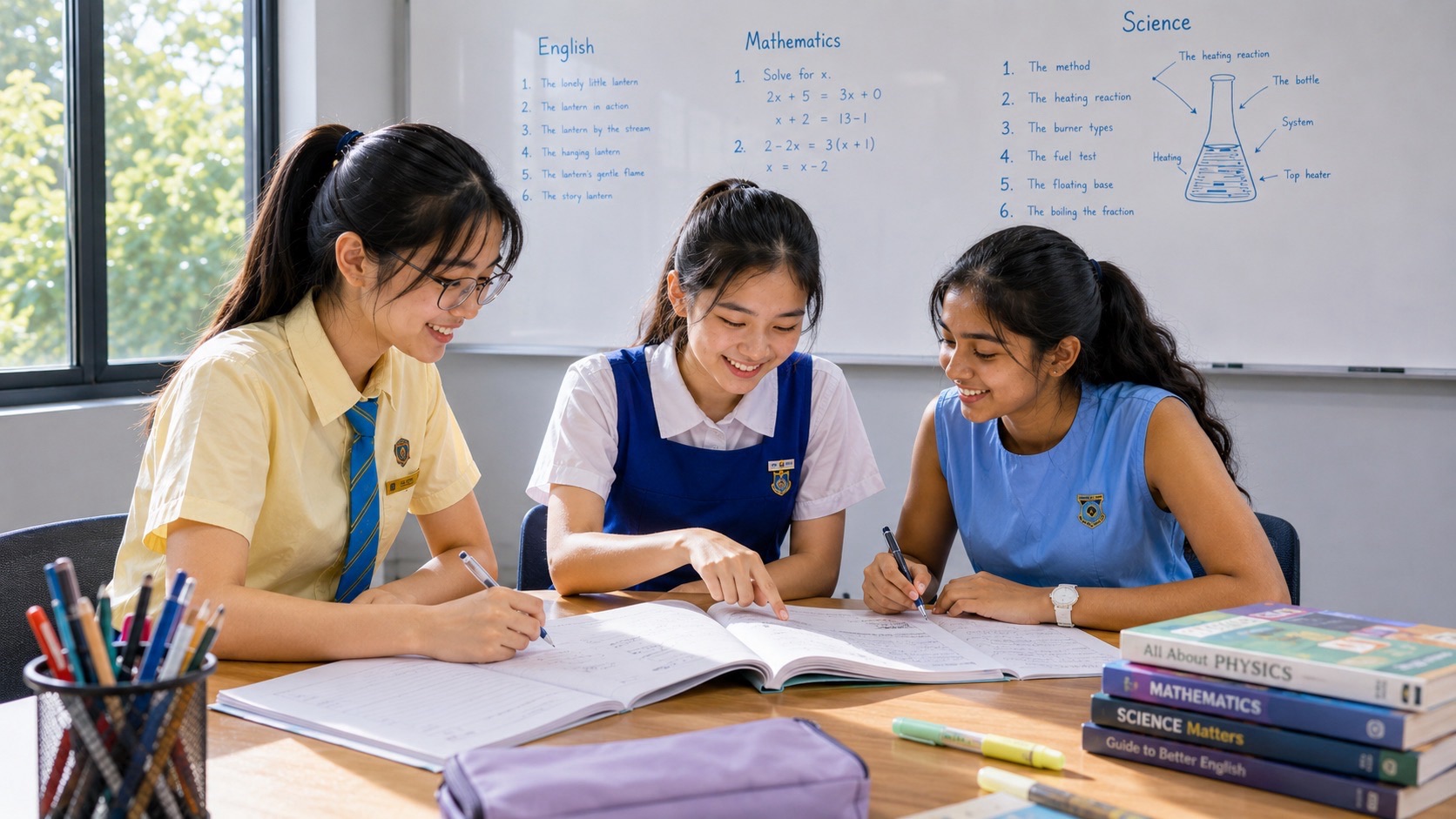
If the provider confirms genuine Higher Tamil provision, a three-student lesson can be useful: one learner defends a selected point, one challenges an unnecessary detail and one checks whether the paraphrase preserves meaning. Roles should rotate, and every learner must still produce an individual answer. The value comes from hearing the reasoning, not from copying a group version.
Learning continuity matters. Keep one running summary log with the date, question focus, omitted detail, strongest compression and next target. The school teacher’s terminology should lead; the tutor can reinforce it so the child does not juggle two competing systems.
Match practice to 2027 SEC G3 Higher Tamil K357
The official 2027 syllabus identifies three papers. Paper 1 Writing carries 40%, Paper 2 Language Use and Comprehension carries 40%, and Paper 3 Oral carries 20%. Paper 2 lasts 1 hour 45 minutes. Its comprehension work includes a passage of about 245–255 words and a summary-writing question, alongside other comprehension and language items. A tutor should therefore teach summary writing as one part of a wider language-and-comprehension system.
Read the visible official sources: 2027 SEC G3 Higher Tamil Language K357 syllabus and the SEAB 2027 G3 syllabus directory. SEAB lists K357 under Local Subjects. Check the child’s school documents because subject entry and arrangements belong to the school and examination system.
Know the limits of tuition
Tuition can teach selection, paraphrase, sentence control and checking. It cannot replace broad Tamil reading, school feedback or the child’s own decisions under timed conditions. A tutor should not rewrite school work for submission or train a single memorised answer for every passage.
Ask the provider which Higher Tamil syllabus and examination year they teach, who teaches it, and how they diagnose comprehension separately from writing. If that match cannot be confirmed, use the official syllabus and school teacher as the planning authority.
Check for independent progress
- The child states the summary focus before selecting points.
- Selected points survive a “why is this necessary?” challenge.
- Examples and repeated detail are removed without losing the central meaning.
- The child paraphrases accurately in Tamil instead of stitching together long copied clauses.
- On a fresh passage, the child repeats the method without tutor prompts.
Track two fresh passages over several weeks. Fewer prompts with stable meaning is stronger evidence than one polished answer completed with heavy help.
Useful next reading
- Which 2027 G3 Higher Mother Tongue syllabus should my child’s tutor follow?
- Which MOE and SEAB syllabus should a tutor use for each subject?
- A teaching reference for diagnosis, small-group explanation and learning continuity
Official syllabus details checked on 11 October 2026. Use the document for the child’s actual examination year.


