
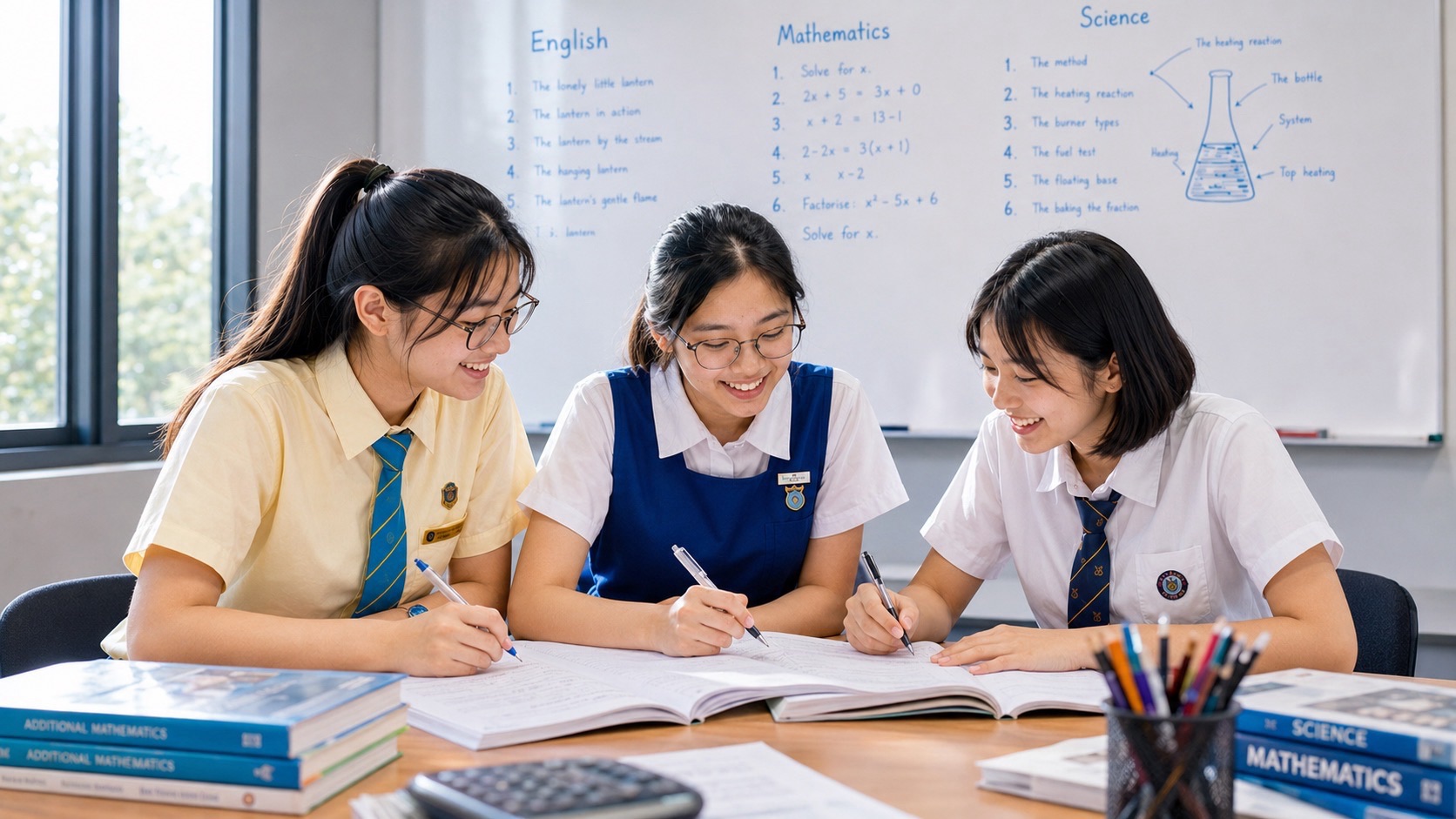
Did you know? In a water-displacement question, the final measuring-cylinder reading is not the object’s volume. G2 Science tuition can help your child subtract the initial reading from the final reading, then divide the object’s mass by that change in volume. Label all three quantities before using the density formula.
For an original example, a sinking solid has a mass of 54 g. The water level rises from 40 cm³ to 60 cm³ when the solid is fully submerged. Its volume is 20 cm³ and its density is 54 ÷ 20 = 2.7 g/cm³. Using 60 cm³ would include the water already in the cylinder.
This focus belongs to the Physics component of the 2027 SEC G2 Science combinations K223 and K224. K225 is the Chemistry–Biology combination, so parents should check the actual subject route. For Punggol families choosing support, bring the child’s measurement diagram and working, not just the final mark.
Find your next learning step
Match density practice to the right Science combination · Find which quantity the student has misunderstood · Calculate from the change in water level · Use errors to explain the measurement · Look for understanding on a fresh diagram
Match density practice to the right Science combination
The shared 2027 G2 Science document covers K223 Physics–Chemistry, K224 Physics–Biology and K225 Chemistry–Biology. Its Physics section includes applying density = mass ÷ volume.
The Physics practical guidance includes measuring volumes with cylinders and finding the density of a regularly or irregularly shaped solid that sinks in water. The worked activity below is a teaching example, not an official examination question or a claim that every listed practical has a separate practical examination.
Read the official 2027 G2 Science syllabus alongside the school’s current guidance.
Find which quantity the student has misunderstood
Ask the student to point to the initial water volume, the final cylinder reading and the object’s volume. If all three are called ‘volume’ without distinction, work on the physical meaning before the calculation.
If the subtraction is correct but the division is reversed, revisit density as mass per unit volume. If the method is right but the answer has no unit, practise connecting grams and cubic centimetres to g/cm³.
One wrong answer can hide several different problems. A tutor who sees the student’s annotated diagram can target the actual missing step.
Calculate from the change in water level
For the 54 g solid, subtract 40 cm³ from 60 cm³ to obtain 20 cm³. Then calculate 54 g ÷ 20 cm³ = 2.7 g/cm³. State what each number represents rather than writing an unexplained sequence.
This simple method assumes the solid is fully submerged, does not dissolve or react in the liquid, and has no attached air bubbles affecting the reading. The rise in liquid level represents the volume of liquid displaced by the submerged object.
Read a water meniscus at eye level using the appropriate part of the curve, normally the bottom for water in an ordinary measuring cylinder. In supervised practical work, use suitable apparatus and the teacher’s instructions. A drawn-data exercise is enough for practising the arithmetic at home.
| Quantity | Value | Meaning |
|---|---|---|
| Mass | 54 g | Mass of the solid |
| Initial water reading | 40 cm³ | Water before submerging the solid |
| Final reading | 60 cm³ | Water reading with the solid submerged |
| Solid volume | 60 − 40 = 20 cm³ | Change in reading |
| Density | 54 ÷ 20 = 2.7 g/cm³ | Mass per unit volume |
Use errors to explain the measurement
If trapped bubbles increase the apparent volume, the calculated density becomes too small for the same mass. Explain the chain: larger denominator, smaller quotient. Avoid the vague answer ‘human error’.
Ask what happens if only part of the object is submerged. The measured displacement no longer represents its full volume, so dividing total mass by that partial volume produces an overestimate of density.
Practise with two diagrams using different scale intervals. Reading the scale, finding a difference and calculating a quotient are separate skills; check each one.
Look for understanding on a fresh diagram
Try a new example: a solid of mass 84 g raises the water from 35 cm³ to 65 cm³. Its volume is 30 cm³ and its density is 2.8 g/cm³. Ask the student to explain why the denominator is 30.
For unit transfer, ask why 2.8 g/cm³ equals 2800 kg/m³. One gram is 0.001 kg and one cubic centimetre is 0.000001 m³, so the numerical conversion factor is 1000.
Bring a diagram and teacher comments to a consultation. Ask whether the lesson will address scale reading, displacement, formula rearrangement or units, and how the student will demonstrate the method independently.
Choose a focused next step
Explore the wider physical ideas in the existing density and buoyancy guide.
See the related G2 Science answer-format guide and the Primary, PSLE and SEC subject directory.
For parents in Punggol, bring the actual subject level, examination year, recent work and teacher feedback. Ask what the proposed support will address and how independent progress will be checked. Confirm the provider’s subject availability before booking.
The Clementi Secondary 1 Mathematics guide shows how diagnosis and focused 3-pax support can make a student’s reasoning visible. Use that teaching principle when assessing support for your child’s actual subject.
Official syllabus checked 11 October 2026. The examples in this guide are original teaching activities, not SEAB questions or official model answers.


