
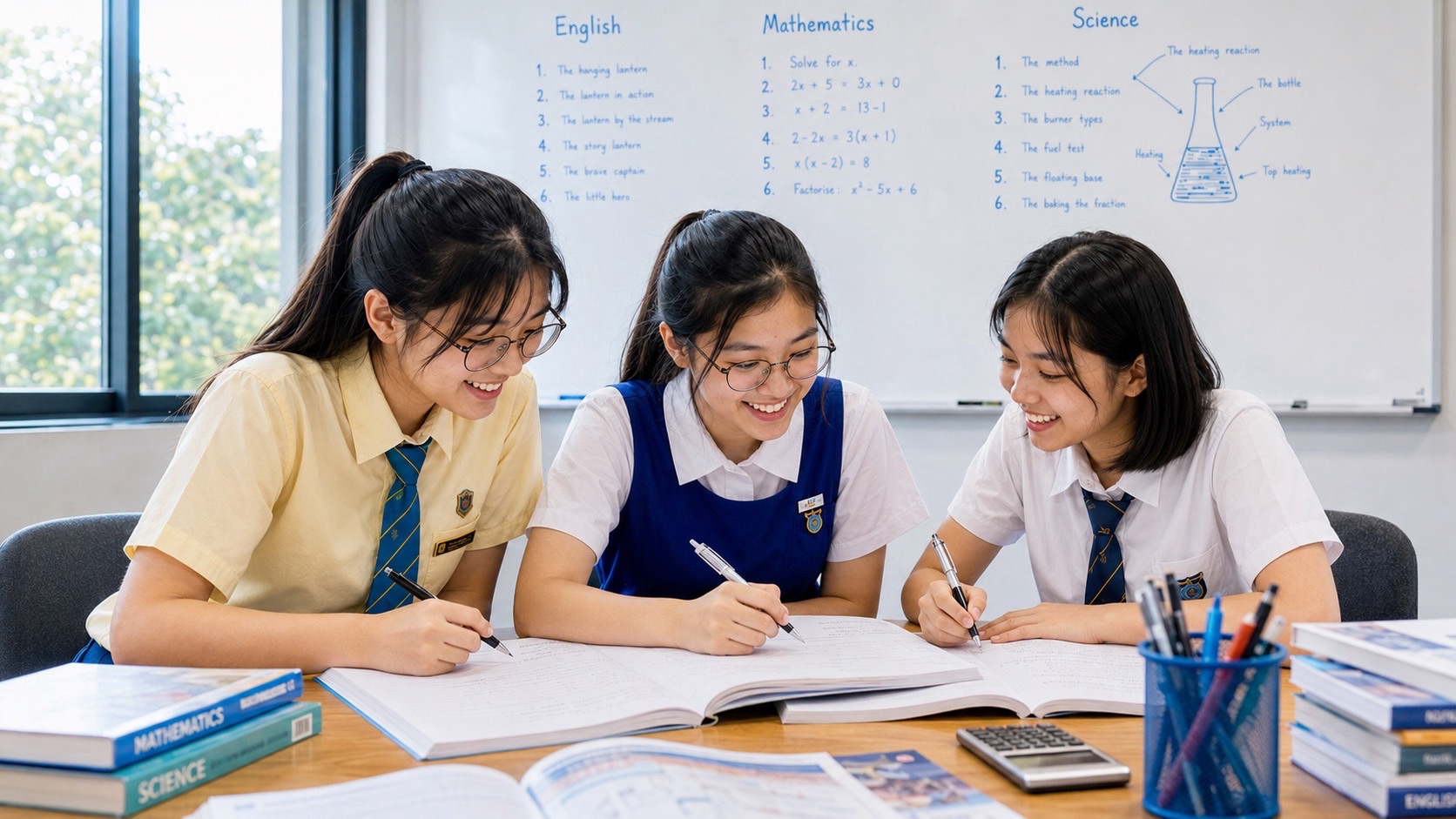
A G2 Science tutor should follow the exact combination on the child’s school record: Physics/Chemistry K223, Physics/Biology K224, or Chemistry/Biology K225. “G2 Science” alone is not specific enough to choose papers, content or revision time.
Your immediate next step is to check the school’s subject entry, write down the two components and code, then sort the child’s last two assessments by component. This quickly shows whether tuition is covering the correct pair and whether one science is masking a weakness in the other.
Did you know? The 2027 G2 Science syllabus uses one shared document for all three combinations, but candidates take different paper pairs. G2 is the subject level, while Posting Group describes the posting route; the two labels are not interchangeable.
Choose the correct G2 Science route
- Match the combination and code
- Diagnose each component separately
- Teach shared scientific practices
- Work through one paired example
- Map the correct papers
- Check independent progress
Orientation: the SEAB directory lists combinations available to school candidates; it does not mean every school offers every pair. Confirm the school offering before arranging materials or specialised tuition.
Which 2027 code belongs to each combination?
| G2 Science combination | 2027 SEC code | Papers taken |
|---|---|---|
| Science (Physics, Chemistry) | K223 | Physics Papers 1 and 2; Chemistry Papers 3 and 4 |
| Science (Physics, Biology) | K224 | Physics Papers 1 and 2; Biology Papers 5 and 6 |
| Science (Chemistry, Biology) | K225 | Chemistry Papers 3 and 4; Biology Papers 5 and 6 |
Each component contributes a multiple-choice paper and a structured paper. A learner does not take all six papers. The code decides which four papers apply, so a generic resource pack can waste time or omit half the child’s actual course.
Why should the two sciences be diagnosed separately?
A single total can hide different learning profiles. The child may recall Biology accurately but struggle to infer from data, or calculate in Physics yet explain forces imprecisely. In Chemistry, symbols and particle explanations may fail for different reasons. Tuition should therefore record error type and component.
- Knowledge: is the relevant concept understood and recalled?
- Representation: can the learner move between words, diagrams, symbols, tables and graphs?
- Application: can the concept be used in an unfamiliar situation?
- Practical reasoning: can the child interpret observations, evaluate a method and suggest an improvement?
- Communication: does the answer use accurate scientific vocabulary and a complete causal chain?
A good diagnostic samples both components and both question modes. Ten multiple-choice questions alone may miss a structured-answer weakness; one long response may miss misconceptions that appear across topics.
What can be taught across all three combinations?
The official syllabus treats science as more than a collection of facts. Shared practices include posing questions, designing investigations, interpreting data, constructing explanations and defending ideas with evidence. These habits transfer across Physics, Chemistry and Biology even though the disciplinary content differs.
A tutor can use the same reasoning frame across components: observe → identify the relevant idea → connect cause and effect → support with evidence → check the claim. The language and models change, but the discipline of explanation remains.
Practical skills should be taught through safe, appropriate activities and analysis of genuine data. A tutor should not replace school laboratory supervision or claim that a home demonstration reproduces the school’s safety controls and equipment.
How can one lesson reveal both shared and component-specific needs?
Use a cooling drink as a shared context. A Physics learner explains energy transfer and interprets a temperature-time graph. A Chemistry learner considers particle movement or a material change only where the syllabus makes it relevant. A Biology learner might evaluate how temperature affects a biological process in a separate, suitable dataset. The same context must not blur the distinct scientific models.
After modelling one response, change the graph, material or condition and ask the learner to decide which idea still applies. The goal is transfer, not a memorised paragraph. The tutor marks the answer for concept, evidence and causal connection.
In a 3-pax group, students can critique whether an explanation overclaims the data, then complete individual component-specific questions. Peer discussion should sharpen scientific language without turning two different syllabuses into one vague lesson.
How does the 2027 assessment structure affect tuition?
The official 2027 SEC G2 Science syllabus K223/K224/K225 says each selected science contributes a 20-mark multiple-choice paper weighted at 20% and a 30-mark structured paper weighted at 30%. The paired papers for one component are taken in a single 1 hour 15 minute session.
The theory-paper objectives are weighted approximately 45% knowledge with understanding, 45% handling information and solving problems, and 10% experimental skills and investigations. Tuition should therefore combine accurate recall with unfamiliar data, practical reasoning and complete explanations.
For the exact combination and current documents, use the SEAB 2027 G2 school-candidate directory. The 2027 code is not the same as the 2026-and-earlier reference code, so label older resources by topic and learning outcome before reusing them.
How can parents check that both sciences are improving?
- Track Physics, Chemistry or Biology separately instead of relying only on a combined mark.
- Keep one unfamiliar data question and one explanation question for each component.
- Ask the child to name the evidence that supports a conclusion.
- Check that practical-method improvements are specific and feasible.
- Repeat the skill later with a different context and fewer prompts.
If one component improves while the other stays flat, rebalance time rather than adding equal quantities of work. Tuition cannot guarantee a grade or substitute for school laboratory learning. Its useful role is to make misconceptions visible, connect ideas to evidence and help the child solve new questions independently.
Official sources and useful next reading
Official references: SEAB 2027 G2 Science K223/K224/K225 · SEAB 2027 G2 school-candidate directory.
Continue with switching between G2 Science question formats, turning science knowledge into explanations and the series syllabus directory.


