
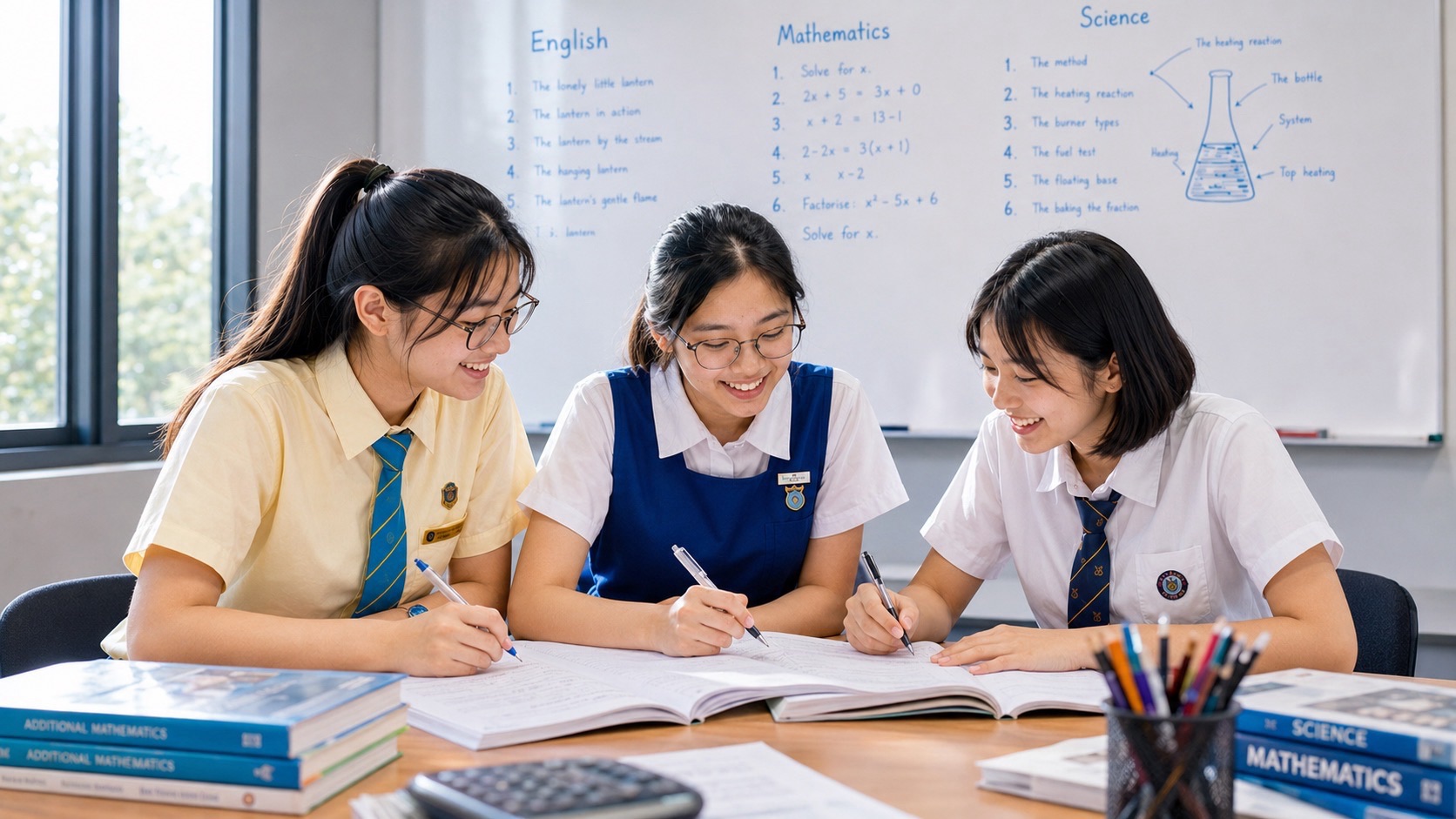
G3 Science tuition should follow either the child’s exact combined-science code—K326, K327 or K328—or the separate G3 Science syllabuses K323, K324 and K325. Combined Science is not simply two separate-science courses squeezed together.
Your immediate next step is to copy the subject title and code from the school record, then match every tuition resource to that entry. If the record says K326, for example, the child takes the Physics and Chemistry parts of the combined syllabus, not separate Physics K323 plus separate Chemistry K324.
Did you know? Posting Group and subject level are different. A child’s posting route does not by itself identify whether the school has entered the child for combined or separate G3 Science.
Choose the right G3 Science route
- Match subject titles and codes
- Understand the assessment difference
- Diagnose by discipline and skill
- See why one topic needs different depth
- Build a route-matched lesson
- Check independent transfer
Orientation: SEAB lists national syllabuses; schools decide their own subject offerings and entries. Confirm the child’s actual combination before selecting specialised tuition.
Which 2027 G3 Science code is which?
| Route | 2027 code | Science entry |
|---|---|---|
| Combined | K326 | Science (Physics, Chemistry) |
| Combined | K327 | Science (Physics, Biology) |
| Combined | K328 | Science (Chemistry, Biology) |
| Separate | K323 | Physics |
| Separate | K324 | Chemistry |
| Separate | K325 | Biology |
The SEAB 2027 G3 school-candidate directory is the canonical code list. The older reference codes shown there are not the 2027 SEC codes.
Why can’t combined and separate Science use one generic plan?
The combined 2027 G3 Science K326/K327/K328 syllabus requires Paper 1, Paper 5 and two discipline papers. Paper 1 is multiple choice across the selected pair, each discipline paper is structured and free response, and Paper 5 is a practical test on both selected sciences.
The separate syllabuses have their own content scope and assessment design. A chapter bearing the same name may ask for different detail, mathematical treatment or experimental reasoning. The tutor should read the exact learning outcomes and paper scheme rather than judge by a textbook cover.
Combined Science still requires disciplinary accuracy. Separate Science does not mean memorising extra facts without reasoning. Both routes assess the use of concepts in unfamiliar situations.
How should a tutor diagnose the starting point?
Split the evidence twice: first by discipline, then by skill. A learner may be strong in Chemistry recall but weak in interpreting experimental data; another may understand Physics ideas but lose marks through units and incomplete causal explanations.
- Knowledge: accurate ideas, terms, relationships and equations.
- Representation: moving among diagrams, graphs, symbols, tables and prose.
- Application: selecting principles for unfamiliar contexts.
- Practical reasoning: planning, observing, evaluating and improving methods.
- Communication: answering the command word with a complete, bounded claim.
One total mark hides this pattern. A route-matched diagnostic prevents tuition from spending equal time where needs are unequal.
How can the same topic demand different teaching?
Take electrical circuits. Both learners may need to identify components, connect current and potential difference, and interpret a circuit. The precise quantities, relationships, calculations and practical expectations must then be checked against the child’s syllabus. Adding separate-science detail to a combined-science lesson can crowd out required practice; teaching only the combined outcome to a separate-science learner can leave gaps.
A tutor can model one reasoning chain, then give each learner a code-matched question. The learner identifies what is known, chooses the relevant principle, represents the situation, calculates or explains, and checks whether the answer is physically sensible.
For practical work, analyse authentic observations and safe investigations, but do not replace school laboratory supervision. Equipment, risk assessment and hands-on experience matter.
What should a route-matched tuition lesson contain?
- A short retrieval task drawn from the exact syllabus.
- One misconception made visible through a question or demonstration.
- A worked example that explains decisions, not just steps.
- An unfamiliar code-matched question completed with fading prompts.
- An exit task the learner completes alone.
In a 3-pax group, students can share a reasoning routine while receiving different discipline questions. Grouping only works when the provider really offers the required route and the tutor can keep the syllabuses distinct.
How can parents check genuine progress?
- Ask the child to state the exact subject title and code.
- Track errors separately by discipline and skill.
- Use unseen data and changed contexts, not only repeated worksheets.
- Check that practical improvements are specific, feasible and justified.
- Reduce hints and revisit the skill after a gap.
Tuition cannot choose the school combination, guarantee a result or substitute for laboratory learning. It can make the correct syllabus visible, repair misconceptions and help the learner apply ideas independently.
Official sources and useful next reading
Official references: SEAB 2027 G3 Science K326/K327/K328 · SEAB 2027 G3 school-candidate directory.
Continue with the separate-science guides for G3 Physics, G3 Chemistry and G3 Biology, plus the series syllabus directory.


