
Quick orientation for parents
Short answer: G3 Mathematics tuition should build two connected kinds of control: quick, accurate execution across many short Paper 1 questions, and slower modelling, reasoning and checking for Paper 2—including its final real-world problem.
Do this first: sort mistakes from the child’s last two assessments into four columns: routine technique, translating context, reasoning, and checking. Practise the largest column first while maintaining the others.
In this guide
- The 2027 paper structure
- Diagnose before drilling
- Build Paper 1 control
- Model the Paper 2 real-world problem
- A concrete example
- Independent-progress checks
What does G3 Mathematics look like in 2027?
According to the official 2027 G3 Mathematics syllabus K310, Paper 1 and Paper 2 are each 2 hours 15 minutes, worth 90 marks and contribute 50%. All questions are compulsory, and approved calculators may be used in both papers.
Paper 1 has about 26 short-answer questions. Paper 2 has 9 to 10 questions of varying lengths, and its final question focuses on applying Mathematics to a real-world scenario. Across the examination, the assessment objectives are approximately 45% use of mathematical concepts and skills, 40% interpretation and analysis in context, and 15% reasoning and communication.
This is why “more difficult sums” is not a complete tuition plan. The child needs breadth, representation, decision-making and visible working as well as correct calculation.
Diagnose before drilling
For every lost mark, identify the earliest cause. Was a fact or procedure unavailable? Was the correct topic known but the context translated wrongly? Did the child abandon a multi-step plan? Was essential working omitted? Or was a reasonable answer left unchecked?
Then test the diagnosis with one nearby question. If a percentage method works in a bare calculation but fails inside a fare comparison, the primary gap is interpretation, not percentage arithmetic. If both fail, rebuild the concept before adding a longer context.
How should tuition build Paper 1 control?
Paper 1 rewards accurate switching across topics. Use short mixed sets rather than spending every lesson inside one comfortable chapter. A useful cycle is retrieve the method, solve with essential working, estimate or check, and name the cue that identified the topic.
Speed comes after a method is stable. Timing an unstable process simply rehearses panic. Once accuracy holds, shorten the available time in small steps and include deliberate topic changes. Calculator use should support judgment, not replace it: the child still needs to notice an impossible sign, unit or order of magnitude.
How should tuition teach the real-world Paper 2 problem?
Teach a modelling loop rather than a stock formula: clarify the decision, select relevant information, define quantities and units, choose a representation, calculate, interpret the result in context, and test whether it is sensible. The syllabus notes that real-world contexts may include travel, transport, sports, recipes, floor plans, finance, tables and graphs, and may integrate several topics.
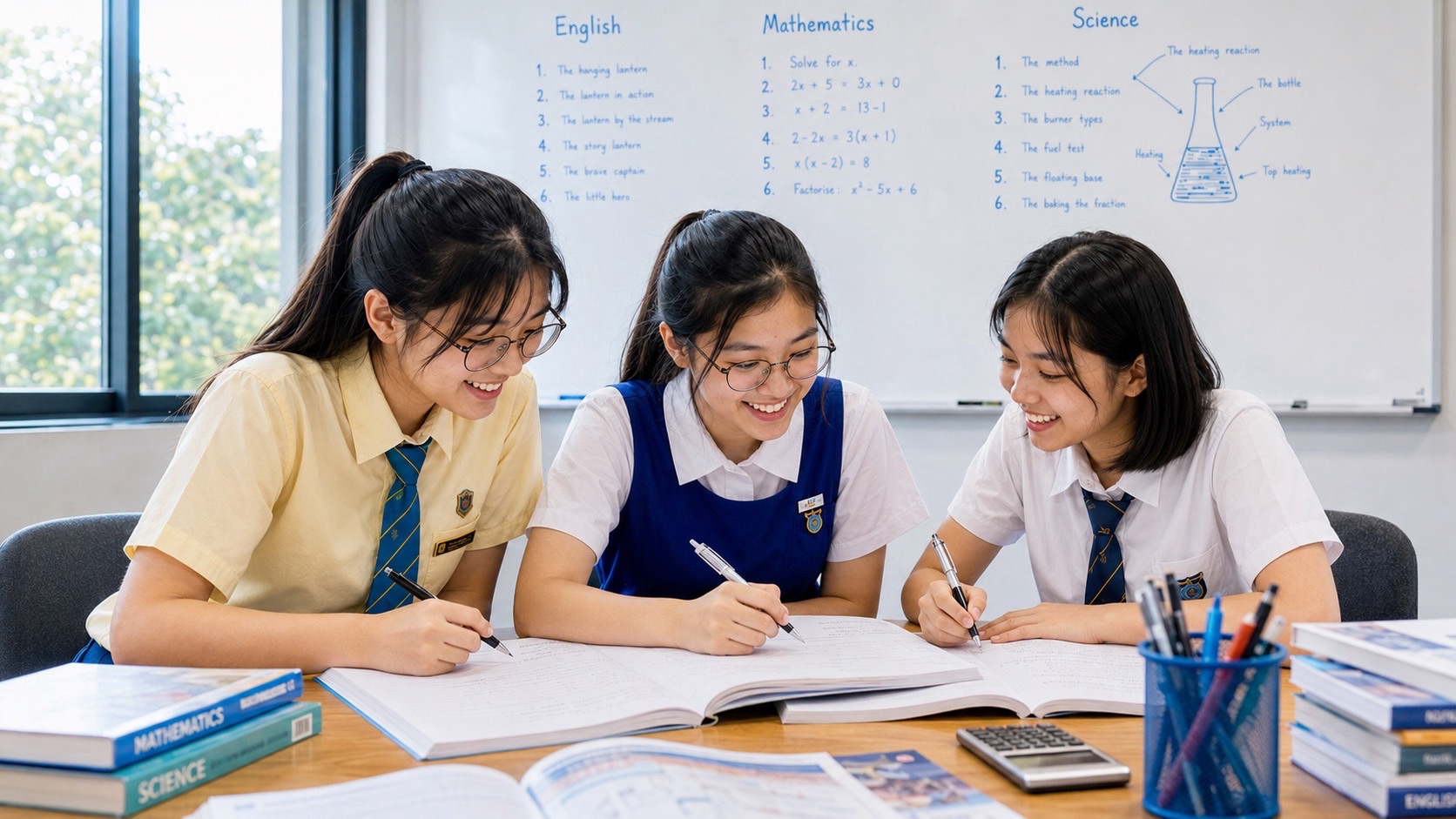
If a provider actually teaches this exact level, a three-student group can make the reasoning visible. One child extracts constraints, one proposes a model and one tries to disprove the conclusion. Each then completes a new version independently. The conversation is useful only if the final thinking remains the student’s own.
A concrete example: choosing a transport plan
Suppose a family compares two travel passes with different fixed fees, per-trip costs and weekend conditions. A weak response immediately multiplies the most visible numbers. A stronger response first states the family’s number of weekday and weekend journeys, represents each plan’s total cost, applies the conditions, and checks whether the recommendation changes if two journeys are cancelled.
The tutor can vary one condition at a time so the child sees which information controls the decision. This develops transfer: the same reasoning can later serve a recipe, floor-plan or finance problem even though the surface story changes.
How can parents check independent progress?
Use a fortnightly pair of unfamiliar tasks: a 15-minute mixed set and one longer context problem. Track accuracy, time, completeness of working and whether the child checks units and plausibility without being reminded. Progress is not merely getting a rehearsed question right; it is choosing a workable representation when the setting changes.
Do not judge growth from a single hard paper. Look for fewer repeated error types over several attempts and for the child’s ability to explain why a method fits. For continuity from lower secondary, read how tuition can help when PSLE methods stop working in Secondary 1, or return to the MOE and SEAB syllabus tuition directory.


