
Did you know? A correct-looking A-Math answer can still be invalid if it violates the original equation, a domain restriction or the interval in the question. G3 Additional Mathematics tuition helps when checking becomes part of the method, rather than a hurried glance at the final line.
Start with one recent wrong answer and ask your child to substitute it into the original question. Then ask whether every operation preserved the same solutions. This separates an arithmetic mistake from a reasoning step that introduced an extra candidate or lost a valid one.
For the 2027 SEC, G3 Additional Mathematics is K341, distinct from G2 Additional Mathematics K232 and G3 Mathematics K310. Bring the school subject code and two examples of the child’s working. The next lesson should repair the precise missing check.
Find your next learning step
Why is checking part of A-Math reasoning? · A worked example: squaring can add a candidate · Which checks fit which problems? · How should tuition build the habit? · What should a parent notice?
Why is checking part of A-Math reasoning?
The official 2027 K341 syllabus assesses standard techniques, solving problems in context, and mathematical reasoning and communication. It assumes G3 Mathematics knowledge. Both papers require essential working, so a final numerical answer does not replace an intelligible solution.
Checking is a teaching habit that supports those aims. It helps students connect a procedure with the conditions that make it valid.
A worked example: squaring can add a candidate
Consider the original practice equation √(x + 2) = x. The square root is non-negative, so any solution must have x ≥ 0. Squaring gives x + 2 = x², hence x² − x − 2 = 0 and (x − 2)(x + 1) = 0. The candidates are x = 2 and x = −1.
Substitution settles the question. For x = 2, √4 = 2, so the equation holds. For x = −1, √1 = 1, which is not −1. The only solution is x = 2. Squaring made the transformed equation accept a value the original equation rejected.
Ask the child to explain why the rejected value appeared. If they can only remember “always reject negatives”, change the example: some equations legitimately have negative solutions. The original expression determines the restriction.
Which checks fit which problems?
For fractions, record values that make a denominator zero. For real logarithms, the argument must be positive. For trigonometric equations, use the given interval and the correct angle unit. For a word problem, test whether the quantity fits the situation.
Do not turn this into a universal checklist copied onto every question. Teach the student to name the restriction relevant to the expression in front of them. That keeps the working concise and purposeful.
Dividing by an expression containing the unknown also needs care. For example, x² = x should be rearranged to x(x − 1) = 0, giving x = 0 or 1. Dividing immediately by x would discard the zero solution.
How should tuition build the habit?
Use pairs of questions that look similar but have different restrictions. After solving, ask the student to identify the step most likely to lose or introduce solutions. Then require an appropriate independent check.
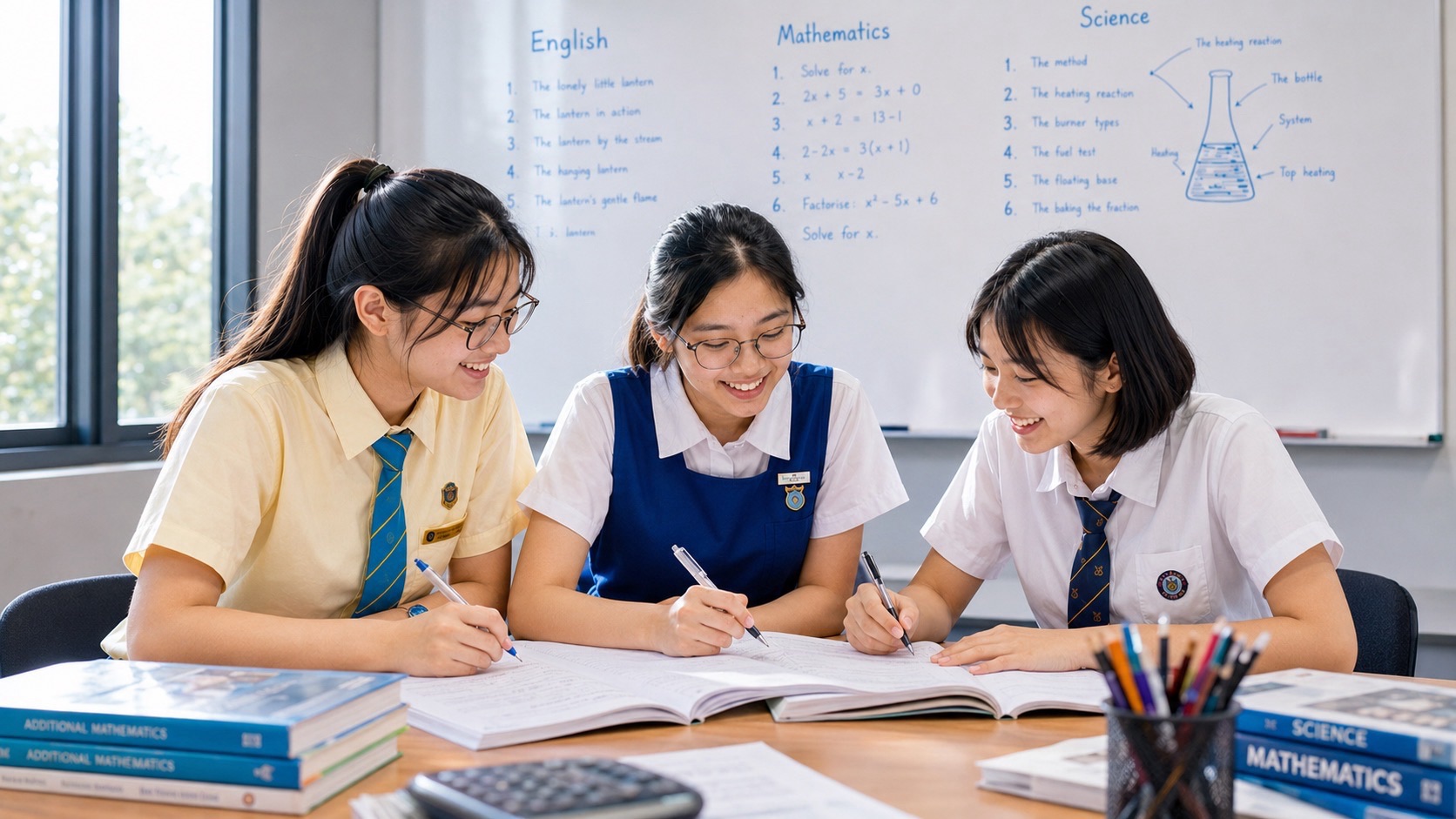
In a three-student group, one learner can solve, another check the original expression, and a third inspect the restrictions. Rotate roles and finish with individual work. The discussion helps only when each student can perform the check alone.
What should a parent notice?
Look for fewer rejected or missing solutions, clearer restrictions and checks made without reminders. A child who explains why a candidate is invalid has learned more than one who merely crosses it out after the tutor prompts them.
If choosing a method is still the earlier difficulty, read why a child can follow an A-Math solution but not choose the method. Fix selection before increasing the difficulty of checking.
Choose a focused next step
Return to the Primary, PSLE and SEC tuition syllabus directory. For an example of diagnosis, sequenced practice and premium three-student Mathematics teaching, see eduKateSG’s Secondary 1 Mathematics tutorial guide. Confirm subject and location availability separately; that programme’s service details belong to its own offer.
Official syllabus details checked on 10 October 2026. Worked examples and supplied-data scenarios here are original teaching illustrations, not official examination questions.


